REVIEW 2 major objections 6 minor 49 references
Impact of model uncertainty on SPARC operating scenario predictions with empirical modeling
T0 review · 2 major / 6 minor · reviewed 2026-08-07 · deepseek-v4-flash
Pith's one-line read Accounting for uncertainty shifts SPARC's optimal operating point to a broad success-rate maximum rather than the deterministic prediction.
desk verdict A practical, well-executed uncertainty workflow for SPARC operating scenarios, with a central qualitative result that holds up, though the exact location of the 'statistical optimum' is underdetermined by the flat success-rate surface. read the letter →
The pith
A machine-rendered reading of the paper's core claim, the machinery that carries it, and where it could break.
The reading
What carries the argument
The central object is the statistical POPCON: a map over volume-averaged density and temperature in which each point is assigned the fraction of Monte Carlo samples that satisfy all success conditions ($Q>2$, $P_{\rm aux}<25$ MW, nonzero flattop time, Greenwald fraction below one). Three mechanisms carry the argument. First, physically motivated gradient-based profile forms replace parabolic profiles, using density and temperature peaking plus a core inverse gradient scale length $a/L_T$ with a fixed pedestal width, so profiles do not demand unrealistically large logarithmic gradients. Second, Monte Carlo draws from gamma and Gaussian distributions propagate the table of ten uncertainties through the power-balance workflow. Third, a multi-fidelity Bayesian optimization routine—Gaussian-process surrogates with Matern kernel and logarithmic expected-improvement acquisition, starting at 2,000 Monte Carlo samples and rising to 40,000—locates the maximum pointwise success rate much faster than brute force, which is what makes the extensive assumption scans feasible.
What would settle it
Re-run the statistical POPCON using correlated Monte Carlo draws (joint covariance among $H$, $k_{LH}$, and $T_i/T_e$ from physics-based transport ensembles) or using the first measured SPARC shot-to-shot distributions; if the location of the maximum pointwise success rate shifts by more than the grid spacing, or if predicted high-success points fail systematically, the independent gamma and Gaussian assumptions are the deciding factor.
Extended reading notes
Core claim
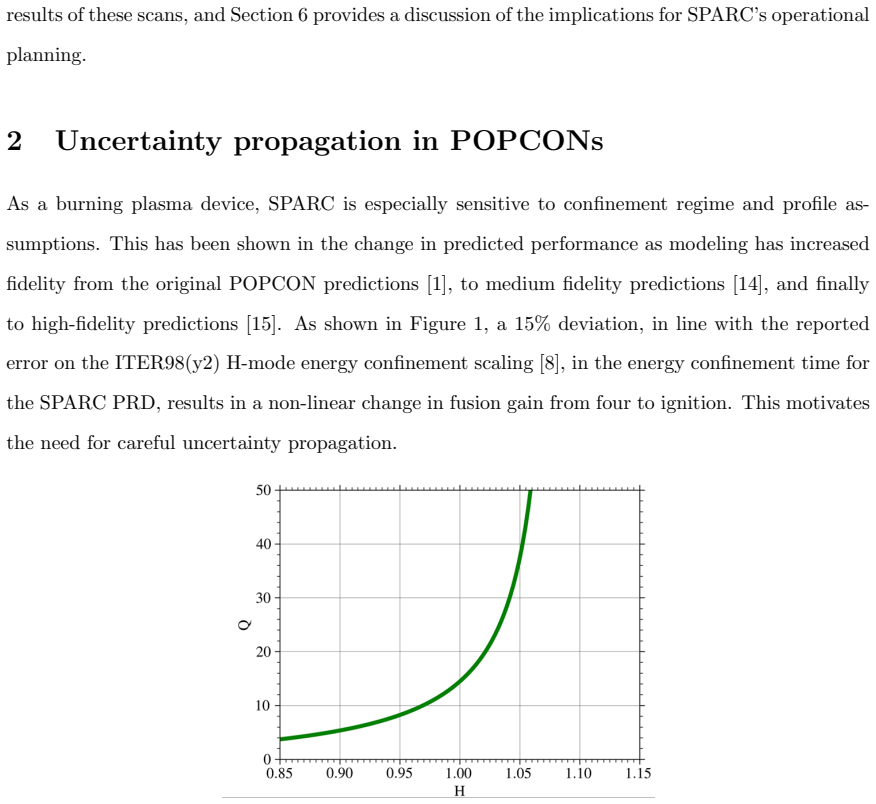
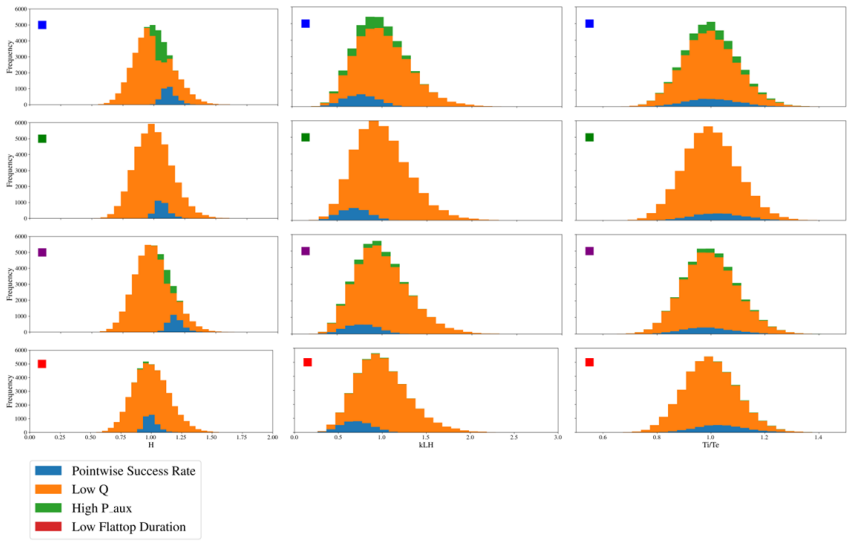
On the paper's own terms, the discovery is that uncertainty is not a small correction to POPCON-based scenario design: it changes the recommended operating point. Propagating the uncertainties of empirical scalings, profile shapes, and impurity concentrations through the SPARC power balance yields a broad plateau of high pointwise success rate whose maximum sits near the nominal Primary Reference Discharge location (when edge argon dilution is ignored) and quite far from the deterministic POPCON optimum that includes core dilution from argon. The dominant sensitivities are $H$, $k_{LH}$, and $T_i/T_e$; notably, only moderately high $H$ values are preferred, because too high a confinement factor lowers the predicted scrape-off-layer power below the L–H threshold and locks the sample into L-mode scaling. For the nominal assumptions the total success rate—the fraction of Monte Carlo samples that succeed somewhere in operating space—exceeds 50%, and the authors conclude that future devices should not rely on operating close to uncertain boundaries such as the H-mode transition.
Load-bearing premise
The load-bearing premise is that the ten input distributions—their widths, shapes, and especially their independence—faithfully represent how SPARC's real confinement, threshold, profile, and impurity behavior will vary.
Editorial extensions
If this is right
- SPARC operators should aim for the broad high-success-rate plateau rather than the deterministic optimum, avoiding operation close to the H-mode transition boundary.
- Reducing uncertainty in the confinement factor $H$ substantially raises the predicted success rate, whereas tightening $k_{LH}$ alone lowers it because it removes favorable low-threshold samples.
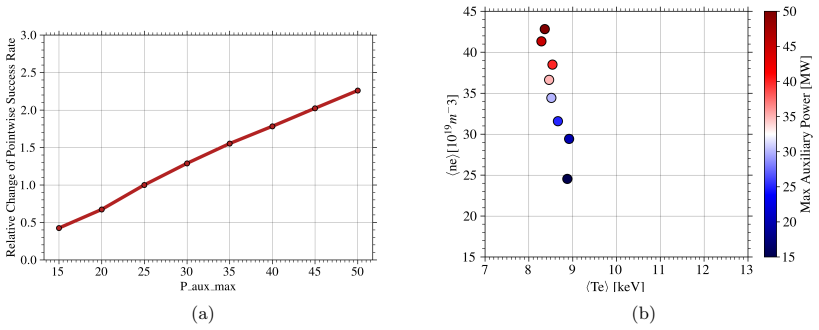
- The full 25 MW of launched auxiliary power and high divertor argon enrichment are both worth more than small confinement improvements; reducing plasma current to avoid disruptions degrades success rapidly.
- Total success rate exceeds 50% under nominal assumptions and is improved by attempting multiple shots, since different Monte Carlo samples succeed at different operating points.
- The updated ITPA confinement scaling produces a statistical POPCON very similar to the ITER98y2-based one, so the main conclusions are not an artifact of that scaling choice.
Reading between the lines
- Editorial inference: the independence assumption on the ten parameters is likely the weakest link; correlated draws (e.g., high $H$ accompanying low $k_{LH}$ through pedestal physics) could narrow or shift the success plateau in ways the current gamma and Gaussian sampling cannot show.
- Editorial inference: the pointwise success rate is a proxy for the total success rate, and the proxy can mislead when the area of the successful region changes; future work should optimize the total success rate directly despite its higher cost.
- Editorial inference: the same machinery could be turned into a real-time shot-planning tool that updates the success-rate map from measured confinement and L–H behavior after each SPARC discharge, which the authors name as future work.
- Editorial inference: substituting physics-based transport surrogates for the empirical scalings inside the Monte Carlo loop would test whether the dominant-uncertainty ranking survives with more faithful profile and confinement correlations.
Signed reviews
Editorial analysis
A structured set of objections, weighed in public.
Referee Report
Summary. This paper introduces 'statistical POPCONs,' a Monte Carlo extension of conventional plasma operating contour analysis, and applies it to the SPARC primary reference discharge. Uncertainties in the confinement time multiplier H, the L-H threshold multiplier k_LH, profile parameters (Ti/Te, peaking factors, a/L_T), and impurity concentrations are propagated through the CFSPOPCON power-balance workflow. The pointwise success rate is defined as the fraction of Monte Carlo samples satisfying four criteria: Q>2, auxiliary power <25 MW, positive flattop time, and Greenwald fraction <1. A gradient-based profile parameterization replaces parabolic profiles, and a multi-fidelity Bayesian optimization workflow is developed to locate the operating point maximizing the success rate. The central finding is that this statistical optimum (white star in Fig. 6) differs from the deterministic optimum (black star), lying instead in a broad, nearly flat maximum that balances H-mode access, confinement, impurity dilution, and auxiliary power. The paper also scans distribution means and standard deviations, edge argon enrichment, magnetic field, plasma current, and auxiliary power, and identifies H, k_LH, and Ti/Te as the dominant sensitivity drivers.
Significance. If the central claim is made statistically robust, the paper provides a valuable methodological contribution: it converts a traditionally deterministic design tool into a probabilistic one, quantifies Monte Carlo resolution, benchmarks Bayesian optimization against brute force and Powell methods, and demonstrates a practical multi-fidelity speed-up. The use of open-source tools (CFSPOPCON, MITIM, BoTorch) and the explicit convergence checks in Figs. 5, 13, and 14 are strengths. The sensitivity rankings and the recommendation to avoid operating near the uncertain H-mode boundary are actionable for SPARC operational planning. However, the headline claim about a different optimal operating point needs additional statistical support before it can be accepted as stated.
major comments (2)
- [Section 3, Figure 6; Section 4, Figures 13-14] The paper's central claim, stated in the abstract and Section 3, is that accounting for uncertainties leads to an optimal operating point (white star in Fig. 6) that differs from the deterministic prediction (black star). This claim is not yet quantitatively supported because the success-rate surface is described as a 'broad nearly maximal zone' (Section 3) and the paper gives no confidence region, bootstrap spread, or multi-seed distribution for the argmax location in the nominal case or in the Section 5 scans. Figures 13-14 show convergence of the averaged optimal density and temperature and a one-standard-deviation seed spread, but the reported optimal points in Section 5 appear to be outputs of a single high-fidelity run rather than a distribution. On a nearly flat objective, Monte Carlo noise, the Gaussian-process surrogate, and the random seed can move the argmax substantially while changing the success rate by less than the ~1% Monte Carlo error quoted in Section 2.4. Please either report the argmax with an uncertainty region (e.g., bootstrap over seeds or resamples) or replace the 'different optimal operating point' formulation with a robustly testable statement such as 'the deterministic optimum lies in a region where the pointwise success rate is significantly below the maximum'; the latter is directly supported by the success-rate surface.
- [Section 2.2, Table 1] The quantitative content of the sensitivity rankings (H, k_LH, Ti/Te as dominant drivers) and all absolute success rates are conditional on the chosen input distributions. The standard deviations for Ti/Te, nu_T, a/L_T, and W are not derived from regression errors of the relevant scalings but are 'motivated by' physics-based modeling or generic impurity uncertainty references, and all ten parameters are sampled independently. The authors do acknowledge the uncorrelated assumption in Section 2.2 and the Discussion, but the abstract and Section 6 present the findings without that conditionality. I would like to see either a small correlation-sensitivity test for the top three drivers (e.g., imposing a plausible correlation between H and k_LH or between Ti/Te and a/L_T) or an explicit caveat in the abstract and conclusions that the ranking and quantitative success rates are conditional on Table 1. This is load-bearing because the operational recommendation to avoid the H-mode boundary is grounded in the k_LH and H rankings.
minor comments (6)
- [Section 3] The sentence 'The automated enforcement of the 140 MW fusion power limit can be sen' contains a typo: 'sen' should be 'seen'.
- [Figure 14 caption] The caption states that both the low-fidelity and multi-fidelity cases switch from training to optimization at '10,000 point evaluations'; this is inconsistent with the described workflow of five initial training points plus five iterations and will confuse readers. It likely should be '10 point evaluations'.
- [Section 2.3] The phrase 'Note, a fusion power less than 140 MW is enforced...' should be 'Note that a fusion power less than 140 MW is enforced...' for grammatical clarity.
- [Section 3 and Section 6] The paper introduces the maximum pointwise success rate as a 'loosely proportional proxy' for the total success rate, but Section 6 later states that the pointwise rate is not directly proportional because the area of the successful region can change. The caveat should be stated where the proxy is first introduced, not only in the Discussion.
- [Section 6] The limitation that empirical models may not capture critical-gradient transport and that some temperatures in the statistical POPCONs 'may not be achievable at all' is important; I recommend restating this alongside the abstract's claim so that readers do not over-interpret the optimal operating point as directly realizable.
- [Figure 8 caption] The phrase 'The color squares correspond' should be 'The colored squares correspond'.
Circularity Check
No material circularity: the statistical-POPCON optimum is a computed Monte Carlo argmax, not an input; only minor self-citations set input widths and are not load-bearing.
full rationale
The paper's central claim—that maximizing the pointwise success rate under the Table 1 uncertainties yields a different operating point than the deterministic maximum—is not circular: the success-rate surface is defined in Section 2.3 as the fraction of Monte Carlo samples satisfying Q>2, P_aux<25 MW, flattop>0, and Greenwald<1, and the optimum is located by brute-force grid search (Figure 6) and independently by Bayesian and Powell optimizers (Figures 13-14). The argmax is therefore a computed function of the inputs, not an input itself, and no equation in the derivation chain is equivalent to its own conclusion by construction. The only self-citations are (i) Section 2.2, where the Ti/Te, nu_T, and a/LT standard deviations are 'motivated by variations in physics-based modeling [15]', and (ii) Section 2.1, where the density-peaking offset is called 'an appropriate approximation for SPARC [15]'; note that [15] is Rodriguez-Fernandez, Howard, and Candy, with two authors overlapping the present paper, so these are genuine self-citations. However, they are input-calibration choices from the authors' prior gyrokinetic surrogate work, not derivations of the output, and the dominant drivers H and kLH are anchored to external scaling laws [8,11]. The finding that uncertainty shifts the optimum is somewhat entangled with the simultaneous redefinition of the optimization metric from maximizing fusion power to maximizing success probability, and the paper does not provide a confidence region for the argmax of a deliberately broad, nearly flat plateau (Section 3, Figure 6); those are statistical-identifiability concerns, not circularity. Hence no load-bearing circular step is exhibited.
Assumptions & free parameters
free parameters (6)
- Relative std dev of Ti/Te (0.10) =
0.10
- Relative std dev of temperature peaking nu_T (0.10) =
0.10
- Relative std dev of a/LT (0.25) =
0.25
- Edge argon enrichment factor (5) =
5
- Target electron temperature in boundary model (25 eV) =
25 eV
- Relative std dev of tungsten concentration (1.0) =
1.0
assumptions (5)
- domain assumption The ITER98(y2) H-mode and ITER89p L-mode energy confinement scalings, and the Martin/Ryter L-H power threshold with 2/A correction, are valid empirical models for SPARC.
- domain assumption Monte Carlo parameters are sampled independently with no correlations.
- domain assumption The plasma satisfies steady-state power balance: input power equals output power at every operating point.
- domain assumption Density and temperature can be treated as independent engineering parameters in the operating space.
- ad hoc to paper The pedestal width is 5% of the minor radius (x_ped = 0.95).
Cite this review
Pith. "Pith review of Impact of model uncertainty on SPARC operating scenario predictions with empirical modeling." pith.science (2026). https://pith.science/paper/TPW5V264
@misc{pith2026250609879,
  author       = {Pith},
  title        = {Pith review of: Impact of model uncertainty on SPARC operating scenario predictions with empirical modeling},
  year         = {2026},
  howpublished = {\url{https://pith.science/paper/TPW5V264}},
  note         = {Machine review of arXiv:2506.09879}
}
read the original abstract
Understanding and accounting for uncertainty helps to ensure next-step tokamaks such as SPARC will robustly achieve their goals. While traditional Plasma OPerating CONtour (POPCON) analyses guide design, they often overlook the significant impact of uncertainties in scaling laws, plasma profiles, and impurity concentrations on performance predictions. This work confronts these challenges by introducing statistical POPCONs, which leverage Monte Carlo analysis to quantify the sensitivity of SPARC's operating points [1] to these crucial variables. For profiles, a physically motivated gradient-based functional form is introduced. We further develop a multi-fidelity Bayesian optimization workflow that effectively identifies operating points maximizing the probability of meeting performance goals, which gives a significant speed-up over brute force methods. Our findings reveal that accounting for these uncertainties leads to an optimal operating point different from deterministic predictions, which balances H-mode access, confinement, impurity dilution, and auxiliary power.
Figures


Figures from the paper (19 more)




Reference graph
Works this paper leans on
-
[15]
Nonlinear gyrokinetic predictions of SPARC burning plasma profiles enabled by surrogate modeling
P. Rodriguez-Fernandez, N. T. Howard, and J. Candy. “Nonlinear gyrokinetic predictions of SPARC burning plasma profiles enabled by surrogate modeling”. In: Nuclear Fusion 62.7 (2022). Publisher: IOP Publishing, p. 076036
work page 2022
-
[1]
A. J. Creely et al. “Overview of the SPARC tokamak”. en. In: Journal of Plasma Physics 86.5 (Oct. 2020), p. 865860502. issn: 0022-3778, 1469-7807. doi: 10.1017/S0022377820001257 . url: https://www.cambridge.org/core/product/identifier/S0022377820001257/type/ journal_article (visited on 11/06/2020)
-
[2]
Fusion reactor plasma-performance mod- eling: POPCON analysis
W.A. Houlberg, S.E. Attenberger, and Lee Hively. “Fusion reactor plasma-performance mod- eling: POPCON analysis”. In: (June 1982)
work page 1982
-
[4]
W. E. Han et al. “Start-up requirements and current-drive issues for a pulsed DEMO, and po- tential implications for power output to the grid”. In:Fusion Engineering and Design. Proceed- ings of the 27th Symposium On Fusion Technology (SOFT-27); Li` ege, Belgium, September 24- 28, 2012 88.6 (Oct. 2013), pp. 994–997.issn: 0920-3796. doi: 10.1016/j.fusengde...
-
[5]
B. N. Sorbom et al. “ARC: A compact, high-field, fusion nuclear science facility and demon- stration power plant with demountable magnets”. en. In: Fusion Engineering and Design 100 (Nov. 2015), pp. 378–405. issn: 0920-3796. doi: 10.1016/j.fusengdes.2015.07.008 . url: https://www.sciencedirect.com/science/article/pii/S0920379615302337 (visited on 08/09/2022)
-
[6]
Radiative pulsed L-mode operation in ARC-class reactors
S. J. Frank et al. “Radiative pulsed L-mode operation in ARC-class reactors”. en. In: Nuclear Fusion 62.12 (Oct. 2022). Publisher: IOP Publishing, p. 126036. issn: 0029-5515. doi: 10. 1088/1741-4326/ac95ac . url: https://dx.doi.org/10.1088/1741-4326/ac95ac (visited on 11/16/2022)
-
[7]
MANTA: A Negative-Triangularity NASEM-Compliant Fusion Pilot Plant
MANTA Collaboration et al. MANTA: A Negative-Triangularity NASEM-Compliant Fusion Pilot Plant . arXiv:2405.20243 [physics]. May 2024. doi: 10.48550/arXiv.2405.20243 . url: http://arxiv.org/abs/2405.20243 (visited on 07/30/2024)
work page Pith review arXiv doi:10.48550/arxiv.2405.20243 2024
-
[8]
Chapter 2: Plasma confinement and transport
ITER Physics Expert Group on Confinement and Transport, ITER Physics Basis ITER Physics Expert Group on Confinement Modelling and Database, and ITER Physics Basis Editors. “Chapter 2: Plasma confinement and transport”. In: Nuclear Fusion 39.12 (1999). Publisher: Institute of Physics, pp. 2175–2249
work page 1999
Show all 49 references
-
[9]
Scalings for tokamak energy confinement
P. N. Yushmanov et al. “Scalings for tokamak energy confinement”. en. In: Nuclear Fusion 30.10 (Oct. 1990), p. 1999. issn: 0029-5515. doi: 10 . 1088 / 0029 - 5515 / 30 / 10 / 001. url: https://dx.doi.org/10.1088/0029-5515/30/10/001 (visited on 03/08/2023)
1990 doi
-
[10]
ITER L mode confinement database
S. M. Kaye et al. “ITER L mode confinement database”. en. In: Nuclear Fusion 37.9 (Sept. 1997), p. 1303. issn: 0029-5515. doi: 10.1088/0029-5515/37/9/I10. url: https://dx.doi. org/10.1088/0029-5515/37/9/I10 (visited on 06/12/2023)
1997 doi
-
[11]
Power requirement for accessing the H-mode in ITER
Y R Martin, T Takizuka, and the ITPA CDBM H-mode Threshold Data Group. “Power requirement for accessing the H-mode in ITER”. In: Journal of Physics: Conference Series 123 (July 2008), p. 012033. issn: 1742-6596. doi: 10.1088/1742-6596/123/1/012033 . url: https://iopscience.iop...
2008 doi
-
[12]
Experimental evidence for the key role of the ion heat channel in the physics of the L–H transition
F. Ryter et al. “Experimental evidence for the key role of the ion heat channel in the physics of the L–H transition”. In: Nuclear Fusion 54.8 (Aug. 2014), p. 083003. issn: 0029-5515, 1741-
2014
-
[13]
Overview of the SPARC physics basis towards the exploration of burning-plasma regimes in high-field, compact tokamaks
P. Rodriguez-Fernandez et al. “Overview of the SPARC physics basis towards the exploration of burning-plasma regimes in high-field, compact tokamaks”. en. In: Nuclear Fusion 62.4 (Mar. 2022). Publisher: IOP Publishing, p. 042003. issn: 0029-5515. doi: 10 . 1088 / 1741 - 4326 /...
2022 doi
-
[14]
Predictions of core plasma performance for the SPARC toka- mak
P. Rodriguez-Fernandez et al. “Predictions of core plasma performance for the SPARC toka- mak”. en. In: Journal of Plasma Physics 86.5 (Oct. 2020). Publisher: Cambridge University Press. issn: 0022-3778, 1469-7807. doi: 10.1017/S0022377820001075 . url: https://www. cambridge.o...
2020 doi
-
[16]
cfs-energy/cfspopcon: v7.0.1
Tom Body et al. cfs-energy/cfspopcon: v7.0.1. Sept. 2024. doi: 10.5281/zenodo.13754104 . url: https://zenodo.org/records/13754104 (visited on 10/25/2024)
2024
-
[17]
The SPARC Primary Reference Discharge defined by cfsPOPCON
Thomas Body, Christoph Hasse, and Alex Creely. The SPARC Primary Reference Discharge defined by cfsPOPCON . arXiv:2311.05016 [physics]. Nov. 2023. doi: 10.48550/arXiv.2311. 05016. url: http://arxiv.org/abs/2311.05016 (visited on 04/05/2024)
-
[18]
Basic physical processes and reduced models for plasma detachment
P. C. Stangeby. “Basic physical processes and reduced models for plasma detachment”. en. In: Plasma Physics and Controlled Fusion 60.4 (Mar. 2018). Publisher: IOP Publishing, p. 044022. issn: 0741-3335. doi: 10.1088/1361- 6587/aaacf6. url: https://dx.doi.org/10.1088/ 1361-6587...
2018 doi
-
[19]
Divertor enrichment of recycling impurity species (He, N2, Ne, Ar, Kr) in ASDEX Upgrade H-modes
A. Kallenbach et al. “Divertor enrichment of recycling impurity species (He, N2, Ne, Ar, Kr) in ASDEX Upgrade H-modes”. en. In: Nuclear Fusion 64.5 (Mar. 2024), p. 056003. issn: 0029-5515. doi: 10.1088/1741- 4326/ad3139. url: https://dx.doi.org/10.1088/1741- 4326/ad3139 (visit...
2024 doi
-
[20]
Projections of H-mode access and edge pedestal in the SPARC tokamak
J. Hughes et al. “Projections of H-mode access and edge pedestal in the SPARC tokamak”. In: Journal of Plasma Physics 86 (Oct. 2020). doi: 10.1017/S0022377820001300
2020 doi
-
[21]
Isotope scaling of the H mode power threshold on JET
E. Righi et al. “Isotope scaling of the H mode power threshold on JET”. en. In: Nuclear Fusion 39.3 (Mar. 1999), p. 309. issn: 0029-5515. doi: 10.1088/0029-5515/39/3/302 . url: https://dx.doi.org/10.1088/0029-5515/39/3/302 (visited on 05/19/2025)
1999 doi
-
[22]
Enhancing predictive capabilities in fusion burning plasmas through surrogate-based optimization in core transport solvers
P. Rodriguez-Fernandez et al. “Enhancing predictive capabilities in fusion burning plasmas through surrogate-based optimization in core transport solvers”. en. In: Nuclear Fusion 64.7 (June 2024). Publisher: IOP Publishing, p. 076034.issn: 0029-5515. doi: 10.1088/1741-4326/ ad...
2024 doi
-
[23]
Scaling of density peaking in H-mode plasmas based on a combined database of AUG and JET observations
C. Angioni et al. “Scaling of density peaking in H-mode plasmas based on a combined database of AUG and JET observations”. en. In: Nuclear Fusion 47.9 (Aug. 2007), p. 1326. issn: 0029-
2007
-
[24]
Review of the NLTE-5 kinetics workshop
Christopher J Fontes et al. “Review of the NLTE-5 kinetics workshop”. In: High Energy Density Physics 5.1-2 (2009). Publisher: Elsevier, pp. 15–22
2009
-
[25]
Physics basis for the ICRF system of the SPARC tokamak
Y. Lin, J. C. Wright, and S. J. Wukitch. “Physics basis for the ICRF system of the SPARC tokamak”. en. In:Journal of Plasma Physics 86.5 (Oct. 2020). Publisher: Cambridge University Press. issn: 0022-3778, 1469-7807. doi: 10.1017/S0022377820001269 . url: https://www. cambridge...
2020 doi
-
[26]
A new look at density limits in tokamaks
Martin Greenwald et al. “A new look at density limits in tokamaks”. In: Nuclear Fusion 28.12 (1988). Publisher: IOP Publishing, p. 2199. url: https://iopscience.iop.org/article/ 10.1088/0029-5515/28/12/009/meta (visited on 11/01/2024). 36
1988 doi
-
[27]
Power requirements for superior H-mode confinement on Alcator C-Mod: experiments in support of ITER
J. W. Hughes et al. “Power requirements for superior H-mode confinement on Alcator C-Mod: experiments in support of ITER”. en. In: Nuclear Fusion 51.8 (June 2011), p. 083007. issn: 0029-5515. doi: 10.1088/0029-5515/51/8/083007 . url: https://dx.doi.org/10.1088/ 0029-5515/51/8/...
2011 doi
-
[28]
The updated ITPA global H-mode confinement database: description and analysis
G. Verdoolaege et al. “The updated ITPA global H-mode confinement database: description and analysis”. en. In: Nuclear Fusion 61.7 (May 2021). Publisher: IOP Publishing, p. 076006. issn: 0029-5515. doi: 10.1088/1741-4326/abdb91 . url: https://doi.org/10.1088/1741- 4326/abdb91 ...
2021 doi
-
[29]
url: https://docs.scipy.org/doc/ scipy/reference/optimize.minimize-powell.html (visited on 01/26/2025)
minimize(method=’Powell’) — SciPy v1.15.1 Manual . url: https://docs.scipy.org/doc/ scipy/reference/optimize.minimize-powell.html (visited on 01/26/2025)
2025
-
[30]
BoTorch: A Framework for Efficient Monte-Carlo Bayesian Op- timization
Maximilian Balandat et al. “BoTorch: A Framework for Efficient Monte-Carlo Bayesian Op- timization”. In: 34th Conference on Neural Information Processing Systems. arXiv: 1910.06403 ISSN: 10495258. Neural information processing systems foundation, Oct. 2020.isbn: 1910.06403v3. ...
1910 arXiv
-
[31]
pabloprf/MITIM-fusion
Pablo Rodriguez-Fernandez. pabloprf/MITIM-fusion. original-date: 2023-12-20T16:31:29Z. Sept
2023
-
[32]
Rodriguez-Fernandez et al
P. Rodriguez-Fernandez et al. Enhancing predictive capabilities in fusion burning plasmas through surrogate-based optimization in core transport solvers. arXiv:2312.12610 [physics]. Dec
-
[33]
Unexpected improvements to expected improvement for bayesian opti- mization
Sebastian Ament et al. “Unexpected improvements to expected improvement for bayesian opti- mization”. In: Advances in neural information processing systems. Ed. by A. Oh et al. Vol. 36. Curran Associates, Inc., 2023, pp. 20577–20612. url: https://proceedings.neurips.cc/ paper_...
2023
-
[34]
L–H transition studies on DIII-D to determine H-mode access for operational scenarios in ITER
P. Gohil et al. “L–H transition studies on DIII-D to determine H-mode access for operational scenarios in ITER”. In: Nuclear Fusion 51.10 (Oct. 2011), p. 103020. issn: 0029-5515, 1741- 37
2011
-
[36]
L–H power threshold studies in JET with Be/W and C wall
C.F. Maggi et al. “L–H power threshold studies in JET with Be/W and C wall”. en. In: Nuclear Fusion 54.2 (Jan. 2014). Publisher: IOP Publishing, p. 023007. issn: 0029-5515. doi: 10.1088/ 0029- 5515/54/2/023007. url: https://dx.doi.org/10.1088/0029- 5515/54/2/023007 (visited on...
2014 doi
-
[37]
Roles of aspect ratio, absolute B and effective Z of the H-mode power threshold in tokamaks of the ITPA database
ITPA H-mode Power Threshold Databas Takizuka. “Roles of aspect ratio, absolute B and effective Z of the H-mode power threshold in tokamaks of the ITPA database”. In: Plasma Physics and Controlled Fusion 46.5A (May 2004), A227–A233. issn: 0741-3335, 1361-6587. doi: 10.1088/0741...
2004 doi
-
[38]
L to H mode transition: on the role of Zeff
C. Bourdelle et al. “L to H mode transition: on the role of Zeff”. en. In: Nuclear Fusion 54.2 (Jan. 2014). Publisher: IOP Publishing, p. 022001. issn: 0029-5515. doi: 10 . 1088 / 0029 - 5515/54/2/022001 . url: https://dx.doi.org/10.1088/0029-5515/54/2/022001 (visited on 05/19/2025)
2014 doi
-
[39]
Investigation of the critical edge ion heat flux for L-H transitions in Alcator C-Mod and its dependence on B T
M. Schmidtmayr et al. “Investigation of the critical edge ion heat flux for L-H transitions in Alcator C-Mod and its dependence on B T”. In: Nuclear Fusion 58.5 (May 2018), p. 056003. issn: 0029-5515, 1741-4326. doi: 10.1088/1741-4326/aaaed0 . url: https://iopscience. iop.org/...
2018 doi
-
[40]
1088 / 0029 - 5515 / 51 / 10 / 103020
doi: 10 . 1088 / 0029 - 5515 / 51 / 10 / 103020. url: https : / / iopscience . iop . org / article/10.1088/0029-5515/51/10/103020 (visited on 08/13/2020)
2020 doi
-
[42]
Integrated Modeling of SPARC H-mode Scenarios: Exploration of the Impact of Modeling Assumptions on Predicted Performance
Marco Muraca et al. Integrated Modeling of SPARC H-mode Scenarios: Exploration of the Impact of Modeling Assumptions on Predicted Performance . arXiv:2502.00187 [physics]. Jan
-
[43]
A first-principles predictive model of the pedestal height and width: development, testing and ITER optimization with the EPED model
P. B. Snyder et al. “A first-principles predictive model of the pedestal height and width: development, testing and ITER optimization with the EPED model”. en. In: Nuclear Fusion 51.10 (Aug. 2011), p. 103016. issn: 0029-5515. doi: 10.1088/0029-5515/51/10/103016. url: https://d...
2011 doi
-
[44]
Self-consistent core-pedestal transport simulations with neural network accelerated models
O. Meneghini et al. “Self-consistent core-pedestal transport simulations with neural network accelerated models”. en. In: Nuclear Fusion 57.8 (July 2017). Publisher: IOP Publishing, p. 086034. issn: 0029-5515. doi: 10 . 1088 / 1741 - 4326 / aa7776. url: https : / / dx . doi . ...
2017 doi
-
[45]
url: https://www.sciencedirect.com/science/article/pii/S0920379613003396 (visited on 10/25/2024). 33
2024
-
[46]
H-mode physics of near double null plasmas in MAST and its applications to other tokamaks
H. Meyer et al. “H-mode physics of near double null plasmas in MAST and its applications to other tokamaks”. en. In: Nuclear Fusion 46.1 (Dec. 2005), p. 64. issn: 0029-5515. doi: 10.1088/0029-5515/46/1/008 . url: https://dx.doi.org/10.1088/0029-5515/46/1/008 (visited on 05/19/...
2005 doi
-
[53]
Multi-Fidelity Predictive Core Performance Modeling for an ARC Power Plant
Joe Hall. Multi-Fidelity Predictive Core Performance Modeling for an ARC Power Plant . Atlanta, GA, Oct. 2024. url: https://meetings.aps.org/Meeting/DPP24/Session/TO06.3 (visited on 02/27/2025). 39
2024
-
[533]
doi: 10.1002/ctpp.201610034
issn: 1521-3986. doi: 10.1002/ctpp.201610034. url: https://onlinelibrary.wiley. com/doi/abs/10.1002/ctpp.201610034 (visited on 05/19/2025)
2025 doi
- [2023]
-
[2024]
url: https://github.com/pabloprf/MITIM-fusion (visited on 09/26/2024)
2024
- [2025]
-
[4326]
1088 / 0029 - 5515 / 54 / 8 / 083003
doi: 10 . 1088 / 0029 - 5515 / 54 / 8 / 083003. url: https : / / iopscience . iop . org / article/10.1088/0029-5515/54/8/083003 (visited on 08/12/2020)
2020 doi
Reviewed August 7, 2026 · model on record in the stance chip above.
Discussion (0). Continue with ORCID to comment.