REVIEW 2 major objections 4 minor 37 references
An indefinite Coulomb interaction from the Steklov spectrum of perforated manifolds
T0 review · 2 major / 4 minor · reviewed 2026-08-01 · deepseek-v4-flash
Pith's one-line read Perforating a closed manifold with many small, mass-balanced holes makes its Steklov spectrum converge to the weighted Laplace–Beltrami spectrum at an optimal rate, with a next-order correction governed by an indefinite Coulomb-type interac
desk verdict Genuine new expansion for Steklov spectra on perforated manifolds; the upper bounds are sharp in scale, but the 'optimal' claim lacks a lower-bound proof. read the letter →
The pith
A machine-rendered reading of the paper's core claim, the machinery that carries it, and where it could break.
The reading
What carries the argument
The key object is a global cell function Φ^ε satisfying ΔΦ^ε = β away from the hole boundaries and a jump of normal derivative equal to 1 across ∂Ω^ε. This function quantifies the signed discrepancy measure μ^ε = βdV − dA and converts the eigenvalue difference σ^ε−λ into two controlled terms via integration by parts. Together with the reduced Green function G_λ — the kernel of the inverse of Δ+λβ on the orthogonal complement of the λ-eigenspace, with Coulomb-type singularity near the diagonal — it turns the spectral correction into a double-integral interaction energy. The per-cell neutrality condition μ^ε(V_p)=0 for every Voronoi cell suppresses monopole contributions and is what makes the
What would settle it
On a flat 2-torus with a maximally ε-separated set of mass-balanced holes, compute the first nonzero Steklov eigenvalue and compare σ^ε−λ with the Coulomb integral λ²∬ G_λ U U dμ^ε dμ^ε; if the difference does not track that integral at order ε²|log ε|, or if changing the hole configuration changes the sign of the leading correction in a way the indefinite kernel cannot reproduce, the expansion is falsified.
Extended reading notes
Core claim
The central claim is that, for a simple weighted Laplace–Beltrami eigenvalue λ with eigenfunction U, the corresponding Steklov eigenvalue σ^ε on the critically perforated manifold admits an expansion whose leading term, of order ω_d(ε), is governed by the indefinite Coulomb-type energy λ² ∬_{M×M} G_λ(x,y) U(x)U(y) dμ^ε(x)dμ^ε(y), where dμ^ε = βdV − dA on the hole boundaries and G_λ is the reduced Green function of Δ+λβ. A companion bound shows |σ^ε−λ| ≤ C ω_d(ε), with eigenfunctions converging at rate √ω_d in H¹, uniformly across eigenvalue clusters. In dimensions two and three, two correction scales are identified explicitly. The perforated manifold behaves, to leading order, like a system
Load-bearing premise
The load-bearing premise is the per-cell neutrality condition (1.1)/(2.8): each hole's surface area must exactly equal the weighted volume of its Voronoi cell, so that μ^ε(V_p)=0; if this mass balance fails, a monopole contribution enters at a larger scale and both the convergence rate and the form of the leading correction change.
Editorial extensions
If this is right
- Steklov eigenvalues on mass-balanced perforated manifolds converge to weighted Laplace–Beltrami eigenvalues at the optimal rate ω_d(ε), and harmonically extended eigenfunctions converge at rate √ω_d in H¹.
- The next-order correction is an indefinite Coulomb-type interaction energy, so the perforated manifold is, to leading order, a discrete system of neutral charges coupled to a background charge through the reduced Green function.
- In dimensions two and three, two distinct correction scales appear, allowing finer predictions than the qualitative convergence results that preceded this work.
- The expansion is carried out for simple eigenvalues and adapted to spectral clusters with multiplicity, giving a uniform statement across degenerate eigenvalues.
- The result bridges spectral geometry of perforated manifolds and the variational theory of Coulomb-type interaction energies, opening the door to quantitative variational analysis of shape-optimization limits.
Reading between the lines
- If the per-cell neutrality condition were only approximately satisfied, a monopole term would enter at a larger scale, so the sharp rate ω_d(ε) is itself a signature of exact mass balance rather than a generic homogenization phenomenon.
- Because the Coulomb-type interaction is indefinite, any variational limit built from these energies will not be coercive; quantitative Gamma-convergence would require a signed or conditional formulation.
- The global cell-function technique should adapt to the Euclidean 'dynamical eigenvalue' setting mentioned in the paper, yielding a companion next-order expansion there.
- A numerical experiment with prescribed hole configurations on a flat torus could test the predicted dependence of the eigenvalue shift on the reduced Green function and on the signed measure μ^ε, including the sign changes of the leading correction.
Editorial analysis
A structured set of objections, weighed in public.
Referee Report
Summary. The paper studies Steklov eigenvalues of a closed manifold perforated by many small geodesic balls, with each hole radius chosen so that its boundary area exactly balances the weighted volume of the corresponding Voronoi cell. The main results are (i) an upper bound of order ω_d(ε) for the difference between the k-th Steklov eigenvalue and the k-th weighted Laplace–Beltrami eigenvalue, together with an H^1 convergence rate of order √ω_d(ε) for harmonically extended eigenfunctions (Theorem 1.2), and (ii) a second-order expansion of the eigenvalue gap whose leading term is an indefinite Coulomb-type energy of the discrepancy measure μ^ε = β dV − dA|∂Ω^ε, mediated by the reduced Green function of Δ+λβ (Theorem 1.3). The proof introduces a global cell function Φ^ε, obtains sharp norm estimates for it (Theorem 3.1), and uses a corrector equation with a Green-function representation in Section 5.
Significance. If the results are correct, the second-order expansion is an original and valuable quantitative link between spectral homogenization on manifolds and Coulomb-gas/interaction-energy theory. The proof is largely self-contained, the estimates are explicit, and the derivation is parameter-free: the hole radii are determined by the mass-balance equation (2.8) and no eigenvalue data are fitted. The introduction of a global cell function, rather than per-cell functions, is a conceptually useful tool. However, the advertised optimality of the convergence rate is not actually proved, and the central theorem is unreadable as printed because of severe textual corruption.
major comments (2)
- [§1.1, Theorem 1.2; §3.4, Prop. 3.9] The manuscript repeatedly calls the bound (1.8) ‘optimal’ and the abstract/title advertise ‘optimal convergence rates’, but no matching lower bound for |σ^ε−λ| is proved. The only explicit sharpness statement, Proposition 3.9, concerns the L∞ norm of the auxiliary cell function Φ^ε, not the eigenvalue gap. Theorem 1.3 gives an expansion, but the leading Coulomb-type term is indefinite and depends on the configuration and on U; it may vanish for symmetric configurations or for eigenfunctions with zeros at the hole centers, and the remaining volume term (for d≥3) could in principle cancel it. Since no argument shows that the leading term is bounded below by c ω_d(ε), the claim ‘optimal’ is an overstatement. The authors should either prove a lower bound under a precise nondegeneracy hypothesis or rephrase the claim as a sharp upper bound.
- [§1.1, Theorem 1.3, Eqs. (1.12)–(1.14)] The displayed formulas of Theorem 1.3 are heavily corrupted by long strings of non-mathematical symbols (e.g. ‘⌟⟨⟨⟪rl⟫l⟩⟩⟪⌟⟪⟨⟨⟪rl⟫mo⟨...’). As printed, these are not well-formed assertions, making it impossible to verify the exact coefficients, the scales at which each term appears, and the claimed error orders. Since this theorem is the central quantitative result, the manuscript is not in publishable form. The authors must replace the corrupted displays with clean, parseable formulas and re-check the ordering of retained terms versus the error O(ω_d(ε)^{3/2}) in dimensions d≥4.
minor comments (4)
- [§1.1, after Theorem 1.2] The phrase ‘The rate ω_d(ε) is optimal’ is not supported by the preceding statements; see major comment.
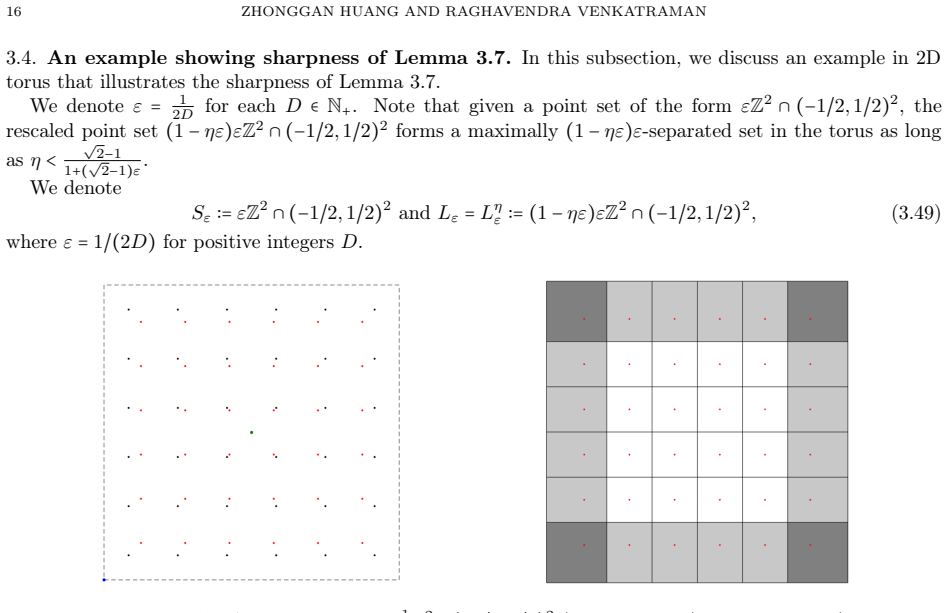
- [§3.4, Proposition 3.9] The proof refers to Figure 1, which is not included in the provided text; the figure is important for the construction of the perturbed point set and should be supplied.
- [Header/running title] The author name appears as ‘Ragha Vendra Venkatraman’ in the running header; this should be corrected.
- [Various] There are numerous stray symbol sequences and OCR-like artifacts throughout the text (not only in Theorem 1.3), e.g. in Section 5 and the appendix. A full proofread of the LaTeX source is needed.
Circularity Check
No circularity: the Steklov expansion is computed from exact identities and the spectral Green function, with no fitted parameter or self-citation chain carrying the argument.
full rationale
The claimed derivation is not circular. The starting point is the qualitative convergence theorem imported from the external works [21,23], not from the present authors' own prior results. The hole radii are defined by the mass-balance equation (2.8), H^{d-1}(∂B_{r_{ε,p}}(p)) = ∫_{V_p} β dV, which makes each hole neutral; this is a structural assumption, not a fit to any target eigenvalue. The eigenvalue expansion in Theorem 1.3 is obtained by substituting the corrector ansatz U^ε ≈ U + Z^ε into the exact integration-by-parts identity (1.15)/(4.2)-(4.3), with Z^ε defined as the solution of the corrector equation (5.4)/(1.19). Corollary 5.7 then rewrites the term ∫ Z^ε U dμ^ε using the standard spectral Green function G_λ from (1.11)/(5.34); this is an exact representation of the inverse of Δ+λβ on the orthogonal complement of U, not an assumed form of the answer. Thus the Coulomb-type interaction energy is derived, not imposed. No constant is fitted to any eigenvalue or eigenfunction data, and the claimed prediction is not statistically forced. The only self-citations in the paper, [2] and [36], appear in the literature review as contextual references and play no load-bearing role in the proof. Separately, the word "optimal" in Theorem 1.2 is not supported by a lower bound on |σ^ε−λ| in units of ω_d(ε); Proposition 3.9 establishes sharpness only for the auxiliary cell function Φ^ε, not for the eigenvalue gap. That is a completeness or correctness concern, not a circularity step, and it does not raise the circularity score.
Assumptions & free parameters
assumptions (5)
- standard math Standard spectral theory of Steklov and weighted Laplace–Beltrami operators on compact Riemannian manifolds, including Weyl asymptotics and Green function estimates for (M,g).
- domain assumption For small ε, Voronoi cells V_p are geodesically convex with C^{-1}ε^d ≤ |V_p| ≤ C ε^d and B_{ε/4}(p) ⊂ V_p ⊂ B_ε(p).
- domain assumption For each p, the radius r_{ε,p} exists uniquely as the solution of A(∂B_r(p)) = ∫_{V_p} β dV, with C^{-1}ε^{d/(d−1)} ≤ r ≤ C ε^{d/(d−1)}.
- domain assumption Theorem 1.3 is stated for a simple eigenvalue λ; the multiplicity-m case is delegated to Lemma 5.1 in Section 5.
- standard math The reduced Green function G_λ exists as a symmetric distribution with smooth kernel off the diagonal and near-diagonal singularity |log d_g| (d=2) or d_g^{2−d} (d≥3).
invented entities (2)
-
Global cell function Φ_ε
-
Corrector Z_ε
Cite this review
Pith. "Pith review of An indefinite Coulomb interaction from the Steklov spectrum of perforated manifolds." pith.science (2026). https://pith.science/paper/TQ6NHNKK
@misc{pith2026260725211,
  author       = {Pith},
  title        = {Pith review of: An indefinite Coulomb interaction from the Steklov spectrum of perforated manifolds},
  year         = {2026},
  howpublished = {\url{https://pith.science/paper/TQ6NHNKK}},
  note         = {Machine review of arXiv:2607.25211}
}
read the original abstract
We establish optimal convergence rates for Steklov eigenvalues and harmonically extended eigenfunctions toward their weighted Laplace--Beltrami counterparts on a closed manifold perforated by many small geodesic balls. The holes have radii that scale critically with respect to their spacing in the sense that the boundary area of each hole balances with the weighted volume of its Voronoi cell. We then derive a higher-order expansion of the Steklov eigenvalues; in dimensions two and three, we identify two correction scales. The expansion is governed by an indefinite Coulomb-type energy of the discrepancy between the boundary and bulk measures, mediated by the reduced Green function of the limiting operator. The proof relies on sharp estimates for certain auxiliary functions that we introduce in order to quantify the discrepancy measure between the surface measure on the holes and their background density. Our paper serves to bridge an emerging literature in spectral geometry with one on systems of points interacting via Coulomb-type energies.
Figures
Reference graph
Works this paper leans on
-
[1]
1, 27–68
Grégoire Allaire, Eric Bonnetier, Gilles Francfort, and François Jouve,Shape optimization by the homogenization method, Numerische Mathematik76(1997), no. 1, 27–68
1997
-
[2]
Scott Armstrong and Raghavendra Venkatraman,Optimal convergence rates for the spectrum of the graph laplacian on poisson point clouds, Foundations of Computational Mathematics (2025), 1–26
2025
-
[3]
Monge-Ampère Equations(M
Thierry Aubin,Nonlinear Analysis on Manifolds. Monge-Ampère Equations(M. Artin, S. S. Chern, J. L. Doob, A. Grothendieck, E. Heinz, F. Hirzebruch, L. Hörmander, S. Mac Lane, W. Magnus, C. C. Moore, J. K. Moser, M. Nagata, W.Schmidt,D.S.Scott,J.Tits,B.L.VanDerWaerden,M.Berger,B.Eckmann,andS.R.S.Varadhan,eds.),Grundlehren der mathematischen Wissenschaften, ...
1982
-
[4]
,Some Nonlinear Problems in Riemannian Geometry, Springer Monographs in Mathematics, Springer, Berlin, Heidelberg, 1998
1998
-
[5]
Laurent Bétermin and Etienne Sandier,Renormalized energy and asymptotic expansion of optimal logarithmic energy on the sphere, arXiv preprint arXiv:1404.4485 (2014)
arXiv 2014
-
[6]
6, 4122–4164
DenisI.Borisov,Operator estimates for non-periodically perforated domains with Dirichlet and nonlinear Robin conditions: strange term, Mathematical Methods in the Applied Sciences47(2024), no. 6, 4122–4164
2024
-
[7]
M. Carme Calderer, Antonio DeSimone, Dmitry Golovaty, and Alexander Panchenko,An effective model for nematic liquid crystal composites with ferromagnetic inclusions, SIAM Journal on Applied Mathematics74(2014), no. 2, 237–262
2014
-
[8]
Giacomo Canevari, Kirill Cherednichenko, and Arghir Zarnescu,A not-so-strange term coming from somewhere, 2025. arXiv:2511.20071
arXiv 2025
Show all 37 references
-
[9]
2, 309–342
Giacomo Canevari and Arghir Zarnescu,Design of effective bulk potentials for nematic liquid crystals via colloidal ho- mogenisation, Mathematical Models and Methods in Applied Sciences30(2020), no. 2, 309–342
2020
-
[10]
Google-Books-ID: 0v1VfTWuKGgC
Isaac Chavel,Eigenvalues in Riemannian Geometry, Academic Press, 1984 (en). Google-Books-ID: 0v1VfTWuKGgC
1984
-
[11]
3–4, 163–184
Kirill Cherednichenko, Patrick Dondl, and Frank Rösler,Norm-resolvent convergence in perforated domains, Asymptotic Analysis110(2018), no. 3–4, 163–184
2018
-
[12]
ii, Communications in Mathematical Physics406 (2025), no
Kirill Cherednichenko, Alexander V Kiselev, Igor Velčić, and Josip Žubrinić,Effective behaviour of critical-contrast pdes: micro-resonances, frequency conversion, and time dispersive properties. ii, Communications in Mathematical Physics406 (2025), no. 4, 72
2025
-
[13]
Nazarov, and Andrey L
Valeria Chiadò Piat, Sergey S. Nazarov, and Andrey L. Piatnitski,Steklov problems in perforated domains with a coefficient of indefinite sign, Networks and Heterogeneous Media7(2012), no. 1, 151–178
2012
-
[14]
arXiv:2509.18630
Adrian Chun-Pong Chu and Daniel Stern,Minimal surface doublings and electrostatics for Schrödinger operators, 2025. arXiv:2509.18630
2025
-
[15]
Un terme étrange venu d’ailleurs,
Doina Cioranescu and François Murat,A strange term coming from nowhere, Topics in the mathematical modelling of composite materials, 1997, pp. 45–93. Translation of “Un terme étrange venu d’ailleurs,” Collège de France Seminar (1982)
1997
-
[16]
1, 1–161
Bruno Colbois, Alexandre Girouard, Carolyn Gordon, and David Sher,Some recent developments on the Steklov eigenvalue problem, Revista Matemática Complutense37(2024), no. 1, 1–161
2024
-
[17]
5, 4011–4030
Ailana Fraser and Richard Schoen,The first Steklov eigenvalue, conformal geometry, and minimal surfaces, Advances in Mathematics226(2011), no. 5, 4011–4030
2011
-
[18]
3, 823–890
,Sharp eigenvalue bounds and minimal surfaces in the ball, Inventiones mathematicae203(2016), no. 3, 823–890
2016
-
[19]
2, 245–268
Nicola Garofalo and Fang-Hua Lin,Monotonicity properties of variational integrals, A p weights and unique continuation, Indiana University Mathematics Journal35(1986), no. 2, 245–268
1986
-
[20]
Trudinger,Elliptic Partial Differential Equations of Second Order, 2nd ed., Classics in Mathe- matics, Springer Berlin, Heidelberg, 2001
David Gilbarg and Neil S. Trudinger,Elliptic Partial Differential Equations of Second Order, 2nd ed., Classics in Mathe- matics, Springer Berlin, Heidelberg, 2001
2001
-
[21]
2, 981–1023 (en)
Alexandre Girouard, Antoine Henrot, and Jean Lagacé,From Steklov to Neumann via homogenisation, Archive for Rational Mechanics and Analysis239(February 2021), no. 2, 981–1023 (en). 42 ZHONGGAN HUANG AND RAGHA VENDRA VENKATRAMAN
2021
-
[22]
3, 513–561 (en)
Alexandre Girouard, Mikhail Karpukhin, and Jean Lagacé,Continuity of eigenvalues and shape optimisation for Laplace and Steklov problems, Geometric and Functional Analysis31(June 2021), no. 3, 513–561 (en)
2021
-
[23]
3, 1011–1056 (en)
Alexandre Girouard and Jean Lagacé,Large Steklov eigenvalues via homogenisation on manifolds, Inventiones mathemat- icae226(December 2021), no. 3, 1011–1056 (en)
2021
-
[24]
2, 321–359
Alexandre Girouard and Iosif Polterovich,Spectral geometry of the Steklov problem, Journal of Spectral Theory7(2017), no. 2, 321–359
2017
-
[25]
Mathieu Lewin,Coulomb and riesz gases: The known and the unknown, Journal of Mathematical Physics63(2022), no. 6
2022
-
[26]
Peter Li,Geometric Analysis, Cambridge Studies in Advanced Mathematics, Cambridge University Press, Cambridge, 2012
2012
-
[27]
11, 364 (en)
Chia-Chun Lo,Homogenisation for the Robin Eigenvalue Problem on Manifolds and Flexibility of Optimal Schrödinger Potentials, The Journal of Geometric Analysis35(September 2025), no. 11, 364 (en)
2025
-
[28]
Marchenko and Evgueni Ya
Vladimir A. Marchenko and Evgueni Ya. Khruslov,Homogenization of partial differential equations, Progress in Mathe- matical Physics, vol. 46, Birkhäuser, Boston, 2006
2006
-
[29]
Charles W Misner, Kip S Thorne, and John Archibald Wheeler,Gravitation, W. H. Freeman and Company, San Francisco, 1973
1973
-
[30]
G. C. Papanicolaou and S. R. S. Varadhan,Diffusion in regions with many small holes, Collected papers. volume ii: Pde, sde, diffusions, random media. edited by rajendra bhatia, abhay bhatt and k. r. parthasarathy, 2012, pp. 477–493 (English)
2012
-
[31]
X. Pennec,Hessian of the Riemannian Squared Distance,https://www.semanticscholar.org/paper/ Hessian-of-the-Riemannian-Squared-Distance-Pennec/0eed5a28d23c3b10f351eb2b20f59db9bfc85cda(2017)
2017
-
[32]
Jeffrey Rauch and Michael Taylor,Potential and scattering theory on wildly perturbed domains, Journal of Functional Analysis18(1975), 27–59
1975
-
[33]
3, 635–743
Etienne Sandier and Sylvia Serfaty,From the ginzburg-landau model to vortex lattice problems, Communications in Math- ematical Physics313(2012), no. 3, 635–743
2012
-
[34]
Sylvia Serfaty,Systems of points with coulomb interactions, European Mathematical Society Magazine110(2018), 16–21
2018
-
[35]
,Lectures on coulomb and riesz gases, arXiv preprint arXiv:2407.21194 (2024)
2024 arXiv
-
[36]
Nicolás García Trillos, Chenghui Li, and Raghavendra Venkatraman,Minimax rates for the estimation of eigenpairs of weighted laplace-beltrami operators on manifolds, arXiv preprint arXiv:2506.00171 (2025)
2025 arXiv
-
[37]
Muthusamy Vanninathan,Homogenization of eigenvalue problems in perforated domains, Proceedings of the indian acad- emy of sciences-mathematical sciences, 1981, pp. 239–271. Email address:zhonggan@math.utah.edu Email address:raghav@math.utah.edu
1981
Reviewed August 1, 2026 · model on record in the stance chip above.
Discussion (0). Sign in to comment.