REVIEW 3 major objections 4 minor 30 references
Lighthill's mechanism and vorticity cascade in the logarithmic layer of wall turbulence
T0 review · 3 major / 4 minor · reviewed 2026-08-04 · deepseek-v4-flash
Pith's one-line read Lighthill's 1963 mechanism for concentrating spanwise vorticity at walls operates unchanged throughout the logarithmic layer, with hairpin vortices and 'shawl' vortices splitting the transport roughly evenly.
desk verdict Solid conditional-averaging results with honest caveats, but the 'cascade' and 'half' language outruns what the statistics actually show. read the letter →
The pith
A machine-rendered reading of the paper's core claim, the machinery that carries it, and where it could break.
The reading
What carries the argument
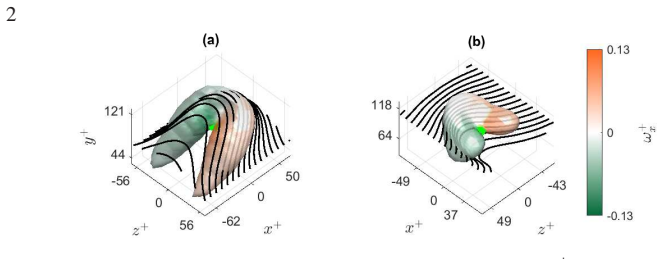
The central object is the Eulerian vorticity flux tensor, whose wall-normal, spanwise-vorticity component obeys a constant-flux relation in channel flow; antisymmetry of the tensor encodes the fact that vortex lines cannot end in the fluid. Conditional averaging around local extrema of wall-normal velocity, with sampling windows sized by linear stochastic estimation, turns this flux tensor into a visualization of the mean coherent eddies—hairpin for outflows, shawl for inflows—whose spanwise convergence or divergence fixes the sign of the stretching/tilting flux.
What would settle it
Measure time-lagged conditional statistics: pick a strong out-flow or in-flow event at height y0 in the log layer and ask whether its vorticity flux predicts, at a later time, an event at a smaller height (say y0/2) with the same sign. If the cascade claim is correct, a lead-lag correlation across scales should appear; if the flux events at the two scales are uncorrelated in time, the scale hierarchy is statistical similarity rather than a cascade.
Extended reading notes
Core claim
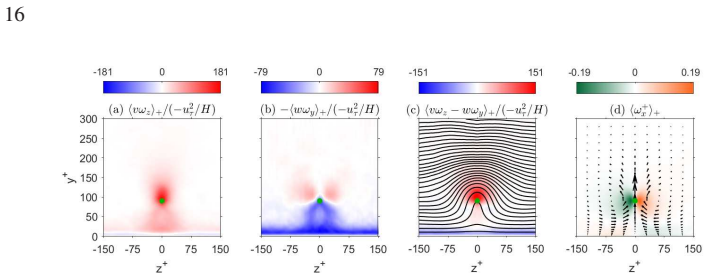
The paper's central quantitative result is that the wall-normal flux of spanwise vorticity, decomposed into advective and stretching/tilting parts, is anti-correlated in every conditional ensemble throughout the logarithmic layer, and the mean flow geometry explains why. For outflows, a spanwise-converging flow below the conditioning point weakens the upward-moving vortex lines, producing up-gradient stretching flux toward the wall; above it, a counterflow stretches them, producing down-gradient flux. For inflows the pattern is reversed, with a spanwise-diverging flow stretching and strengthening downward-moving vortex lines below the point. Thus Lighthill's proposed correlation between wall
Load-bearing premise
The load-bearing premise is that the scale-similar conditional eddies at different wall distances are dynamically linked steps of one cascade; the paper's Conclusions explicitly state that 'no strict causal connection has been established between vorticity at different scales, locations, and times,' so the cascade claim rests on that unproven connection.
Editorial extensions
If this is right
- If the mechanism is universal across the log layer, no separate wall-distance-specific explanation is needed for near-wall vorticity concentration; the same conditional event, scaled by wall distance, does the work at every height.
- The roughly equal division between hairpin and shawl vortices suggests the attached-eddy model should include up-gradient carriers: shawl vortices supply the inward flux that the standard AEM misses, so AEM-based Reynolds-stress and drag predictions can be refined by adding them.
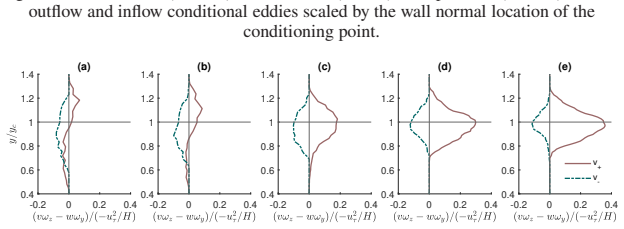
- Because each scale's transport is local in height (about 0.4 y0 to 1.4 y0), the log layer can be modeled as a step-by-step vertical cascade rather than by long-range transport.
- Strong sweeps and ejections are not mirror images or spanwise phase shifts of one another; at most 26% of strong sweeps are phase shifts of strong ejections, so models pairing them as one undulating vortex line would misrepresent the statistics.
Reading between the lines
- If shawl vortices are the main up-gradient carriers, drag-reduction strategies that suppress or modify sweep-shawl structures may lower skin friction more effectively than targeting ejections alone—an implication the paper leaves implicit.
- The paper's 'cascade' is inferred from scale similarity and height locality, not measured causality; a time-lagged correlation between flux at y0 and at y0/2 would test whether the hierarchy is a true dynamical chain.
- At higher Reynolds numbers, the 50/50 hairpin/shawl split could drift if it is an artifact of Re_tau=1000; a constant ratio would indicate the split is part of a scale-invariant equilibrium.
- Because only one flow geometry and one Reynolds number is examined, the same conditioning analysis in a boundary layer or pipe, and across a range of Re_tau, would show whether the two-structure split is universal.
Editorial analysis
A structured set of objections, weighed in public.
Referee Report
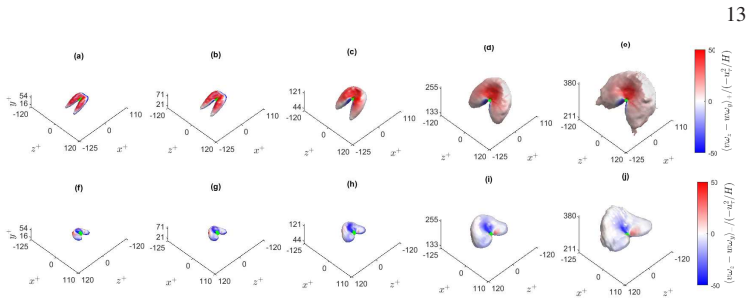
Summary. The paper tests Lighthill's 1963 conjecture that turbulent wall-bounded flows concentrate spanwise vorticity near the wall through a tight correlation between wall-normal velocity and vortex stretching/weakening. Using conditional averaging on the JHTDB Re_tau=1000 channel-flow database at five wall-normal positions in the log layer, the authors compute conditional mean velocity fields, vortex lines, and the advective, stretching/tilting, and total vorticity fluxes. For outflows they find hairpin-like eddies with spanwise-converging flow below the conditioning point, which weakens rising vortex lines and produces up-gradient stretching flux; for inflows they find inverted-hairpin or 'shawl' vortices with spanwise-diverging flow below the conditioning point, which strengthens descending vortex lines and also produces up-gradient stretching flux. They also identify counter-flows above/below the conditioning point that explain the observed anti-correlation between advective and stretching/tilting fluxes. Based on the self-similar growth of these conditional eddies with wall distance, the paper argues for Lighthill's proposed 'cascade process' and claims that hairpin-type eddies account for half of the vorticity cascade and shawl-type eddies for the other half.
Significance. If the results hold, they provide the first detailed conditional-mean confirmation of Lighthill's mechanism across the entire logarithmic layer, and they identify concrete vortex structures that can supply the up-gradient vorticity transport missing from the standard attached-eddy model. This would be a substantial advance: Eyink (2008) left open what vortex structure could produce such transport, and the paper's proposed 'shawl vortices' are a plausible candidate. Strengths of the manuscript include the use of an independent high-Reynolds-number DNS database, explicit robustness checks for the conditional threshold (Appendix A), quantitative verification that fluctuation correlations are small (Appendix C), extensive supplementary visualizations, and an unusually candid statement in the conclusions that no strict causal connection has been established. The paper is carefully executed and the conditional-mean results appear reliable; the main weaknesses concern the strength of the claims drawn from them, especially the 'cascade' and 'half' language in the abstract.
major comments (3)
- [§2.2, §3.3, Figs. 10–11] The scale-hierarchy evidence is potentially imprinted by the analysis procedure. The sampling-window extents at each y0 are chosen so that the conditional eddy fits inside the window, and the λ2 isosurface threshold in Fig. 10 is explicitly rescaled as -6 uτ²/y0². Under these choices the near-constant values of Ly/y0 and Lz/y0 in Fig. 11 are not an independent confirmation of self-similarity: the window selection and threshold rescaling can impose exactly this scaling. The constant 47% area fraction cited as an a posteriori justification is likewise an output of a non-overlapping sampling algorithm that removes rectangles of area growing like y0². This concern does not affect the conditional-mean description at each fixed y0, but it weakens the paper's central 'cascade' claim. Please provide controls: for example, test a fixed λ2 threshold (or a threshold with different prefactor) and ve
- [Abstract, §3.3, Fig. 12] The abstract states that Townsend's model of hairpin-type attached eddies 'accounts for half of the vorticity cascade' and that shawl vortices supply 'the other half.' No such decomposition is quantified in the text. Figure 12 shows signed flux contributions from conditional outflows and inflows at the conditioning points, but the magnitude of each contribution relative to the total vorticity flux is not reported, and no 'half' partition is derived anywhere in the paper. Either provide a quantitative decomposition, with error bars, that justifies the 50/50 statement, or remove the 'half' claim from the abstract and replace it with a qualitative statement about comparable contributions.
- [§4, Conclusions] The paper's own conclusions state that 'no strict causal connection has been established between vorticity at different scales, locations, and times.' This is a serious caveat that is not reflected in the abstract, which says the results 'present evidence' for Lighthill's cascade process, nor in the concluding sentence that the vorticity dynamics 'is a cascade process proceeding through a hierarchy of turbulent eddies.' The conditional statistics at a fixed time and different y0 establish self-similar conditional eddies with local flux contributions; they do not establish a dynamical transfer from one scale to the next. Please soften the cascade language throughout, or add a causal analysis (e.g., the Lagrangian/adjoint methods referenced in §4) that actually tests the multi-scale transfer. At minimum the abstract should be consistent with the stated limitation.
minor comments (4)
- [Fig. 6 caption] The caption repeats '(c)' for both 'total nonlinear flux' and 'streamwise vorticity'; the second should be '(d)'.
- [Fig. 11] The vertical axis appears to lack an explicit label; state clearly that the plotted quantities are Lx±/y0+, Ly±/y0+, Lz±/y0+.
- [Fig. 10 caption] The links 'available here' are placeholders in the text; ensure the JFM Notebooks URLs are live in the published version.
- [Appendix C] The discussion of Pearson correlations is clear, but the near-wall region where correlations reach 0.4 should be mentioned in the main text near §3.2, not only in the appendix, since it qualifies the control-volume explanation there.
Circularity Check
Core Lighthill-mechanism validation is external and sound; the scale-hierarchy ('cascade') evidence is partly self-constructed through adaptive sampling windows, and the causal cascade link is admittedly untested.
-
fitted input called prediction
[Section 2.2 (sampling-window selection and 'a posteriori justification'; Table 1)]
"The size of the sampling window at each y0-level was selected by calculating approximate conditional averages with a linear estimator (Adrian et al. 1989) and determining the smallest rectangle to contain the conditional eddy visualized by the lambda2-criterion at a low threshold. In fact, as an a posteriori justification of our sampling procedure, we note that the percentage of the total area occupied both by the outflow (v+) events and by the inflow (v-) events is about 47% for each sign, independent of y0."
The window extents are fitted at each y0 to contain the conditional eddy; with non-overlap sampling of a fixed-area wall-parallel plane, the number of events is forced to be inversely proportional to window area. Table 1 shows this exactly: as y0 increases, window area grows by ~4.5x while event count falls by ~4.4x, so the product N x area — i.e., the reported ~47% area fraction — is constant by the sampling algorithm. Using this constancy as an 'a posteriori justification' of attached-eddy scale invariance is circular: the scale invariance of the sampled area fraction was put in by choosing windows to contain y0-scaled eddies.
full rationale
The central empirical result — Lighthill's spanwise-convergence/divergence mechanism and the associated conditional vorticity fluxes — is obtained by conditional averaging of the external JHTDB DNS data; it is not an input to the calculation, and Lighthill's hypothesis is an independent 1963 proposal. Thus the main corroboration is not circular. The paper also directly verifies that velocity–vorticity fluctuation correlations are small (Appendix C), so the flux explanation is not a tautology. The main circularity concern is confined to the scale-hierarchy evidence in §2.2/§3.3: sampling windows are chosen to contain each conditional eddy, and the constant 47% area fraction is then cited as a posteriori support for attached-eddy scale invariance; that constancy is an artifact of the window-selection/non-overlap algorithm (Table 1 shows N inversely proportional to window area). The λ2 threshold in Fig. 10 uses the natural similarity scaling -6u_tau^2/y0^2; this is a standard similarity test and the authors report insensitivity to the prefactor, so it does not by itself constitute circularity, but it weakens the independence of the measured growth. Finally, the paper's own Conclusion concedes 'no strict causal connection has been established between vorticity at different scales, locations, and times,' so the 'cascade process' and 'half of the vorticity cascade' wording is a modeling inference rather than a directly measured causal transfer. That is a limitation, not a circular step. Overall score 3: one fitted-input-called-prediction element in a supporting argument, while the central mechanism validation is external.
Assumptions & free parameters
free parameters (4)
- Conditional sampling threshold alpha =
1 (kept), with robustness check at 2
- lambda2 isosurface prefactor =
6
- Sampling window extents Lx by Lz =
515x208, 515x257, 614x307, 712x405, 810x601 (viscous units, at y+ = 39, 52, 93, 197, 298)
- Reverse-event classification thresholds =
r <= r_a, |theta| <= pi/4
assumptions (4)
- standard math Incompressible Navier-Stokes and the Huggins vorticity flux tensor (Eq 2.1) govern vorticity transport
- domain assumption Mean spanwise vorticity flux is constant and equal to streamwise pressure gradient in statistically steady channel flow (Eq 2.2)
- domain assumption JHTDB Re_tau=1000 DNS data is an accurate representation of fully developed turbulent channel flow
- domain assumption Conditional mean fields represent the coherent vorticity-transporting motions in individual events
invented entities (1)
-
Shawl vortices (necklace vortices)
independent evidence
Cite this review
Pith. "Pith review of Lighthill's mechanism and vorticity cascade in the logarithmic layer of wall turbulence." pith.science (2026). https://pith.science/paper/TQWHSHA3
@misc{pith2026250907746,
  author       = {Pith},
  title        = {Pith review of: Lighthill's mechanism and vorticity cascade in the logarithmic layer of wall turbulence},
  year         = {2026},
  howpublished = {\url{https://pith.science/paper/TQWHSHA3}},
  note         = {Machine review of arXiv:2509.07746}
}
abstract
We investigate Lighthill's proposed turbulent mechanism for near-wall concentration of spanwise vorticity by calculating mean flows conditioned on motion away from or toward the wall in an $Re_\tau=1000$ database of plane-parallel channel flow. Our results corroborate Lighthill's proposal throughout the entire logarithmic layer, but extended by counterflows that help explain anti-correlation of vorticity transport by advection and by stretching/tilting. We present evidence also for Lighthill's hypothesis that the vorticity transport in the log-layer is a ``cascade process'' through a scale-hierarchy of eddies, with intense competition between transport outward from and inward to the wall. Townsend's model of attached eddies of hairpin-vortex type accounts for half of the vorticity cascade, whereas we identify necklace-type or ``shawl vortices'' that envelop turbulent sweeps as supplying the other half.
Figures


Figures from the paper (20 more)




Reference graph
Works this paper leans on
-
[1]
, " * write output.state after.block = add.period write newline
ENTRY address author booktitle chapter edition editor howpublished institution journal key month note number organization pages publisher school series title type volume year eprint label extra.label sort.label short.list INTEGERS output.state before.all mid.sentence after.sentence after.block FUNCTION init.state.consts #0 'before.all := #1 'mid.sentence ...
-
[2]
write newline
" write newline "" before.all 'output.state := FUNCTION n.dashify 't := "" t empty not t #1 #1 substring "-" = t #1 #2 substring "--" = not "--" * t #2 global.max substring 't := t #1 #1 substring "-" = "-" * t #2 global.max substring 't := while if t #1 #1 substring * t #2 global.max substring 't := if while FUNCTION word.in bbl.in capitalize " " * FUNCT...
-
[3]
Adrian, R. J. , Jones, B. G. , Chung, M. K. , Hassan, Y. , Nithianandan, C. K. & Tung, A.T.-C. 1989 Approximation of turbulent conditional averages by stochastic estimation . Phys. Fluids A 1 (6), 992--998
work page 1989
-
[4]
Anderson, P. W. 1966 Considerations on the flow of superfluid helium . Rev. Mod. Phys. 38 , 298--310
work page 1966
-
[5]
Brown, G. L. , Lee, M. & Moser, R. D. 2015 Vorticity transport: the transfer of viscous stress to R eynolds stress in turbulent channel flow. In Ninth International Symposium on Turbulence and Shear Flow Phenomena (TSFP-9)\/ , , vol. 2, talk 6B-5 . Begel House Inc
work page 2015
-
[6]
2025 Vorticity dynamics and drag for flows over a sphere and a prolate spheroid
Du, Yifan & Zaki, Tamer A. 2025 Vorticity dynamics and drag for flows over a sphere and a prolate spheroid. J. Fluid Mech. p. In press
work page 2025
-
[7]
Eyink, G. L. 2008 Turbulent flow in pipes and channels as cross-stream “inverse cascades” of vorticity . Phys. Fluids 20 (12), 125101
work page 2008
-
[8]
Graham, J. , Kanov, K. , Yang, X. I. A. , Lee, M. , Malaya, N. , Lalescu, C. C. , Burns, R. , Eyink, G. , Szalay, A. , Moser, R. D. & Meneveau, C. 2016 A web services accessible database of turbulent channel flow and its use for testing a new integral wall model for les . J. Turbulence 17 (2), 181--215
work page 2016
Show all 30 references
-
[9]
1990 Large gradients due to wall turbulence
Gad-el Hak, M. 1990 Large gradients due to wall turbulence. In: Some Unanswered Questions in Fluid Mechanics, eds. Trefethen, L. M. and Panton, R. L., Appl. Mech. Rev. 43, 153--170 (1990), p.159
1990
-
[10]
Huggins, E. R. 1971 Dynamical theory and probability interpretation of the vorticity field . Phys. Rev. Lett. 26 (21), 1291
1971
-
[11]
Huggins, E. R. 1994 Vortex currents in turbulent superfluid and classical fluid channel flow, the M agnus effect, and G oldstone boson fields . J. Low Temp. Phys. 96 (5), 317--346
1994
-
[12]
Hutchins, Nicholas , Monty, Jason P , Ganapathisubramani, Bharathram , Ng, Henry Chi-Hin & Marusic, Ivan 2011 Three-dimensional conditional structure of a high-reynolds-number turbulent boundary layer . J. Fluid Mechanics 673 , 255--285
2011
-
[13]
Josephson, B. D. 1965 Potential differences in the mixed state of type II superconductors . Phys. Lett. 16 (3), 242--243
1965
-
[14]
& Moin, P
Kim, J. & Moin, P. 1986 The structure of the vorticity field in turbulent channel flow. P art 2. S tudy of ensemble-averaged fields . J. Fluid Mech. 162 , 339--363
1986
-
[15]
Klewicki, J. C. , Fife, P. , Wei, T. & McMurtry, P. 2007 A physical model of the turbulent boundary layer consonant with mean momentum balance structure . Philo. Trans. Roy. Soc. A 365 (1852), 823--840
2007
-
[16]
Kumar, Samvit & Eyink, Gregory L 2024 A J osephson-- A nderson relation for drag in classical channel flows with streamwise periodicity: E ffects of wall roughness . Phys. Fluids 36 (9)
2024
-
[17]
, Meneveau, C
Kumar, S. , Meneveau, C. & Eyink, G. L. 2023 Vorticity cascade and turbulent drag in wall-bounded flows: plane P oiseuille flow . J. Fluid Mech. 974 , A27
2023
-
[18]
, Toedtli, S
Kumar, S. , Toedtli, S. , Zaki, T. A. & Eyink, G. L. 2025 J osephson- A nderson relation as diagnostic of turbulent drag reduction by polymers . Phys. Rev. E 111 (1), 015105
2025
-
[19]
, Perlman, E
Li, Y. , Perlman, E. , Wan, M. , Yang, Y. , Meneveau, C. , Burns, R. , Chen, S. , Szalay, A. & Eyink, G. L. 2008 A public turbulence database cluster and applications to study lagrangian evolution of velocity increments in turbulence . J. Turbulence 9 , N31
2008
-
[20]
Lighthill, M. J. 1963 Introduction: B oundary layer theory . In Laminar Boundary Theory\/ (ed. L. Rosenhead ) , pp. 46--113 . Oxford: Oxford University Press
1963
-
[21]
Lozano-Dur \'a n, Adri \'a n , Flores, Oscar & Jim \'e nez, Javier 2012 The three-dimensional structure of momentum transfer in turbulent channels . J. luid Mech. 694 , 100--130
2012
-
[22]
& Monty, J
Marusic, I. & Monty, J. P. 2019 Attached eddy model of wall turbulence . Annu. Rev. Fluid Mech. 51 , 49--74
2019
-
[23]
Taylor, G. I. 1932 The transport of vorticity and heat through fluids in turbulent motion . Proc. Roy. Soc. Lond. A 135 (828), 685--702
1932
-
[24]
& Lumley, J.L
Tennekes, H. & Lumley, J.L. 1972 A First Course in Turbulence\/ . Cambridge, MA: MIT Press
1972
-
[25]
Terrington, S. J. , Hourigan, K. & Thompson, M. C. 2021 The generation and diffusion of vorticity in three-dimensional flows: Lyman's flux . J. Fluid Mech. 915
2021
-
[26]
Townsend, A. A. 1976 The Structure of Turbulent Shear Flow\/ , 2nd edn. Cambridge University Press
1976
-
[27]
, Eyink, G
Wang, M. , Eyink, G. L. & Zaki, T. A. 2022 Origin of enhanced skin friction at the onset of boundary-layer transition . J. Fluid Mech. 941
2022
-
[28]
Willmarth, W. W. & Lu, S. S. 1972 Structure of the reynolds stress near the wall . Journal of Fluid Mechanics 55 (1), 65–92
1972
-
[29]
Physics of Fluids 27 (1)
Woodcock, JD & Marusic, I 2015 The statistical behaviour of attached eddies . Physics of Fluids 27 (1)
2015
-
[30]
, Eyink, G
Xiang, T. , Eyink, G. L. & Zaki, T. A. 2025 The origin of vorticity in viscous incompressible flows . J. Fluid Mech. 1011 , A33
2025
Reviewed August 4, 2026 · model on record in the stance chip above.
Discussion (0). Continue with ORCID to comment.