Stability Analysis in Large-scale Centralized Bidirectional Inverter-based Stations Connected to Bulk Power Systems through AC and DC Connections
Pith reviewed 2026-06-26 23:22 UTC · model grok-4.3
The pith
DC connections reduce subsynchronous oscillation risks in large-scale bidirectional inverter stations compared to AC when line resistance is low.
A machine-rendered reading of the paper's core claim, the machinery that carries it, and where it could break.
Core claim
Large-scale IBSs can cause SSO instability through AC connections as the number of CDCRs grows regardless of power flow direction, while DC connections reduce the instability if DC line resistance is much less than AC line reactance; control-parameter tuning is more effective at raising the critical stability limit under DC, so the DC-IBS configuration is preferred for high-voltage transmission.
What carries the argument
Side-by-side examination of AC versus DC connection effects on stability, driven by changes in the number of CDCRs, power-flow direction, and inverter control parameters.
If this is right
- AC-connected IBSs require an upper limit on power amplitude to stay stable.
- DC connections lower instability risk for high-voltage transmission.
- Tuning inverter control parameters raises the stability limit more effectively when the connection is DC.
- The stability advantage of DC holds across varied network topologies and system scales.
Where Pith is reading between the lines
- Grid planners might favor DC links when adding many battery or storage resources to avoid repeated stability studies for each added unit.
- The same resistance-versus-reactance condition could be checked in medium-voltage distribution networks that also use many inverters.
- Real-world validation would need to confirm that AC and DC cases truly differ only in the line impedance and not in unmodeled control or protection details.
Load-bearing premise
The comparison treats the inverter models, control structures, and network parameters as identical except for the choice of AC or DC connection.
What would settle it
A test system in which increasing the number of CDCRs produces growing subsynchronous oscillations under AC connection but not under an otherwise identical DC connection with low line resistance.
Figures
read the original abstract
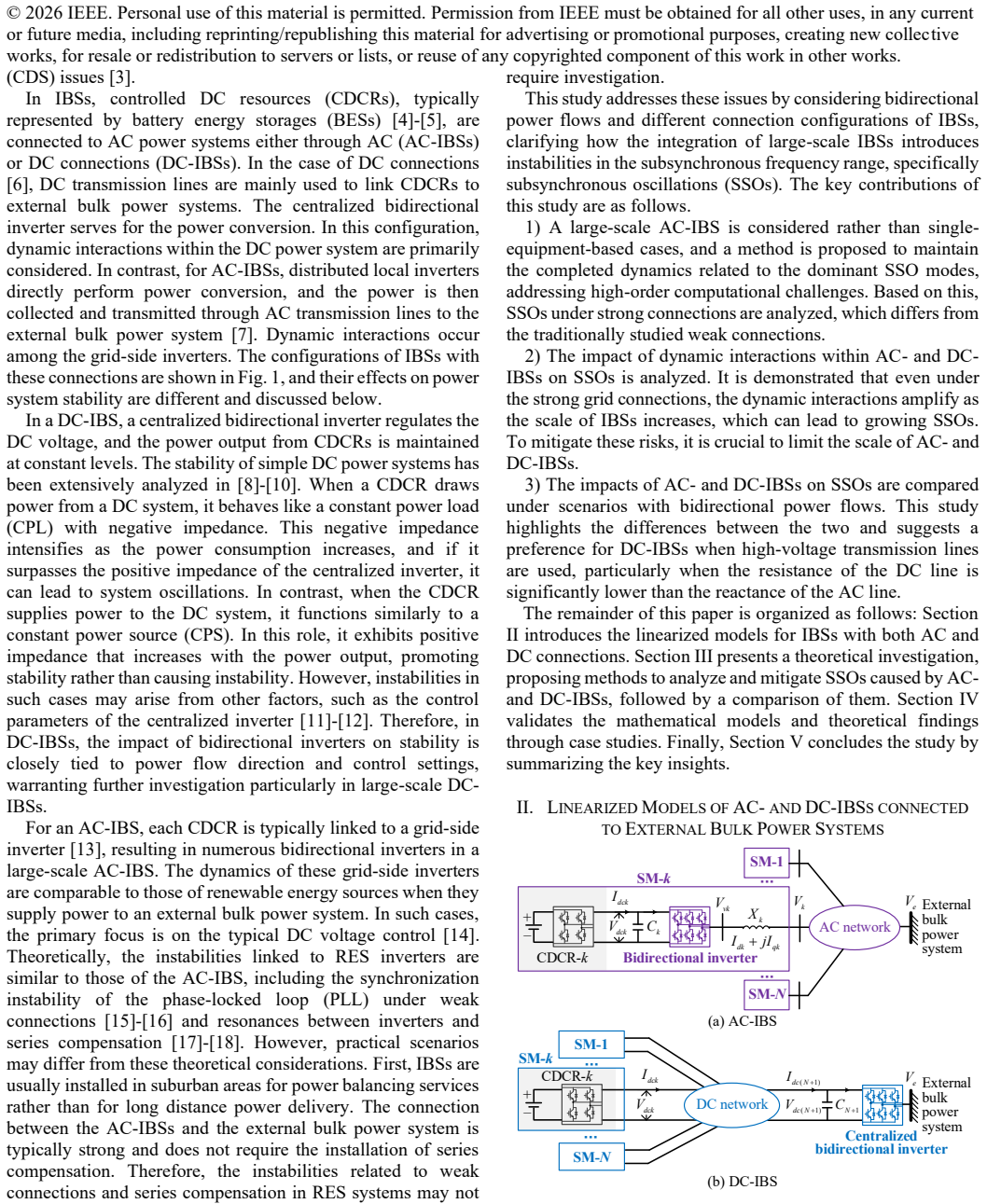
Massive controlled DC resources (CDCRs), such as battery energy storage systems, are connected to AC power systems through bidirectional inverters for power balance requirements. This study investigates converter-driven stability (CDS) issues in the sub-synchronous frequency range caused by large-scale bidirectional inverter-based stations (IBSs). The impacts of the AC and DC connections of IBSs on subsynchronous oscillations (SSOs) are compared by examining three factors: the number of CDCRs, power flow direction, and control parameters of the inverters. For AC connections, IBSs may induce instability as the number of CDCRs increases, regardless of the power flow direction. To maintain stability, the maximum power amplitude of the IBS is calculated. It is found that switching to DC connections can reduce these instability risks if the DC line resistance is much less than the AC line reactance. Moreover, the method of tuning control parameters is demonstrated to be more effective in improving power-related critical stability under DC connections. Therefore, The DC-IBS is preferred for high-voltage transmission. Finally, the conclusions are validated in power systems connected with both AC- and DC-IBSs under various network topologies and system scales.
Editorial analysis
A structured set of objections, weighed in public.
Referee Report
Summary. The paper analyzes converter-driven stability (CDS) and subsynchronous oscillations (SSOs) in large-scale bidirectional inverter-based stations (IBSs) connected to bulk power systems. It claims that AC-connected IBSs become unstable as the number of controlled DC resources (CDCRs) increases, independent of power-flow direction, and derives a maximum power amplitude to preserve stability. It further claims that DC connections mitigate these risks provided DC line resistance is much smaller than AC line reactance, that control-parameter tuning is more effective for power-related stability margins under DC connections, and that DC-IBS configurations are therefore preferable for high-voltage transmission. These conclusions are stated to have been validated across multiple network topologies and system scales.
Significance. If the small-signal models and cross-connection comparisons are rigorously established, the results would supply concrete design guidance on connection type and parameter tuning for large-scale battery and similar resources, potentially reducing SSO risk in future high-voltage transmission planning.
major comments (2)
- [Abstract (modeling and comparison claims)] The central attribution of stability improvement to the connection type (DC vs. AC) rests on the unverified premise that the underlying inverter models, PLL, current-control loops, and network parameters are identical except for the replacement of line reactance by resistance. No derivation or cross-check confirming that the DC-IBS state-space or impedance model is obtained from the AC-IBS model solely by this substitution is referenced in the abstract or validation statements.
- [Abstract (stability-limit and tuning claims)] The reported maximum power amplitude for AC connections and the claim that parameter tuning is “more effective” under DC connections are presented without explicit small-signal equations, eigenvalue loci, or impedance-based margins that would allow independent verification of whether these quantities are derived from first principles or fitted to specific control gains.
minor comments (1)
- [Abstract] The sentence beginning “Therefore, The DC-IBS …” contains an erroneous capital “The.”
Simulated Author's Rebuttal
We thank the referee for the constructive comments, which help clarify the presentation of our modeling approach and results. We respond to each major comment below and indicate planned revisions to strengthen the manuscript.
read point-by-point responses
-
Referee: [Abstract (modeling and comparison claims)] The central attribution of stability improvement to the connection type (DC vs. AC) rests on the unverified premise that the underlying inverter models, PLL, current-control loops, and network parameters are identical except for the replacement of line reactance by resistance. No derivation or cross-check confirming that the DC-IBS state-space or impedance model is obtained from the AC-IBS model solely by this substitution is referenced in the abstract or validation statements.
Authors: We agree that the abstract does not explicitly reference the model equivalence. Sections II and III of the manuscript derive the small-signal state-space models for the inverters, PLL, and current-control loops identically for both AC- and DC-IBSs. The sole difference is in the network impedance term: the AC case uses line reactance X in the admittance matrix, while the DC case substitutes the line resistance R (with no imaginary component). This direct substitution is shown by comparing the network equations in both configurations. We will revise the abstract to note this model equivalence and add an explicit cross-reference to Sections II–III in the validation statements. revision: yes
-
Referee: [Abstract (stability-limit and tuning claims)] The reported maximum power amplitude for AC connections and the claim that parameter tuning is “more effective” under DC connections are presented without explicit small-signal equations, eigenvalue loci, or impedance-based margins that would allow independent verification of whether these quantities are derived from first principles or fitted to specific control gains.
Authors: The maximum power amplitude is obtained analytically in Section IV from the condition that the real part of the critical eigenvalue remains negative as the number of CDCRs increases; this follows directly from the system state matrix without fitting. The claim that tuning is more effective under DC connections is supported by comparative eigenvalue loci and participation-factor analysis in the same section, showing larger stability-margin shifts for the same gain changes when R_dc ≪ X_ac. These derivations are from first principles. The abstract summarizes the outcomes; to improve verifiability we will add a brief clause indicating that both the power limit and tuning comparison are obtained via small-signal eigenvalue analysis. revision: partial
Circularity Check
No circularity detected; abstract contains no derivation chain or equations
full rationale
The provided abstract summarizes conclusions on AC vs. DC connections and parameter tuning but includes no equations, state-space models, impedance derivations, or self-citations. No load-bearing steps can be inspected for reduction to inputs by construction, fitted parameters renamed as predictions, or self-citation chains. The claims are presented as validated across topologies, making the derivation self-contained against external benchmarks with no evidence of circularity in the given text.
Axiom & Free-Parameter Ledger
Reference graph
Works this paper leans on
-
[1]
Virtual Inertia Emulator-Based Model Predictive Control for Grid Frequency Regulation Considering High Penetration of Inverter-Based Energy Storage System,
N. Sockeel, J. Gafford, B. Papari and M. Mazzola, “Virtual Inertia Emulator-Based Model Predictive Control for Grid Frequency Regulation Considering High Penetration of Inverter-Based Energy Storage System,” IEEE Trans. Sustain. Energy, vol. 11, no. 4, pp. 2932-2939, Oct. 2020
2020
-
[2]
M. Guan, “Scheduled Power Control and Autonomous Energy Control of Grid-Connected Energy Storage System (ESS) With Virtual Synchronous Generator and Primary Frequency Regulation Capabilities,” IEEE Trans. Power Syst., vol. 37, no. 2, pp. 942-954, Mar. 2022
2022
-
[3]
Stability definitions and characterization of dynamic behavior in systems with high penetration of power electronic interfaced technologies,
N. Hatziargyriou, J. V . Milanović, and C. Rahmann, et al., “Stability definitions and characterization of dynamic behavior in systems with high penetration of power electronic interfaced technologies,” Power System Dynamic Performance Committee, PES-TR77, pp.1-42. Apr. 2020
2020
-
[4]
A Module -Integrated Distributed Battery Energy Storage and Management System,
Y. Li and Y. Han, “A Module -Integrated Distributed Battery Energy Storage and Management System,” IEEE Trans. Power Electron., vol. 31, no. 12, pp. 8260-8270, Dec. 2016
2016
-
[5]
Battery Energy Storage System Models for Microgrid Stability Analysis and Dynamic Simulation,
M. Farrokhabadi, S. König, and C. A. Cañizares, et al, “Battery Energy Storage System Models for Microgrid Stability Analysis and Dynamic Simulation,” IEEE Trans. Power Syst., vol. 33, no. 2, pp. 2301-2312, Mar. 2018
2018
-
[6]
Bidirectional Single-Stage Grid- Connected Inverter for a Battery Energy Storage System,
K.-Y . Lo, Y .-R. Chang, and Y .-M. Chen, “Bidirectional Single-Stage Grid- Connected Inverter for a Battery Energy Storage System,” IEEE Trans. Ind. Electron., vol. 64, no. 6, pp. 4581–4590, June 2017
2017
-
[7]
A Stochastic Stability Enhancement Method of Grid -Connected Distributed Energy Storage Systems,
S. Liu, X. Wang and P . X. Liu, “A Stochastic Stability Enhancement Method of Grid -Connected Distributed Energy Storage Systems,” IEEE Trans. Smart Grid, vol. 8, no. 5, pp. 2062-2070, Sept. 2017
2062
-
[8]
Comprehensive Review of Stability Criteria for DC Power Distribution Systems,
A. Riccobono and E. Santi, “Comprehensive Review of Stability Criteria for DC Power Distribution Systems,” IEEE Trans. on Ind. Applicat., vol. 50, no. 5, pp. 3525–3535, Sept. 2014
2014
-
[9]
Smart Resistor: Stabilization of DC Microgrids Containing Constant Power Loads Using High-Bandwidth Power Converters and Energy Storage,
K. A. Potty, E. Bauer, H. Li and J. Wang, “Smart Resistor: Stabilization of DC Microgrids Containing Constant Power Loads Using High-Bandwidth Power Converters and Energy Storage,” IEEE Trans. Power Electron., vol. 35, no. 1, pp. 957-967, Jan. 2020
2020
-
[10]
Scalable Robust V oltage Control of DC Microgrids With Uncertain Constant Power Loads,
M. S. Sadabadi and Q. Shafiee, “Scalable Robust V oltage Control of DC Microgrids With Uncertain Constant Power Loads,” IEEE Trans. Power Syst., vol. 35, no. 1, pp. 508-515, Jan. 2020
2020
-
[11]
Existence and Stability of Equilibrium of DC Micro-Grid Under Master-Slave Control,
Z. Liu, Ruisong Liu, and Ziqing Xia, et al., “Existence and Stability of Equilibrium of DC Micro-Grid Under Master-Slave Control,” IEEE Trans. Power Syst., vol. 37, no. 1, pp. 212-223, Jan. 2022
2022
-
[12]
DC V oltage Stability Analysis and Enhancement for Grid- Forming-Based MTDC Systems,
Y . Pang, A. Egea-Alvarez, J. C. Gonzalez-Torres, K. Shinoda, F. Perez and A. Benchaib, “DC V oltage Stability Analysis and Enhancement for Grid- Forming-Based MTDC Systems,” IEEE Trans. Power Electron., vol. 39, no. 10, pp. 12113-12117, Oct. 2024
2024
-
[13]
Dynamic Modeling of Battery Energy Storage and Applications in Transmission Systems,
F. Calero, C. A. Cañizares and K. Bhattacharya, “Dynamic Modeling of Battery Energy Storage and Applications in Transmission Systems,” IEEE Trans. Smart Grid, vol. 12, no. 1, pp. 589-598, Jan. 2021
2021
-
[14]
Analysis of Subsynchronous Oscillation Caused by Multiple VSCs with Different Dynamics Under Strong Grid Connections,
Q. Fu, W. Du, H. Wang and X. Xiao, “Analysis of Subsynchronous Oscillation Caused by Multiple VSCs with Different Dynamics Under Strong Grid Connections,” IEEE Trans. Sustain. Energy, vol. 14, no. 4, pp. 2364-2375, Oct. 2023
2023
-
[15]
Improved Grid Impedance Compensation for Phase -Locked Loop to Stabilize the Very - Weak-Grid Connection of VSIs,
C. Li, W. Liu, J. Liang, X. Ding and L. M. Cipcigan, "Improved Grid Impedance Compensation for Phase -Locked Loop to Stabilize the Very - Weak-Grid Connection of VSIs," IEEE Trans. Power Del., vol. 37, no. 5, pp. 3863-3872, Oct. 2022
2022
-
[16]
Robust PLL Synchronization Unit for Grid-Feeding Converters in Micro/Weak Grids,
M. Eskandari and A. V. Savkin, "Robust PLL Synchronization Unit for Grid-Feeding Converters in Micro/Weak Grids," IEEE Trans. on Ind. Inform., vol. 19, no. 4, pp. 5400-5411, Apr. 2023
2023
-
[17]
Small-Signal Stability Analysis of Type-4 Wind in Series -Compensated Networks,
Y. Xu, M. Zhang, L. Fan and Z. Miao, “Small-Signal Stability Analysis of Type-4 Wind in Series -Compensated Networks,” IEEE Trans . Energy Conversion, vol. 35, no. 1, pp. 529-538, Mar. 2020
2020
-
[18]
Stability Analysis of SSR in Multiple Wind Farms Connected to Series -Compensated Systems Using Impedance Network Model,
H. Liu, X. Xie, X. Gao, H. Liu and Y. Li, “Stability Analysis of SSR in Multiple Wind Farms Connected to Series -Compensated Systems Using Impedance Network Model,” IEEE Trans. Power Syst., vol. 33, no. 3, pp. 3118-3128, May 2018
2018
-
[19]
100MW PV & 25MWdc/117MWh DC Coupled Energy Storage Project in Nevada, USA
Sungrow Power Supply Co., Ltd., “100MW PV & 25MWdc/117MWh DC Coupled Energy Storage Project in Nevada, USA” , available: https://en.sungrowpower.com/caseDetail/27/storage-system-case###, Jun. 2024
2024
-
[20]
Planning of the DC System Considering Restrictions on the Small -Signal Stability of EV Charging Stations and Comparison Between Series and Parallel Connections,
Q. Fu, W. Du and H. Wang, “Planning of the DC System Considering Restrictions on the Small -Signal Stability of EV Charging Stations and Comparison Between Series and Parallel Connections,” IEEE Trans . Vehicular Technology, vol. 69, no. 10, pp. 10724-10735, Oct. 2020
2020
-
[21]
A mathematical model for stability analysis of a DC distribution system for power system integration of plug -in electric vehicles,
M. Tabari and A. Yazdani, “A mathematical model for stability analysis of a DC distribution system for power system integration of plug -in electric vehicles,” IEEE Trans. Smart Grid, vol. 5, no. 5, pp. 2564 -2573, Sep. 2014
2014
-
[22]
DC Shipboard Microgrids With Constant Power Loads: A Review of Advanced Nonlinear Control Strategies and Stabilization Techniques,
M. A. Hassan et al., “DC Shipboard Microgrids With Constant Power Loads: A Review of Advanced Nonlinear Control Strategies and Stabilization Techniques,” IEEE Trans. Smart Grid , vol. 13, no. 5, pp. 3422-3438, Sept. 2022
2022
-
[23]
DC -Bus Voltage Control Stability Affected by AC -Bus Voltage Control in VSCs Connected to Weak AC Grids,
Y. Huang, X. Yuan, J. Hu, P. Zhou and D. Wang, “DC -Bus Voltage Control Stability Affected by AC -Bus Voltage Control in VSCs Connected to Weak AC Grids,” IEEE Journal of Emerging and Selected Topics in Power Electronics, vol. 4, no. 2, pp. 445-458, Jun. 2016
2016
-
[24]
Power System Electromechanical Oscillation Modes as Affected by Dynamic Interactions From Grid - Connected PMSGs for Wind Power Generation,
W. Du, X. Chen and H. F. Wang, “Power System Electromechanical Oscillation Modes as Affected by Dynamic Interactions From Grid - Connected PMSGs for Wind Power Generation,” IEEE Trans. Sustain. Energy, vol. 8, no. 3, pp. 1301-1312, Jul. 2017
2017
-
[25]
Q. Fu, W. Du, H. Wang and X. Xiao, "Effect of the Dynamics of the MTDC © 2026 IEEE. Personal use of this material is permitted. Permission from IEEE must be obtained for all other uses, in any current or future media, including reprinting/republishing this material for advertising or promotional purposes, creating new collec tive works, for resale or redi...
2026
-
[26]
Dynamic analysis of energy storage integrated systems considering bidirectional power flow and different control loops of energy storages,
Q. Fu, Wenjuan Du, and Xiao Chen, et al., “Dynamic analysis of energy storage integrated systems considering bidirectional power flow and different control loops of energy storages,” Journal of Energy Storage, V ol. 86, Part A, 111171, 2024
2024
-
[27]
Small -Signal Stability Analysis of a VSC -MTDC System for Investigating DC V oltage Oscillation,
Q. Fu, W. Du, H. Wang, B. Ren and X. Xiao, "Small -Signal Stability Analysis of a VSC -MTDC System for Investigating DC V oltage Oscillation," IEEE Trans. Power Syst., vol. 36, no. 6, pp. 5081-5091, Nov. 2021
2021
-
[28]
Small-Signal Stability Assessment of Heterogeneous Grid-Following Converter Power Systems Based on Grid Strength Analysis,
Y . Zhou, H. Xin, and D. Wu, et al., “Small-Signal Stability Assessment of Heterogeneous Grid-Following Converter Power Systems Based on Grid Strength Analysis,” IEEE Trans. Power Syst., vol. 38, no. 3, pp. 2566-2579, May 2023
2023
-
[29]
Cauchy's Interlace Theorem for Eigenvalues of Hermitian Matrices,
Suk-Geun Hwang, “Cauchy's Interlace Theorem for Eigenvalues of Hermitian Matrices,” The American Mathematical Monthly, vol. 111, no. 2, pp. 157-159, Feb. 2004
2004
-
[30]
Analysis of Small -Signal Power Oscillations in MTDC Power Transmission System,
Q. Fu, W. Du, H. F. Wang, et al., “Analysis of Small -Signal Power Oscillations in MTDC Power Transmission System,” IEEE Trans. Power Syst., vol. 36, no. 4, pp. 3248-3259, 2021
2021
-
[31]
AC/DC Three -Level PWM Converter,
P. Giroux, “AC/DC Three -Level PWM Converter,” MathWorks, available: https://ww2.mathworks.cn/help/sps/ug/ac-dc-three-level-pwm- converter.html?searchHighlight=VSC%20&s_tid=srchtitle_support_resu lts_15_VSC%20, Nov. 2023
2023
discussion (0)
Sign in with ORCID, Apple, or X to comment. Anyone can read and Pith papers without signing in.