REVIEW 3 major objections 5 minor 24 references
Spreading over OFDM for Integrated Sensing and Communications (ISAC) Ranging: Multi-user Interference Mitigation
T0 review · 3 major / 5 minor · reviewed 2026-08-16 · deepseek-v4-flash
Pith's one-line read The paper claims that in a two-user OFDMA ISAC system, inter-band aperiodic cross-correlation leakage dominates ranging sidelobes at high interference and is suppressible by a P-DPSS spreading layer.
desk verdict Solid closed-form analysis of OFDMA ISAC inter-band leakage, but the P-DPSS spreading claim does not follow from Theorem 1 and needs either a real proof or a more modest abstract. read the letter →
The pith
A machine-rendered reading of the paper's core claim, the machinery that carries it, and where it could break.
The reading
What carries the argument
The central objects are the inter-band cross-correlation energy $E_\mathrm{IB}$ and the upper bound on it, together with P-DPSS spreading: the eigenvectors of the discrete Dirichlet kernel that concentrate signal energy within a user's assigned band. The zero-padding used to express aperiodic correlation as a $2N$-point frequency-domain product up-samples each user's spectrum by a factor of two, so frequency-disjoint bands acquire overlapping tails; $E_\mathrm{IB}$ captures the resulting leakage, and Theorem 1 bounds it by the cross-band Frobenius norms of $W^{(1)}$, $W^{(2)}$. The P-DPSS eigenvectors are the global leakage-minimizing signaling directions for the Dirichlet kernel, and retaining only the most concentrated fraction $\eta$ of them forms the orthogonal spreading layer. The spectral-utilization factor $\eta$ is the dial that trades sidelobe suppression against communication capacity.
What would settle it
In a two-user OFDMA ISAC experiment or simulation, pass user-2's signal through a multipath channel with two or more taps at different delays instead of a single scaled copy, then measure EISL versus alpha with and without P-DPSS spreading. If spreading no longer keeps EISL flat as alpha grows, or if the measured leakage energy no longer tracks Eq. (17), the paper's central claim is contradicted.
Extended reading notes
Core claim
In a two-user OFDMA ISAC setting, user-1's aperiodic correlation sidelobes split into in-band auto-correlation terms plus an inter-band leakage term $E_\mathrm{IB}=\alpha^2(2M-1)\operatorname{tr}(W^{(1)}W^{(1)H}\circ W^{(2)}W^{(2)H})$, where $W^{(1)}$, $W^{(2)}$ are the zero-padded, up-sampled basis/spreading matrices of the two users and $\alpha$ is the amplitude of user-2's signal at user-1. As $\alpha$ grows, this term dominates the integrated sidelobe energy, so the ranging sidelobes rise roughly quadratically with the interferer's amplitude. The paper proves an upper bound on $E_\mathrm{IB}$ and shows that the bound is controlled by the Frobenius norms of the cross-band blocks of the spreading matrices. Choosing orthonormal spreading columns from the primary eigenvectors of the discrete Dirichlet kernels, i.e. periodic DPSS sequences, minimizes the leakage for a given spectral utilization. Simulations show that with both users spread, EISL remains nearly constant as $\alpha$ grows to 20 dB and higher, whereas plain OFDM's EISL rises sharply.
Load-bearing premise
The interference path is modeled as a single delay-free, frequency-flat, noiseless scaled copy alpha times the other user's signal added to the sensing user's received signal; real multipath, delay, or frequency-selective interference would change the correlation-leakage structure and is not covered by the analysis.
Editorial extensions
If this is right
- With both users spread, EISL stays nearly constant as the interferer amplitude rises to at least 20 dB, while plain OFDM's EISL climbs; the crossover benefit appears near 12 dB for L=16, 15 dB for L=32, and 19 dB for L=64 subcarriers.
- Increasing the number of OFDM symbols M lowers sidelobes in both cases, and spreading outperforms plain OFDM at high interference for M > 1; at M=10 and alpha=20 dB the gap narrows to about 1 dB.
- The interference suppression is not free: lowering the spectral utilization eta below 0.9 reduces E_IB but raises autocorrelation sidelobes, so eta near 0.9 is the practical sweet spot in the simulated settings.
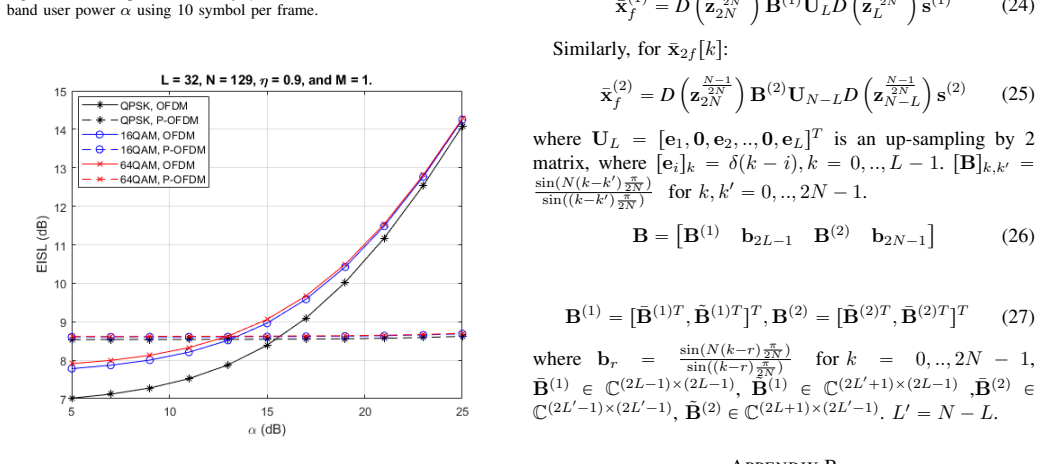
- Higher-order modulation such as 16QAM and 64QAM worsens EISL under plain OFDM but has almost no effect under P-DPSS spreading at high interference, making the spread waveform insensitive to modulation choice in strong-interference regimes.
Reading between the lines
- The pairwise trace form of E_IB suggests that a K-user OFDMA extension would simply sum pairwise leakage terms, one per interfering user with its own alpha; the paper does not derive this, but the P-DPSS mechanism would likely carry over if each user spreads.
- P-DPSS spreading acts effectively as a soft guard band: instead of blanking edge subcarriers, it shapes each user's energy into a spectrally concentrated subspace, so the same leakage reduction can be traded with a continuous parameter eta rather than an integer number of unused subcarriers.
- Because the inter-band term vanishes in the M-to-infinity limit, long coherent frames already suppress the leakage; spreading therefore matters most for short frames or fast-moving targets where M cannot be made large.
- A frequency-selective interference channel would weight the terms inside the trace by per-subcarrier gains, so a fixed P-DPSS basis may not be optimal under multipath; adapting the spreading subspace to the measured interference channel is a natural testable extension.
Signed reviews
Editorial analysis
A structured set of objections, weighed in public.
Referee Report
Summary. The paper studies a two-user OFDMA ISAC system in which user 1 performs ranging by aperiodic correlation between its transmitted OFDM signal and a received signal that is modeled as the user's own backscatter plus a scaled version of user 2's transmission. The authors derive closed-form expressions for the expected squared aperiodic autocorrelation function (Proposition 1), the expected integrated sidelobe energy EISL (Corollary 1), and an inter-band interference energy term EIB (Eq. 17). They propose an orthogonal spreading layer based on periodic discrete prolate spheroidal sequences (P-DPSS) with a spectral utilization back-off parameter η<1, and claim that this spreading minimizes EIB and keeps EISL nearly constant as the interferer strength α grows. Simulation results compare OFDM with and without spreading for varying α, M, L, and modulation order, and show the claimed robustness at η=0.9.
Significance. If the central design claim holds, the paper would provide a useful analytical characterization of inter-band correlation leakage in OFDMA-based ISAC and a concrete waveform modification that trades a small amount of spectral efficiency for sidelobe robustness. The derivations of Proposition 1 and Corollary 1 appear to be validated by the simulations, which sweep α, M, L, and modulation order, and the agreement between the theoretical A-ACF curves and simulated curves in Fig. 4 is a clear strength. However, the paper's main analytical claim about the optimality of the P-DPSS spreading is not established by the presented theorem, and the received-signal model is highly idealized. The empirical comparison at η=0.9 is suggestive but does not by itself separate the effect of the spreading transform from the effect of reducing the active signaling dimensions.
major comments (3)
- [Section IV, Theorem 1, Eqs. (17)-(21)] Theorem 1 cannot support the claim that P-DPSS spreading minimizes EIB. For square orthonormal P, W^(i)W^(i)H = D B^(i) U_L D P^(i)P^(i)H D^H U_L^H B^(i)H D^H = D B^(i) U_L D D^H U_L^H B^(i)H D^H, so EIB in Eq. (17) and the upper bound in Eq. (18) are independent of the spreading matrix. The proposed benefit appears only for rectangular P_η with η<1, but Theorem 1 is stated and proved for square P, and no analogous bound is derived for the truncated case. Moreover, no argument is given that the leading eigenvectors of \bar B^(1) minimize the Hadamard-product trace in Eq. (17). Section IV-A explicitly concedes that "how the auto-correlation energy changes with η is not known, and thus the overall impact of η on EISL is not fully known." The simulations may support an empirical claim at η=0.9, but the analytical claim that the proposed spreading itself minimizes IB energy is not established.
- [Section III-A, Eq. (11)] The received signal model y_t = x_t^(1) + α x_t^(2) omits delay, multipath, frequency selectivity, and noise on the interference path. Equations (13)-(17) and the spreading design in Eqs. (20)-(21) are therefore tied to a single-tap, frequency-flat interferer with a single scalar amplitude α. For a frequency-selective or delayed interfering path, the leakage distribution over the rows of W changes, and the P-DPSS eigenvectors of the in-band Dirichlet kernel need not be the minimizer of EIB. This is a scope restriction that should be stated prominently, and the claimed robustness of spreading should be tested at least with a one-tap delayed interferer or a simple two-tap channel.
- [Section V, first paragraph and Figs. 4-8] The fairness of the η=0.9 comparison is not fully established at the modeling level. For OFDM, η is implemented by zeroing edge subcarriers as guard bands, while for P-DPSS it is implemented by truncating the spreading basis to the most concentrated eigenvectors. However, the analytical W^(1) and W^(2) in Eqs. (8)-(9) are derived for all L (respectively N-L) subcarriers being active. It is not specified whether the theoretical curves for the OFDM η=0.9 case use modified W matrices that account for the guard bands or use the full-band formulas. This matters because Fig. 8 shows that reducing η alone degrades EISL at small α, so the reader cannot tell how much of the apparent improvement of P-DPSS is due to the spreading transform itself and how much is due to the different way the active dimensions are reduced.
minor comments (5)
- [Eqs. (20)-(21)] The definitions of P_η^(1) and P_η^(2) contain an undefined variable k in the diagonal exponent (z^{kL(N-1)/(2N)} and z^{k(N-L)(N-1)/(2N)}). This should be corrected to a fixed notation consistent with Eq. (8).
- [Section IV-A, Eq. (22)] The statement "the supported capacity is MtηLu" is dimensionally incorrect: with modulation order M and ⌈ηL⌉ dimensions, the number of bits per OFDM symbol is ⌈ηL⌉ log2 M, not M⌈ηL⌉. This should be corrected since the paper uses η as a spectral-efficiency back-off.
- [Abstract and Section V] The abstract's claim that spreading results in ISL levels "significantly lower" than OFDM without spreading is an overstatement without the qualifiers that the advantage appears at sufficiently large α and sufficiently large M; at low α and small M, the simulations in Figs. 4-7 show OFDM without spreading is better. The abstract should state the condition under which the benefit holds.
- [Fig. 4 caption] The caption contains an incomplete sentence: "for example α = 15 dB, sie the amplitude difference ... is 20 dB." This should be rewritten.
- [Theorem 1 statement] The theorem statement begins with a stray "E" before "For an in-band user signal spreading matrix..." which should be removed.
Circularity Check
No significant circularity: the EISL/EIB derivation is self-contained, and the P-DPSS design is an externally motivated ansatz rather than a fitted or self-referential input.
full rationale
The paper's derivation chain is not circular. The EISL expression in Corollary 1 and the EIB term in Eq. (17) are derived from the assumed received-signal model in Eq. (11) and the zero-padded frequency-domain representation of aperiodic correlation; Proposition 1 and Corollary 1 are then checked against Monte Carlo simulations across independent sweeps of alpha, M, L, and modulation order. No parameter is fitted to the target EISL curve and then renamed a prediction; the spreading-matrix choice in Eqs. (20)-(21) is imported from the known spectral-concentration property of periodic DPSS eigenvectors (external reference [23]), not obtained by minimizing the paper's own EIB expression. The paper even concedes the relevant limitation: "how the auto-correlation energy changes with eta is not known, and thus the overall impact of eta on EISL is not fully known" (Section IV-A), and the upper bound in Theorem 1 is admitted to be unaffected by square orthogonal spreading ("their specific choices will have no impact on the upper bound (18)"). Those are gaps in the theoretical support for P-DPSS, but they do not make the claimed EISL prediction equivalent to its inputs by construction. The choice of eta = 0.9 is selected from the EISL-versus-eta sweep in Fig. 8, but it is thereafter used as a fixed design parameter when the paper evaluates behavior versus alpha, M, L, and modulation, so it is not a fitted input called a prediction. No load-bearing self-citation was found: the only same-author citations [17], [21], [24] support ancillary definitions or a continuous-time analogue, while the load-bearing DPSS optimality claim is attributed to [23].
Assumptions & free parameters
free parameters (1)
- η (spectral utilization back-off) =
0.9
assumptions (4)
- standard math DFT and zero-padding properties: aperiodic correlation equals periodic correlation of zero-padded signals (Eqs. 6-7).
- domain assumption Received signal at the sensing user is y_t = x_t^(1) + α x_t^(2), a noiseless sum of the user's own backscatter and the other user's LOS signal with a single scalar amplitude α (Section III-A).
- domain assumption Symbols are independent across users and across symbols, with zero mean and known kurtosis μ4, enabling the moment decomposition S = I + S1 + S2 in Eq. (34) cited from [16].
- domain assumption The target delay is longer than the cyclic prefix but shorter than one OFDM symbol, so only same-index and adjacent-index symbol correlations contribute (Eq. 12).
Cite this review
Pith. "Pith review of Spreading over OFDM for Integrated Sensing and Communications (ISAC) Ranging: Multi-user Interference Mitigation." pith.science (2026). https://pith.science/paper/TRQF2LNI
@misc{pith2026250502160,
  author       = {Pith},
  title        = {Pith review of: Spreading over OFDM for Integrated Sensing and Communications (ISAC) Ranging: Multi-user Interference Mitigation},
  year         = {2026},
  howpublished = {\url{https://pith.science/paper/TRQF2LNI}},
  note         = {Machine review of arXiv:2505.02160}
}
read the original abstract
In the context of communication-centric integrated sensing and communication (ISAC), the orthogonal frequency division multiplexing (OFDM) waveform was proven to be optimal in minimizing ranging sidelobes when random signaling is used. A typical assumption in OFDM-based ranging is that the max target delay is less than the cyclic prefix (CP) length, which is equivalent to performing a \textit{periodic} correlation between the signal reflected from the target and the transmitted signal. In the multi-user case, such as in Orthogonal Frequency Division Multiple Access (OFDMA), users are assigned disjoint subsets of subcarriers which eliminates mutual interference between the communication channels of the different users. However, ranging involves an aperiodic correlation operation for target ranges with delays greater than the CP length. Aperiodic correlation between signals from disjoint frequency bands will not be zero, resulting in mutual interference between different user bands. We refer to this as \textit{inter-band} (IB) cross-correlation interference. In this work, we analytically characterize IB interference and quantify its impact on the integrated sidelobe levels (ISL). We introduce an orthogonal spreading layer on top of OFDM that can reduce IB interference resulting in ISL levels significantly lower than for OFDM without spreading in the multi-user setup. We validate our claims through simulations, and using an upper bound on IB energy which we show that it can be minimized using our proposed spreading. However, for orthogonal spreading to be effective, a price must be paid in terms of spectral utilization, which is yet another manifestation of the trade-off between sensing accuracy and data communication capacity
Figures


Figures from the paper (6 more)


Reference graph
Works this paper leans on
-
[1]
Integrated sensing and communications: Toward dual-functional wire- less networks for 6g and beyond,
F. Liu, Y . Cui, C. Masouros, J. Xu, T. X. Han, Y . C. Eldar, and S. Buzzi, “Integrated sensing and communications: Toward dual-functional wire- less networks for 6g and beyond,” IEEE Journal on Selected Areas in Communications, vol. 40, no. 6, pp. 1728–1767, 2022
2022
-
[2]
Integrated sensing and communication: 3gpp standardization progress,
H. Li, J. Xu, C. Sun, S. Wang, X. Wang, and H. Zhang, “Integrated sensing and communication: 3gpp standardization progress,” in 2023 21st International Symposium on Modeling and Optimization in Mobile, Ad Hoc, and Wireless Networks (WiOpt) , 2023, pp. 1–7
work page 2023
-
[3]
Integrated sensing and communications (isac) for vehicular communication networks (vcn),
X. Cheng, D. Duan, S. Gao, and L. Yang, “Integrated sensing and communications (isac) for vehicular communication networks (vcn),” IEEE Internet of Things Journal , vol. 9, no. 23, pp. 23 441–23 451, 2022
2022
-
[4]
Integrated sensing and communication signals toward 5g- a and 6g: A survey,
Z. Wei, H. Qu, Y . Wang, X. Yuan, H. Wu, Y . Du, K. Han, N. Zhang, and Z. Feng, “Integrated sensing and communication signals toward 5g- a and 6g: A survey,” IEEE Internet of Things Journal , vol. 10, no. 13, pp. 11 068–11 092, 2023
2023
-
[5]
Seeing is not always believing: Isac-assisted predictive beam tracking in multipath channels,
Y . Cui, Q. Zhang, Z. Feng, Q. Wen, Z. Wei, F. Liu, and P. Zhang, “Seeing is not always believing: Isac-assisted predictive beam tracking in multipath channels,” IEEE Wireless Communications Letters, vol. 13, no. 1, pp. 14–18, 2024
work page 2024
-
[6]
Spectrum sharing for uav communications: Spatial spectrum sensing and open issues,
B. Shang, V . Marojevic, Y . Yi, A. S. Abdalla, and L. Liu, “Spectrum sharing for uav communications: Spatial spectrum sensing and open issues,” IEEE Vehicular Technology Magazine, vol. 15, no. 2, pp. 104– 112, 2020
work page 2020
-
[7]
Characterization of range sidelobe modulation arising from radar-embedded communications,
C. Sahin, J. G. Metcalf, and S. D. Blunt, “Characterization of range sidelobe modulation arising from radar-embedded communications,” in International Conference on Radar Systems (Radar 2017) . IET, 2017, p. 7
work page 2017
-
[8]
Rate-splitting multiple access for simultaneous multi-user communication and multi-target sensing,
K. Chen, Y . Mao, L. Yin, C. Xu, and Y . Huang, “Rate-splitting multiple access for simultaneous multi-user communication and multi-target sensing,” IEEE Transactions on Vehicular Technology, 2024
work page 2024
Show all 24 references
-
[9]
Mu-mimo commu- nications with mimo radar: From co-existence to joint transmission,
F. Liu, C. Masouros, A. Li, H. Sun, and L. Hanzo, “Mu-mimo commu- nications with mimo radar: From co-existence to joint transmission,” IEEE Transactions on Wireless Communications , vol. 17, no. 4, pp. 2755–2770, 2018
2018
-
[10]
Joint transceiver optimization for mmwave/thz mu-mimo isac systems,
P. Wang, J. Fang, X. Zeng, Z. Chen, and H. Li, “Joint transceiver optimization for mmwave/thz mu-mimo isac systems,” arXiv preprint arXiv:2401.17681, 2024
2024 arXiv
-
[11]
Information and sensing beam- forming optimization for multi-user multi-target mimo isac systems,
M. Zhu, L. Li, S. Xia, and T.-H. Chang, “Information and sensing beam- forming optimization for multi-user multi-target mimo isac systems,” EURASIP Journal on Advances in Signal Processing , vol. 2023, no. 1, p. 15, 2023
2023
-
[12]
Ris-assisted coopera- tive multicell isac systems: A multi-user and multi-target case,
X. Yang, Z. Wei, Y . Liu, H. Wu, and Z. Feng, “Ris-assisted coopera- tive multicell isac systems: A multi-user and multi-target case,” IEEE Transactions on Wireless Communications , 2024
2024
-
[13]
Ofdm numerology design for 5g new radio to support iot, embb, and mbsfn,
A. A. Zaidi, R. Baldemair, V . Moles-Cases, N. He, K. Werner, and A. Cedergren, “Ofdm numerology design for 5g new radio to support iot, embb, and mbsfn,” IEEE Communications Standards Magazine , vol. 2, no. 2, pp. 78–83, 2018
2018
-
[14]
Multicarrier isac: Advances in waveform design, signal processing, and learning under nonidealities,
V . Koivunen, M. F. Keskin, H. Wymeersch, M. Valkama, and N. Gonz ´alez-Prelcic, “Multicarrier isac: Advances in waveform design, signal processing, and learning under nonidealities,” IEEE Signal Pro- cessing Magazine, vol. 41, no. 5, pp. 17–30, 2024. 12
2024
-
[15]
Mimo-ofdm joint radar- communications: Is ici friend or foe?
M. F. Keskin, H. Wymeersch, and V . Koivunen, “Mimo-ofdm joint radar- communications: Is ici friend or foe?” IEEE Journal of Selected Topics in Signal Processing , vol. 15, no. 6, pp. 1393–1408, 2021
2021
-
[16]
OFDM Achieves the Lowest Ranging Sidelobe Under Random ISAC Signaling,
F. Liu, Y . Zhang, Y . Xiong, S. Li, W. Yuan, F. Gao, S. Jin, and G. Caire, “OFDM Achieves the Lowest Ranging Sidelobe Under Random ISAC Signaling,” arXiv preprint arXiv:2407.06691 , 2024
2024 arXiv
-
[17]
Conflict and trade-off of waveform uncertainty in joint com- munication and sensing systems,
H. Li, “Conflict and trade-off of waveform uncertainty in joint com- munication and sensing systems,” in ICC 2022 - IEEE International Conference on Communications , 2022, pp. 5561–5566
2022
-
[18]
Reshaping the ISAC Tradeoff Under OFDM Signaling: A Probabilistic Constella- tion Shaping Approach,
Z. Du, F. Liu, Y . Xiong, T. X. Han, Y . C. Eldar, and S. Jin, “Reshaping the ISAC Tradeoff Under OFDM Signaling: A Probabilistic Constella- tion Shaping Approach,” arXiv preprint arXiv:2312.15941 , 2023
2023 arXiv
-
[19]
Peak sidelobe level based waveform optimization for ofdm joint radar-communications,
M. F. Keskin, R. F. Tigrek, C. Aydogdu, F. Lampel, H. Wymeersch, A. Alvarado, and F. M. Willems, “Peak sidelobe level based waveform optimization for ofdm joint radar-communications,” in 2020 17th Euro- pean Radar Conference (EuRAD) , 2021, pp. 1–4
2020
-
[20]
Low-range-sidelobe waveform design for mimo-ofdm isac systems,
P. Li, Z. Xiao, M. Li, R. Liu, and Q. Liu, “Low-range-sidelobe waveform design for mimo-ofdm isac systems,” in ICC 2024 - IEEE International Conference on Communications , 2024, pp. 909–914
2024
-
[21]
Frequency multiplexing and waveform synthesis in joint com- munications and sensing,
H. Li, “Frequency multiplexing and waveform synthesis in joint com- munications and sensing,” in 2022 IEEE Wireless Communications and Networking Conference (WCNC) , 2022, pp. 199–204
2022
-
[22]
R. T. Seeley, An introduction to Fourier series and integrals . Courier Corporation, 2014
2014
-
[23]
On the periodic discrete prolate spheroidal sequences,
W. Y . Xu and C. Chamzas, “On the periodic discrete prolate spheroidal sequences,” SIAM Journal on Applied Mathematics , vol. 44, no. 6, pp. 1210–1217, 1984
1984
-
[24]
Maximally concentrated sequences after half-sample shifts,
K. A. Said, A. A. Beex, and L. Liu, “Maximally concentrated sequences after half-sample shifts,” IEEE Signal Processing Letters , vol. 31, pp. 1354–1358, 2024
2024
Reviewed August 16, 2026 · model on record in the stance chip above.
Discussion (0). Continue with ORCID to comment.