REVIEW 4 major objections 5 minor 10 references
Users' traffic on two-sided Internet platforms. Qualitative dynamics
T0 review · 4 major / 5 minor · reviewed 2026-08-14 · deepseek-v4-flash
Pith's one-line read A two-sided platform's long-run traffic is fixed by the local slopes of its attachment functions.
desk verdict A compact, honest synthesis of earlier results: useful qualitative framing for platform traffic, but the central theorem is deferred to the author's own prior paper and the data examples are illustrative, not evidential. read the letter →
The pith
A machine-rendered reading of the paper's core claim, the machinery that carries it, and where it could break.
The reading
What carries the argument
The object that carries the argument is the two-dimensional system $b'=V(g)-\epsilon b$, $g'=W(b)-\delta g$ on the unit square, with $V,W:[0,1]\to[0,1]$ the cross-side attachment functions and $-\epsilon b$, $-\delta g$ the same-side competition terms. The load-bearing identity is the comparison between $V'(g_0)W'(b_0)$ and $\epsilon\delta$ at a fixed point, which decides whether the linearized flow is attracting, repelling-in-one-direction (saddle), or center. A second mechanism is the reconstruction procedure: approximate the vector field by sparse regression over a library of simple functions, using data points from many trajectories, then analyze the recovered equations instead of the raw time series. The classification theorem is what converts the reconstructed vector field into qualitative predictions about basins of attraction and long-run tendencies.
What would settle it
Collect real traffic data from a seller-buyer platform with negative same-side effects and fit the model $b'=V(g)-\epsilon b$, $g'=W(b)-\delta g$. If a fixed point with $V'(g_0)W'(b_0)<\epsilon\delta$ is observed to repel nearby trajectories, or if sustained oscillating user counts appear despite the negative-divergence assumption, the classification would be contradicted.
Extended reading notes
Core claim
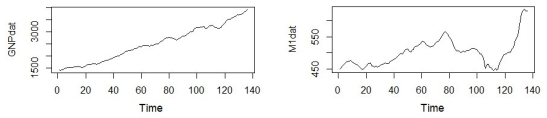
On the paper's own terms, the discovery is a complete local classification of the phase portrait for the smooth two-sided platform model $b'=V(g)-\epsilon b$, $g'=W(b)-\delta g$: a fixed point $(b_0,g_0)$ is a stable node or spiral exactly when $V'(g_0)W'(b_0)<\epsilon\delta$, a saddle exactly when the product is larger, and lies on a center manifold exactly when the product equals $\epsilon\delta$. Because the divergence is negative, every trajectory in the unit square converges to a fixed point, so the long-run tendency of any 'seller-buyer' type platform is decided by these local slope products. The paper also claims that reconstructing the vector field from observed traffic data, rather than fitting trajectories directly, gives better short-term predictions and reveals the underlying mechanism; this is demonstrated on the GNP/M1 example, where the reconstructed system outperforms the VAR(3) baseline.
Load-bearing premise
The model assumes that every external event, policy change, or shock only moves the platform to a new initial condition, leaving the attachment functions and competition coefficients unchanged.
Editorial extensions
If this is right
- Platform owners can identify which equilibria are attracting, which are saddles, and which lie on center manifolds by estimating only the local slopes of the attachment functions at the fixed points.
- Since there are no repelling fixed points and no cycles, a stable seller-buyer platform cannot show persistent oscillations; it must settle into one of finitely many steady states.
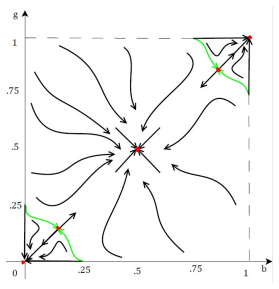
- Basins of attraction are separated by separatrices through saddle points, so small external shocks move traffic to a different steady state only when they push the system across such a separatrix.
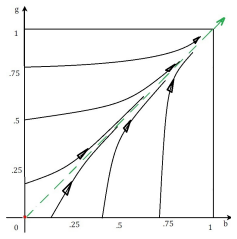
- For platforms without same-side competition, such as Wikipedia in the paper's model, user volume never decreases on the long run, and observed decline should be attributed to temporary external jumps to lower trajectories.
- The reconstruction method applied to real data yields a differential equation whose qualitative analysis can be used for short-term prediction and for planning platform policy.
Reading between the lines
- Extending the paper's logic, real policy changes and platform redesigns that alter the attachment functions would require re-estimating the vector field; the phase portrait is not invariant under such changes.
- If the theorem is combined with data on user preferences, it suggests a testable diagnostic: platforms whose fitted slope product is near $\epsilon\delta$ should exhibit slow or non-generic dynamics, while larger gaps imply faster convergence.
- The same classification should transfer to any two-sided market with negative same-side effects and smooth attachment curves, so the result may apply to offline markets such as labor markets and dating markets.
- The reconstruction step is where model error enters: if the library of candidate functions omits the true mechanism, the recovered vector field may preserve the phase portrait qualitatively even if it differs term by term, as the paper's own example suggests.
Signed reviews
Editorial analysis
A structured set of objections, weighed in public.
Referee Report
Summary. This paper proposes a dynamical-systems framework for studying user traffic on two-sided Internet platforms. It argues that reconstructing the governing vector field from data is preferable to estimating individual trajectories, and it outlines a SINDy-style sparse regression that uses data from many trajectories rather than one. The main theoretical result, Theorem 1 in Section 5.1, classifies the fixed points of the 'seller-buyer' model b'=V(g)-epsilon b, g'=W(b)-delta g according to whether V'(g0)W'(b0) is less than, greater than, or equal to epsilon delta. The paper then applies this framework to power-law and step-function attachments and to Wikipedia-like platforms without same-side network effects, drawing qualitative conclusions about long-run behavior, basins of attraction, and the absence of cycles.
Significance. Theorem 1, if backed by a complete proof, gives a clean and useful criterion: for a plausible two-sided platform model, the long-run behavior is governed by the local slopes of the attachment functions, and cyclic traffic is impossible. The classification is consistent with a direct computation of the Jacobian of (6), whose trace is -(epsilon+delta) and whose determinant is epsilon delta - V'(g0)W'(b0), so the central mathematical claim appears sound. The reconstruction idea of using multiple trajectories in sparse regression is attractive and works in the simulated noiseless examples. However, the paper's applied conclusions for real platforms are not supported by real data, and the main theorem is cited from the author's own previous work rather than derived here. The paper is a useful conceptual contribution, but it needs substantial strengthening in proof detail and in empirical validation before it meets the standards of a journal article.
major comments (4)
- [Section 5.1, Theorem 1] The theorem is the paper's central classification result, yet the proof is entirely deferred to [9], an earlier paper by the same author. A direct Jacobian calculation is short (trace is -(epsilon+delta), determinant is epsilon delta - V'(g0)W'(b0)), and the qualitative conclusions of the paper stand or fall on this result. The manuscript should reproduce at least a proof sketch, including the center-manifold condition, or state the theorem as an assumption with a precise reference to the published proof.
- [Section 1 and Section 3] The method assumes that all external events act only as switches of initial conditions within one fixed autonomous vector field. If policy changes or platform redesigns alter the attachment functions V, W or the coefficients epsilon, delta, then the data in Section 3 are generated by a family of vector fields, and the single coefficient matrix A fitted by the sparse regression is a mixture that need not correspond to any actual dynamics. The paper should state this as an explicit limitation and, ideally, offer a diagnostic test for whether a single autonomous system is consistent with the data.
- [Section 5.2] The Wikipedia discussion depends on the claim that edit wars are 'temporary external effects.' If they are persistent, the decline documented in [6] could reflect a change in the vector field itself, not a jump between trajectories of a fixed field. The conclusion that Wikipedia's long-run popularity increases is therefore conditional on an unverified assumption. The manuscript should make this condition explicit and discuss how one would detect a change in the vector field.
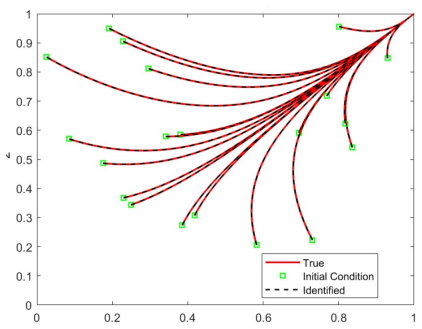
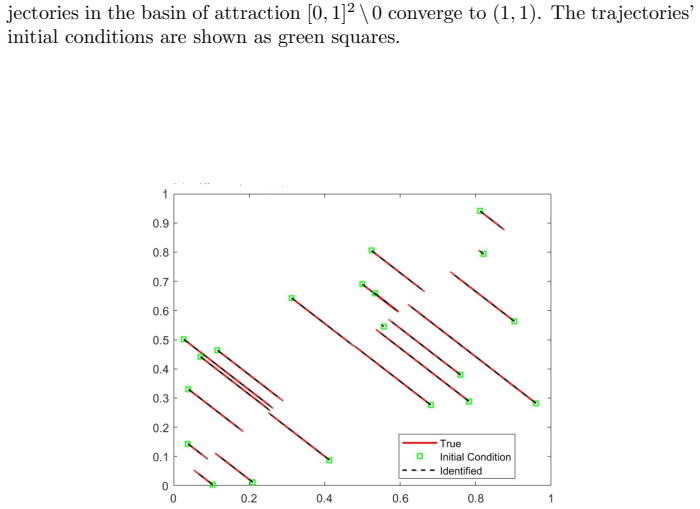
- [Section 4] The reconstruction examples provide no quantitative validation: they use noiseless simulated data, do not report regularization parameters, and give no error bars or accuracy metrics. Since reconstruction is the bridge between raw data and the phase-portrait conclusions, the examples should include noisy data from the same system and, ideally, from perturbed systems, to show that the method's output is robust.
minor comments (5)
- [Section 2] There are several typos: 'Lorentz' should be 'Lorenz' (two occurrences), 'hight' should be 'height', and 'homogenious monoms' should be 'homogeneous monomials'.
- [Section 5.2, Eq. (10)] The displayed first integral is not correct as written. Along solutions of (9), the conserved quantity is ∫ W(b) db - ∫ V(g) dg = const, since d/dt[∫W(b)db - ∫V(g)dg] = W(b)V(g) - V(g)W(b) = 0. The sign and the constant should be corrected.
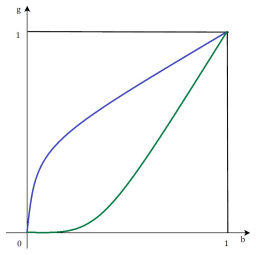
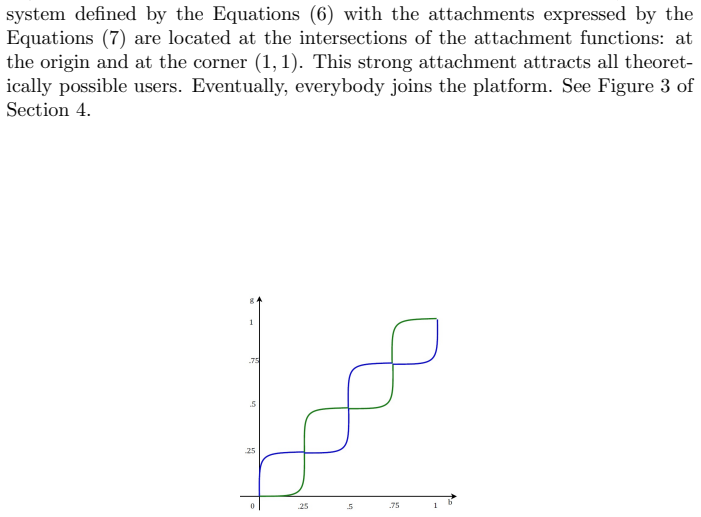
- [Section 5] The paper says it constructs models for Amazon.com, Homes.mil, and Wikipedia, but no real traffic data are used; the figures and phase portraits come from assumed attachment functions. The authors should clarify that these are stylized illustrations rather than empirical reconstructions.
- [Section 4, Figures 3-5] The figure captions mention green squares for initial conditions but do not label the axes; adding axis labels would improve readability.
- [Section 5.1, Theorem 1] The phrase 'stable nodes/saddles/saddle-nodes, and stable spirals' is imprecise: a saddle-node is a bifurcation phenomenon, not a fixed-point type of a fixed system. The equality case is better described as a non-hyperbolic fixed point lying on a center manifold.
Circularity Check
Theorem 1's proof is deferred to same-author reference [9], making the central formal claim citation-dependent rather than derived in-paper.
-
self citation load bearing
[Section 5.1, Theorem 1; also Section 5 opening sentence]
"The proof of this result can be found in [9]. ... For more detailed analysis and proof of the results stated in this section see [8] and [9]."
Theorem 1 is the paper's central result: it classifies all fixed points of the two-sided platform model (6). The proof is not reproduced here; the derivation chain stops at the same author's prior paper [9]. The introduction likewise credits the 'new dynamical systems approach' to [8] and [9]. Thus the central formal claim rests on the author's own earlier work rather than on an in-paper derivation. The theorem does follow from the stated ODE by a standard Jacobian calculation and is not fitted to data, so this is a partial, authority-based circularity rather than a constructional equivalence; still, the paper's key theorem is not self-contained.
full rationale
Apart from Theorem 1's deferred proof, the paper's qualitative conclusions are not circular. The stability classification in Theorem 1 is the standard linearization of b'=V(g)-epsilon b, g'=W(b)-delta g: the Jacobian has determinant epsilon*delta - V'(g0)W'(b0), so the stated inequalities directly give stable node/spiral versus saddle versus center-manifold; the basin conclusions in the examples follow from the stated phase portraits and monotonicity, not from data fitting. The GNP-M1 comparison in Section 2 is reported without an explicit train/test split, so I do not treat it as a demonstrated fitted-input-called-prediction. The modeling assumption that external effects are switches of initial conditions is a substantive limitation, not a circular step. The main circularity-type concern is the outsourced proof of Theorem 1 to the same-author reference [9], which is load-bearing for the paper's formal claim but does not make the claim equivalent to its inputs.
Assumptions & free parameters
free parameters (3)
- epsilon, delta (same-side decay rates) =
Unspecified; constrained epsilon, delta >= 1
- alpha (power attachment exponent) =
<=1
- smoothing half-width in step attachment =
Not specified; denoted delta in Eq. (8)
assumptions (6)
- domain assumption V and W map [0,1] to [0,1], are nonnegative, and vanish at 0
- domain assumption Same-side network effects can be represented by linear terms -epsilon b and -delta g
- domain assumption External effects are equivalent to changes in initial conditions of a fixed autonomous ODE
- ad hoc to paper Wikipedia's edit wars are temporary external effects, not a persistent same-side term
- ad hoc to paper Trajectories that escape the unit square do so slowly enough to be ignored over reasonable time scales
- standard math The platform vector field is smooth and has finitely many fixed points
Cite this review
Pith. "Pith review of Users' traffic on two-sided Internet platforms. Qualitative dynamics." pith.science (2026). https://pith.science/paper/TSLEKMKB
@misc{pith2026190803059,
  author       = {Pith},
  title        = {Pith review of: Users' traffic on two-sided Internet platforms. Qualitative dynamics},
  year         = {2026},
  howpublished = {\url{https://pith.science/paper/TSLEKMKB}},
  note         = {Machine review of arXiv:1908.03059}
}
read the original abstract
Internet platforms' traffic defines important characteristics of platforms, such as pricing of services, advertisements, speed of operations. One can estimate the traffic with the traditional time series models like ARIMA, Holt-Winters, functional and kernel regressions. When using these methods, we usually smooth-out noise and various external effects in the data and obtain short-term predictions of processes. However, these models do not necessarily help us to understand the underlying mechanism and the tendencies of the processes. In this article, we discuss the dynamical system approach to the modeling, which is designed to discover the underlying mechanism and the qualitative properties of the system's phase portrait. We show how to reconstruct the governing differential equations from data. The external effects are modeled as system's parameters (initial conditions). Utilizing this new approach, we construct the models for the volume of users, interacting through Internet platforms, such as "Amazon.com", "Homes.mil" or "Wikipedia.org". Then, we perform qualitative analysis of the system's phase portrait and discuss the main characteristics of the platforms.
Figures
Figures from the paper (7 more)


Reference graph
Works this paper leans on
-
[9]
V. Rayskin, Users’ dynamics on digital platforms , Mathematics and Com- puters in Simulation , 142, (2017)
work page 2017
-
[6]
A. Halfaker, R.S. Gieger, J. Morgan, J. Riedl The Rise and Decline of an Open Collaboration System: How Wikipedia’s reaction to sudden pop- ularity is causing its decline (2013) American Behavioral Scientist, 57(5) 664-688, DOI:10.1177/0002764212469365
-
[1]
I. Beschastnikh, T. Kriplean, D.W. McDonald Wikipedian Self- Governance in Action: Motivating the Policy Lens , ICWSM, 2008
work page 2008
-
[2]
S.L. Brunton, J.L. Proctorb, J.N. Kutzc, Discovering governing equations from data by sparse identification of nonlinear dynamical systems, Pro- ceedings of the National Academy of Sciences, 113, (2016), 3932–3937
work page 2016
-
[3]
Cowpertwait, P. S. P., & Metcalfe, A. V. (2009) Introductory time series with R. New York: Springer-Verlag 14
work page 2009
-
[4]
T.R. Eisenmann, G. Parker, M. van Alstyne, Strategies for Two-Sided Markets, Harvard Business Review, 84(10), (2006)
work page 2006
-
[5]
A. Halfaker, A. Kittur, R. Kraut, J. Riedl, it A Jury of Your Peers: Quality, Experience and Ownership in Wikipedia (2009). WikiSym Article 15, 10 pages. DOI:10.1145/1641309.1641332
arXiv 2009
-
[7]
T. Krieplean, I. Beschastnikh, D.W. McDonald, S.A. Golder Community, Consensus, Coercion, Control: CS*W or How Policy Mediates Mass Pop- ulation, presentation at GROUP 2007
work page 2007
Show all 10 references
-
[8]
Rayskin, Dynamics of two-sided markets, Review of Marketing Science, 14, (2016), 1–19
V. Rayskin, Dynamics of two-sided markets, Review of Marketing Science, 14, (2016), 1–19
2016
-
[10]
Rochet, J
J.-C. Rochet, J. Tirole, Platform competition in two-sided markets, Jour- nal of the European Economic Association, 1(4), (2003), 990–1029. 15
2003
Reviewed August 14, 2026 · model on record in the stance chip above.
Discussion (0). Continue with ORCID to comment.