pith. sign in

arxiv: 2606.29622 · v1 · pith:TTVT2DSJnew · submitted 2026-06-28 · 🧮 math.PR

Fourier-Laplace Transforms of the Brownian Signature via Riccati Equations on the Tensor Algebra

Pith reviewed 2026-06-30 01:44 UTC · model grok-4.3

classification 🧮 math.PR
keywords Brownian signatureFourier-Laplace transformRiccati equationtensor algebraaffine structurenon-Markovian processesconditional distributions
0
0 comments X

The pith

The conditional Fourier-Laplace transform of the time-augmented Brownian signature admits an entire signature expansion whose coefficients solve a linear differential equation on the extended tensor algebra, while its logarithm satisfies a

A machine-rendered reading of the paper's core claim, the machinery that carries it, and where it could break.

The paper develops a transform theory for the signature of time-augmented Brownian motion. For suitable linear functions of the signature, the conditional Fourier-Laplace transform has an entire expansion in the signature, with coefficients solving an infinite-dimensional linear differential equation on the extended tensor algebra. The logarithm of the transform has a local signature expansion whose coefficients satisfy a Riccati equation. This structure is intrinsically local, as zeros of the transform in the complex plane block any global expansion. Randomized Riccati equations with path-dependent terminal conditions recover global representations through a recentering argument, and uniqueness holds in a suitable class of solutions.

Core claim

For a suitable class of linear functions of the signature, the conditional Fourier-Laplace transform admits an entire signature expansion whose coefficients solve an infinite-dimensional linear differential equation on the extended tensor algebra. The logarithm admits a local signature expansion whose coefficients satisfy a Riccati equation on the extended tensor algebra, revealing a generalized affine structure of the Brownian signature that is intrinsically local.

What carries the argument

Signature expansions on the extended tensor algebra, which reduce the Fourier-Laplace transform and its logarithm to linear and Riccati differential equations.

If this is right

  • Uniqueness of solutions to both the linear and Riccati equations holds within a suitable class.
  • Global representations are obtained by introducing randomized Riccati equations with path-dependent terminal conditions.
  • The results supply a framework for transform methods that apply directly in non-Markovian settings.
  • The approach enables computation of conditional distributions for models built on the Brownian signature.

Where Pith is reading between the lines

These are editorial extensions of the paper, not claims the author makes directly.

  • The local character implies that many path-dependent processes may lack global affine representations unless randomization is used.
  • The equations could be discretized on truncated tensor algebras to test numerical accuracy against simulated paths.
  • Similar expansions might apply to other rough-path driven processes by replacing the Brownian signature with the appropriate rough path.

Load-bearing premise

There exists a suitable class of linear functions of the signature for which the conditional Fourier-Laplace transform is well-defined and admits the claimed entire expansion, without new singularities from recentering.

What would settle it

A concrete linear functional of the Brownian signature whose conditional Fourier-Laplace transform fails to admit the signature expansion or whose logarithm fails to satisfy the Riccati equation on the tensor algebra.

Figures

Figures reproduced from arXiv: 2606.29622 by Dimitri Sotnikov, Eduardo Abi Jaber, Elie Attal.

Figure 1
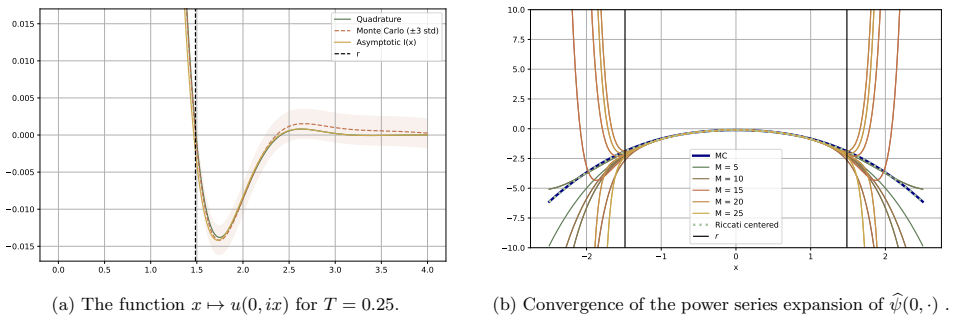
Figure 1. Figure 1: Numerical illustrations of the solution u and the function ψ. Left: zeros of u(0, ·) along the imaginary axis. Right: power series approximations of ψb(0, x) for truncation orders ranging from 5 to 25. The dark blue line is the Monte Carlo estimate using 106 samples; the dotted green line corresponds to the expansions obtained via the recentered Riccati equation (5.18). The horizontal bars correspond to th… view at source ↗
read the original abstract

We establish an infinite-dimensional affine transform theory for the time-augmented Brownian signature. Our first main result shows that, for a suitable class of linear functions of the signature, the conditional Fourier-Laplace transform admits an entire signature expansion. We prove that the associated coefficients solve an infinite-dimensional linear differential equation on the extended tensor algebra. Our second main result shows that the logarithm admits a local signature expansion whose coefficients satisfy a Riccati equation on the extended tensor algebra, revealing a generalized affine structure of the Brownian signature in a genuinely path-dependent setting. In contrast to conventional affine processes, we show that this representation is intrinsically local: zeros of the Fourier-Laplace transform in the complex plane prevent any global expansion. To recover global representations, we introduce a new class of randomized Riccati equations with path-dependent terminal conditions through a recentering argument. Furthermore, we establish uniqueness of solutions to the linear and Riccati equations within a suitable class of solutions. Our results provide a theoretical framework for transform methods in non-Markovian settings, with applications to the computation of conditional distributions.

Editorial analysis

A structured set of objections, weighed in public.

Desk editor's note, referee report, simulated authors' rebuttal, and a circularity audit. Tearing a paper down is the easy half of reading it; the pith above is the substance, this is the friction.

Referee Report

2 major / 2 minor

Summary. The paper establishes an infinite-dimensional affine transform theory for the time-augmented Brownian signature. For a suitable class of linear functions of the signature, the conditional Fourier-Laplace transform admits an entire signature expansion whose coefficients solve an infinite-dimensional linear differential equation on the extended tensor algebra. The logarithm admits a local signature expansion whose coefficients satisfy a Riccati equation on the same algebra, revealing a generalized affine structure that is intrinsically local because zeros of the transform in the complex plane prevent global expansions. A recentering argument produces a new class of randomized Riccati equations with path-dependent terminal conditions to recover global representations, and uniqueness of solutions to both the linear and Riccati equations is established within a suitable class.

Significance. If the central claims hold, the work supplies a rigorous framework for transform methods in genuinely non-Markovian, path-dependent settings by lifting affine-process ideas to the signature level. The explicit linear and Riccati structures on the tensor algebra, together with the demonstration that the representation must be local, constitute a substantive extension of classical affine theory. The randomized Riccati construction is a potentially useful device for applications to conditional distributions, provided the analytic controls are complete.

major comments (2)
  1. [Recentering argument (post-second-main-result section)] The recentering construction invoked to obtain global randomized Riccati equations (described after the second main result) must be shown to preserve the domain of analyticity inside the extended tensor algebra. The abstract asserts that zeros prevent global expansions yet recentering recovers them; however, it is not evident that the randomization map avoids reintroducing singularities at the level of the signature series or the infinite-dimensional linear operators, which is load-bearing for the global-representation claim.
  2. [Uniqueness theorem for the Riccati equation] The uniqueness statement for solutions of the Riccati equation (final paragraph of the abstract and corresponding theorem) is stated within a 'suitable class of solutions,' but the precise definition of this class and its relation to the complex zeros of the Fourier-Laplace transform must be made explicit; without it, the local-to-global transition via recentering risks being circular.
minor comments (2)
  1. [Introduction / notation section] The definition of the 'extended tensor algebra' and the precise topology or norm used for convergence of the signature series should be stated at the first appearance rather than deferred.
  2. [Preliminaries] Notation for the time-augmented signature and the linear functions to which the transform applies could be consolidated into a single preliminary subsection to improve readability.

Simulated Author's Rebuttal

2 responses · 0 unresolved

We thank the referee for the careful reading and for identifying two points that require clarification to strengthen the presentation of the analytic controls. We address each major comment below and will incorporate the requested details in a revised manuscript.

read point-by-point responses
  1. Referee: The recentering construction invoked to obtain global randomized Riccati equations (described after the second main result) must be shown to preserve the domain of analyticity inside the extended tensor algebra. The abstract asserts that zeros prevent global expansions yet recentering recovers them; however, it is not evident that the randomization map avoids reintroducing singularities at the level of the signature series or the infinite-dimensional linear operators, which is load-bearing for the global-representation claim.

    Authors: We agree that an explicit verification of analyticity preservation under recentering is needed. The manuscript already constructs the randomization so that the new terminal condition lies in the complement of the zero set of the transform; however, the argument is only sketched. In the revision we will add a dedicated lemma (placed immediately after the recentering construction) that shows the randomization map keeps the signature series inside the open set of the extended tensor algebra on which the linear operators remain bounded and the exponential remains entire. The proof proceeds by controlling the distance to the nearest zero via the path-dependent shift and invoking the same radius-of-convergence estimates used for the local Riccati solution. revision: yes

  2. Referee: The uniqueness statement for solutions of the Riccati equation (final paragraph of the abstract and corresponding theorem) is stated within a 'suitable class of solutions,' but the precise definition of this class and its relation to the complex zeros of the Fourier-Laplace transform must be made explicit; without it, the local-to-global transition via recentering risks being circular.

    Authors: We accept that the phrase 'suitable class' must be replaced by an explicit definition. In the revised manuscript the class will be defined as the set of solutions whose signature series converge in a ball whose radius is bounded below by the distance to the nearest complex zero of the Fourier-Laplace transform (measured in the extended tensor algebra norm). Uniqueness is first proved locally inside this ball; the recentering argument then uses this local uniqueness to produce a global randomized solution whose terminal condition is chosen to lie outside the zero set. The definition therefore precedes and justifies the recentering step, removing any circularity. The corresponding theorem statement and the abstract will be updated accordingly. revision: yes

Circularity Check

0 steps flagged

No significant circularity; derivations are self-contained from signature properties.

full rationale

The paper derives the entire signature expansion for the conditional Fourier-Laplace transform and the associated infinite-dimensional linear DE directly from the definition of the time-augmented Brownian signature and properties of linear functionals on the tensor algebra. The local Riccati equation for the logarithm follows from the same expansion without reduction to fitted inputs or prior self-citations. The recentering argument for randomized Riccati equations is presented as a novel construction to address intrinsic locality (zeros preventing global expansions), and uniqueness is established within the paper's own class of solutions. No load-bearing step reduces by construction to its inputs; the framework is independent of external fitted parameters or author-overlapping citations for its central claims.

Axiom & Free-Parameter Ledger

0 free parameters · 2 axioms · 0 invented entities

The central claims rest on the well-definedness of the time-augmented Brownian signature, the existence of suitable linear functionals, and the analytic properties of the Fourier-Laplace transform in the complex plane; these are standard in rough-path theory but treated as background.

axioms (2)
  • domain assumption The time-augmented Brownian signature is a well-defined element of the tensor algebra with the usual shuffle product and Chen relations.
    Invoked implicitly when defining the signature expansions and the differential equations on the extended tensor algebra.
  • domain assumption The conditional Fourier-Laplace transform exists and is analytic in a neighborhood of the origin in the complex plane for the chosen linear functionals.
    Required for the entire signature expansion to hold and for the logarithm to be locally defined.

pith-pipeline@v0.9.1-grok · 5727 in / 1490 out tokens · 34858 ms · 2026-06-30T01:44:24.627417+00:00 · methodology

discussion (0)

Sign in with ORCID, Apple, or X to comment. Anyone can read and Pith papers without signing in.

Reference graph

Works this paper leans on

57 extracted references · 9 canonical work pages · 1 internal anchor

  1. [1]

    Signature

    Cuchiero, Christa and Svaluto-Ferro, Sara and Teichmann, Josef , journal=. Signature

  2. [2]

    Litterer, Christian and Oberhauser, Harald , journal=. On a. 2014 , publisher=

  3. [3]

    arXiv preprint arXiv:2212.13628 , year=

    Functional expansions , author=. arXiv preprint arXiv:2212.13628 , year=

  4. [4]

    Mathematical Finance , volume=

    The Laplace transform of the integrated Volterra Wishart process , author=. Mathematical Finance , volume=. 2022 , publisher=

  5. [5]

    2000 , publisher=

    An introduction to superprocesses , author=. 2000 , publisher=

  6. [6]

    2002 , institution=

    Affine processes and application in finance , author=. 2002 , institution=

  7. [7]

    Abi Jaber, Eduardo and Larsson, Martin and Pulido, Sergio , journal=. Affine. 2019 , publisher=

  8. [8]

    Abi Jaber, Eduardo and Li, Shaun and Lin, Xuyang , journal=

  9. [9]

    arXiv preprint arXiv:2508.02759 , year=

    Hedging with memory: shallow and deep learning with signatures , author=. arXiv preprint arXiv:2508.02759 , year=

  10. [10]

    Signature volatility models: pricing and hedging with

    Abi Jaber, Eduardo and G. Signature volatility models: pricing and hedging with. SIAM Journal on Financial Mathematics , volume=. 2025 , publisher=

  11. [11]

    arXiv preprint arXiv:2407.04956, to appear in Annals of Applied Probability , year=

    Path-dependent processes from signatures , author=. arXiv preprint arXiv:2407.04956, to appear in Annals of Applied Probability , year=

  12. [12]

    Lyons, Terry and Ni, Hao and Tao, Jiajie , journal=. A

  13. [13]

    arXiv preprint arXiv:2511.23295 , year=

    Signature approach for pricing and hedging path-dependent options with frictions , author=. arXiv preprint arXiv:2511.23295 , year=

  14. [14]

    The Annals of Probability , volume=

    Forests, cumulants, martingales , author=. The Annals of Probability , volume=. 2022 , publisher=

  15. [15]

    The Annals of Probability , volume=

    A variational representation for certain functionals of Brownian motion , author=. The Annals of Probability , volume=. 1998 , publisher=

  16. [16]

    Bulletin of the American Mathematical Society , volume=

    Iterated path integrals , author=. Bulletin of the American Mathematical Society , volume=

  17. [17]

    Flots et s

    Ben Arous, G. Flots et s. Probability Theory and Related Fields , volume=. 1989 , publisher=

  18. [18]

    Revista Matem

    Differential equations driven by rough signals , author=. Revista Matem

  19. [19]

    Numerical Solution of Stochastic Differential Equations , pages=

    Stochastic Differential Equations , author=. Numerical Solution of Stochastic Differential Equations , pages=

  20. [20]

    Integration of paths, geometric invariants and a generalized

    Chen, Kuo-Tsai , journal=. Integration of paths, geometric invariants and a generalized. 1957 , publisher=

  21. [21]

    Hariya, Yuu and Watanabe, Sou , journal=. The. 2022 , publisher=

  22. [22]

    2026 , journal=

    Martingale property and moment explosions in signature volatility models , author=. 2026 , journal=

  23. [23]

    A Simple Option Formula for General Jump-Diffusion and Other Exponential

    Lewis, Alan , year =. A Simple Option Formula for General Jump-Diffusion and Other Exponential

  24. [24]

    Note on Analytic Regularity of Heat Kernels on Nilpotent

    Zienkiewicz, Jacek , year = 2003, journal =. Note on Analytic Regularity of Heat Kernels on Nilpotent

  25. [25]

    Transactions of the American Mathematical Society , volume=

    Integration of paths--A faithful representation of paths by noncommutative formal power series , author=. Transactions of the American Mathematical Society , volume=. 1958 , publisher=

  26. [26]

    Journal of Algebra , year=

    A natural ring basis for the shuffle algebra and an application to group schemes , author=. Journal of Algebra , year=

  27. [27]

    , journal =

    Lyndon, Roger C. , journal =. On

  28. [28]

    Quantitative Finance , volume =

    Bruno Dupire , title =. Quantitative Finance , volume =. 2019 , publisher =

  29. [29]

    Advances in Mathematics , volume=

    The signature of a rough path: uniqueness , author=. Advances in Mathematics , volume=. 2016 , publisher=

  30. [30]

    Tychonoff, Andrei , journal=. Th

  31. [31]

    arXiv preprint arXiv:2602.23473 , year=

    Solving Linear-Quadratic Stochastic Control Problems with Signatures , author=. arXiv preprint arXiv:2602.23473 , year=

  32. [32]

    The Annals of Probability , number =

    Ilya Chevyrev and Terry Lyons , title =. The Annals of Probability , number =

  33. [33]

    Futter, B

    Signature trading: A path-dependent extension of the mean-variance framework with exogenous signals , author=. arXiv preprint arXiv:2308.15135 , year=

  34. [34]

    SIAM Journal on Financial Mathematics , volume=

    Optimal execution with rough path signatures , author=. SIAM Journal on Financial Mathematics , volume=. 2020 , publisher=

  35. [35]

    arXiv preprint arXiv:2501.06758 , year=

    Pricing American options under rough volatility using deep-signatures and signature-kernels , author=. arXiv preprint arXiv:2501.06758 , year=

  36. [36]

    SIAM Journal on Control and Optimization , volume=

    Stochastic control with signatures , author=. SIAM Journal on Control and Optimization , volume=. 2025 , publisher=

  37. [37]

    Finance and Stochastics , pages=

    Primal and dual optimal stopping with signatures , author=. Finance and Stochastics , pages=. 2025 , publisher=

  38. [38]

    The Annals of Applied Probability , volume=

    Optimal stopping with signatures , author=. The Annals of Applied Probability , volume=. 2023 , publisher=

  39. [39]

    Conference on Modern Topics in Stochastic Analysis and Applications (in honour of Terry Lyons’ 70th birthday) , pages=

    Pricing American Options Under Rough Volatility Using Signatures , author=. Conference on Modern Topics in Stochastic Analysis and Applications (in honour of Terry Lyons’ 70th birthday) , pages=. 2024 , organization=

  40. [40]

    Abi Jaber, Eduardo and Attal, Elie and Sotnikov, Dimitri , journal =

  41. [41]

    Signature Methods for Optimal Market Making

    Signature Methods for Optimal Market Making , author=. arXiv preprint arXiv:2606.19772 , year=

  42. [42]

    Advances in neural information processing systems , volume=

    Deep signature transforms , author=. Advances in neural information processing systems , volume=

  43. [43]

    SIAM Journal on Financial Mathematics , volume=

    Double-execution strategies using path signatures , author=. SIAM Journal on Financial Mathematics , volume=. 2022 , publisher=

  44. [44]

    Applied Mathematical Finance , volume=

    Non-parametric pricing and hedging of exotic derivatives , author=. Applied Mathematical Finance , volume=. 2020 , publisher=

  45. [45]

    SIAM Journal on Financial Mathematics , volume=

    Signature methods in stochastic portfolio theory , author=. SIAM Journal on Financial Mathematics , volume=. 2025 , publisher=

  46. [46]

    Stochastic Differential Systems Filtering and Control , pages=

    An entropy approach to the time reversal of diffusion processes , author=. Stochastic Differential Systems Filtering and Control , pages=. 1985 , publisher=

  47. [47]

    Sur une classe d’

    Fredholm, Ivar , year=. Sur une classe d’

  48. [48]

    SIAM Journal on Control and Optimization , volume=

    Integral operator Riccati equations arising in stochastic Volterra control problems , author=. SIAM Journal on Control and Optimization , volume=. 2021 , publisher=

  49. [49]

    1999 , publisher=

    Stochastic controls: Hamiltonian systems and HJB equations , author=. 1999 , publisher=

  50. [50]

    arXiv preprint arXiv:2306.05433 , year=

    Equilibrium in functional stochastic games with mean-field interaction , author=. arXiv preprint arXiv:2306.05433 , year=

  51. [51]

    The Annals of Applied Probability , volume=

    Linear-quadratic control for a class of stochastic Volterra equations: Solvability and approximation , author=. The Annals of Applied Probability , volume=. 2021 , publisher=

  52. [52]

    Stochastic control with signatures via

    Abi Jaber, Eduardo and Elie Attal and Dimitri Sotnikov , journal =. Stochastic control with signatures via

  53. [53]

    Fourier–

    Abi Jaber, Eduardo and Elie Attal and Dimitri Sotnikov , journal =. Fourier–

  54. [54]

    Concentration

    Boucheron, St. Concentration

  55. [55]

    Hariya, Yuu and Watanabe, Sou , year =. The. Electronic Communications in Probability , volume =

  56. [56]

    Annales de l'Institut Henri Poincaré, Probabilités et Statistiques , number =

    Joseph Lehec , title =. Annales de l'Institut Henri Poincaré, Probabilités et Statistiques , number =

  57. [57]

    2026 , journal=

    Malliavin calculus for signatures with applications to finance , author=. 2026 , journal=