REVIEW 2 major objections 5 minor 48 references
X-ray polarization in radio-quiet AGN: Insights from the wedge corona model using Monte Carlo simulations
T0 review · 2 major / 5 minor · reviewed 2026-08-05 · deepseek-v4-flash
Pith's one-line read The X-ray corona of NGC 4151 is best described as a wedge-shaped electron cloud around a maximally spinning black hole, with the accretion disk dipping into the cloud.
desk verdict Solid, honest parameter study of the wedge corona model for NGC 4151; the spin preference is plausible but rests on a flagged uniform-profile assumption and a visual, not quantitative, data comparison. read the letter →
The pith
A machine-rendered reading of the paper's core claim, the machinery that carries it, and where it could break.
The reading
What carries the argument
The load-bearing object is the wedge corona: a homogeneous, thermally uniform electron cloud with tan α = h/r, an inner radius at the ISCO, a prescribed outer radius, and Thomson optical depth defined radially. It is the geometry that converts a warm disk's seed photons into the Comptonized X-ray continuum while keeping the subtended disk area small enough to avoid over-steep spectra. The MONK Monte Carlo code transports seed photons on Kerr geodesics, computes Compton scattering in the electron rest frame, and accumulates Stokes Q and U to produce Π and Ψ as functions of inclination. The comparison region is defined by two inputs: the IXPE primary-continuum polarization fraction 7.1%±1.2% a
What would settle it
Measure the polarization fraction of the primary continuum in additional radio-quiet AGNs with independently known inclinations, and check whether the observed Π(θ) matches the model curve for kTe=60 keV, a=0.998, Rdisk=12 RG, α=30°. Alternatively, a future hard-X-ray polarimeter operating above 10 keV could test the energy dependence of Π predicted by the wedge geometry, since the Compton-scattering depolarization curve is geometry-specific.
Extended reading notes
Core claim
The authors run Monte Carlo radiative-transfer simulations, using the MONK code, of a 'wedge corona'—a homogeneous electron cloud whose height grows linearly with radius (opening angle α) and extends from the innermost stable orbit outward. They compute the 2–8 keV polarization fraction Π and angle Ψ for combinations of opening angle (5–60°), temperature (25–400 keV), optical depth (0.5–10), spin (0 and 0.998), and disk inner radius (outer edge, half-depth, or ISCO). The results show Π decreasing with opening angle, temperature, and optical depth, and increasing with spin and with the disk extending deeper into the corona; Ψ remains parallel to the disk axis in nearly all cases. Adopting the
Load-bearing premise
The simulations assume the corona's radial density and temperature are uniform, and the paper itself flags that this may hamper comparison between black-hole spins; if the real corona is centrally concentrated or has a temperature gradient, the predicted polarization, particularly at high spin, would shift and the list of accepted and rejected configurations could change.
Editorial extensions
If this is right
- For NGC 4151, only geometries with low opening angles, high spin, and disks partially entering the corona survive the joint IXPE and BLR constraints; null spin with opening angles above 5° is excluded.
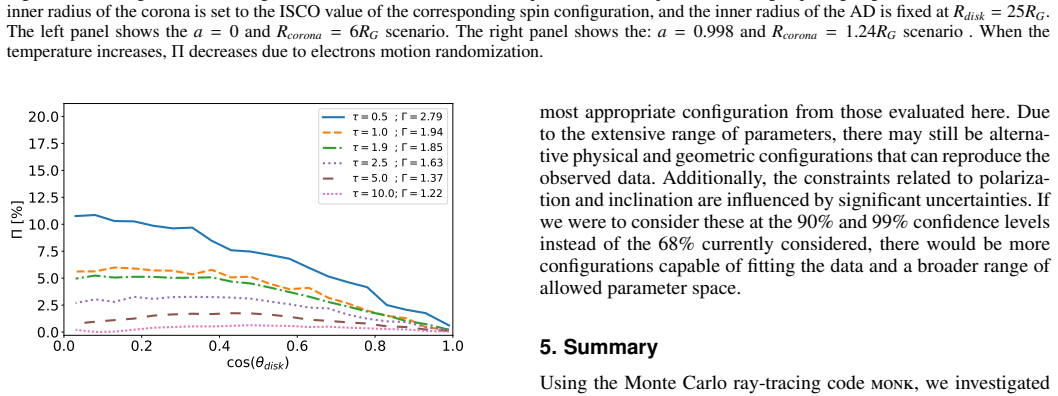
- The best-fitting wedge configuration (kTe=60 keV, a=0.998, Rdisk=12 RG, α=30°) matches the polarization constraints over a wider range of source inclinations than any other tested scenario and is consistent with the spectroscopically derived near-maximal spin.
- In all tested configurations the polarization angle is parallel to the accretion disk axis, reinforcing the IXPE-based conclusion that the NGC 4151 corona is radially extended rather than vertically extended.
- If the 68% constraints are relaxed to 90% or 99% confidence, additional wedge configurations become viable, so the present exclusion list is confidence-level dependent.
- A disk that dips into the corona yields a softer spectrum and higher polarization because seed photons emitted at low radii experience fewer scatterings; this is a general prediction of the model, not just a fit to one source.
Reading between the lines
- The uniform density/temperature assumption flagged in Sect. 2.2 means the spin comparison is provisional; a corona with emission concentrated near the ISCO would raise the predicted Π at high spin and could exclude or admit configurations differently. Testing this with a radially varying corona is the natural next step.
- The same grid of wedge templates could be applied to other radio-quiet unobscured AGNs with IXPE data, such as MCG-05-23-16 and IC 4329A, once their primary-continuum polarization is better constrained; their inclination estimates would provide independent checks.
- The predicted energy dependence of Π across the 2–8 keV band and into harder X-rays is a testable signature that could distinguish the wedge from lamppost or slab geometries using higher-energy X-ray polarimetry.
- If the wedge geometry is correct, it implies the coronal electron distribution is quasi-steady and radially extended, which would favor magnetic-loop or hot-accretion-flow origins over a compact, point-like 'lamppost' source for radio-quiet AGNs.
Editorial analysis
A structured set of objections, weighed in public.
Referee Report
Summary. The paper presents Monte Carlo radiative transfer simulations of X-ray polarization from a geometrically defined 'wedge corona' around a Kerr black hole, using the MONK code. The model is applied to the Seyfert galaxy NGC 4151, with source parameters chosen from X-ray spectroscopy and broad-line reverberation studies. The authors vary the wedge opening angle (5–60°), black hole spin (0 and 0.998), inner disk radius (Rdisk = 25, 12, and ISCO), coronal electron temperature (25–400 keV), and optical depth. For the comparison configurations, the optical depth is tuned so that the 2–8 keV photon index is Γ = 1.85. The principal outputs are the polarization fraction and angle as functions of source inclination. They report that the polarization angle is generally parallel to the disk axis, that Π decreases with increasing opening angle, temperature, and optical depth, and that Π increases for high spin and for smaller disk inner radii. Comparing with the IXPE measured primary-continuum polarization Π = 7.1% ± 1.2% and the BLR-derived inclination 47° < θ < 66°, they identify kTe = 60 keV, a = 0.998, Rdisk = 12 RG, α = 30° as the configuration that best reproduces the constraints, and they rule out several other combinations, including null spin with opening angles greater than 5° for Rdisk = 25 RG.
Significance. If the conclusions are robust, the paper is a useful step toward using X-ray polarimetry to discriminate coronal geometries in radio-quiet AGNs. The study uses a published Monte Carlo code (MONK) with general-relativistic ray tracing and Compton-scattering polarization, and the parameter trends are physically motivated and clearly presented. The authors are also transparent: all model parameters are tabulated in Table A.1, the uniform radial density/temperature limitation is explicitly disclosed in Sect. 2.2, and the paper states that the identified configuration is the best among those tested rather than the definitive model. The main weaknesses are that the comparison with IXPE constraints is visual rather than quantitative, and that the spin preference is directly sensitive to the uniform-profile assumption that the paper itself flags as limiting. Both issues are load-bearing for the central claim and should be addressed before the quantitative conclusions are accepted.
major comments (2)
- [Sect. 2.2 and Sect. 4 / Figs. 10–12] The spin preference (a = 0.998, Rdisk = 12 RG as the best configuration) and the exclusion of several a = 0 cases are directly sensitive to the assumption of uniform radial density and temperature in the wedge corona. The manuscript itself notes that this 'may hamper the comparison between different BH spins' because high-spin dissipation is expected to peak at smaller radii, where general-relativistic effects are stronger. The differences between allowed and excluded configurations are only a few percent in Π at the relevant inclinations (e.g., Fig. 12, right panel). A radially stratified or centrally concentrated corona could shift the predicted Π by this amount and change which configurations are preferred or ruled out. I ask the authors to either test this sensitivity with a radially dependent density/temperature prescription or temper the conclusions to be explicitly conditional on
- [Sect. 4 and Figs. 10–13] The claim that one configuration 'best reproduces' the IXPE and BLR constraints is based on visual overlap of the model curves with the 68% green regions, not on a quantitative goodness-of-fit or likelihood calculation. Several model curves cross or approach the allowed band at similar inclinations, and differences of about one percentage point in Π can determine whether a configuration is considered consistent. To make the ranking and exclusions statistically meaningful, I recommend computing a simple statistic (e.g., a 2D χ² or likelihood over the measured Π and inclination constraints) and reporting which configurations are distinguishable at 68%, 90%, and 99% confidence. Without this, the 'best' designation is not quantitatively supported.
minor comments (5)
- [Figs. 5, 7, 12; Table A.1] The innermost disk radius for the a = 0.998 case is labeled '1.5 RG' in several figures but is given as 1.24 RG in the text and Table A.1. Please harmonize these values and clarify whether the simulations actually used 1.5 RG or 1.24 RG. If 1.5 RG was used, the phrase 'close to the ISCO' should be adjusted.
- [Figs. 10–13] The numbers listed in the legends next to α, Rdisk, and kTe appear to be the optical depths τ that reproduce Γ = 1.85, but they are rendered in some places as 'Γ = ...'. For example, Fig. 10 left shows 'α = 5; Γ = 7.8', which should presumably be τ = 7.8. Please correct the notation throughout.
- [Sect. 3.1] The text says 'testing four different cases' but then lists five opening angles (5°, 15°, 30°, 45°, 60°). Please correct this.
- [Sect. 4] The combined IXPE polarization fraction Π = 7.1% ± 1.2% is attributed to Gianolli et al. (2023), but the combined analysis is presented in Gianolli et al. (2024) in Sect. 2. Please correct the citation.
- [Sect. 2.1] Typo: 'NCG 2110' should be 'NGC 2110'.
Circularity Check
No significant circularity: polarization predictions are genuine simulation outputs compared against external IXPE and BLR constraints; self-citations are non-load-bearing.
full rationale
The paper's central claim is a model-selection statement within the wedge corona model: after fixing the optical depth to reproduce the observed spectral index Gamma=1.85, the Monte Carlo code MONK computes the polarization fraction and angle as outputs. The IXPE polarization constraints (Pi=7.1%±1.2%, Psi aligned with the disk axis) and the BLR reverberation inclination (47<theta<66 deg) are external observational inputs, not parameters fitted in the simulations. The paper explicitly discloses the optical-depth calibration ('we determined the coronal optical depth such that it reproduced a primary continuum spectral index of 1.85'), and the target result (polarization) is not used to set this parameter. Self-citations to Tagliacozzo et al. (2023) and Gianolli et al. (2023, 2024) appear, but they are either corroborated by the paper's own Section 3 results or refer to independent IXPE measurements; none of these citations carries the load of the central derivation. The paper itself flags a modeling limitation in Sect. 2.2: 'A limitation of the present version of the monk code is that the radial density and temperature profiles of the wedge corona are assumed to be uniform. This may hamper the comparison between different BH spins.' This is an honest caveat about robustness under a physical assumption, not an instance of circular reasoning: the assumption is an input to the model, not a restatement of the predicted polarization. The comparison with data is visual/qualitative rather than a rigorous goodness-of-fit, but that is a methodological weakness, not circularity. The derivation chain is therefore self-contained with respect to its inputs, and no equation or fitted parameter is renamed as a prediction.
Assumptions & free parameters
free parameters (1)
- Coronal optical depth tau =
varies by configuration (e.g., 1.9 for baseline; 0.2-9.5 in Table A.1)
assumptions (4)
- domain assumption The wedge corona has uniform radial density and temperature profiles.
- domain assumption Seed photons originate from a Novikov-Thorne accretion disk with local polarization parallel to the disk surface, ranging from 0 to 11.7%.
- domain assumption The observed polarization from NGC 4151 is entirely or predominantly due to the primary coronal emission.
- standard math Relativistic effects are correctly implemented in the MONK code.
Cite this review
Pith. "Pith review of X-ray polarization in radio-quiet AGN: Insights from the wedge corona model using Monte Carlo simulations." pith.science (2026). https://pith.science/paper/TUCCGDLQ
@misc{pith2026250821203,
  author       = {Pith},
  title        = {Pith review of: X-ray polarization in radio-quiet AGN: Insights from the wedge corona model using Monte Carlo simulations},
  year         = {2026},
  howpublished = {\url{https://pith.science/paper/TUCCGDLQ}},
  note         = {Machine review of arXiv:2508.21203}
}
read the original abstract
In this study, we present novel calculations of X-ray polarization from radio-quiet and unobscured active galactic nuclei (AGNs) using the Monte Carlo code MONK, which includes all general and special relativity effects. Our geometric model, referred to as the ``wedge corona'', features a homogeneous cloud of electrons characterized by an aspect ratio of h/r and a radius that extends down to the innermost stable circular orbit around the central black hole (BH). Adopting the physical parameters of the Seyfert galaxy NGC 4151 as a baseline, we investigated various geometric and physical configurations of the BH-corona-accretion disk (AD) system, such as the coronal opening angle, temperature, optical depth, BH spin, and the inner radius of the disk. Finally, we compared our calculations with results from the Imaging X-ray Polarimetry Explorer (IXPE) for NGC 4151, the only radio-quiet and unobscured AGN with significant polarization detected by IXPE, to constrain the system's geometric parameters within the framework of the wedge corona model.
Figures


Figures from the paper (11 more)




Reference graph
Works this paper leans on
-
[1]
Antonucci, R. R. J. & Cohen, R. D. 1983, ApJ, 271, 564
work page 1983
-
[2]
Beloborodov, A. M. 2017, ApJ, 850, 141
work page 2017
-
[3]
C., Denney, K
Bentz, M. C., Denney, K. D., Cackett, E. M., et al. 2006, ApJ, 651, 775
2006
-
[4]
C., Williams, P
Bentz, M. C., Williams, P. R., & Treu, T. 2022, ApJ, 934, 168
2022
-
[5]
Beuchert, T., Markowitz, A. G., Dauser, T., et al. 2017, A&A, 603, A50 Caballero-García, M. D., Papadakis, I. E., Dov ˇciak, M., et al. 2020, MNRAS, 498, 3184
work page 2017
-
[6]
M., Zoghbi, A., Reynolds, C., et al
Cackett, E. M., Zoghbi, A., Reynolds, C., et al. 2014, MNRAS, 438, 2980
work page 2014
-
[7]
1960, Radiative transfer (New York: Dover)
Chandrasekhar, S. 1960, Radiative transfer (New York: Dover)
1960
-
[8]
2007, A&A, 461, 1209 De Rosa, A., Panessa, F., Bassani, L., et al
Dadina, M. 2007, A&A, 461, 1209 De Rosa, A., Panessa, F., Bassani, L., et al. 2012, MNRAS, 420, 2087
work page 2007
Show all 48 references
-
[9]
A., McClintock, J
Esin, A. A., McClintock, J. E., & Narayan, R. 1997, ApJ, 489, 865
1997
-
[10]
A., Narayan, R., Cui, W., Grove, J
Esin, A. A., Narayan, R., Cui, W., Grove, J. E., & Zhang, S.-N. 1998, ApJ, 505, 854
1998
-
[11]
C., Alston, W
Fabian, A. C., Alston, W. N., Cackett, E. M., et al. 2017, Astronomische Nachrichten, 338, 269
2017
-
[12]
2004, A&A, 413, 535
Ghisellini, G., Haardt, F., & Matt, G. 2004, A&A, 413, 535
2004
-
[13]
E., Bianchi, S., Kammoun, E., et al
Gianolli, V . E., Bianchi, S., Kammoun, E., et al. 2024, A&A, 691, A29
2024
-
[14]
E., Kim, D
Gianolli, V . E., Kim, D. E., Bianchi, S., et al. 2023, MNRAS, 523, 4468
2023
-
[15]
& Maraschi, L
Haardt, F. & Maraschi, L. 1991, ApJ, 380, L51
1991
-
[16]
& Maraschi, L
Haardt, F. & Maraschi, L. 1993, ApJ, 413, 507
1993
-
[17]
& Petrucci, P
Henri, G. & Petrucci, P. O. 1997, A&A, 326, 87
1997
-
[18]
2023, MNRAS, 525, 5437
Ingram, A., Ewing, M., Marinucci, A., et al. 2023, MNRAS, 525, 5437
2023
-
[19]
A., et al
Kamraj, N., Brightman, M., Harrison, F. A., et al. 2022, The Astrophysical Jour- nal, 927, 42
2022
-
[20]
L., Brenneman, L
Keck, M. L., Brenneman, L. W., Ballantyne, D. R., et al. 2015, ApJ, 806, 149
2015
-
[21]
Liang, E. P. T. 1979, ApJ, 231, L111
1979
-
[22]
Lightman, A. P. & Zdziarski, A. A. 1987, ApJ, 319, 643
1987
-
[23]
2014, ApJ, 782, L25
Malizia, A., Molina, M., Bassani, L., et al. 2014, ApJ, 782, L25
2014
-
[24]
2022, MNRAS, 516, 5907
Marinucci, A., Muleri, F., Dovciak, M., et al. 2022, MNRAS, 516, 5907
2022
-
[25]
2018, Galaxies, 6, 44
Marinucci, A., Tamborra, F., Bianchi, S., et al. 2018, Galaxies, 6, 44
2018
-
[26]
1996, Radiation Physics and Chemistry, 48, 403
Matt, G., Feroci, M., Rapisarda, M., & Costa, E. 1996, Radiation Physics and Chemistry, 48, 403
1996
-
[27]
2019, A&A, 630, A131
Middei, R., Bianchi, S., Marinucci, A., et al. 2019, A&A, 630, A131
2019
-
[28]
Novikov, I. D. & Thorne, K. S. 1973, in Black Holes (Les Astres Occlus), ed. C. Dewitt & B. S. Dewitt, 343–450
1973
-
[29]
Penston, M. V . & Perez, E. 1984, MNRAS, 211, 33P
1984
-
[30]
2008, Monthly Notices of the Royal Astronomical Society: Letters, 385, L88–L92
Petrucci, P.-O., Ferreira, J., Henri, G., & Pelletier, G. 2008, Monthly Notices of the Royal Astronomical Society: Letters, 385, L88–L92
2008
-
[31]
1994, ApJS, 92, 607
Poutanen, J. 1994, ApJS, 92, 607
1994
-
[32]
& Svensson, R
Poutanen, J. & Svensson, R. 1996, ApJ, 470, 249
1996
-
[33]
Poutanen, J., Veledina, A., & Zdziarski, A. A. 2018, A&A, 614, A79
2018
-
[34]
2007, MNRAS, 377, 607
Puccetti, S., Fiore, F., Risaliti, G., et al. 2007, MNRAS, 377, 607
2007
-
[35]
Schnittman, J. D. & Krolik, J. H. 2010, ApJ, 712, 908
2010
-
[36]
Shakura, N. I. & Sunyaev, R. A. 1973, A&A, 24, 337
1973
-
[37]
L., Lightman, A
Shapiro, S. L., Lightman, A. P., & Eardley, D. M. 1976, ApJ, 204, 187
1976
-
[38]
I., Popovi´c, L
Shapovalova, A. I., Popovi´c, L. ˇC., Collin, S., et al. 2008, A&A, 486, 99
2008
-
[39]
I., Popovic, L
Shapovalova, A. I., Popovic, L. C., Collin, S., et al. 2012, Astron. Astrophys. Trans., 27, 429
2012
-
[40]
E., Poutanen, J., Svensson, R., Sikora, M., & Begelman, M
Stern, B. E., Poutanen, J., Svensson, R., Sikora, M., & Begelman, M. C. 1995, ApJ, 449, L13
1995
-
[41]
Sunyaev, R. A. & Titarchuk, L. G. 1980, A&A, 86, 121
1980
-
[42]
2023, MNRAS, 525, 4735
Tagliacozzo, D., Marinucci, A., Ursini, F., et al. 2023, MNRAS, 525, 4735
2023
-
[43]
2018, Astron
Tamborra, F., Matt, G., Bianchi, S., & Dov ˇciak, M. 2018, Astron. Astrophys., 619, A105
2018
-
[44]
Tortosa, Bianchi, S., Marinucci, A., Matt, G., & Petrucci, P. O. 2018, A&A, 614, A37
2018
-
[45]
2022, MNRAS, 510, 3674
Ursini, F., Matt, G., Bianchi, S., et al. 2022, MNRAS, 510, 3674
2022
-
[46]
M., Fabian, A
Uttley, P., Cackett, E. M., Fabian, A. C., Kara, E., & Wilkins, D. R. 2014, A&A Rev., 22, 72
2014
-
[47]
C., Soffitta, P., Baldini, L., et al
Weisskopf, M. C., Soffitta, P., Baldini, L., et al. 2022, Journal of Astronomical
2022
-
[48]
2019, ApJ, 875, 148 Article number, page 8 of 10 D
Zhang, W., Dovˇciak, M., & Bursa, M. 2019, ApJ, 875, 148 Article number, page 8 of 10 D. Tagliacozzo et al.: Wedge corona model insights Appendix A: Simulations parameters summary Article number, page 9 of 10 A&A proofs: manuscript no. aa54138-25 Table A.1: Summary table listi...
2019
Reviewed August 5, 2026 · model on record in the stance chip above.
Discussion (0). Continue with ORCID to comment.