REVIEW 4 major objections 5 minor 98 references
The fate of rotating massive stars across cosmic times
T0 review · 4 major / 5 minor · reviewed 2026-08-05 · deepseek-v4-flash
Pith's one-line read A massive star's fate is set at the end of helium burning by its carbon–oxygen core mass and envelope composition; rotation shifts the remnant boundaries enough to change black-hole masses and supernova-type rates.
desk verdict Useful, honest fate map for massive stars, but the quantitative predictions lean on an unsettled explodability mapping that the paper itself flags and then uses deterministically. read the letter →
The pith
A machine-rendered reading of the paper's core claim, the machinery that carries it, and where it could break.
The reading
What carries the argument
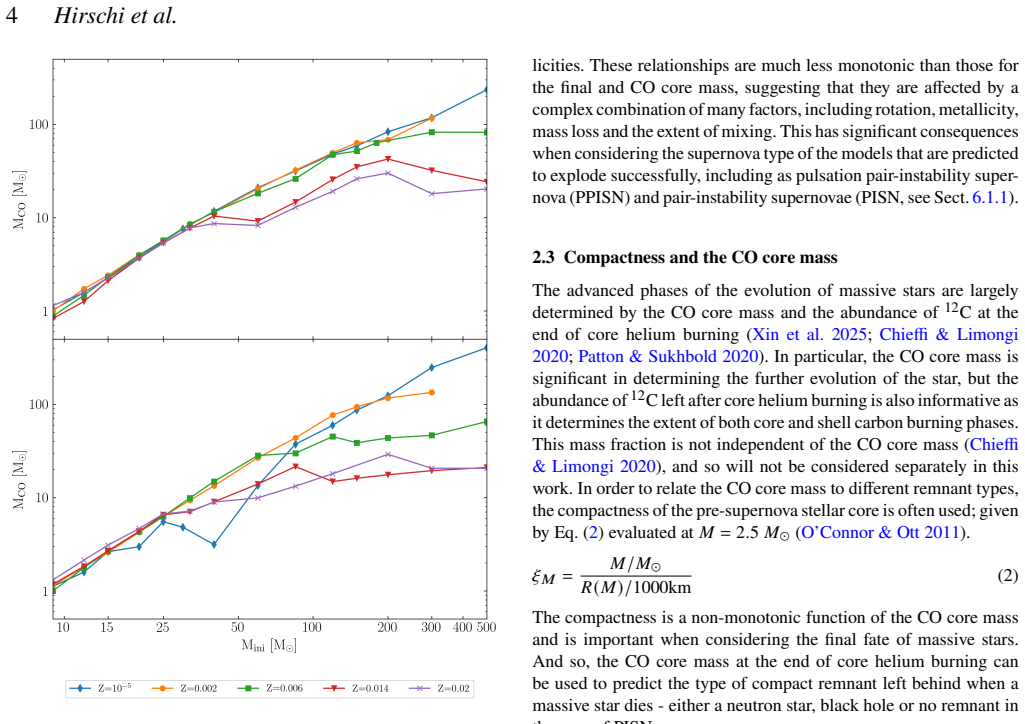
The carbon–oxygen (CO) core mass at the end of core helium burning, defined as the mass coordinate where the helium mass fraction first drops below 1%, is the load-bearing quantity. It is used because it sets the pre-collapse compactness of the core, which governs whether the supernova shock revives or the star collapses directly into a black hole. Table 1 encodes the fate map: M_CO < 6 M_sun -> neutron star; 6–8 -> black hole with possible neutron star; 8–12 -> neutron star with possible black hole; 12–40 -> direct black hole; 40–60 -> pulsational pair-instability supernova leaving a black hole; 60–130 -> pair-instability supernova leaving no remnant; >130 -> direct black hole. The companio
What would settle it
If gravitational-wave detections confirm merging black holes with component masses inside the predicted 90–150 solar-mass gap from isolated stellar evolution, the central mapping fails; alternatively, a null result in near-infrared searches for high-redshift pair-instability supernovae would put the framework under pressure.
Extended reading notes
Core claim
The paper's central claim is that two quantities read off at the end of core helium burning — the carbon–oxygen core mass and the hydrogen/helium envelope mass — are sufficient to classify the fate of a massive star. The CO core mass sets the remnant through the compactness-based Table 1 mapping: below 6 solar masses a neutron star; 6–8 a black hole with possible neutron star; 8–12 a neutron star with possible black hole; 12–40 a direct black hole; 40–60 a pulsational pair-instability supernova leaving a black hole; 60–130 a pair-instability supernova leaving nothing; above 130 a direct black hole again. On top of this, envelope thresholds assign spectroscopic types (IIP, IIL, IIb, Ib, Ic).
Load-bearing premise
The load-bearing premise is that a star's doom is already decided when helium burning ends: the carbon–oxygen core mass at that moment reliably dictates whether the star becomes a neutron star, a black hole, or a pair-instability supernova, even though the paper notes that newer studies place successful explosions at different core masses and convection remains a major uncertainty.
Editorial extensions
If this is right
- At Small Magellanic Cloud or higher metallicity, no black hole below the pair-instability gap is predicted above about 50 solar masses, so gravitational-wave events with heavy black holes must come from metal-poor environments.
- The pair-instability gap is predicted to lie near 90–150 solar masses, and pair-instability supernovae appear only below solar metallicity for initial masses above about 100 solar masses; this sharpens the expected black-hole mass distribution and helps explain the lack of confirmed pair-instability supernovae in optical surveys.
- Rotation lowers the initial mass at which black holes form in most environments, nearly doubling the predicted black-hole fraction at solar metallicity and changing the mix of supernova types in initial-mass-function-weighted populations.
- Type Ic supernovae from single stars are rare in these models; the observed fraction is larger than predicted, implying that envelope stripping in binaries or other mechanisms must supply the missing progenitors.
- A top-heavy initial mass function reproduces the observed core-collapse supernova type fractions much better than the Salpeter initial mass function, providing a population-level constraint on the massive-star mass distribution.
Reading between the lines
- If the CO-core-mass mapping were replaced by the newer explodability islands the paper cites, the absolute remnant boundaries would move, but the qualitative rotation trend — shifting boundaries relative to non-rotating stars — might survive; recomputing the contour maps with those islands would test this.
- The predicted 90–150 solar-mass gap gives a clean interpretation test for events like GW190521: a single-star remnant inside the gap would violate the gap, so a confirmed event there would favour hierarchical mergers in dense clusters.
- The extremely metal-poor hydrogen-shell effect predicts an elevated neutron-star fraction at very low metallicity relative to SMC metallicity; targeted searches for compact-object populations in very low-metallicity regions could discriminate this.
- The factor-level deficit of Type Ic supernovae from single stars provides a quantitative upper bound on the fraction of Type Ic progenitors requiring binary mass transfer, which could be refined with binary population synthesis.
Signed reviews
Editorial analysis
A structured set of objections, weighed in public.
Referee Report
Summary. The paper uses the GENEC grid of rotating and non-rotating stellar models (initial masses 9–500 Msun, metallicities Z=1e-5 to 0.02) to predict the final fates of massive stars. The fate is diagnosed from the CO core mass at the end of core helium burning, using fixed thresholds (Table 1) to assign neutron star, black hole, PPISN, or PISN outcomes, and from envelope H/He masses to assign spectroscopic supernova types (Table 2). The authors produce remnant-type and supernova-type maps as a function of initial mass and metallicity, compute black hole mass distributions (including a PPISN fit from Eq. 3), and then weight the outcomes by Salpeter and top-heavy IMFs to derive population fractions. The main claims are that rotation significantly alters remnant types and supernova engines, that metallicity strongly controls the fates with maximum black hole masses below 50 Msun at SMC and higher metallicities, and that a pair-instability mass gap is predicted between about 90 and 150 Msun.
Significance. If the mapping from CO core mass to remnant type is reliable, the paper provides a broad and homogeneous census of single-star fates across cosmic times, connecting stellar evolution grids to gravitational-wave and supernova observations. The release of the model grid and Table A2 is a valuable resource. The qualitative trends — e.g., that rotation can promote or inhibit black hole formation depending on metallicity, and that higher metallicity suppresses the most massive remnants — are physically plausible and worth publishing. However, the quantitative results (fractions, maximum BH masses, mass-gap edges) are all derived from a small number of imported explodability thresholds and from linear interpolation over a sparse grid, and the paper provides no uncertainty quantification on these steps. The abstract additionally overstates the rotation effect at low metallicity. The strengths are the parameter-space coverage and the falsifiability of the predictions, but the numerical precision implied by the paper exceeds what the underlying assumptions can support.
major comments (4)
- [Section 2.3 / Table 1] The remnant-type classification uses fixed M_CO thresholds (6, 8, 12, 40, 60, 130 Msun) taken from a subset of the explodability literature. The paper itself concedes that later studies (Wang et al. 2022; Boccioli et al. 2023; Maltsev et al. 2025) find islands of explodability at very different masses with metallicity dependence. Many models in Table A2 lie within ~1 Msun of a boundary: at Z=0.002 the non-rotating 25 Msun model has M_CO=5.66 (NS) while the rotating model has M_CO=6.25 (BH(NS)); at Z=1e-5 the non-rotating 30 Msun model has M_CO=7.57 (BH(NS)) and the rotating one 4.81 (NS). A ±1 Msun shift of the 6/8/12 Msun cuts changes which side of the NS/BH boundary these models fall on. Since all remnant fractions, BH mass distributions, and mass-gap edges in Figs. 3–10 and Tables A3–A4 are derived from these cuts, the quantitative predictions inherit the full mapping uncertainty. The
- [Abstract; Section 3.2] The abstract states that 'rotating stars favouring black hole formation at lower initial masses than their non-rotating counterparts.' This is not supported by the paper's own models at low metallicity. For Z=1e-5 and M_ini < 60 Msun, rotation reduces the CO core mass (hydrogen-burning-shell effect, Section 3.2, first case) and produces more NS, not BH; e.g., the rotating 30 Msun model has M_CO=4.81 (NS) versus 7.57 (BH(NS)) for the non-rotating model. The effect of rotation is described in Section 3.2 as mass- and metallicity-dependent, with four regimes where mixing or mass loss dominates. The abstract should be revised to state that rotation can either promote or inhibit BH formation depending on metallicity and mass, or to restrict the claim to subsolar but not extremely metal-poor metallicities.
- [Section 3 (interpolation); Fig. 3] The contour maps use linear interpolation over a sparse and unevenly spaced grid (e.g., initial masses 9,12,15,20,25,32,40,60,85,120,150,200,300,500 Msun per metallicity, Table A1). The paper correctly notes that interpolation 'may also result in missing features,' but the interpolated boundaries are used to derive all population fractions and the BH mass distribution. For instance, the NS/BH boundary between 25 and 32 Msun at Z=0.002 is estimated from endpoints with M_CO=5.66 and 8.59; the crossing mass could shift by several Msun if the true M_CO(M_ini) relation is non-linear. This is a known limitation, but it is propagated into the quantitative claims without an uncertainty estimate. Please either report the discrete model values on the contour plots, use the model grid directly for the population synthesis, or provide an interpolation-error estimate.
- [Section 3.3 / Eq. (3)] The black-hole remnant masses for PPISN are computed with Eq. (3), a fit taken from Farmer et al. (2019) with fixed coefficients. The uncertainty in this fit and in the assumed M_CO ranges (40–60, 60–130 Msun) is not propagated into the predicted mass gap of ~90–150 Msun or the maximum BH masses in Table 4. Since these numbers are directly compared to GW190521 and GW231123, the gap boundaries should be presented as ranges reflecting the fit and threshold uncertainties, not as sharp values.
minor comments (5)
- [Section 2.3] 'Eluded to' should be 'alluded to'.
- [Table A1] The superscript origin codes are difficult to parse in the typeset version; please display them in a clearer format so each initial mass is unambiguously associated with its source grid.
- [Figures 3 and 4] The four rotation regimes described in Section 3.2 are not indicated on the figure; adding region labels or shading would help the reader connect the text to the plots.
- [Section 5.1.2] 'Increase in failed supernova leading to BH' should be 'increase in failed supernovae leading to BHs'.
- [Section 3 / Fig. 4 caption] The assumption that the rotating 500 Msun Z=0.02 model has the same properties as the rotating 300 Msun model is stated in the text but not flagged in the figure caption or Table A2; this should be clearly marked wherever the interpolated 500 Msun values appear.
Circularity Check
No significant circularity: predictions follow from independent CO-core/SN-type mappings applied to pre-existing GENEC model grids.
full rationale
The paper's derivation chain is: (1) take CO core masses, final masses, and H/He envelope masses from GENEC stellar models at the end of core He burning; (2) convert these to remnant types and SN types using Table 1 and Table 2 thresholds; (3) weight by IMFs to get population fractions. The thresholds in Table 1 come from external literature (O'Connor & Ott 2011; Patton & Sukhbold 2020; Sukhbold & Woosley 2014; Farmer et al. 2019; Heger et al. 2003), not from the present data; Eq. (3) is explicitly 'adapted from Farmer et al. (2019)' and its coefficients are fixed, not fitted to the quantities being predicted. The GENEC grids are from the authors' earlier papers, but those are the model data, not an argument whose conclusion is presupposed; using one's own previously published models as input is standard practice and is not circular. The paper even flags the uncertainty in the explodability mapping (Wang et al. 2022; Boccioli et al. 2023; Maltsev et al. 2025) and notes that 'no black holes below 6 M_sun are predicted by design'—both are honest uncertainty statements, not hidden reductions. Comparisons to observed SN type fractions and to GW events are made without fitting. No load-bearing step reduces by definition to its own input.
Assumptions & free parameters
free parameters (5)
- PPISN black hole mass relation coefficients =
a1=-0.096, a2=8.564, a3=-2.07, a4=-152.97
- CO core mass remnant boundaries =
6, 8, 12, 40, 60, 130 Msun
- Envelope mass thresholds for SN type =
M_H<0.5, 0.033, 2; M_He<0.5 Msun
- Initial rotation rate v_ini/v_crit =
0.4
- Mass-loss metallicity exponents =
alpha=0.85 (O/WN), 0.66 (WC/WO), 0.5 (de Jager)
assumptions (6)
- domain assumption 1D GENEC stellar evolution models correctly evolve stars to the end of core helium burning with the specified input physics.
- domain assumption CO core mass at end of core He burning is a reliable indicator of remnant type and explodability.
- domain assumption Envelope H/He masses determine spectroscopic SN type.
- domain assumption Mass loss after core He burning is negligible for final mass and fate.
- ad hoc to paper The rotating 500 Msun Z=0.02 model has the same properties as the rotating 300 Msun model at that metallicity.
- ad hoc to paper Linear interpolation between the sparse grid points captures the fate boundaries.
Cite this review
Pith. "Pith review of The fate of rotating massive stars across cosmic times." pith.science (2026). https://pith.science/paper/TUJDYFMZ
@misc{pith2026250821233,
  author       = {Pith},
  title        = {Pith review of: The fate of rotating massive stars across cosmic times},
  year         = {2026},
  howpublished = {\url{https://pith.science/paper/TUJDYFMZ}},
  note         = {Machine review of arXiv:2508.21233}
}
abstract
The initial mass and metallicity of stars both have a strong impact on their fate. Stellar axial rotation also has a strong impact on the structure and evolution of massive stars. In this study, we exploit the large grid of GENEC models, covering initial masses from 9 to 500 $M_{\odot}$ and metallicities ranging from $Z=10^{-5}$ (nearly zero) to 0.02 (supersolar), to determine the impact of rotation on their fate across cosmic times. Using the carbon-oxygen core mass and envelope composition as indicators of their fate, we predict stellar remnants, supernova engines, and spectroscopic supernova types for both rotating and non-rotating stars. We derive rates of the different supernova and remnant types considering two initial mass functions to help solve puzzles such as the absence of observed pair-instability supernovae. We find that rotation significantly alters the remnant type and supernova engine, with rotating stars favouring black hole formation at lower initial masses than their non-rotating counterparts. Additionally, we confirm the expected strong metallicity dependence of the fates with a maximum black hole mass predicted to be below 50 $M_{\odot}$ at SMC or higher metallicities. A pair-instability mass gap is predicted between about 90 and 150 $M_{\odot}$, with the most massive black holes below the gap found at the lowest metallicities. Considering the fate of massive single stars has far-reaching consequences across many different fields within astrophysics, and understanding the impact of rotation and metallicity will improve our understanding of how massive stars end their lives, and their impact on the universe.
Figures


Figures from the paper (7 more)


Reference graph
Works this paper leans on
-
[1]
write newline
" write newline "" before.all 'output.state := FUNCTION fin.entry write newline FUNCTION new.block output.state before.all = 'skip after.block 'output.state := if FUNCTION new.sentence output.state after.block = 'skip output.state before.all = 'skip after.sentence 'output.state := if if FUNCTION not #0 #1 if FUNCTION and 'skip pop #0 if FUNCTION or pop #1...
-
[2]
Aamer A., et al., 2024, Monthly Notices of the Royal Astronomical Society, 527, 11970
2024
-
[3]
Abbott R., et al., 2020, The Astrophysical Journal Letters, 900, L13
2020
-
[4]
Aguilera-Dena D. R., M \"u ller B., Antoniadis J., Langer N., Dessart L., Vigna-G \'o mez A., Yoon S.-C., 2023, @doi [ ] 10.1051/0004-6361/202243519 , https://ui.adsabs.harvard.edu/abs/2023A&A...671A.134A 671, A134
-
[5]
Angulo C., et al., 1999, Nuclear Physics A, 656, 3
1999
-
[6]
Angus C., et al., 2024, The Astrophysical Journal Letters, 977, L41
2024
-
[7]
M., Callister T., 2025, @doi [Phys
Antonini F., Romero-Shaw I. M., Callister T., 2025, @doi [Phys. Rev. Lett.] 10.1103/PhysRevLett.134.011401 , 134, 011401
-
[8]
D., Jain R
Bailyn C. D., Jain R. K., Coppi P., Orosz J. A., 1998, The Astrophysical Journal, 499, 367
1998
Show all 98 references
-
[9]
Boccioli L., Roberti L., 2024, Universe, 10, 148
2024
-
[10]
J., Chieffi A., 2023, The Astrophysical Journal, 949, 17
Boccioli L., Roberti L., Limongi M., Mathews G. J., Chieffi A., 2023, The Astrophysical Journal, 949, 17
2023
-
[11]
S., 2024, Master's thesis, Keele University, United Kingdom
Chambers C. S., 2024, Master's thesis, Keele University, United Kingdom
2024
-
[12]
Chieffi A., Limongi M., 2020, The Astrophysical Journal, 890, 43
2020
-
[13]
Chini R., Hoffmeister V., Nasseri A., Stahl O., Zinnecker H., 2012, Monthly Notices of the Royal Astronomical Society, 424, 1925
2012
-
[14]
Costa G., et al., 2025, @doi [ ] 10.1051/0004-6361/202452573 , https://ui.adsabs.harvard.edu/abs/2025A&A...694A.193C 694, A193
2025 doi
-
[15]
A., 2000, Astronomy and Astrophysics, v
Crowther P. A., 2000, Astronomy and Astrophysics, v. 356, p. 191-199 (2000), 356, 191
2000
-
[16]
De Donder E., Vanbeveren D., 2002, New Astronomy, 7, 55
2002
-
[17]
J., Li C., Woosley S., 2012, Monthly Notices of the Royal Astronomical Society, 424, 2139
Dessart L., Hillier D. J., Li C., Woosley S., 2012, Monthly Notices of the Royal Astronomical Society, 424, 2139
2012
-
[18]
Eggenberger P., et al., 2021, Astronomy & Astrophysics, 652, A137
2021
-
[19]
Ekstr \"o m S., et al., 2012, Astronomy & Astrophysics, 537, A146
2012
-
[20]
S., 2006, Astronomy & Astrophysics, 452, 295
Eldridge J., Vink J. S., 2006, Astronomy & Astrophysics, 452, 295
2006
-
[21]
R., Xiao L., McClelland L., Taylor G., Ng M., Greis S
Eldridge J., Stanway E. R., Xiao L., McClelland L., Taylor G., Ng M., Greis S. M., Bray J., 2017, Publications of the Astronomical Society of Australia, 34, e058
2017
-
[22]
Farmer R., Renzo M., de Mink S., Marchant P., Justham S., 2019, The Astrophysical Journal, 887, 53
2019
-
[23]
M., Sravan N., Cantrell A., Kreidberg L., Bailyn C
Farr W. M., Sravan N., Cantrell A., Kreidberg L., Bailyn C. D., Mandel I., Kalogera V., 2011, The Astrophysical Journal, 741, 103
2011
-
[24]
H., Hirschi R., Murphy L., Kaiser E., Ekstr \"o m S., Georgy C., Meynet G., 2021, @doi [ ] 10.1093/mnrasl/slaa196 , https://ui.adsabs.harvard.edu/abs/2021MNRAS.502L..40F 502, L40
Farrell E., Groh J. H., Hirschi R., Murphy L., Kaiser E., Ekstr \"o m S., Georgy C., Meynet G., 2021, @doi [ ] 10.1093/mnrasl/slaa196 , https://ui.adsabs.harvard.edu/abs/2021MNRAS.502L..40F 502, L40
2021 doi
-
[25]
W., Alexander D
Ferguson J. W., Alexander D. R., Allard F., Barman T., Bodnarik J. G., Hauschildt P. H., Heffner-Wong A., Tamanai A., 2005, The Astrophysical Journal, 623, 585
2005
-
[26]
H., Fryer C
Frey L. H., Fryer C. L., Young P. A., 2013, The Astrophysical Journal Letters, 773, L7
2013
-
[27]
Gal-Yam A., 2012, Science, 337, 927
2012
-
[28]
Georgy C., Meynet G., Walder R., Folini D., Maeder A., 2009, Astronomy & Astrophysics, 502, 611
2009
-
[29]
Georgy C., et al., 2013, Astronomy & Astrophysics, 558, A103
2013
-
[30]
Gilkis A., Arcavi I., 2022, Monthly Notices of the Royal Astronomical Society, 511, 691
2022
-
[31]
S., Kozyreva A., Hirschi R., Fr \"o hlich C., Yusof N., 2017, @doi [ ] 10.3847/1538-4357/aa8461 , https://ui.adsabs.harvard.edu/abs/2017ApJ...846..100G 846, 100
Gilmer M. S., Kozyreva A., Hirschi R., Fr \"o hlich C., Yusof N., 2017, @doi [ ] 10.3847/1538-4357/aa8461 , https://ui.adsabs.harvard.edu/abs/2017ApJ...846..100G 846, 100
2017 doi
-
[32]
Gomez S., et al., 2019, The Astrophysical Journal, 881, 87
2019
-
[33]
Gr \"a fener G., Hamann W.-R., 2008, Astronomy & Astrophysics, 482, 945
2008
-
[34]
Hachinger S., Mazzali P., Taubenberger S., Hillebrandt W., Nomoto K., Sauer D., 2012, Monthly Notices of the Royal Astronomical Society, 422, 70
2012
-
[35]
Heger A., Fryer A., Woosley S., Langer N., Hartmann D., 2003, The Astrophysical Journal, 591, 288
2003
-
[36]
R., Vink J
Higgins E. R., Vink J. S., Sabhahit G. N., Sander A. A. C., 2022, @doi [ ] 10.1093/mnras/stac2485 , https://ui.adsabs.harvard.edu/abs/2022MNRAS.516.4052H 516, 4052
2022 doi
-
[37]
Hirschi R., 2004, PhD thesis, University of Geneva, Switzerland
2004
-
[38]
Hirschi R., Meynet G., Maeder A., 2004, Astronomy & Astrophysics, 425, 649
2004
-
[39]
R., McSwain M., 2010, The Astrophysical Journal, 722, 605
Huang W., Gies D. R., McSwain M., 2010, The Astrophysical Journal, 722, 605
2010
-
[40]
A., Rogers F
Iglesias C. A., Rogers F. J., 1996, Astrophysical Journal v. 464, p. 943, 464, 943
1996
-
[41]
Jin H., Yoon S.-C., Blinnikov S., 2023, @doi [ ] 10.3847/1538-4357/accf0d , https://ui.adsabs.harvard.edu/abs/2023ApJ...950...44J 950, 44
2023 doi
-
[42]
G., Kaur K., Stone N., Torres M
Jonker P. G., Kaur K., Stone N., Torres M. A., 2021, The Astrophysical Journal, 921, 131
2021
-
[43]
A., Hirschi R., Arnett W
Kaiser E. A., Hirschi R., Arnett W. D., Georgy C., Scott L. J. A., Cristini A., 2020, @doi [ ] 10.1093/mnras/staa1595 , https://ui.adsabs.harvard.edu/abs/2020MNRAS.496.1967K 496, 1967
2020 doi
-
[44]
Kobayashi C., 2015, Proceedings of the International Astronomical Union, 11, 57
2015
-
[45]
I., Lugaro M., 2020, The Astrophysical Journal, 900, 179
Kobayashi C., Karakas A. I., Lugaro M., 2020, The Astrophysical Journal, 900, 179
2020
-
[46]
Kozyreva A., et al., 2017, Monthly Notices of the Royal Astronomical Society, 464, 2854
2017
-
[47]
Langer N., 2012, Annual Review of Astronomy and Astrophysics, 50, 107
2012
-
[48]
E., 2021, @doi [ ] 10.1051/0004-6361/202140506 , https://ui.adsabs.harvard.edu/abs/2021A&A...656A..58L 656, A58
Laplace E., Justham S., Renzo M., G \"o tberg Y., Farmer R., Vartanyan D., de Mink S. E., 2021, @doi [ ] 10.1051/0004-6361/202140506 , https://ui.adsabs.harvard.edu/abs/2021A&A...656A..58L 656, A58
2021 doi
-
[49]
Li W., et al., 2011, Monthly Notices of the Royal Astronomical Society, 412, 1441
2011
-
[50]
B., Graur O., 2016, The Astrophysical Journal, 827, 90
Liu Y.-Q., Modjaz M., Bianco F. B., Graur O., 2016, The Astrophysical Journal, 827, 90
2016
-
[51]
Maeder A., Meynet G., 2000, Astronomy and Astrophysics, 361, 159
2000
-
[52]
Maeder A., Meynet G., 2012, Reviews of Modern Physics, 84, 25
2012
- [53]
-
[54]
M., Moriya T
Marchant P., Langer N., Podsiadlowski P., Tauris T. M., Moriya T. J., 2016, Astronomy & Astrophysics, 588, A50
2016
-
[55]
Martinet S., Meynet G., Ekstr \"o m S., Georgy C., Hirschi R., 2023, Astronomy & Astrophysics, 679, A137
2023
-
[56]
J., et al., 2021, The Astrophysical Journal, 908, 249
Moriya T. J., et al., 2021, The Astrophysical Journal, 908, 249
2021
-
[57]
R., Cantiello M., Langer N., 2011, Astronomy & Astrophysics, 529, L9
Neilson H. R., Cantiello M., Langer N., 2011, Astronomy & Astrophysics, 529, L9
2011
-
[58]
Nugis T., Lamers H., 2000, Astronomy and Astrophysics, Vol. 360, p. 227-244, 360, 227
2000
-
[59]
D., 2011, The Astrophysical Journal, 730, 70
O'Connor E., Ott C. D., 2011, The Astrophysical Journal, 730, 70
2011
-
[60]
J., 2006, @doi [ ] 10.1086/504578 , https://ui.adsabs.harvard.edu/abs/2006ApJ...645.1352O 645, 1352
Ohkubo T., Umeda H., Maeda K., Nomoto K., Suzuki T., Tsuruta S., Rees M. J., 2006, @doi [ ] 10.1086/504578 , https://ui.adsabs.harvard.edu/abs/2006ApJ...645.1352O 645, 1352
2006 doi
-
[61]
Patton R., Sukhbold T., 2020, Monthly Notices of the Royal Astronomical Society, 499, 2803
2020
-
[62]
pp 69--78
Preibisch T., Weigelt G., Zinnecker H., 2001, in Symposium-International Astronomical Union. pp 69--78
2001
-
[63]
Springer, pp 229--256
Reimers D., 1975, in , Problems in stellar atmospheres and envelopes. Springer, pp 229--256
1975
-
[64]
C., Belczynski K., 2024, @doi [ ] 10.3847/2041-8213/ad2fbe , https://ui.adsabs.harvard.edu/abs/2024ApJ...964L..23R 964, L23
Romagnolo A., Gormaz-Matamala A. C., Belczynski K., 2024, @doi [ ] 10.3847/2041-8213/ad2fbe , https://ui.adsabs.harvard.edu/abs/2024ApJ...964L..23R 964, L23
2024 doi
-
[65]
Romagnolo A., Klencki J., Vigna-G \'o mez A., Belczynski K., 2025, @doi [ ] 10.1051/0004-6361/202452169 , https://ui.adsabs.harvard.edu/abs/2025A&A...693A.137R 693, A137
2025 doi
-
[66]
E., 1955, Astrophysical Journal, vol
Salpeter E. E., 1955, Astrophysical Journal, vol. 121, p. 161, 121, 161
1955
-
[67]
Sana H., et al., 2012, Science, 337, 444
2012
-
[68]
Scaramella R., et al., 2022, Astronomy & Astrophysics, 662, A112
2022
-
[69]
Schneider F. R. N., et al., 2013, The Astrophysical Journal, 780, 117
2013
-
[70]
Schneider F. R. N., et al., 2018, Science, 359, 69
2018
-
[71]
Schneider F. R. N., Podsiadlowski P., M \"u ller B., 2021, Astronomy & Astrophysics, 645, A5
2021
-
[72]
Schulze S., et al., 2024, Astronomy & Astrophysics, 683, A223
2024
-
[73]
Sibony Y., et al., 2024, Astronomy & Astrophysics, 690, A91
2024
-
[74]
V., Chornock R., 2011, Monthly Notices of the Royal Astronomical Society, 412, 1522
Smith N., Li W., Filippenko A. V., Chornock R., 2011, Monthly Notices of the Royal Astronomical Society, 412, 1522
2011
- [75]
-
[76]
Sukhbold T., Woosley S., 2014, The Astrophysical Journal, 783, 10
2014
-
[77]
M., Janka H.-T., 2016, The Astrophysical Journal, 821, 38
Sukhbold T., Ertl T., Woosley S., Brown J. M., Janka H.-T., 2016, The Astrophysical Journal, 821, 38
2016
-
[78]
Sylvester R., Skinner C., Barlow M., 1998, Monthly Notices of the Royal Astronomical Society, 301, 1083
1998
- [79]
-
[80]
Ugliano M., Janka H.-T., Marek A., Arcones A., 2012, The Astrophysical Journal, 757, 69
2012
-
[81]
P., Mapelli M., P \'e rigois C., Barone D., Artale M
Vaccaro M. P., Mapelli M., P \'e rigois C., Barone D., Artale M. C., Dall'Amico M., Iorio G., Torniamenti S., 2024, @doi [ ] 10.1051/0004-6361/202348509 , https://ui.adsabs.harvard.edu/abs/2024A&A...685A..51V 685, A51
2024 doi
-
[82]
S., de Koter A., Lamers H., 2001, Astronomy & Astrophysics, 369, 574
Vink J. S., de Koter A., Lamers H., 2001, Astronomy & Astrophysics, 369, 574
2001
-
[83]
S., Higgins E
Vink J. S., Higgins E. R., Sander A. A., Sabhahit G. N., 2021, Monthly Notices of the Royal Astronomical Society, 504, 146
2021
-
[84]
S., 2022, Monthly Notices of the Royal Astronomical Society, 517, 543
Wang T., Vartanyan D., Burrows A., Coleman M. S., 2022, Monthly Notices of the Royal Astronomical Society, 517, 543
2022
-
[85]
Astrophys, 350, 148
Wellstein S., Langer N., 1999, Astron. Astrophys, 350, 148
1999
-
[86]
R., Vink J
Winch E. R., Vink J. S., Higgins E. R., Sabhahitf G. N., 2024, Monthly Notices of the Royal Astronomical Society, 529, 2980
2024
-
[87]
E., 2019, The Astrophysical Journal, 878, 49
Woosley S. E., 2019, The Astrophysical Journal, 878, 49
2019
-
[88]
Xin W., Nomoto K., Zhao G., 2025, arXiv preprint arXiv:2502.11012
2025 arXiv
-
[89]
E., Langer N., 2010, The Astrophysical Journal, 725, 940
Yoon S.-C., Woosley S. E., Langer N., 2010, The Astrophysical Journal, 725, 940
2010
-
[90]
Yoshida T., Umeda H., 2011, Monthly Notices of the Royal Astronomical Society: Letters, 412, L78
2011
-
[91]
Yusof N., et al., 2013, Monthly Notices of The Royal Astronomical Society, 433, 1114
2013
-
[92]
Yusof N., et al., 2022, Monthly Notices of the Royal Astronomical Society, 511, 2814
2022
-
[93]
Zahn J.-P., 1975, Astronomy and Astrophysics, 41, 329
1975
-
[94]
Zahn J.-P., 1977, Astronomy and Astrophysics, 57, 383
1977
-
[95]
Springer, pp 301--325
Zahn J.-P., 2013, in , Tides in astronomy and astrophysics. Springer, pp 301--325
2013
-
[96]
de Jager C., Nieuwenhuijzen H., Van Der Hucht K., 1988, Astronomy and Astrophysics Supplement Series (ISSN 0365-0138), vol. 72, no. 2, Feb. 1988, p. 259-289., 72, 259
1988
-
[97]
F., Jerkstrand A., Wongwathanarat A., Janka H.-T., 2024, Monthly Notices of the Royal Astronomical Society, 532, 4106
van Baal B. F., Jerkstrand A., Wongwathanarat A., Janka H.-T., 2024, Monthly Notices of the Royal Astronomical Society, 532, 4106
2024
-
[98]
T., Groenewegen M., de Koter A., Trams N., Waters L., Zijlstra A., Whitelock P., Loup C., 1999, Astronomy and Astrophysics, 351, 559
van Loon J. T., Groenewegen M., de Koter A., Trams N., Waters L., Zijlstra A., Whitelock P., Loup C., 1999, Astronomy and Astrophysics, 351, 559
1999
Reviewed August 5, 2026 · model on record in the stance chip above.
Discussion (0). Continue with ORCID to comment.