Probing the environments of FRI and FRII radio galaxies in LoTSS DR2 with galaxy clusters
Pith reviewed 2026-05-25 03:23 UTC · model grok-4.3
The pith
FRII radio galaxies appear in galaxy clusters less often than FRI ones, especially at high luminosities, but occupy similar positions once inside clusters.
A machine-rendered reading of the paper's core claim, the machinery that carries it, and where it could break.
Core claim
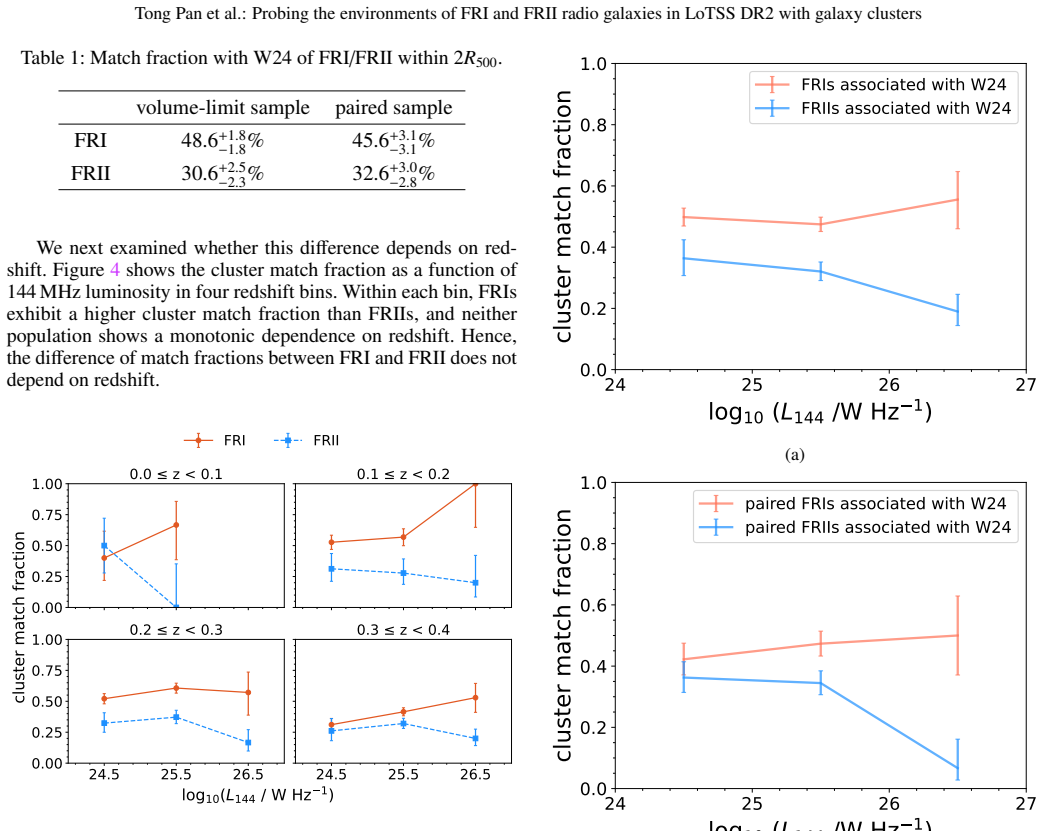
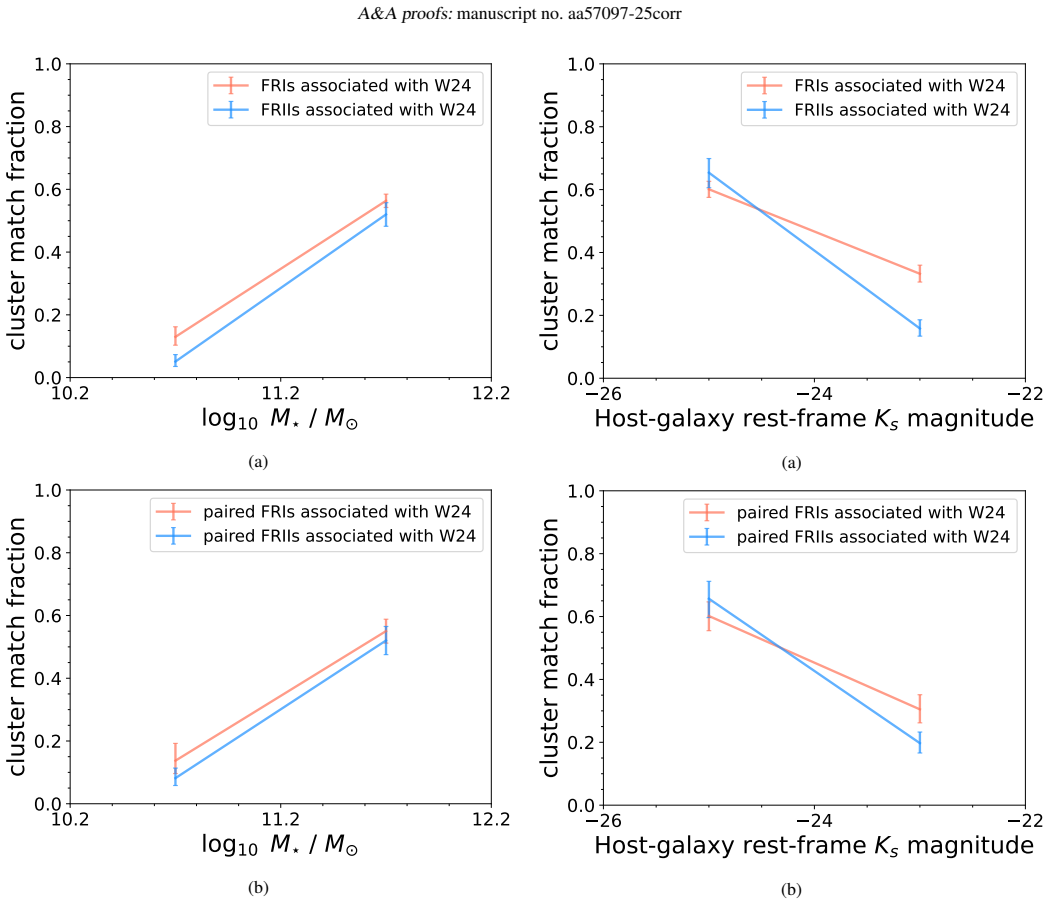
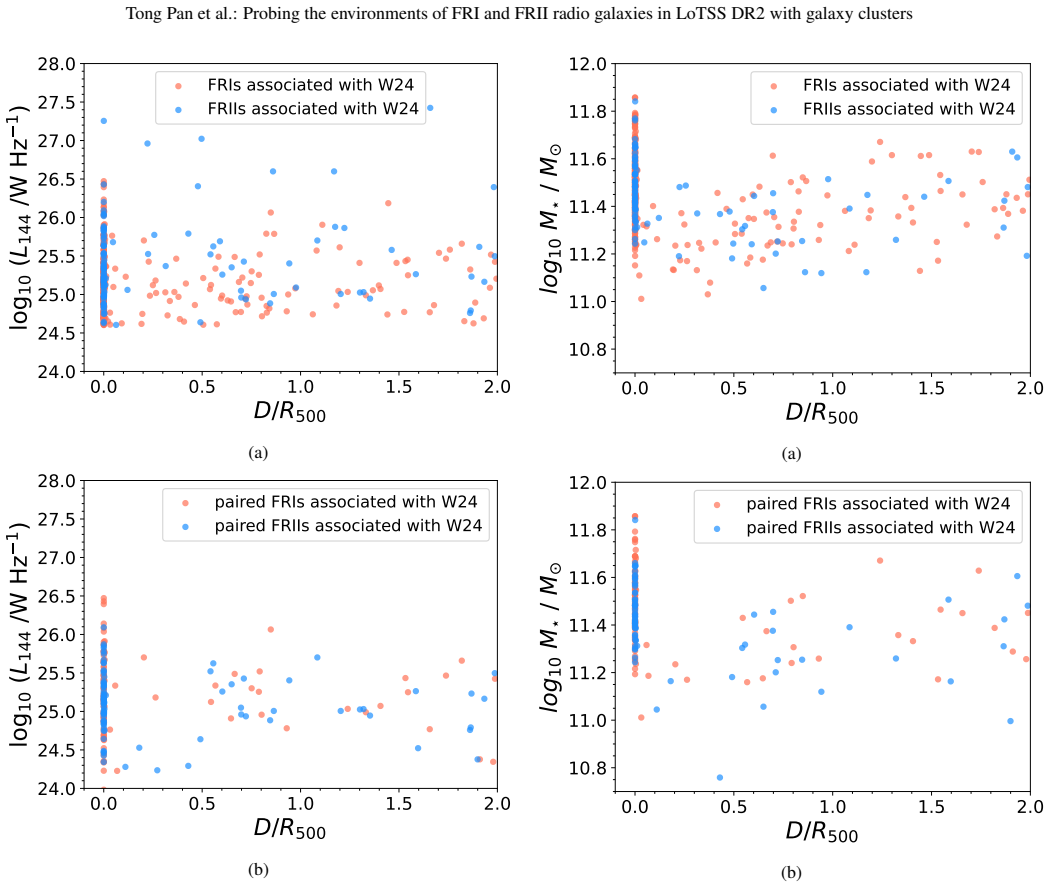
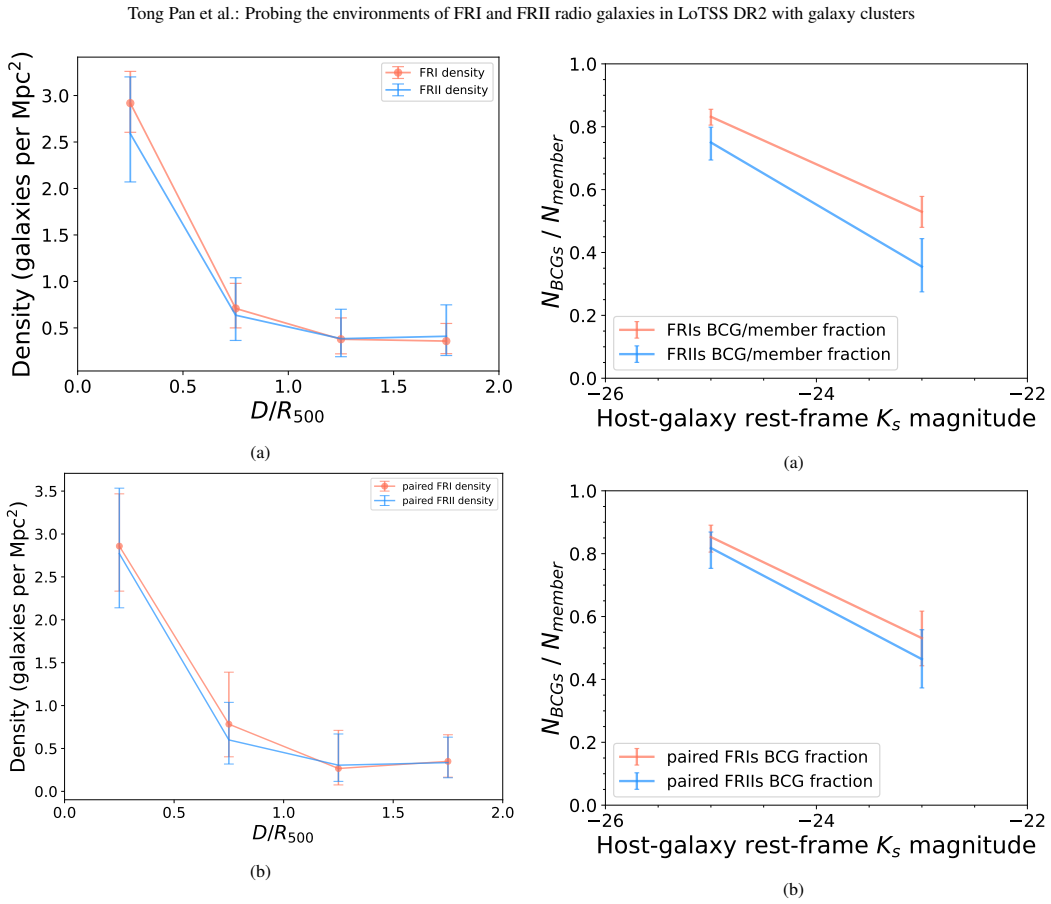
In the volume-limited sample, 48.6 percent of FRIs versus 30.6 percent of FRIIs meet the cluster association criteria of |Δz| < 0.01 and projected separation less than 2 R500; the fractions become 55.6 percent versus 19.0 percent at L_144 > 10^26 W Hz^{-1}. The luminosity-redshift paired sample yields similar differences. Cluster-associated FRIs and FRIIs nevertheless display comparable relations between radio luminosity, stellar mass, cluster richness, and M500, with both populations peaking near 0.5 R500 and declining beyond R500. Most sources in clusters are brightest cluster galaxies (74.8 percent FRIs, 61.9 percent FRIIs in the volume-limited sample).
What carries the argument
Cluster association defined by redshift difference |Δz| < 0.01 and projected separation < 2 R500, applied to compare occurrence rates, radial distributions, and scaling relations of FRI versus FRII radio galaxies.
If this is right
- Dense intracluster gas can disrupt or slow jets, preventing stable FRII structures at high radio power.
- Cluster-scale properties are unlikely to be the main cause of the FRI/FRII morphological difference.
- Both FRI and FRII sources that reside in clusters are predominantly brightest cluster galaxies.
- The radial distribution of cluster-associated sources of either type peaks near 0.5 R500 and drops beyond R500.
Where Pith is reading between the lines
- Smaller-scale factors such as jet power or the host galaxy's gas reservoir may dominate the morphological outcome.
- Direct measurements of local intracluster medium density around individual sources could test the proposed jet-disruption picture.
- Extending the same matching exercise to z > 0.4 would show whether the luminosity-dependent avoidance persists at earlier epochs.
Load-bearing premise
The redshift and separation thresholds correctly identify galaxies that are physically inside the same clusters rather than chance alignments.
What would settle it
Repeating the cross-match with spectroscopic redshifts accurate to |Δz| < 0.001 and finding that high-luminosity FRII association fractions equal those of FRIs would falsify the reported difference.
Figures



read the original abstract
The origin of the Fanaroff--Riley Class I/II (FRI/FRII) morphological dichotomy remains uncertain. We investigate whether cluster-scale environment contributes to this distinction using a morphologically classified LoTSS DR2 catalogue at \(z<0.4\). We construct a volume-limited sample with \(L_{144}>4\times10^{24}\,\mathrm{W\,Hz^{-1}}\) and a luminosity--redshift paired sample, and cross-match them with DESI Legacy Imaging Survey galaxy clusters. A radio galaxy is associated with a cluster if \(|\Delta z|<0.01\), projected separation \(<2R_{500}\). In the volume-limited sample, \(48.6\%\) of FRIs and \(30.6\%\) of FRIIs are cluster-associated; in the paired sample, the corresponding fractions are \(45.6\%\) and \(32.6\%\). The difference is stronger at \(L_{144}>10^{26}\,\mathrm{W\,Hz^{-1}}\), where the fractions are \(55.6\%\) versus \(19.0\%\) in the volume-limited sample and \(50.0\%\) versus \(6.7\%\) in the paired sample. However, cluster-associated FRIs and FRIIs occupy similar environments: their radio luminosities and stellar masses show similar trends with cluster richness and \(M_{500}\), and their radial distributions both peak near \(0.5R_{500}\) and decline beyond \(R_{500}\). Most cluster-associated sources are brightest cluster galaxies (BCGs), with fractions of \(74.8\%\) for FRIs and \(61.9\%\) for FRIIs in the volume-limited sample, and \(78.1\%\) and \(65.9\%\) in the paired sample. These results show that FRIIs are less frequently found in clusters, especially at high radio luminosity, consistent with dense intracluster gas disrupting or decelerating jets and suppressing stable FRII structures. Nevertheless, once inside clusters, FRIs and FRIIs inhabit similar large-scale environments, implying that cluster-scale properties alone are unlikely to be the primary driver of the FRI/FRII dichotomy.
Editorial analysis
A structured set of objections, weighed in public.
Referee Report
Summary. The paper claims that FRII radio galaxies from a morphologically classified LoTSS DR2 sample at z<0.4 are less frequently associated with galaxy clusters than FRIs (30.6% vs 48.6% in the volume-limited sample with L_144>4e24 W Hz^-1; 32.6% vs 45.6% in the luminosity-redshift paired sample), with the deficit stronger at L_144>1e26 W Hz^-1. Cluster-associated FRIs and FRIIs occupy similar large-scale environments (similar trends in radio luminosity and stellar mass with cluster richness and M_500; radial distributions peaking near 0.5 R_500), and most are BCGs. This is interpreted as evidence that dense intracluster gas can suppress stable FRII structures, but cluster-scale properties are unlikely to be the primary driver of the FRI/FRII dichotomy.
Significance. If the associations hold, the explicit percentages from defined volume-limited and paired samples provide a controlled observational constraint on environment's role in the FRI/FRII dichotomy, showing a morphology-dependent cluster occupancy that weakens at fixed luminosity while associated sources share similar properties. This adds to the literature on jet-environment interactions without relying on fitted parameters or self-referential derivations.
major comments (1)
- [Association criteria] Association criteria (as described in the abstract and sample construction): the adopted matching (|Δz|<0.01 and projected separation <2R500) is load-bearing for the headline cluster-fraction results (e.g., 48.6% vs 30.6% and the high-L split). At z<0.4 the redshift window spans ~3000 km/s (several times a typical cluster velocity dispersion) and the aperture reaches ~2-3 Mpc, raising the risk of line-of-sight interlopers. If contamination differs systematically between morphological classes, the reported FRII deficit could be partly spurious; the manuscript should quantify expected contamination (e.g., via random offsets or mock catalogs) or demonstrate robustness with stricter cuts.
minor comments (1)
- [Abstract and results] The abstract and results sections report fractions to one decimal place but do not state the absolute numbers of sources in each subsample; adding these (or a table of sample sizes) would improve transparency.
Simulated Author's Rebuttal
We thank the referee for their constructive comments on our manuscript. We address the single major comment below and will revise the paper accordingly to strengthen the robustness of the reported results.
read point-by-point responses
-
Referee: [Association criteria] Association criteria (as described in the abstract and sample construction): the adopted matching (|Δz|<0.01 and projected separation <2R500) is load-bearing for the headline cluster-fraction results (e.g., 48.6% vs 30.6% and the high-L split). At z<0.4 the redshift window spans ~3000 km/s (several times a typical cluster velocity dispersion) and the aperture reaches ~2-3 Mpc, raising the risk of line-of-sight interlopers. If contamination differs systematically between morphological classes, the reported FRII deficit could be partly spurious; the manuscript should quantify expected contamination (e.g., via random offsets or mock catalogs) or demonstrate robustness with stricter cuts.
Authors: We agree that a quantitative assessment of line-of-sight contamination is warranted given the adopted matching criteria. These criteria are standard in the literature for cluster associations at low redshift and were chosen to encompass typical cluster velocity dispersions and projected extents. Because the FRI and FRII samples are drawn from the same parent catalogue and classified morphologically (independent of environment), any differential contamination is expected to be modest; however, this remains an assumption. In the revised manuscript we will add an explicit contamination estimate using randomized offset catalogues (both positional and redshift shifts) applied separately to the FRI and FRII subsamples. The resulting false-association rates will be reported for the volume-limited and paired samples, including the high-luminosity subsets, together with a brief discussion of their impact on the observed FRII deficit. We will also present results for a stricter redshift cut (|Δz|<0.005) as a robustness check. These additions will directly address the referee's concern without altering the headline conclusions. revision: yes
Circularity Check
No circularity; purely observational catalog cross-matching and counting
full rationale
The paper's central results consist of empirical fractions of radio galaxies associated with clusters, obtained by applying fixed, externally motivated matching criteria (|Δz|<0.01 and projected separation <2R500) to existing catalogs and then counting. No model equations, parameter fits, predictions, or self-citations are invoked to derive these fractions; the association step is a direct data operation, not a derivation that reduces to its own inputs. Secondary statements about similar environments inside clusters are likewise direct comparisons of the matched subsamples. No load-bearing step matches any of the enumerated circularity patterns.
Axiom & Free-Parameter Ledger
axioms (2)
- domain assumption The morphological classification of FRI/FRII sources in the LoTSS DR2 catalogue is reliable and unbiased.
- domain assumption The redshift and projected-separation cuts identify true physical associations rather than line-of-sight projections.
Reference graph
Works this paper leans on
- [1]
-
[2]
Barkus, B., Croston, J. H., Piotrowska, J., et al. 2022, MNRAS, 509, 1
work page 2022
-
[3]
Becker, R. H., White, R. L., & Helfand, D. J. 1994, in Astronomical Society of the Pacific Conference Series, V ol. 61, Astronomical Data Analysis Software and Systems III, ed. D. R. Crabtree, R. J. Hanisch, & J. Barnes, 165
work page 1994
-
[4]
Best, P. N. 2009, Astronomische Nachrichten, 330, 184
work page 2009
-
[5]
Bicknell, G. V . 1994, ApJ, 422, 542
work page 1994
-
[6]
Bicknell, G. V . 1995, ApJS, 101, 29
work page 1995
- [7]
-
[8]
Capetti, A., Massaro, F., & Baldi, R. D. 2017, A&A, 601, A81
work page 2017
-
[9]
Castignani, G., Chiaberge, M., Celotti, A., & Norman, C. 2014, ApJ, 792, 113
work page 2014
-
[10]
Chiaberge, M., Tremblay, G., Capetti, A., et al. 2009, ApJ, 696, 1103
work page 2009
-
[11]
Clews, L., Croston, J. H., Dickinson, H., et al. 2025, MNRAS de Jong, J. M. G. H. J., Röttgering, H. J. A., Kondapally, R., et al. 2024, A&A, 683, A23 DESI Collaboration, Adame, A. G., Aguilar, J., et al. 2024, AJ, 168, 58
work page 2025
- [12]
-
[13]
Fanaroff, B. L. & Riley, J. M. 1974, MNRAS, 167, 31P
work page 1974
-
[14]
Gendre, M. A., Best, P. N., Wall, J. V ., & Ker, L. M. 2013, MNRAS, 430, 3086
work page 2013
-
[15]
Hardcastle, M. J. & Croston, J. H. 2020, New A Rev., 88, 101539
work page 2020
-
[16]
Hardcastle, M. J., Pierce, J. C. S., Duncan, K. J., et al. 2025, MNRAS, 539, 1856
work page 2025
- [17]
-
[18]
1946, Proceedings of the Royal Society of London Series A, 186, 453
Jeffreys, H. 1946, Proceedings of the Royal Society of London Series A, 186, 453
work page 1946
-
[19]
Kaiser, C. R. & Best, P. N. 2007, MNRAS, 381, 1548
work page 2007
-
[20]
Klein, M., Hernández-Lang, D., Mohr, J. J., Bocquet, S., & Singh, A. 2023, MNRAS, 526, 3757
work page 2023
-
[21]
Konishi, M., Akiyama, M., Kajisawa, M., et al. 2011, PASJ, 63, S363
work page 2011
-
[22]
Laing, R. A. & Bridle, A. H. 2002, MNRAS, 336, 1161
work page 2002
-
[23]
Laing, R. A. & Bridle, A. H. 2014, MNRAS, 437, 3405
work page 2014
-
[24]
Ledlow, M. J. & Owen, F. N. 1996, AJ, 112, 9
work page 1996
-
[25]
Lin, Y .-T., Shen, Y ., Strauss, M. A., Richards, G. T., & Lunnan, R. 2010, ApJ, 723, 1119
work page 2010
- [26]
- [27]
-
[28]
Massaro, F., Álvarez-Crespo, N., Capetti, A., et al. 2019, ApJS, 240, 20
work page 2019
- [29]
- [30]
-
[31]
Mingo, B., Croston, J. H., Hardcastle, M. J., et al. 2019, MNRAS, 488, 2701
work page 2019
-
[32]
Mirakhor, M. S. & Walker, S. A. 2020, MNRAS, 497, 3204
work page 2020
-
[33]
Morandi, A., Sun, M., Forman, W., & Jones, C. 2015, MNRAS, 450, 2261
work page 2015
-
[34]
Muldrew, S. I., Croton, D. J., Skibba, R. A., et al. 2012, MNRAS, 419, 2670
work page 2012
-
[35]
Pan, T., Fu, Y ., Rottgering, H. J. A., et al. 2025, A&A, 695, A69
work page 2025
-
[36]
Pedlar, A., Ghataure, H. S., Davies, R. D., et al. 1990, MNRAS, 246, 477
work page 1990
-
[37]
Perucho, M. & Martí, J. M. 2007, MNRAS, 382, 526 Planck Collaboration, Ade, P. A. R., Aghanim, N., et al. 2016, A&A, 594, A27
work page 2007
- [38]
-
[39]
Shabala, S. S. 2018, MNRAS, 478, 5074
work page 2018
-
[40]
Shimwell, T. W., Hardcastle, M. J., Tasse, C., et al. 2022, A&A, 659, A1
work page 2022
-
[41]
Shimwell, T. W., Röttgering, H. J. A., Best, P. N., et al. 2017, A&A, 598, A104
work page 2017
-
[42]
Singal, A. K. & Rajpurohit, K. 2014, MNRAS, 442, 1656
work page 2014
-
[43]
Smith, D. J. B., Best, P. N., Duncan, K. J., et al. 2016, in SF2A-2016: Proceedings of the Annual meeting of the French Society of Astronomy and Astrophysics, ed. C. Reylé, J. Richard, L. Cambrésy, M. Deleuil, E. Pécontal, L. Tresse, & I. Vauglin, 271–280
work page 2016
-
[44]
Smith, H. E., Spinrad, H., & Smith, E. O. 1976, PASP, 88, 621
work page 1976
-
[45]
Tchekhovskoy, A. & Bromberg, O. 2016, MNRAS, 461, L46 van Haarlem, M. P., Wise, M. W., Gunst, A. W., et al. 2013, A&A, 556, A2
work page 2016
-
[46]
Vardoulaki, E., Jiménez Andrade, E. F., Delvecchio, I., et al. 2021, A&A, 648, A102
work page 2021
- [47]
-
[48]
Wen, Z. L. & Han, J. L. 2024, ApJS, 272, 39
work page 2024
-
[49]
Wing, J. D. & Blanton, E. L. 2011, AJ, 141, 88
work page 2011
-
[50]
Zirbel, E. L. 1997, ApJ, 476, 489 Article number, page 11 A&A proofs:manuscript no. aa57097-25corr Appendix A: Examples FRI/FRII radio galaxies and their associated clusters Table A.1 lists five FRI and five FRII radio galaxies together with their associated W24 clusters. The columns give the Equatorial coordinates, redshift, and radio luminosity of the r...
work page 1997
discussion (0)
Sign in with ORCID, Apple, or X to comment. Anyone can read and Pith papers without signing in.