A Koopman Operator Framework for Nonlinear Epidemic Dynamics: Application to an SIRSD Model
Pith reviewed 2026-05-21 22:40 UTC · model grok-4.3
The pith
A Koopman operator with EDMD approximates nonlinear SIRSD dynamics and predicts peak infections from synthetic data across multiple diseases.
A machine-rendered reading of the paper's core claim, the machinery that carries it, and where it could break.
Core claim
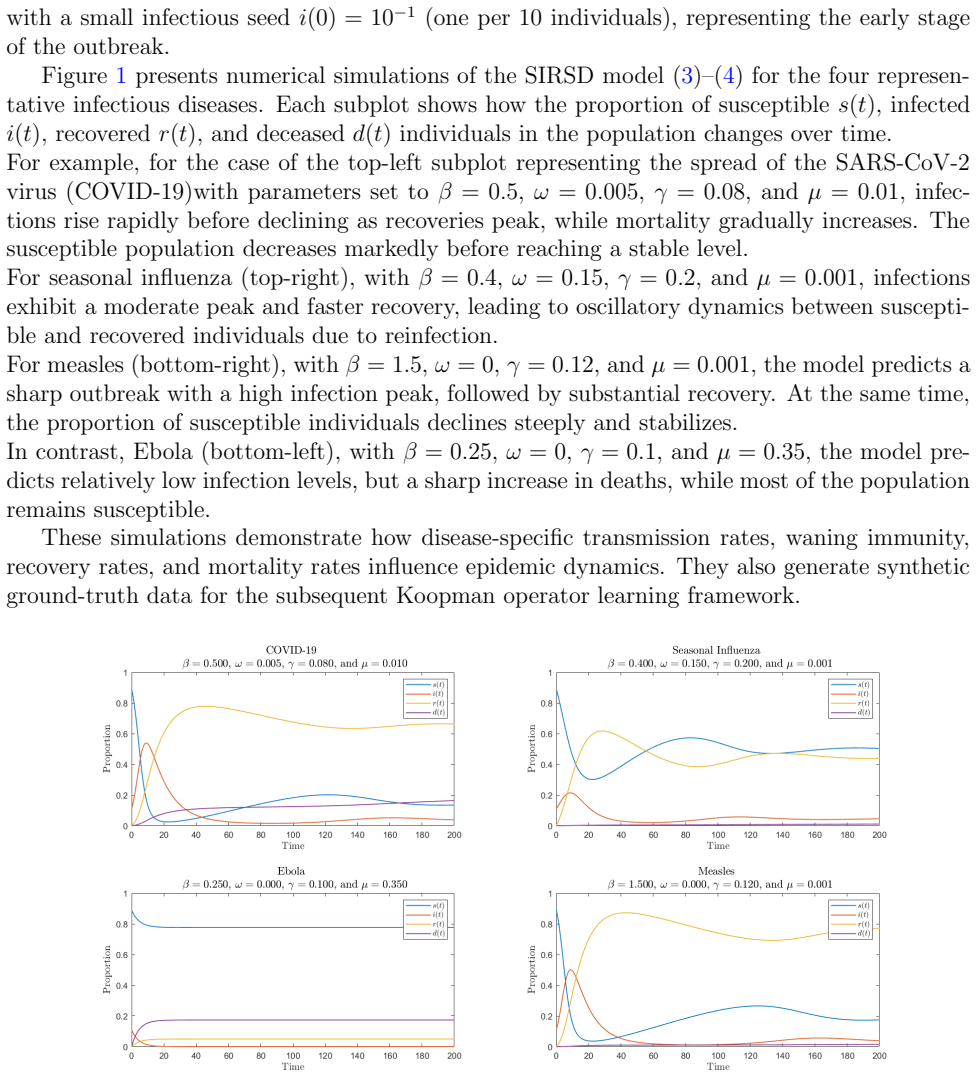
The central claim is that the Koopman operator framework, realized through extended dynamic mode decomposition with an epidemiologically informed dictionary on the normalized SIRSD system, identifies dominant epidemic modes and accurately predicts outbreak features including peak infection dynamics when tested on synthetic data generated by a nonstandard finite difference scheme for SARS-CoV-2, seasonal influenza, Ebola, and measles.
What carries the argument
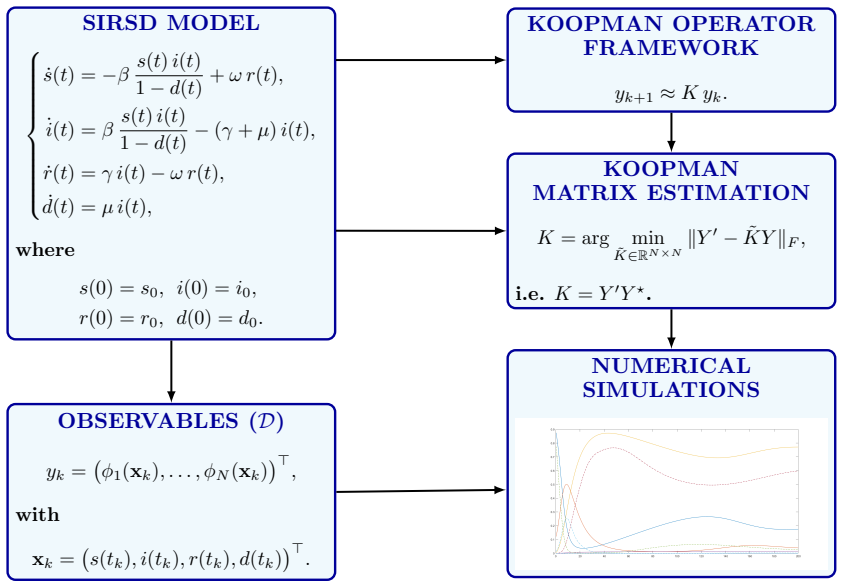
The extended dynamic mode decomposition (EDMD) approximation of the Koopman operator applied to a dictionary of epidemiological observables on the normalized SIRSD state variables, with comparison between a minimal dictionary and one augmented by nonlinear and cross terms.
If this is right
- Dominant modes extracted by the operator can be used to analyze long-term epidemic behavior without repeated full nonlinear integration.
- Peak infection timing and other outbreak metrics become directly computable from the linear Koopman representation for the tested diseases.
- Enriching the dictionary with nonlinear and cross terms measurably improves fidelity to the original SIRSD trajectories.
- The normalized formulation supports both rigorous existence proofs and the subsequent data-driven Koopman construction in a single consistent variable set.
Where Pith is reading between the lines
- The same pipeline could be tested on streaming surveillance data to assess real-time forecasting performance beyond synthetic cases.
- The framework may transfer to other compartmental models that include waning immunity or mortality terms once an appropriate dictionary is chosen.
- Error bounds on the EDMD approximation could be derived to quantify prediction uncertainty for different epidemic parameter regimes.
Load-bearing premise
The synthetic trajectories produced by the nonstandard finite difference scheme are representative enough that the chosen dictionary and EDMD procedure recover the essential nonlinear dynamics without large approximation errors.
What would settle it
If the predicted peak infection times from the Koopman model deviate substantially from observed historical peaks when the same procedure is applied to real reported case data for measles or Ebola, the accuracy claim would be refuted.
Figures


read the original abstract
We develop and analyze an SIRSD epidemic model, which extends the classical SIR framework by incorporating waning immunity and disease-induced mortality. A rigorous well-posedness analysis ensures the existence, uniqueness, positivity, and boundedness of solutions, guaranteeing the model's epidemiological feasibility. To facilitate theoretical investigations and data-driven modeling, we reformulated the system in normalized variables. To capture and predict complex nonlinear epidemic dynamics, we use the Koopman operator framework with extended dynamic mode decomposition (EDMD) and an epidemiologically informed dictionary of observables. We compare two Koopman approximations: one based on a minimal epidemiological dictionary and another enriched with nonlinear and cross terms. We generate synthetic data using a nonstandard finite difference (NSFD) scheme for four representative epidemics: SARS-CoV-2, seasonal influenza, Ebola, and measles. Numerical experiments demonstrate that the Koopman-based approach effectively identifies dominant epidemic modes and accurately predicts key outbreak characteristics, including peak infection dynamics.
Editorial analysis
A structured set of objections, weighed in public.
Referee Report
Summary. The manuscript develops an SIRSD epidemic model extending the classical SIR framework with waning immunity and disease-induced mortality. It provides a rigorous well-posedness analysis ensuring existence, uniqueness, positivity, and boundedness of solutions, reformulates the system in normalized variables, and applies the Koopman operator with extended dynamic mode decomposition (EDMD) using an epidemiologically informed dictionary. Synthetic trajectories are generated via a nonstandard finite difference (NSFD) scheme for four representative epidemics (SARS-CoV-2, seasonal influenza, Ebola, measles). Numerical experiments compare a minimal epidemiological dictionary against an enriched version with nonlinear and cross terms, claiming that the approach identifies dominant epidemic modes and accurately predicts key outbreak characteristics including peak infection dynamics.
Significance. If the numerical validation is strengthened, the work provides a data-driven Koopman framework for capturing nonlinear dynamics in extended epidemic models, potentially useful for mode identification and peak prediction. The combination of theoretical well-posedness with EDMD on structure-preserving discretizations is a positive aspect, though the accuracy claims currently lack quantitative anchoring.
major comments (2)
- [Numerical Experiments] Numerical experiments section: The central claim that the Koopman-EDMD approach 'accurately predicts key outbreak characteristics, including peak infection dynamics' depends on the enriched dictionary applied to NSFD-generated data faithfully approximating the true continuous SIRSD flow. No a-posteriori residual norms, no comparison against a standard ODE integrator on identical initial conditions, and no sensitivity tests to NSFD step size are reported, leaving the prediction accuracy without an independent verification anchor.
- [Well-posedness Analysis and EDMD Approximation] Well-posedness and EDMD sections: The abstract asserts well-posedness results and prediction accuracy, yet the manuscript supplies no explicit derivations for the well-posedness theorems, no quantitative error metrics (e.g., peak timing or amplitude errors), and no verification details for the EDMD approximation quality on the synthetic trajectories.
minor comments (2)
- [Dictionary Construction] Clarify the precise composition of the 'enriched' dictionary observables (e.g., which nonlinear and cross terms are included) and ensure consistent notation for the normalized variables across sections.
- [Numerical Experiments] Consider adding a brief comparison table of prediction errors across the four epidemics and the two dictionaries to make the accuracy claims more transparent.
Simulated Author's Rebuttal
We thank the referee for their thorough review and valuable suggestions. We have carefully considered the comments and will revise the manuscript to address the concerns regarding numerical validation and the presentation of theoretical results. Below, we provide point-by-point responses to the major comments.
read point-by-point responses
-
Referee: [Numerical Experiments] Numerical experiments section: The central claim that the Koopman-EDMD approach 'accurately predicts key outbreak characteristics, including peak infection dynamics' depends on the enriched dictionary applied to NSFD-generated data faithfully approximating the true continuous SIRSD flow. No a-posteriori residual norms, no comparison against a standard ODE integrator on identical initial conditions, and no sensitivity tests to NSFD step size are reported, leaving the prediction accuracy without an independent verification anchor.
Authors: We agree that additional verification of the NSFD scheme would strengthen the numerical claims. The NSFD discretization was deliberately chosen to preserve positivity and boundedness, which are essential for the epidemiological validity of the SIRSD model. In the revised manuscript we will add direct comparisons of NSFD trajectories against a standard ODE integrator (e.g., MATLAB ode45) on identical initial conditions, report a-posteriori residual norms, and include sensitivity tests with respect to step size, quantifying the resulting errors in peak timing and amplitude. These additions will supply the requested independent verification anchor. revision: yes
-
Referee: [Well-posedness Analysis and EDMD Approximation] Well-posedness and EDMD sections: The abstract asserts well-posedness results and prediction accuracy, yet the manuscript supplies no explicit derivations for the well-posedness theorems, no quantitative error metrics (e.g., peak timing or amplitude errors), and no verification details for the EDMD approximation quality on the synthetic trajectories.
Authors: The well-posedness analysis appears in Section 3, where existence and uniqueness follow from the Picard-Lindelöf theorem and positivity/boundedness are established via invariant-region arguments. We acknowledge that the derivations can be made more explicit. In the revision we will expand the proofs with additional intermediate steps. We will also insert quantitative tables reporting relative errors in peak timing and amplitude for both dictionary choices across the four diseases, together with EDMD verification metrics such as Koopman residual norms and reconstruction errors on held-out synthetic trajectories. revision: yes
Circularity Check
No significant circularity; derivation is self-contained
full rationale
The paper first defines the SIRSD model and performs a standard well-posedness analysis (existence, uniqueness, positivity, boundedness) in normalized variables. It then generates synthetic trajectories via an NSFD discretization of that same model and applies EDMD with an epidemiologically informed dictionary to obtain a linear Koopman approximation. The numerical claims concern the quality of this approximation on the generated data (dominant modes, peak prediction). This workflow is a conventional data-driven validation exercise: the EDMD step is a least-squares fit to observed trajectories rather than a redefinition or tautological renaming of the original vector field. No load-bearing step reduces by construction to a fitted parameter, a self-citation chain, or an imported uniqueness theorem; the central results rest on explicit numerical comparison rather than on any circular equivalence between inputs and outputs.
Axiom & Free-Parameter Ledger
free parameters (1)
- Dictionary observables
axioms (2)
- domain assumption Existence, uniqueness, positivity, and boundedness of solutions for the SIRSD system.
- domain assumption The NSFD scheme generates accurate synthetic trajectories for the continuous SIRSD model.
Lean theorems connected to this paper
-
IndisputableMonolith/Cost/FunctionalEquation.leanwashburn_uniqueness_aczel unclear?
unclearRelation between the paper passage and the cited Recognition theorem.
We compare two Koopman approximations: one based on a minimal epidemiological dictionary and another enriched with nonlinear and cross terms... D2 = {s, i, r, d, si, sr, ir, si/(1-d), s², i², r², d²}
-
IndisputableMonolith/Foundation/RealityFromDistinction.leanreality_from_one_distinction unclear?
unclearRelation between the paper passage and the cited Recognition theorem.
Numerical experiments demonstrate that the Koopman-based approach effectively identifies dominant epidemic modes and accurately predicts key outbreak characteristics, including peak infection dynamics.
What do these tags mean?
- matches
- The paper's claim is directly supported by a theorem in the formal canon.
- supports
- The theorem supports part of the paper's argument, but the paper may add assumptions or extra steps.
- extends
- The paper goes beyond the formal theorem; the theorem is a base layer rather than the whole result.
- uses
- The paper appears to rely on the theorem as machinery.
- contradicts
- The paper's claim conflicts with a theorem or certificate in the canon.
- unclear
- Pith found a possible connection, but the passage is too broad, indirect, or ambiguous to say the theorem truly supports the claim.
Reference graph
Works this paper leans on
-
[1]
V. Bitsouni, N. Gialelis, and V. Tsilidis. An age-structured SVEAIR epidemiological model. Mathematical Methods in the Applied Sciences , 47(16):12460–12486, 2024
work page 2024
-
[2]
M. Sekiguchi and E. Ishiwata. Dynamics of a discretized SIR epidemic model with pulse vaccination and time delay. Journal of Computational and Applied Mathematics , 236(6):997–1008, 2011
work page 2011
- [3]
-
[4]
S. Lopez and N. L. Komarova. An optimal network that promotes the spread of an advantageous variant in an SIR epidemic. Journal of Theoretical Biology, 605:112095, 2025
work page 2025
-
[5]
S. Guerrero-Flores, O. Osuna, and C. Vargas-De-Le´ on. Periodic solutions of seasonal epidemiological models with information-dependent vaccination. Mathematical Methods in the Applied Sciences , 47(4):1961–1972, 2023
work page 1961
- [6]
-
[7]
L. B. Puglisi, G. S.P. Malloy, T. D. Harvey, M. L. Brandeau, and E. A. Wang. Estimation of COVID-19 basic reproduction ratio in a large urban jail in the United States. Annals of Epidemiology , 53:103–105, 2021
work page 2021
-
[8]
M. V. I. Soto-Rocha, O. Walle-Garc´ ıa, F. Salda˜ na-Jim´ enez, F. Hern´ andez-Cabrera, and F.J. Almaguer- Mart´ ınez. COVID-19 infection and recovery rates in Mexico: An ARMA time series model. Journal of Computational and Applied Mathematics , 472:116781, 2026
work page 2026
-
[9]
O. Simeonov and C. D. Eaton. Modeling the drivers of oscillations in COVID-19 data on college campuses. Annals of Epidemiology, 82:40–44, 2023
work page 2023
-
[10]
A Nonstandard Finite Difference Scheme for an SEIQR Epidemiological PDE Model
A. Zinihi, M. Ehrhardt, and M. R. Sidi Ammi. A nonstandard finite difference scheme for an SEIQR epidemiological PDE model, 2025. arXiv preprint 2508.02928
work page internal anchor Pith review Pith/arXiv arXiv 2025
- [11]
- [12]
- [13]
-
[14]
M. T. Hoang and M. Ehrhardt. A dynamically consistent nonstandard finite difference scheme for a generalized SEIR epidemic model. Journal of Difference Equations and Applications , 30(4):409–434, 2023. 16
work page 2023
- [15]
- [16]
-
[17]
S. L. Brunton, M. Budiˇ si´ c, E. Kaiser, and J. N. Kutz. Modern Koopman theory for dynamical systems. SIAM Review, 64(2):229–340, 2022
work page 2022
-
[18]
T. Berry and S. Das. Limits of learning dynamical systems. SIAM Review, 67(1):107–137, 2025
work page 2025
-
[19]
W. A. Manzoor, S. Rawashdeh, and A. Mohammadi. Vehicular applications of Koopman operator theory – A survey. IEEE Access, 11:25917–25931, 2023
work page 2023
-
[20]
I. Mezi´ c, Z. Drmaˇ c, N.ˇCrnjari´ c, S. Ma´ ceˇ si´ c, M. Fonoberova, R. Mohr, A. M. Avila, I. Manojlovi´ c, and A. Andrejˇ cuk. A Koopman operator-based prediction algorithm and its application to COVID-19 pandemic and influenza cases. Scientific Reports, 14(1), 2024
work page 2024
-
[21]
J. L. Proctor and P. A. Eckhoff. Discovering dynamic patterns from infectious disease data using dynamic mode decomposition. International Health, 7(2):139–145, 2015
work page 2015
-
[22]
S. Mustavee, S. Agarwal, C. Enyioha, and S. Das. A linear dynamical perspective on epidemiology: Interplay between early COVID-19 outbreak and human mobility. Nonlinear Dynamics, 109(2):1233–1252, 2022
work page 2022
-
[23]
J. L. Proctor, S. L. Brunton, and J. N. Kutz. Generalizing Koopman theory to allow for inputs and control. SIAM Journal on Applied Dynamical Systems , 17(1):909–930, 2018
work page 2018
-
[24]
N. Takeishi, Y. Kawahara, and T. Yairi. Subspace dynamic mode decomposition for stochastic Koopman analysis. Physical Review E, 96(3), 2017
work page 2017
-
[25]
Z. Xu, R. Dai, and K. C. Howell. Tensor-based Koopman operator and its application to optimal control problems. Journal of Guidance, Control, and Dynamics , page 1–13, 2025
work page 2025
- [26]
- [27]
- [28]
-
[29]
M Korda and I. Mezi´ c. On convergence of extended dynamic mode decomposition to the Koopman operator. Journal of Nonlinear Science , 28(2):687–710, 2017
work page 2017
-
[30]
Y. Jin, L. Hou, and S. Zhong. Extended dynamic mode decomposition with invertible dictionary learning. Neural Networks, 173:106177, 2024
work page 2024
-
[31]
R. E. Mickens. Nonstandard finite difference models of differential equations . World Scientific, 1993
work page 1993
-
[32]
M. Ehrhardt and R. E. Mickens. A nonstandard finite difference scheme for convection–diffusion equations having constant coefficients. Applied Mathematics and Computation , 219(12):6591–6604, 2013
work page 2013
-
[33]
G. Costa, M. Lobosco, M. Ehrhardt, and R. Reis. Mathematical analysis and a nonstandard scheme for a model of the immune response against COVID-19. Mathematical and Computational Modeling of Phenomena Arising in Population Biology and Nonlinear Oscillations , page 251–270, 2024
work page 2024
-
[34]
M. H. Maamar, M. Ehrhardt, and L. Tabharit. A nonstandard finite difference scheme for a time-fractional model of Zika virus transmission. Mathematical Biosciences and Engineering , 21(1):924–962, 2023
work page 2023
-
[35]
COVID-19 dashboard; https://coronavirus.jhu.edu/data, Accessed on: August 18, 2025 (2020)
Johns Hopkins University. COVID-19 dashboard; https://coronavirus.jhu.edu/data, Accessed on: August 18, 2025 (2020)
work page 2025
-
[36]
Centers for Disease Control and Prevention. CDC COVID data tracker; https://www.cdc.gov/ covid-data-tracker/index.html, Accessed on: August 18, 2025
work page 2025
-
[37]
Seasonal influenza (Flu), https://www.cdc.gov/flu/index.htm, Accessed on: August 18, 2025
Centers for Disease Control and Prevention. Seasonal influenza (Flu), https://www.cdc.gov/flu/index.htm, Accessed on: August 18, 2025
work page 2025
-
[38]
Seasonal influenza data; https://www.ecdc.europa
European Centre for Disease Prevention and Control. Seasonal influenza data; https://www.ecdc.europa. eu/en/seasonal-influenza, Accessed on: August 18, 2025
work page 2025
-
[39]
Centers for Disease Control and Prevention. Ebola virus disease outbreak, West Africa, october 2014; https://www.cdc.gov/mmwr/preview/mmwrhtml/mm6343a3.htm, Accessed on: August 18, 2025
work page 2014
-
[40]
World Health Organization. Ebola outbreak 2014–2016, West Africa; https://www.who.int/emergencies/ situations/ebola-outbreak-2014-2016-west-africa, Accessed on: August 18, 2025
work page 2014
-
[41]
Centers for Disease Control and Prevention. Measles Surveillance Manual; https://www.cdc.gov/ surv-manual/php/table-of-contents/chapter-7-measles.html, Accessed on: August 18, 2025
work page 2025
-
[42]
Centers for Disease Control and Prevention. Pink Book – Measles; https://www.cdc.gov/pinkbook/hcp/ table-of-contents/chapter-13-measles.html, Accessed on: August 18, 2025. 17
work page 2025
discussion (0)
Sign in with ORCID, Apple, or X to comment. Anyone can read and Pith papers without signing in.