REVIEW 3 major objections 7 minor 59 references
Analysis of inverse stochastic resonance: Effects of neural excitability and timescale separation
T0 review · 3 major / 7 minor · reviewed 2026-08-15 · deepseek-v4-flash
Pith's one-line read A sign criterion decides when noise truly silences a bistable neuron's spiking.
desk verdict A useful quasi-potential partition and a correct invariant-measure proof, but the headline ISR-minimum prediction rests on a validation fit that is largely censored and needs major revision before the quantitative claims stand. read the letter →
The pith
A machine-rendered reading of the paper's core claim, the machinery that carries it, and where it could break.
The reading
What carries the argument
The mechanism that carries the argument is the reduced metastable two-state description of the bistable neuron: the trajectory spends long random times near the fixed point or near the limit cycle and occasionally crosses the separating unstable cycle, after which it forgets its history. Two computed ingredients enter. The first is the quasi-potential barrier difference $\Delta S(a,\varepsilon) = S_{\mathrm{LC}} - S_{\mathrm{FP}}$, obtained from a degenerate-noise geometric minimum action method that finds the least noise-action path from each attractor to the separatrix. The second is the weak-noise form of the mean exit times, $E[\tau] \sim P\,\sigma^\beta \exp(S/\sigma^2)$, whose ratio produces the occupation formula, the sign criterion $\Delta S\,\beta < 0$, and the explicit minimizer $\sigma_*^2 = -2\Delta S/\beta$.
What would settle it
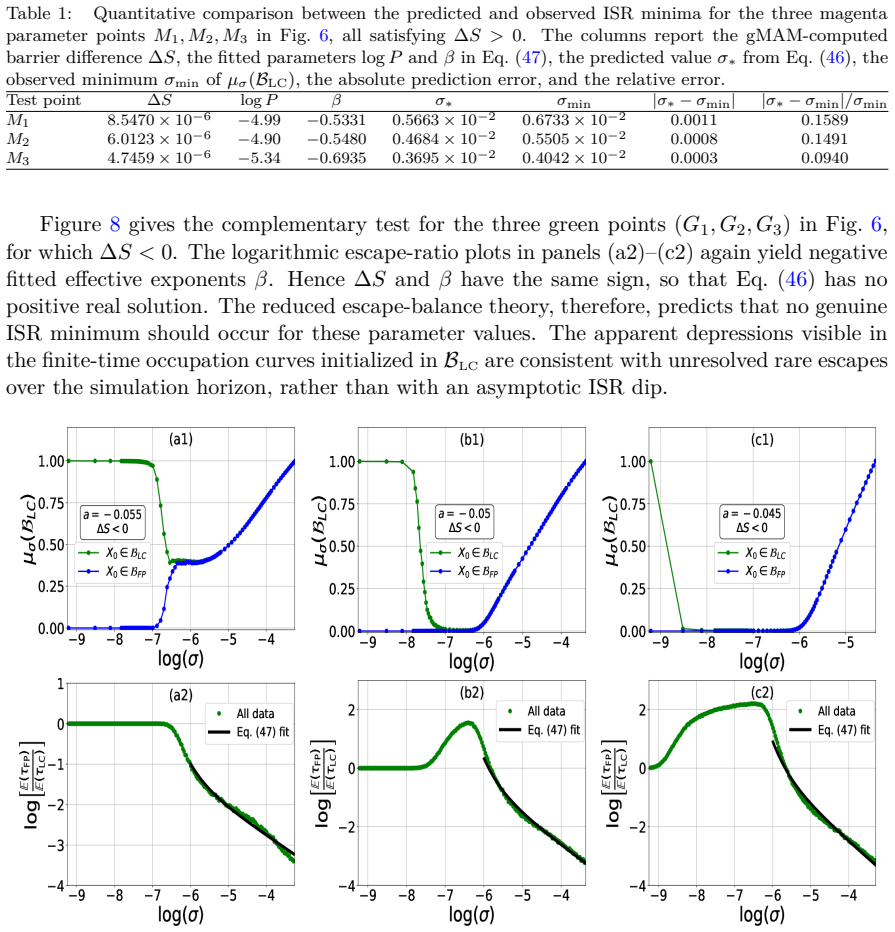
Run the same Monte Carlo protocol for a green test point such as $G_1$, where $\Delta S < 0$ and the fitted $\beta < 0$, with a substantially longer horizon than $T = 2.5\times10^5$; if an interior minimum in $\mu_\sigma(B_{\mathrm{LC}})$ persists and deepens as $T$ grows, the claim that no genuine asymptotic ISR occurs on the $\Delta S < 0$ side fails. Independently, at a $\Delta S > 0$ point, an extended fit of $\beta$ over a wider weak-noise window that yields a positive slope would leave Eq. (46) with no positive solution and contradict the predicted minimum.
Extended reading notes
Core claim
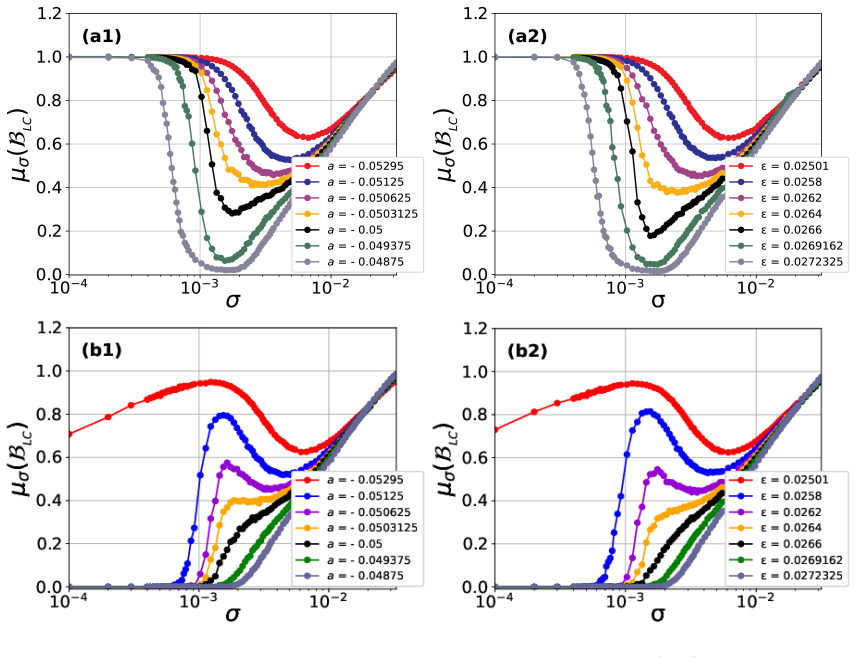
The central claim, stated on the paper's own terms, is this. In the bistable wedge of the $(a,\varepsilon)$ parameter plane where a stable quiescent fixed point and a stable spiking limit cycle coexist, the weak-noise occupation probability of the limit-cycle basin has the closed form $$\mu_\$\sigma$(B_\mathrm{LC}^\delta) = \left[1 + P\,\$\sigma$^\$\beta$ \exp\left(-\frac{\$\Delta$ S}{\$sigma^{2}$}\right)\right]^{-1},$$ where $\Delta S = S_{\mathrm{LC}} - S_{\mathrm{FP}}$ is the difference between the quasi-potential escape barriers to the separating unstable cycle. From this expression the paper derives the sign criterion $\Delta S\,\beta < 0$ for non-monotone dependence on $\sigma$ and, in the fitted regime where $\beta < 0$, predicts a genuine ISR minimum only on the $\Delta S > 0$ side of the wedge, at $\sigma_*^2 = -2\Delta S/\beta$. It also proves uniqueness of the invariant measure for the stochastic FitzHugh-Nagumo system, so the apparent dependence of finite-time ISR curves on the initial basin is not asymptotic. Tables 1 and 2 report semiquantitative agreement between the predicted minimizer and the Monte Carlo occupation minima at three $\Delta S > 0$ points, and absence of an asymptotic dip at three $\Delta S < 0$ points.
Load-bearing premise
The load-bearing premise is that, at the small noise levels used in the fits, the neuron's stays in the quiet and spiking states are independent random waits whose average sizes follow the stated exponential-and-power-law escape formula, so the two-state jump process faithfully represents the real dynamics.
Editorial extensions
If this is right
- If the formula and sign criterion are correct, the existence and location of the ISR dip in a bistable neuron are fixed by two computable quantities: the quasi-potential barrier difference and the effective noise exponent of the escape-time prefactors.
- Near the curve $\Delta S = 0$, the predicted minimizer $\sigma_*$ approaches zero, so the model exhibits full inverse stochastic resonance: arbitrarily close to the balance curve, an arbitrarily weak noise can drive the spiking-basin occupation toward zero.
- Because a unique invariant measure guarantees that initial-condition dependence vanishes asymptotically, finite-time Monte Carlo studies of ISR must sample both escape directions sufficiently before a noise-induced dip can be attributed to genuine ISR.
- The semiquantitative agreement in Tables 1 and 2 suggests the same escape-balance formula can be used as a parameter-dependent diagnostic for ISR in slow-fast excitable models of the FitzHugh-Nagumo type.
Reading between the lines
- Extending the paper's logic, the sign criterion should be testable in other two-variable excitable neuron models: only the quasi-potential barrier difference and the fitted exponent are needed, since the formula does not use the specific polynomial drift of the FitzHugh-Nagumo system.
- A natural reading the paper leaves implicit is that the ISR dip is a minimum of a ratio of two Arrhenius-type rates, where the power-law prefactor $\sigma^\beta$ tilts the exponential competition; this explains why the sign of $\beta$ matters as much as the ordering of the barriers.
- A practical consequence for network-scale simulations: because one escape direction can be exponentially rarer than the other, reported ISR dips in finite-horizon studies may disappear when the simulation time is increased, even in parameter regions where the two-state formula would predict a genuine minimum.
Signed reviews
Editorial analysis
A structured set of objections, weighed in public.
Referee Report
Summary. The paper studies inverse stochastic resonance (ISR) in a bistable FitzHugh–Nagumo neuron driven by additive voltage noise. After identifying a bistable wedge in the (a,ε) parameter plane via deterministic bifurcation analysis, it shows that finite-time Monte Carlo occupation curves of the limit-cycle basin can depend on the initial basin, and proves that this dependence disappears asymptotically: the SDE admits a unique invariant probability measure (Theorem 5.1, Appendix). The paper then computes quasi-potential barriers S_FP and S_LC with a degenerate-noise geometric minimum action method, and uses their difference ΔS = S_LC − S_FP to partition the wedge into two escape-dominated regimes. A reduced two-state Markov approximation leads to the occupation formula μσ(B_LC) = [1 + P σ^β exp(−ΔS/σ²)]^{-1}, the sign criterion ΔSβ < 0 for genuine ISR, and the predicted ISR-minimizing noise amplitude σ*² = −2ΔS/β. These predictions are compared with Monte Carlo simulations at three parameter points with ΔS > 0 and three with ΔS < 0.
Significance. The invariant-measure theorem is a solid and useful contribution: it cleanly separates finite-time initial-condition effects from asymptotic behavior and is proved with standard tools (Lyapunov function, Hörmander bracket condition, strong Feller property, irreducibility). The gMAM quasi-potential computation is methodologically appropriate and is logically independent of the later fitting step. The reduced escape-balance formula is simple, falsifiable, and leads to an interpretable partition of parameter space. If the quantitative validation were reliable, the paper would provide a valuable mechanistic account of ISR in bistable excitable systems. However, as detailed below, the fitting-based validation of the sign criterion and of σ* is currently not solid enough to support the paper's central quantitative claims.
major comments (3)
- [Section 7, Tables 1–2 and Figs. 7–8] The reported fits are not supported by the stated Monte Carlo data over the full fitting interval. The paper excludes log σ < −6 because mean exit times saturate at T = 2.5×10^5, but for M1, ΔS = 8.547×10^-6, so at log σ = −5 (σ = 10^-5) one has ΔS/σ² ≈ 8.5×10^4; the ratio E[τ_LC]/E[τ_FP] is then of order exp(8.5×10^4) up to polynomial prefactors, so the limit-cycle exit is completely unresolved at that noise level. The same censoring that motivates the cutoff at −6 therefore extends into the interior of the stated fitting interval [−6.0, −3.3]. A least-squares fit of Eq. (48) over the full stated interval would be dominated by censored points with log(E[τ_FP]/E[τ_LC]) = 0 and a rapidly growing correction ΔS/σ², which is inconsistent with the clean linear fits displayed. In addition, the predicted minima σ* in Table 1 (≈ 0.0057, 0.0047, 0.0037) and the observed minima σ_min (≈ 0.0067, 0.0055, 0.0040) all lie above the upper end of the fitting interval (σ = 10^-3.3 ≈ 5×10^-4), so the claimed agreement requires extrapolating the fitted power law outside the range where Eq. (42) is asserted to hold. The fitted β, and hence the sign criterion and Eq. (46), are therefore not empirically established by the present data.
- [Section 7, after Eq. (40)] The two-state reduction used for Eq. (42) is an assumption rather than a consequence of the cited exponential exit law. Ref. [54] (Eq. (35) in the manuscript) gives marginal exponentiality of each exit time, but the independence of successive waiting times, the exponentiality conditional on the previous state, and especially the asserted uniform distribution of the post-exit state Y_k on {FP, LC} are additional structural assumptions. The uniform post-exit claim is delicate for an asymmetric pair of basins separated by an unstable limit cycle, and no numerical diagnostic (e.g., empirical distribution of return states or autocorrelation of the sequence Y_k) is provided. Since Eq. (42), the sign criterion ΔSβ < 0, and the formula for σ* all rest on this reduction, the central quantitative prediction is conditional on an unverified assumption.
- [Section 7, Eq. (48)] The validation protocol is partially circular. The parameters β and log P are obtained by least-squares fitting Eq. (47) to Monte Carlo estimates of E[τ_FP] and E[τ_LC] at the same parameter points whose occupation curves are then used to read off σ_min; the predicted σ* is thus not an independent, out-of-sample prediction. Furthermore, no sensitivity analysis with respect to the arbitrarily chosen fitting interval endpoints (−6.0 and −3.3) is reported; since β is an effective exponent, different endpoints could change its sign or magnitude and hence the sign criterion. An independent validation, such as estimating β from resolved events only or predicting an unseen parameter point, is needed before the semiquantitative agreement in Tables 1–2 can be taken as evidence for the mechanism.
minor comments (7)
- [Eqs. (34) and (42)] The notation σβFP, σβLC, and Pσβ should be typeset as σ^{β_FP}, σ^{β_LC}, and P σ^β; as written the expressions can be misread as products with β.
- [Section 3, paragraph after Eq. (16)] The inequality '0 = V1 < V−' is inconsistent with the immediately following sentence and with the condition V− < V1 = 0 used in Proposition 3.6; this appears to be a typographical reversal.
- [Section 4, Eq. (21)] The symbol T_LC is used before it is defined; it should be defined at first use in Eq. (21) or immediately before it.
- [Section 6] No numerical details of the gMAM implementation (discretization, number of nodes, stopping criteria, verification against known test cases) are provided, so the quasi-potential values in Tables 1–2 are not reproducible from the text.
- [Figures 7 and 8] The quantity plotted on the vertical axis in panels (a2)–(c2) is not fully specified in the captions; the text should state explicitly that the plotted quantity is y + ΔS/σ² versus log σ.
- [Appendix 8.6] The name 'Strook's theorem' should be 'Stroock's theorem'.
- [References] References [57] and [60] are the same article by Hörmander and should be merged or cross-referenced.
Circularity Check
The claimed ISR-minimizer prediction is an in-sample property of the fitted escape-time ansatz rather than an independent first-principles prediction.
-
fitted input called prediction
[Section 7, Eqs. (42)-(48), Tables 1-2]
"For each parameter point, the quasi-potential difference ΔS was first computed independently from the quasi-potential landscape using the degenerate-noise gMAM and then kept fixed during the fitting procedure, so that only logP and β were estimated from the mean escape-time data. ... The predicted values σ∗ are close to the observed minima σmin measured from the Monte Carlo occupation curves."
Eq. (42) defines μσ(BLC) as a one-to-one function of the ratio E[τFP]/E[τLC]; Eq. (48) then fits logP and β by least squares to Monte Carlo estimates of exactly that ratio over logσ∈[-6.0,-3.3]. The 'predicted' minimizer σ*²=-2ΔS/β is just the algebraic minimizer of the fitted curve, and Tables 1-2 compare it with observed minima σmin lying in the same fitting interval and obtained from the same simulations. Thus the quantitative validation is an in-sample consistency check of the two-state reduction, not a parameter-free prediction; the only independently computed input is ΔS. The sign criterion ΔSβ<0 is likewise applied with a fitted β, so its empirical confirmation is partly tautological, although the gMAM barrier computation and the invariant-measure theorem remain independent.
full rationale
The invariant-measure proof (Theorem 5.1, Appendix) and the degenerate-noise gMAM computation of S_FP and S_LC are independent of the fitting: they do not use the target ISR curve as an input, and the ansatz Eq. (34) is supported by external small-noise asymptotics (Berglund-Gentz, Maier-Stein), not by self-citation. I found no load-bearing self-citations: the authors' own references are contextual, and the proof of Theorem 5.1 relies on external results [55,56,58]. The circular component is confined to Section 7: the escape-time parameters β and logP are fitted to Monte Carlo data on the same interval over which the μ-minima are then 'predicted', so Eq. (46) is a property of the fitted curve rather than a fresh quantitative prediction. Separately, as a correctness concern (not circularity), the reported ΔS values make the Arrhenius factors in the fitting interval extremely large (e.g. for M1, ΔS/σ²≈34 even at the upper end logσ=-3.3), so both mean exit times can vastly exceed T=2.5e5; the paper excludes only logσ<-6 as saturated, but the same censoring may contaminate most of the fitting interval, which would further undermine the empirical status of the fitted β. This does not change the circularity verdict: the barrier mechanics are self-contained, while the quantitative ISR-minimizer claim reduces to the fitted ansatz.
Assumptions & free parameters
free parameters (3)
- beta (effective noise-prefactor exponent) =
-0.5331 (M1), -0.5480 (M2), -0.6935 (M3), -0.6395 (G1), -0.9842 (G2), -1.1424 (G3)
- log P (logarithmic prefactor constant) =
-4.99 (M1), -4.90 (M2), -5.34 (M3), -5.32 (G1), -6.56 (G2), -7.07 (G3)
- fitting interval endpoints =
log σ = -6.0 and -3.3 (manual choice)
assumptions (5)
- domain assumption Mean escape times have Arrhenius form E[τ_FP]=P_FP σ^{β_FP} exp(S_FP/σ^2) and E[τ_LC]=P_LC σ^{β_LC} exp(S_LC/σ^2) (Eq. 34).
- domain assumption Two-state Markov reduction: exit times are asymptotically independent and exponential, and the post-exit state Y_k is uniform on {FP,LC} (Eqs. 37-41).
- domain assumption Bistability, coexistence of a stable fixed point and a stable limit cycle, is necessary for ISR in this setting.
- standard math Hörmander hypoellipticity, strong Feller property, topological irreducibility, and Down-Meyn-Tweedie ergodicity criteria.
- domain assumption The geometric minimum action method computes quasi-potentials correctly for this degenerate-noise system.
Cite this review
Pith. "Pith review of Analysis of inverse stochastic resonance: Effects of neural excitability and timescale separation." pith.science (2026). https://pith.science/paper/TXPSQEHK
@misc{pith2026260803454,
  author       = {Pith},
  title        = {Pith review of: Analysis of inverse stochastic resonance: Effects of neural excitability and timescale separation},
  year         = {2026},
  howpublished = {\url{https://pith.science/paper/TXPSQEHK}},
  note         = {Machine review of arXiv:2608.03454}
}
read the original abstract
We analyze inverse stochastic resonance (ISR) in a bistable FitzHugh--Nagumo neuron driven by additive noise in the voltage variable, focusing on how neural excitability and timescale separation regulate the noise-induced modulation of spiking activity. A codimension-two bifurcation analysis identifies a narrow bistable region in which a stable fixed point and a stable limit cycle coexist, separated by an unstable periodic orbit. Finite-time Monte Carlo simulations show that the occupation of the limit-cycle basin may appear to depend on the initial basin when rare transitions are not fully resolved. We prove that this dependence is not asymptotic: the stochastic system admits a unique invariant probability measure, so long-time firing statistics are independent of the initial basin of attraction. The parameter dependence of ISR is characterized by quasi-potential barriers computed with a geometric minimum action method for the degenerate noise. The difference between the limit-cycle and fixed-point quasi-potentials partitions the bistable wedge into two escape-dominated regimes. A reduced metastable two-state Markov approximation yields a weak-noise formula for the limit-cycle basin occupation probability, a sign criterion for genuine ISR, and a semiquantitative prediction of the ISR-minimizing noise amplitude. In the fitted regime with a negative effective exponent, a genuine ISR minimum occurs only when the limit-cycle quasi-potential exceeds that of the fixed point. These results provide an escape-balance mechanism linking intrinsic neuronal parameters to asymptotic noise-induced spike suppression.
Figures


Figures from the paper (5 more)


Reference graph
Works this paper leans on
-
[54]
M. V. Day, On the exponential exit law in the small parameter exit problem, Stochastics: An International Journal of Probability and Stochastic Processes 8 (4) (1983) 297–323. doi:10.1080/17442508308833244
-
[1]
H. C. Tuckwell, J. Jost, Analysis of inverse stochastic resonance and the long-term firing of Hodgkin–Huxley neurons with Gaussian white noise, Physica A: Statistical Mechanics and its Applications 391 (22) (2012) 5311–5325.doi:10.1016/j.physa.2012.06.019
-
[2]
Z. Ye, Y. Yang, Y. Jia, Inverse stochastic resonance in Izhikevich neural motifs driven by Gaussian colored noise under electromagnetic induction, International Journal of Modern Physics B 37 (05) (2023) 2350049.doi:10.1142/S0217979223500492
-
[3]
L. Lu, Y. Jia, M. Ge, Y. Xu, A. Li, Inverse stochastic resonance in Hodgkin–Huxley neural system driven by Gaussian and non-Gaussian colored noises, Nonlinear Dynamics 100 (2020) 877–889.doi:10.1007/s11071-020-05492-y
-
[4]
B. S. Gutkin, J. Jost, H. C. Tuckwell, Inhibition of rhythmic neural spiking by noise: The occurrence of a minimum in activity with increasing noise, Die Naturwissenschaften 96 (2009) 1091–1097.doi:10.1007/s00114-009-0570-5. 26
-
[5]
H. C. Tuckwell, J. Jost, B. S. Gutkin, Inhibition and modulation of rhythmic neuronal spiking by noise, Physical Review E 80 (3) (2009) 031907.doi:https://doi.org/10. 1103/PhysRevE.80.031907
work page 2009
-
[6]
D. Guo, Inhibition of rhythmic spiking by colored noise in neural systems, Cognitive Neurodynamics 5 (2011) 293–300.doi:10.1007/s11571-011-9160-2
-
[7]
M. E. Yamakou, J. Zhu, E. A. Martens, Inverse stochastic resonance in adaptive small- world neural networks, Chaos: An Interdisciplinary Journal of Nonlinear Science 34 (11) (2024).doi:10.1063/5.0225760
Show all 59 references
-
[8]
Longtin, Stochastic resonance in neuron models, Journal of Statistical Physics 70 (1) (1993) 309–327.doi:10.1007/BF01053970
A. Longtin, Stochastic resonance in neuron models, Journal of Statistical Physics 70 (1) (1993) 309–327.doi:10.1007/BF01053970
1993 doi
-
[9]
Berglund, B
N. Berglund, B. Gentz, Universality of first-passage-and residence-time distributions in non-adiabatic stochastic resonance, EPL (Europhysics Letters) 70 (1) (2005) 1–7.doi: 10.1209/epl/i2004-10472-2
2005 doi
-
[10]
Berglund, B
N. Berglund, B. Gentz, Noise-Induced Phenomena in Slow-Fast Dynamical Systems: A Sample-Paths Approach, Springer Science & Business Media, 2006
2006
-
[11]
Zamani, N
A. Zamani, N. Novikov, B. Gutkin, Concomitance of inverse stochastic resonance and stochastic resonance in a minimal bistable spiking neural circuit, Communications in Nonlinear Science and Numerical Simulation 82 (2020) 105024.doi:10.1016/j.cnsns. 2019.105024
2020
-
[12]
Gammaitoni, P
L. Gammaitoni, P. Hänggi, P. Jung, F. Marchesoni, Stochastic resonance, Reviews of Modern Physics 70 (1) (1998) 223.doi:10.1103/RevModPhys.70.223
1998 doi
-
[13]
A. S. Pikovsky, J. Kurths, Coherence resonance in a noise-driven excitable system, Phys- ical Review Letters 78 (5) (1997) 775.doi:10.1103/PhysRevLett.78.775
1997 doi
-
[14]
M. E. Yamakou, C. Kuehn, Combined effects of spike-timing-dependent plasticity and homeostatic structural plasticity on coherence resonance, Physical Review E 107 (4) (2023) 044302.doi:10.1103/PhysRevE.107.044302
2023 doi
-
[15]
M. E. Yamakou, E. M. Inack, Coherence resonance and stochastic synchroniza- tion in a small-world neural network: An interplay in the presence of spike-timing- dependent plasticity, Nonlinear Dynamics 107 (4) (2023) 7789–7805.doi:10.1007/ s11071-023-08238-8
2023
-
[16]
C. B. Muratov, E. Vanden-Eijnden, et al., Self-induced stochastic resonance in excitable systems, Physica D: Nonlinear Phenomena 210 (3-4) (2005) 227–240.doi:10.1016/j. physd.2005.07.014
2005 doi
-
[17]
R. L. DeVille, E. Vanden-Eijnden, Self-induced stochastic resonance for Brownian ratchets under load, Communications in Mathematical Sciences 5 (2) (2007) 431–466. doi:10.4310/CMS.2007.v5.n2.a10
2007 doi
-
[18]
M. E. Yamakou, J. Jost, Control of coherence resonance by self-induced stochastic resonance in a multiplex neural network, Physical Review E 100 (2) (2019) 022313. doi:10.1103/PhysRevE.100.022313. 27
2019 doi
-
[19]
J. Zhu, F. Zhao, X. Liu, Reduced-order dynamics of coupled self-induced stochastic res- onance quasiperiodic oscillators driven by varying noise intensities, Nonlinear Dynamics 112 (20) (2024) 17671–17681.doi:10.1007/s11071-024-09898-w
2024 doi
-
[20]
J. J. Torres, M. Uzuntarla, J. Marro, A theoretical description of inverse stochastic resonance in nature, Communications in Nonlinear Science and Numerical Simulation 80 (2020) 104975.doi:10.1016/j.cnsns.2019.104975
2020
-
[21]
Uzuntarla, J
M. Uzuntarla, J. J. Torres, P. So, M. Ozer, E. Barreto, Double inverse stochastic resonance with dynamic synapses, Physical Review E 95 (1) (2017) 012404.doi: 10.1103/PhysRevE.95.012404
2017 doi
-
[22]
Bači´c, I
I. Bači´c, I. Franovi´c, Two paradigmatic scenarios for inverse stochastic resonance, Chaos: An Interdisciplinary Journal of Nonlinear Science 30 (3) (2020).doi:10.1063/1. 5139628
2020 doi
-
[23]
Franovi´c, O
I. Franovi´c, O. E. Omel’chenko, M. Wolfrum, Phase-sensitive excitability of a limit cycle, Chaos: An Interdisciplinary Journal of Nonlinear Science 28 (7) (2018) 071105.doi: 10.1063/1.5045179
2018 doi
-
[24]
J. Zhu, Unified mechanism of inverse stochastic resonance for monostability and bistabil- ity in Hindmarsh–Rose neuron, Chaos: An Interdisciplinary Journal of Nonlinear Science 31 (3) (2021) 033119.doi:10.1063/5.0041410
2021 doi
-
[25]
Buchin, S
A. Buchin, S. Rieubland, M. Häusser, B. S. Gutkin, A. Roth, Inverse stochastic resonance in cerebellar purkinje cells, PLOS Computational Biology 12 (8) (2016) e1005000.doi: https://doi.org/10.1371/journal.pcbi.1005000
2016 doi
-
[26]
J.-H. Huh, M. Shiomi, N. Miyagawa, Control of stochastic and inverse stochastic res- onances in a liquid-crystal electroconvection system using amplitude and phase noises, Scientific Reports 13 (1) (2023) 16883.doi:10.1038/s41598-023-44043-4
2023 doi
-
[27]
Paydarfar, D
D. Paydarfar, D. B. Forger, J. R. Clay, Noisy inputs and the induction of on–off switching behavior in a neuronal pacemaker, Journal of Neurophysiology 96 (6) (2006) 3338–3348. doi:10.1152/jn.00486.2006
2006
-
[28]
Buchin, Modeling of single cell and network phenomena of the nervous system: Ion dynamics during epileptic oscillations and inverse stochastic resonance, Ph.D
A. Buchin, Modeling of single cell and network phenomena of the nervous system: Ion dynamics during epileptic oscillations and inverse stochastic resonance, Ph.D. thesis, Paris, Ecole Normale Supérieure (2015)
2015
-
[29]
J.-H. Huh, Inverse stochastic resonance in electroconvection by multiplicative colored noise, Physical Review E: Statistical Physics, Plasmas, Fluids, and Related Interdisci- plinary Topics 94 (5) (2016) 052702.doi:10.1103/PhysRevE.94.052702
2016 doi
-
[30]
J. D. Touboul, A. C. Staver, S. A. Levin, On the complex dynamics of savanna landscapes, Proceedings of the National Academy of Sciences 115 (7) (2018) E1336–E1345.doi: 10.1073/pnas.1712356115
2018 doi
-
[31]
J. Zhu, X. Liu, Inverse stochastic resonance in a two-dimensional airfoil system with nonlinear pitching stiffness driven by Lévy noise, Chaos: An Interdisciplinary Journal of Nonlinear Science 35 (2025) 013145.doi:10.1063/5.0244641. 28
2025 doi
-
[33]
G. Wang, Y. Wu, F. Xiao, Z. Ye, Y. Jia, Non-Gaussian noise and autapse-induced inverse stochastic resonance in bistable Izhikevich neural system under electromagnetic induction, Physica A: Statistical Mechanics and Its Applications 598 (2022) 127274. doi:10.1016/j.physa.2022.127274
2022
-
[34]
Y. Zhao, D. Li, Levy noise-induced inverse stochastic resonance in a single neuron, Mod- ern Physics Letters B 33 (21) (2019) 1950252.doi:10.1142/S021798491950252X
2019 doi
-
[35]
H. C. Tuckwell, J. Jost, The effects of various spatial distributions of weak noise on rhythmic spiking, Journal of Computational Neuroscience 30 (2011) 361–371.doi:10. 1007/s10827-010-0260-5
2011
-
[36]
C. Liu, D. Yu, T. Li, X. Wang, Y. Xie, Y. Jia, Effects of neuronal morphology and time delay on inverse stochastic resonance in two-compartment neuron model, Physics Letters A 493 (2024) 129268.doi:10.1016/j.physleta.2023.129268
2024
-
[37]
Zhang, D
N. Zhang, D. Li, Y. Xing, Autapse-induced multiple inverse stochastic resonance in a neural system, The European Physical Journal B 94 (2021) 1–11.doi:10.1140/epjb/ s10051-020-00008-4
2021 doi
-
[38]
Bači´c, V
I. Bači´c, V. Klinshov, V. Nekorkin, M. Perc, I. Franovi´c, Inverse stochastic resonance in a system of excitable active rotators with adaptive coupling, Europhysics Letters 124 (4) (2018) 40004.doi:10.1209/0295-5075/124/40004
2018 doi
-
[39]
B. Xu, S. Binczak, S. Jacquir, O. Pont, H. Yahia, Parameters analysis of FitzHugh- Nagumo model for a reliable simulation, in: 2014 36th Annual International Conference of the IEEE Engineering in Medicine and Biology Society, IEEE, 2014, pp. 4334–4337. doi:10.1109/EMBC.2014.6944583
2014
-
[40]
Fitzhugh, Thresholds and plateaus in the Hodgkin-Huxley nerve equations, Journal of General Physiology 43 (5) (1960) 867–896.doi:10.1085/jgp.43.5.867
R. Fitzhugh, Thresholds and plateaus in the Hodgkin-Huxley nerve equations, Journal of General Physiology 43 (5) (1960) 867–896.doi:10.1085/jgp.43.5.867
1960 doi
-
[41]
FitzHugh, Impulses and physiological states in theoretical models of nerve membrane, Biophysical Journal 1 (6) (1961) 445–466.doi:10.1016/S0006-3495(61)86902-6
R. FitzHugh, Impulses and physiological states in theoretical models of nerve membrane, Biophysical Journal 1 (6) (1961) 445–466.doi:10.1016/S0006-3495(61)86902-6
1961 doi
-
[42]
Nagumo, S
J. Nagumo, S. Arimoto, S. Yoshizawa, An active pulse transmission line simulating nerve axon, Proceedings of the IRE 50 (10) (1962) 2061–2070.doi:10.1109/JRPROC.1962. 288235
1962 doi
-
[43]
D. J. Higham, An algorithmic introduction to numerical simulation of stochastic differen- tial equations, SIAM Review 43 (3) (2001) 525–546.doi:10.1137/S0036144500378302
2001 doi
-
[44]
Kuehn, Multiple time scale dynamics, Vol
C. Kuehn, Multiple time scale dynamics, Vol. 191, Springer, 2015
2015
-
[45]
X. Li, H. He, W. Tang, Y. Peng, Y. Jia, L. Yang, Role of pairwise and higher-order interactions in the inverse stochastic resonance, Chaos, Solitons & Fractals 209 (2026) 118488.doi:10.1016/j.chaos.2026.118488. 29
2026
-
[46]
Mil’Shtein, L
G. Mil’Shtein, L. Ryashko, A first approximation of the quasipotential in problems of the stability of systems with random non-degenerate perturbations, Journal of Applied Mathematics and Mechanics 59 (1) (1995) 47–56.doi:10.1016/0021-8928(95)00006-B
1995 doi
-
[47]
L. Lin, H. Yu, X. Zhou, Quasi-potential calculation and minimum action method for limit cycle, Journal of Nonlinear Science 29 (3) (2019) 961–991.doi:10.1007/ s00332-018-9509-3
2019
-
[48]
A. D. W. Mark I. Freidlin, Random perturbations of dynamical systems, Springer, 2012
2012
-
[49]
Heymann, E
M. Heymann, E. Vanden-Eijnden, The geometric minimum action method: A least action principle on the space of curves, Communications on Pure and Applied Mathematics: A Journal Issued by the Courant Institute of Mathematical Sciences 61 (8) (2008) 1052– 1117.doi:10.1002/cpa.20238
2008 doi
-
[50]
Heymann, E
M. Heymann, E. Vanden-Eijnden, Pathways of maximum likelihood for rare events in nonequilibrium systems: Application to nucleation in the presence of shear, Physical Review Letters 100 (14) (2008) 140601.doi:10.1103/PhysRevLett.100.140601
2008 doi
-
[51]
Berglund, B
N. Berglund, B. Gentz, On the noise-induced passage through an unstable periodic orbit I: Two-level model, Journal of Statistical Physics 114 (5) (2004) 1577–1618.doi:10. 1023/B:JOSS.0000013966.54504.da
2004
-
[52]
Berglund, B
N. Berglund, B. Gentz, On the noise-induced passage through an unstable periodic orbit II: General case, SIAM Journal on Mathematical Analysis 46 (1) (2014) 310–352.doi: 10.1137/120887965
2014 doi
-
[53]
R. S. Maier, D. L. Stein, Oscillatory behavior of the rate of escape through an unstable limit cycle, Physical Review Letters 77 (24) (1996) 4860.doi:10.1103/PhysRevLett. 77.4860
1996 doi
-
[55]
L. Wu, Large and moderate deviations and exponential convergence for stochastic damp- ing hamiltonian systems, Stochastic Processes and their Applications 91 (2) (2001) 205– 238.doi:10.1016/S0304-4149(00)00081-6
2001 doi
-
[56]
J. R. León, A. Samson, Hypoelliptic stochastic Fitzhugh–Nagumo neuronal model: Mix- ing, up-crossing and estimation of the spike rate, The Annals of Applied Probability 28 (4) (2018) 2243–2274.doi:10.1214/17-AAP1355
2018 doi
-
[58]
D. Down, S. P. Meyn, R. L. Tweedie, Exponential and uniform ergodicity of Markov processes, The Annals of Probability 23 (4) (1995) 1671–1691.doi:10.1214/aop/ 1176987798
1995 doi
-
[59]
Øksendal, Stochastic differential equations: An introduction with applications, 5th Edition, Universitext, Springer, 2003
B. Øksendal, Stochastic differential equations: An introduction with applications, 5th Edition, Universitext, Springer, 2003. 30
2003
-
[60]
Hörmander, Hypoelliptic second order differential equations, Acta Mathematica 119 (1) (1967) 147–171.doi:10.1007/BF02392081
L. Hörmander, Hypoelliptic second order differential equations, Acta Mathematica 119 (1) (1967) 147–171.doi:10.1007/BF02392081
1967 doi
-
[61]
J. C. Mattingly, A. M. Stuart, D. J. Higham, Ergodicity for sdes and approximations: locally Lipschitz vector fields and degenerate noise, Stochastic Processes and their Ap- plications 101 (2) (2002) 185–232.doi:10.1016/S0304-4149(02)00150-3. 31
2002 doi
Reviewed August 15, 2026 · model on record in the stance chip above.
Discussion (0). Continue with ORCID to comment.