REVIEW 5 major objections 6 minor 40 references
Anticipatory Planning for Performant Long-Lived Robot in Large-Scale Home-Like Environments
T0 review · 5 major / 6 minor · reviewed 2026-08-12 · deepseek-v4-flash
Pith's one-line read The paper claims that a graph-neural-network anticipatory planner reduces long-horizon task-sequence costs by 5.38% in homes and 31.5% in restaurants, and by 40.6% and 42.5% respectively when the robot can prepare the environment in…
desk verdict A credible scaling of anticipatory planning to large simulated homes and restaurants, but the headline gains rest on point estimates and same-distribution train/test, so treat them as promising rather than proven. read the letter →
The pith
A machine-rendered reading of the paper's core claim, the machinery that carries it, and where it could break.
The reading
What carries the argument
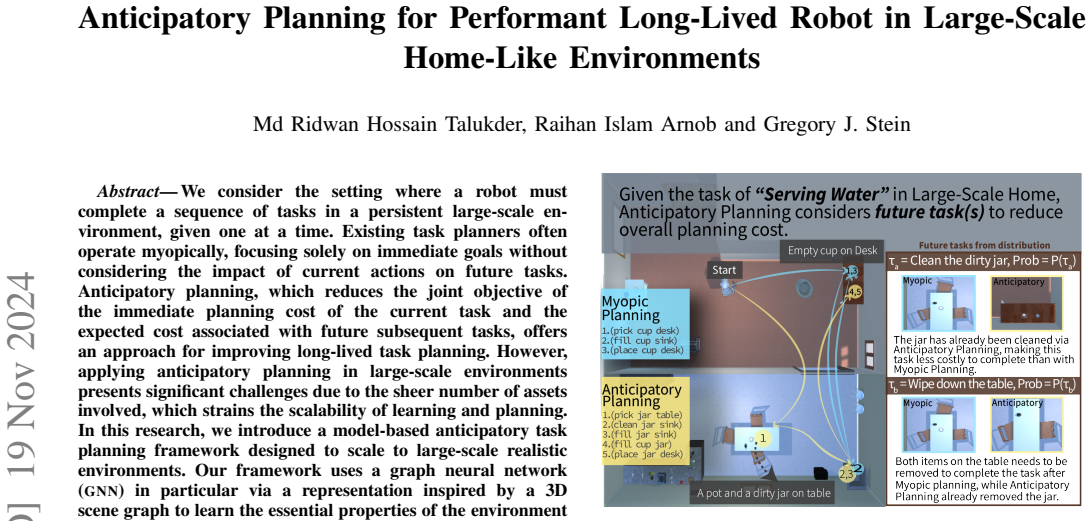
The mechanism is a learned expected-cost estimator paired with a focused plan sampler. The estimator is a graph neural network whose input is the environment encoded as a graph: nodes are semantic entities (rooms, containers, objects) with features for type, location, and state, and edges encode spatial and logical relations; a sequence of graph-convolution layers with pooling maps each graph to $V_{A.P.}(s)$, the expected cost of completing a follow-up task from that state. On the planning side, candidate plans are generated by solving 'augmented tasks'—the current task extended with additional predicates on entities within a bounded region of the robot's path—using a classical symbolic planner. The planner then keeps the plan whose terminal state has the lowest sum of immediate cost plus estimated future cost. Preparation uses the same estimator inside a simulated-annealing search over environment states.
What would settle it
Take the trained estimator and planner and evaluate on task sequences drawn from a distribution that intentionally excludes all training tasks but stays within the same environment layouts—for example, novel object categories or new cleaning and serving tasks. If the anticipatory planner's average sequence cost is not below the myopic baseline, or if preparation no longer reduces cost, the generalization claim behind the reported numbers is falsified. A more gradual version is to measure whether the cost advantage decays monotonically as the test distribution is perturbed away from the training distribution.
Extended reading notes
Core claim
The paper's central claim is that anticipatory planning, which minimizes the sum of immediate task cost and the expected cost of the next task drawn from a known distribution, can be scaled from small block-world domains to large home-like environments and that doing so materially reduces long-horizon costs. The concrete instantiation is a graph neural network over a scene-graph-like representation that predicts the anticipatory planning cost $V_{A.P.}(s)$ of any state, integrated with a planner that samples augmented tasks—the current task plus extra predicates involving nearby entities—and selects the plan whose terminal state minimizes $V_{s'_g}(s_0) + V_{A.P.}(s'_g)$. The same estimator powers a preparation phase that searches for a low-expected-cost state before any task is assigned, using simulated annealing. In randomized large-scale home and restaurant environments, the anticipatory planner beats the myopic baseline on average cost per task, and preparation yields the largest gains.
Load-bearing premise
Everything rests on the assumption that the robot knows the task distribution $P(\tau)$ and that both training and evaluation tasks are drawn from it; if deployed tasks fall outside that distribution, the learned cost estimates become unreliable and the reported gains, especially the preparation gains, may fail to appear. The paper itself acknowledges this assumption in its conclusion.
Editorial extensions
If this is right
- A service robot can reduce total task-sequence cost using only the task distribution, not knowing exactly which task comes next, by accepting slightly higher immediate cost for a state that makes likely follow-up tasks cheaper.
- Idle time before a task is assigned is valuable: guided by the learned cost estimate, even a myopic planner becomes substantially cheaper when the environment is prepared in advance.
- Anticipatory planning remains tractable as environments grow because the focused sampling procedure only needs to explore augmented tasks involving entities near the robot's path, not all possible completions.
- The larger gains in restaurant settings than in homes suggest that the approach's benefit grows with task interdependency, since placement-only tasks leave fewer side effects to exploit.
Reading between the lines
- If the estimator generalizes, the same learned expected-cost function could serve as a heuristic for other long-horizon problems, such as multi-robot coordination or persistent human-robot collaboration, where today's actions create side effects for later activities.
- A testable extension would train the estimator on task distributions with different long-tail structures and measure how gracefully preparation gains degrade; the paper's known-distribution assumption makes this the main open risk.
- The home gain of 5.38% likely understates the approach's potential because the home tasks used are essentially pick-and-place; re-running the same framework with cleaning, filling, or washing tasks in homes, as was done in the restaurant domain, would probably widen the gap.
- The paper's preparation result implies a practical scheduling rule: when the robot has free time, it should spend it rearranging the environment toward lower expected cost rather than idling, provided the task distribution is stable.
Signed reviews
Editorial analysis
A structured set of objections, weighed in public.
Referee Report
Summary. The paper presents a learning-augmented, model-based anticipatory task planning framework for large-scale domestic environments. It learns a GNN-based estimator of expected future cost from a 3D scene graph representation and combines it with focused sampling of augmented tasks for anticipatory planning and simulated annealing for preparation. Experiments in PROCTHOR/ALFRED homes and a custom restaurant domain report average cost reductions of 5.38% and 31.5% over myopic planning, and 40.6% and 42.5% when preparation is allowed. The central claim is that the learned estimator plus focused plan sampling yields cheaper long-horizon task execution than planning only for the immediate task.
Significance. If established, the result would be a useful step toward long-horizon task planning in persistent environments, where myopic planners are known to suffer from side effects. The evaluation has real strengths: it uses a standard PDDL planner (FastDownward), spans 500 PROCTHOR homes and 500 restaurant layouts with 10,000 and 20,000 task executions, and includes a preparation mode that goes beyond anticipatory replanning. The paper also builds on a previously published formulation rather than inventing a new objective. However, the statistical and generalization evidence for the headline numbers is incomplete, and the learned estimator's accuracy is not directly measured; these gaps are load-bearing for the paper's central claim.
major comments (5)
- [Section V, Table I] The reported reductions are point estimates over 500 sequences per environment, with no standard deviations, confidence intervals, or paired significance tests. The 5.38% improvement in PROCTHOR is small relative to the variability one would expect across 500 randomly generated homes, so it is not yet distinguishable from run-to-run noise. The authors should report the per-sequence pairwise difference between methods and a paired test (e.g., Wilcoxon signed-rank) across the 500 sequences, for both environments.
- [Sections IV-C, V-B, V-C] The paper never states whether the evaluation maps are disjoint from the maps used to generate training data. Both training and evaluation tasks are drawn from the same distribution P(tau), and Section V-B says 'The tasks for data generation and evaluation are taken from this task distribution,' which leaves open the possibility that the same homes or restaurant layouts appear in both sets. If there is overlap, the reported gains, especially the 40.6% preparation gain that optimizes under P(tau), could reflect layout-specific memorization rather than generalization. An explicit map-level train/eval split with results on held-out layouts is needed to support the claim that the estimator transfers.
- [Sections V-A, V-B, V-C] No estimator-accuracy metric is reported anywhere. The APCost estimator is the learned component that drives both anticipatory planning and preparation, but the paper does not give its MAE, R^2, or correlation against ground-truth expected cost on a validation set. Without such a metric, the reader cannot tell whether the learned model is actually accurate, or whether the downstream planning improvements are caused by the estimator at all.
- [Sections IV-A, V] The contribution of the learned estimator is not isolated from the sampling procedure. The anticipatory planning pipeline consists of focused sampling of augmented tasks plus the APCost estimator, and the preparation pipeline uses simulated annealing with the same estimator. An ablation with an oracle estimator (or a sampling-only baseline) is needed to establish that the learned estimator, rather than the broader search over plans, is responsible for the reported cost reductions.
- [Conclusion] The conclusion explicitly acknowledges that the robot may encounter unseen tasks outside P(tau), which is a real deployment limitation. However, the benchmark-internal question is more basic: even within P(tau), the paper does not demonstrate that the estimator generalizes to held-out maps. That internal generalization issue should be settled before the headline reductions are treated as established; the unseen-task limitation alone is not a substitute for a train/eval split in the experiments.
minor comments (6)
- [Throughout] The spacing in 'PROCTHOR' is inconsistent; the text uses 'P ROCTHOR' in many places (e.g., Fig. 1, Section V-B) and 'PROCTHOR' elsewhere.
- [Section V-C] The task name 'ClearConatiners' appears to be a typo for 'ClearContainers.'
- [Section IV-A, Algorithm 1] The term 'APC OST ESTIMATOR' should read 'APCost Estimator' for readability and consistency with the text.
- [Section V-B] The phrase 'employing myopic planning insignificantly reduces the average cost per task over time' is ambiguous; please clarify whether the small decrease is statistically insignificant and what 'insignificantly' means here.
- [Section V-C] The restaurant environment is of the authors' design and is not a public benchmark; this limits comparability with prior work unless the environment and task distributions are released.
- [Section III-B] Equation (1) minimizes the immediate cost plus the expected cost of a single next task, while the evaluation measures cost over 20-40-task sequences; a short discussion of why one-step anticipation is sufficient for long-horizon improvement would help.
Circularity Check
No significant circularity: the reported cost reductions are measured by the planner's actual plan costs, not by the fitted GNN estimator's outputs.
full rationale
The central claim is that anticipatory planning reduces long-horizon task costs, and the reported numbers in Table I are computed from FastDownward's actual plan costs on task sequences sampled from P(τ), not from the GNN's predicted anticipatory costs. The GNN is trained to predict V_AP(s) as defined in Eq. (1), and the same objective guides plan selection; however, the evaluation metric is the real cost of executing the selected plans, which is an independent quantity. The formulation is imported from the authors' prior ICRA paper [10], but this is a normal scientific dependency rather than a circular reduction: the novelty here is the GNN/scene-graph estimator and the sampling-based planner, and the experiments are new and independently measured. The same-distribution assumption (Section IV-C and VI) is an acknowledged generalization limitation for deployment, not a step that forces the result by construction, because the estimator's training loss is not the reported performance metric. No equation in the paper sets the reported cost reduction equal to a fitted parameter or to the estimator's loss, so no specific circular reduction can be exhibited.
Assumptions & free parameters
free parameters (4)
- GNN network weights =
Learned, not reported
- Augmented-task sampling budget N =
Unspecified
- Bounded sampling region for predicate augmentation =
Unspecified
- Simulated annealing hyperparameters =
Unspecified
assumptions (4)
- domain assumption The 3D scene graph representation preserves the information needed to estimate a state's expected future cost.
- domain assumption The task distribution P(tau) is known, fixed, and is the same for training and evaluation.
- domain assumption FastDownward with the ff-astar heuristic computes sufficiently accurate plan costs for all sampled tasks, so the supervised labels are reliable.
- domain assumption The learned GNN generalizes from training states to states reached during evaluation planning and preparation.
Cite this review
Pith. "Pith review of Anticipatory Planning for Performant Long-Lived Robot in Large-Scale Home-Like Environments." pith.science (2026). https://pith.science/paper/TXZNKUPF
@misc{pith2026241112837,
  author       = {Pith},
  title        = {Pith review of: Anticipatory Planning for Performant Long-Lived Robot in Large-Scale Home-Like Environments},
  year         = {2026},
  howpublished = {\url{https://pith.science/paper/TXZNKUPF}},
  note         = {Machine review of arXiv:2411.12837}
}
read the original abstract
We consider the setting where a robot must complete a sequence of tasks in a persistent large-scale environment, given one at a time. Existing task planners often operate myopically, focusing solely on immediate goals without considering the impact of current actions on future tasks. Anticipatory planning, which reduces the joint objective of the immediate planning cost of the current task and the expected cost associated with future subsequent tasks, offers an approach for improving long-lived task planning. However, applying anticipatory planning in large-scale environments presents significant challenges due to the sheer number of assets involved, which strains the scalability of learning and planning. In this research, we introduce a model-based anticipatory task planning framework designed to scale to large-scale realistic environments. Our framework uses a GNN in particular via a representation inspired by a 3D Scene Graph to learn the essential properties of the environment crucial to estimating the state's expected cost and a sampling-based procedure for practical large-scale anticipatory planning. Our experimental results show that our planner reduces the cost of task sequence by 5.38% in home and 31.5% in restaurant settings. If given time to prepare in advance using our model reduces task sequence costs by 40.6% and 42.5%, respectively.
Figures


Figures from the paper (2 more)


Reference graph
Works this paper leans on
-
[10]
Anticipatory planning: Improving long-lived planning by estimating expected cost of future tasks,
R. Dhakal, M. R. Hossain Talukder, and G. J. Stein, “Anticipatory planning: Improving long-lived planning by estimating expected cost of future tasks,” in 2023 IEEE International Conference on Robotics and Automation (ICRA) , 2023, pp. 11 538–11 545
work page 2023
-
[1]
PDDLStream: Integrating symbolic planners and blackbox samplers via optimistic adaptive planning,
C. R. Garrett, T. Lozano-P ´erez, and L. P. Kaelbling, “PDDLStream: Integrating symbolic planners and blackbox samplers via optimistic adaptive planning,” in Proceedings of the International Conference on Automated Planning and Scheduling , vol. 30, 2020, pp. 440–448
work page 2020
-
[2]
Sampling-based motion and symbolic action planning with geometric and differential constraints,
E. Plaku and G. D. Hager, “Sampling-based motion and symbolic action planning with geometric and differential constraints,” in 2010 IEEE International Conference on Robotics and Automation (ICRA) . IEEE, 2010, pp. 5002–5008
work page 2010
-
[3]
Logic-geometric programming: An optimization-based approach to combined task and motion planning,
M. Toussaint, “Logic-geometric programming: An optimization-based approach to combined task and motion planning,” in Twenty-Fourth International Joint Conference on Artificial Intelligence , 2015
work page 2015
-
[4]
Hierarchical task and motion planning in the now
L. P. Kaelbling and T. Lozano-P ´erez, “Hierarchical task and motion planning in the now.” in 2011 IEEE international conference on robotics and automation (ICRA) . IEEE, 2011, pp. 1470–1477
work page 2011
-
[5]
Learning value functions with relational state representations for guiding task-and-motion planning,
B. Kim and L. Shimanuki, “Learning value functions with relational state representations for guiding task-and-motion planning,” in Con- ference on Robot Learning . PMLR, 2020, pp. 955–968
work page 2020
-
[6]
Combined task and motion planning through an extensible planner- independent interface layer,
S. Srivastava, E. Fang, L. Riano, R. Chitnis, S. Russell, and P. Abbeel, “Combined task and motion planning through an extensible planner- independent interface layer,” in 2014 IEEE international conference on robotics and automation (ICRA) . IEEE, 2014, pp. 639–646
work page 2014
-
[7]
Learning to guide task and motion planning using score-space representation,
B. Kim, Z. Wang, L. P. Kaelbling, and T. Lozano-P ´erez, “Learning to guide task and motion planning using score-space representation,” The International Journal of Robotics Research , vol. 38, no. 7, pp. 793–812, 2019
work page 2019
Show all 40 references
-
[8]
Guided search for task and motion plans using learned heuristics,
R. Chitnis, D. Hadfield-Menell, A. Gupta, S. Srivastava, E. Groshev, C. Lin, and P. Abbeel, “Guided search for task and motion plans using learned heuristics,” in 2016 IEEE International Conference on Robotics and Automation (ICRA) . IEEE, 2016, pp. 447–454
2016
-
[9]
Incremental task and motion planning: A constraint-based approach,
N. T. Dantam, Z. K. Kingston, S. Chaudhuri, and L. E. Kavraki, “Incremental task and motion planning: A constraint-based approach,” in Robotics: Science and systems , vol. 12. Ann Arbor, MI, USA, 2016, p. 00052
2016
-
[11]
3D Scene Graph: A structure for unified semantics, 3D space, and camera,
I. Armeni, Z.-Y . He, J. Gwak, A. R. Zamir, M. Fischer, J. Malik, and S. Savarese, “3D Scene Graph: A structure for unified semantics, 3D space, and camera,” in Proceedings of the IEEE/CVF International Conference on Computer Vision (ICCV) , October 2019
2019
-
[12]
Relational inductive biases, deep learning, and graph networks,
P. W. Battaglia, J. B. Hamrick, V . Bapst, A. Sanchez-Gonzalez, V . Zambaldi, M. Malinowski, A. Tacchetti, D. Raposo, A. Santoro, R. Faulkner et al. , “Relational inductive biases, deep learning, and graph networks,” arXiv preprint arXiv:1806.01261 , 2018
2018 arXiv
-
[13]
ProcTHOR: Large-Scale Embodied AI Using Procedural Generation,
M. Deitke, E. VanderBilt, A. Herrasti, L. Weihs, J. Salvador, K. Ehsani, W. Han, E. Kolve, A. Farhadi, A. Kembhavi, and R. Mottaghi, “ProcTHOR: Large-Scale Embodied AI Using Procedural Generation,” in NeurIPS, 2022, outstanding Paper Award
2022
-
[15]
PDDL2.1: An extension to PDDL for ex- pressing temporal planning domains,
M. Fox and D. Long, “PDDL2.1: An extension to PDDL for ex- pressing temporal planning domains,” Journal of Artificial Intelligence Research, vol. 20, pp. 61–124, 2003
2003
-
[16]
Pddl— the planning domain definition language,
C. Aeronautiques, A. Howe, C. Knoblock, I. D. McDermott, A. Ram, M. Veloso, D. Weld, D. W. Sri, A. Barrett, D. Christianson et al. , “Pddl— the planning domain definition language,” Technical Report, Tech. Rep., 1998
1998
-
[17]
Pushing the envelope: Planning, propo- sitional logic, and stochastic search,
H. Kautz and B. Selman, “Pushing the envelope: Planning, propo- sitional logic, and stochastic search,” in Proceedings of the national conference on artificial intelligence , 1996, pp. 1194–1201
1996
-
[18]
Planning as heuristic search,
B. Bonet, “Planning as heuristic search,” Artificial Intelligence, 2001
2001
-
[19]
The Fast Downward planning system,
M. Helmert, “The Fast Downward planning system,” Journal of Artificial Intelligence Research , vol. 26, pp. 191–246, 2006
2006
-
[20]
S. M. LaValle, Planning Algorithms . Cambridge University Press, 2006
2006
-
[21]
The FF planning system: Fast plan generation through heuristic search,
J. Hoffmann and B. Nebel, “The FF planning system: Fast plan generation through heuristic search,” J. Artif. Int. Res. , vol. 14, no. 1, p. 253–302, May 2001
2001
-
[22]
Integrated task and motion planning,
C. R. Garrett, R. Chitnis, R. Holladay, B. Kim, T. Silver, L. P. Kael- bling, and T. Lozano-P ´erez, “Integrated task and motion planning,” Annual review of control, robotics, and autonomous systems , vol. 4, pp. 265–293, 2021
2021
-
[23]
Anticipatory task and motion planning,
R. Dhakal, D. M. Nguyen, T. Silver, X. Xiao, and G. J. Stein, “Anticipatory task and motion planning,” 2024. [Online]. Available: https://arxiv.org/abs/2407.13694
2024 arXiv
-
[24]
Anticipate & Act: Integrating LLMs and classical planning for efficient task execution in household environments,
R. Arora, S. Singh, K. Swaminathan, A. Datta, S. Banerjee, B. Bhowmick, K. M. Jatavallabhula, M. Sridharan, and M. Krishna, “Anticipate & Act: Integrating LLMs and classical planning for efficient task execution in household environments,” in International Conference on Roboti...
2024
-
[25]
Proactive robot assistance via spatio- temporal object modeling,
M. Patel and S. Chernova, “Proactive robot assistance via spatio- temporal object modeling,” arXiv preprint arXiv:2211.15501 , 2022
2022 arXiv
-
[26]
Hatp/ehda: A robot task planner anticipating and eliciting human decisions and actions,
G. Buisan, A. Favier, A. Mayima, and R. Alami, “Hatp/ehda: A robot task planner anticipating and eliciting human decisions and actions,” in 2022 International Conference on Robotics and Automation (ICRA), 2022, pp. 2818–2824
2022
-
[27]
Human-aware robot task planning based on a hierarchical task model,
Y . Cheng, L. Sun, and M. Tomizuka, “Human-aware robot task planning based on a hierarchical task model,” IEEE Robotics and Automation Letters, vol. 6, no. 2, pp. 1136–1143, 2021
2021
-
[28]
Avoiding side effects by considering future tasks,
V . Krakovna, L. Orseau, R. Ngo, M. Martic, and S. Legg, “Avoiding side effects by considering future tasks,” Advances in Neural Infor- mation Processing Systems , vol. 33, pp. 19 064–19 074, 2020
2020
-
[29]
Learning domain-independent planning heuristics with hypergraph networks,
W. Shen, F. Trevizan, and S. Thi ´ebaux, “Learning domain-independent planning heuristics with hypergraph networks,” in Proceedings of the International Conference on Automated Planning and Scheduling , vol. 30, 2020, pp. 574–584
2020
-
[30]
Taskography: Evaluating robot task planning over large 3D scene graphs,
C. Agia, K. M. Jatavallabhula, M. Khodeir, O. Miksik, V . Vineet, M. Mukadam, L. Paull, and F. Shkurti, “Taskography: Evaluating robot task planning over large 3D scene graphs,” in Proceedings of the 5th Conference on Robot Learning , ser. Proceedings of Machine Learning Resea...
-
[31]
3D dynamic scene graphs: Actionable spatial perception with places, objects, and humans,
A. Rosinol, A. Gupta, M. Abate, J. Shi, and L. Carlone, “3D dynamic scene graphs: Actionable spatial perception with places, objects, and humans,” arXiv preprint arXiv:2002.06289 , 2020
2002 arXiv
-
[32]
3-D scene graph: A sparse and semantic representation of physical environments for intelligent agents,
U.-H. Kim, J.-M. Park, T.-J. Song, and J.-H. Kim, “3-D scene graph: A sparse and semantic representation of physical environments for intelligent agents,” IEEE transactions on cybernetics , vol. 50, no. 12, pp. 4921–4933, 2019
2019
-
[33]
Planning with learned object importance in large problem instances using graph neural networks,
T. Silver, R. Chitnis, A. Curtis, J. B. Tenenbaum, T. Lozano-P ´erez, and L. P. Kaelbling, “Planning with learned object importance in large problem instances using graph neural networks,” in Proceedings of the AAAI conference on artificial intelligence , vol. 35, no. 13, 2021...
2021
-
[34]
Simulated annealing,
D. Bertsimas and J. Tsitsiklis, “Simulated annealing,” Statistical science, vol. 8, no. 1, pp. 10–15, 1993
1993
-
[35]
ConceptGraphs: Open-vocabulary 3D Scene Graphs for perception and planning,
Q. Gu, A. Kuwajerwala, S. Morin, K. M. Jatavallabhula, B. Sen, A. Agarwal, C. Rivera, W. Paul, K. Ellis, R. Chellappa, C. Gan, C. M. de Melo, J. B. Tenenbaum, A. Torralba, F. Shkurti, and L. Paull, “ConceptGraphs: Open-vocabulary 3D Scene Graphs for perception and planning,” i...
2024
-
[36]
A survey on graph neural networks and graph transformers in computer vision: A task-oriented perspective,
C. Chen, Y . Wu, Q. Dai, H.-Y . Zhou, M. Xu, S. Yang, X. Han, and Y . Yu, “A survey on graph neural networks and graph transformers in computer vision: A task-oriented perspective,” IEEE Transactions on Pattern Analysis and Machine Intelligence , pp. 1–20, 2024
2024
-
[37]
Sentence-BERT: Sentence embeddings using siamese BERT-networks,
N. Reimers and I. Gurevych, “Sentence-BERT: Sentence embeddings using siamese BERT-networks,” 2019. [Online]. Available: https: //arxiv.org/abs/1908.10084
2019 arXiv
-
[38]
Masked label prediction: Unified massage passing model for semi-supervised classification,
Y . Shi, Z. Huang, W. Wang, H. Zhong, S. Feng, and Y . Sun, “Masked label prediction: Unified massage passing model for semi-supervised classification,” CoRR, vol. abs/2009.03509, 2020. [Online]. Available: https://arxiv.org/abs/2009.03509
2009 arXiv
-
[39]
PyTorch: An imperative style, high-performance deep learning library,
A. Paszke, S. Gross, F. Massa, A. Lerer, J. Bradbury, G. Chanan, T. Killeen, Z. Lin, N. Gimelshein, L. Antiga, A. Desmaison, A. K ¨opf, E. Yang, Z. DeVito, M. Raison, A. Tejani, S. Chilamkurthy, B. Steiner, L. Fang, J. Bai, and S. Chintala, “PyTorch: An imperative style, high-...
2019 arXiv
-
[164]
PMLR, 08–11 Nov 2022, pp. 46–58. [Online]. Available: https://proceedings.mlr.press/v164/agia22a.html
2022
-
[2019]
Available: http://arxiv.org/abs/1912.01734
[Online]. Available: http://arxiv.org/abs/1912.01734
1912 arXiv
Reviewed August 12, 2026 · model on record in the stance chip above.
Discussion (0). Continue with ORCID to comment.