Quantum Entanglement Beyond Kinematics: A Dynamical Hypothesis in (3,2)-Dimensional Spacetime
Pith reviewed 2026-06-29 05:34 UTC · model grok-4.3
The pith
A massless bulk field in an extra temporal dimension mediates quantum entanglement correlations via null geodesics while forbidding controllable superluminal signals.
A machine-rendered reading of the paper's core claim, the machinery that carries it, and where it could break.
Core claim
Within the warped-product metric fixed uniquely by the five-dimensional vacuum Einstein equations with Z2 symmetry, a massless bulk field X_a(x,t,τ) sourced by preparation and measurement events on the brane propagates causally through the extra-time dimension; equal-time correlations at arbitrarily large brane separation arise via the E=0 null geodesic family without admitting controllable superluminal signaling, the propagation time and crossed ratios emerge from the null geodesic kinematics, and the Bohm-Bub framework extended by the brane-projected bulk field gives deterministic collapse at fixed contextual microstate λ with Born statistics from an equivariant ensemble; when applied to t
What carries the argument
The massless bulk field X_a(x,t,τ) sourced on the brane and propagating through the extra temporal dimension, whose E=0 null geodesics generate the observed correlations.
If this is right
- The time of propagation and the crossed ratios of earlier work follow directly from the null geodesic kinematics rather than being postulated.
- Collapse remains deterministic at each fixed contextual microstate λ while Born statistics emerge from averaging over an equivariant ensemble.
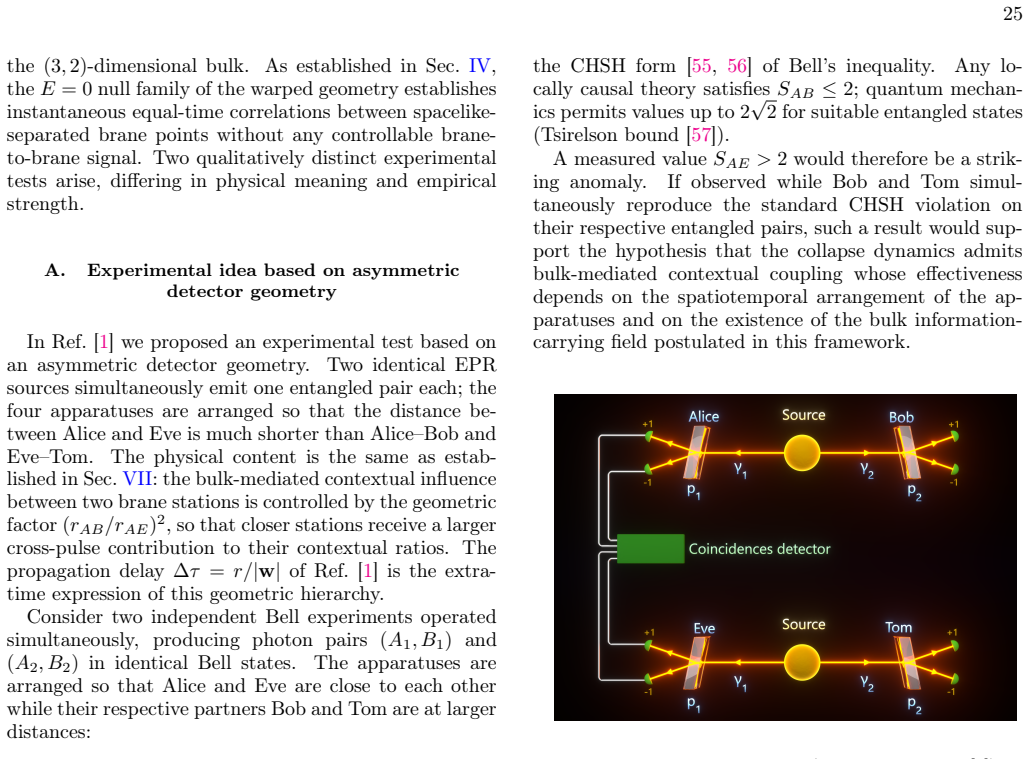
- The bulk field sourced by one Bell pair reaches the detectors of a second independent pair and induces a measurable cross-pair correlation.
- The cross-pair correlation strength scales exactly as the square of the intra-pair to inter-pair separation ratio.
Where Pith is reading between the lines
- Confirmation of the predicted scaling would supply a direct experimental distinction between this dynamical account and standard quantum mechanics.
- The framework supplies a concrete dynamical mechanism that could be examined for consistency with other no-signaling constraints in relativistic settings.
- The same bulk-field mediation could be tested in higher-order entanglement configurations beyond two pairs.
Load-bearing premise
The extra temporal dimension together with the warped-product metric supplies the physical mediator for entanglement correlations.
What would settle it
Detection or absence of a cross-pair correlation between two independent Bell pairs whose magnitude scales with the square of the ratio of intra-pair separation to inter-pair separation, measurable with existing photonic Bell-test apparatus.
Figures
read the original abstract
Quantum entanglement produces nonlocal correlations for which no local dynamical account is known. In Ref.[1] we proposed that these correlations are mediated through an extra temporal dimension and introduced a $(3,2)$-dimensional spacetime framework on a phenomenological basis; the present paper derives that framework from the bulk geometry. A single extra spatial dimension admits no effective superluminal shortcut on the brane, this rules it out as a candidate mediator and motivates the extra-time setting. Within the warped-product metric ansatz the five-dimensional vacuum Einstein equations fix the warp factor uniquely, leaving no freedom in the geometry once $\mathbb{Z}_2$ symmetry is imposed. A massless bulk field $\mathscr{X}_a(\mathbf{x},t,\tau)$, sourced on the brane by the preparation event and by the measurement interactions, propagates causally through the extra-time dimension; equal-time correlations at arbitrarily large brane separation arise via the $E=0$ null geodesic family, without admitting controllable superluminal signaling. The propagation time and crossed ratios of Ref.~\cite{PRR}, previously postulated, emerge here from the null geodesic kinematics. The Bohm--Bub collapse framework is extended to a bipartite entangled system by replacing the abstract hidden vector with the brane-projected bulk field $\mathscr{X}_a$. At fixed contextual microstate $\lambda$ collapse is deterministic; Born statistics follow upon averaging over an equivariant ensemble. When the framework is extended to two independent Bell pairs, the bulk field sourced by one pair reaches the detectors of the other and induces a cross-pair correlation scaling as the square of the intra-pair to inter-pair separation ratio, a concrete falsifiable prediction with no counterpart in standard quantum mechanics, accessible with existing photonic Bell-test technology.
Editorial analysis
A structured set of objections, weighed in public.
Referee Report
Summary. The paper derives a (3,2)-dimensional warped-product geometry from the five-dimensional vacuum Einstein equations under Z2 symmetry. It introduces a massless bulk field sourced on the brane that propagates causally through the extra temporal dimension via E=0 null geodesics to mediate equal-time entanglement correlations at arbitrary brane separations without controllable superluminal signaling. The work extends the Bohm-Bub collapse framework by replacing the hidden vector with the brane-projected bulk field, yielding deterministic collapse at fixed contextual microstate λ and Born statistics upon ensemble averaging. It predicts a cross-pair correlation for two independent Bell pairs that scales as the square of the intra-pair to inter-pair separation ratio, presented as a falsifiable test using existing photonic Bell-test technology. Previously postulated quantities such as propagation time and crossed ratios are claimed to emerge from the null geodesic kinematics.
Significance. If the derivation of the unique warp factor and the explicit scaling prediction are rigorously supported, the manuscript supplies a dynamical mechanism for entanglement correlations together with a concrete, parameter-free falsifiable output that has no counterpart in standard quantum mechanics. The provision of an explicit testable prediction is a strength.
major comments (3)
- [Einstein equations / metric derivation] The abstract and the section deriving the metric from the 5D vacuum Einstein equations claim that Z2 symmetry fixes the warp factor uniquely with no remaining freedom. The explicit solution of the Einstein equations (including the form of the warp factor and verification that no auxiliary assumptions enter) must be shown to confirm this uniqueness claim, as it is load-bearing for the subsequent geodesic analysis.
- [Bulk field and null geodesics] In the section on bulk field propagation, the assertion that the E=0 null geodesic family produces equal-time brane correlations at arbitrary separation while forbidding controllable superluminal signaling requires an explicit calculation of the field propagation and the induced correlation function to demonstrate that the result follows directly from the metric without additional inputs.
- [Two-pair extension and correlation prediction] The extension to two independent Bell pairs and the claimed cross-pair correlation scaling as the square of the intra- to inter-pair separation ratio is a central falsifiable prediction. The explicit computation showing how the bulk field sourced by one pair reaches the detectors of the other and produces precisely this quadratic scaling must be provided, including the relevant separation variables and any averaging over the ensemble.
minor comments (2)
- The notation for the bulk field \mathscr{X}_a(x,t,τ) and its brane projection should be introduced with a clear definition and index conventions at the first appearance.
- References to the author's prior work (Ref.[1]) and to Ref. PRR should explicitly distinguish which quantities were postulated there versus derived here, to clarify the logical flow.
Simulated Author's Rebuttal
We thank the referee for the careful reading and for recognizing the potential significance of a dynamical mechanism with a concrete falsifiable prediction. We address each major comment below and will revise the manuscript to supply the requested explicit derivations and calculations.
read point-by-point responses
-
Referee: [Einstein equations / metric derivation] The abstract and the section deriving the metric from the 5D vacuum Einstein equations claim that Z2 symmetry fixes the warp factor uniquely with no remaining freedom. The explicit solution of the Einstein equations (including the form of the warp factor and verification that no auxiliary assumptions enter) must be shown to confirm this uniqueness claim, as it is load-bearing for the subsequent geodesic analysis.
Authors: We agree that the uniqueness claim requires an explicit, step-by-step solution. The manuscript states that the five-dimensional vacuum Einstein equations under the warped-product ansatz and Z2 symmetry fix the warp factor with no remaining freedom, but we will expand the relevant section to display the full derivation, the resulting warp-factor form, and verification that no auxiliary assumptions are introduced. This will be added in the revised version. revision: yes
-
Referee: [Bulk field and null geodesics] In the section on bulk field propagation, the assertion that the E=0 null geodesic family produces equal-time brane correlations at arbitrary separation while forbidding controllable superluminal signaling requires an explicit calculation of the field propagation and the induced correlation function to demonstrate that the result follows directly from the metric without additional inputs.
Authors: The equal-time correlations at arbitrary brane separation are obtained from the E=0 null geodesic family of the derived metric. To make this fully explicit, we will add the detailed calculation of the massless bulk field propagation along these geodesics and the induced brane correlation function, confirming that the result follows directly from the metric geometry without further inputs and that controllable superluminal signaling remains forbidden. revision: yes
-
Referee: [Two-pair extension and correlation prediction] The extension to two independent Bell pairs and the claimed cross-pair correlation scaling as the square of the intra- to inter-pair separation ratio is a central falsifiable prediction. The explicit computation showing how the bulk field sourced by one pair reaches the detectors of the other and produces precisely this quadratic scaling must be provided, including the relevant separation variables and any averaging over the ensemble.
Authors: The cross-pair correlation is induced when the bulk field sourced by one Bell pair propagates through the extra-time dimension to the detectors of the second pair. We will include the explicit computation in the revised manuscript, specifying the intra-pair and inter-pair separation variables, demonstrating the quadratic scaling, and showing the ensemble averaging that produces the reported correlation while preserving the deterministic collapse at fixed contextual microstate λ. revision: yes
Circularity Check
Derivation self-contained from Einstein equations; no circularity
full rationale
The paper adopts a warped-product metric ansatz with Z2 symmetry, derives the warp factor uniquely from the 5D vacuum Einstein equations, extracts the E=0 null geodesic family for causal bulk propagation of the massless field, extends the Bohm-Bub framework using the brane-projected field, and obtains a new cross-pair correlation scaling as a concrete prediction. The self-citation to Ref.[1] is only for the initial phenomenological motivation of extra time (which is independently motivated here by ruling out extra space); the propagation times and ratios are shown to emerge from the new geometry rather than being presupposed. No step reduces by construction to fitted inputs, self-citations, or prior ansatzes; the chain is independent and supplies an externally falsifiable output.
Axiom & Free-Parameter Ledger
axioms (2)
- standard math Five-dimensional vacuum Einstein equations
- domain assumption Z2 symmetry imposed on the geometry
invented entities (2)
-
Extra temporal dimension
no independent evidence
-
Massless bulk field X_a(x,t,tau)
no independent evidence
Reference graph
Works this paper leans on
-
[1]
self” terms arise fromY(AB) (resp.Y (ET)) projected at the Alice–Bob (resp. Eve–Tom) stations, and the “cross
Loophole controls and distance-dependence test Of course, to perform a loophole-free test of this kind the polariser settings at each of the four stations must be changed randomly while the photons are in flight be- tween the sources and the polarisers, so that no setting is correlated with the source emission or with the ori- entations at the other stati...
2014
-
[2]
Pettini,Quantum Entanglement without nonlocal cau- sation in (3,2)-dimensional spacetime, Phys
M. Pettini,Quantum Entanglement without nonlocal cau- sation in (3,2)-dimensional spacetime, Phys. Rev. Re- search7, 013261 (2025)
2025
-
[3]
Aspect,Proposed experiment to test the separable hidden-variables theories, Phys
A. Aspect,Proposed experiment to test the separable hidden-variables theories, Phys. Lett.A54, 117 (1975); A. Aspect,Proposed experiment to test the nonseparabil- ity of quantum mechanics, Phys. Rev.D14, 1944 (1976)
1975
-
[4]
Aspect, P
A. Aspect, P. Grangier, and G. Roger,Experimental re- alization of Einstein-Podolsky-Rosen-Bohm Gedankenex- periment - A new violation of Bell inequalities, Phys. Rev. Lett.49, 91 (1982)
1982
-
[5]
Aspect, J
A. Aspect, J. Dalibard, and G. Roger,Experimental test of Bell’s inequalities using time-varying analyzers, Phys. Rev. Lett.49, 1804 (1982)
1982
-
[6]
Weihs, T
G. Weihs, T. Jennewein, C. Simon, H. Weinfurter, and A. Zeilinger,Violation of Bell’s Inequality under Strict Einstein Locality Conditions, Phys. Rev. Lett.81, 5039 (1998)
1998
-
[7]
Tittel, J
W. Tittel, J. Brendel, H. Zbinden, and N. Gisin,Vio- lation of Bell Inequalities by Photons More Than 10 km Apart, Phys. Rev. Lett.81, 3563 (1998)
1998
-
[8]
Ursin, et al.,Entanglement-based quantum communi- cation over 144 km, Nature Phys.3, 481 (2007)
R. Ursin, et al.,Entanglement-based quantum communi- cation over 144 km, Nature Phys.3, 481 (2007)
2007
-
[9]
Hensen et al.,Loophole-free Bell inequality violation using electron spins separated by 1.3 kilometres, Nature 526, 682 (2015)
B. Hensen et al.,Loophole-free Bell inequality violation using electron spins separated by 1.3 kilometres, Nature 526, 682 (2015)
2015
-
[10]
The full quotation of Newton’s sentence can be found in the second paper of Ref.[10]
-
[11]
P. H. Eberhard,A realistic model for Quantum Theory with a locality property, in W. Shommers (Ed.),Quantum Theory and Pictures of Reality, (Springer, Berlin, 1989); P. H. Eberhard,Restoring Locality with Faster-Than- Light Velocities, Lawrence Berkeley Laboratory Report LBL-34575 (1993), available athttp://www.osti.gov/ bridge/purl.cover.jsp?purl=/1019180...
1989
-
[12]
Scarani, W.Tittel, H
V. Scarani, W.Tittel, H. Zbinden, N. Gisin,The speed of quantum information and the preferred frame: analysis of experimental data, Phys. Lett.A276, 1 (2000)
2000
-
[13]
Salart, A
D. Salart, A. Baas, C. Branciard, N. Gisin, and H. Zbinden,Testing the speed of ‘spooky action at a dis- tance’, Nature454, 861 (2008)
2008
-
[14]
Lett.A375, 379 (2011)
B.Cocciaro, S.Faetti, andL.Fronzoni,A lower bound for the velocity of quantum communications in the preferred frame, Phys. Lett.A375, 379 (2011)
2011
-
[15]
spooky action at a distance
L. Santamaria Amato, et al.,Testing the speed of “spooky action at a distance” in a tabletop experiment, Sci. Rep. 13, 8201 (2023)
2023
-
[16]
D.Bohm, andB.J.Hiley,TheUndividedUniverse, Chap- ter 12, (Routledge, London, 1993)
1993
-
[17]
Bancal, S
J-D. Bancal, S. Pironio, A. Acin, Y-C. Liang, V. Scarani, and N. Gisin,Quantum non-locality based on finite-speed causal influences leads to superluminal signalling, Nature Physics8, 867 (2012)
2012
-
[18]
Casetti, C
L. Casetti, C. Clementi and M. Pettini,Riemannian the- ory of Hamiltonian chaos and Lyapunov exponents, Phys. Rev. E54, 5969 (1996)
1996
-
[19]
Franzosi, and M
R. Franzosi, and M. Pettini,Theorem on the origin of Phase Transitions, Phys. Rev. Lett.92, 060601 (2004)
2004
-
[20]
Pettini,Geometry and Topology in Hamiltonian Dy- namics and Statistical Mechanics, (Springer, New York 2007)
M. Pettini,Geometry and Topology in Hamiltonian Dy- namics and Statistical Mechanics, (Springer, New York 2007)
2007
-
[21]
D.J. Bohm, J. Bub,A Proposed Solution of the Mea- surement Problem in Quantum Mechanics by a Hidden Variable Theory, Rev. Mod. Phys.38, 453 (1966)
1966
-
[22]
Quantum Grav.14, L69 (1997)
M.Tegmark,On the dimensionality of spacetime, Class. Quantum Grav.14, L69 (1997)
1997
-
[23]
Bars,Survey of Two-Time Physics, Class
I. Bars,Survey of Two-Time Physics, Class. Quantum Grav.18, 3113 (2001)
2001
-
[24]
Craig and S
W. Craig and S. Weinstein,On determinism and well- posedness in multiple time dimensions, Proc. Roy. Soc. A465, 3023 (2009)
2009
-
[25]
S. Weinstein,Multiple time dimensions, arXiv:0812.3869v1 [physics.gen-ph]
work page internal anchor Pith review Pith/arXiv arXiv
-
[26]
C. Bär, N. Ginoux, and F. Pfäffle,Wave Equations on Lorentzian Manifolds and Quantization, ESI Lectures in Mathematics and Physics, (EMS Publishing House, 35 2007)
2007
-
[27]
Rubakov and M.E
V.A. Rubakov and M.E. Shaposhnikov,Do we live inside a domain wall?, Phys. Lett.B125, 136 (1983)
1983
-
[28]
Visser,An Exotic Class of Kaluza-Klein Models, Phys
M. Visser,An Exotic Class of Kaluza-Klein Models, Phys. Lett.B159, 22 (1985)
1985
-
[29]
T. G. Rizzo,Pedagogical Introduction to Extra Di- mensions, SLAC Summer Institute, SLAC-PUB-10753 (2004); arXiv:hep-ph/0409309v2
work page internal anchor Pith review Pith/arXiv arXiv 2004
-
[30]
Genovese,Can quantum non-locality be connected to extra-dimensions?, Int
M. Genovese,Can quantum non-locality be connected to extra-dimensions?, Int. J. of Quantum Information, 2340003 (2023)
2023
-
[31]
D. C. Brody and E.-M. Graefe,Six-dimensional space- time from quaternionic quantum mechanics, Phys. Rev. D84, 125016 (2011)
2011
-
[32]
Furquan, T
M. Furquan, T. P. Singh, and P. S. Wesley,Time-like ex- tra dimensions: quantum nonlocality, spin, and Tsirelson bound, Universe11, 137 (2025)
2025
-
[33]
Randall and R
L. Randall and R. Sundrum,Large Mass Hierarchy from a Small Extra Dimension, Phys. Rev. Lett.83, 3370 (1999)
1999
-
[34]
Randall and R
L. Randall and R. Sundrum,An Alternative to Compact- ification, Phys. Rev. Lett.83, 4690 (1999)
1999
-
[35]
do Carmo,Rieman- nian Geometry, (Birkhäuser, Boston, 1992)
Hereafter for all the basic concepts and definitions of Rie- mannian Geometry refer to : M.P. do Carmo,Rieman- nian Geometry, (Birkhäuser, Boston, 1992)
1992
-
[36]
Israel,Singular hypersurfaces and thin shells in gen- eral relativity, Nuovo Cimento B44, 2 (1966); erratum 48463 (1967)
W. Israel,Singular hypersurfaces and thin shells in gen- eral relativity, Nuovo Cimento B44, 2 (1966); erratum 48463 (1967)
1966
-
[37]
Courant, D
R. Courant, D. Hilbert,Methods of Mathematical Physics, Volume 1, (John Wiley & Sons, New York, 1989)
1989
-
[38]
M. Reed, B. Simon,Methods of Modern Mathemat- ical Physics, Vol. I: Functional Analysis, (Academic Press, New York, 1972);Methods of Modern Mathemat- ical Physics, Vol. II: Fourier Analysis, Self-Adjointness, (Academic Press, New York, 1975)
1972
-
[39]
Jackson,Classical Electrodynamics, (John Wiley & Sons, New York, 1998), Chapt
J.D. Jackson,Classical Electrodynamics, (John Wiley & Sons, New York, 1998), Chapt. 6
1998
-
[40]
Garriga and T
J. Garriga and T. Tanaka,Gravity in the Randall– Sundrum brane world, Phys. Rev. Lett.84, 2778 (2000)
2000
-
[41]
[38] Chapt
See Ref. [38] Chapt. 12
-
[42]
J. Dereziński and and C. Gaß,Propagators in Curved Spacetimes from Operator Theory, Annales Henri Poincaré (2025). https://doi.org/10.1007/s00023- 025-01647-y
-
[43]
SeeEq.C8in: M.Fukuma, S.Sugishita, andY.Sakatani, Propagators in de Sitter space, Phys. Rev. D88, 024041 (2013)
2013
-
[44]
Abramowitz and I
M. Abramowitz and I. A. Stegun,Handbook of Mathe- matical Functions with Formulas, Graphs, and Mathe- matical Tables, (Dover Publications, New York, 1972)
1972
-
[45]
M. E. Taylor,Partial Differential Equations I: Qualita- tive Studies of Linear Equations(Springer, New York, 1996), Chapt. 6, Eqs. (6.5) – (6.7)
1996
-
[46]
Toscano, R.O
F. Toscano, R.O. Vallejos, and D. Wisniacki,Semiclas- sical description of wave packet revival, Phys. Rev. E80, 046218 (2009)
2009
-
[47]
M. C. Gutzwiller,Chaos in Classical and Quantum Me- chanics, (Springer, New York, 1990), Chap. 12
1990
-
[48]
Tutsch,Mathematics of the Measurement Problem in Quantum Mechanics, J
J.H. Tutsch,Mathematics of the Measurement Problem in Quantum Mechanics, J. Math. Phys.12, 1711 (1971)
1971
-
[49]
Bassi, K
A. Bassi, K. Lochan, S. Satin, T. P. Singh, and H. Ul- bricht,Models of wave-function collapse, underlying the- ories, and experimental tests, Rev. Mod. Phys.85, 471 (2013)
2013
-
[50]
Genovese,Research on hidden variable theories: A review of recent progresses, Phys
M. Genovese,Research on hidden variable theories: A review of recent progresses, Phys. Rep.413, 319 (2005)
2005
-
[51]
D. C. Brody and L. P. Hughston,Lévy models for col- lapse of the wave function, J. Phys. A: Math. Theor.56, 125303 (2023)
2023
-
[52]
M. A. Nielsen,Quantum information theory, PhD Dissertation, The University of New Mexico (1998); arXiv:quant-ph/0011036
work page internal anchor Pith review Pith/arXiv arXiv 1998
-
[53]
Kochen and E.P
S. Kochen and E.P. Specker,The problem of hidden vari- ables in quantum mechanics, J. of Mathematics and Me- chanics17, 59 (1967)
1967
-
[54]
Valentini,Signal-locality, uncertainty, and the sub- quantumH-theorem, Phys
A. Valentini,Signal-locality, uncertainty, and the sub- quantumH-theorem, Phys. Lett. A156, 5 (1991)
1991
-
[55]
A.Valentini, andH.Westman,Dynamical origin of quan- tum probabilities, Proc. R. Soc. A461, 253 (2005)
2005
-
[56]
J. S. Bell,On the Einstein Podolsky Rosen paradox, Physics1, 195 (1964)
1964
-
[57]
J. F. Clauser, M. A. Horne, A. Shimony, and R. A. Holt, Proposed experiment to test local hidden-variable theo- ries, Phys. Rev. Lett.23, 880 (1969)
1969
-
[58]
B. S. Tsirelson,Quantum generalizations of Bell’s in- equality, Lett. Math. Phys.4, 93 (1980)
1980
-
[59]
S. L. Adler,Lower and upper bounds on CSL parameters from latent image formation and IGM heating, J. Phys. A40, 2935 (2007)
2007
-
[60]
D. Dürr, S. Goldstein, and N. Zanghì,Quantum equi- librium and the origin of absolute uncertainty, J. Stat. Phys.67, 843 (1992)
1992
-
[61]
R. M. Wald,General Relativity, (University of Chicago Press, Chicago, 1984)
1984
-
[62]
Barrabès and W
C. Barrabès and W. Israel,Thin shells in general relativ- ity and cosmology: The lightlike limit, Phys. Rev. D43, 1129 (1991)
1991
-
[63]
Shiromizu, K.-i
T. Shiromizu, K.-i. Maeda, and M. Sasaki,The Einstein equations on the 3-brane world, Phys. Rev. D62, 024012 (2000)
2000
-
[64]
Relativ.13, 5 (2010)
R.MaartensandK.Koyama,Brane-world gravity, Living Rev. Relativ.13, 5 (2010)
2010
-
[65]
Yu. V. Shtanov and V. Sahni,Bouncing brane worlds, Phys. Lett. B557, 1 (2003)
2003
-
[66]
Risken,The Fokker–Planck Equation: Methods of So- lution and Applications, (Springer, Berlin, 1989)
H. Risken,The Fokker–Planck Equation: Methods of So- lution and Applications, (Springer, Berlin, 1989)
1989
discussion (0)
Sign in with ORCID, Apple, or X to comment. Anyone can read and Pith papers without signing in.