REVIEW 2 major objections 6 minor 243 references
Vision-Based Assistive Technologies for People with Cerebral Visual Impairment: A Review and Focus Study
T0 review · 2 major / 6 minor · reviewed 2026-08-07 · deepseek-v4-flash
Pith's one-line read The paper argues that vision-based assistive technologies have almost entirely overlooked cerebral visual impairment (CVI), a brain-based visual condition that is a leading cause of childhood vision impairment, and that CVI users have…
desk verdict A transparent, timely scoping review plus a small focus-group study; the central 'significant gap' claim survives the acknowledged keyword gaps, though the absolute counts are softer than the prose suggests. read the letter →
The pith
A machine-rendered reading of the paper's core claim, the machinery that carries it, and where it could break.
The reading
What carries the argument
The argument is carried by two instruments: a scoping review and a focus-group study. The scoping review combines CVI-related keywords with VBAT-related keywords (computer vision, artificial intelligence, machine learning, image enhancement, augmented reality, virtual reality, mixed reality) across Google Scholar, Scopus, Web of Science, and PubMed, screening 819 raw hits down to 17 papers and classifying each by study type, technology, age group, and stage of CVI participant involvement. The focus-group study runs three two-hour sessions with seven adults with CVI, uses image demonstrations of smart glasses to ground discussion, and applies thematic analysis to the transcripts. The central objects that carry the "not the same as ocular low vision" claim are the seven-challenge taxonomy and the five-way comparison table distinguishing CVI from ocular blindness and ocular low vision.
What would settle it
A reader could rerun the scoping review with an expanded keyword set — adding hemianopsia, hemineglect, simultanagnosia, akinetopsia, and 'neurological vision impairment' — and if that search surfaces a substantial number of assistance-focused studies or prototypes evaluated with CVI users, the paper's central 'significant research gap' claim would need to be revised.
Extended reading notes
Core claim
The paper establishes that the intersection of CVI and VBAT is nearly empty: a structured search across four databases up to March 2024 yielded 17 papers, only three of which were classified as Assistance, and of those three only one was CVI-specific (and it proposed rather than implemented an augmented-reality approach). All 17 studies engaged CVI participants only for understanding or evaluation, never for design. The focus-group study with seven CVI adults contributes a taxonomy of seven challenges (unawareness, locating, identifying, reading, sensory overload, mobility, luminance and contrast sensitivity) and nine device considerations, along with a five-point comparison of CVI versus ocular low vision, with single-modality preference, high impact of visual complexity, frequent co-occurring neurological conditions, and potential for neuroplasticity-based change as the notable differences.
Load-bearing premise
The claim that a significant research gap exists depends on the scoping review's search strategy capturing the relevant literature; the authors acknowledge that condition-specific terms like hemianopsia and hemineglect were excluded, so assistive-technology studies for those conditions could have been missed, making the gap appear larger than it is.
Editorial extensions
If this is right
- Assistive smart glasses and AR/VR devices designed for ocular low vision should be evaluated separately with CVI users, because high-level visual processing (recognition, attention, clutter tolerance) differs from low-level acuity and field issues.
- Because none of the 17 reviewed studies involved CVI participants in design or requirements gathering, the paper implies that co-design from the start is necessary for VBAT for CVI.
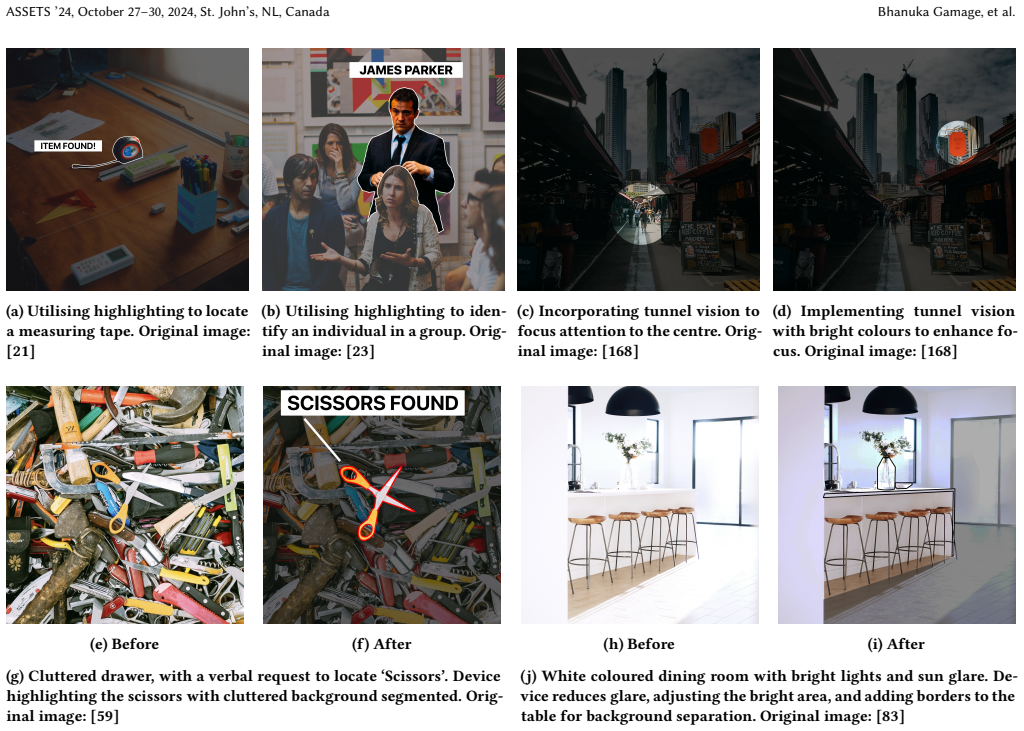
- Vision-first interaction design is indicated: since people with CVI can be overwhelmed by simultaneous audio and visual input, VBAT should prioritize visual augmentations (highlighting, borders, text standardization, brightness adjustment) and use audio sparingly.
- The seven-challenge taxonomy gives a checklist for evaluating whether a VBAT device addresses needs that matter to CVI users, not just to ocular low vision users.
- Future research should report co-occurring neurological conditions and include adults with CVI, since CVI often co-occurs with cerebral palsy and most existing studies focus on children.
Reading between the lines
- If the single-modality preference holds, multimodal AI assistants (voice plus vision) may need a vision-only mode by default for CVI users; this is a testable design recommendation the paper does not fully develop.
- The three 'assistance' papers are mostly proposals or incidental inclusions, so the natural next step is a working prototype — for instance, AR glasses that highlight a requested object — evaluated in daily environments with CVI users, measuring both task success and sensory overload.
- Because CVI is frequently undiagnosed, some participants in existing ocular low-vision studies may unknowingly have CVI; separate reporting of CVI status could reinterpret past results.
- Since people with CVI may have normal visual acuity, standard acuity-based screening is insufficient for VBAT studies; future trials may need to include high-level functional vision questionnaires.
Editorial analysis
A structured set of objections, weighed in public.
Referee Report
Summary. The paper combines a scoping review of research at the intersection of Cerebral Visual Impairment (CVI) and Vision-Based Assistive Technologies (VBAT) with three focus groups involving seven adults with CVI. The scoping review, run in four databases with explicit keywords and inclusion criteria, yields 17 papers, of which only three are directly relevant to assistance rather than diagnosis, understanding, simulation, or rehabilitation. The focus groups identify seven challenges (e.g., unawareness, locating, identifying, reading, sensory overload, mobility, luminance/contrast sensitivity), current coping strategies, opportunities for VBAT, and nine device considerations. The paper then compares the assistive technology needs of people with CVI with those of people with ocular low vision, concluding that CVI poses distinct high-level visual processing needs and that a significant research gap exists at the intersection of CVI and VBAT.
Significance. If the results hold, this is a valuable agenda-setting paper for the HCI and assistive technology communities. It is, to my knowledge, one of the first reviews to focus specifically on visual assistive technology for people with CVI, and it makes a useful first step by distinguishing CVI from ocular low vision in concrete, design-relevant terms. The authors are transparent about their search strategy, inclusion criteria, participant demographics, coding process, and limitations, and the positionality statement is a welcome addition for this kind of qualitative work. The focus-group findings, though preliminary, provide concrete and plausible design directions such as selective highlighting, visual field modification, hazard awareness, and sensory-overload detection. The paper does not overclaim quantitative precision and explicitly frames the work as opening a research direction rather than delivering a mature solution.
major comments (2)
- [Section 4, Table 1a; Section 7; Section 8] The scoping review's search keywords omit condition-specific terms that the paper itself treats as falling under CVI, such as hemianopsia/hemianopia, hemineglect/visual neglect, simultanagnosia, and akinetopsia. Section 7 concedes that papers on hemianopsia and hemineglect were likely missed for this reason, citing examples including [20] and [94]. Because the finding of only three assistance papers in Section 4.1 is the empirical basis for the conclusion of a 'significant research gap' in Section 8, this omission is load-bearing rather than a mere completeness nicety. The authors should either rerun the search with an expanded keyword set covering these condition-specific terms, or, at minimum, rephrase the conclusion to describe the gap as existing at the intersection of VBAT with papers using the broad CVI label. The current wording overstates the robustness of the central claim.
- [Section 5.1 and Section 5.3; Section 6.1] The focus-group evidence is presented as a foundation for the paper's comparisons between CVI and ocular low vision, but the sample consists of seven participants, one of whom is a co-author, and the thematic analysis is described only as 'inductive but deductively framed' with no reported inter-coder reliability, saturation, or member-checking procedure. The discussion in Section 6.1 makes fairly strong distinctions, such as people with CVI preferring a single modality and being more susceptible to visual complexity, based on this small sample. These claims are plausible and valuable as exploratory hypotheses, but the manuscript should more consistently frame them as hypotheses requiring validation with larger and more systematically recruited CVI populations, especially adults with acquired CVI. The current presentation risks overgeneralizing from seven participants.
minor comments (6)
- [Section 5.2] The procedure used the term 'smart glasses' to explain VBAT to participants, but VBAT is defined more broadly to include various wearable devices, image enhancement, and augmented/virtual reality; the paper should clarify whether participant responses were elicited specifically about glasses or about the broader class of devices.
- [Section 4, Table 1a] The search strings for each database are not provided (for example, whether phrase search, Boolean operators, and field restrictions were implemented consistently across Google Scholar, Scopus, Web of Science, and PubMed); adding the exact queries as an appendix would strengthen reproducibility.
- [Figure 3a] The text notes that some papers fall into multiple study-type categories, so the counts exceed 17; the figure caption should say this explicitly, as the figure alone is ambiguous.
- [Section 6.2] The statement that 'SOTA object detection algorithms can achieve an accuracy of 85%' is too vague; the cited survey [215] covers many benchmarks and settings, so the authors should specify the dataset and evaluation condition to which the figure refers.
- [Table 2] The participant labeled RP is identified in the text as a co-author, but the table does not flag this; adding a footnote or annotation directly in Table 2 would make the dual role of this participant immediately visible.
- [Section 5.4, C5] The description of sensory overload mentions that two participants discussed face-to-face conversations, but the seven challenges are said to be 'high-level'; a brief definition of what counts as a high-level challenge would help readers map the qualitative findings to the background taxonomy in Section 2.2.
Circularity Check
No significant circularity: the conclusions derive from a literature search and participant reports, not from premises that already contain the findings.
full rationale
The paper's central claims are empirical: a scoping review found only three papers directly relevant to vision-based assistive technology (VBAT) for cerebral visual impairment (CVI), and focus groups with seven participants identified challenges and opportunities. There is no mathematical derivation, fitted model, or formal predictive chain, so the 'derivation' cannot reduce to its inputs by construction. The scoping review's search keywords and inclusion criteria are stated transparently (Table 1), and the 'significant research gap' conclusion is a direct summarization of the retrieved set of 17 papers. The authors explicitly acknowledge in Section 7 that condition-specific terms such as hemianopsia and hemineglect were not in the keyword set, so some relevant works may have been missed; this is a limitation affecting the strength of the gap claim, not a circularity. The paper cites some prior work by its own authors (e.g., Gamage et al. [66, 67]), but those citations are contextual background about VBAT reviews and CVI assistive technology and are not load-bearing for the focus-group findings or the scoping-review counts. The reviewer's own limitation analysis confirms that the gap could be overstated by the search strategy, but overstatement is a validity or correctness concern, not a circular one. No step in the paper exhibits the pattern of defining the output in terms of the input or renaming a fitted value as a prediction.
Assumptions & free parameters
assumptions (4)
- domain assumption CVI is a visual dysfunction caused by brain damage and is distinct from ocular visual impairment.
- domain assumption The dorsal and ventral stream model explains high-level visual difficulties in CVI.
- domain assumption Focus-group participants' self-reports accurately reflect their visual experiences.
- domain assumption Thematic coding by two researchers with consensus yields valid representations of participant experiences.
Cite this review
Pith. "Pith review of Vision-Based Assistive Technologies for People with Cerebral Visual Impairment: A Review and Focus Study." pith.science (2026). https://pith.science/paper/TYVZQ3I2
@misc{pith2026250522983,
  author       = {Pith},
  title        = {Pith review of: Vision-Based Assistive Technologies for People with Cerebral Visual Impairment: A Review and Focus Study},
  year         = {2026},
  howpublished = {\url{https://pith.science/paper/TYVZQ3I2}},
  note         = {Machine review of arXiv:2505.22983}
}
read the original abstract
Over the past decade, considerable research has investigated Vision-Based Assistive Technologies (VBAT) to support people with vision impairments to understand and interact with their immediate environment using machine learning, computer vision, image enhancement, and/or augmented/virtual reality. However, this has almost totally overlooked a growing demographic: people with Cerebral Visual Impairment (CVI). Unlike ocular vision impairments, CVI arises from damage to the brain's visual processing centres. Through a scoping review, this paper reveals a significant research gap in addressing the needs of this demographic. Three focus studies involving 7 participants with CVI explored the challenges, current strategies, and opportunities for VBAT. We also discussed the assistive technology needs of people with CVI compared with ocular low vision. Our findings highlight the opportunity for the Human-Computer Interaction and Assistive Technologies research community to explore and address this underrepresented domain, thereby enhancing the quality of life for people with CVI.
Figures


Figures from the paper (2 more)

Reference graph
Works this paper leans on
-
[20]
ASSETS ’24, October 27–30, 2024, St
Navid Amini, Jung S Lim, Farnaz Mohammadi, Clinton Thod os, Benjamin Braun, Hassan Ghasemzadeh, Melissa W Chun, and Kouros Nouri -Mahdavi. ASSETS ’24, October 27–30, 2024, St. John’s, NL, Canada Bhan uka Gamage, et al
2024
-
[94]
Susanne Karner, Hanna Stenner, Melanie Spate, Johann B ehrens, and Karsten Krakow. 2019. Effects of a robot intervention on visuospatia l hemineglect in postacute stroke patients: a randomized controlled trial. Clinical Rehabilitation 33, 12 (2019), 1940–1948
2019
-
[1]
Vision our dominant sense
2018. Vision our dominant sense. https://www.brainlin e.org/article/vision-our-dominant-sense
2018
-
[2]
Meta Connect 2022: Meta Quest Pro, More Social VR and a Look Into the Future
2022. Meta Connect 2022: Meta Quest Pro, More Social VR and a Look Into the Future. https://about.fb.com/news/2022/10/meta-quest-pro-so cial-vr-connect-2022/
2022
-
[3]
Empowering your vision
2023. Empowering your vision. https://www.nueyes.com /
2023
-
[4]
Envision glasses
2023. Envision glasses. https://www.letsenvision.co m/glasses
2023
-
[5]
Introducing Apple Vision Pro: Apple’s first spatia l computer
2023. Introducing Apple Vision Pro: Apple’s first spatia l computer. https://www.apple.com/au/newsroom/2023/06/introducing-apple-vision-pro/
2023
-
[6]
Meet Meta Quest 3, Our Mixed Reality Headset
2023. Meet Meta Quest 3, Our Mixed Reality Headset. https://about.fb.com/news/2023/09/meet-meta-quest-3 -mixed-reality-headset/
2023
Show all 243 references
-
[7]
Seeing AI app from Microsoft
2023. Seeing AI app from Microsoft. https://www.microsoft.com/en-us/ai/seeing-ai
2023
-
[8]
Strap tech
2023. Strap tech. https://strap.tech/home
2023
-
[9]
Vision buddy - television watching for visually im paired
2023. Vision buddy - television watching for visually im paired. https://visionbuddy.com/
2023
-
[10]
Apple Maps introduces new ways to explore major ci ties in 3D
2024. Apple Maps introduces new ways to explore major ci ties in 3D. https://www.apple.com/newsroom/2021/09/apple-maps-i ntroduces-new-ways-to-explore-major-cities-
2024
-
[11]
Flaticon
2024. Flaticon. https://www.flaticon.com/
2024
-
[12]
Microsoft Hololens
2024. Microsoft Hololens. https://www.microsoft.co m/en-us/hololens
2024
-
[13]
2024. Varjo. https://varjo.com/products/xr-4/
2024
-
[14]
Ali Abdolrahmani, Maya Howes Gupta, Mei-Lian Vader, Ra vi Kuber, and Stacy Branham. 2021. Towards More Transactional Voice Assistant s: Investigating the Potential for a Multimodal Voice-Activated Indoor Navi gation Assistant for Blind and Sighted Travelers. In Proceedings of ...
2021
-
[15]
Richa Agarwal and Alka Tripathi. 2021. Current modalit ies for low vision re- habilitation. Cureus 13, 7 (2021)
2021
-
[16]
Yahya Qasim I Al-Fadhili, Paul WH Chung, Baihua Li, and R ichard Bowman
-
[17]
Mariano Albaladejo-González, José A Ruipérez-Valien te, and Félix Gómez Már- mol. 2023. Evaluating different configurations of machine le arning models and their transfer learning capabilities for stress detection using heart rate. Journal of Ambient Intelligence and Humanized C...
2023
-
[18]
Syed Rizal Alfam Wan Alwi and Mohamad Noh Ahmad. 2013. Su rvey on out- door navigation system needs for blind people. In 2013 IEEE student conference on research and developement. IEEE, 144–148
2013
-
[19]
Pierluigi Vito Amadori, Tobias Fischer, Ruohan Wang, a nd Yiannis Demiris
-
[21]
Ryan Ancill. 2020. White digital device at 22. https://unsplash.com/photos/white-digital-device-at -22-8xDkgJMUYlc
2020
-
[22]
Susann Andersson, Eva-Karin Persson, Eva Aring, Barbr o Lindquist, Gordon N Dutton, and Ann Hellström. 2006. Vision in children with hyd rocephalus. De- velopmental medicine and child neurology 48, 10 (2006), 836–841
2006
-
[23]
Antenna. 2018. People meeting in a room. https://unsplash.com/photos/people-meeting-in-room- cw-cj_nFa14
2018
-
[24]
Adwitiya Arora, Atul Grover, Raksha Chugh, and S Sofana Reka. 2019. Real time multi object detection for blind using single shot mult ibox detector. Wire- less Personal Communications 107 (2019), 651–661
2019
-
[25]
Kleanthis Avramidis, Melinda Y Chang, Rahul Sharma, Ma rk S Borchert, and Shrikanth Narayanan. 2024. Evaluating Atypical Gaze Patte rns through Vision Models: The Case of Cortical Visual Impairment. arXiv preprint arXiv:2402.09655 (2024)
2024 arXiv
-
[26]
Melissa Bambery, Camille S Corre, Daniel Kelly, Amanda Nagy, Catherine Becker, Claire Manley, Christopher Bennett, Lotfi B Merabet , and Florian Eich- ler. 2022. Virtual Reality Testing to Assess Cerebral Visua l Impairment in X- linked Adrenoleukodystrophy (P1-5.001)
2022
-
[27]
Jyoti Sekhar Banerjee, Mufti Mahmud, and David Brown. 2 023. Heart rate variability-based mental stress detection: an explainabl e machine learning ap- proach. SN Computer Science 4, 2 (2023), 176
2023
-
[28]
Fereshteh S Bashiri, Eric LaRose, Jonathan C Badger, Ro shan M D’Souza, Zeyun Yu, and Peggy Peissig. 2018. Object detection to assist visu ally impaired peo- ple: A deep neural network adventure. In Advances in Visual Computing: 13th International Symposium, ISVC 2018, Las Veg...
2018
-
[29]
Christopher Bennett, Corinna Bauer, Peter Bex, Davide Bottari, and LOTFI MERABET. 2020. Alpha Oscillatory Activity Associated with Impaired Visual Search in Cerebral Visual Impairment. (2020)
2020
-
[31]
Christopher R Bennett, Emma S Bailin, Timothy K Gottlie b, Corinna M Bauer, Peter J Bex, and Lotfi B Merabet. 2018. Assessing visual searc h performance in ocular compared to cerebral visual impairment using a virtu al reality simula- tion of human dynamic movement. In Proceedi...
2018
-
[32]
Christopher R Bennett, Emma S Bailin, Timothy K Gottlie b, Corinna M Bauer, Peter J Bex, and Lotfi B Merabet. 2018. Virtual reality based a ssessment of static object visual search in ocular compared to cerebral v isual impairment. In Universal Access in Human-Computer Interact...
2018
-
[33]
Christopher R Bennett, Corinna M Bauer, Emma S Bailin, a nd Lotfi B Merabet
-
[34]
Christopher R Bennett, Corinna M Bauer, Peter J Bex, Dav ide Bottari, and Lotfi B Merabet. 2021. Visual search performance in cerebral visual impair- ment is associated with altered alpha band oscillations. Neuropsychologia 161 (2021), 108011
2021
-
[35]
Christopher R Bennett, Peter J Bex, Corinna M Bauer, and Lotfi B Merabet
-
[36]
Jay S Bhatia, Nimit K Vasavat, Manali U Maniyar, Neha N Do shi, and Ruhina Karani. 2022. Audio-Based Staircase Navigation System for Visually Impaired. In Machine Learning and Autonomous Systems: Proceedings of ICM LAS 2021 . Springer, 411–424
2022
-
[37]
Neu- roscience & Biobehavioral Reviews 108 (2020), 171–181
Neuroplasticity in cerebral visual impairment (CVI) : assessing functional vision and the neurophysiological correlates of dorsal stream dysfunction. Neu- roscience & Biobehavioral Reviews 108 (2020), 171–181
2020
-
[38]
Daniëlle GM Bosch, F Nienke Boonstra, Michèl AAP Willem sen, Frans PM Cre- mers, and Bert de Vries. 2014. Low vision due to cerebral visu al impairment: differentiating between acquired and genetic causes. BMC ophthalmology 14, 1 (2014), 1–9
2014
-
[39]
LouAnne Boyd, Vincent Berardi, Deanna Hughes, Francel i Cibrian, Jazette Johnson, Viseth Sean, Eliza DelPizzo-Cheng, Brandon Macki n, Ayra Tusneem, Riya Mody, et al. 2022. Manipulating image luminance to improve eye gaze and verbal behavior in autistic children. Humanities and...
2022
-
[40]
Big pic- ture
LouAnne E Boyd, Jazette Johnson, Franceli Cibrian, Dea nna Hughes, Eliza Delpizzo-Cheng, Karen Lotich, Sara Jones, Hollis Pass, Viseth Sean, and Gillian Hayes. 2023. Global filter: Augmenting images to support see ing the “Big pic- ture” for people with local interference.ACM T...
2023
-
[41]
Diego Renan Bruno, Marcelo Henrique de Assis, and Ferna ndo Santos Osório
-
[42]
Faith A Birnbaum, Steven A Hackley, and Lenworth N Johns on. 2015. Enhanc- ing visual performance in individuals with cortical visualimpairment (homony- mous hemianopsia): Tapping into blindsight. Journal of Medical Hypotheses and Ideas 9, 2 (2015), S8–S13
2015
-
[43]
Ryan J Carnie, Rodney A Walker, and Peter I Corke. 2005. C omputer vision based collision avoidance for UA Vs. In 11th Australian International Aerospace Congress
2005
-
[44]
Arvind Chandna, Saeideh Ghahghaei, Susan Foster, and R am Kumar. 2021. Higher visual function deficits in children with cerebral vi sual impairment and good visual acuity. Frontiers in Human Neuroscience 15 (2021), 711873
2021
-
[45]
Ching-Han Chen and Ming-Fang Shiu. 2020. Smart guiding glasses with descriptive video service and spoken dialogue system for vi sually impaired. In 2020 IEEE International Conference on Consumer Electronic s-Taiwan (ICCE- Taiwan). IEEE, 1–2
2020
-
[46]
Matteo Ciman, Ombretta Gaggi, Laura Nota, Luisa Pinell o, Nicola Riparelli, and Teresa Maria Sgaramella. 2013. HelpMe!: A Serious Game for R ehabilitation of Children Affected by CVI.. In WEBIST. 257–262
2013
-
[47]
In 2019 Latin American Robotics Symposium (LARS), 2019 Brazilian Symposium on Robotics (SBR) and 2019 Workshop on Ro- botics in Education (WRE)
Development of a mobile robot: Robotic guide dog for ai d of visual dis- abilities in urban environments. In 2019 Latin American Robotics Symposium (LARS), 2019 Brazilian Symposium on Robotics (SBR) and 2019 Workshop on Ro- botics in Education (WRE) . IEEE, 104–108
2019
-
[48]
Davide Caffagni, Federico Cocchi, Luca Barsellotti, Ni cholas Moratelli, Sara Sarto, Lorenzo Baraldi, Marcella Cornia, and Rita Cucchiar a. 2024. The (R) Evolution of Multimodal Large Language Models: A Survey. arXiv preprint arXiv:2402.12451 (2024)
2024
-
[49]
Henry Cowan, Sama Daryanavard, Bernd Porr, and Ravinde r Dahiya. 2020. Real-time noise cancellation with Deep Learning. A vailable at SSRN 3875777 (2020)
2020
-
[50]
Emily Da Cruz, Diana Tambala, Anna Lynch, Claire Manley , Melissa Bambery, Daniel Kelly, Kenda Alhadid, Lotfi Merabet, and Patricia Mus olino. 2024. Ab- stract TMP11: Cerebral Visual Impairment in Pediatric Stroke Patients Assessed by Virtual Reality Testing. Stroke 55, Suppl_1...
2024
-
[51]
Ariana Delay, Melissa Rice, Elsie Bush, and Karen Harps ter. 2023. Interventions for children with cerebral visual impairment: A scoping rev iew. Developmental Medicine & Child Neurology 65, 4 (2023), 469–478
2023
-
[52]
Lingling Deng and Prapa Rattadilok. 2022. A sensor and m achine learning- based sensory management recommendation system for childr en with autism spectrum disorders. Sensors 22, 15 (2022), 5803
2022
-
[53]
Roee Cohen. 2023. Experience the power of assistive tec hnology with Orcam’s AI devices. https://www.orcam.com/en-us/home
2023
-
[54]
Francisco M Costela, Sarah S Sheldon, Bethany Walker, a nd Russell L Woods
-
[55]
Optometry and Vision Science 95, 5 (2018), 428–434
People with hemianopia report difficulty with TV, compu ter, cinema use, and photography. Optometry and Vision Science 95, 5 (2018), 428–434
2018
-
[56]
GN Dutton. 2003. Cognitive vision, its disorders and di fferential diagnosis in adults and children: knowing where and what things are. Eye 17, 3 (2003), 289– 304
2003
-
[57]
Gordon N Dutton. 2011. Structured history taking to cha racterize visual dys- function and plan optimal habilitation for children with ce rebral visual impair- ment. Developmental Medicine & Child Neurology 53, 5 (2011), 390–390
2011
-
[58]
Gordon N Dutton, A Saaed, Badsha Fahad, Richie Fraser, Gizelda McDaid, Jenny McDade, Anna Mackintosh, Talal Rane, and Katherine Spowart . 2004. Associ- ation of binocular lower visual field impairment, impaired s imultaneous per- ception, disordered visually guided motion and i...
2004
-
[59]
Ashim D’Silva. 2016. Assorted Type Hand Tool Lot. https://unsplash.com/photos/assorted-type-hand-tool -lot-Kw_zQBAChws
2016
-
[60]
Kody R Dillman, Terrance Tin Hoi Mok, Anthony Tang, Lora Oehlberg, and Alex Mitchell. 2018. A visual interaction cue framework fro m video game en- vironments for augmented reality. In Proceedings of the 2018 CHI conference on human factors in computing systems . 1–12
2018
-
[61]
Changxing Ding and Dacheng Tao. 2016. A comprehensive s urvey on pose- invariant face recognition. ACM Transactions on intelligent systems and tech- nology (TIST) 7, 3 (2016), 1–42
2016
-
[62]
Duckett and Rebekah Pratt
Paul S. Duckett and Rebekah Pratt. 2001. The Researched Opinions on Re- search: Visually impaired people and visual impairment res earch. Disability & Society 16, 6 (2001), 815–835. https://doi.org/10.1080/09687590 120083976 arXiv:https://doi.org/10.1080/09687590120083976
2001 doi
-
[63]
Alessandra Federici, Christopher R Bennett, Corinna M Bauer, Claire E Manley, Emiliano Ricciardi, Davide Bottari, and Lotfi B Merabet. 202 2. Altered Neural Oscillations Underlying Visuospatial Processing in Cerebral Visual Impairment (CVI). medRxiv (2022), 2022–10
2022
-
[64]
Gordon N Dutton MD FRCOPHTH. 2009. ’Dorsal stream dysfu nc- tion’and’dorsal stream dysfunction plus’: a potential cla ssification for percep- tual visual impairment in the context of cerebral visual imp airment? Develop- mental medicine and child neurology 51, 3 (2009), 170
2009
-
[65]
Melody Zagami Furze and John P Phillips. 2018. Integrat ing Functional MRI Information into the Educational Plan of a Child with Cerebr al Visual Impair- ment: A Case Study. Journal of Visual Impairment & Blindness 112, 5 (2018), 532–540
2018
-
[66]
Bhanuka Gamage, Thanh-Toan Do, Nicholas Seow Chiang Pr ice, Arthur Low- ery, and Kim Marriott. 2023. What do Blind and Low-Vision People Really Want from Assistive Smart Devices? Comparison of the Literaturewith a Focus Study. In Proceedings of the 25th International ACM SIGAC...
2023
-
[67]
Fatma El-Zahraa El-Taher, Luis Miralles-Pechuán, Jan e Courtney, Kristina Mil- lar, Chantelle Smith, and Susan Mckeever. 2023. A survey on o utdoor naviga- tion applications for people with visual impairments. IEEE Access 11 (2023), 14647–14666
2023
-
[68]
Mohamed Elhoseny. 2020. Multi-object detection and tr acking (MODT) ma- chine learning model for real-time video surveillance syst ems. Circuits, Sys- tems, and Signal Processing 39, 2 (2020), 611–630. Vision-Based Assistive Technologies for People with Cerebr al Visual Impair...
2020
-
[69]
Muhd Amin Hj Fauzul and Noor Deenina Hj Mohd Salleh. 2021 . Navigation for the Vision Impaired with Spatial Audio and Ultrasonic Ob stacle Sensors. In Computational Intelligence in Information Systems: Procee dings of the Com- putational Intelligence in Information Systems Con...
2021
-
[70]
William V Good, James E Jan, Susan K Burden, Ann Skoczens ki, and Rowan Candy. 2001. Recent advances in cortical visual impairment . Developmental medicine and child neurology 43, 1 (2001), 56–60
2001
-
[71]
William V Good, James E Jan, Luis DeSa, A James Barkovich , Myryka Groen- veld, et al. 1994. Cortical visual impairment in children. Survey of ophthalmol- ogy 38, 4 (1994), 351–364
1994
-
[72]
Melvyn A Goodale. 2013. Separate visual systems for per ception and action: a framework for understanding cortical visual impairment. Developmental Medicine & Child Neurology 55 (2013), 9–12
2013
-
[73]
Trudy Goodenough, Anna Pease, and Cathy Williams. 2021 . Bridging the gap: Parent and child perspectives of living with cerebral visua l impairments. Fron- tiers in human neuroscience 15 (2021), 689683
2021
-
[74]
Bhanuka Gamage, Leona Holloway, Nicola McDowell, Than h-Toan Do, Nicholas Seow Chiang Price, Arthur James Lowery, and Kim Mar riott. 2024. Broadening Our View: Assistive Technology for Cerebral Vis ual Impairment. In Extended Abstracts of the 2024 CHI Conference on Human Facto...
2024 doi
-
[75]
Tarak Gandhi and Mohan M Trivedi. 2006. Pedestrian coll ision avoidance sys- tems: A survey of computer vision based recent studies. In 2006 IEEE Intelligent Transportation Systems Conference. IEEE, 976–981
2006
-
[76]
Robert G Giorgi, Russell L Woods, and Eli Peli. 2009. Cli nical and laboratory evaluation of peripheral prism glasses for hemianopia. Optometry and Vision Science 86, 5 (2009), 492–502
2009
-
[77]
Savyasachi Gupta, Dhananjai Chand, and Ilaiah Kavati. 2021. Computer vi- sion based animal collision avoidance framework for autono mous vehicles. In Computer Vision and Image Processing: 5th International Con ference, CVIP 2020, Prayagraj, India, December 4-6, 2020, Revised S...
2021
-
[78]
Danna Gurari, Qing Li, Abigale J Stangl, Anhong Guo, Chi Lin, Kristen Grau- man, Jiebo Luo, and Jeffrey P Bigham. 2018. Vizwiz grand chall enge: Answer- ing visual questions from blind people. In Proceedings of the IEEE conference on computer vision and pattern recognition . 3608–3617
2018
-
[79]
Yeaminul Haque, Rahat Shahriar Zawad, Chowdhury Saleh Ahmed Rony, Hasan Al Banna, Tapotosh Ghosh, M Shamim Kaiser, and Mufti Mahmud. 2024. State-of-the-art of stress prediction from heart rate vari ability using artificial intelligence. Cognitive Computation 16, 2 (2024), 455–481
2024
-
[80]
Esin Darici Haritaoglu and Ismail Haritaoglu. 2003. Re al time image enhance- ment and segmentation for sign/text detection. In Proceedings 2003 Interna- tional Conference on Image Processing (Cat. No. 03CH37429) , Vol. 3. IEEE, III– 993
2003
-
[81]
Steve Grogorick, Georgia Albuquerque, Jan-Philipp Ta uscher, and Marcus Mag- nor. 2018. Comparison of unobtrusive visual guidance methods in an immersive dome environment. ACM Transactions on Applied Perception (TAP) 15, 4 (2018), 1–11
2018
-
[82]
Renan Guarese, Franklin Bastidas, João Becker, Marian e Giambastiani, Yhonatan Iquiapaza, Lennon Macedo, Luciana Nedel, Anderso n Maciel, Fabio Zambetta, and Ron van Schyndel. 2021. Cooking in the Dark: Ex ploring Spatial Audio as MR Assistive Technology for the Visually Impai...
2021
-
[83]
Xiaojie Guo and Qiming Hu. 2023. Low-light image enhanc ement via breaking down the darkness. International Journal of Computer Vision 131, 1 (2023), 48– 66
2023
-
[84]
Bin Hong, Zhangxi Lin, Xin Chen, Jing Hou, Shunya Lv, and Zhendong Gao
-
[85]
Junlei Hong, Tobias Langlotz, Jonathan Sutton, and Hol ger Regenbrecht. 2023. Visual Noise Cancellation: Exploring Visual Discomfort an d Opportunities for Vision Augmentations. ACM Trans. Comput.-Hum. Interact. (dec 2023). https://doi.org/10.1145/3634699 Just Accepted
2023 doi
-
[86]
Junlei Hong, Tobias Langlotz, Jonathan Sutton, and Hol ger Regenbrecht. 2024. Visual noise cancellation: Exploring visual discomfort an d opportunities for vision augmentations. ACM Transactions on Computer-Human Interaction 31, 2 (2024), 1–26
2024
-
[87]
Mary Jane Houliston, Abdel H Taguri, Gordon N Dutton, Co nstantinos Haji- vassiliou, and Daniel G Young. 1999. Evidence of cognitive v isual problems in children with hydrocephalus: a structured clinical hist ory-taking strategy. Developmental medicine and child neurology 41, ...
1999
-
[88]
Deborah D Hatton, Eric Schwietz, Burt Boyer, and Paul Ry chwalski. 2007. Ba- bies Count: the national registry for children with visual i mpairments, birth to 3 years. Journal of American Association for Pediatric Ophthalmolog y and Strabismus 11, 4 (2007), 351–355
2007
-
[89]
James V Haxby, Cheryl L Grady, Barry Horwitz, Leslie G Un gerleider, Mortimer Mishkin, Richard E Carson, Peter Herscovitch, Mark B Schapi ro, and Stanley I Rapoport. 1991. Dissociation of object and spatial visual p rocessing pathways in human extrastriate cortex. Proceedings ...
1991
-
[90]
Josh Hemsley. 2019. Empty brown bar chairs. https://unsplash.com/photos/empty-brown-bar-chairs- qPZWOXjUPtI
2019
-
[91]
MT Islam, MA Rashid, M Ahmad, A Kuwana, and H Kobayashi. 2 020. Design and Implementation of Smart Guided Glass for Visually Impai red People. In- ternational Journal of Electrical and Computer Engineerin g (IJECE) 9, 4 (2020)
2020
-
[92]
Licheng Jiao, Fan Zhang, Fang Liu, Shuyuan Yang, Lingli ng Li, Zhixi Feng, and Rong Qu. 2019. A survey of deep learning-based object detect ion. IEEE access 7 (2019), 128837–128868
2019
-
[93]
Rakesh Chandra Joshi, Saumya Yadav, and Malay Kishore D utta. 2020. YOLO- v3 based currency detection and recognition system for visu ally impaired per- sons. In 2020 International Conference on Contemporary Computing a nd Appli- cations (IC3A). IEEE, 280–285
2020
-
[95]
Oliver Beren Kaul, Kersten Behrens, and Michael Rohs. 2 021. Mobile Recogni- tion and Tracking of Objects in the Environment through Augm ented Reality and 3D Audio Cues for People with Visual Impairments. In Extended Abstracts of the 2021 CHI Conference on Human Factors in Co...
2021
-
[96]
Haosheng Huang and Georg Gartner. 2010. A survey of mobile indoor navigation systems. Springer
2010
-
[97]
HyperAR. [n. d.]. HyperAR - Indoor location that actual ly works. https://www.hyperar.com/
-
[98]
Lea Hyvärinen. 1995. Considerations in evaluation and treatment of the child with low vision. The American Journal of Occupational Therapy 49, 9 (1995), 891–897
1995
-
[99]
Barry S Kran, Linda Lawrence, D Luisa Mayer, and Gena Hei dary. 2019. Cere- bral/cortical visual impairment: a need to reassess curren t definitions of visual impairment and blindness. In Seminars in pediatric neurology , Vol. 31. Elsevier, 25–29
2019
-
[100]
Sari Kujala. 2003. User involvement: a review of the be nefits and challenges. Behaviour & information technology 22, 1 (2003), 1–16
2003
-
[101]
Vikash Kumar, Shivam Kumar Gupta, Harsh Sharma, Uchit Bhadauriya, and Chandra Prakash Varma. [n. d.]. A Review Paper on Voice Isola tion Using Ar- tificial Neural Network. ([n. d.])
-
[102]
S-S Kuo and MV Ranganath. 1995. Real time image enhance ment for both text and color photo images. In Proceedings., International Conference on Image Processing, Vol. 1. IEEE, 159–162
1995
-
[103]
Bineeth Kuriakose, Raju Shrestha, and Frode Eika Sand nes. 2020. Multimodal Navigation Systems for Users with Visual Impairments—A Rev iew and Analy- sis. Multimodal Technologies and Interaction 4, 4 (2020), 73
2020
-
[104]
Akif Khan and Shah Khusro. 2021. An insight into smartph one-based assistive solutions for visually impaired and blind people: issues, c hallenges and oppor- tunities. Universal Access in the Information Society 20 (2021), 265–298
2021
-
[105]
Masaki Koshi, Nobuchika Sakata, and Kiyoshi Kiyokawa. 2019. Augmented concentration: Concentration improvement by visual noise reduction with a video see-through hmd. In 2019 IEEE Conference on Virtual Reality and 3D User Interfaces (VR). IEEE, 1030–1031
2019
-
[106]
N Kozeis. 2010. Brain visual impairment in childhood: m ini review. Hippokratia 14, 4 (2010), 249
2010
-
[107]
Florian Lang, Albrecht Schmidt, and Tonja Machulla. 2 020. Augmented real- ity for people with low vision: symbolic and alphanumeric re presentation of information. In Computers Helping People with Special Needs: 17th Internati onal Conference, ICCHP 2020, Lecco, Italy, Septem...
2020
-
[108]
Tobias Langlotz, Jonathan Sutton, and Holger Regenbr echt. 2024. A Design Space for Vision Augmentations and Augmented Human Perception using Dig- ital Eyewear. (2024)
2024
-
[109]
Tobias Langlotz, Jonathan Sutton, Stefanie Zollmann , Yuta Itoh, and Holger Regenbrecht. 2018. ChromaGlasses: Computational Glasses for Compensating Colour Blindness. In Proceedings of the 2018 CHI Conference on Human Factors in Computing Systems (CHI ’18) . Association for Co...
2018 doi
-
[110]
Chan-Su Lee, Jae-Ik Lee, and Han Eol Seo. 2021. Deep Lea rning Based Mo- bile Assistive Device for Visually Impaired People. In 2021 IEEE International Conference on Consumer Electronics-Asia (ICCE-Asia). IEEE, 1–3
2021
-
[111]
Manja Lehmann, Josephine Barnes, Gerard R Ridgway, Jo hn Wattam-Bell, Eliz- abeth K Warrington, Nick C Fox, and Sebastian J Crutch. 2011. Basic visual function and cortical thickness patterns in posterior cort ical atrophy. Cerebral cortex 21, 9 (2011), 2122–2132
2011
-
[112]
Fook Chang Lam, Fiona Lovett, and Gordon N Dutton. 2010 . Cerebral visual im- pairment in children: a longitudinal case study of function al outcomes beyond the visual acuities. Journal of Visual Impairment & Blindness 104, 10 (2010), 625–635. ASSETS ’24, October 27–30, 2024, ...
2010
-
[113]
Ecosse L Lamoureux, Julie F Pallant, Konrad Pesudovs, Gwyn Rees, Jennifer B Hassell, and Jill E Keeffe. 2007. The effectiveness of low-vis ion rehabilitation on participation in daily living and quality of life. Investigative Ophthalmology & Visual Science 48, 4 (2007), 1476–1482
2007
-
[114]
Katie Lane-Karnas. 2023. A Case Study on Cerebral Visu al Impairment, Read- ing, and Braille. Journal of Visual Impairment & Blindness 117, 6 (2023), 498– 504
2023
-
[115]
Jacobus C Lock, Iain D Gilchrist, Iain D Gilchrist, Grz egorz Cielniak, and Nicola Bellotto. 2020. Experimental analysis of a spatialised aud io interface for people with visual impairments. ACM Transactions on Accessible Computing (TAC- CESS) 13, 4 (2020), 1–21
2020
-
[116]
Marie-Céline Lorenzini and Walter Wittich. 2021. Per sonalized telerehabilita- tion for a head-mounted low vision aid: a randomized feasibi lity study. Optom- etry and Vision Science 98, 6 (2021), 570
2021
-
[117]
Amanda Hall Lueck and Gordon Dutton. 2015. Vision and the brain: Under- standing cerebral visual impairment in children . Vol. 2. AFB Press, American Foundation for the Blind Arlington, V A
2015
-
[118]
Marta Lupón, Manuel Armayones, and Genís Cardona. 201 8. Quality of life among parents of children with visual impairment: A literat ure review. Re- search in developmental disabilities 83 (2018), 120–131
2018
-
[119]
Catriona Macintyre-Béon, Hussein Ibrahim, Isobel Ha y, Debbie Cockburn, Julie Calvert, Gordon N Dutton, and Richard Bowman. 2010. Dorsal s tream dys- function in children. A review and an approach to diagnosis a nd management. Current Pediatric Reviews 6, 3 (2010), 166–182
2010
-
[120]
Yifan Li, Kangsoo Kim, Austin Erickson, Nahal Norouzi , Jonathan Jules, Gerd Bruder, and Gregory F Welch. 2022. A Scoping Review of Assist ance and Ther- apy with Head-Mounted Displays for People Who Are Visually Impaired. ACM Transactions on Accessible Computing (TACCESS) (2022)
2022
-
[121]
Jyun-You Lin, Chi-Lin Chiang, Meng-Jin Wu, Chih-Chiu ng Yao, and Ming- Chiao Chen. 2020. Smart Glasses Application System for Visu ally Impaired People Based on Deep Learning. In 2020 Indo–Taiwan 2nd International Confer- ence on Computing, Analytics and Networks (Indo-Taiwan ...
2020
-
[122]
door-to-door
L Liu and S Zlatanova. 2011. A “door-to-door” path-find ing approach for indoor navigation. Proceedings Gi4DM (2011), 3–8
2011
-
[123]
Sina Masnadi, Brian Williamson, Andrés N Vargas Gonzá lez, and Joseph J LaVi- ola. 2020. Vriassist: An eye-tracked virtual reality low vi sion assistance tool. In 2020 IEEE Conference on Virtual Reality and 3D User Interfac es Abstracts and Workshops (VRW). IEEE, 808–809
2020
-
[124]
Daniela Massiceti, Stephen Lloyd Hicks, and Joram Jac ob van Rheede. 2018. Stereosonic vision: Exploring visual-to-auditory sensor y substitution map- pings in an immersive virtual reality navigation paradigm. PloS one 13, 7 (2018), e0199389
2018
-
[125]
Carey A Matsuba and James E Jan. 2006. Long-term outcom e of children with cortical visual impairment. Developmental medicine and child neurology 48, 6 (2006), 508–512
2006
-
[126]
Keenan R May, Brianna J Tomlinson, Xiaomeng Ma, Philli p Roberts, and Bruce N Walker. 2020. Spotlights and soundscapes: On the des ign of mixed reality auditory environments for persons with visual impairment. ACM Trans- actions on Accessible Computing (TACCESS) 13, 2 (2020), 1–47
2020
-
[127]
Emma L McConnell, Kathryn J Saunders, and Julie-Anne L ittle. 2021. What assessments are currently used to investigate and diagnose cerebral visual im- pairment (CVI) in children? A systematic review. Ophthalmic and Physiological Optics 41, 2 (2021), 224–244
2021
-
[128]
Dariusz Man and Ryszard Olchawa. 2018. The possibilit ies of using BCI tech- nology in biomedical engineering. In Biomedical Engineering and Neuroscience: Proceedings of the 3rd International Scientific Conference o n Brain-Computer In- terfaces, BCI 2018, March 13-14, Opole, P...
2018
-
[129]
Claire E Manley, Christopher R Bennett, and Lotfi B Mera bet. 2022. Assessing Higher-Order Visual Processing in Cerebral Visual Impairm ent Using Natural- istic Virtual-Reality-Based Visual Search Tasks. Children 9, 8 (2022), 1114
2022
-
[130]
Maria BC Martín, Alejandro Santos-Lozano, Juan Martí n-Hernández, Alberto López-Miguel, Miguel Maldonado, Carlos Baladrón, Corinna M Bauer, and Lotfi B Merabet. 2016. Cerebral versus ocular visual impairm ent: the impact on developmental neuroplasticity. Frontiers in psychology...
2016
-
[131]
Nicola McDowell and Philippa Butler. 2023. Validatio n of the Austin Assess- ment: A screening tool for cerebral visual impairment related visual issues. Plos one 18, 11 (2023), e0293904
2023
-
[132]
Erick Mendez, Steven Feiner, and Dieter Schmalstieg. 2010. Focus and con- text in mixed reality by modulating first order salient featu res. In Smart Graph- ics: 10th International Symposium on Smart Graphics, Banff, Canada, June 24-26, 2010 Proceedings 10 . Springer, 232–243
2010
-
[133]
Tram Thi Minh Tran, Shane Brown, Oliver Weidlich, Mark Billinghurst, and Callum Parker. 2023. Wearable Augmented Reality: Resea rch Trends and Future Directions from Three Major Venues. IEEE Trans- actions on Visualization and Computer Graphics 29, 11 (2023), 4782–4793. https:...
2023
-
[134]
Mortimer Mishkin, Leslie G Ungerleider, and Kathleen A Macko. 1983. Object vision and spatial vision: two cortical pathways.Trends in neurosciences6 (1983), 414–417
1983
-
[135]
Zachary Munn, Micah DJ Peters, Cindy Stern, Catalin Tu fanaru, Alexa McArthur, and Edoardo Aromataris. 2018. Systematic review or scoping re- view? Guidance for authors when choosing between a systemat ic or scoping review approach. BMC medical research methodology 18 (2018), 1–7
2018
-
[136]
Nicola McDowell. 2020. The CVI practice framework: an effective approach to supporting children with cerebral visual impairment (CVI) : a thesis presented in partial fulfilment of the requirements for the degree of Doct or of Philosophy in Education at Massey University, Manawat...
2020
-
[137]
Nicola McDowell. 2022. Using digital technology to he lp identify children with brain based visual issues. Pacific Journal of Technology Enhanced Learning 4, 1 (2022), 36–37
2022
-
[138]
Nicola McDowell. 2023. A review of the literature to in form the development of a practice framework for supporting children with cerebral visual impairment (CVI). International Journal of Inclusive Education 27, 6 (2023), 718–738
2023
-
[139]
Jason Orlosky, Qifan Wu, Kiyoshi Kiyokawa, Haruo Take mura, and Christian Nitschke. 2014. Fisheye vision: peripheral spatial compre ssion for improved field of view in head mounted displays. In Proceedings of the 2nd ACM sympo- sium on Spatial user interaction . 54–61
2014
-
[140]
Oihana Otaegui, J Seybold, J Spiller, A Marconi, R Olme do, and M Dubielzig
-
[141]
Zahide Pamir, Corinna M Bauer, Christopher R Bennett, Barry S Kran, and Lotfi B Merabet. 2021. Visual perception supported by verbal mediation in an individual with cerebral visual impairment (CVI). Neuropsychologia 160 (2021), 107982
2021
-
[142]
Karan Patel and Bhavesh Parmar. 2020. Assistive devic e using computer vision and image processing for visually impaired; review and curr ent status. Disabil- ity and Rehabilitation: Assistive Technology (2020), 1–8
2020
-
[143]
Victoria S Pelak, Mark Dubin, and Edward Whitney. 2007 . Homonymous hemi- anopia: a critical analysis of optical devices, compensato ry training, and No- vaVision. Current Treatment Options in Neurology 9, 1 (2007), 41–47
2007
-
[144]
Eduardo Gross Muñoz, Ramon Fabregat, Jorge Bacca-Aco sta, Néstor Duque- Méndez, and Cecilia Avila-Garzon. 2022. Augmented reality , virtual reality, and Game Technologies in ophthalmology training. Information 13, 5 (2022), 222
2022
-
[145]
American Conference on Pediatric Cortical Visual Imp airment. 2019. What is CVI? https://pcvis.vision/what-is-cvi/
2019
-
[146]
OpenAI. 2023. ChatGPT by OpenAI. https://chat.openai.com/ 12th April 2023
2023
-
[147]
Minh Tien Phan, Indira Thouvenin, Vincent Fremont, an d Véronique Cherfaoui
-
[148]
Swetha Sara Philip and Gordon N Dutton. 2014. Identify ing and characterising cerebral visual impairment in children: a review. Clinical and Experimental Optometry 97, 3 (2014), 196–208
2014
-
[149]
Chris Phillips. 2023. New ways maps is getting more imm ersive and sustainable. https://blog.google/products/maps/sustainable-immer sive-maps-announcements/ Vision-Based Assistive Technologies for People with Cerebr al Visual Impairment ASSETS ’24, October 27–30, 2024, St. Jo ...
2023
-
[150]
Kevin M Pitt and John W McCarthy. 2023. Strategies for h ighlighting items within visual scene displays to support augmentative and al ternative commu- nication access for those with physical impairments. Disability and Rehabilita- tion: Assistive Technology 18, 8 (2023), 1319–1329
2023
-
[151]
Alicia Ponce-Valencia, Diana Jiménez-Rodríguez, Ju an José Hernán- dez Morante, Carlos Martínez Cortés, Horacio Pérez-Sánche z, and Paloma Echevarría Pérez. 2024. An Interpretable Machine Learning Approach to Predict Sensory Processing Sensitivity Trait in Nursing St udents. E...
2024
-
[152]
Bernd Porr, Sama Daryanavard, Lucía Muñoz Bohollo, He nry Cowan, and Ravinder Dahiya. 2022. Real-time noise cancellation with d eep learning. Plos one 17, 11 (2022), e0277974
2022
-
[153]
Eli Peli. 2000. Treating hemianopia using prisms to cr eate peripheral diplopia. Vision rehabilitation: Assessment, intervention and outc omes. New York (NY): Swets & Zeitlinger Publishers (2000), 104–9
2000
-
[154]
Eli Peli. 2001. Vision multiplexing: an engineering a pproach to vision rehabili- tation device development. Optometry and Vision Science 78, 5 (2001), 304–315
2001
-
[155]
Eli Peli, Gang Luo, Alex Bowers, and Noa Rensing. 2007. Applications of augmented-vision head-mounted systems in vision rehabili tation. Journal of the Society for Information Display 15, 12 (2007), 1037–1045
2007
-
[156]
Dominik Maximilián Ramík, Christophe Sabourin, Ramo n Moreno, and Kurosh Madani. 2014. A machine learning based intelligent vision s ystem for au- tonomous object detection and recognition. Applied intelligence 40 (2014), 358– 375
2014
-
[157]
Nicholas Reyes, Jaxon J Huang, Anjalee Choudhury, Nic holas Pondelis, Elyana VT Locatelli, Ruby Hollinger, Elizabeth R Felix, Pra dip M Pattany, Anat Galor, and Eric A Moulton. 2024. FL-41 Tint Reduces Activation of Neural Path- ways of Photophobia in Patients with Chronic Ocu...
2024
-
[158]
Fabiana Sofia Ricci, Alain Boldini, Xinda Ma, Mahya Beh eshti, Duane R Ger- uschat, William H Seiple, John-Ross Rizzo, and Maurizio Por firi. 2023. Virtual reality as a means to explore assistive technologies for the visually impaired. PLOS Digital Health 2, 6 (2023), e0000275
2023
-
[159]
Ringland, Jennifer Nicholas, Rachel Kornfi eld, Emily G
Kathryn E. Ringland, Jennifer Nicholas, Rachel Kornfi eld, Emily G. Lattie, David C. Mohr, and Madhu Reddy. 2019. Understanding Mental I ll-health as Psychosocial Disability: Implications for Assistive Tech nology. In Proceedings of the 21st International ACM SIGACCESS Conferen...
2019
-
[160]
Christine Roman-Lantzy. 2007. Cortical visual impairment: An approach to as- sessment and intervention. American Foundation for the Blind
2007
-
[161]
Shohista Saidkasimova, David M Bennett, Sandra Butle r, and Gordon N Dutton
-
[162]
Hanna EA Sakki, Naomi J Dale, Jenefer Sargent, Teresa P erez-Roche, and Richard Bowman. 2018. Is there consensus in defining childho od cerebral vi- sual impairment? A systematic review of terminology and defi nitions. British Journal of Ophthalmology 102, 4 (2018), 424–432
2018
-
[163]
Tipa Prangrat, William C Mann, and Machiko Tomita. 200 0. Impact of uni- lateral neglect on assistive device use. Technology and Disability 12, 1 (2000), 53–69
2000
-
[164]
Daiana R Pur, Nathan Lee-Wing, and Mark D Bona. 2023. Th e use of augmented reality and virtual reality for visual field expansion and vi sual acuity improve- ment in low vision rehabilitation: a systematic review. Graefe’s Archive for Clinical and Experimental Ophthalmology 26...
2023
-
[165]
Abhijeet Singh Raina, Ronak R Mohanty, Abhirath Bhuva nesh, Manohar Swaminathan, Vinayak R Krishnamurthy, et al. 2023. Pointin g Tasks Using Spatial Audio on Smartphones for People With Vision Impairm ents. Journal of Computing and Information Science in Engineering 23, 6 (2023)
2023
-
[166]
CVI Scotland. 2021. Wagon Wheel Ap- proach (Methodological Visual Search Approach). https://cviscotland.org/mem-portal/wagon-wheel-way- methodological-visual-search-approach--08-06-2020
2021
-
[167]
Sachin Umesh Sharma and Dharmesh J Shah. 2016. A practi cal animal detection and collision avoidance system using computer vision techn ique. IEEE access 5 (2016), 347–358
2016
-
[168]
Shawnanggg. 2018. Photo of street during daytime phot o. https://unsplash.com/photos/photo-of-street-during- daytime-NlN78jXybSo
2018
-
[169]
Ammar I Shihab et al. 2023. Voice separation and recogn ition using machine learning and deep learning a review paper.Journal of Al-Qadisiyah for computer science and mathematics 15, 3 (2023), Page–11
2023
-
[170]
Walter CSS Simões, Guido S Machado, André MA Sales, Mat eus M de Lucena, Nasser Jazdi, and Vicente F de Lucena Jr. 2020. A review of tec hnologies and techniques for indoor navigation systems for the visually i mpaired. Sensors 20, 14 (2020), 3935
2020
-
[171]
Brijesh K Soni and Akhilesh A Waoo. 2023. Convolutiona l neural network model for identifying neurological visual disorder. In Artificial Intelligence for Neurological Disorders. Elsevier, 61–75
2023
-
[172]
S Srija, P Kawya, T Akshara Reddy, and M Dhanalakshmi. 2 020. Raspberry Pi Based Wearable Reader For Visually Impaired People with H aptic Feedback. In 2020 International Conference on Electronics and Sustaina ble Communication Systems (ICESC). IEEE, 257–260
2020
-
[173]
Froehlich
Lee Stearns, Leah Findlater, and Jon E. Froehlich. 2018. Design of an Augmented Reality Magnification Aid for Low Vision Users. In Proceedings of the 20th Inter- national ACM SIGACCESS Conference on Computers and Accessi bility (Galway, Ireland) (ASSETS ’18) . Association for C...
2018
-
[174]
Masoud Salavati, Eugene AA Rameckers, Bert Steenberg en, and Cees van der Schans. 2014. Gross motor function, functional skills and c aregiver assistance in children with spastic cerebral palsy (CP) with and withou t cerebral visual impairment (CVI). European Journal of Physio...
2014
-
[175]
Marvin Sambur. 1978. Adaptive noise canceling for spe ech signals. IEEE Trans- actions on acoustics, speech, and signal processing 26, 5 (1978), 419–423
1978
-
[176]
Lisbeth Sandfeld Nielsen, Liselotte Skov, and Hanne J ensen. 2007. Visual dys- functions and ocular disorders in children with developmen tal delay. I. preva- lence, diagnoses and aetiology of visual impairment. Acta Ophthalmologica Scandinavica 85, 2 (2007), 149–156
2007
-
[177]
Jonathan Sutton, Tobias Langlotz, Alexander Plopski , and Kasper Hornbæk
-
[178]
Jonathan Sutton, Tobias Langlotz, Alexander Plopski , Stefanie Zollmann, Yuta Itoh, and Holger Regenbrecht. 2022. Look over there! Invest igating Saliency Modulation for Visual Guidance with Augmented Reality Glas ses. In Proceed- ings of the 35th Annual ACM Symposium on User ...
2022
-
[179]
Jonathan Sutton, Tobias Langlotz, Alexander Plopski , Stefanie Zollmann, Yuta Itoh, and Holger Regenbrecht. 2022. Look over there! invest igating saliency modulation for visual guidance with augmented reality glas ses. In Proceedings of the 35th Annual ACM Symposium on User In...
2022
-
[180]
Suzanne H Swift, Roseanna C Davidson, and Linda J Weems . 2008. Cortical Visual Impairment in Children: Presentation Intervention, and Prognosis in Ed- ucational Settings. Teaching exceptional children plus 4, 5 (2008), n5
2008
-
[181]
Sarit Szpiro, Yuhang Zhao, and Shiri Azenkot. 2016. Fi nding a store, searching for a product: a study of daily challenges of low vision people. In Proceedings of the 2016 ACM International Joint Conference on Pervasive and Ubiquitous Com- puting. 61–72
2016
-
[182]
Sarit Felicia Anais Szpiro, Shafeka Hashash, Yuhang Z hao, and Shiri Azenkot
-
[183]
Diana Tambala, Emily Da Cruz, Anna Lynch, Claire Manle y, Melissa Bambery, Daniel Kelly, Kenda Alhadid, Lotfi Merabet, and Patricia Mus olino. 2024. Ab- stract WP223: Cerebral Visual Impairment in ACTA2 Patients Assessed by Vir- tual Reality Testing. Stroke 55, Suppl_1 (2024), ...
2024
-
[184]
Xiaoyang Tan, Songcan Chen, Zhi-Hua Zhou, and Fuyan Zh ang. 2006. Face recognition from a single image per person: A survey. Pattern recognition 39, 9 (2006), 1725–1745
2006
-
[185]
Marc Steen, Menno Manschot, and Nicole De Koning. 2011 . Benefits of co- design in service design projects. International Journal of Design 5, 2 (2011)
2011
-
[186]
Joan Stelmack. 2001. Quality of life of low-vision pat ients and outcomes of low-vision rehabilitation. Optometry and Vision Science 78, 5 (2001), 335–342
2001
-
[187]
Ahmad Rauf Subhani, Wajid Mumtaz, Mohamed Naufal Bin M ohamed Saad, Nidal Kamel, and Aamir Saeed Malik. 2017. Machine Learning F ramework for the Detection of Mental Stress at Multiple Levels. IEEE Access 5 (2017), 13545– 13556. https://doi.org/10.1109/ACCESS.2017.2723622
2017
-
[188]
Mohammad Moeen Valipoor and Angélica de Antonio. 2022 . Recent trends in computer vision-driven scene understanding for VI/blind u sers: a systematic mapping. Universal Access in the Information Society (2022), 1–23
2022
-
[189]
Fernando Vargas-Martín and Eli Peli. 2001. P-16: Augm ented View for Tunnel Vision: Device Testing by Patients in Real Environments. In SID Symposium Digest of Technical Papers, Vol. 32. Wiley Online Library, 602–605
2001
-
[190]
Ashish Vaswani, Noam Shazeer, Niki Parmar, Jakob Uszk oreit, Llion Jones, Aidan N Gomez, Łukasz Kaiser, and Illia Polosukhin. 2017. At tention is all you need. Advances in neural information processing systems 30 (2017)
2017
-
[191]
Eduardo E Veas, Erick Mendez, Steven K Feiner, and Diet er Schmalstieg. 2011. Directing attention and influencing memory with visual sali ency modulation. In Proceedings of the SIGCHI conference on human factors in comp uting systems. 1471–1480
2011
-
[192]
Diego Villamarín and José Manuel Menéndez. 2021. Hapt ic glove TV device for people with visual impairment. Sensors 21, 7 (2021), 2325
2021
-
[193]
Jonathan Waddington and Timothy Hodgson. 2017. Revie w of rehabilitation and habilitation strategies for children and young people w ith homonymous visual field loss caused by cerebral vision impairment. British Journal of Visual Impairment 35, 3 (2017), 197–210. ASSETS ’24, Oc...
2017
-
[194]
Kathleen Weden, Dawn DeCarlo, and Beth Barstow. 2022. What evidence exists on intervention for pediatric cerebral visual impairment: A review. Archives of Physical Medicine and Rehabilitation 103, 12 (2022), e128
2022
-
[195]
Sharon Whiting, James E Jan, Peter KH Wong, Olof Flodma rk, Kevin Farrell, and Andrew Q McCormick. 1985. Permanent cortical visual imp airment in children. Developmental Medicine & Child Neurology 27, 6 (1985), 730–739
1985
-
[196]
Cathy Williams, Anna Pease, Penny Warnes, Sean Harris on, Florine Pilon, Lea Hyvarinen, Stephanie West, Jay Self, John Ferris, CVI Preva lence Study Group, et al. 2021. Cerebral visual impairment-related vision pro blems in primary school children: a cross-sectional survey. De...
2021
-
[197]
James S Wolffsohn, Ditipriya Mukhopadhyay, and Martin Rubinstein. 2007. Im- age enhancement of real-time television to benefit the visually impaired. Amer- ican journal of ophthalmology 144, 3 (2007), 436–440
2007
-
[198]
NM Taylor, LS Jakobson, D Maurer, and TL Lewis. 2009. Di fferential vulnerabil- ity of global motion, global form, and biological motion pro cessing in full-term and preterm children. Neuropsychologia 47, 13 (2009), 2766–2778
2009
-
[199]
Bianca Trăistar. 2023. Sensory: Designing an Ai-Powe red Interactive Artefact for Managing Sensory Overload Experiences
2023
-
[200]
Jonathan D Trobe. 2001. The neurology of vision . Oxford university press
2001
-
[201]
Kai-Fu Yang, Xian-Shi Zhang, and Yong-Jie Li. 2019. A b iological vision in- spired framework for image enhancement in poor visibility c onditions. IEEE Transactions on Image Processing 29 (2019), 1493–1506
2019
-
[202]
Shamima Yasmin. 2020. Haptic Selfies: Bold and Beautif ul Living for the Blind and Visually Impaired. In Proceedings of the 26th ACM Symposium on Virtual Reality Software and Technology. 1–3
2020
-
[203]
Ming Yin, Jennifer Wortman Vaughan, and Hanna Wallach . 2019. Understand- ing the Effect of Accuracy on Trust in Machine Learning Models. In Proceedings of the 2019 CHI Conference on Human Factors in Computing Syst ems (Glasgow, Scotland Uk) (CHI ’19). Association for Computing...
2019
-
[204]
Shukang Yin, Chaoyou Fu, Sirui Zhao, Ke Li, Xing Sun, To ng Xu, and Enhong Chen. 2023. A Survey on Multimodal Large Language Models. arXiv preprint arXiv:2306.13549 (2023)
2023 arXiv
-
[205]
Zhenqiang Ying, Ge Li, Yurui Ren, Ronggang Wang, and We nmin Wang. 2017. A new low-light image enhancement algorithm using camera re sponse model. In Proceedings of the IEEE international conference on computer vision workshops. 3015–3022
2017
-
[206]
Qing Zhang. 2022. Programmable Peripheral Vision: au gment/reshape human visual perception. In CHI Conference on Human Factors in Computing Systems Extended Abstracts. 1–5
2022
-
[207]
Xiaojun Zhang, Sachin Kedar, Michael J Lynn, Nancy J Ne wman, and Valérie Biousse. 2006. Homonymous hemianopia in stroke. Journal of Neuro- ophthalmology 26, 3 (2006), 180–183
2006
-
[208]
Xin Zhang, Claire E Manley, Serena Micheletti, Isidor a Tesic, Christopher R Bennett, Elisa M Fazzi, and Lotfi B Merabet. 2022. Assessing v isuospatial pro- cessing in cerebral visual impairment using a novel and naturalistic static visual search task. Research in Developmental...
2022
-
[209]
Yucheng Zhang, Tian Wang, Kexin Liu, Baochang Zhang, a nd Lei Chen. 2021. Recent advances of single-object tracking methods: A brief survey. Neurocom- puting 455 (2021), 1–11
2021
-
[210]
Zhaoyang Zhang, Yitong Jiang, Jun Jiang, Xiaogang Wan g, Ping Luo, and Jin- wei Gu. 2021. Star: A structure-aware lightweight transfor mer for real-time image enhancement. In Proceedings of the IEEE/CVF International Conference on Computer Vision . 4106–4115
2021
-
[211]
Hui-Yin Wu, Aurélie Calabrèse, and Pierre Kornprobst . 2021. Towards accessi- ble news reading design in virtual reality for low vision. Multimedia Tools and Applications 80, 18 (2021), 27259–27278
2021
-
[212]
Jiayang Wu, Wensheng Gan, Zefeng Chen, Shicheng Wan, and Philip S Yu. 2023. Multimodal large language models: A survey. arXiv preprint arXiv:2311.13165 (2023)
2023 arXiv
-
[213]
Jianxin Wu and Zhi-Hua Zhou. 2002. Face recognition wi th one training image per person. Pattern Recognition Letters 23, 14 (2002), 1711–1719
2002
-
[214]
Yuhang Zhao, Sarit Szpiro, Jonathan Knighten, and Shi ri Azenkot. 2016. Cue- See: exploring visual cues for people with low vision to facilitate a visual search task. In Proceedings of the 2016 ACM International Joint Conference o n Pervasive and Ubiquitous Computing . 73–84
2016
-
[215]
Zhengxia Zou, Keyan Chen, Zhenwei Shi, Yuhong Guo, and Jieping Ye. 2023. Object Detection in 20 Years: A Survey. Proc. IEEE 111, 3 (2023), 257–276. https://doi.org/10.1109/JPROC.2023.3238524 A REVIEW PAPERS Table 4: List of 17 papers from the scoping review with the extracted ...
2023
-
[224]
Yuhang Zhao, Elizabeth Kupferstein, Brenda Veronica Castro, Steven Feiner, and Shiri Azenkot. 2019. Designing AR visualizations to fac ilitate stair naviga- tion for people with low vision. In Proceedings of the 32nd annual ACM sympo- sium on user interface software and techno...
2019
-
[225]
Yuhang Zhao, Elizabeth Kupferstein, Hathaitorn Rojn irun, Leah Findlater, and Shiri Azenkot. 2020. The effectiveness of visual and audio wa yfinding guid- ance on smartglasses for people with low vision. In Proceedings of the 2020 CHI conference on human factors in computing sys...
2020
-
[226]
Yuhang Zhao, Sarit Szpiro, and Shiri Azenkot. 2015. Fo resee: A customizable head-mounted vision enhancement system for people with low vision. In Pro- ceedings of the 17th international ACM SIGACCESS conferenc e on computers & accessibility. 239–249
2015
-
[229]
2015 N N A N Computer Vision, Image Enhancement, Augmented Reality, Mixed Reality
2015
-
[230]
2018 N 14-28 U E Virtual Reality
2018
-
[231]
2018 N N S N Computer Vision, Artificial Intelligence, Machine Learning, Virtual Reality
2018
-
[232]
2018 B 14-28 U E Virtual Reality
2018
-
[233]
2020 B 14-25 U E Virtual Reality
2020
-
[234]
2021 ? ? A, R E Computer Vision, Image Enhancement, Machine Learning
2021
-
[235]
2021 C 17 U E Virtual Reality
2021
-
[236]
2021 N N A N Computer Vision, Image Enhancement, Machine Learning
2021
-
[237]
2021 B 15-22 U E Virtual Reality
2021
-
[238]
2022 B 14-21 U E Virtual Reality
2022
-
[239]
2022 ? ? U, D E Virtual Reality
2022
-
[240]
2022 B 7-20 U E Virtual Reality
2022
-
[241]
2022 B 11-20 D E Virtual Reality
2022
-
[242]
2023 N N D N Computer Vision, Artificial Intelligence, Image Enhancement, Machine Learning
2023
-
[243]
2024 C 1-12 U E Computer Vision, Ma- chine Learning
2024
-
[245]
2024 ? ? U E Virtual Reality
2024
-
[2007]
Journal of American Association for Pediatric Ophthalmology and Strab ismus 11, 5 (2007), 426–430
Cognitive visual impairment with good visual acuity i n children with posterior periventricular white matter injury: a series of 7 cases. Journal of American Association for Pediatric Ophthalmology and Strab ismus 11, 5 (2007), 426–430
2007
-
[2013]
In Proceedings of the 26th International Technical Meeting of T he Satellite Division of the Institute of Navigation (ION GNSS + 2013)
ARGUS: Assisting peRsonal GUidance System for people with visual impairment. In Proceedings of the 26th International Technical Meeting of T he Satellite Division of the Institute of Navigation (ION GNSS + 2013). 2276–2283
2013
-
[2014]
In International Joint Conference on Computer Vision, Imaging and Computer Graphics Theory and Applications
Estimating driver unawareness of pedestrian based on visual behaviors and driving behaviors. In International Joint Conference on Computer Vision, Imaging and Computer Graphics Theory and Applications . 35–39
-
[2016]
In Proceedings of the 18th International ACM SIGACCESS Conference on Computers and Accessibility
How people with low vision access computing devices: U nderstand- ing challenges and opportunities. In Proceedings of the 18th International ACM SIGACCESS Conference on Computers and Accessibility . 171–180
-
[2018]
In Advances in Computational Intelligence Systems: Contributions Pre- sented at the 17th UK Workshop on Computational Intelligenc e, September 6-8, 2017, Cardiff, UK
3D simulation of navigation problem of people with cer ebral visual im- pairment. In Advances in Computational Intelligence Systems: Contributions Pre- sented at the 17th UK Workshop on Computational Intelligenc e, September 6-8, 2017, Cardiff, UK . Springer, 265–275
2017
-
[2019]
In Seminars in pediatric neurology, Vol
The assessment of visual function and functional visi on. In Seminars in pediatric neurology, Vol. 31. Elsevier, 30–40
-
[2020]
In Proceedings of the 2020 ACM International Symposium on Wearable Computers
Design and evaluation of a wearable assistive technol ogy for hemianopic stroke patients. In Proceedings of the 2020 ACM International Symposium on Wearable Computers. 7–11
2020
-
[2021]
IEEE Transactions on Cognitive and Developmental Systems 14, 4 (2021), 1474–1485
Predicting secondary task performance: A directly ac tionable metric for cognitive overload detection. IEEE Transactions on Cognitive and Developmental Systems 14, 4 (2021), 1474–1485
2021
-
[2022]
Robotics and Autonomous Systems (2022), 104104
Development and application of key technologies for Guide Dog Robot: A systematic literature review. Robotics and Autonomous Systems (2022), 104104
2022
-
[2024]
Flicker Augmentations: Rapid Brightness Modulation for Real-World Vi- sual Guidance using Augmented Reality. (2024)
2024
Reviewed August 7, 2026 · model on record in the stance chip above.
Discussion (0). Continue with ORCID to comment.