REVIEW 4 major objections 4 minor 60 references
A General Safety Framework for Autonomous Manipulation in Human Environments
T0 review · 4 major / 4 minor · reviewed 2026-08-11 · deepseek-v4-flash
Pith's one-line read SARA shield is a formal safety framework that classifies every potential human-robot contact as clamped or free, verifies the robot's impact energy against pain and injury thresholds for that contact type, and lets autonomous manipulators…
desk verdict The contact-type classification is genuinely new and the efficiency gains look real, but the formal energy guarantee only checks interval endpoints and the pendulum experiment cannot support the unconstrained-contact claim; both are fixable. read the letter →
The pith
A machine-rendered reading of the paper's core claim, the machinery that carries it, and where it could break.
The reading
What carries the argument
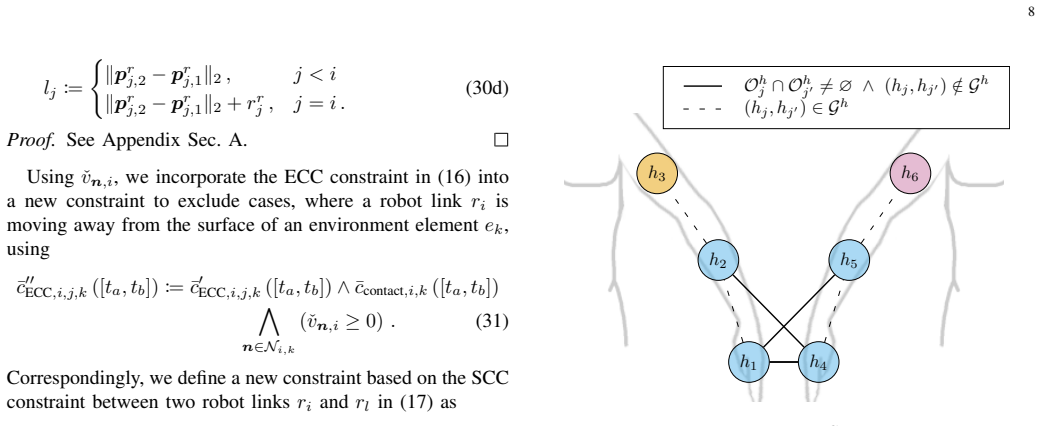
The load-bearing object is the monitored trajectory, a concatenation of the intended trajectory and a path-consistent failsafe braking trajectory, whose safety is checked before any action is executed. Reachability analysis over-approximates the occupancies of all human body parts and robot links over the prediction horizon, given a bounded human speed, a bounded measurement error and delay, and a bounded tracking error. The contact classifier then marks a potential contact as unconstrained only if no environmental clamping (human occupancy intersecting a static obstacle) and no self-clamping (human occupancy intersecting two robot links) is possible, with three relaxations: the gap between robot and obstacle must be smaller than the body-part diameter, the robot's velocity must actually point toward the obstacle, and known safe link topologies are exempted. On the energy side, the paper proves that the effective kinetic energy exerted through a contact on link $i$ equals $T_i^r(q) = \frac{1}{2}\dot{q}^{\mathsf{T}} E_i B(q) E_i \dot{q}$, independent of the rotational velocities of joints distal to $i$, which keeps the verification feasible at control frequency. Verified trajectories are then checked against per-body-part energy thresholds for blunt, wedge, edge, and sheet geometries, separately for constrained and unconstrained contacts.
What would settle it
Repeat the paper's pendulum collision test with the pendulum actively swinging toward the robot so that the relative speed along the contact normal at impact exceeds the robot's own speed: if the energy transferred to the pendulum exceeds the shield's allowed threshold for a trajectory the shield cleared, the formal claim as stated is falsified. A cheaper check is to measure the relative approach speed along the contact normal in real deployments and find it exceeding the robot speed while the shield remains active.
Extended reading notes
Core claim
The central claim is that in each control cycle, SARA shield detects all possible contacts between the robot and the human using reachability analysis, categorizes them as constrained or unconstrained, and verifies that the kinetic energy of the robot link at contact is below the pain and injury thresholds for the detected contact type and body part. Because the verification is carried out on a monitored trajectory that consists of the intended motion followed by a failsafe braking trajectory, an unsafe action is never executed: the shield substitutes the last verified failsafe motion instead. The energy bound is computed from the robot's effective kinetic energy with respect to the contacting link, and the contact classification is made formally correct by checking occupancy intersections with the environment, the possibility of clamping between two robot links, the human body-part diameter, and the direction of robot motion. Under the stated assumptions, the paper claims this yields provable safety for dynamically changing robot paths, arbitrary human motion, and sharp robot geometries, with significantly less conservatism than speed-and-separation monitoring or worst-case power-and-force limiting.
Load-bearing premise
The whole guarantee rests on the assumption that a person never moves toward the robot faster than the robot moves toward them along the line of contact; if someone actively lunges into or grabs the robot, the relative impact energy can exceed the amount the thresholds are designed to bound.
Editorial extensions
If this is right
- Autonomous manipulators can run at near full speed through most of a collaborative task: SARA shield achieves 92.6 percent of the unshielded trajectory length in simulation and 93.7 percent on a real setup, versus 55.9 percent for dynamic speed-and-separation monitoring.
- A robot controlled by SARA shield satisfies the contact-energy constraints for every contact type: measured constrained-contact forces stayed below the admissible limits for all five body parts and four end-effector geometries, and measured pendulum energies stayed below all five unconstrained thresholds.
- Sharp end-effector geometries no longer force a blanket speed reduction: because most contacts are unconstrained, edge, wedge, and sheet tools permit nearly the same efficiency as blunt ones.
- The framework is certifiable rather than heuristic: time delays, measurement errors, bounded human speed, and tracking errors are explicitly absorbed into the reachable sets, so the safety guarantee holds by induction over control cycles.
- The contact-type classification itself, not the energy verification, is what unlocks the performance gain: without the $c_{\mathrm{free}}$ term the approach performs no better than the reflected-mass baseline.
Reading between the lines
- The safety argument is one-sided in a specific sense: the energy bounds are stated in terms of the robot's kinetic energy, and the assumption that the human never approaches faster than the robot along the contact normal is not enforced or measured. A deployment that logs the actual relative approach speed at each contact would show whether the guarantee holds outside that assumption.
- The same classification machinery should transfer to mobile manipulators and humanoid robots, which the paper names as future work, but the velocity-direction test for clamping assumes the occluding obstacle is static; a moving base or moving workpiece would require the signed-distance condition to be re-derived in relative coordinates.
- The unconstrained-contact thresholds come from surrogate experiments with pendulums and artificial tissue, so the framework's practical safety margin inherits the fidelity of those data sets; re-running the verification with live-tissue injury data would be the natural way to tighten or relax Table I.
- A testable consequence of the framework is that a robot executing a shield-cleared trajectory never delivers more than the tabulated energy to a passive human contactor; this could be monitored continuously in deployment with a force-torque sensor at the contact point, turning the formal bound into a runtime check.
Signed reviews
Editorial analysis
A structured set of objections, weighed in public.
Referee Report
Summary. The paper presents SaRA shield, a power and force limiting framework for autonomous manipulators in human environments. It combines reachability analysis with contact-type classification: potential human-robot contacts are detected over a monitored trajectory, classified as constrained (clamping) or unconstrained, and the robot's effective kinetic energy at a contact candidate is verified against body-part-specific injury thresholds taken from ISO standards and recent surrogate studies. If verification succeeds the intended trajectory is executed; otherwise a failsafe braking trajectory is used. The authors report that SaRA shield significantly improves task efficiency over several baseline methods in simulation and on a real manipulator, that constrained-contact force measurements with a Pilz system respect the derived force limits, and that pendulum-collision experiments show the transferred energy remains below the set unconstrained-contact thresholds.
Significance. The reachability-based classification of constrained versus unconstrained contacts is a novel and practically valuable idea, and the formal development in Sec. V (Propositions V.1, V.2, V.3 and the combined-body-part proof in Appendix B) is detailed and mostly rigorous. The constrained-contact force validation with a certified Pilz measurement system is a concrete, reproducible test that supports H2 for clamped contacts. However, the central claim of a formal energy safety guarantee is currently undermined by the endpoint-only energy check in Sec. VI and by the use of the nominal trajectory rather than the reachable set for energy verification; the unconstrained-contact pendulum experiment also does not directly bound the robot's kinetic energy at contact. With those gaps closed, the framework would represent a meaningful advance for safe, non-conservative human-robot collaboration.
major comments (4)
- [Sec. VI, Eqs. (47)-(48)] The energy constraints cT,free,i,j and cT,clamp,i,j are evaluated only at the interval endpoints q(ta) and q(tb), but the safety specification in Eq. (6d) requires the energy bound to hold for every t in the interval. The effective kinetic energy T^r_i(q) is a configuration-dependent quadratic form in the joint velocities and can attain an interior maximum even on a smooth trajectory, e.g., when the intended trajectory accelerates and the failsafe trajectory brakes within the same interval, or when the inertia matrix varies along the path. The checker in Eq. (10) can therefore return true while a contact at an interior time would involve kinetic energy above the admissible threshold. This is an under-approximation in the wrong direction for a safety proof. The paper needs an upper bound on T^r_i over each interval, derived from the reachable state set, not just the two endpoint states.
- [Sec. VI, Eqs. (47)-(48) and Sec. III-C] The energy verification uses the nominal monitored trajectory q(·) only, but the problem statement in Eq. (6d) restricts the 'maximal reachable kinetic energy' T^r_i(t) and accounts for the disturbance model W in the reachable occupancy. The actual robot state can deviate from the nominal trajectory within the assumed tracking-error bounds, and the kinetic energy of the deviating state can be larger than the nominal value. Since no disturbance set is propagated through Eqs. (47)-(48), the formal guarantee does not hold under the stated uncertainty model. The energy check should be applied to the reachable set of states over the interval, analogous to the occupancy verification.
- [Sec. VII-B2, pendulum experiment] The pendulum experiment measures the maximum potential energy of the pendulum after impact, which is a lower bound on the energy transferred from the robot, not an upper bound on the robot's kinetic energy at contact. The statement that 'the kinetic energy of the robot at the time of contact can never exceed the potential energy of the pendulum' is incorrect: the robot's pre-contact kinetic energy can exceed the pendulum's post-impact energy, with the remainder dissipated or retained in the robot. Consequently, the fact that the measured pendulum energy stays below the set threshold does not establish that the robot's kinetic energy at contact was below that threshold. The paper should either directly measure or compute T^r_i at the contact instant from joint states, or redesign the experiment to infer the robot's pre-contact energy by accounting for post-contact robot motion and energy losses.
- [Sec. III-D, final assumption] The safety guarantee is conditional on the assumption that 'the human does not actively move into hurtful contact with the robot so that the speed difference between the human and the robot along the contact normal is always smaller or equal to the robot speed.' This assumption is not enforced or measured in the experiments, and it is in tension with the introductory claim of 'arbitrary human motion' in Sec. I. Since the energy thresholds in Sec. VI bound only the robot's kinetic energy, not the relative impact energy, a human moving toward the robot faster than the robot can violate the energy limit even when the robot itself satisfies Eq. (6d). The paper should state this conditionality prominently in the abstract and conclusions, and ideally provide an argument or measurement that the experimental scenarios satisfy the assumption.
minor comments (4)
- [Sec. V-B2, Theorem V.3] In the definition of li, the text reads 'li = ∥pr_i,2 − pr_i,2∥2 + rr_i', which appears to be a typo; it should presumably be ∥pr_i,2 − pr_i,1∥2 + rr_i, matching the usage in Eq. (30d) and Appendix A.
- [Sec. VII-B2, paragraph 2] The sentence 'the kinetic energy of the robot at the time of contact can never exceed the potential energy of the pendulum' should be reworded to say that the energy transferred to the pendulum cannot exceed the robot's initial kinetic energy; as written it misstates the direction of the inequality.
- [Sec. I, contribution (c)] The claim of formal safety for 'arbitrary human motion' overstates the actual assumptions in Sec. III-D, which restrict human speed and assume no active movement into hurtful contact. Consider aligning the wording with the stated assumptions, e.g., 'under the stated bounded-human-motion assumptions'.
- [Sec. VII-A, Table II] The runtime comparison is informative, but the standard deviations are quite large for several methods (e.g., Reflected mass 1.00 ± 5.02 ms). It would be helpful to state the number of control cycles or trials over which the runtimes are averaged.
Circularity Check
No significant circularity: the energy limits are external, the new contact classification and energy verification are derived rather than assumed, and the performance claims are benchmarked against independent baselines.
full rationale
The central derivation chain is not circular. The admissible contact energies in Table I are taken from ISO/FDIS 10218-2:2024 [17] and from external surrogate injury studies [16,40], so the energy constraints cT,free and cT,clamp are not fitted to the experiments that later claim to confirm them. The constrained/unconstrained contact classification (Eqs. (10)-(36)) is a geometric reachability over-approximation with proofs in Propositions V.1-V.3, and the effective kinetic energy expression in Eq. (46) is derived from the operational-space inertia matrix of Khatib [27] rather than assumed. The shield machinery in Sec. III-B is inherited from the authors' own prior work [19,23,24]; this is normal compositional use of published, code-released tools, and the new claim of contact-type-dependent energy verification does not reduce to restating those citations. Efficiency claims are tested against external baselines with a Wilcoxon signed-rank test, and the energy claims are checked with a certified Pilz force measurement system and a pendulum experiment, so the results are not statistically forced by fitted inputs. The endpoint-only energy checks in Eqs. (47)-(48) are a potential soundness gap relative to the all-times requirement in Eq. (6d), because an interior kinetic-energy peak is not bounded; however, this is a correctness concern, not a circular reduction, and per the review rules it does not raise the circularity score.
Assumptions & free parameters
assumptions (9)
- domain assumption Human pose is measured with bounded error delta_meas and bounded delay delta_t_meas, and these are folded into the human reachable sets.
- domain assumption Every human body part approaches the robot at speed at most 1.6 m/s (DIN EN ISO 13855).
- domain assumption Humans do not actively move into hurtful contact; the speed difference between human and robot along the contact normal is at most the robot speed.
- domain assumption The admissible contact energies in Table I, sourced from [17], [40], and [16], correctly represent pain and injury thresholds for the listed body parts and geometries.
- domain assumption The force limit conversion F = sqrt(2 K T) of ISO 10218-2 Annex M is valid for the sharp and blunt end effector geometries tested.
- domain assumption Environment elements that can clamp the human are known and have a static polytope representation.
- domain assumption The robot's controller tracks the intended trajectory with bounded error, and joint velocity, acceleration, and jerk bounds are known.
- domain assumption Human body part diameters from DIN 33402-2 95th percentile bound the clamped diameter, and the sets G_h and G_r of safe body part and link pairs are correct.
- standard math The convex geometry and reachable-set calculus used in Propositions V.1 and V.2 and Theorem V.3 are valid.
Cite this review
Pith. "Pith review of A General Safety Framework for Autonomous Manipulation in Human Environments." pith.science (2026). https://pith.science/paper/TYX3NYKC
@misc{pith2026241210180,
  author       = {Pith},
  title        = {Pith review of: A General Safety Framework for Autonomous Manipulation in Human Environments},
  year         = {2026},
  howpublished = {\url{https://pith.science/paper/TYX3NYKC}},
  note         = {Machine review of arXiv:2412.10180}
}
read the original abstract
Autonomous robots are projected to significantly augment the manual workforce, especially in repetitive and hazardous tasks. For a successful deployment of such robots in human environments, it is crucial to guarantee human safety. State-of-the-art approaches to ensure human safety are either too conservative to permit a natural human-robot collaboration or make strong assumptions that do not hold for autonomous robots, e.g., knowledge of a pre-defined trajectory. Therefore, we propose the shield for Safe Autonomous human-robot collaboration through Reachability Analysis (SARA shield). This novel power and force limiting framework provides formal safety guarantees for manipulation in human environments while realizing fast robot speeds. As unconstrained contacts allow for significantly higher contact forces than constrained contacts (also known as clamping), we use reachability analysis to classify potential contacts by their type in a formally correct way. For each contact type, we formally verify that the kinetic energy of the robot is below pain and injury thresholds for the respective human body part in contact. Our experiments show that SARA shield satisfies the contact safety constraints while significantly improving the robot performance in comparison to state-of-the-art approaches.
Figures


Figures from the paper (5 more)


Reference graph
Works this paper leans on
-
[1]
Robotics in hazardous applications,
J. Trevelyan, W. R. Hamel, and S.-C. Kang, “Robotics in hazardous applications,” in Springer Handbook of Robotics. Springer International Publishing, 2016, pp. 1521–1548
work page 2016
-
[2]
Robots in the workplace: A threat to—or opportunity for—meaningful work?
J. Smids, S. Nyholm, and H. Berkers, “Robots in the workplace: A threat to—or opportunity for—meaningful work?” Philosophy & Technology , vol. 33, no. 3, pp. 503–522, 2020
work page 2020
-
[3]
I. Research, “Size of the market for industrial robots worldwide from 2018 to 2020, with a forecast through 2028 (in billion u.s. Dollars).” Statista, Tech. Rep., 2021
work page 2018
-
[4]
Industry 4.0: In-depth market analysis,
Statista, “Industry 4.0: In-depth market analysis,” Tech. Rep., 2023
work page 2023
-
[5]
K. Suita, Y . Yamada, N. Tsuchida, K. Imai, H. Ikeda, and N. Sugimoto, “A failure-to-safety ”kyozon” system with simple contact detection and stop capabilities for safe human-autonomous robot coexistence,” in Proc. of the IEEE Int. Conf. on Robotics and Automation (ICRA) , vol. 3, 1995, pp. 3089–3096
work page 1995
-
[6]
An approach for implementing power and force limiting in sensorless industrial robots,
K. Kokkalis, G. Michalos, P. Aivaliotis, and S. Makris, “An approach for implementing power and force limiting in sensorless industrial robots,” Procedia CIRP, vol. 76, pp. 138–143, 2018
work page 2018
-
[7]
P. Svarny, M. Tesar, J. K. Behrens, and M. Hoffmann, “Safe physical HRI: Toward a unified treatment of speed and separation monitoring together with power and force limiting,” in Proc. of the IEEE/RSJ Int. Conf. on Intelli- gent Robots and Systems (IROS) , 2019, pp. 7580–7587
work page 2019
-
[8]
N. Lucci, B. Lacevic, A. M. Zanchettin, and P. Rocco, “Combining speed and separation monitoring with power and force limiting for safe collaborative robotics appli- cations,” IEEE Robotics and Automation Letters , vol. 5, no. 4, pp. 6121–6128, 2020
work page 2020
Show all 60 references
-
[9]
A unified perception benchmark for capacitive proximity sensing towards safe human-robot collaboration (HRC),
S. Ergun, Y . Ding, H. Alagi, C. Sch ¨offmann, B. Ubezio, G. Soti, M. Rathmair, S. M ¨uhlbacher-Karrer, U. Thomas, B. Hein, M. Hofbaur, and H. Zangl, “A unified perception benchmark for capacitive proximity sensing towards safe human-robot collaboration (HRC),” in Proc. of the...
2021
-
[10]
Mean reflected mass: A physically interpretable metric for safety assessment and posture optimization in human- robot interaction,
T. Steinecker, A. Kurdas, N. Mansfeld, M. Hamad, R. J. Kirschner, S. Abdolshah, and S. Haddadin, “Mean reflected mass: A physically interpretable metric for safety assessment and posture optimization in human- robot interaction,” in Proc. of the IEEE Int. Conf. on Robotics and...
2022
-
[11]
On making robots understand safety: Embedding injury knowledge into control,
S. Haddadin, S. Haddadin, A. Khoury, T. Rokahr, S. Parusel, R. Burgkart, A. Bicchi, and A. Albu-Sch ¨affer, “On making robots understand safety: Embedding injury knowledge into control,” The International Journal of Robotics Research, vol. 31, no. 13, pp. 1578–1602, 2012
2012
-
[12]
Online verifica- tion of multiple safety criteria for a robot trajectory,
D. Beckert, A. Pereira, and M. Althoff, “Online verifica- tion of multiple safety criteria for a robot trajectory,” in Proc. of the IEEE Conf. on Decision and Control (CDC), 2017, pp. 6454–6461
2017
-
[13]
Online verification of impact- force-limiting control for physical human-robot interac- tion,
S. B. Liu and M. Althoff, “Online verification of impact- force-limiting control for physical human-robot interac- tion,” in Proc. of the IEEE/RSJ Int. Conf. on Intelligent Robots and Systems (IROS) , 2021, pp. 777–783
2021
-
[14]
Energy budgets for coordinate invariant robot control in physical human–robot interaction,
J. Lachner, F. Allmendinger, E. Hobert, N. Hogan, and S. Stramigioli, “Energy budgets for coordinate invariant robot control in physical human–robot interaction,” The International Journal of Robotics Research , vol. 40, no. 8-9, pp. 968–985, 2021
2021
-
[15]
Experimental analysis of impact forces in con- strained collisions according to ISO/ts 15066,
R. J. Kirschner, N. Mansfeld, S. Abdolshah, and S. Had- dadin, “Experimental analysis of impact forces in con- strained collisions according to ISO/ts 15066,” in IEEE Int. Conf. on Intelligence and Safety for Robotics (ISR) , 2021, pp. 1–5
2021
-
[16]
Towards unconstrained collision injury protection data sets: Initial surrogate ex- periments for the human hand,
R. J. Kirschner, J. Yang, E. Elshani, C. M. Micheler, T. Leibbrand, D. M ¨uller, C. Glowalla, N. Rajaei, R. Burgkart, and S. Haddadin, “Towards unconstrained collision injury protection data sets: Initial surrogate ex- periments for the human hand,” in Proc. of the IEEE/RSJ In...
2024
-
[17]
Robotics - safety requirements - part 2: Industrial robot applications and robot cells,
ISO, “Robotics - safety requirements - part 2: Industrial robot applications and robot cells,” International Organi- zation for Standardization, Tech. Rep. ISO/FDIS 10218- 2:2024-04, 2024. 16
2024
-
[18]
Safe robot reflexes: A taxonomy-based decision and modulation framework,
J. V orndamme, A. Melone, R. Kirschner, L. Figueredo, and S. Haddadin, “Safe robot reflexes: A taxonomy-based decision and modulation framework,” IEEE Transactions on Robotics, vol. 41, pp. 982–1001, 2025
2025
-
[19]
Provably safe deep reinforce- ment learning for robotic manipulation in human envi- ronments,
J. Thumm and M. Althoff, “Provably safe deep reinforce- ment learning for robotic manipulation in human envi- ronments,” in Proc. of the IEEE Int. Conf. on Robotics and Automation (ICRA) , 2022, pp. 6344–6350
2022
-
[20]
Implementing speed and separation monitoring in collaborative robot work- cells,
J. A. Marvel and R. Norcross, “Implementing speed and separation monitoring in collaborative robot work- cells,” Robotics and computer-integrated manufacturing , vol. 44, pp. 144–155, 2017
2017
-
[21]
Towards the exact solution for speed and separation monitoring for improved human-robot collaboration,
B. Lacevic, A. M. Zanchettin, and P. Rocco, “Towards the exact solution for speed and separation monitoring for improved human-robot collaboration,” in Proc. of the IEEE Int. Symp. on Robot and Human Interactive Communication (ROMAN), 2020, pp. 1190–1195
2020
-
[22]
Overapproximative human arm occupancy prediction for collision avoidance,
A. Pereira and M. Althoff, “Overapproximative human arm occupancy prediction for collision avoidance,” IEEE Transactions on Automation Science and Engineering , vol. 15, no. 2, pp. 818–831, 2018
2018
-
[23]
Effort- less creation of safe robots from modules through self- programming and self-verification,
M. Althoff, A. Giusti, S. B. Liu, and A. Pereira, “Effort- less creation of safe robots from modules through self- programming and self-verification,” Science Robotics , vol. 4, no. 31, pp. 1–14, 2019
2019
-
[24]
SaRA: A tool for safe human–robot coexistence and collabora- tion through reachability analysis,
S. Schepp, J. Thumm, S. B. Liu, and M. Althoff, “SaRA: A tool for safe human–robot coexistence and collabora- tion through reachability analysis,” in Proc. of the IEEE Int. Conf. on Robotics and Automation (ICRA), 2022, pp. 4312–4317
2022
-
[25]
Re- quirements for safe robots: Measurements, analysis and new insights,
S. Haddadin, A. Albu-Sch ¨affer, and G. Hirzinger, “Re- quirements for safe robots: Measurements, analysis and new insights,” The International Journal of Robotics Research, vol. 28, no. 11-12, pp. 1507–1527, 2009
2009
-
[26]
Notion on the correct use of the robot effective mass in the safety context and comments on ISO/ts 15066,
R. J. Kirschner, N. Mansfeld, G. G. Pe ˜na, S. Abdolshah, and S. Haddadin, “Notion on the correct use of the robot effective mass in the safety context and comments on ISO/ts 15066,” in IEEE Int. Conf. on Intelligence and Safety for Robotics (ISR) , 2021, pp. 6–9
2021
-
[27]
Inertial properties in robotic manipulation: An object-level framework,
O. Khatib, “Inertial properties in robotic manipulation: An object-level framework,” The International Journal of Robotics Research , vol. 14, no. 1, pp. 19–36, 1995
1995
-
[28]
Energy tank-based control framework for satisfying the ISO/ts 15066 con- straint,
F. Benzi, F. Ferraguti, and C. Secchi, “Energy tank-based control framework for satisfying the ISO/ts 15066 con- straint,” IFAC-PapersOnLine, vol. 56, no. 2, pp. 1288– 1293, 2023
2023
-
[29]
Computation of safe path velocity for collaborative robots,
C. Sloth and H. G. Petersen, “Computation of safe path velocity for collaborative robots,” in Proc. of the IEEE/RSJ Int. Conf. on Intelligent Robots and Systems (IROS), 2018, pp. 6142–6148
2018
-
[30]
Power and force lim- iting on industrial robots for human-robot collabora- tion,
P. Aivaliotis, S. Aivaliotis, C. Gkournelos, K. Kokkalis, G. Michalos, and S. Makris, “Power and force lim- iting on industrial robots for human-robot collabora- tion,” Robotics and Computer-Integrated Manufacturing, vol. 59, pp. 346–360, 2019
2019
-
[31]
Control design for safe human-robot collaboration based on ISO/ts 15066 with power and force limit,
A. Golshani, A. Kouhkord, A. Ghanbarzadeh, and E. Na- jafi, “Control design for safe human-robot collaboration based on ISO/ts 15066 with power and force limit,” in Proc. of the Int. Conf. on Robotics and Mechatronics (ICRoM), 2023, pp. 279–284
2023
-
[32]
Modularize-and-conquer: A generalized impact dynamics and safe precollision control framework for floating-base tree-like robots,
M. Hamad, A. Kurdas, N. Mansfeld, S. Abdolshah, and S. Haddadin, “Modularize-and-conquer: A generalized impact dynamics and safe precollision control framework for floating-base tree-like robots,” IEEE Transactions on Robotics, pp. 1–22, 2023
2023
-
[33]
A time-optimal energy planner for safe human-robot collaboration,
A. Pupa, M. Minelli, and C. Secchi, “A time-optimal energy planner for safe human-robot collaboration,” in Proc. of the IEEE Int. Conf. on Robotics and Automation (ICRA), 2024, pp. 17 373–17 379
2024
-
[34]
Spitze, scharfe und halbscharfe gewalt,
W. Eisenmenger, “Spitze, scharfe und halbscharfe gewalt,” in Handbuch Gerichtliche Medizin . Springer Berlin, 2004, vol. 1, pp. 571–592
2004
-
[35]
Corre- lation between impact-energy density and pain intensity during robot-man collision,
B. Povse, D. Koritnik, T. Bajd, and M. Munih, “Corre- lation between impact-energy density and pain intensity during robot-man collision,” in Proc. of the IEEE RAS & EMBS Int. Conf. on Biomedical Robotics and Biomecha- tronics (BIOROB), 2010, pp. 179–183
2010
-
[36]
Study on meaningful and verified thresholds for minimizing the consequences of human-robot collisions,
R. Behrens and N. Elkmann, “Study on meaningful and verified thresholds for minimizing the consequences of human-robot collisions,” in Proc. of the IEEE Int. Conf. on Robotics and Automation (ICRA) , 2014, pp. 3378– 3383
2014
-
[37]
A statistical model to predict the occurrence of blunt impact injuries on the human hand-arm system,
R. Behrens, G. Pliske, S. Piatek, F. Walcher, and N. Elk- mann, “A statistical model to predict the occurrence of blunt impact injuries on the human hand-arm system,” Journal of Biomechanics , vol. 151, 2023
2023
-
[38]
Fail-safe human/robot contact in the safety space,
Y . Yamada, Y . Hirasawa, S. Huang, and Y . Umetani, “Fail-safe human/robot contact in the safety space,” in Proc. of the IEEE Int. Workshop on Robot and Human Communication (RO-MAN), 1996, pp. 59–64
1996
-
[39]
Biomechanical modeling of human–robot accident scenarios: A computational assessment for heavy-payload-capacity robots,
U. Asad, S. Rasheed, W. A. Lughmani, T. Kazim, A. Khalid, and J. Pannek, “Biomechanical modeling of human–robot accident scenarios: A computational assessment for heavy-payload-capacity robots,” Applied Sciences, vol. 13, no. 3, 2023
2023
-
[40]
Towards safe robot use with edged or pointed objects: A surrogate study assembling a human hand injury protection database,
R. J. Kirschner, C. M. Micheler, Y . Zhou, S. Sieg- ner, M. Hamad, C. Glowalla, J. Neumann, N. Rajaei, R. Burgkart, and S. Haddadin, “Towards safe robot use with edged or pointed objects: A surrogate study assembling a human hand injury protection database,” in Proc. of the IE...
2024
-
[41]
Reach- ability analysis for solvable dynamical systems,
T. Gan, M. Chen, Y . Li, B. Xia, and N. Zhan, “Reach- ability analysis for solvable dynamical systems,” IEEE Transactions on Automatic Control , vol. 63, no. 7, pp. 2003–2018, 2018
2003
-
[42]
An introduction to CORA 2015,
M. Althoff, “An introduction to CORA 2015,” in EPiC Series in Computing , vol. 34, 2015, pp. 120–151
2015
-
[43]
Safety of machinery - positioning of safeguards with respect to the approach speeds of parts of the human body,
ISO, “Safety of machinery - positioning of safeguards with respect to the approach speeds of parts of the human body,” International Organization for Standardization, Tech. Rep. DIN EN ISO 13855:2010-10 ST N, 2010
2010
-
[44]
Speed and separation monitoring using on-robot time-of-flight laser-ranging sensor arrays,
S. Kumar, S. Arora, and F. Sahin, “Speed and separation monitoring using on-robot time-of-flight laser-ranging sensor arrays,” in IEEE Int. Conf. on Automation Science and Engineering (CASE) , 2019, pp. 1684–1691. 17
2019
-
[45]
Towards safe speed and separation monitoring in human-robot collaboration with 3D-time-of-flight cameras,
U. B. Himmelsbach, T. M. Wendt, and M. Lai, “Towards safe speed and separation monitoring in human-robot collaboration with 3D-time-of-flight cameras,” inProc. of the IEEE Int. Conf. on Robotic Computing (IRC) , 2018, pp. 197–200
2018
-
[46]
Hu- man robot collaboration - using kinect V2 for ISO/ts 15066 speed and separation monitoring,
M. J. Rosenstrauch, T. J. Pannen, and J. Kr ¨uger, “Hu- man robot collaboration - using kinect V2 for ISO/ts 15066 speed and separation monitoring,” Procedia CIRP, vol. 76, pp. 183–186, 2018
2018
-
[47]
Dynamic speed and separation monitoring based on scene semantic information,
B. Yang, S. Xie, G. Chen, Z. Ding, and Z. Wang, “Dynamic speed and separation monitoring based on scene semantic information,” Journal of Intelligent & Robotic Systems, vol. 106, no. 2, 2022
2022
-
[48]
Real-time batched distance computation for time-optimal safe path tracking,
S. Fujii and Q.-C. Pham, “Real-time batched distance computation for time-optimal safe path tracking,” in Proc. of the IEEE Int. Conf. on Robotics and Automation (ICRA), 2024, pp. 13 383–13 389
2024
-
[49]
Guarantees for real robotic systems: Unifying formal controller synthesis and reachset-conformant identification,
S. B. Liu, B. Sch ¨urmann, and M. Althoff, “Guarantees for real robotic systems: Unifying formal controller synthesis and reachset-conformant identification,” IEEE Transac- tions on Robotics , vol. 39, no. 5, pp. 3776–3790, 2023
2023
-
[50]
Reachset conformance of forward dynamic models for the formal analysis of robots,
S. B. Liu and M. Althoff, “Reachset conformance of forward dynamic models for the formal analysis of robots,” in Proc. of the IEEE/RSJ Int. Conf. on Intelligent Robots and Systems (IROS) , 2018, pp. 370–376
2018
-
[51]
A survey of low-cost 3D laser scanning technology,
S. Bi, C. Yuan, C. Liu, J. Cheng, W. Wang, and Y . Cai, “A survey of low-cost 3D laser scanning technology,” Applied Sciences, vol. 11, no. 9, 2021
2021
-
[52]
Schneider and D
P. Schneider and D. H. Eberly, Geometric Tools for Computer Graphics . Morgan Kaufmann Publishers, 2003
2003
-
[53]
Boyd and L
S. Boyd and L. Vandenberghe, Convex Optimization , 7th ed. Cambridge University Press, 2009
2009
-
[54]
Siciliano, L
B. Siciliano, L. Sciavicco, L. Villani, and G. Oriolo, Robotics: Modelling, Planning and Control . Springer, 2009
2009
-
[55]
Algorithm 447: Efficient algo- rithms for graph manipulation,
J. Hopcroft and R. Tarjan, “Algorithm 447: Efficient algo- rithms for graph manipulation,” Commun. ACM, vol. 16, no. 6, pp. 372–378, 1973
1973
-
[56]
Robotics - safety requirements - part 1: Industrial robots,
ISO, “Robotics - safety requirements - part 1: Industrial robots,” International Organization for Standardization, Tech. Rep. DIN EN ISO 10218-1:2021-09 DC, 2021
2021
-
[57]
An analysis of vari- ance test for normality (complete samples),
S. S. Shapiro and M. B. Wilk, “An analysis of vari- ance test for normality (complete samples),” Biometrika, vol. 52, no. 3 and 4, pp. 591–611, 1965
1965
-
[58]
Individual comparisons by ranking meth- ods,
F. Wilcoxon, “Individual comparisons by ranking meth- ods,” Biometrics Bulletin, vol. 1, no. 6, pp. 80–83, 1945
1945
-
[59]
Robots and robotic devices - collaborative robots,
ISO, “Robots and robotic devices - collaborative robots,” International Organization for Standardization, Tech. Rep. ISO/TS 15066:2016(E), 2016
2016
-
[60]
Collision detection and safe reaction with the dlr-iii lightweight manipulator arm,
A. De Luca, A. Albu-Schaffer, S. Haddadin, and G. Hirzinger, “Collision detection and safe reaction with the dlr-iii lightweight manipulator arm,” in Proc. of the IEEE/RSJ Int. Conf. on Intelligent Robots and Systems (IROS), 2006, pp. 1623–1630. PLACE PHOTO HERE Jakob Thumm Bi...
2006
Reviewed August 11, 2026 · model on record in the stance chip above.
Discussion (0). Continue with ORCID to comment.