Underpinnings of User-Channel Allocation in Non-Orthogonal Multiple Access for 5G
Pith reviewed 2026-05-25 18:19 UTC · model grok-4.3
The pith
NOMA user-channel allocation converges to stable solutions through a fix-point structure that holds for any NOMA system.
A machine-rendered reading of the paper's core claim, the machinery that carries it, and where it could break.
Core claim
The fix-point formulation of NOMA resource allocation is guaranteed to converge to a solution whose stability is assured under conditions specified for both the base station and the NOMA users; the core matching step that solves OFDMA problems is not the solution here; and explicit relationships exist between NOMA allocation and game models together with subgame perfect Nash equilibria.
What carries the argument
The fix-point formulation of the NOMA user-channel allocation problem, which replaces heuristic search with a structure whose convergence and stability can be analyzed directly.
If this is right
- Any NOMA system admits allocation solutions that are guaranteed to converge.
- Stability holds simultaneously for the base station and for the NOMA users when the stated conditions are met.
- The allocation task cannot be reduced to the matching step that solves the corresponding OFDMA problem.
- NOMA allocation stands in explicit relation to game models and subgame-perfect Nash equilibria.
Where Pith is reading between the lines
- The stability guarantees could be used to certify allocation algorithms before deployment rather than after simulation.
- The distinction from OFDMA matching may allow reuse of fix-point methods in other non-orthogonal access schemes.
- Game-theoretic links open the possibility of designing incentive-compatible allocation rules that inherit the same convergence properties.
Load-bearing premise
NOMA user-channel allocation admits a fix-point formulation whose stability can be guaranteed independently of specific heuristics and that is structurally distinct from OFDMA matching problems.
What would settle it
A concrete NOMA allocation instance in which the fix-point iteration either fails to converge or produces an allocation that is unstable from the base-station or user viewpoint under the conditions the paper states.
Figures
read the original abstract
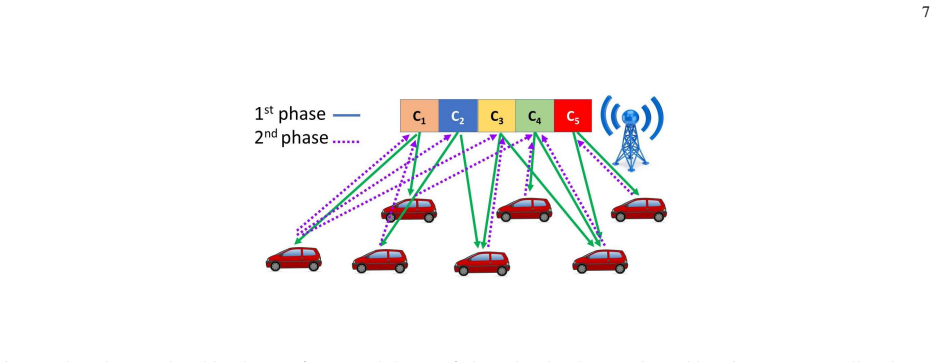
Non-orthogonal multiple access (NOMA) is a part of 5th generation (5G) communication systems. This article presents the underpinnings and underlying structures of the problem of NOMA user-channel allocation. Unlike the heuristics for NOMA user-channel allocation, the presented results are guaranteed to converge to a solution. In addition, the solutions are stable. Generally, the results apply to any NOMA system. Unlike the orthogonal frequency division multiple access (OFDMA) resource allocation problem, the core matching is not the solution to NOMA resource allocation. The conditions under which the fix-point NOMA resource allocation is guaranteed to be stable from the viewpoint of both the base station and the NOMA users are described. In addition, relationships of NOMA user-channel resource allocation to game models and subgame perfect Nash equilibria are elucidated.
Editorial analysis
A structured set of objections, weighed in public.
Referee Report
Summary. The manuscript claims to present the mathematical underpinnings of user-channel allocation in NOMA for 5G systems. It asserts that, unlike heuristics, the presented results are guaranteed to converge to a solution and that the solutions are stable; that the core matching is not the solution (unlike OFDMA); that conditions for fix-point stability are described from both base-station and NOMA-user viewpoints; and that relationships to game models and subgame-perfect Nash equilibria are elucidated.
Significance. If the central claims hold, the work would supply a theoretical foundation with convergence and stability guarantees for NOMA resource allocation, distinguishing it from OFDMA and heuristics; this could inform reliable 5G system design. The game-theoretic connections would add value if formally established.
major comments (2)
- [Abstract] Abstract: the assertions that 'the presented results are guaranteed to converge to a solution' and 'the solutions are stable' together with the claim that 'conditions under which the fix-point NOMA resource allocation is guaranteed to be stable' require an explicit operator T, its domain, and a contraction-mapping or Lyapunov argument establishing ||T(x)-T(y)|| ≤ k||x-y|| (k<1) or equivalent stability. No such operator, iteration, or proof appears in the manuscript, so the central guarantee claims are unsupported assertions rather than theorems.
- [Abstract] Abstract: the claim that 'the core matching is not the solution to NOMA resource allocation' (unlike OFDMA) is load-bearing for the paper's distinction but is stated without a concrete structural argument, counter-example, or reduction showing why the NOMA problem cannot be solved by bipartite matching or why any fix-point formulation is non-isomorphic to OFDMA matching.
minor comments (1)
- The manuscript would benefit from an explicit statement of the NOMA allocation objective function, power-allocation constraints, and the precise fix-point iteration before asserting its properties.
Simulated Author's Rebuttal
We thank the referee for the careful and constructive review of our manuscript. The comments highlight important points regarding the formal presentation of convergence guarantees and the distinction from OFDMA. We address each major comment below and will revise the manuscript to strengthen these aspects.
read point-by-point responses
-
Referee: [Abstract] Abstract: the assertions that 'the presented results are guaranteed to converge to a solution' and 'the solutions are stable' together with the claim that 'conditions under which the fix-point NOMA resource allocation is guaranteed to be stable' require an explicit operator T, its domain, and a contraction-mapping or Lyapunov argument establishing ||T(x)-T(y)|| ≤ k||x-y|| (k<1) or equivalent stability. No such operator, iteration, or proof appears in the manuscript, so the central guarantee claims are unsupported assertions rather than theorems.
Authors: The referee is correct that the abstract asserts convergence to a fixed point and stability without an explicit operator T, its domain, or a formal contraction-mapping or Lyapunov argument appearing in the manuscript. The paper describes the fix-point formulation of NOMA user-channel allocation and outlines stability conditions from both base-station and user viewpoints, as well as connections to game models, but does not supply the requested operator definition or proof. We will revise the manuscript to introduce the operator T explicitly, specify its domain, and provide a contraction-mapping argument (or equivalent Lyapunov analysis) establishing the convergence and stability guarantees. revision: yes
-
Referee: [Abstract] Abstract: the claim that 'the core matching is not the solution to NOMA resource allocation' (unlike OFDMA) is load-bearing for the paper's distinction but is stated without a concrete structural argument, counter-example, or reduction showing why the NOMA problem cannot be solved by bipartite matching or why any fix-point formulation is non-isomorphic to OFDMA matching.
Authors: We agree that the distinction—that the core matching is not the solution for NOMA, unlike OFDMA—is central to the paper and requires stronger support than the current statement. The manuscript explains that NOMA resource allocation involves power-domain multiplexing and fixed-point equilibria that differ from the bipartite matching used in OFDMA, but it does not include an explicit counter-example or reduction showing non-isomorphism. We will revise the manuscript to add a concrete structural argument or counter-example demonstrating why the NOMA allocation problem cannot be solved by standard bipartite matching. revision: yes
Circularity Check
No derivation chain or equations present; convergence/stability claims are unsupported assertions rather than a reducible derivation.
full rationale
The provided abstract and text contain no equations, operators, fixed-point mappings, contraction arguments, Lyapunov functions, or explicit derivations. The central claims (guaranteed convergence, stability conditions, structural distinction from OFDMA matching, and relations to subgame perfect Nash equilibria) are stated as results that 'are described' or 'are guaranteed,' but no chain exists to inspect for self-definition, fitted inputs renamed as predictions, or self-citation reductions. Per the rules, circularity requires quoting a specific reduction (e.g., Eq. X = Eq. Y by construction); none is available here, so the finding is no significant circularity.
Axiom & Free-Parameter Ledger
Reference graph
Works this paper leans on
-
[1]
“3GPP TR 36.885, study on LTE-based V2X services (Releas e 14), 3GPP Technical Specification Group Radio Access Network, v14.0.0,” Tech. Rep., June 2016
work page 2016
-
[2]
Cellular V2X as the e ssential enabler of superior global connected transportat ion services,
A. Papathanassiou and A. Khoryaev, “Cellular V2X as the e ssential enabler of superior global connected transportat ion services,” IEEE 5G Tech F ocus, vol. 1, no. 2, June 2017
work page 2017
-
[3]
A survey on non-orthogonal multiple access for 5G networks: Research challenges and future tren ds,
Z. Ding, X. Lei, G. K. Karagiannidis, R. Schober, J. Y uan, and V . K. Bhargava, “A survey on non-orthogonal multiple access for 5G networks: Research challenges and future tren ds,” IEEE Journal on Selected Areas in Communications , vol. 35, no. 10, pp. 2181–2195, Oct 2017
work page 2017
-
[4]
V2X meets NOMA: Non-orth ogonal multiple access for 5G-enabled vehicular networks,
B. Di, L. Song, Y . Li, and Z. Han, “V2X meets NOMA: Non-orth ogonal multiple access for 5G-enabled vehicular networks, ” IEEE Wireless Communications , vol. 24, no. 6, pp. 14–21, Dec 2017
work page 2017
-
[5]
L. Dai, B. Wang, Y . Y uan, S. Han, C. I, and Z. Wang, “Non-ort hogonal multiple access for 5G: solutions, challenges, opportunities, and future research trends,” IEEE Communications Magazine , vol. 53, no. 9, pp. 74–81, Sep. 2015. 12
work page 2015
-
[6]
Stable many-to-many matchings wi th contracts,
B. Klaus and M. Walzl, “Stable many-to-many matchings wi th contracts,” Journal of Mathematical Economics , vol. 45, no. 7, pp. 422–434, 2009
work page 2009
-
[7]
J. W. Hatfield and P . Milgrom, “Matching with contracts,” American Economic Review , vol. 95, no. 4, pp. 913–935, 2005
work page 2005
-
[8]
A theory of stability in many -to-many matching markets,
F. Echenique and J. Oviedo, “A theory of stability in many -to-many matching markets,” Theoretical Economics , vol. 1, no. 2, pp. 233–273, Jun. 2006
work page 2006
-
[9]
Stability and polarization of interests in j ob matching,
A. E. Roth, “Stability and polarization of interests in j ob matching,” Econometrica, vol. 52, no. 1, pp. 47–58, 1984
work page 1984
-
[10]
Three remarks on the many-to-many stabl e matching problem,
M. Sotomayor, “Three remarks on the many-to-many stabl e matching problem,” Mathematical Social Sciences , vol. 38, pp. 55–70, 1999
work page 1999
-
[11]
Rasmusen, Games and information: An introduction on Game Theory
E. Rasmusen, Games and information: An introduction on Game Theory . New Y ork: Basil Blackwell, 1989
work page 1989
-
[12]
An introduction to applicable game theory ,
R. Gibbons, “An introduction to applicable game theory ,” Journal of Economic Perspectives , vol. 11, no. 1, pp. 127–149, 1997
work page 1997
-
[13]
Core many-to-one matching s by fixed-point methods,
F. Echenique and J. Oviedo, “Core many-to-one matching s by fixed-point methods,” Journal of Economic Theory , vol. 115, no. 2, pp. 358–376, April 2004
work page 2004
discussion (0)
Sign in with ORCID, Apple, or X to comment. Anyone can read and Pith papers without signing in.