REVIEW 2 major objections 4 minor 1 cited by
Search for supersymmetry using Higgs boson to diphoton decays at $\sqrt{s} =$ 13 TeV
T0 review · 2 major / 4 minor · reviewed 2026-08-14 · deepseek-v4-flash
Pith's one-line read A search for supersymmetry in Higgs-to-diphoton events at 13 TeV observes no excess and excludes sbottom masses below 530 GeV and chargino-neutralino masses below 235-290 GeV at 95% confidence.
desk verdict A well-executed CMS SUSY search with genuinely new exclusions (sbottom ~530 GeV, wino ~235 GeV, higgsino ~290 GeV), but the EWP limits rest on a background functional-form choice that lacks an explicit spurious-signal systematic. read the letter →
The pith
A machine-rendered reading of the paper's core claim, the machinery that carries it, and where it could break.
The reading
What carries the argument
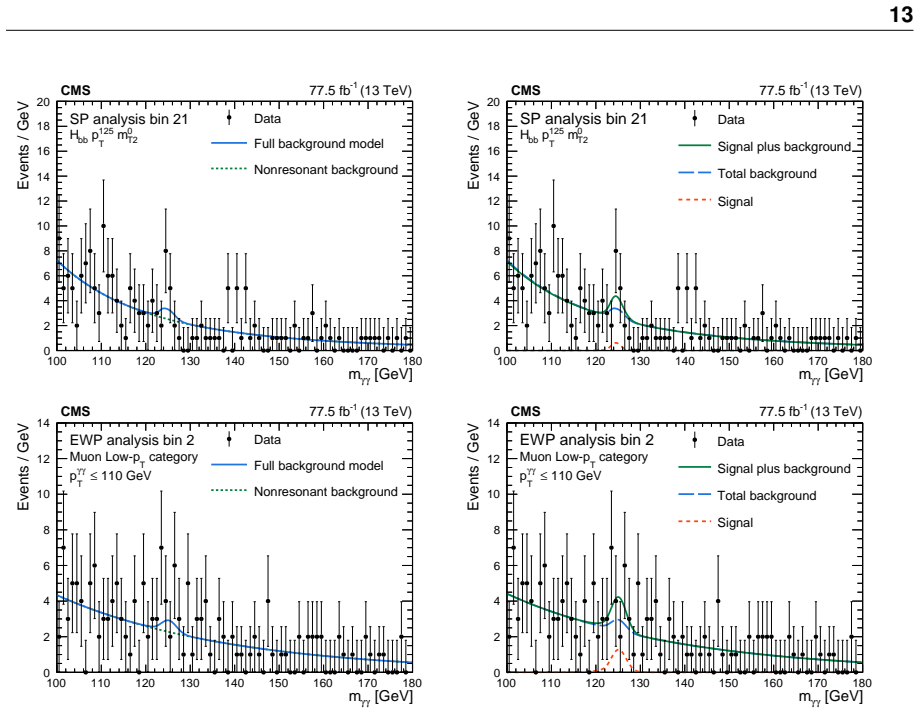
The search's central tool is the Higgs-to-diphoton resonance tag: the diphoton invariant mass $m_{\gamma\gamma}$ is the discriminating observable, with SUSY signals producing a narrow peak near 125 GeV on top of a smoothly falling nonresonant background from standard model diphoton and photon+jets production. Events are divided into exclusive search regions using the number and flavor of leptons, b-tagged jet pairs compatible with $H\to bb$ or $Z\to bb$, and the kinematic variables $M_R$ and $R^2$ (razor variables, EWP analysis) or $m_{T2}$ and $p_T^{\gamma\gamma}/m_{\gamma\gamma}$ (SP analysis). The background shape is determined by fitting a family of analytic functions (sums of exponentials, Bernstein polynomials, Laurent series, and power laws) independently in each bin, selected by the Akaike information criterion for the EWP analysis or treated as a discrete nuisance via the envelope method for the SP analysis; signal and SM Higgs shapes are fixed from simulation using double Crystal Ball functions.
What would settle it
A concrete test would be to take a high-statistics diphoton control sample with negligible expected signal, split it into the same search region bins, inject a known artificial Higgs-like peak at 125 GeV, and check whether the background-family fit recovers the injected signal yield within the quoted uncertainty; a systematic bias larger than the quoted uncertainty would falsify the background-model assumption.
Extended reading notes
Core claim
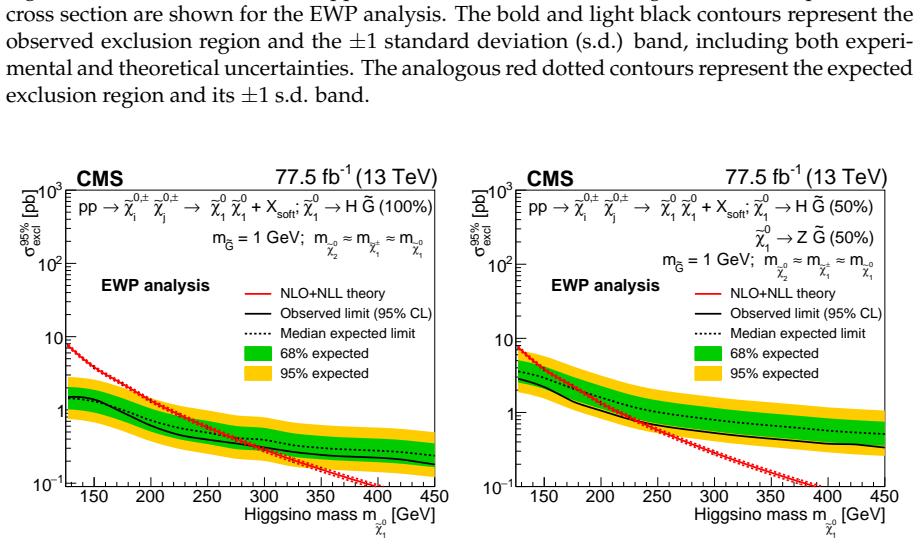
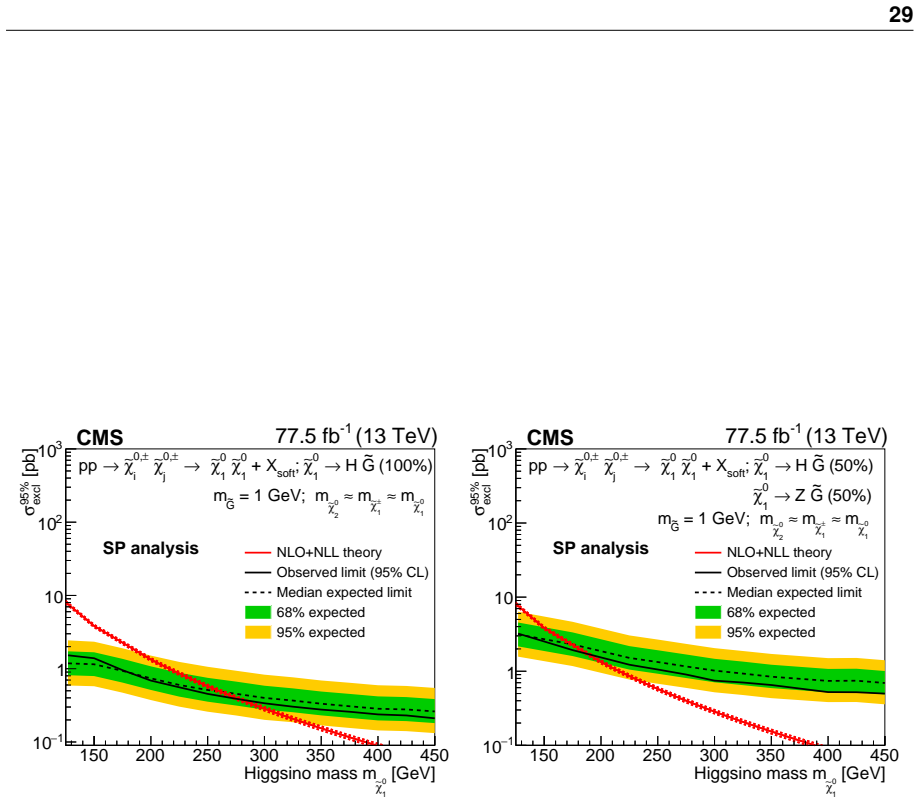
The central claim is that no supersymmetry signal appears in the $\mathrm{H}\to\gamma\gamma$ final state at 13 TeV. After a simultaneous unbinned maximum-likelihood fit to the diphoton mass in all search regions, the data are consistent with the standard model prediction. The paper therefore reports exclusion limits at 95% confidence level for the simplified SUSY scenarios studied: bottom squark pair production with masses below 530 GeV (for a 1 GeV lightest SUSY particle), wino-like chargino-neutralino production in gauge-mediated SUSY breaking with chargino and neutralino masses below 235 GeV (1 GeV gravitino), and higgsino-like chargino-neutralino production in GMSB with neutralino masses below 290 GeV when $\tilde\chi^0_1\to H\tilde G$ is 100%, or below 230 GeV when $H\tilde G$ and $Z\tilde G$ are each 50%.
Load-bearing premise
The result rests on the assumption that the standard model diphoton and photon-plus-jets background is accurately described by the chosen family of smooth analytic functions in the 125 GeV mass window, so that a genuine resonance is neither absorbed into the fit nor mimicked by it.
Editorial extensions
If this is right
- If the result is correct, bottom squark pair production is excluded at 95% confidence for squark masses below 530 GeV when the lightest SUSY particle has mass 1 GeV.
- Wino-like chargino-neutralino production in gauge-mediated SUSY breaking is excluded for chargino and neutralino masses below 235 GeV with a 1 GeV gravitino.
- Higgsino-like chargino-neutralino production in GMSB is excluded for neutralino masses below 290 GeV when the $\tilde\chi^0_1\to H\tilde G$ branching fraction is 100%, and below 230 GeV when the $H\tilde G$ and $Z\tilde G$ branching fractions are each 50%.
- The two-pronged analysis strategy (razor variables for electroweak production, $m_{T2}$ and jet/b-tag counting for strong production) extends the previous CMS result by about 100 GeV for sbottom and 50 GeV for chargino-neutralino mass reach.
Reading between the lines
- One consequence the paper leaves implicit: applying the same event categorization and background-fitting procedure to the full LHC Run 2 dataset (roughly twice the integrated luminosity) would likely extend the sbottom mass exclusion toward 600 GeV, provided the smooth background family remains adequate.
- An independent cross-check would be to estimate the diphoton background with a data-driven control region (for example, $Z\to e^+e^-$ events with the electrons treated as photons) instead of the analytic family; agreement between the two methods would strengthen the exclusion, while disagreement would expose a bias in the background model.
- The categorization by leptons, $H\to bb$, and $Z\to bb$ tags is directly reusable for other new-physics searches that use a Higgs boson as a tag, such as top-squark pair production decaying through a Higgs boson, where similar final-state signatures appear.
Editorial analysis
A structured set of objections, weighed in public.
Referee Report
Summary. This paper presents a search for supersymmetry in events with at least one Higgs boson decaying to two photons, using 77.5 fb^-1 of 13 TeV proton-proton collisions recorded by CMS. Two complementary analysis strategies are used: an electroweak-production-oriented analysis (EWP) with categories based on leptons, additional H/Z candidates, and razor variables, and a strong-production-oriented analysis (SP) with jet and b-jet counting plus mT2. The nonresonant diphoton and photon+jets background is modeled with functional fits, while the SM Higgs background is taken from simulation. No significant excess is found, and 95% CL exclusions are set on sbottom pair production, wino-like chargino-neutralino production, and higgsino-like GMSB production.
Significance. If the exclusions are correct, they extend previous CMS results by about 100 GeV for sbottom pair production and about 50 GeV for chargino-neutralino production, and they provide useful constraints on GMSB simplified models. The paper is commendably detailed: per-bin data yields, fitted backgrounds, signal expectations, and systematic uncertainties are shown in Tables 5-10, and the two-analysis strategy is a useful cross-check. The SP analysis uses discrete profiling for the background shape, which is a recognized way to cover functional-form uncertainty. The main weakness is that the EWP analysis does not explicitly assign a spurious-signal systematic to the AIC-selected background function, and the AIC bias test is not fully specified; since the EWP analysis drives the chargino-neutralino exclusions, this is a load-bearing point that needs to be addressed.
major comments (2)
- [Section 6 and Section 7, Table 7] The EWP analysis selects the nonresonant background function using the AIC after a bias test, but no explicit spurious-signal uncertainty is assigned for the discrete choice of functional form. Section 7 propagates only the uncertainties in the profiled parameters of the selected function, even though the nonresonant background is stated to contribute 75-99% of the total uncertainty. Because the EWP analysis is used for the central wino-like and higgsino-like chargino-neutralino exclusions in Section 8, a low-side bias of the AIC-selected function near m_gamma_gamma = 125 GeV in sensitive bins (for example EWP 2, 9, and 23 in Table 7, where the observed yields are above the fitted background) would directly strengthen the reported exclusions. The authors should either add a spurious-signal systematic estimated from closure tests with injected signals, or demonstrate quantitatively that the AIC bias-test threshold bounds any such bias to a level negligible for the limits.
- [Section 6] The description of the EWP bias test is incomplete: the manuscript does not specify the test statistic, the passing threshold, or the maximum allowed bias in the mass window around 125 GeV. The statement that the chosen functional form is 'adequate' is therefore not quantitatively supported. Since the central limits of the paper are derived from this background-modeling procedure, the authors should provide the bias-test details and, if possible, show the envelope of the bias across the 35 EWP search-region bins.
minor comments (4)
- [Table 6] The first row for SP 25 is garbled: '53 252 53 662 ± 104 973 ± 68' should be formatted with consistent separators, e.g., observed 53,252, fitted background 53,662 ± 104, and SM Higgs background 973 ± 68.
- [Figure 2 caption] The caption reads 'two example search bin is shown' and should be corrected to 'two example search bins are shown'.
- [Section 9] The summary states the limits extend 'previous best CMS results [8,9]', but Ref. [9] is an ATLAS paper; the wording should distinguish the CMS and ATLAS comparisons or cite only Ref. [8] for CMS.
- [Section 8 and Section 9] The text describing the higgsino-like limit as 'chargino and neutralino (chi_1^0) masses of up to 290 and 230 GeV' is confusing because Figure 5 is plotted against the chi_1^0 mass; please clarify whether the quoted numbers refer to the neutralino mass or the chargino mass.
Circularity Check
No significant circularity: the exclusion limits follow from an independent profile-likelihood fit of data against Monte Carlo signal models, not from a self-referential construction.
full rationale
The central claim — exclusion of sbottom, wino-like, and higgsino-like simplified SUSY models — is derived from a profile-likelihood ratio test under the CLs criterion with the asymptotic formula, comparing observed diphoton-mass spectra in 99 search bins against background-only and signal-plus-background hypotheses. Signal contributions are taken from independent MadGraph and PYTHIA Monte Carlo samples with a fixed double-Crystal-Ball resonance shape and NLO+NLL theoretical cross sections; the nonresonant background is a smooth falling function fit to each bin's m_gamma_gamma distribution, with functional-form choice handled either by AIC plus bias tests (EWP) or by discrete profiling (SP). Neither input is defined in terms of the output exclusions: the data are not generated from the fitted signal hypothesis, and the limits are observed counts compared with independent model expectations, not fitted cross sections renamed as predictions. Self-citations to Ref. [8] carry over the EWP categorization, the AIC procedure, and the 0.85% resolution threshold, but the previous search is an independent prior analysis on an earlier data set, and the present exclusion limits are new statistical results from the 2016-2017 data. The skeptical concern that the EWP AIC choice lacks an explicit spurious-signal systematic is a potential functional-form-bias or uncertainty-coverage issue, not an equation-level circular reduction; the paper never defines the derived exclusion in terms of the fitted background model. No circular step can be identified by the quoted equations or load-bearing self-citations.
Assumptions & free parameters
free parameters (3)
- Nonresonant background shape and normalization parameters =
profiled, values not reported
- ISR shape corrections =
0.92 to 0.51 for jet multiplicity, 1.18 to 0.78 for pT
- Search region bin boundaries =
not applicable
assumptions (5)
- ad hoc to paper The nonresonant background in each search bin can be described by one of the fitted analytic function families.
- domain assumption The SM Higgs background and SUSY signal shapes are described by double Crystal Ball functions with parameters fixed from simulation.
- domain assumption CMS fast simulation accurately models object efficiencies, resolutions, and missing transverse momentum for the signal samples.
- domain assumption The NLO plus NLL cross sections for the simplified SUSY models are correct.
- standard math The profile likelihood ratio test statistic follows the asymptotic chi-square distribution used for CLs limits.
Cite this review
Pith. "Pith review of Search for supersymmetry using Higgs boson to diphoton decays at $\sqrt{s} =$ 13 TeV." pith.science (2026). https://pith.science/paper/U3BULFC4
@misc{pith2026190808500,
  author       = {Pith},
  title        = {Pith review of: Search for supersymmetry using Higgs boson to diphoton decays at $\sqrts =$ 13 TeV},
  year         = {2026},
  howpublished = {\url{https://pith.science/paper/U3BULFC4}},
  note         = {Machine review of arXiv:1908.08500}
}
abstract
A search for supersymmetry (SUSY) is presented where at least one Higgs boson is produced and decays to two photons in the decay chains of pair-produced SUSY particles. Two analysis strategies are pursued: one focused on strong SUSY production and the other focused on electroweak SUSY production. The presence of charged leptons, additional Higgs boson candidates, and various kinematic variables are used to categorize events into search regions that are sensitive to different SUSY scenarios. The results are based on data from proton-proton collisions at the Large Hadron Collider at a center-of-mass energy of 13 TeV collected by the CMS experiment, corresponding to an integrated luminosity of 77.5 fb$^{-1}$. No statistically significant excess of events is observed relative to the standard model expectations. We exclude bottom squark pair production for bottom squark masses below 530 GeV and a lightest SUSY particle mass of 1 GeV; wino-like chargino-neutralino production in gauge-mediated SUSY breaking (GMSB) for chargino and neutralino masses below 235 GeV with a gravitino mass of 1 GeV; and higgsino-like chargino-neutralino production in GMSB, where the neutralino decays exclusively to a Higgs boson and a gravitino for neutralino masses below 290 GeV.
Figures


Figures from the paper (4 more)


Forward citations
Cited by 1 Pith paper
-
Search for bottom-squark pair production with the ATLAS detector in final states containing Higgs bosons, $b$-jets and missing transverse momentum
A search for bottom-squark pairs decaying into Higgs bosons, b-quarks, and missing energy found no excess and excluded bottom-squark masses up to 1.5 TeV.
Reference graph
Works this paper leans on
-
[1]
Phenomenology of Minimal Unified Tree Level Gauge Mediation at the LHC
M. Monaco, M. Pierini, A. Romanino, and M. Spinrath, “Phenomenology of minimal unified tree level gauge mediation at the LHC”, JHEP 07 (2013) 078, doi:10.1007/JHEP07(2013)078, arXiv:1302.1305
work page Pith review arXiv 2013
-
[2]
Squark-mediated Higgs+jets production at the LHC
J. Duarte et al., “Squark-mediated Higgs+jets production at the LHC”, (2017). arXiv:1703.06544
work page Pith review arXiv 2017
-
[3]
Softly broken supersymmetry and SU(5)
S. Dimopoulos and H. Georgi, “Softly broken supersymmetry and SU(5)”, Nucl. Phys. B 193 (1981) 150, doi:10.1016/0550-3213(81)90522-8
-
[4]
Experimental Signatures of Low Energy Gauge Mediated Supersymmetry Breaking
S. Dimopoulos, M. Dine, S. Raby, and S. D. Thomas, “Experimental signatures of low-energy gauge mediated supersymmetry breaking”, Phys. Rev. Lett. 76 (1996) 3494, doi:10.1103/PhysRevLett.76.3494, arXiv:hep-ph/9601367
work page Pith review arXiv 1996
-
[5]
Higgs and Z-boson Signatures of Supersymmetry
K. T. Matchev and S. D. Thomas, “Higgs and Z boson signatures of supersymmetry”, Phys. Rev. D 62 (2000) 077702, doi:10.1103/PhysRevD.62.077702, arXiv:hep-ph/9908482
work page Pith review arXiv 2000
-
[6]
ATLAS Collaboration, “Search for direct pair production of a chargino and a neutralino decaying to the 125 GeV Higgs boson in√s = 8 TeV pp collisions with the ATLAS detector”, Eur. Phys. J. C 75 (2015) 208, doi:10.1140/epjc/s10052-015-3408-7 , arXiv:1501.07110
work page Pith review arXiv 2015
-
[7]
CMS Collaboration, “Searches for electroweak neutralino and chargino production in channels with Higgs, Z, and W bosons in pp collisions at 8 TeV”, Phys. Rev. D 90 (2014) 092007, doi:10.1103/PhysRevD.90.092007, arXiv:1409.3168
work page Pith review arXiv 2014
-
[8]
Search for supersymmetry with Higgs boson to diphoton decays using the razor variables at√s = 13 TeV
CMS Collaboration, “Search for supersymmetry with Higgs boson to diphoton decays using the razor variables at√s = 13 TeV”, Phys. Lett. B 779 (2018) 166, doi:10.1016/j.physletb.2017.12.069, arXiv:1709.00384
arXiv 2018
Show all 61 references
-
[9]
Search for chargino and neutralino production in final states with a Higgs boson and missing transverse momentum at√s = 13 TeV with the ATLAS detector
ATLAS Collaboration, “Search for chargino and neutralino production in final states with a Higgs boson and missing transverse momentum at√s = 13 TeV with the ATLAS detector”, Phys. Rev. D100 (2019), no. 1, 012006, doi:10.1103/PhysRevD.100.012006, arXiv:1812.09432
2019 arXiv
-
[10]
Search for pair production of higgsinos in final states with at least three b-tagged jets in√s = 13 TeV pp collisions using the ATLAS detector
ATLAS Collaboration, “Search for pair production of higgsinos in final states with at least three b-tagged jets in√s = 13 TeV pp collisions using the ATLAS detector”, Phys. Rev. D 98 (2018), no. 9, 092002, doi:10.1103/PhysRevD.98.092002, arXiv:1806.04030
2018 arXiv
-
[11]
The CMS trigger system
CMS Collaboration, “The CMS trigger system”, JINST 12 (2017) P01020, doi:10.1088/1748-0221/12/01/P01020, arXiv:1609.02366
2017 arXiv
-
[12]
The CMS experiment at the CERN LHC
CMS Collaboration, “The CMS experiment at the CERN LHC”, JINST 3 (2008) S08004, doi:10.1088/1748-0221/3/08/S08004
2008 doi
-
[13]
The automated computation of tree-level and next-to-leading order differential cross sections, and their matching to parton shower simulations
J. Alwall et al., “The automated computation of tree-level and next-to-leading order differential cross sections, and their matching to parton shower simulations”, JHEP 07 (2014) 079, doi:10.1007/JHEP07(2014)079, arXiv:1405.0301
2014 arXiv
-
[14]
Combined measurement of the Higgs boson mass in pp collisions at√s = 7 and 8 TeV with the ATLAS and CMS experiments
ATLAS and CMS Collaborations, “Combined measurement of the Higgs boson mass in pp collisions at√s = 7 and 8 TeV with the ATLAS and CMS experiments”, Phys. Rev. Lett. 114 (2015) 191803, doi:10.1103/PhysRevLett.114.191803, arXiv:1503.07589. 24
2015 arXiv
-
[15]
Measurements of properties of the Higgs boson decaying into the four-lepton final state in pp collisions at√s = 13 TeV
CMS Collaboration, “Measurements of properties of the Higgs boson decaying into the four-lepton final state in pp collisions at√s = 13 TeV”, JHEP 11 (2017) 047, doi:10.1007/JHEP11(2017)047, arXiv:1706.09936
2017 arXiv
-
[16]
Handbook of LHC Higgs cross sections: 4. deciphering the nature of the Higgs sector
D. de Florian et al., “Handbook of LHC Higgs cross sections: 4. deciphering the nature of the Higgs sector”, CERN Report CERN-2017-002-M, 2016. doi:10.23731/CYRM-2017-002, arXiv:1610.07922
2017 arXiv
-
[17]
Merging meets matching in MC@NLO
R. Frederix and S. Frixione, “Merging meets matching in MC@NLO”, JHEP 12 (2012) 061, doi:10.1007/JHEP12(2012)061, arXiv:1209.6215
2012 arXiv
-
[18]
Comparative study of various algorithms for the merging of parton showers and matrix elements in hadronic collisions
J. Alwall et al., “Comparative study of various algorithms for the merging of parton showers and matrix elements in hadronic collisions”, Eur. Phys. J. C 53 (2008) 473, doi:10.1140/epjc/s10052-007-0490-5 , arXiv:0706.2569
2008 arXiv
-
[19]
An Introduction to PYTHIA 8.2
T. Sj ¨ostrand et al., “An Introduction to PYTHIA 8.2”, Comput. Phys. Commun. 191 (2015) 159, doi:10.1016/j.cpc.2015.01.024, arXiv:1410.3012
2015 arXiv
-
[20]
Tuning PYTHIA 8.1: the Monash 2013 tune
P . Skands, S. Carrazza, and J. Rojo, “Tuning PYTHIA 8.1: the Monash 2013 tune”, Eur. Phys. J. C 74 (2014) 3024, doi:10.1140/epjc/s10052-014-3024-y
2014 doi
-
[21]
Extraction and validation of a new set of CMS PYTHIA8 tunes from underlying-event measurements
CMS Collaboration, “Extraction and validation of a new set of CMS PYTHIA8 tunes from underlying-event measurements”, (2019). arXiv:1903.12179. Submitted to EPJC
2019 arXiv
-
[22]
Parton distributions for the LHC Run II
NNPDF Collaboration, “Parton distributions for the LHC Run II”, JHEP 04 (2015) 040, doi:10.1007/JHEP04(2015)040, arXiv:1410.8849
2015 arXiv
-
[23]
Parton distributions from high-precision collider data
NNPDF Collaboration, “Parton distributions from high-precision collider data”, Eur. Phys. J. C 77 (2017) 663, doi:10.1140/epjc/s10052-017-5199-5 , arXiv:1706.00428
2017 arXiv
-
[24]
Squark and gluino production at hadron colliders
W. Beenakker, R. H ¨opker, M. Spira, and P . M. Zerwas, “Squark and gluino production at hadron colliders”, Nucl. Phys. B 492 (1997) 51, doi:10.1016/S0550-3213(97)80027-2, arXiv:hep-ph/9610490
1997 arXiv
-
[25]
Threshold resummation for squark-antisquark and gluino-pair production at the LHC
A. Kulesza and L. Motyka, “Threshold resummation for squark-antisquark and gluino-pair production at the LHC”, Phys. Rev. Lett. 102 (2009) 111802, doi:10.1103/PhysRevLett.102.111802, arXiv:0807.2405
2009 arXiv
-
[26]
Soft gluon resummation for the production of gluino-gluino and squark-antisquark pairs at the LHC
A. Kulesza and L. Motyka, “Soft gluon resummation for the production of gluino-gluino and squark-antisquark pairs at the LHC”, Phys. Rev. D 80 (2009) 095004, doi:10.1103/PhysRevD.80.095004, arXiv:0905.4749
2009 arXiv
-
[27]
Soft-gluon resummation for squark and gluino hadroproduction
W. Beenakker et al., “Soft-gluon resummation for squark and gluino hadroproduction”, JHEP 12 (2009) 041, doi:10.1088/1126-6708/2009/12/041, arXiv:0909.4418
2009 arXiv
-
[28]
Squark and gluino hadroproduction
W. Beenakker et al., “Squark and gluino hadroproduction”, Int. J. Mod. Phys. A 26 (2011) 2637, doi:10.1142/S0217751X11053560, arXiv:1105.1110
2011 arXiv
-
[29]
Squark and gluino production cross sections in pp collisions at√s = 13, 14, 33 and 100 TeV
C. Borschensky et al., “Squark and gluino production cross sections in pp collisions at√s = 13, 14, 33 and 100 TeV”, Eur. Phys. J. C 74 (2014) 3174, doi:10.1140/epjc/s10052-014-3174-y , arXiv:1407.5066
2014 arXiv
-
[30]
Production of charginos, neutralinos, and sleptons at hadron colliders
W. Beenakker et al., “Production of charginos, neutralinos, and sleptons at hadron colliders”, Phys. Rev. Lett. 83 (1999) 3780, doi:10.1103/PhysRevLett.83.3780, arXiv:hep-ph/9906298. [Erratum: doi:10.1103/PhysRevLett.100.029901]. References 25
1999 arXiv
-
[31]
Gaugino production in proton-proton collisions at a center-of-mass energy of 8 TeV
B. Fuks, M. Klasen, D. R. Lamprea, and M. Rothering, “Gaugino production in proton-proton collisions at a center-of-mass energy of 8 TeV”, JHEP 10 (2012) 081, doi:10.1007/JHEP10(2012)081, arXiv:1207.2159
2012 arXiv
-
[32]
Precision predictions for electroweak superpartner production at hadron colliders with RESUMMINO
B. Fuks, M. Klasen, D. R. Lamprea, and M. Rothering, “Precision predictions for electroweak superpartner production at hadron colliders with RESUMMINO ”, Eur. Phys. J. C 73 (2013) 2480, doi:10.1140/epjc/s10052-013-2480-0 , arXiv:1304.0790
2013 arXiv
-
[33]
SUSY Les Houches accord: interfacing SUSY spectrum calculators, decay packages, and event generators
P . Z. Skands and Others, “SUSY Les Houches accord: interfacing SUSY spectrum calculators, decay packages, and event generators”, JHEP 07 (2004) 036, doi:10.1088/1126-6708/2004/07/036, arXiv:Hep-Ph/0311123
2004
-
[34]
GEANT4—a simulation toolkit
GEANT4 Collaboration, “GEANT4—a simulation toolkit”, Nucl. Instrum. Meth. A 506 (2003) 250, doi:10.1016/S0168-9002(03)01368-8
2003 doi
-
[35]
The fast simulation of the CMS detector at LHC
S. Abdullin et al., “The fast simulation of the CMS detector at LHC”, J. Phys. Conf. Ser. 331 (2011) 032049, doi:10.1088/1742-6596/331/3/032049
2011 doi
-
[36]
The fast simulation of the CMS experiment
A. Giammanco, “The fast simulation of the CMS experiment”, J. Phys. Conf. Ser. 513 (2014) 022012, doi:10.1088/1742-6596/513/2/022012
2014 doi
-
[37]
Search for top-squark pair production in the single-lepton final state in pp collisions at√s = 8 TeV
CMS Collaboration, “Search for top-squark pair production in the single-lepton final state in pp collisions at√s = 8 TeV”, Eur. Phys. J. C 73 (2013), no. 12, 2677, doi:10.1140/epjc/s10052-013-2677-2 , arXiv:1308.1586
2013 arXiv
-
[38]
Particle-flow reconstruction and global event description with the CMS detector
CMS Collaboration, “Particle-flow reconstruction and global event description with the CMS detector”, JINST 12 (2017) P10003, doi:10.1088/1748-0221/12/10/P10003, arXiv:1706.04965
2017 arXiv
-
[39]
The anti-kT jet clustering algorithm
M. Cacciari, G. P . Salam, and G. Soyez, “The anti-kT jet clustering algorithm”, JHEP 04 (2008) 063, doi:10.1088/1126-6708/2008/04/063, arXiv:0802.1189
2008 arXiv
-
[40]
FastJet user manual
M. Cacciari, G. P . Salam, and G. Soyez, “FastJet user manual”, Eur. Phys. J. C 72 (2012) 1896, doi:10.1140/epjc/s10052-012-1896-2 , arXiv:1111.6097
2012 arXiv
-
[41]
Performance of photon reconstruction and identification with the CMS detector in proton-proton collisions at√s = 8 TeV
CMS Collaboration, “Performance of photon reconstruction and identification with the CMS detector in proton-proton collisions at√s = 8 TeV”, JINST 10 (2015), no. 08, P08010, doi:10.1088/1748-0221/10/08/P08010, arXiv:1502.02702
2015 arXiv
-
[42]
Pileup subtraction using jet areas
M. Cacciari and G. P . Salam, “Pileup subtraction using jet areas”, Phys. Lett. B 659 (2008) 119, doi:10.1016/j.physletb.2007.09.077, arXiv:0707.1378
2008 arXiv
-
[43]
Jet energy scale and resolution in the CMS experiment in pp collisions at 8 TeV
CMS Collaboration, “Jet energy scale and resolution in the CMS experiment in pp collisions at 8 TeV”, JINST 12 (2017) P02014, doi:10.1088/1748-0221/12/02/P02014, arXiv:1607.03663
2017 arXiv
-
[44]
Identification of b-quark jets with the CMS experiment
CMS Collaboration, “Identification of b-quark jets with the CMS experiment”, JINST 8 (2013) P04013, doi:10.1088/1748-0221/8/04/P04013, arXiv:1211.4462
2013 arXiv
-
[45]
Missing transverse energy performance of the CMS detector
CMS Collaboration, “Missing transverse energy performance of the CMS detector”, JINST 6 (2011) P09001, doi:10.1088/1748-0221/6/09/P09001, arXiv:1106.5048
2011 arXiv
-
[46]
Kinematical variables towards new dynamics at the LHC
C. Rogan, “Kinematical variables towards new dynamics at the LHC”, (2010). arXiv:1006.2727. 26
2010 arXiv
-
[47]
Inclusive search for supersymmetry using razor variables in pp collisions at√s = 13 TeV
CMS Collaboration, “Inclusive search for supersymmetry using razor variables in pp collisions at√s = 13 TeV”, Phys. Rev. D 95 (2017) 012003, doi:10.1103/PhysRevD.95.012003, arXiv:1609.07658
2017 arXiv
-
[48]
Search for new physics with the MT2 variable in all-jets final states produced in pp collisions at√s = 13 TeV
CMS Collaboration, “Search for new physics with the MT2 variable in all-jets final states produced in pp collisions at√s = 13 TeV”, JHEP 10 (2016) 006, doi:10.1007/JHEP10(2016)006, arXiv:1603.04053
2016 arXiv
-
[49]
Measuring masses of semi-invisibly decaying particles pair produced at hadron colliders
C. G. Lester and D. J. Summers, “Measuring masses of semi-invisibly decaying particles pair produced at hadron colliders”, Phys. Lett. B 463 (1999) 99, doi:10.1016/S0370-2693(99)00945-4, arXiv:hep-ph/9906349
1999 arXiv
-
[50]
A new look at the statistical model identification
H. Akaike, “A new look at the statistical model identification”, IEEE T ransactions on Automatic Control 19-6 (1974) 716, doi:10.1109/TAC.1974.1100705
1974
-
[51]
Handling uncertainties in background shapes
P . D. Dauncey, M. Kenzie, N. Wardle, and G. J. Davies, “Handling uncertainties in background shapes”, JINST 10 (2015) P04015, doi:10.1088/1748-0221/10/04/P04015, arXiv:1408.6865
2015 arXiv
-
[52]
Observation of the diphoton decay of the Higgs boson and measurement of its properties
CMS Collaboration, “Observation of the diphoton decay of the Higgs boson and measurement of its properties”, Eur. Phys. J. C 74 (2014), no. 10, 3076, doi:10.1140/epjc/s10052-014-3076-z , arXiv:1407.0558
2014 arXiv
-
[53]
A study of the reactions ψ′→ γγψ
M. J. Oreglia, “A study of the reactions ψ′→ γγψ”. PhD thesis, Stanford University,
-
[54]
Charmonium Spectroscopy From Radiative Decays of the J/ψ and ψ′
J. Gaiser, “Charmonium Spectroscopy From Radiative Decays of the J/ψ and ψ′”. PhD thesis, SLAC, 1982
1982
-
[55]
The SysCalc code: A tool to derive theoretical systematic uncertainties
A. Kalogeropoulos and J. Alwall, “The SysCalc code: A tool to derive theoretical systematic uncertainties”, (2018). arXiv:1801.08401
2018 arXiv
-
[56]
PDF4LHC recommendations for LHC Run II
J. Butterworth et al., “PDF4LHC recommendations for LHC Run II”, J. Phys. G 43 (2016) 023001, doi:10.1088/0954-3899/43/2/023001, arXiv:1510.03865
2016 arXiv
-
[57]
Confidence level computation for combining searches with small statistics
T. Junk, “Confidence level computation for combining searches with small statistics”, Nucl. Instrum. Meth. A 434 (1999) 435, doi:10.1016/S0168-9002(99)00498-2, arXiv:hep-ex/9902006
1999 arXiv
-
[58]
Presentation of search results: The CL s technique
A. L. Read, “Presentation of search results: The CL s technique”, J. Phys. G 28 (2002) 2693, doi:10.1088/0954-3899/28/10/313
2002 doi
-
[59]
Procedure for the LHC Higgs boson search combination in summer 2011
ATLAS and CMS Collaborations, “Procedure for the LHC Higgs boson search combination in summer 2011”, Technical Report ATL-PHYS-PUB-2011-011, CMS-NOTE-2011-005, 2011
2011
-
[60]
Asymptotic formulae for likelihood-based tests of new physics
G. Cowan, K. Cranmer, E. Gross, and O. Vitells, “Asymptotic formulae for likelihood-based tests of new physics”, Eur. Phys. J. C 71 (2011) 1554, doi:10.1140/epjc/s10052-011-1554-0 , arXiv:1007.1727. [Erratum: doi:10.1140/epjc/s10052-013-2501-z ]. 27 A Additional simplified mode...
2011 arXiv
-
[1980]
SLAC Report SLAC-R-236, see Appendix D
Reviewed August 14, 2026 · model on record in the stance chip above.
Discussion (0). Continue with ORCID to comment.