A mixed boundary value problem for u_(xy)=f(x,y,u,u_x,u_y)
Pith reviewed 2026-05-24 20:17 UTC · model grok-4.3
The pith
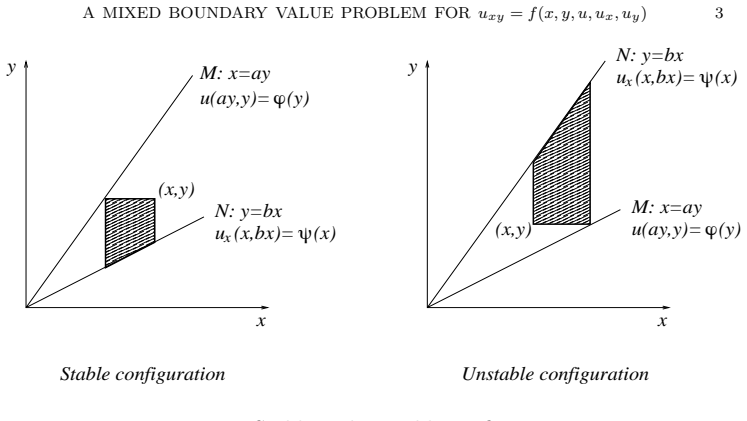
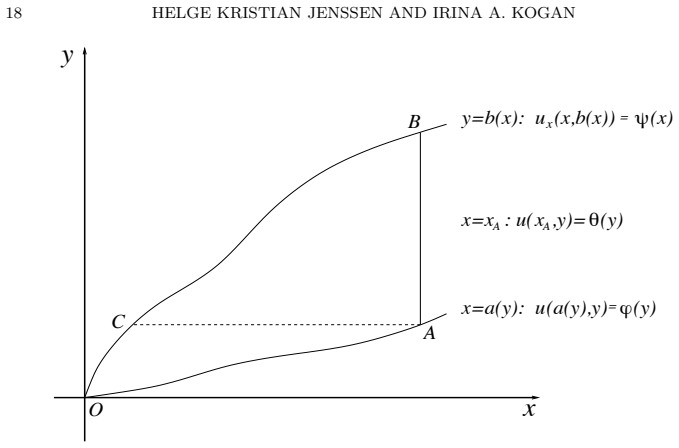
When the curve prescribing u lies below the one prescribing u_x, the mixed boundary problem for u_xy = f can have multiple local solutions differing near the origin.
A machine-rendered reading of the paper's core claim, the machinery that carries it, and where it could break.
Core claim
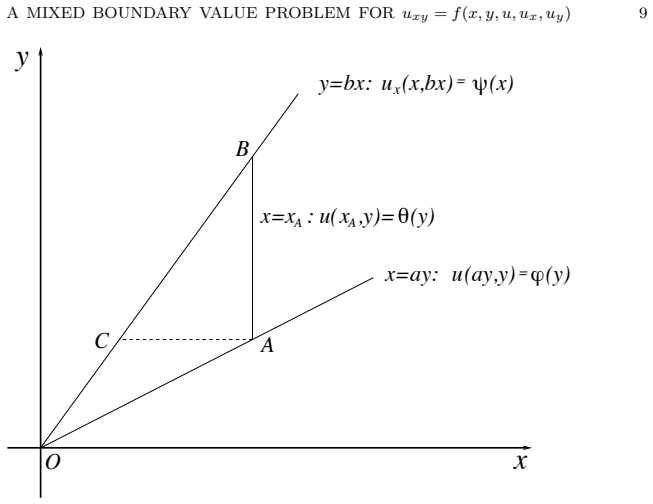
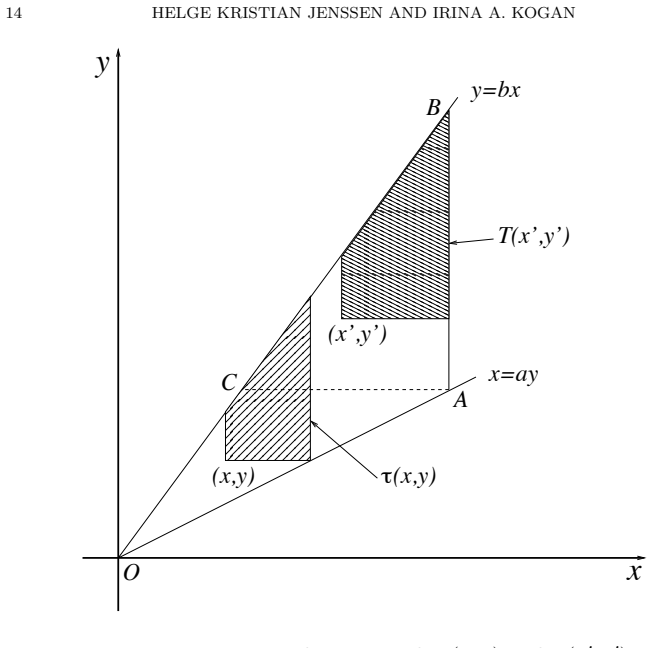
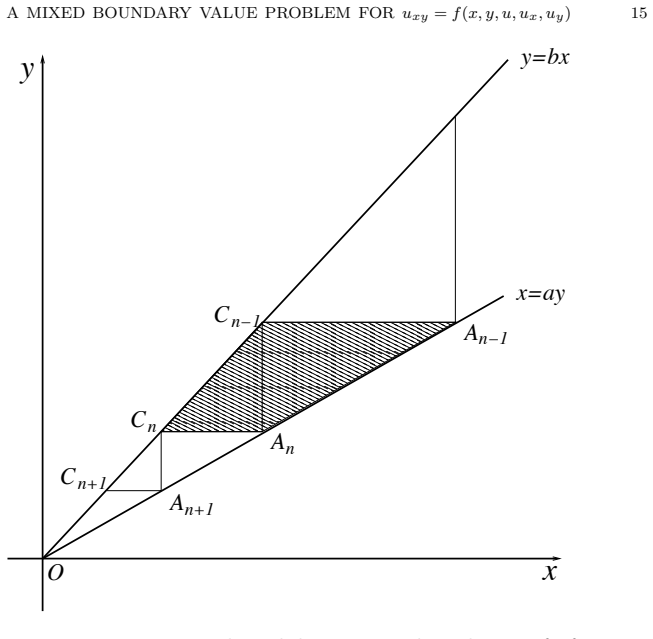
When M lies below N, for the same boundary data there exist two solutions that differ at points arbitrarily close to the origin. In the same setting a local solution exists provided f satisfies a Lipschitz condition. The solutions are constructed via Picard iteration that incorporates a careful choice of additional u-data updated at each iteration step.
What carries the argument
The relative ordering of the two non-characteristic curves M (carrying u-data) and N (carrying u_x-data) in the first quadrant; the ordering determines whether the Picard iteration can be made to produce distinct solutions from the same data.
If this is right
- Uniqueness holds only when the curve for u lies above the curve for u_x.
- When M lies below N at least one local solution still exists under the Lipschitz assumption on f.
- The iteration procedure that constructs the solution must update auxiliary u-values at each step.
- Solutions that coincide on the data curves can separate immediately inside the domain.
Where Pith is reading between the lines
- The result indicates that the ordering of data curves relative to the characteristics controls well-posedness for this class of mixed hyperbolic problems.
- It would be natural to check whether the same ordering-dependent non-uniqueness appears for quasilinear or fully nonlinear hyperbolic equations with analogous mixed data.
- Concrete numerical experiments with simple Lipschitz f could produce explicit pairs of solutions that separate near the origin.
Load-bearing premise
M and N must be graphs of one-to-one functions intersecting only at the origin in the first quadrant, with the given data prescribed along non-characteristic curves.
What would settle it
Exhibit an explicit f, explicit curves M below N, and explicit data on M and N for which two distinct C^2 solutions exist that agree on M and N but differ inside the domain at some sequence of points approaching the origin.
Figures
read the original abstract
Consider a single hyperbolic PDE $u_{xy}=f(x,y,u,u_x,u_y)$, with locally prescribed data: $u$ along a non-characteristic curve $M$ and $u_x$ along a non-characteristic curve $N$. We assume that $M$ and $N$ are graphs of one-to-one functions, intersecting only at the origin, and located in the first quadrant of the $(x,y)$-plane. It is known that if $M$ is located above $N$, then there is a unique local solution, obtainable by successive approximation. We show that in the opposite case, when $M$ lies below $N$, the uniqueness can fail in the following strong sense: for the same boundary data, there are two solutions that differ at points arbitrarily close to the origin. In the latter case, we also establish existence of a local solution (under a Lipschitz condition on the function $f$). The construction, via Picard iteration, makes use of a careful choice of additional $u$-data which are updated in each iteration step.
Editorial analysis
A structured set of objections, weighed in public.
Referee Report
Summary. The paper considers the mixed boundary-value problem for the hyperbolic PDE u_xy = f(x,y,u,u_x,u_y) with u prescribed along a non-characteristic curve M and u_x along a non-characteristic curve N (both graphs of one-to-one functions intersecting only at the origin in the first quadrant). It recalls that uniqueness holds via successive approximation when M lies above N. For the case M below N, the authors construct (via Picard iteration on an integral form, with additional u-data updated at each step) two distinct local solutions satisfying identical boundary data yet differing at points arbitrarily close to the origin; they also prove existence of at least one local solution under a Lipschitz assumption on f.
Significance. If the non-uniqueness construction is rigorous, the result supplies a sharp, geometrically explicit counterexample to uniqueness for this mixed problem and clarifies the transition between well-posed and ill-posed regimes according to the relative ordering of M and N. The iterative method with updated auxiliary data is a concrete technique that could be of interest for other hyperbolic problems with over- or under-determined data.
major comments (2)
- [construction via Picard iteration (abstract and proof outline)] The non-uniqueness claim requires that both constructed solutions satisfy exactly the same u_x data along the entire curve N. The abstract states that additional u-data are updated at each Picard step, but it is not clear from the given description whether these updates are confined to a region disjoint from N (except at the origin) or whether the iteration separately enforces the prescribed u_x values on N independently of the auxiliary data. If the updates propagate to N, the two limits would solve distinct boundary-value problems rather than the same one. This verification is load-bearing for the central non-uniqueness statement.
- [existence proof under Lipschitz condition] The existence proof under the Lipschitz condition on f likewise relies on the same iterative scheme. It must be shown that the limit satisfies both the PDE and the original boundary conditions on M and N; any gap in preserving the u_x condition on N would invalidate both the existence and non-uniqueness results simultaneously.
minor comments (2)
- [Introduction] Notation for the curves M and N and the precise meaning of “above” versus “below” should be fixed with a figure or explicit coordinate description early in the paper.
- [Setup] The statement that M and N are “graphs of one-to-one functions” should be accompanied by the explicit functional forms or at least the monotonicity assumptions used in the estimates.
Simulated Author's Rebuttal
We thank the referee for the detailed reading and for identifying points where the manuscript's description of the iteration requires greater explicitness. The two major comments both concern verification that the u_x boundary condition on N is preserved exactly by the constructed solutions. We address each below and will revise the manuscript accordingly for clarity.
read point-by-point responses
-
Referee: [construction via Picard iteration (abstract and proof outline)] The non-uniqueness claim requires that both constructed solutions satisfy exactly the same u_x data along the entire curve N. The abstract states that additional u-data are updated at each Picard step, but it is not clear from the given description whether these updates are confined to a region disjoint from N (except at the origin) or whether the iteration separately enforces the prescribed u_x values on N independently of the auxiliary data. If the updates propagate to N, the two limits would solve distinct boundary-value problems rather than the same one. This verification is load-bearing for the central non-uniqueness statement.
Authors: The auxiliary u-data are updated only along an auxiliary curve lying strictly between M and N (except at the origin) and therefore remain disjoint from N. The prescribed u_x values on N are enforced at every step by the integral representation of the solution, which is written so that the contribution along N is fixed by the given data and is independent of the auxiliary updates. Consequently every iterate (and hence both limit solutions) satisfies the identical u_x condition on the whole of N. A new paragraph will be inserted immediately after the description of the iteration to state this separation explicitly and to record the integral identity that fixes the N-data. revision: yes
-
Referee: [existence proof under Lipschitz condition] The existence proof under the Lipschitz condition on f likewise relies on the same iterative scheme. It must be shown that the limit satisfies both the PDE and the original boundary conditions on M and N; any gap in preserving the u_x condition on N would invalidate both the existence and non-uniqueness results simultaneously.
Authors: Because each approximant satisfies the u_x condition on N exactly (by the same integral identity used for non-uniqueness), and the convergence is uniform on compact subsets that include N, the limit inherits the boundary condition on N. The PDE is recovered in the limit by the Lipschitz assumption on f together with the integral equation. We will add a short lemma (placed before the existence theorem) that records the uniform convergence on N and the passage to the limit in the boundary integrals. revision: yes
Circularity Check
No circularity: standard iterative existence/non-uniqueness proof for hyperbolic PDE
full rationale
The paper establishes local existence and non-uniqueness for the mixed BVP via Picard iteration on an integral form of the PDE, with an auxiliary choice of u-data updated per step when M lies below N. No quoted step reduces by definition to its own input (no self-definitional relations, no fitted parameters renamed as predictions). No load-bearing self-citation chains or uniqueness theorems imported from the authors' prior work appear in the provided abstract or description. The construction is presented as a direct iterative argument under a Lipschitz assumption on f; it does not rename known empirical patterns or smuggle ansatzes via citation. This is a self-contained analytic proof whose central claims rest on the iteration scheme itself rather than on any enumerated circular pattern.
Axiom & Free-Parameter Ledger
Reference graph
Works this paper leans on
-
[1]
A. K. Aziz and J. B. Diaz, On a mixed boundary-value problem for linear hyperbolic partial differential equations in two independent variables, Arch. Rational Mech. Anal. 10 (1962), 1–28, DOI 10.1007/BF00281176. MR0142909
-
[2]
M. Benfield, H.K. Jenssen, and I.A. Kogan, A Generalization of an Integrability The- orem of Darboux, J. Geom. Anal. (2018)
work page 2018
-
[3]
Carlo Ciliberto, Su alcuni problemi relativi ad una equazione di tipo iperbolico in due variabili, Boll. Un. Mat. Ital. (3) 11 (1956), 383–393 (Italian). MR0087863
work page 1956
-
[4]
R. Courant and D. Hilbert, Methods of mathematical physics. Vol. II , Wiley Classics Library, John Wiley & Sons, Inc., New York, 1989. Partial differential equations; Reprint of the 1962 original; A Wiley-Interscience Publication. MR1013360
work page 1989
-
[5]
II, Les Grands Clas- siques Gauthier-Villars
Gaston Darboux, Le¸ cons sur la th´ eorie g´ en´ erale des surfaces. II, Les Grands Clas- siques Gauthier-Villars. [Gauthier-Villars Great Classics], ´Editions Jacques Gabay, Sceaux, 1993 (French). Les congruences et les ´ equations lin´ eaires aux d´ eriv´ ees par- tielles. Les lignes trac´ ees sur les surfaces. [Congruences and linear partial differentia...
work page 1993
-
[6]
IV, Les Grands Classiques Gauthier-Villars
, Le¸ cons sur la th´ eorie g´ en´ erale des surfaces. IV, Les Grands Classiques Gauthier-Villars. [Gauthier-Villars Great Classics], ´Editions Jacques Gabay, Sceaux, 1993 (French). D´ eformation infiniment petite et repr´ esentation sph´ erique. [Infinitely small deformation and spherical representation]; Reprint of the 1896 original; Cours de G´ eom´ etri...
work page 1993
- [7]
-
[8]
P. R. Garabedian, Partial differential equations , AMS Chelsea Publishing, Provi- dence, RI, 1998. Reprint of the 1964 original. MR1657375
work page 1998
-
[9]
Tome III, 3rd ed., Les Grands Clas- siques Gauthier-Villars
´Edouard Goursat, Cours d’analyse math´ ematique. Tome III, 3rd ed., Les Grands Clas- siques Gauthier-Villars. [Gauthier-Villars Great Classics], ´Editions Jacques Gabay, Sceaux, 1992 (French). Int´ egrales infiniment voisines. ´Equations aux d´ eriv´ ees du second ordre. ´Equations int´ egrales. Calcul des variations. [Infinitely near integrals. A MIXED BO...
work page 1992
-
[10]
S. Kharibegashvili, Goursat and Darboux type problems for linear hyperbolic partial differential equations and systems, Mem. Differential Equations Math. Phys.4 (1995), 127 (English, with English and Georgian summaries). MR1415805
work page 1995
-
[11]
S. S. Kharibegashvili and O. M. Jokhadze, On the solvability of a boundary value problem for nonlinear wave equations in angular domains , Differ. Equ. 52 (2016), no. 5, 644–666, DOI 10.1134/S0012266116050104. Translation of Differ. Uravn. 52 (2016), no. 5, 665–686. MR3541458
-
[12]
Melvin Lieberstein, Theory of partial differential equations , Academic Press, New York-London, 1972
H. Melvin Lieberstein, Theory of partial differential equations , Academic Press, New York-London, 1972. Mathematics in Science and Engineering, Vol. 93. MR0355280
work page 1972
-
[13]
A. M. Nakhushev, Goursat problem , Encyclopedia of Mathematics, https://www.encyclopediaofmath.org/index.php/Goursat−problem, accessed May 2019
work page 2019
-
[14]
Trans- lated from the 1892 German edition by Roger Baker, Charles Christenson and Henry Orde
Bernhard Riemann, Collected papers, Kendrick Press, Heber City, UT, 2004. Trans- lated from the 1892 German edition by Roger Baker, Charles Christenson and Henry Orde. MR2121437
work page 2004
-
[15]
R´ edig´ ees par Eug` ene Blanc, Gauthier-Villars, Paris, 1950 (French)
´Emile Picard, Le¸ cons sur quelques ´ equations fonctionnelles avec des applications ` a divers probl` emes d’analyse et de physique math´ ematique. R´ edig´ ees par Eug` ene Blanc, Gauthier-Villars, Paris, 1950 (French). MR0033960
work page 1950
-
[16]
Pogorzelski, Integral equations and their applications
W. Pogorzelski, Integral equations and their applications. Vol. I , Translated from the Polish by Jacques J. Schorr-Con, A. Kacner and Z. Olesiak. International Series of Monographs in Pure and Applied Mathematics, Vol. 88, Pergamon Press, Oxford-New York-Frankfurt; PWN-Polish Scientific Publishers, Warsaw, 1966. MR0201934
work page 1966
-
[17]
Z. Szmydt, Sur l’existence de solutions de certains nouveaux probl` emes pour un syst` eme d’´ equations diff´ erentielles hyperboliques du second ordre ` a deux variables ind´ ependantes, Ann. Polon. Math. 4 (1957), 40–60, DOI 10.4064/ap-4-1-40-60 (French). MR0094568
-
[18]
, Sur l’existence d’une solution unique de certains probl` emes pour un syst` eme d’´ equations diff´ erentielles hyperboliques du second ordre ` a deux variables ind´ ependantes, Ann. Polon. Math. 4 (1958), 165–182, DOI 10.4064/ap-4-2-165-182 (French). MR0094569
-
[19]
Ergebnisse der Mathematik und ihrer Grenzgebiete, Band 55, Springer-Verlag, New York-Berlin, 1970
Wolfgang Walter, Differential and integral inequalities , Translated from the German by Lisa Rosenblatt and Lawrence Shampine. Ergebnisse der Mathematik und ihrer Grenzgebiete, Band 55, Springer-Verlag, New York-Berlin, 1970. MR0271508 H. K. Jenssen, Department of Mathematics, Penn State University, Univer- sity Park, State College, PA 16802, USA ( jenssen...
work page 1970
discussion (0)
Sign in with ORCID, Apple, or X to comment. Anyone can read and Pith papers without signing in.