Mechanism of the ordered particles arrangement in a concentration grating excited in the field of counter-propagating Gaussian beams
Pith reviewed 2026-05-25 09:19 UTC · model grok-4.3
The pith
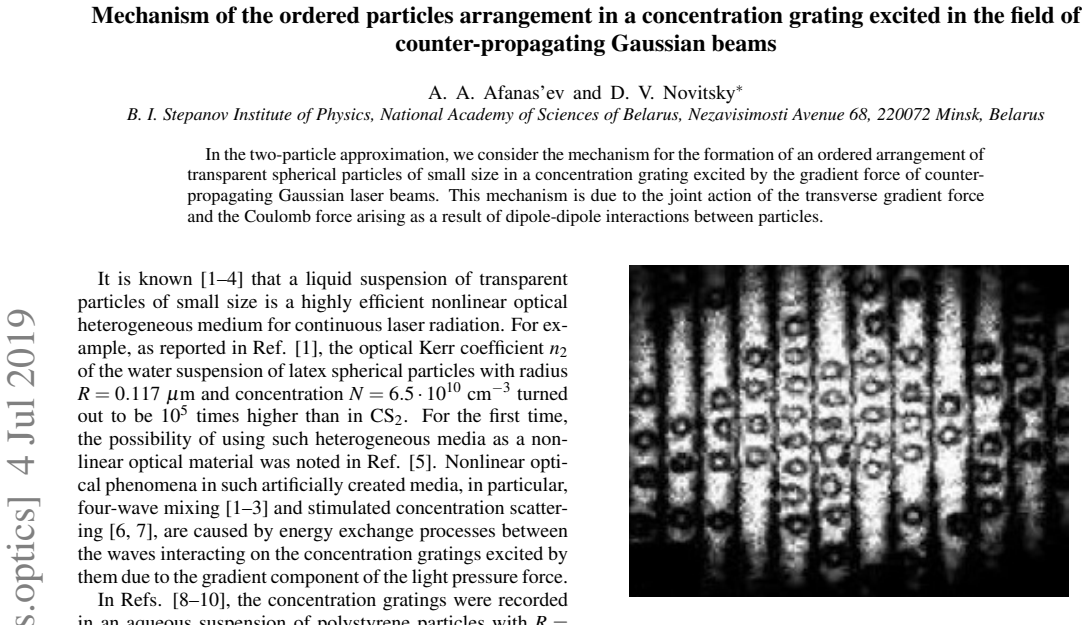
Ordered arrangements of small particles in laser-induced concentration gratings form through the combined transverse gradient force and Coulomb repulsion from dipole-dipole interactions.
A machine-rendered reading of the paper's core claim, the machinery that carries it, and where it could break.
Core claim
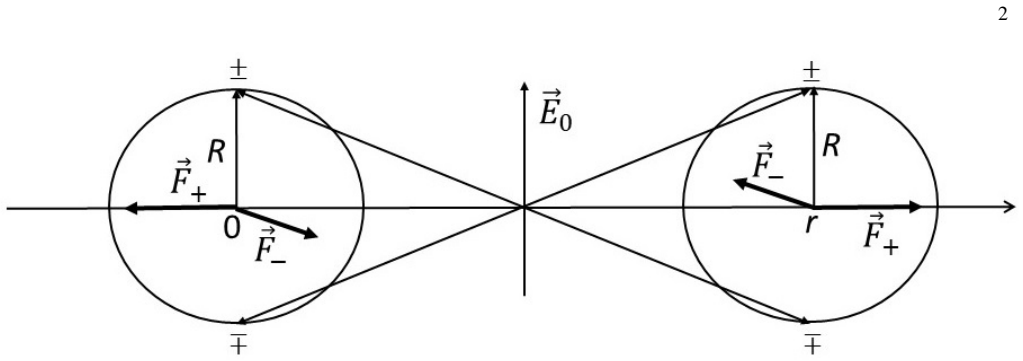
In the two-particle approximation the ordered arrangement of particles in the concentration grating arises from the joint action of the transverse gradient force exerted by the beams and the Coulomb force generated by dipole-dipole interactions between the particles.
What carries the argument
Two-particle approximation that couples the transverse gradient force of the counter-propagating Gaussian beams to the Coulomb force produced by mutual dipole-dipole interactions.
If this is right
- The transverse component of the gradient force supplies the confining potential while dipole-dipole Coulomb repulsion supplies the spacing that stabilizes the grating.
- The resulting particle lattice period is set by the balance between these two forces rather than by the optical interference fringe spacing alone.
- The mechanism operates for transparent dielectric spheres whose induced dipoles are weak enough that higher-order multipoles can be neglected.
Where Pith is reading between the lines
- The same pairwise force balance may set the minimum scale at which multi-particle simulations must be performed to recover the grating.
- If the two-particle picture holds, the ordering threshold should depend only on beam intensity, particle polarizability, and separation rather than on total particle number.
- The mechanism suggests a route to predict grating contrast from measurable single-particle scattering properties without solving the full many-body problem.
Load-bearing premise
The two-particle approximation is sufficient to explain the formation of the ordered arrangement of particles in the concentration grating.
What would settle it
An observation that stable ordering disappears when particle separations exceed the range where only pairwise dipole interactions matter, or that ordering requires simultaneous participation of three or more particles.
Figures
read the original abstract
In the two-particle approximation, we consider the mechanism for the formation of an ordered arrangement of transparent spherical particles of small size in a concentration grating excited by the gradient force of counter-propagating Gaussian laser beams. This mechanism is due to the joint action of the transverse gradient force and the Coulomb force arising as a result of dipole-dipole interactions between particles.
Editorial analysis
A structured set of objections, weighed in public.
Referee Report
Summary. The paper examines the formation of ordered arrangements of small transparent spherical particles in a concentration grating created by counter-propagating Gaussian laser beams. It proposes that, within a two-particle approximation, this ordering arises from the combined action of the transverse gradient force exerted by the beams and the Coulomb force generated by dipole-dipole interactions between the particles.
Significance. If the two-particle mechanism is shown to extend reliably to macroscopic ensembles, the work would contribute to the understanding of optical forces and self-organization in laser fields. The absence of any validation that pairwise equilibria persist under summation over N>2 particles, however, leaves the applicability to observed gratings unestablished.
major comments (1)
- [two-particle approximation (throughout)] The central claim rests on the two-particle approximation, yet the manuscript supplies no explicit check that the equilibrium positions derived from the transverse gradient force plus pairwise Coulomb force remain stable when the identical forces are summed over an ensemble of N>2 particles, nor any estimate of the relative size of neglected three-body or higher multipole contributions.
Simulated Author's Rebuttal
We thank the referee for the report. Our manuscript is explicitly limited to the two-particle approximation, as stated in the title and abstract. We respond to the single major comment below.
read point-by-point responses
-
Referee: [two-particle approximation (throughout)] The central claim rests on the two-particle approximation, yet the manuscript supplies no explicit check that the equilibrium positions derived from the transverse gradient force plus pairwise Coulomb force remain stable when the identical forces are summed over an ensemble of N>2 particles, nor any estimate of the relative size of neglected three-body or higher multipole contributions.
Authors: The manuscript confines its analysis to the two-particle approximation, as indicated throughout, and makes no claim that the derived equilibria persist for N>2. The central claim concerns only the joint action of the transverse gradient force and pairwise dipole-dipole Coulomb force within this approximation. We agree that no explicit stability check for larger ensembles or estimate of three-body/higher-multipole terms is supplied, because such extensions lie outside the stated scope. We will add a brief clarifying paragraph in the conclusions noting these limitations and that many-body effects require separate analysis. revision: partial
Circularity Check
No circularity: derivation is a force-balance analysis within stated two-particle approximation
full rationale
The manuscript presents a theoretical mechanism for particle ordering via transverse gradient force plus pairwise dipole-dipole Coulomb interaction, derived under the explicit two-particle approximation. No parameter fitting to data, no self-citation load-bearing uniqueness theorems, and no renaming of known results as new derivations are present in the provided text. The central claim reduces to solving the equations of motion for two particles under the stated forces; this is a direct calculation, not a tautology or statistical prediction forced by construction. Absence of any quoted reduction (e.g., Eq. X defined as Eq. Y) confirms the derivation chain is self-contained against external benchmarks.
Axiom & Free-Parameter Ledger
Reference graph
Works this paper leans on
- [1]
-
[2]
D. Rogovin, S.O. Sari, Phase conjugation in liquid suspensions of microspheres in the diffusive limit, Phys. Rev. A 31 (1985) 2375–2389
work page 1985
-
[3]
A.A. Afanas’ev, A.N. Rubinov, S.Yu. Mikhnevich, I.E. Ermo- laev, Four-wave mixing in a liquid suspension of transparent dielectric microspheres, J. Exp. Theor. Phys. 101 (2005) 389– 400
work page 2005
-
[4]
A. Bezryadina, T. Hansson, R. Gautam, B. Wetzel, G. Sig- gins, A. Kalmbach, J. Lamstein, D. Gallardo, E.J. Carpenter, A. Ichimura, R. Morandotti, Z. Chen, Nonlinear self-action of light through biological suspensions, Phys. Rev. Lett. 119 (2017) 058101
work page 2017
-
[5]
Palmer, Nonlinear optics in aerosols, Opt
A.J. Palmer, Nonlinear optics in aerosols, Opt. Lett. 5 (1980) 54–55
work page 1980
-
[6]
A.A. Afanas’ev, A.N. Rubinov, S.Yu. Mikhnevich, I.E. Ermo- laev, Theory of stimulated concentration scattering of light in a liquid suspension of transparent microspheres, Opt. Spectr. 102 (2007) 106–111
work page 2007
-
[7]
I.S. Burkhanov, S.V . Krivokhizha, L.L. Chaikov, Stokes and anti-Stokes stimulated Mie scattering on nanoparticle suspen- sions of latex, Opt. Commun. 381 (2016) 360–364
work page 2016
-
[8]
M.M. Burns, J.M. Fournier, J.A. Golovchenko, Optical binding, Phys. Rev. Lett. 63 (1989) 1233–1236
work page 1989
-
[9]
A.A. Afanas’ev, V .M. Katarkevich, A.N. Rubinov, T.Sh. Efendiev, Modulation of particle concentrations in the interfer- ence laser radiation field, J. Appl. Spectr. 69 (2002) 782–787
work page 2002
-
[10]
A.N. Rubinov, V .M. Katarkevich, A.A. Afanas’ev, T.Sh. Efendiev, Interaction of interference laser field with an ensem- ble of particles in liquid, Opt. Commun. 224 (2003) 97–106
work page 2003
-
[11]
C.D. Mellor, C.D. Bain, Array formation in evanescent waves, Chem. Phys. Chem. 7 (2006) 329–332
work page 2006
-
[12]
J. Xie, J. Zhang, J. Ye, H. Liu, Z. Liang, S. Long, K. Zhou, D. Deng, Paraxial propagation of the first-order chirped Airy vortex beams in a chiral medium, Opt. Express 26 (2018) 5845– 5856
work page 2018
-
[13]
J. Xie, J. Zhang, X. Zheng, J. Ye, D. Deng, Paraxial propaga- tion dynamics of the radially polarized Airy beams in uniaxial crystals orthogonal to the optical axis, Opt. Express 26 (2018) 11309–11320
work page 2018
-
[14]
A.N. Rubinov, A.A. Afanas’ev, Nonresonance mechanisms of biological effects of coherent and incoherent light, Opt. Spectr. 98 (2005) 943–948
work page 2005
-
[15]
Stratton, Electromagnetic Theory, McGraw Hill, New York & London, 1941
J.A. Stratton, Electromagnetic Theory, McGraw Hill, New York & London, 1941
work page 1941
-
[16]
D.V . Guzatov, L.S. Gaida, A.A. Afanas’ev, Theoretical study of the light pressure force acting on a spherical dielectric par- ticle of an arbitrary size in the interference field of two plane monochromatic electromagnetic waves, Quant. Electron. 38 (2008) 1155–1162
work page 2008
discussion (0)
Sign in with ORCID, Apple, or X to comment. Anyone can read and Pith papers without signing in.