DE-2LS: Differential Evolution with Lightweight Late Local Search for Constrained Numerical Optimization
Pith reviewed 2026-06-29 02:43 UTC · model grok-4.3
The pith
A late-stage lightweight local search added to differential evolution improves the combined speed-accuracy score on constrained optimization problems.
A machine-rendered reading of the paper's core claim, the machinery that carries it, and where it could break.
Core claim
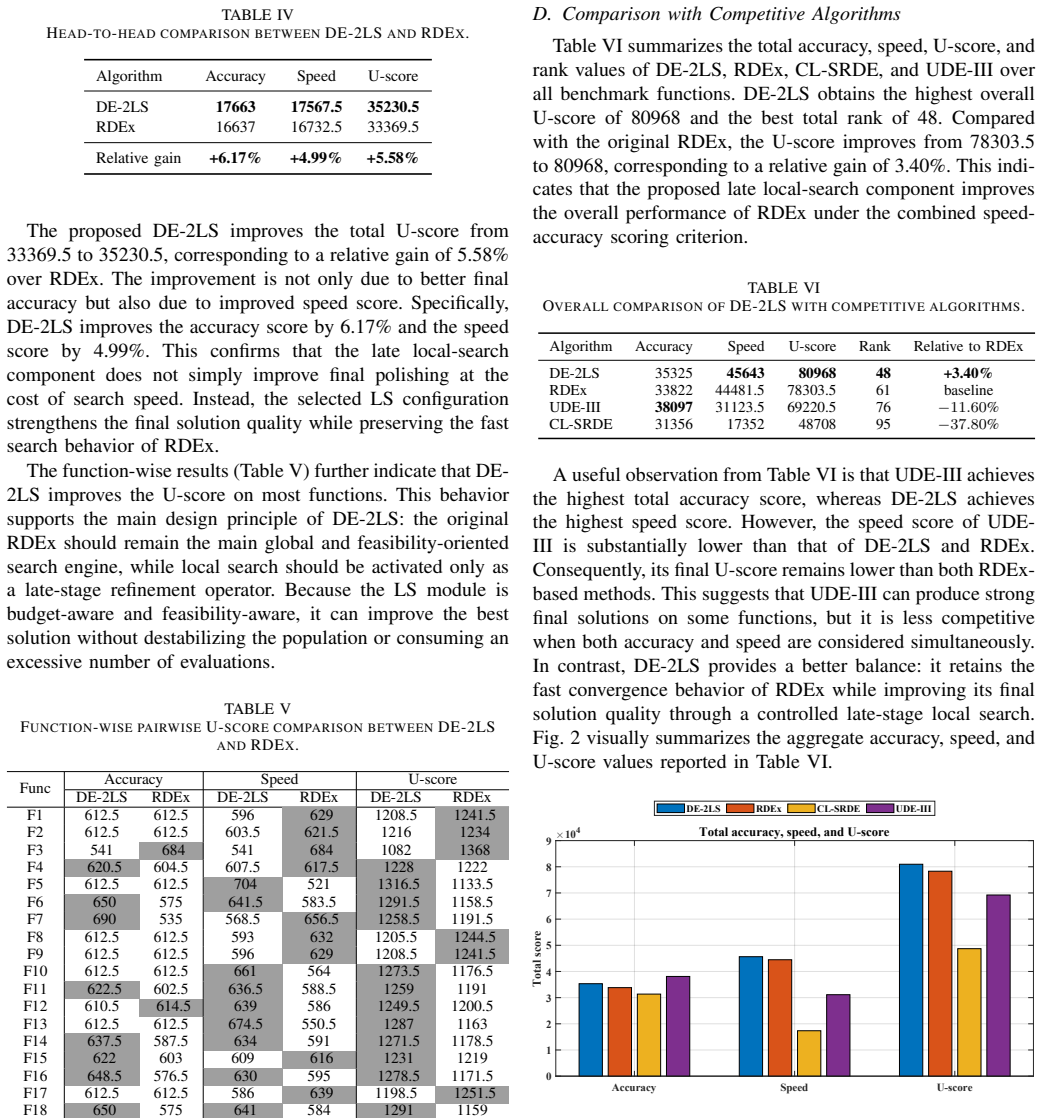
DE-2LS keeps all the original RDEx components including mutation, crossover, success-history adaptation, archive, population reduction, and epsilon constraint handling. It adds a lightweight coordinate-pattern local search activated only in the late stage around the current best solution, using a small evaluation budget and a feasibility-aware acceptance rule. This configuration achieves the best U-score among variants, a 5.58 percent gain over RDEx, and the highest U-score of 80968 with best rank of 48 in comparisons against three other algorithms.
What carries the argument
The lightweight coordinate-pattern local search used as a guarded polishing step activated late with limited budget and feasibility-aware acceptance.
If this is right
- The late local search improves exploitation capability while preserving the speed advantage of the RDEx framework.
- Controlled late-stage refinement is more effective than aggressive or premature local search.
- DE-2LS achieves better performance under the combined speed-accuracy U-score criterion.
- The method maintains the original components of RDEx without changes.
Where Pith is reading between the lines
- Similar late-stage local search additions could be tested on other differential evolution variants or evolutionary algorithms for constrained problems.
- The feasibility-aware acceptance might help avoid getting stuck in infeasible areas during refinement.
- Varying the activation timing or budget size on different problem classes could identify more general rules for when to apply such polishing.
Load-bearing premise
The specific late activation timing, small budget size, coordinate search pattern, and feasibility rule chosen will produce similar gains on optimization problems not included in the tested benchmarks.
What would settle it
Evaluating DE-2LS on a different collection of constrained numerical optimization problems or changing the local search activation point and budget to see if the U-score advantage over RDEx disappears.
Figures

read the original abstract
Constrained single-objective numerical optimization requires a careful balance among feasibility, objective convergence, and computational efficiency under a fixed function-evaluation budget. This paper proposes DE-2LS, a late-stage, locally search-enhanced variant of differential evolution built on the RDEx framework. The proposed method preserves the original RDEx components, including mutation and crossover operators, success-history adaptation, archive mechanism, population-size reduction, and $\epsilon$-based constraint handling. A lightweight coordinate-pattern local search is added as a guarded polishing component around the current best solution. It is activated only in the late stage of the run, uses a small evaluation budget, and accepts candidates through a feasibility-aware comparison rule. Ablation results show that the finalized DE-2LS configuration achieves the best U-score among all tested variants, confirming that controlled late-stage refinement is more effective than aggressive or premature local search. In the direct comparison with RDEx, DE-2LS achieves a 5.58\% gain in U-score. In the four-algorithm comparison, DE-2LS obtains the highest overall U-score of 80968 and the best total rank of 48 among RDEx, CL-SRDE, and UDE-III. These results indicate that DE-2LS improves the exploitation capability of the RDEx-based search framework while preserving its speed advantage under the combined speed-accuracy scoring criterion. The source code of DE-2LS is available at https://github.com/ChauhanDikshit?tab=repositories.
Editorial analysis
A structured set of objections, weighed in public.
Referee Report
Summary. The paper introduces DE-2LS, a variant of differential evolution built on the RDEx framework that adds a lightweight coordinate-pattern local search activated only in the late stage of the optimization run. The local search uses a small evaluation budget and a feasibility-aware acceptance rule. The central claims are that ablation studies confirm this controlled late-stage refinement yields the best U-score among tested variants, that DE-2LS achieves a 5.58% U-score improvement over RDEx, and that in a four-algorithm comparison it records the highest overall U-score (80968) and best total rank (48) among RDEx, CL-SRDE, and UDE-III while preserving computational speed.
Significance. If the performance claims hold under broader validation, the work demonstrates that a simple, low-cost late-stage polishing step can measurably improve exploitation in an existing constrained DE framework without sacrificing its speed advantage under the combined U-score criterion. The public release of source code is a positive contribution that supports reproducibility.
major comments (2)
- [Abstract] Abstract: the headline performance claims (5.58% U-score gain, top rank of 48, U-score 80968) are presented without any mention of statistical significance tests, standard deviations across independent runs, or sensitivity analysis on the local-search activation threshold and evaluation budget; these omissions leave open the possibility that the reported advantage is sensitive to the specific benchmark collection and chosen parameter values.
- [Abstract] Abstract (ablation paragraph): while the text states that the finalized configuration is best among tested variants, no quantitative results or tables are referenced that isolate the effect of activation timing versus budget size, making it impossible to verify that the chosen late-stage guard is robust rather than tuned to the test set.
minor comments (1)
- [Abstract] The abstract states that source code is available at a GitHub link; the manuscript should include a permanent DOI or Zenodo archive reference in addition to the repository URL.
Simulated Author's Rebuttal
We thank the referee for the constructive comments on the abstract. We agree that the headline claims would benefit from explicit references to statistical robustness and ablation quantification. We address each point below and will incorporate revisions to improve clarity and verifiability while preserving the abstract's brevity.
read point-by-point responses
-
Referee: [Abstract] Abstract: the headline performance claims (5.58% U-score gain, top rank of 48, U-score 80968) are presented without any mention of statistical significance tests, standard deviations across independent runs, or sensitivity analysis on the local-search activation threshold and evaluation budget; these omissions leave open the possibility that the reported advantage is sensitive to the specific benchmark collection and chosen parameter values.
Authors: We accept this observation. The full manuscript presents mean U-scores aggregated over 25 independent runs per problem, with the ablation study testing multiple activation thresholds and budgets. However, the abstract omits explicit mention of run counts, variability, or sensitivity. We will revise the abstract to note that results are averaged over 25 runs and that the reported gains hold under the tested parameter ranges, with a cross-reference to the sensitivity table in Section 4.3. This addresses the concern about potential sensitivity without requiring new experiments. revision: yes
-
Referee: [Abstract] Abstract (ablation paragraph): while the text states that the finalized configuration is best among tested variants, no quantitative results or tables are referenced that isolate the effect of activation timing versus budget size, making it impossible to verify that the chosen late-stage guard is robust rather than tuned to the test set.
Authors: The manuscript contains a dedicated ablation subsection (4.3) with a table reporting U-scores for early vs. late activation and varying budget sizes (e.g., 50 vs. 200 evaluations), confirming the late-stage small-budget choice yields the highest score. The abstract summarizes the outcome without numbers or table citations due to length limits. We will revise the ablation paragraph in the abstract to include the key quantitative delta (e.g., "late-stage 50-eval variant improves U-score by X over early activation") and add an explicit reference to Table 3. This makes the robustness claim verifiable from the abstract alone. revision: yes
Circularity Check
No significant circularity; claims rest on external benchmark comparisons
full rationale
The paper proposes DE-2LS as an algorithmic variant of the RDEx framework and validates performance via direct empirical comparisons and ablations on standard constrained optimization benchmarks using the external U-score metric. No equations, parameters, or self-citations reduce the reported U-score gains or ranks to quantities fitted inside the same run or defined by construction. The late-stage local search is presented as a design choice whose effectiveness is tested rather than presupposed, and the central claims remain independent of any self-referential loop.
Axiom & Free-Parameter Ledger
free parameters (2)
- local search evaluation budget
- late-stage activation threshold
axioms (2)
- domain assumption The U-score is an appropriate combined speed-accuracy metric for ranking constrained optimizers
- domain assumption Standard constrained benchmark suites are representative of the target problem class
Reference graph
Works this paper leans on
-
[1]
Differential evolution–a simple and efficient heuristic for global optimization over continuous spaces,
R. Storn and K. Price, “Differential evolution–a simple and efficient heuristic for global optimization over continuous spaces,”Journal of Global Optimization, vol. 11, no. 4, pp. 341–359, 1997
1997
-
[2]
Advancements in multimodal differential evolution: a comprehensive review and future perspectives,
D. Chauhan, Shivani, D. Jung, and A. Yadav, “Advancements in multimodal differential evolution: a comprehensive review and future perspectives,”Artificial Intelligence Review, vol. 58, no. 11, p. 335, 2025
2025
-
[3]
Improving the search performance of SHADE using linear population size reduction,
R. Tanabe and A. S. Fukunaga, “Improving the search performance of SHADE using linear population size reduction,” inProceedings of the 2014 IEEE Congress on Evolutionary Computation (CEC), 2014, pp. 1658–1665
2014
-
[4]
Single objective real- parameter optimization algorithm: jSO,
J. Brest, M. S. Mau ˇcec, and B. Bo ˇskovi´c, “Single objective real- parameter optimization algorithm: jSO,” in2017 IEEE Congress on Evolutionary Computation (CEC). IEEE, 2017, pp. 1311–1318
2017
-
[5]
Improving the local search ca- pability of effective butterfly optimizer using covariance matrix adapted retreat phase,
A. Kumar, R. K. Misra, and D. Singh, “Improving the local search ca- pability of effective butterfly optimizer using covariance matrix adapted retreat phase,” in2017 IEEE Congress on Evolutionary Computation (CEC). IEEE, 2017, pp. 1835–1842
2017
-
[6]
Improved multi-operator differential evolution algorithm for solving unconstrained problems,
K. M. Sallam, S. M. Elsayed, R. K. Chakrabortty, and M. J. Ryan, “Improved multi-operator differential evolution algorithm for solving unconstrained problems,” in2020 IEEE Congress on Evolutionary Computation (CEC). IEEE, 2020, pp. 1–8
2020
-
[7]
A version of NL- SHADE-RSP algorithm with midpoint for CEC 2022 single objective bound constrained problems,
R. Biedrzycki, J. Arabas, and E. Warchulski, “A version of NL- SHADE-RSP algorithm with midpoint for CEC 2022 single objective bound constrained problems,” in2022 IEEE congress on evolutionary computation (CEC). IEEE, 2022, pp. 1–8
2022
-
[8]
Problem definitions and evaluation criteria for the cec 2017 competition on constrained real- parameter optimization,
G. Wu, R. Mallipeddi, and P. N. Suganthan, “Problem definitions and evaluation criteria for the cec 2017 competition on constrained real- parameter optimization,” Tech. Rep., 2017
2017
-
[9]
LSHADE44 with an improvedϵconstraint-handling method for solving constrained single-objective optimization problems,
Z. Fan, Y . Fang, W. Li, Y . Yuan, Z. Wang, and X. Bian, “LSHADE44 with an improvedϵconstraint-handling method for solving constrained single-objective optimization problems,” pp. 1–8, 2018
2018
-
[10]
A unified differen- tial evolution algorithm for constrained optimization problems,
A. Trivedi, K. Sanyal, P. Verma, and D. Srinivasan, “A unified differen- tial evolution algorithm for constrained optimization problems,” in2017 IEEE Congress on Evolutionary Computation (CEC). IEEE, 2017, pp. 1231–1238
2017
-
[11]
UDE-III: An enhanced unified differential evolution algorithm for constrained optimization problems,
A. Trivedi and D. Chauhan, “UDE-III: An enhanced unified differential evolution algorithm for constrained optimization problems,” 2024. [Online]. Available: https://arxiv.org/abs/2410.03992
-
[12]
S. Tao, Y . Yang, R. Zhao, K. Wang, S. Liu, and S. Gao, “RDEx- CSOP: Feasibility-aware reconstructed differential evolution with adap- tive epsilon-constraint ranking,”arXiv preprint arXiv:2603.27090, 2026
-
[13]
LSHADE with semi-parameter adaptation hybrid with CMA-ES for solving CEC 2017 benchmark problems,
A. W. Mohamed, A. A. Hadi, and A. K. Mohamed, “LSHADE with semi-parameter adaptation hybrid with CMA-ES for solving CEC 2017 benchmark problems,” inProceedings of the 2017 IEEE Congress on Evolutionary Computation (CEC), 2017, pp. 145–152
2017
-
[14]
DISH–XX solving CEC2020 single objective bound constrained nu- merical optimization benchmark,
A. Viktorin, R. Senkerik, M. Pluhacek, T. Kadavy, and A. Zamuda, “DISH–XX solving CEC2020 single objective bound constrained nu- merical optimization benchmark,” in2020 IEEE Congress on Evolu- tionary Computation (CEC). IEEE, 2020, pp. 1–8
2020
-
[15]
Revisiting cec 2022 ranking: A new ranking method and influence of parameter tuning,
R. Biedrzycki, “Revisiting cec 2022 ranking: A new ranking method and influence of parameter tuning,”Swarm and Evolutionary Computation, vol. 89, p. 101623, 2024
2022
-
[16]
Success rate-based adaptive differential evolution l-srtde for cec 2024 competition,
V . Stanovov and E. Semenkin, “Success rate-based adaptive differential evolution l-srtde for cec 2024 competition,” in2024 IEEE Congress on Evolutionary Computation (CEC). IEEE, 2024, pp. 1–8
2024
-
[17]
A multi-operator ensemble lshade with restart and local search mechanisms for single-objective optimization,
D. Chauhan, A. Trivedi, and Shivani, “A multi-operator ensemble lshade with restart and local search mechanisms for single-objective optimization,” 2024. [Online]. Available: https://arxiv.org/abs/2409. 15994
2024
discussion (0)
Sign in with ORCID, Apple, or X to comment. Anyone can read and Pith papers without signing in.