REVIEW 2 major objections 6 minor 1 cited by
Who With Whom? Learning Optimal Matching Policies
T0 review · 2 major / 6 minor · reviewed 2026-08-06 · deepseek-v4-flash
Pith's one-line read A planner can learn a near-optimal one-to-one matching policy from conditionally randomized training data by solving an entropy-regularized optimal transport problem, with a welfare regret bound that vanishes as the training sample grows.
desk verdict Entropic OT for matching with estimated costs is a real gap and the paper mostly fills it, but a false mean-value step in the main proof needs repair before the regret bound can be taken as stated. read the letter →
The pith
A machine-rendered reading of the paper's core claim, the machinery that carries it, and where it could break.
The reading
What carries the argument
The central object is the entropy-regularized empirical optimal transport plan, defined as the minimizer of estimated average match cost plus $(1/\eta)\mathrm{KL}(\pi_n\|\mu_n\otimes\nu_n)$ over couplings with the empirical marginal distributions of the two sides. The KL penalty pushes the solution away from the extreme-point permutations of the linear program, smoothing the policy and limiting its sensitivity to errors in the estimated cost function, while $\eta$ controls how close the plan is to random matching. The dual formulation reduces the decision variables from $n^2$ to $2n$, making the Sinkhorn algorithm applicable, and the plan is converted into a distribution over permutations via the Birkhoff–von Neumann procedure. The proof machinery decomposes regret into a plug-in error term governed by the $L^1$ and squared $L^2$ errors of the cost estimator and a regularization-bias term of $\log n/\eta$.
What would settle it
A randomized field trial that implements the estimated policy in some agencies and keeps random matching in others, and that finds no positive or about-one-percentage-point gain in six-month job-finding rates, would contradict the paper's welfare prediction.
Extended reading notes
Core claim
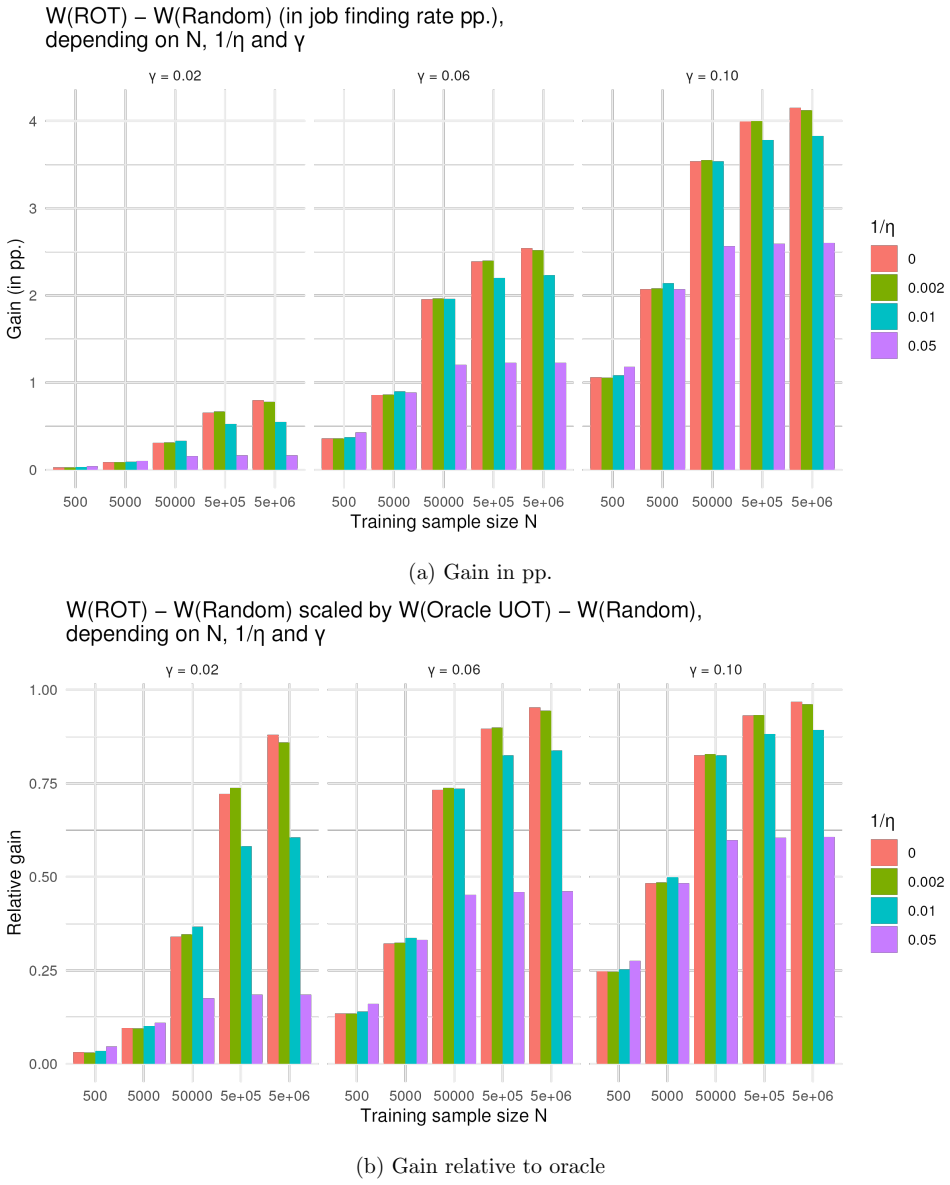
The paper claims that a welfare-optimal one-to-one matching policy can be learned even though the match cost function is unknown, by plugging an estimated cost function $\hat{c}$ into an entropy-regularized optimal transport program and applying the Sinkhorn algorithm. Theorem 1 gives, under the single regularity condition that costs are bounded in $[0,\bar c]$, the non-asymptotic bound $$$e^{{2\eta\bar c}}$\left(\|\hat{c}-c\|_{$L^{1}$(\mu\otimes\nu)} + \|\hat{c}-c\|^2_{$L^{2}$(\mu\otimes\nu)}\right) + \frac{\log n}{\eta}$$ for expected regret relative to the oracle unregularized optimal policy. The first term is the cost of estimation error and sampling uncertainty, the second is the regularization bias, and the choice of $\eta$ trades the two off. Expected regret therefore converges to zero when the integrated $L^1$ error of the cost estimator decays and $\eta$ grows like $\log N$. The calibrated job-seeker and caseworker simulations indicate that the learned policy can capture most of the welfare gap between random matching and the oracle optimum, with about a one-percentage-point gain in job-finding rates under realistic training sample sizes and complementarities.
Load-bearing premise
The load-bearing premise is that, in the historical training data, match assignment is as good as random once observed characteristics are accounted for, so the estimated cost function is unbiased.
Editorial extensions
If this is right
- A public employment service that currently assigns caseworkers randomly can instead learn an assignment from its administrative records and raise average job-finding rates without training new personnel.
- The same recipe applies whenever a planner controls a one-to-one match and has data from conditionally randomized matches: doctors to patients, teachers to classrooms, attorneys to defendants, and auditors to taxpayers.
- The $\log n/\eta$ regularization-bias term means some stochasticity in assignments is statistically beneficial when the training sample is small, so the planner should not automatically pick the unregularized optimal transport solution.
- For matching markets of a few hundred to a few thousand individuals, the Sinkhorn implementation is computationally feasible, unlike the full $n^2$-variable linear program.
- The regret converges to zero only if the cost estimator's integrated $L^1$ error decays with training sample size; nonparametric estimators give slower rates, but the bound can still vanish with an appropriate choice of $\eta$.
Reading between the lines
- A data-driven choice of $\eta$ is the natural next step: because the regret bound splits into an estimation term and a bias term, a planner could select $\eta$ by cross-validating the estimated policy's average outcome on a hold-out sample, a step the paper does not implement.
- The method's logic carries over to many-to-one assignment, where each caseworker or doctor has a capacity larger than one, by replacing the uniform marginal constraint on that side with capacity-weighted margins and solving the same regularized transport program.
- If historical matching was influenced by caseworkers' private information about job seekers, the exogeneity condition fails and the learned policy could systematically reward the types that were historically over-served; the paper's guarantee would then not apply, and a randomized pilot would be required before rollout.
Editorial analysis
A structured set of objections, weighed in public.
Referee Report
Summary. This paper studies policy learning for two-sided one-to-one matching. A planner observes the characteristics of the individuals to be matched and must choose a matching policy under capacity constraints, while the match cost function is unknown and must be estimated from a training sample. The authors propose solving an entropy-regularized optimal transport problem with the estimated cost function, using the Sinkhorn algorithm for tractability, and they derive a non-asymptotic regret bound relative to the oracle unregularized optimal matching policy. The main theorem (Theorem 1, Eq. (31)) claims the regret is bounded by e^{2ηc̄}(∥ĉ−c∥_{L1} + ∥ĉ−c∥²_{L2}) + log n/η, exhibiting a bias-variance trade-off in the regularization parameter η. The paper also presents two simulation studies, one simple and one calibrated to French job-search data, suggesting that learned matching policies could improve job-finding rates by about one percentage point at essentially no reallocation cost.
Significance. If the main theorem were correct, the paper would make a useful contribution to an understudied area: empirical policy learning for two-sided matching with estimated costs, where the number of 'treatments' grows with the sample and capacity constraints bind. The entropy-regularized formulation is computationally attractive, and a non-asymptotic bound that separates cost-estimation error from regularization bias is exactly the kind of guarantee the literature needs. The calibrated simulation is thoughtful and directly relevant to an important policy problem. However, the central proof contains a false step (Eq. (38)) that invalidates the squared-L2 term in the advertised bound; the likely repair replaces that term with an additional L1 error, which still yields convergence but changes the stated result. The paper also relies on an untestable conditional exogeneity assumption and, as the authors note, has not yet applied the method to real administrative data. For these reasons, the contribution is promising but needs substantial revision before the theoretical claims can be accepted.
major comments (2)
- [Appendix A.2, Eq. (38)] The displayed equality is false. The mean value theorem applied to F(t)=Φ_n((1−t)c+tĉ, f̂_n, ĝ_n) gives F(1)−F(0)=F′(t̃) for some t̃∈[0,1], so the integrand is (ĉ−c) exp{−η[(1−t̃)c+t̃ĉ]+η f̂_n+η ĝ_n}, which is linear in (ĉ−c), not quadratic. For n=1 with ĉ−c≡δ, the left-hand side of (38) is of order δ while the right-hand side is of order δ², so inequality (26) is false as stated. Consequently the squared-L2 term in Proposition 1 and in Theorem 1 is not established. A correct bound is |Φ_n(ĉ, f̂_n, ĝ_n)−Φ_n(c, f̂_n, ĝ_n)| ≤ e^{2ηc̄}∥ĉ−c∥_{L1(μn⊗νn)}, which yields ReROT(π̂ROT_n) ≤ 2e^{2ηc̄}∥ĉ−c∥_{L1(μn⊗νn)}. With this repair, the bias-variance trade-off and the convergence conclusion for η∝log N remain qualitatively unchanged, but the theorem and Proposition 1 must be revised accordingly, or a genuinely different argument for the L2² term must be supplied.
- [Section 3.1, Eq. (5)] The conditional exogeneity assumption Wℓ⊥ϵℓ|Xℓ is untestable from the training data and is likely to be violated in observational administrative data, where caseworker assignment may depend on unobserved job-seeker characteristics. The paper does not analyze the bias in the estimated cost function or in the resulting regret bound when this assumption fails. Because the motivating application is to French administrative data (and the authors state in Section 6 that the real-data application is still in progress), this is a substantive limitation for interpreting the regret bound as a welfare guarantee. I ask the authors to at least discuss the direction and potential magnitude of the bias, and ideally to provide a sensitivity analysis or a partial-identification extension.
minor comments (6)
- [Appendix A.3, Proposition 2] The statement that π*_n is 'supported only on n points with equal probability masses 1/n' is not true for a non-extreme optimal solution of the transport LP. However, an extreme-point optimal solution always exists, and for any feasible coupling KL(π||μn⊗νn)≤log n, so the bound in (30) is valid. Please rephrase the proof to avoid the incorrect assertion about the support of π*_n.
- [Section 4, after Theorem 1] The symbol ᾱ in the sentence 'η is chosen to be proportional to ᾱ/(2c̄) log(N) with ᾱ<α' is undefined; it should be a separate parameter (e.g., α̃) with its relation to α stated explicitly.
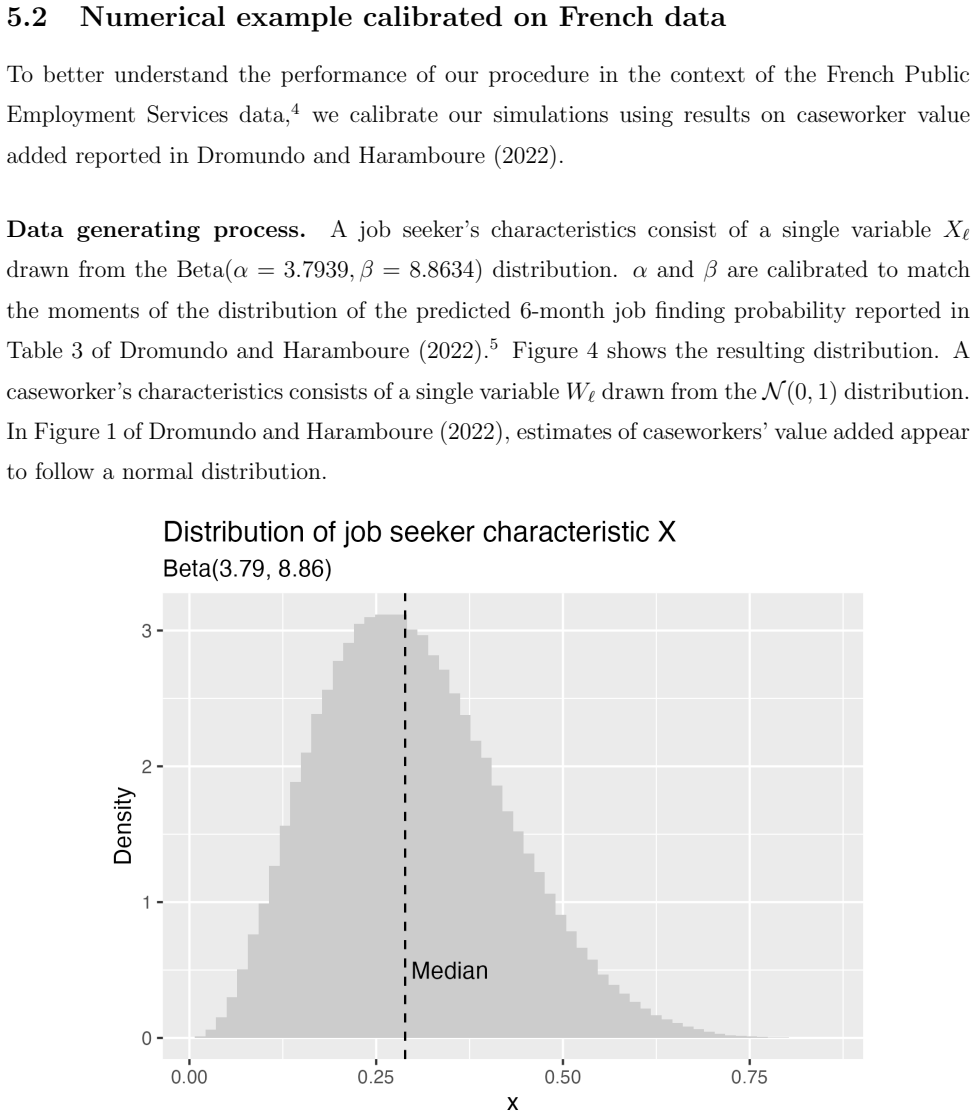
- [Section 5.2] The calibrated parameters (a,b,c,d) of the logistic job-finding function are not reported; providing them would make the simulation reproducible and allow readers to judge the implied degree of complementarity beyond the summary gap γ.
- [Figures 5 and 6] Figures 5 and 6 appear to be identical (same captions and same panels for the same values of N and γ). If they are intended to differ, the figures or captions should be corrected.
- [References] The reference 'Highbee, S., O. A. Katta, and G. Pouliot' appears to contain a spelling error; please verify the author's name.
- [Section 5.1] The rescaled welfare measure is defined using (μn⊗νn)(c) in the text but the notation is not fully consistent across equations; clarify the notation so that the empirical and population measures are distinguished.
Circularity Check
No significant circularity: the regret bound is derived forward from explicit assumptions, and self-citations are not load-bearing.
full rationale
The central derivation, Theorem 1, follows from clearly stated ingredients: Assumption 1 (bounded costs), the dual formulation of entropy-regularized optimal transport, Lemma 1's bounds on the dual potentials and density, Proposition 1's bounds on the regularized-regret components, and Proposition 2's bound on the regularization bias via the KL divergence of a permutation distribution. None of these steps defines a quantity in terms of the target regret or fits a parameter to match the bound. The cost-estimation error terms in the bound are inputs to the guarantee, not outputs that are relabeled as predictions. The paper's self-citations appear only in the literature review and in passing references to prior treatment-choice work; they do not carry any step of the proof. The questionable mean-value expansion in Eq. (38) is a potential correctness concern about the proof, but it is not a circularity: the claimed bound is not assumed as its own input, and the proof would need repair rather than reduction to a fit. The numerical simulations are calibrated to external estimates from Dromundo and Haramboure (2022), and their reported gains are computed from the resulting DGP rather than by fitting the reported outcome. Therefore no circular step is exhibited, and the paper is not circular in the sense assessed here.
Assumptions & free parameters
free parameters (2)
- regularization parameter 1/η =
0, 0.002, 0.01, 0.05 in simulations
- logistic DGP parameters a, b, c, d in Section 5.2 =
not reported; solved from four calibration equations
assumptions (5)
- domain assumption Training matches satisfy conditional exogeneity Wℓ ⊥ ϵℓ | Xℓ
- domain assumption No-interference: Yi(j) ⊥ (Xn,Wn) | Xi,Wj
- domain assumption Cost function and estimator are nonnegative and bounded above by c̄
- standard math Birkhoff-von Neumann theorem
- domain assumption Individuals to be matched are iid draws from population distributions µ and ν
Cite this review
Pith. "Pith review of Who With Whom? Learning Optimal Matching Policies." pith.science (2026). https://pith.science/paper/U5NMPKBN
@misc{pith2026250713567,
  author       = {Pith},
  title        = {Pith review of: Who With Whom? Learning Optimal Matching Policies},
  year         = {2026},
  howpublished = {\url{https://pith.science/paper/U5NMPKBN}},
  note         = {Machine review of arXiv:2507.13567}
}
read the original abstract
There are many economic contexts where the productivity and welfare performance of institutions and policies depend on who matches with whom. Examples include caseworkers and job seekers in job search assistance programs, medical doctors and patients, teachers and students, attorneys and defendants, and tax auditors and taxpayers, among others. Although reallocating individuals through a change in matching policy can be less costly than training personnel or introducing a new program, methods for learning optimal matching policies and their statistical performance are less studied than methods for other policy interventions. This paper develops a method to learn welfare optimal matching policies for two-sided matching problems in which a planner matches individuals based on the rich set of observable characteristics of the two sides. We formulate the learning problem as an empirical optimal transport problem with a match cost function estimated from training data, and propose estimating an optimal matching policy by maximizing the entropy regularized empirical welfare criterion. We derive a welfare regret bound for the estimated policy and characterize its convergence. We apply our proposal to the problem of matching caseworkers and job seekers in a job search assistance program, and assess its welfare performance in a simulation study calibrated with French administrative data.
Figures


Figures from the paper (8 more)




Forward citations
Cited by 1 Pith paper
-
Optimal Transport under Group Fairness Constraints
Group-fairness targets are added as constraints to entropic optimal transport, with a modified Sinkhorn algorithm and two relaxations (penalty and cost learning) that come with sample-complexity bounds.
Reference graph
Works this paper leans on
-
[1]
Adjaho, C. and T. Christensen (2022): Externally valid treatment choice, arXiv preprint arXiv:2205.05561
arXiv 2022
-
[2]
Ai, C., Y. Fang, and H. Xie (2024): Data-driven policy learning for continuous treatments, arXiv preprint arXiv:2402.02535
arXiv 2024
-
[3]
Athey, S. and S. Wager (2021): Policy Learning With Observational Data, Econometrica, 89, 133--161
work page 2021
-
[4]
Behaghel, L., B. Cr \'e pon, and M. Gurgand (2014): Private and public provision of counseling to job seekers: Evidence from a large controlled experiment, American Economic Journal: Applied Economics, 6, 142--174
work page 2014
-
[5]
Bhattacharya, D. (2009): Inferring optimal peer assignment from experimental data, Journal of the American Statistical Association, 104, 486--500
work page 2009
-
[6]
Bhattacharya, D. and P. Dupas (2012): Inferring welfare maximizing treatment assignment under budget constraints, Journal of Econometrics, 167, 168--196
work page 2012
-
[7]
Birkhoff, G. (1946): Tres Observaciones Sobre el Algebra Lineal, Universidad Nacionale de Tucum\' a n Revista Series
work page 1946
-
[8]
Chernozhukov, V., A. Galichon, M. Hallin, and M. Henry (2017): Monge-Kantorovich depth, quantiles, ranks and signs, Annals of Statistics, 45, 223--256
work page 2017
Show all 55 references
-
[9]
Christensen, T., H. R. Moon, and F. Schorfheide (2022): Optimal decision rules when payoffs are partially identified, arXiv preprint arXiv:2204.11748
2022
-
[10]
(2013): Sinkhorn Distances: Lightspeed Computation of Optimal Transport, in Advances in Neural Information Processing Systems, ed
Cuturi, M. (2013): Sinkhorn Distances: Lightspeed Computation of Optimal Transport, in Advances in Neural Information Processing Systems, ed. by C. Burges, L. Bottou, M. Welling, Z. Ghahramani, and K. Weinberger, Curran Associates, Inc., vol. 26
2013
-
[11]
(2024): Defying Distance? The Provision of Services in the Digital Age, Working Paper
Dahlstrand, A. (2024): Defying Distance? The Provision of Services in the Digital Age, Working Paper
2024
-
[12]
Dehejia (2005): Program evaluation as a decision problem, Journal of Econometrics, 125, 141--173
2005
-
[13]
Gaillac, and A
D'Haultfoeuille, X., C. Gaillac, and A. Maurel (2025): Partially Linear Models under Data Combination, The Review of Economic Studies, 92, 238--267
2025
-
[14]
Dromundo, S. and A. Haramboure (2022): Do Job Counselors Matter? Measuring Counselor Value-Added in Job Search, Working Paper
2022
-
[15]
Dupuy, A. and A. Galichon (2014): Personality Traits and the Marriage Market, Journal of Political Economy, 122, 1271--1319
2014
-
[16]
Heckman, and L
Ekeland, I., J. Heckman, and L. Nesheim (2004): Identification and estimation of hedonic models, Journal of Political Economy, 112, 60--109
2004
-
[17]
(2016): Optimal Transport Methods in Economics, Princeton University Press
Galichon, A. (2016): Optimal Transport Methods in Economics, Princeton University Press
2016
-
[18]
Galichon, A. and M. Henry (2011): Set identification in models with multiple equilibria, Review of Economic Studies, 78, 1264--1298
2011
-
[19]
Galichon, A. and B. Salani\' e (2022): Cupid's Invisible Hand: Social Surplus and Identification in Matching Models, Review of Economic Studies, 89, 2600--2629
2022
-
[20]
Chizat, F
Genevay, A., L. Chizat, F. Bach, M. Cuturi, and G. Peyré (2019): Sample Complexity of Sinkhorn Divergences, Proceedings of the 22nd International Conference on Ar- tificial Intelligence and Statistics (AISTATS)
2019
-
[21]
Graham, B. S. (2011): Econometric methods for the analysis of assignment problems in the presence of complementarity and social spillovers, Handbook of Social Economics, 1, 965--1052
2011
-
[22]
Graham, B. S., G. W. Imbens, and G. Ridder (2014): Complementarity and aggregate implications of assortative matching: A nonparametric analysis, Quantitative Economics, 5, 29--66
2014
-
[23]
--- -.1pt --- -.1pt --- (2020): Identification and efficiency bounds for the average match function under conditionally exogenous matching, Journal of Business & Economic Statistics, 38, 303--316
2020
-
[24]
Graham, B. S., G. Ridder, P. Thiemann, and G. Zamarro (2023): Teacher-to-classroom assignment and student achievement, Journal of Business & Economic Statistics, 41, 1328--1340
2023
-
[25]
(2023): Distributional synthetic controls, Econometrica, 91, 1105--1117
Gunsilius, F. (2023): Distributional synthetic controls, Econometrica, 91, 1105--1117
2023
-
[26]
Highbee, S., O. A. Katta, and G. Pouliot (2025): Distributionally robust optimal transport for program evaluation, Work in progress
2025
-
[27]
Hirano, K. and J. R. Porter (2009): Asymptotics for statistical treatment rules, Econometrica, 77, 1683--1701
2009
-
[28]
Mordant, C
Hundrieser, S., G. Mordant, C. A. Weitkamp, and A. Munk (2024): Empirical optimal transport under estimated costs: Distributional limits and statistical applications, Stochastic Processes and their Applications, 178, 104462
2024
-
[29]
Ishihara, T. and T. Kitagawa (2021): Evidence aggregation for treatment choice, arXiv preprint arXiv:2108.06473
2021 arXiv
-
[30]
Lei, and A
Ji, W., L. Lei, and A. Spector (2023): Model-agnostic covariate-assisted inference on partially identified causal effects, arXiv preprint arXiv:2310.08115
2023 arXiv
-
[31]
Kallus, N. and A. Zhou (2018): Policy Evaluation and Optimization with Continuous Treatments, Proceedings of the 21st International Conference on Artificial Intelligence and Statistics (AISTATS), 84
2018
-
[32]
(2022): Distributionally robust policy learning with wasserstein distance, arXiv preprint arXiv:2205.04637
Kido, D. (2022): Distributionally robust policy learning with wasserstein distance, arXiv preprint arXiv:2205.04637
2022 arXiv
-
[33]
Lee, and C
Kitagawa, T., S. Lee, and C. Qiu (2022): Treatment choice with nonlinear regret, arXiv preprint arXiv:2205.08586
2022 arXiv
-
[34]
--- -.1pt --- -.1pt --- (2025): Leave no one undermined: Policy learning with regret aversion, arXiv preprint arXiv:2506.16430
2025 arXiv
-
[35]
Sakaguchi, and A
Kitagawa, T., S. Sakaguchi, and A. Tetenov (2021): Constrained classification and policy learning, arXiv preprint arXiv:2106.12886
2021 arXiv
-
[36]
Kitagawa, T. and A. Tetenov (2018): Who should be treated? empirical welfare maximization methods for treatment choice, Econometrica, 86, 591--616
2018
-
[37]
--- -.1pt --- -.1pt --- (2021): Equality-Minded Treatment Choice, Journal of Business Economics and Statistics, 39, 561--574
2021
-
[38]
Manski, C. F. (2004): Statistical treatment rules for heterogeneous populations, Econometrica, 72, 1221--1246
2004
-
[39]
Masten, M. A. (2023): Minimax-regret treatment rules with many treatments, The Japanese Economic Review, 74, 501--537
2023
-
[40]
Mbakop, E. and M. Tabord-Meehan (2021): Model selection for treatment choice: Penalized welfare maximization, Econometrica, 89, 825--848
2021
-
[41]
Montiel Olea, J. L., C. Qiu, and J. Stoye (2023): Decision Theory for Treatment Choice Problems with Partial Identification, arXiv preprint arXiv:2312.17623
2023 arXiv
-
[42]
(2025): Should Top Surgeons Practice at Top Hospitals? Sorting and Complementarities in Healthcare, Working Paper
Mourot, P. (2025): Should Top Surgeons Practice at Top Hospitals? Sorting and Complementarities in Healthcare, Working Paper
2025
-
[43]
Peyre, G. and M. Cuturi (2019): Computational Optimal Transport, Foundations and Trends in Machine Learning, 11, 355--607
2019
-
[44]
Rigollet, P. and A. J. Stromme (2025): On the sample complexity of entropic optimal transport, The Annals of Statistics, 53, 61--90
2025
-
[45]
(2021): Estimation of Optimal Dynamic Treatment Assignment Rules under Policy Constraints, arXiv preprint arXiv:2106.05031
Sakaguchi, S. (2021): Estimation of Optimal Dynamic Treatment Assignment Rules under Policy Constraints, arXiv preprint arXiv:2106.05031
2021 arXiv
-
[46]
Schennach, S. and V. Starck (2022): Optimally-transported Generalized Method of Moments, cemmap working paper, CWP17/22
2022
-
[47]
Spurr, S. J. (1987): How the market solves an assignment problem: The matching of lawyers with legal claims, Journal of Labor Economics, 5, 502--532
1987
-
[48]
(2009): Minimax regret treatment choice with finite samples, Journal of Econometrics, 151, 70--81
Stoye, J. (2009): Minimax regret treatment choice with finite samples, Journal of Econometrics, 151, 70--81
2009
-
[49]
--- -.1pt --- -.1pt --- (2012): Minimax regret treatment choice with covariates or with limited validity of experiments, Journal of Econometrics, 166, 138--156
2012
-
[50]
(2021): Empirical welfare maximization with constraints, arXiv preprint arXiv:2103.15298
Sun, L. (2021): Empirical welfare maximization with constraints, arXiv preprint arXiv:2103.15298
2021
-
[51]
Sunada, K. and K. Izumi (2025): Optimal treatment assignment rules under capacity constraints, arXiv preprint arXiv:2506.12225
2025 arXiv
-
[52]
(2012): Statistical treatment choice based on asymmetric minimax regret criteria, Journal of Econometrics, 166, 157--165
Tetenov, A. (2012): Statistical treatment choice based on asymmetric minimax regret criteria, Journal of Econometrics, 166, 157--165
2012
-
[53]
(2025): Policy targeting under network interference, Review of Economic Studies, 92, 1257--1292
Viviano, D. (2025): Policy targeting under network interference, Review of Economic Studies, 92, 1257--1292
2025
-
[54]
Bessone, A
Weigel, J., P. Bessone, A. Bergeron, G. Tourek, and J. Kabeya Kabeya (2025): Supermodular Bureaucrats: Evidence from Randomly Assigned Tax Collectors in the RDC, American Economic Review (Forthcoming)
2025
-
[55]
(2021): Optimal decision rules under partial identification, arXiv preprint arXiv:2111.04926
Yata, K. (2021): Optimal decision rules under partial identification, arXiv preprint arXiv:2111.04926
2021 arXiv
Reviewed August 6, 2026 · model on record in the stance chip above.
Discussion (0). Continue with ORCID to comment.