REVIEW 2 major objections 2 minor
Hives from deformed GUE minor processes
T0 review · 2 major / 2 minor · reviewed 2026-07-15 · grok-4.5
Pith's one-line read Under a scalar matching condition, deformed GUE minor processes and the octahedron recurrence produce random hives whose law is within O(n log n) relative entropy of a pure GUE hive law throughout the right-angled and obtuse regime.
desk verdict Abstract-only: clean constructive claim that deformed GUE minors + octahedron recurrence realize GUE hive laws (right-angled/obtuse) with O(n log n) KL; body unchecked. read the letter →
The pith
A machine-rendered reading of the paper's core claim, the machinery that carries it, and where it could break.
The reading
What carries the argument
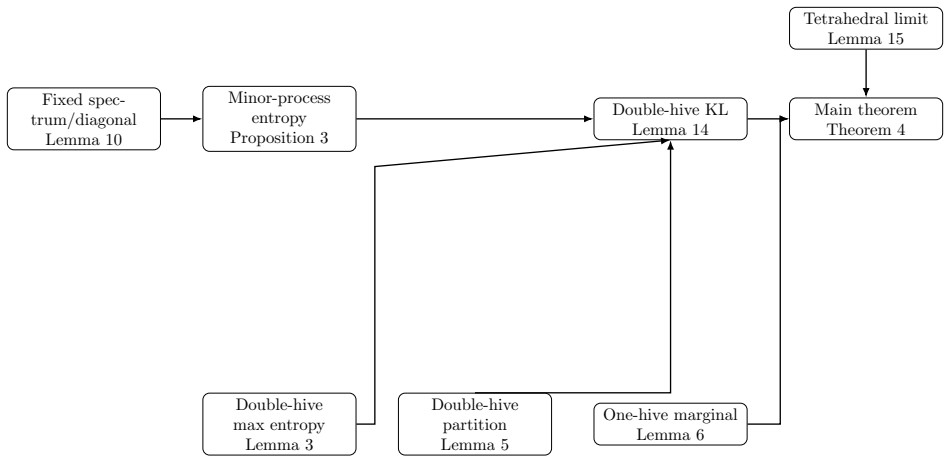
The octahedron recurrence applied to a double hive built from the minor processes of two independently deformed GUE matrices; under the matching condition u/w² = u'/(w')² it converts the deformed boundary data into a hive whose density is relatively entropic to a pure GUE hive of scales (a√n, b√n, c**√n).
What would settle it
Compute or sample the constructed hive density q_n for large n under the matching condition and check whether its relative entropy to Density(H_n(a√n, b√n, c**√n)) grows faster than O(n log n), or whether the observed third scale fails to match the value predicted by the tetrahedral optimization (equivalently by the algebraic formula for δ).
Extended reading notes
Core claim
Starting from two independent diagonally deformed GUE matrices X = √n(wG + uD) and Y = √n(w'G' + u'D'), their minor processes form a double hive; the octahedron recurrence then yields a hive whose law q_n satisfies D_KL(q_n || Density(H_n(a√n, b√n, c**√n))) = O(n log n) whenever u/w² = u'/(w')², with a² = w² + u², b² = (w')² + (u')² and c** determined by the tetrahedral problem (or the stated formula for δ = u + u').
Load-bearing premise
The load-bearing premise is that the minor processes of the two deformed GUE matrices, once the single scalar matching condition holds, supply boundary data for which the octahedron recurrence produces a hive whose law is comparable in relative entropy to the pure GUE hive with the third scale fixed by the tetrahedral problem.
Editorial extensions
If this is right
- GUE hive laws are realized, up to O(n log n) relative entropy, throughout the right-angled and obtuse regime rather than only the acute regime.
- The third scale c** is completely determined by a limiting tetrahedral optimization problem, or by the explicit algebraic relation δ² = 2c**⁴(c**² - a² - b²)/((c**² - a² + b²)(c**² + a² - b²)) with δ = u + u'.
- The same matching condition that equates the two deformation ratios is sufficient to keep the KL gap subleading, so the construction is parameter-efficient.
- Surface-tension approximations recorded in the appendix become practical diagnostics for the quality of the hive approximation.
Reading between the lines
- The same deformation-plus-octahedron pipeline may extend to other classical ensembles (GOE, GSE, or Wishart) once an analogous matching condition is identified.
- Because relative entropy O(n log n) is sub-extensive, macroscopic observables of the hive (edge profiles, surface tension) should coincide with those of the pure GUE hive already at leading order.
- The algebraic formula for δ suggests that free-probability addition of the two deformed spectra is the mechanism that selects the correct third scale c**.
Editorial analysis
A structured set of objections, weighed in public.
Referee Report
Summary. The manuscript constructs random hives from the minor processes of two independent diagonally deformed GUE matrices X=√n(wG+uD) and Y=√n(w'G'+u'D'), with D,D' diagonal of GUE spectra. A double hive is formed and the octahedron recurrence is applied. Under the scalar matching condition u/w²=u'/(w')², with a²=w²+u² and b²=(w')²+(u')², the resulting hive density q_n is shown to satisfy D_KL(q_n || Density(H_n(a√n,b√n,c**√n)))=O(n log n). The third scale c** is fixed by a limiting tetrahedral optimization problem, equivalently by an explicit algebraic formula for δ² with δ=u+u'. The construction is claimed to realize GUE hive laws, up to subleading relative entropy, throughout the right-angled and obtuse regime; an appendix records surface-tension approximations and numerical comparisons that motivated the construction.
Significance. If the claimed O(n log n) relative-entropy bound and the identification of c** hold, the paper supplies a constructive random-matrix realization of GUE hive laws in the right-angled and obtuse regime, linking deformed GUE minor processes to hive combinatorics via the octahedron recurrence. The bound is on the natural free-energy scale relative to the O(n²)-dimensional hive space, and the algebraic formula for δ² together with the appendix numerics give a concrete, falsifiable parameter map. These are genuine strengths of the contribution as stated.
major comments (2)
- [Abstract, displayed KL bound] The central quantitative claim is the O(n log n) KL bound under the single matching condition u/w²=u'/(w')². Only the abstract is available, so the derivation that the deformed minor processes, after the octahedron recurrence, produce a density q_n within this relative-entropy budget of the pure GUE hive cannot be checked. This bound is load-bearing for the claim that the construction realizes GUE hive laws up to subleading entropy; its verification is essential.
- [Abstract, formula for δ² and tetrahedral optimization] The third scale c** is asserted to be recovered from a limiting tetrahedral optimization, equivalently from the displayed algebraic relation for δ². This identification is load-bearing for the coverage of the right-angled and obtuse regime. Without the body of the paper the derivation of the variational problem, its equivalence to the algebraic formula, and the passage from double hive to hive cannot be inspected.
minor comments (2)
- [Abstract, definition of X and Y] The abstract is clear and self-contained as a statement of results, but the independence structure among G, G', D, D' (in particular whether the GUE spectra of D,D' are independent of the Gaussian matrices) should be stated explicitly for the reader.
- [Abstract, final claim sentence] The phrase “throughout the right-angled and obtuse regime” would benefit from a one-line geometric definition (e.g., in terms of a,b,c**) already in the abstract, so that the range of the construction is immediately readable.
Circularity Check
No significant circularity: abstract presents an independent construction from deformed GUE minors whose hive law is compared to a separately defined GUE hive target, with c** fixed by optimization rather than by fitting the target.
full rationale
Only the abstract is available, so the analysis is limited to the claimed derivation chain as stated there. The construction begins from two independent diagonally deformed GUE matrices X and Y, forms a double hive from their minor processes, and applies the octahedron recurrence. Under the single scalar matching condition u/w^{2} = u'/(w')^{2}, the resulting density q_n is asserted to satisfy a relative-entropy bound O(n log n) against Density(H_n(a√n, b√n, c**√n)), where a and b are determined by the Euclidean edge lengths of the deformations and c** is fixed by a limiting tetrahedral optimization problem (equivalently by the displayed algebraic relation in δ = u + u'). Nothing in the abstract defines the target GUE hive law in terms of q_n, fits a free parameter to the target density and then re-labels the fit as a prediction, or invokes a self-cited uniqueness theorem that forces the result. The appendix is described only as recording surface-tension approximations and numerical comparisons that motivated the construction; those are not load-bearing for the KL claim. The derivation is therefore self-contained against the stated external benchmark (the pure GUE hive law) at the level of the abstract. Score 0 is the honest finding; no circular step can be exhibited by quotation and reduction.
Assumptions & free parameters
assumptions (5)
- domain assumption GUE matrix ensembles and their minor processes have well-defined joint eigenvalue laws used as input.
- domain assumption The octahedron recurrence applied to a double hive produces a hive (satisfies hive inequalities).
- domain assumption GUE hive laws H_n(α,β,γ) exist as reference measures with densities against which KL divergence is taken.
- ad hoc to paper Matching condition u/w² = u'/(w')² is the correct scalar relation that makes the deformed construction close to a pure GUE hive.
- ad hoc to paper The third scale c** is correctly recovered from a limiting tetrahedral optimization problem (equivalently the stated algebraic formula for δ²).
Cite this review
Pith. "Pith review of Hives from deformed GUE minor processes." pith.science (2026). https://pith.science/paper/U5W6AQZB
@misc{pith2026260704138,
  author       = {Pith},
  title        = {Pith review of: Hives from deformed GUE minor processes},
  year         = {2026},
  howpublished = {\url{https://pith.science/paper/U5W6AQZB}},
  note         = {Machine review of arXiv:2607.04138}
}
abstract
We construct random hives from deformed GUE minor processes. Starting from two independent diagonally deformed GUE matrices \[ X=\sqrt{n}(wG+uD),\qquad Y=\sqrt{n}(w'G'+u'D'), \] where \(D,D'\) are diagonal and have GUE spectra, we use their minor processes to form a double hive and then apply the octahedron recurrence. Under the matching condition \[ \frac{u}{w^2}=\frac{u'}{(w')^2}, \] we prove that the resulting hive law is close, in relative entropy, to a GUE hive law. More precisely, if \[ a^2=w^2+u^2,\qquad b^2=(w')^2+(u')^2, \] then the produced hive density $q_n$ satisfies \[ D_{\mathrm{KL}}\!\left( q_n\, \middle\|\, \operatorname{Density}\bigl(H_n(a\sqrt n,b\sqrt n,c_{**}\sqrt n)\bigr) \right) = O(n\log n). \] The third scale $c_{**}$ is determined by a limiting tetrahedral optimization problem; equivalently, writing \(\delta=u+u'\), \[ \delta^2 = \frac{ 2c_{**}^4(c_{**}^2-a^2-b^2) }{ (c_{**}^2-a^2+b^2)(c_{**}^2+a^2-b^2) }. \] Thus the construction realizes GUE hive laws, up to subleading relative entropy, throughout the right-angled and obtuse regime. The appendix records two explicit surface-tension approximations and numerical comparisons which motivated the construction.
Figures


Figures from the paper (2 more)

Reviewed July 15, 2026 · model on record in the stance chip above.
Discussion (0). Continue with ORCID to comment.