Suppressed diffusion and gamma-ray emission from the Cygnus Bubble
Pith reviewed 2026-06-28 08:54 UTC · model grok-4.3
The pith
Explaining the PeV gamma rays from the Cygnus Bubble with steady hadronic acceleration requires strongly suppressed diffusion over 150 parsecs.
A machine-rendered reading of the paper's core claim, the machinery that carries it, and where it could break.
Core claim
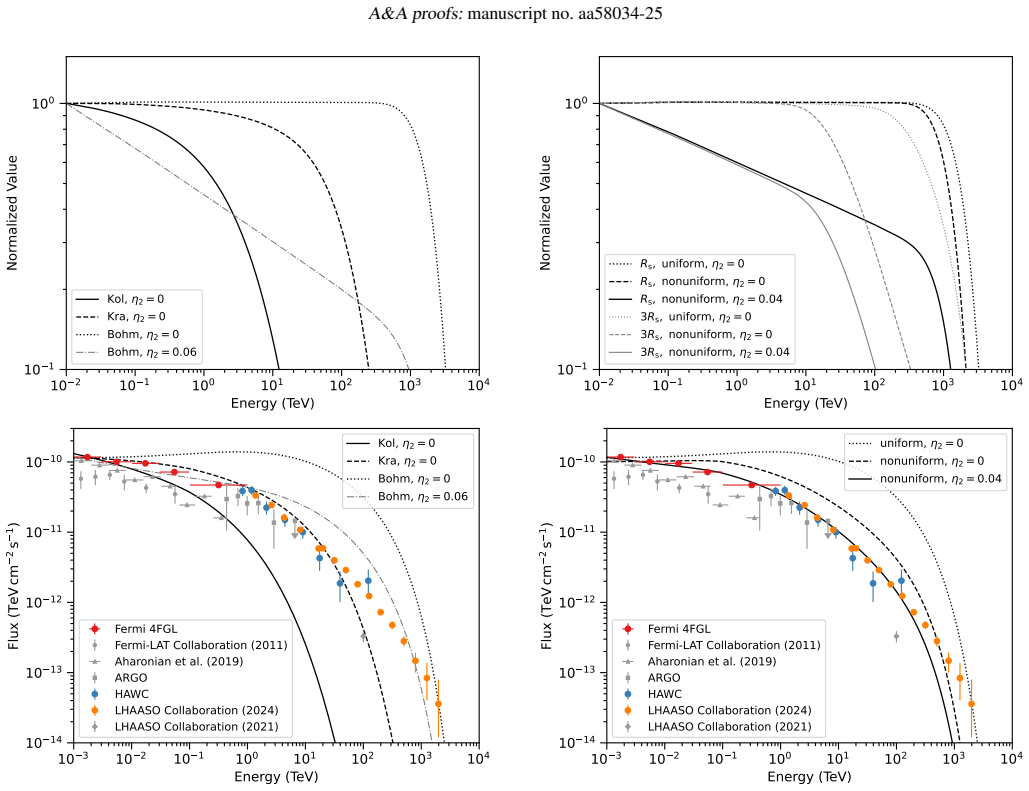
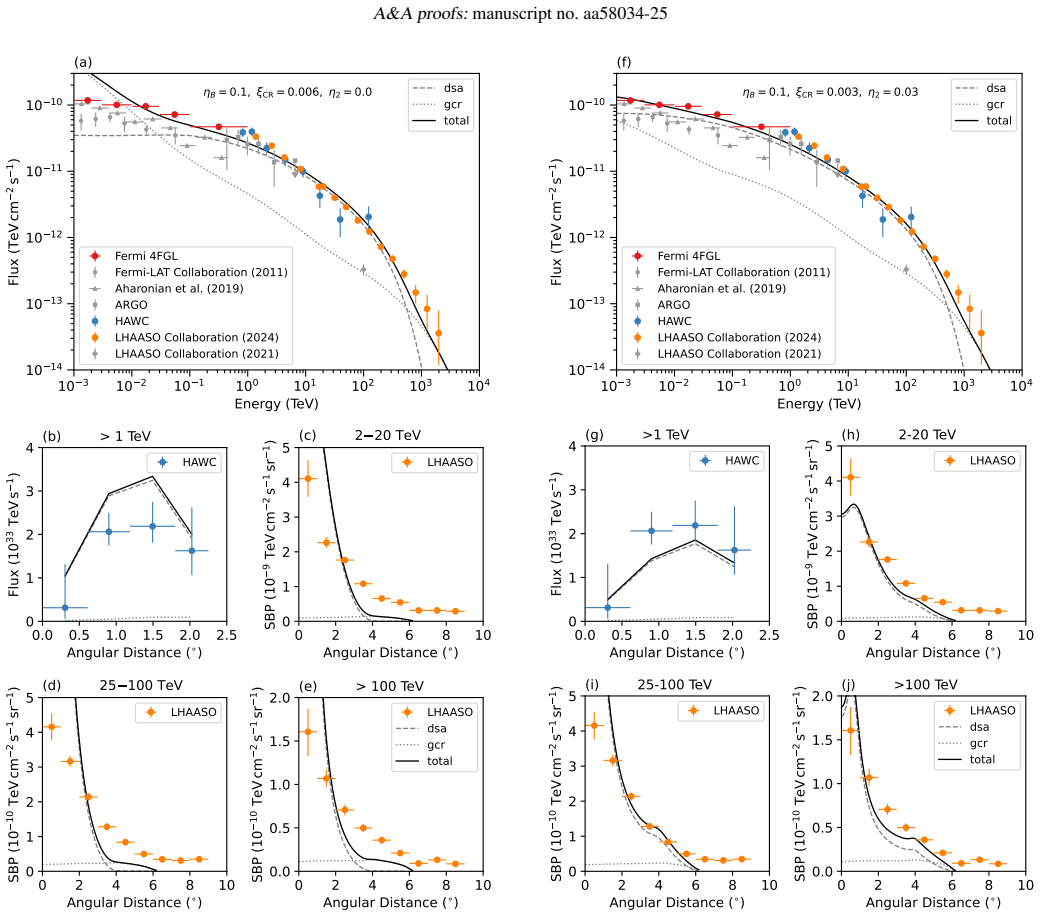
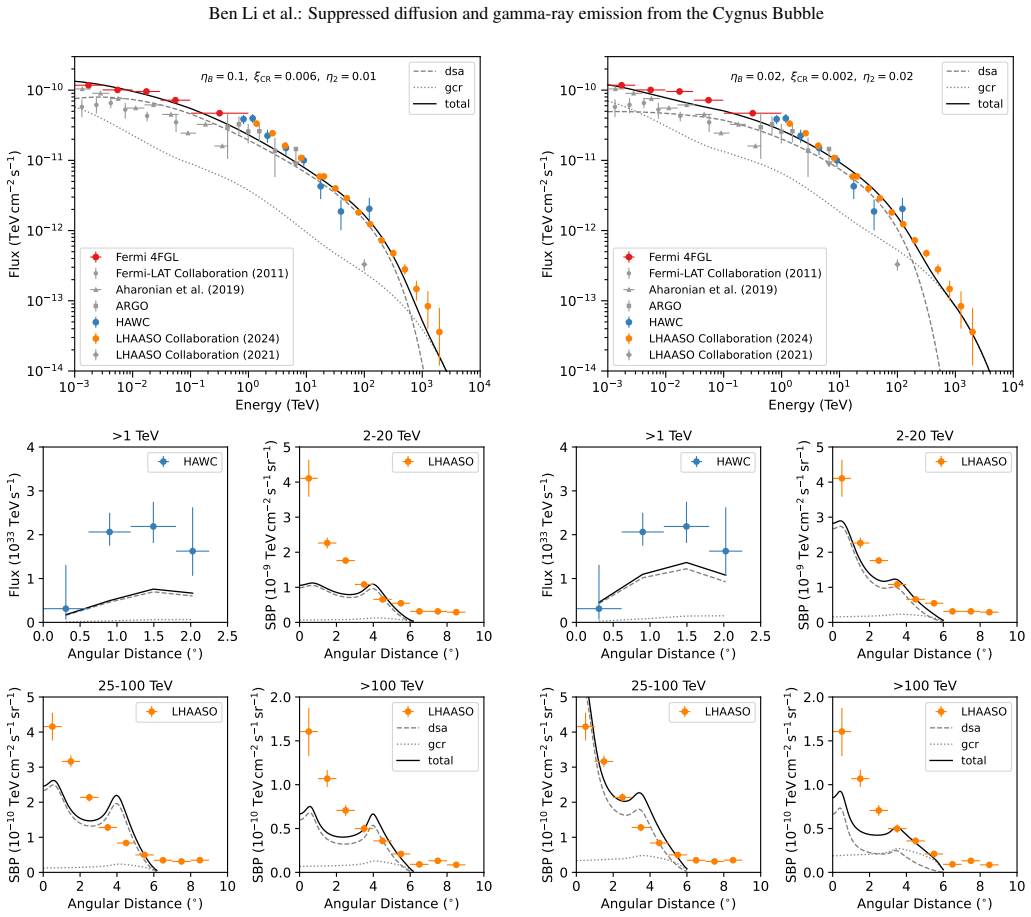
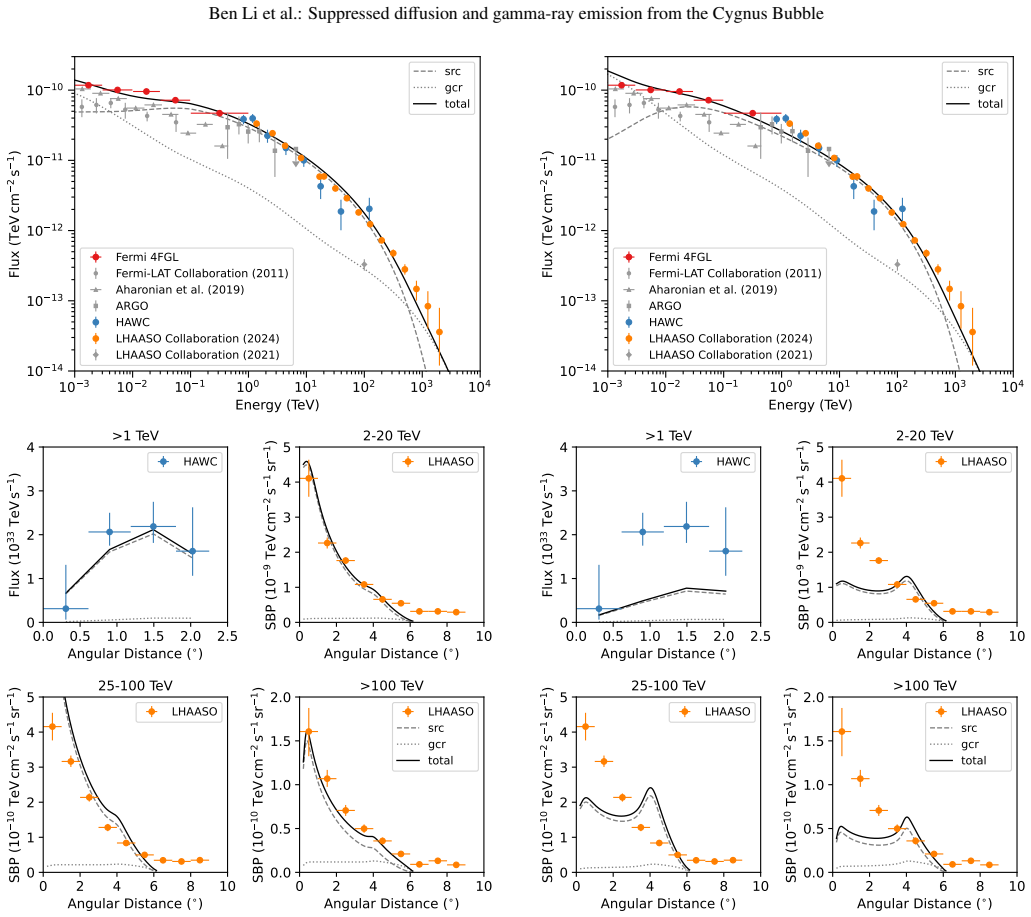
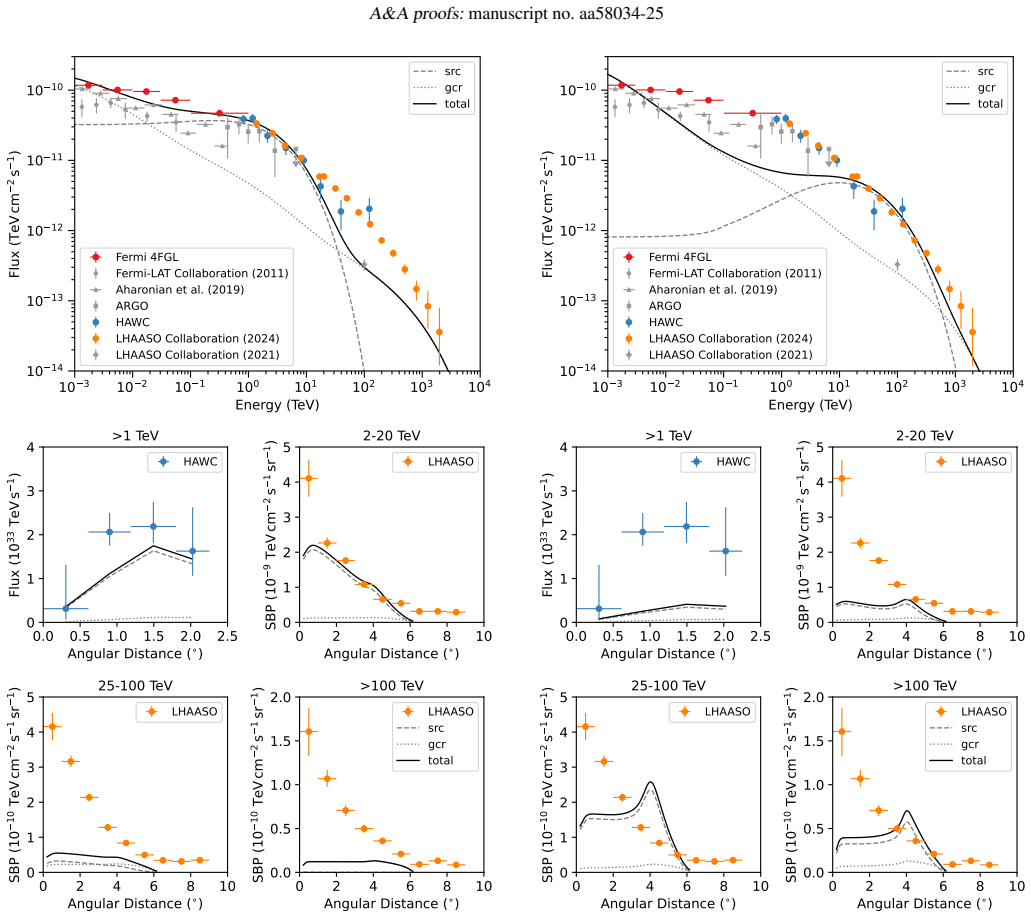
A spatially dependent Bohm diffusion coefficient is required to reproduce both the spectrum and morphology in the cluster wind scenario. Penetrating Galactic cosmic rays can contribute significantly to the gamma-ray emission above ∼300 TeV. A suppressed diffusion coefficient with respect to the Galactic average in a region extending to at least 150 pc from the cluster center is needed to reproduce the LHAASO morphology. The conclusion is that explaining both the spectrum and morphology of the ∼PeV emission with hadrons accelerated in a non-relativistic steady source requires extreme assumptions, with the possibility that some of the highest-energy gamma rays originate from sources behind the
What carries the argument
Numerical solution of the particle transport equation incorporating a spatially dependent diffusion coefficient to obtain the spatial and spectral distributions of non-thermal particles and their gamma-ray emission via pp interactions.
If this is right
- Penetrating Galactic cosmic rays can contribute significantly to the gamma-ray emission above ∼300 TeV.
- The LHAASO morphology requires suppressed diffusion extending at least 150 pc from the cluster center.
- Some of the highest-energy gamma rays may originate from sources behind the Cygnus association rather than the cluster itself.
Where Pith is reading between the lines
- If diffusion suppression on this scale is common, cosmic-ray propagation models for other star clusters would need revision.
- Transient or relativistic acceleration sites may become favored explanations for PeV emission once steady non-relativistic sources are ruled out by morphology.
- Targeted observations of molecular clouds at different distances from the center could test whether particle penetration matches the suppressed-diffusion prediction.
Load-bearing premise
The gamma-ray morphology observed by LHAASO is produced by the spatial distribution of particles whose diffusion is strongly suppressed over a region extending to at least 150 pc from the cluster center.
What would settle it
A direct measurement of the diffusion coefficient near Cygnus OB2 showing values close to the standard Galactic average, or gamma-ray imaging that reveals a morphology inconsistent with the suppressed-diffusion distribution.
Figures
read the original abstract
Recent gamma-ray observations indicate that star clusters can be efficient particle accelerators. In particular, LHAASO has detected diffuse gamma-ray emission from Cygnus OB2 extending to $\gtrsim$ PeV energies, indicating that particles are accelerated to at least $\gtrsim$1 PeV. In this work, we study the gamma-ray emission from the Cygnus region assuming particle acceleration either at the termination shock of the cluster wind (WTS) or in an unspecified source at the bubble center, taken to be either steady or bursting. We numerically solve the transport equation for non-thermal particles in all scenarios and derive their spatial and spectral distributions throughout the bubble. We then calculate the gamma-ray emission from pp interactions, including the contribution from particles interacting with the surrounding molecular cloud, which may help explain the extended emission observed by LHAASO. We also include the penetration of Galactic cosmic rays (GCRs) and the resulting shock reacceleration. The predicted emission is compared with Fermi-LAT, HAWC and LHAASO observations. For three diffusion models, we find that a spatially dependent Bohm diffusion coefficient is required to reproduce both the spectrum and morphology in the cluster wind scenario. Penetrating GCRs can contribute significantly to the gamma-ray emission above $\sim$300 TeV. A suppressed diffusion coefficient with respect to the Galactic average in a region extending to at least 150 pc from the cluster center is needed to reproduce the LHAASO morphology. Our conclusion is that explaining both the spectrum and morphology of the $\sim$PeV emission with hadrons accelerated in a non-relativistic steady source requires extreme assumptions. We also speculate on the possibility that some of the highest-energy gamma rays may originate from sources behind the Cygnus association.
Editorial analysis
A structured set of objections, weighed in public.
Referee Report
Summary. The manuscript models non-thermal particle transport in the Cygnus Bubble, considering acceleration at the cluster wind termination shock or a central source (steady or bursting). The transport equation is solved numerically for three diffusion models, with gamma-ray emission computed from pp interactions including molecular-cloud targets and Galactic cosmic-ray penetration/reacceleration. Predicted spectra and morphologies are compared to Fermi-LAT, HAWC, and LHAASO data. The central claim is that reproducing both the ~PeV spectrum and the extended LHAASO morphology requires a spatially dependent Bohm diffusion coefficient suppressed relative to the Galactic average over a region extending to at least 150 pc; the authors conclude that hadronic emission from a non-relativistic steady source therefore demands extreme assumptions and speculate that some highest-energy photons may originate behind the association.
Significance. If robust, the result would underscore the tension between extended PeV-scale emission and conventional diffusion in star clusters, providing a detailed numerical framework that incorporates multiple source scenarios, cloud targets, and GCR contributions. The explicit inclusion of GCR penetration as a significant component above ~300 TeV is a constructive element. The work supplies a useful benchmark for similar regions even if the 'extreme assumptions' conclusion requires qualification.
major comments (2)
- [§3] §3 (diffusion models): the conclusion that 'extreme assumptions' are required rests on only three diffusion models. The abstract states that a spatially dependent Bohm coefficient is needed to match both spectrum and LHAASO morphology; without evidence that these three exhaust plausible turbulence spectra (e.g., Kolmogorov/Kraichnan) or radial suppression profiles, other prescriptions could potentially reproduce the observed morphology with milder or more localized suppression, directly affecting the load-bearing claim.
- [Abstract] Abstract and results section on LHAASO comparison: the suppression factor is adjusted to reproduce the LHAASO morphology (and spectrum), which introduces circularity; while the paper compares to independent observations, the central requirement of suppression over ≥150 pc is defined by the fit itself, weakening the assertion that the data independently demand extreme conditions.
minor comments (2)
- [§2] Notation for the diffusion coefficient D(r,E) should be defined once and used consistently when comparing the three models.
- [Figure 4] Figure captions for the morphology maps should explicitly state the energy range and the contribution breakdown (WTS vs. GCR) shown in each panel.
Simulated Author's Rebuttal
We thank the referee for the thoughtful and constructive comments. We address each major comment point by point below, providing the strongest honest defense of the manuscript while acknowledging where clarification or qualification is warranted. Revisions will be made to improve the presentation without altering the core scientific conclusions.
read point-by-point responses
-
Referee: [§3] §3 (diffusion models): the conclusion that 'extreme assumptions' are required rests on only three diffusion models. The abstract states that a spatially dependent Bohm coefficient is needed to match both spectrum and LHAASO morphology; without evidence that these three exhaust plausible turbulence spectra (e.g., Kolmogorov/Kraichnan) or radial suppression profiles, other prescriptions could potentially reproduce the observed morphology with milder or more localized suppression, directly affecting the load-bearing claim.
Authors: We appreciate the referee raising this point about model exhaustiveness. The three diffusion models were selected to bracket the range of plausible behaviors, with the spatially dependent Bohm case representing the minimal diffusion (strongest suppression) needed to confine PeV particles over the observed scales. Standard Kolmogorov or Kraichnan spectra typically yield larger diffusion coefficients at high rigidities than Bohm, which would necessitate comparable or greater suppression to reproduce the LHAASO morphology; thus, they would not relax the requirement for extreme conditions. We will add a short discussion in §3 explaining this rationale and noting the limitations of not exploring every possible radial profile. This qualifies the claim appropriately while preserving the result that strong, extended suppression is required in the scenarios considered. revision: partial
-
Referee: [Abstract] Abstract and results section on LHAASO comparison: the suppression factor is adjusted to reproduce the LHAASO morphology (and spectrum), which introduces circularity; while the paper compares to independent observations, the central requirement of suppression over ≥150 pc is defined by the fit itself, weakening the assertion that the data independently demand extreme conditions.
Authors: We disagree that the procedure introduces problematic circularity. Adjusting model parameters to match data is the standard method for determining the physical conditions implied by observations. The LHAASO morphology supplies an independent spatial constraint that cannot be satisfied by varying only the normalization or spectral index; only a diffusion coefficient suppressed relative to the Galactic average and extending to at least 150 pc reproduces the observed extent. The spectrum and morphology are compared jointly to multiple independent datasets (Fermi-LAT, HAWC, LHAASO), and the GCR contribution is treated separately. We will revise the abstract and results section to clarify this distinction between the fitting process and the conclusion that steady hadronic acceleration under conventional diffusion is disfavored. No change to the scientific interpretation is required. revision: partial
Circularity Check
No significant circularity in derivation chain
full rationale
The paper numerically solves the transport equation for non-thermal particles under three explicit diffusion models, computes gamma-ray emission from pp interactions (including molecular clouds and GCR penetration), and directly compares the output spectra and morphologies to independent Fermi-LAT, HAWC, and LHAASO observations. The statement that a suppressed, spatially dependent Bohm-like coefficient is required follows from the mismatch between standard models and data; this is an explicit modeling result, not a self-definitional loop, a fitted parameter renamed as a prediction, or any load-bearing self-citation. The derivation remains self-contained against external benchmarks.
Axiom & Free-Parameter Ledger
free parameters (2)
- diffusion suppression factor
- normalization of accelerated particle spectrum
axioms (2)
- standard math The cosmic ray transport equation governs the spatial and spectral distribution of non-thermal particles
- domain assumption Gamma-ray emission is calculated from pp interactions of accelerated hadrons and penetrating GCRs
Reference graph
Works this paper leans on
-
[1]
Galactic factories of cosmic-ray electrons and positrons. , keywords =. doi:10.1103/PhysRevD.103.083010 , archivePrefix =. 2010.11955 , primaryClass =
-
[2]
Simultaneous Acceleration of Protons and Electrons at Nonrelativistic Quasiparallel Collisionless Shocks. , keywords =. doi:10.1103/PhysRevLett.114.085003 , archivePrefix =. 1412.0672 , primaryClass =
work page internal anchor Pith review Pith/arXiv arXiv doi:10.1103/physrevlett.114.085003
-
[3]
The origin of very high-energy diffuse -ray emission: The case for galactic source cocoons. , keywords =. doi:10.1051/0004-6361/202554796 , archivePrefix =. 2503.14651 , primaryClass =
-
[4]
Gamma rays from star clusters and implications for the origin of Galactic cosmic rays. , keywords =. doi:10.1051/0004-6361/202453017 , archivePrefix =. 2501.16097 , primaryClass =
-
[5]
Understanding the TeV -ray emission surrounding the young massive star cluster Westerlund 1. , keywords =. doi:10.1051/0004-6361/202245444 , archivePrefix =. 2301.10496 , primaryClass =
-
[6]
Multiple emission components in the Cygnus cocoon detected from Fermi-LAT observations. , keywords =. doi:10.1051/0004-6361/202245573 , archivePrefix =. 2301.04504 , primaryClass =
-
[7]
Deciphering the gamma-ray emission in the Cygnus region. , keywords =. doi:10.1051/0004-6361/202555531 , archivePrefix =. 2508.21644 , primaryClass =
-
[8]
Cosmic ray production in superbubbles. , keywords =. doi:10.1093/mnras/stac543 , archivePrefix =. 2201.07488 , primaryClass =
-
[9]
Supernova remnants in super bubbles acting as cosmic ray accelerators. , keywords =. doi:10.1051/0004-6361/202554145 , archivePrefix =. 2505.02523 , primaryClass =
-
[10]
A deep spectromorphological study of the -ray emission surrounding the young massive stellar cluster Westerlund 1. , keywords =. doi:10.1051/0004-6361/202244323 , archivePrefix =. 2207.10921 , primaryClass =
-
[11]
Monthly Notices of the Royal Astronomical Society , volume =
Blasi, Pasquale and Morlino, Giovanni , title =. Monthly Notices of the Royal Astronomical Society , volume =. 2023 , month =. doi:10.1093/mnras/stad1662 , url =
-
[12]
Particle acceleration in winds of star clusters. , keywords =. doi:10.1093/mnras/stab690 , archivePrefix =. 2102.09217 , primaryClass =
-
[13]
Probing star clusters as cosmic ray factories. arXiv e-prints , keywords =. doi:10.48550/arXiv.2307.03477 , archivePrefix =. 2307.03477 , primaryClass =
-
[14]
Gamma-Rays from Active Regions in the Galaxy - the Possible Contribution of Stellar Winds. , keywords =. doi:10.1007/BF00167503 , adsurl =
-
[15]
Cosmic-ray acceleration at stellar wind terminal shocks. , keywords =. doi:10.1086/163652 , adsurl =
-
[16]
Cosmic rays and gamma-rays from OB stars. , keywords =. doi:10.1086/159623 , adsurl =
-
[17]
Superbubbles and energetic particles in the Galaxy. I. Collective effects of particle acceleration. , keywords =. doi:10.1051/0004-6361:20041269 , archivePrefix =. astro-ph/0405531 , primaryClass =
work page internal anchor Pith review Pith/arXiv arXiv doi:10.1051/0004-6361:20041269
-
[18]
Galactic cosmic rays after the AMS-02 observations
Galactic cosmic rays after the AMS-02 observations. , keywords =. doi:10.1103/PhysRevD.99.103023 , archivePrefix =. 1904.10220 , primaryClass =
work page internal anchor Pith review Pith/arXiv arXiv doi:10.1103/physrevd.99.103023 1904
-
[19]
International Journal of Modern Physics D , keywords =
The origin of Galactic cosmic rays: Challenges to the standard paradigm. International Journal of Modern Physics D , keywords =. doi:10.1142/S0218271819300222 , archivePrefix =. 1903.11584 , primaryClass =
-
[20]
, year = 1972, month = aug, volume =
The Dynamical Effects of Stellar Mass Loss on Diffuse Nebulae. , year = 1972, month = aug, volume =
1972
-
[21]
Interstellar bubbles. , keywords =. doi:10.1086/181908 , adsurl =
-
[22]
Interstellar bubbles. II. Structure and evolution. , keywords =. doi:10.1086/155692 , adsurl =
-
[23]
Lack of thermal energy in superbubbles: hint of cosmic rays?
Lack of thermal energy in superbubbles: hint of cosmic rays?. , keywords =. doi:10.1093/mnras/stx2427 , archivePrefix =. 1705.10448 , primaryClass =
work page internal anchor Pith review Pith/arXiv arXiv doi:10.1093/mnras/stx2427
-
[24]
Hydrodynamic simulation of Cygnus OB2: the absence of a cluster wind termination shock. , keywords =. doi:10.1093/mnras/stae1627 , archivePrefix =. 2406.13589 , primaryClass =
-
[25]
Energy spectra of gamma rays, electrons, and neutrinos produced at proton-proton interactions in the very high energy regime. , keywords =. doi:10.1103/PhysRevD.74.034018 , archivePrefix =. astro-ph/0606058 , primaryClass =
work page internal anchor Pith review Pith/arXiv arXiv doi:10.1103/physrevd.74.034018
-
[26]
Parametrization of gamma-ray production cross sections for p p interactions in a broad proton energy range from the kinematic threshold to PeV energies. , keywords =. doi:10.1103/PhysRevD.90.123014 , archivePrefix =. 1406.7369 , primaryClass =
work page internal anchor Pith review Pith/arXiv arXiv doi:10.1103/physrevd.90.123014
-
[27]
Pion Production Momentum Loss of Cosmic Ray Hadrons. , keywords =. doi:10.1088/0004-637X/802/2/114 , adsurl =
-
[28]
Morphology of Gamma-Ray Halos around Middle-aged Pulsars: Influence of the Pulsar Proper Motion. , keywords =. doi:10.3847/1538-4357/ac235e , archivePrefix =. 2010.15731 , primaryClass =
-
[29]
Slow Diffusion is Necessary to Explain the -Ray Pulsar Halos. , keywords =. doi:10.3847/1538-4357/ac8b8a , archivePrefix =. 2107.07395 , primaryClass =
-
[30]
Prospects for the detection of very-high-energy pulsars with LHAASO and SWGO. , keywords =. doi:10.1093/mnras/stae1497 , archivePrefix =. 2407.00262 , primaryClass =
-
[31]
Cygnus X-3 as a semi-hidden PeVatron. , keywords =. doi:10.1051/0004-6361/202554701 , archivePrefix =. 2503.11448 , primaryClass =
-
[32]
Fermi Large Area Telescope Fourth Source Catalog.Astron
Fermi Large Area Telescope Fourth Source Catalog. , keywords =. doi:10.3847/1538-4365/ab6bcb , archivePrefix =. 1902.10045 , primaryClass =
-
[33]
A Cocoon of Freshly Accelerated Cosmic Rays Detected by Fermi in the Cygnus Superbubble. Science , keywords =. doi:10.1126/science.1210311 , adsurl =
-
[34]
Massive Stars as Major Factories of Galactic Cosmic Rays
Massive stars as major factories of Galactic cosmic rays. Nature Astronomy , keywords =. doi:10.1038/s41550-019-0724-0 , archivePrefix =. 1804.02331 , primaryClass =
work page internal anchor Pith review Pith/arXiv arXiv doi:10.1038/s41550-019-0724-0
-
[35]
Identification of the TeV Gamma-ray Source ARGO J2031+4157 with the Cygnus Cocoon
Identification of the TeV Gamma-Ray Source ARGO J2031+4157 with the Cygnus Cocoon. , keywords =. doi:10.1088/0004-637X/790/2/152 , archivePrefix =. 1406.6436 , primaryClass =
work page internal anchor Pith review Pith/arXiv arXiv doi:10.1088/0004-637x/790/2/152
-
[36]
HAWC observations of the acceleration of very-high-energy cosmic rays in the Cygnus Cocoon. Nature Astronomy , keywords =. doi:10.1038/s41550-021-01318-y , archivePrefix =. 2103.06820 , primaryClass =
-
[37]
An ultrahigh-energy -ray bubble powered by a super PeVatron. Science Bulletin , keywords =. doi:10.1016/j.scib.2023.12.040 , archivePrefix =. 2310.10100 , primaryClass =
-
[38]
Cygnus X-3: A variable petaelectronvolt gamma-ray source
Cygnus X-3: A variable petaelectronvolt gamma-ray source. arXiv e-prints , keywords =. doi:10.48550/arXiv.2512.16638 , archivePrefix =. 2512.16638 , primaryClass =
work page internal anchor Pith review Pith/arXiv arXiv doi:10.48550/arxiv.2512.16638
-
[39]
, year = 2021, month = jun, volume =
Ultrahigh-energy photons up to 1.4 petaelectronvolts from 12 -ray Galactic sources. , year = 2021, month = jun, volume =. doi:10.1038/s41586-021-03498-z , adsurl =
-
[40]
Solar Modulation of Galactic Cosmic-Ray Protons Based on a Modified Force-field Approach. , keywords =. doi:10.3847/1538-4357/ac1fe8 , adsurl =
-
[41]
Astroparticle Physics , keywords =
The shape of the cosmic ray proton spectrum. Astroparticle Physics , keywords =. doi:10.1016/j.astropartphys.2020.102441 , archivePrefix =. 1911.01311 , primaryClass =
-
[42]
Measurement of Ultra-High-Energy Diffuse Gamma-Ray Emission of the Galactic Plane from 10 TeV to 1 PeV with LHAASO-KM2A. , keywords =. doi:10.1103/PhysRevLett.131.151001 , archivePrefix =. 2305.05372 , primaryClass =
-
[43]
Galactic Cosmic Rays in the Local Interstellar Medium: Voyager 1 Observations and Model Results. , keywords =. doi:10.3847/0004-637X/831/1/18 , adsurl =
-
[44]
Cosmic ray measurements from Voyager 2 as it crossed into interstellar space. Nature Astronomy , year = 2019, month = nov, volume =. doi:10.1038/s41550-019-0928-3 , adsurl =
-
[45]
New very local interstellar spectra for electrons, positrons, protons and light cosmic ray nuclei
New Very Local Interstellar Spectra for Electrons, Positrons, Protons, and Light Cosmic Ray Nuclei. , keywords =. doi:10.3847/1538-4357/ab1e4a , archivePrefix =. 1902.10438 , primaryClass =
work page internal anchor Pith review Pith/arXiv arXiv doi:10.3847/1538-4357/ab1e4a 1902
-
[46]
Precision Measurement of the Proton Flux in Primary Cosmic Rays from Rigidity 1 GV to 1.8 TV with the Alpha Magnetic Spectrometer on the International Space Station. , keywords =. doi:10.1103/PhysRevLett.114.171103 , adsurl =
-
[47]
Measurement of the cosmic ray proton spectrum from 40 GeV to 100 TeV with the DAMPE satellite. Science Advances , keywords =. doi:10.1126/sciadv.aax3793 , archivePrefix =. 1909.12860 , primaryClass =
-
[48]
Proton and Helium Spectra from the CREAM-III Flight
Proton and Helium Spectra from the CREAM-III Flight. , keywords =. doi:10.3847/1538-4357/aa68e4 , archivePrefix =. 1704.02512 , primaryClass =
work page internal anchor Pith review Pith/arXiv arXiv doi:10.3847/1538-4357/aa68e4
-
[49]
Zhen Cao and F. Aharonian and Y.X. Bai and Y.W. Bao and D. Bastieri and X.J. Bi and Y.J. Bi and W. Bian and A.V. Bukevich and C.M. Cai and W.Y. Cao and Zhe Cao and J. Chang and J.F. Chang and A.M. Chen and E.S. Chen and G.H. Chen and H.X. Chen and Liang Chen and Long Chen and M.J. Chen and M.L. Chen and Q.H. Chen and S. Chen and S.H. Chen and S.Z. Chen an...
-
[50]
Cosmic ray spectrum and composition from PeV to EeV using 3 years of data from IceTop and IceCube. , keywords =. doi:10.1103/PhysRevD.100.082002 , archivePrefix =. 1906.04317 , primaryClass =
-
[51]
Advances in Space Research , keywords =
Modeling of GeV-TeV gamma-ray emission of Cygnus Cocoon. Advances in Space Research , keywords =. doi:10.1016/j.asr.2022.01.029 , archivePrefix =. 2203.09842 , primaryClass =
-
[52]
On the Potential of Bright, Young Pulsars to Power Ultrahigh Gamma-Ray Sources. , keywords =. doi:10.3847/2041-8213/ac66cf , archivePrefix =. 2204.09440 , primaryClass =
-
[53]
Journal of High Energy Astrophysics , keywords =
ASTRI Mini-Array core science at the Observatorio del Teide. Journal of High Energy Astrophysics , keywords =. doi:10.1016/j.jheap.2022.05.005 , archivePrefix =. 2208.03177 , primaryClass =
-
[54]
Astroparticle Physics , year = 2013, month = mar, volume =
Introducing the CTA concept. Astroparticle Physics , year = 2013, month = mar, volume =. doi:10.1016/j.astropartphys.2013.01.007 , adsurl =
-
[55]
Modeling Cosmic-ray Electron Spectra and Synchrotron Emission in the Multiphase Interstellar Medium. , keywords =. doi:10.3847/1538-4357/ade5ad , archivePrefix =. 2507.00142 , primaryClass =
discussion (0)
Sign in with ORCID, Apple, or X to comment. Anyone can read and Pith papers without signing in.