REVIEW 3 major objections 5 minor 82 references
Energy-Casimir, dynamically accessible, and Lagrangian stability of extended magnetohydrodynamic equilibria
T0 review · 3 major / 5 minor · reviewed 2026-08-14 · deepseek-v4-flash
Pith's one-line read The paper derives explicit sufficient stability criteria for axisymmetric XMHD and Hall MHD equilibria with toroidal flow, a wavenumber-limited criterion for incompressible perturbations, and a Lagrangian HMHD energy principle that…
desk verdict Extends energy-Casimir, dynamically accessible, and Lagrangian stability tools to XMHD and gets a new HMHD energy principle, but the load-bearing DA algebra is asserted, and Eq. (37) has a missing rho^{-1} as printed. read the letter →
The pith
A machine-rendered reading of the paper's core claim, the machinery that carries it, and where it could break.
The reading
What carries the argument
The central objects are the noncanonical Poisson bracket (2), the axisymmetric Casimir invariants (9)–(12), and the generalized magnetic field $B^* = B + d_e^2 \nabla\times(\nabla\times B/\rho)$ that carries electron inertia. These convert the Hamiltonian into an energy-Casimir functional whose first variation is the equilibrium condition and whose second variation is the candidate Lyapunov functional; the explicit inequalities come from requiring the matrix $\mathsf A$ in (17) and the surviving squared terms to be positive definite. The dynamically accessible generator $W$ produces variations tangent to the level sets of the Casimirs, giving a second variation for generic equilibria. In the Lagrangian route, the second-order action $L_2$ and its Legendre transform $H_2$ supply the energy principles, and for HMHD the momentum $\pi_\eta$ becomes a constraint whose consistency yields the perturbed induction equation.
What would settle it
Take a numerically constructed XMHD equilibrium satisfying (26)–(27), or an HMHD equilibrium satisfying (28)–(30), and solve the linearized equations with a small axisymmetric perturbation; any growing mode would disprove the claimed Lyapunov sufficiency. A cheaper equivalent is to scan the linear eigenmode spectrum of the operators in (15) and (38) for a positive growth rate in the parameter region where the paper's conditions hold.
Extended reading notes
Core claim
Within the noncanonical Hamiltonian description of XMHD, the paper constructs energy-Casimir functionals $H-\sum_i C_i$ whose first variation vanishes on the equilibria derived in the authors' earlier work and whose second variation, when positive definite, serves as a Lyapunov functional for the linearized dynamics. For purely toroidal flow the indefinite terms in $\delta^2 H_C$ are eliminated, leaving algebraic conditions on the free functions: (26)–(27) for XMHD and (28)–(30) for HMHD, with numerical satisfaction shown on diverted tokamak-like equilibria. For incompressible perturbations, partial minimization over $\delta B_\varphi$ and $\delta v_\perp$ produces the condition $c_\phi>0$, $c_\xi>0$, together with the wavenumber restriction $|k_x|<k_+$ and a lower bound on $|k_x|$ imposed by the geometry of the domain. The dynamically accessible route, generated by $W=\int d^3x(g_0\rho + g_1\cdot v + g_2\cdot B^*)$, yields a second variation $\delta^2 H_{da}$ valid for generic equilibria. The mixed Eulerian–Lagrangian expansion of the quasineutral two-fluid action gives the linearized Hamiltonian $H_2$ with the sufficient condition $-\int W\,d^3x \ge 0$; taking the electron mass to zero produces the HMHD energy principle $-\int W_{\rm hmhd}\,d^3x \ge 0$, and the perturbed induction equation $B_1=\nabla\times[(\zeta-d_i\eta)\times B_0]$ follows from the consistency condition (102) on the canonical momentum $\pi_\eta$.
Load-bearing premise
The entire analysis inherits, without re-derivation, the noncanonical Poisson bracket (2) and the axisymmetric Casimirs (9)–(12) from Refs. [29] and [39]; if that bracket or those invariants are incomplete, the stated inequalities do not certify stability.
Editorial extensions
If this is right
- Axisymmetric XMHD equilibria with purely toroidal rotation are formally stable whenever the free functions $M,N$ are concave and the electron-inertia-modified toroidal speed stays below the sound speed, conditions (26)–(27).
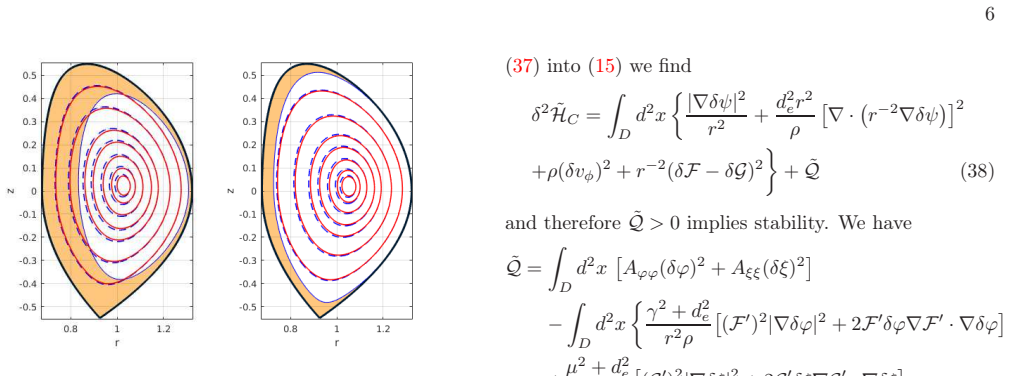
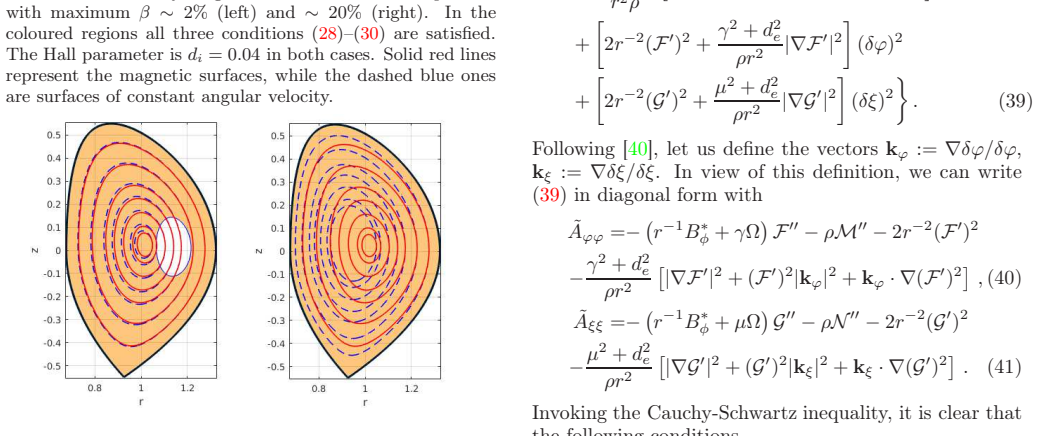
- Hall MHD equilibria with toroidal flow satisfy an analogous explicit criterion (28)–(30); the numerical examples indicate the extra condition (30) is the restrictive one at high $\beta$ and that increasing the Hall parameter $d_i$ can enlarge the stable region.
- For incompressible perturbations, the criteria $c_\phi>0$, $c_\xi>0$ with the wavenumber bound $|k_x|<k_+$ provide sufficient stability for equilibria that need not be of the purely toroidal class.
- The dynamically accessible second variation supplies a stability test for generic three-dimensional equilibria, and its MHD limit recovers the standard flowing-MHD potential energy without the singularities that plague the Casimir/MHD limit.
- The Lagrangian energy principle for the quasineutral two-fluid model, and its HMHD reduction, give a sufficient condition $-\int W\,d^3x \ge 0$ that now includes the electron pressure contribution.
Reading between the lines
- A natural extension the paper does not pursue is to test (26)–(30) against direct linear eigenmode solvers; such a test would show how far the sufficient conditions are from necessary ones.
- Because the DA second variation avoids the singular Casimir/MHD limit noted in the paper, it may be the most practical of the three tools for numerical stability scans of three-dimensional equilibria.
- The mixed Eulerian–Lagrangian derivation keeps the full two-fluid pressure structure before the zero-electron-mass limit, so the resulting energy principle could likely be adapted to non-barotropic closures or to equilibria with electrostatic potentials.
Signed reviews
Editorial analysis
A structured set of objections, weighed in public.
Referee Report
Summary. The paper develops formal stability criteria for extended magnetohrodynamic (XMHD) equilibria using three Hamiltonian-based methods. In the energy-Casimir (EC) approach, sufficient stability conditions are derived for axisymmetric XMHD equilibria with toroidal flow (Eqs. (26)-(27)) and for Hall MHD (HMHD) equilibria (Eqs. (28)-(30)), with a numerical HMHD example. For restricted perturbations, a conditional stability criterion (47) is obtained by partially minimizing the second variation. In the dynamically accessible (DA) approach, a second-order variation of the Hamiltonian is computed for generic equilibria, and a sufficient condition (121) is given for axisymmetric equilibria with toroidal flow under flux-surface-tangent perturbations. In the Lagrangian part, the second-order Lagrangian and Hamiltonian of the linearized two-fluid dynamics are constructed; upon setting the electron mass to zero, a HMHD energy principle (114) is derived including the electron pressure contribution, and the perturbed induction equation is obtained from a consistency condition. The paper emphasizes that all stability criteria are sufficient, not necessary.
Significance. If the derivations are correct, the paper provides explicit Lyapunov-function-based sufficient stability conditions for XMHD and HMHD equilibria with flow, going beyond static MHD. The EC criteria (26)-(30) are explicit and amenable to numerical evaluation, as demonstrated in Figs. 1 and 2. The Lagrangian/Hamiltonian formulation yields a HMHD energy principle with electron pressure and a derivation of the perturbed induction equation from a dynamical constraint, which are valuable new results. The DA section is potentially useful for generic equilibria because it avoids the known Casimir MHD-limit difficulties. However, the strength of the paper rests on several algebraic steps that are asserted rather than shown, and at least one of those steps contains a visible error. The paper’s central claims are plausible, but the load-bearing algebra must be fully verified before the results can be accepted as rigorous.
major comments (3)
- [Sec. II.D, Eq. (37)] The minimization of the functional (15) with respect to δv⊥ gives δv⊥ = -ρ^{-1} v⊥ δρ + ρ^{-1}(γ∇δF + μ∇δG) × ∇φ, not the expression printed in Eq. (37), which omits the factor ρ^{-1} multiplying the second term. This is not a harmless typo: after substitution into (38)-(39), the kinetic contribution changes, so the coefficients in (39) and hence the sufficient conditions (44)-(45) and the criterion (47) are not justified as written. Please correct the minimizer and re-derive the subsequent inequalities, or explicitly state a different convention for the variation that makes Eq. (37) correct.
- [Sec. III, Eq. (63) and Appendix A, Eq. (115)] The equivalence of the intermediate form (115) and the simplified form (63) is asserted after 'some tedious but also straightforward manipulations' without any derivation. The two forms are not manifestly identical: for example, (115) contains the term -ρ^{-1} v ∇·(ρζ) inside the squared velocity, while (63) contains ζ·∇v - v·∇ζ, so the required cancellations involve the equilibrium equations and are nontrivial. Since Eq. (63) underlies the DA stability discussion and the claimed HMHD and MHD limits, this is a load-bearing algebraic assertion. Please provide a complete derivation, either in the paper or in a supplementary file, and identify which equilibrium equations and integration-by-parts identities are used at each step.
- [Appendix A, Eq. (121)] The reduction from (115) to (121) for flux-surface-tangent perturbations is described only verbally ('A rigorous proof can be carried out...'), with no term-by-term computation. The criterion c_s^2 - v_φ^2 - d_e^2 |J|^2/ρ^2 > 0 is one of the main DA results, so the fate of each term in (115), including the terms containing ∇g0, ζ×ω, η×B*, and all cross terms involving δB_da, should be displayed explicitly. Without this demonstration the reader cannot exclude hidden indefinite terms that would invalidate the sufficient condition.
minor comments (5)
- [Title] The title contains a typographical error: 's tability' should read 'stability'.
- [Sec. II.C.2] For reproducibility of the numerical examples, the values of the free coefficients g_i, m_i, n_i in Eq. (35) and the computational parameters should be listed, since the stability diagrams in Figs. 1 and 2 depend on them.
- [Sec. II.D, Eq. (47)] The condition ⟨(|k_x|^2 - C^{-1})(δx)^2⟩ ≥ 0 is a consequence of the Poincaré inequality and is not an additional restriction on the perturbations; this should be stated explicitly to avoid confusion about its role in the criterion.
- [Sec. IV, after Eq. (84)] The notation ζ and η is reused for the Eulerianized displacements after dropping the tildes; a sentence reminding the reader of this change of notation would improve clarity.
- [Ref. [57]] Reference [57] is a technical report that may not be readily accessible; please indicate whether a journal version or a stable online source exists.
Circularity Check
No significant circularity; the central stability criteria are derived, with only a minor non-circular self-citation of the authors' earlier Casimir analysis.
full rationale
The paper's stability claims are derived rather than assumed. In Sec. II, delta^2 H_C is computed from delta(H - sum C_i), and conditions (23)-(25) are the Sylvester criteria for positivity of the quadratic form Q; the special criteria (26)-(27), (28)-(30), and (44)-(45) follow by substituting equilibrium restrictions into those inequalities. In Sec. III, dynamically accessible variations are obtained from the Poisson bracket through delta u_da = {u,W}, and the second variation is assembled from delta H/delta u and delta^2 u, with (60)-(62) computed from the bracket; the generic criterion (121) is obtained by evaluating (115) under the stated surface-tangency conditions. In Secs. IV-V, H_2 is obtained by a Legendre transformation of L_2, and (93) and (114) rest on the standard fact that a Hamiltonian with positive-definite kinetic term and non-negative -W is positive. The only externally imported ingredients are the noncanonical bracket (2), cited to [29] (not by the present authors), and the axisymmetric Casimirs (9)-(12) plus EC equilibrium equations quoted from [39] (same authors). These are parameter-free published results that do not contain the target stability inequalities, so citing them is not circular in the sense of importing the conclusion. The numerical examples adjust free functions in an ansatz and check whether the derived criteria hold; they do not fit a parameter to a predicted quantity. The main presentation gap is that Eq. (63) is asserted as the result of 'some tedious but also straightforward manipulations' of Eq. (115) without displaying the algebra; that is an unverified equivalence, not a reduction by construction. Accordingly, no circular step is established.
Assumptions & free parameters
free parameters (2)
- Polynomial coefficients of the HMHD equilibrium free functions (g_i, m_i, n_i) =
Chosen for the illustrative equilibria; m1=0, p1 fixed, d_i=0.04 or 0.24
- Plasma beta in the HMHD examples =
Maximum beta about 2% and 20% in Fig. 1; about 0.8% in Fig. 2
assumptions (7)
- domain assumption Quasineutral two-fluid barotropic XMHD model with electron inertia is the correct physical model
- domain assumption Noncanonical Poisson bracket and axisymmetric Casimirs from [29,39] are valid
- domain assumption Surface integrals vanish in integrations by parts
- domain assumption EC perturbations respect the axisymmetric field decompositions (7)-(8)
- standard math Poincare inequality and Cauchy-Schwarz inequality for k vectors
- domain assumption Massless electron limit for HMHD and Alfven normalization
- domain assumption Consistency condition (102) for the perturbed magnetic potential is preserved by the dynamics
Cite this review
Pith. "Pith review of Energy-Casimir, dynamically accessible, and Lagrangian stability of extended magnetohydrodynamic equilibria." pith.science (2026). https://pith.science/paper/U7YV7JIK
@misc{pith2026190808821,
  author       = {Pith},
  title        = {Pith review of: Energy-Casimir, dynamically accessible, and Lagrangian stability of extended magnetohydrodynamic equilibria},
  year         = {2026},
  howpublished = {\url{https://pith.science/paper/U7YV7JIK}},
  note         = {Machine review of arXiv:1908.08821}
}
read the original abstract
The formal stability analysis of Eulerian extended magnetohydrodynamics (XMHD) equilibria is considered within the noncanonical Hamiltonian framework by means of the energy-Casimir variational principle and the dynamically accessible stability method. Specifically, we find explicit sufficient stability conditions for axisymmetric XMHD and Hall MHD (HMHD) equilibria with toroidal flow and for equilibria with arbitrary flow under constrained perturbations. The dynamically accessible, second-order variation of the Hamiltonian, which can potentially provide explicit stability criteria for generic equilibria, is also obtained. Moreover, we examine the Lagrangian stability of the general quasineutral two-fluid model written in terms of MHD-like variables, by finding the action and the Hamiltonian functionals of the linearized dynamics, working within a mixed Lagrangian-Eulerian framework. Upon neglecting electron mass, we derive a HMHD energy principle, and in addition, the perturbed induction equation arises from Hamilton's equations of motion in view of a consistency condition for the relation between the perturbed magnetic potential and the canonical variables.
Figures
Reference graph
Works this paper leans on
-
[1]
F ′ = G′ = 0, it is clear that Q > 0 implies δ2HC > 0
Extended MHD For purely toroidal flow and current, i.e. F ′ = G′ = 0, it is clear that Q > 0 implies δ2HC > 0. For our special class of equilibria, we have AϕBφ = AξBφ = 0 , and consequently conditions ( 23)–( 25) yield M′′< 0, N ′′ < 0, (26) M′′N ′′ [ c2 s −v2 φ − d2 e ρ2 ( r2[ ∇ · ( r−2∇ψ )] 2)] +M′′(N ′)2 + N ′′(M′)2 > 0. (27) The first two conditions im...
-
[2]
Here the set of dynamical variables, say u, are the mass density ρ the fluid velocity v and the generalized magnetic field B∗ suggested in [ 38], given by B∗ = B +d2 e∇ × (∇ × B ρ )
is a generalization of that first given for 3 MHD in [ 37]. Here the set of dynamical variables, say u, are the mass density ρ the fluid velocity v and the generalized magnetic field B∗ suggested in [ 38], given by B∗ = B +d2 e∇ × (∇ × B ρ ) . (3) The parametersdi andde are the normalized ion and elec- tron skin depths, respectively. The equations of motion ...
- [3]
-
[4]
In this case, the flow is purely toroidal, but there is poloidal current created by the electrons
Hall MHD In the limit de → 0, µ → 0 as well, and there is only one indefinite term in ( 15), which can be removed upon selecting F ′ = 0. In this case, the flow is purely toroidal, but there is poloidal current created by the electrons. From ( 23)–( 25), we obtain the following sufficient stabil- ity conditions: M′′< 0, (28) r−2GG ′′ +ρN ′′ +r−2(G′)2 < 0, (29...
- [5]
-
[6]
R. L. Miller, F. L. Waelbroeck, A. B. Hassam, and R. E. Waltz, Physics of Plasmas 2, 3676 (1995)
work page 1995
-
[7]
Hence, a simple way to get rid of the indefiniteness is to assume δρ =δBφ = ∇ ×δv⊥ = 0
containing δF and δG and mul- tiplied by ∇ × δv⊥, δBφ and δρ. Hence, a simple way to get rid of the indefiniteness is to assume δρ =δBφ = ∇ ×δv⊥ = 0 . However, such a severe restriction of the permitted perturbations should be justified on physical grounds. Another possibility is to assume only δρ = 0 , which can be justified by the fact that incompressible ...
-
[8]
and then try to eliminate the explicit appearance of δBφ and δv⊥ into δ2HC by other means
is not satis- fied, increasing di results in a completely stable configuration, under EC variations. and then try to eliminate the explicit appearance of δBφ and δv⊥ into δ2HC by other means. A way to do so is to partially minimize the functional (
Show all 82 references
-
[9]
This is a standard procedure to ob- tain simplified forms of the Lyapunov functional and im- proved stability criteria (e.g
with respect to δv⊥ and δBφ. This is a standard procedure to ob- tain simplified forms of the Lyapunov functional and im- proved stability criteria (e.g. see [ 36, 47, 54, 55]). The minimization can be realized upon considering δ2HC as a functional of the variations δu and requ...
-
[10]
X. L. Chen and P. J. Morrison, Phys. Fluids B 3, 863 (1991)
1991
-
[11]
V. V. Mishin and V. M. Tomozov, Solar Phys. 291, 3165–3184 (2016)
2016
-
[12]
S. A. Balbus and J. F. Hawley, Astrophys. J. 376, 214 (1991)
1991
-
[13]
Ishida, H
A. Ishida, H. Momota, and L. C. Steinhauer, Phys. Fluids 31, 3024 (1988)
1988
-
[14]
The most important advantage of our formulation can be seen though, after employing the Lagrange-Euler map: first because (
is ap- plicable for generic thermodynamic closures with scalar pressure, not only for fluids obeying the adiabatic ideal- gas law as in [ 57]. The most important advantage of our formulation can be seen though, after employing the Lagrange-Euler map: first because (
-
[15]
problem- atic
because they are clearly sources of indefiniteness, a characteristic tha t has been identified in previous EC stability analyses of similar models [ 45, 46], and can potentially be related to linear instability or the presence of Negative Energy Modes (NEMs). Both can lead to di...
-
[16]
Eule- rianize
explicitly dic- tates how the labels of the fluid elements are related so that the Lagrange-Euler map will result in a local La- grangian and second because its Eulerian counterpart will be expressed in terms of the MHD-like variables v and J. To employ the Lagrange-Euler map w...
-
[17]
The impact of the Hall term on tokamak plasmas
P. A. Gourdain, “The impact of the Hall term on tokamak plasmas”, arXiv:1703.00987v2, (2017)
2017 arXiv
-
[18]
P. N. Guzdar, S. M. Mahajan, and Z. Yoshida, Phys. Plasmas 12, 032502 (2005)
2005
-
[19]
and the boundary conditions. In addition, the perturbation of the velocity field and of the field J/ρ are given by δv =∂tζ + v · ∇ζ − ζ · ∇v, (98) δ (J ρ ) =∂tη + v · ∇η − η · ∇v (99) + J ρ · ∇ζ − ζ · ∇ J ρ −di (J ρ · ∇η − η · ∇ J ρ ) , while the generalized momenta π ζ and π η ...
-
[20]
P. J. Morrison, Rev. Mod. Phys. 70, 467 (1998)
1998
-
[21]
Holm, Phys
D.D. Holm, Phys. Fluids 30, 1310 (1987)
1987
-
[22]
Hirota, Z
M. Hirota, Z. Yoshida, and E. Hameiri, Physics of Plas- mas 13, 022107 (2006)
2006
-
[23]
Torasso and E
R. Torasso and E. Hameiri, Phys. Plasmas 12, 032106 (2005)
2005
-
[24]
The same holds also for terms of the form bi · (cj × ck), since (cj × ck) is normal to the characteristic surfaces at each point, if not zero
will vanish. The same holds also for terms of the form bi · (cj × ck), since (cj × ck) is normal to the characteristic surfaces at each point, if not zero. In addition the term containing ζ · ∇˜h will vanish as well due to ( 120). A rigorous proof can be carried out upon writi...
-
[25]
I. B. Bernstein, E. A. Frieman, M. D. Kruskal, and R. M. Kulsrud, Proc. R. Soc. London, Ser. A 244, 17 (1958)
1958
-
[26]
E. A. Frieman and M. Rotenberg, Rev. Mod. Phys. 32, 898 (1960)
1960
-
[27]
Lüst, Fortschr
R. Lüst, Fortschr. Phys. 7, 503 (1959)
1959
-
[28]
Wagner, Plasma Phys
F. Wagner, Plasma Phys. Control. Fusion 49, B1 (2007)
2007
-
[29]
H. M. Abdelhamid, Y. Kawazura and Z. Yoshida, J. Phys. A: Math. Theor. 48, 235502 (2015)
2015
-
[30]
is potentially related with the stabilization of pressure driven modes. To capture the influence of the Hall parameter di on stability, we considered an equilib- rium with di = 0.04 where all three stability conditions are satisfied everywhere outside a small region near the cor...
-
[31]
It is not difficult to adjust the free parameters in ( 35) to make conditions ( 28)–( 29) to be satisfied everywhere in the plasma
was solved numerically, using finite differences and a simple SOR iterative solver, on an up-down poloidally asymmet- ric domain with a prescribed diverted boundary having a lower x-point and tokamak pertinent values for the free parameters. It is not difficult to adjust the free ...
-
[32]
Lazzaro, and E
D Brunetti, S. Lazzaro, and E. Nowak, Plasma Phys. Control. Fusion 59, 055012 (2017)
2017
-
[33]
I. T. Chapman N.R. Walkden, J. P. Graves, and C. Wahlberg, Plasma Phys. Control. Fusion 53, 125002 (2011)
2011
-
[34]
M. S. Chu, Physics of Plasmas 5, 183 (1998)
1998
-
[35]
I. K. Charidakos, M. Lingam, P. J. Morrison, R. L. White, and A. Wurm, Phys. Plasmas 21, 092118 (2014)
2014
-
[36]
Andreussi, P
T. Andreussi, P. J. Morrison, F. Pegoraro, Phys. Plasma s 20, 092104 (2013); erratum ibid 22, 039903 (2015)
2013
-
[37]
P. J. Morrison and J. M. Greene, Phys. Rev. Lett. 45, 790 (1980)
1980
-
[38]
Barnes, Physics of Plasmas 9, 560 (2002)
D.C. Barnes, Physics of Plasmas 9, 560 (2002)
2002
-
[39]
J. Birn, M. A. Drake, J. F. Shay, N. Hesse, E. Rogers, M. Denton, M. Kuznetsova, Z. W. Ma, A. Bhattacharjee, A. Otto, and P. L. Pritchett, J. Geophy. Res. 106, 3715 (2001)
2001
-
[40]
Andrés P
N. Andrés P. Dmitruk, and D. Gómez, Physics of Plas- mas 23, 022903 (2016)
2016
-
[41]
J. A. Almaguer, E. Hameiri, J. Herrera, and D. D. Holm, Phys. Fluids 31, 1930 (1988)
1988
-
[42]
Andreussi, P
T. Andreussi, P. J. Morrison, F. Pegoraro, Phys. Plasma s 19, 052102 (8pp) (2012)
2012
-
[43]
Hameiri and R
E. Hameiri and R. Torasso, Physics of Plasmas 11, 4934 (2004)
2004
-
[44]
and ( 45) are sufficient for ˜Aϕϕ > 0 and ˜Aξξ > 0, if |kϕ| < k+ ϕ and |kξ| < k+ ξ . On the other hand, there is a topological lower bound on the admissible values ofkϕ,kξ due to the Poincaré inequality, ∫ D d2x |kϕ|2(δϕ)2 (46) = ∫ D d2x |∇δϕ|2 ≥C−1 ∫ D d2x (δϕ)2, i.e., ⟨ ( |kϕ|...
-
[45]
Tassi, P
E. Tassi, P. J. Morrison, F. L. Waelbroeck and D. Grasso, Plasma Phys. Control. Fusion 50, 085014 (2008)
2008
-
[46]
Tassi, T
E. Tassi, T. S. Ratiu and E. Lazarro, J. Phys.: Conf. Ser. 401, 012023 (2012)
2012
-
[47]
As a final point we stress that this stability criterion is genera l enough to capture a large variety of modes as long as k+’s are large enough
is satisfied for sure if min(|kx|2) ≥ C−1 and hence, cx > 0, x = ϕ,ξ , are sufficient stability conditions if C−1 ≤ | kx|2 <k + x . As a final point we stress that this stability criterion is genera l enough to capture a large variety of modes as long as k+’s are large enough. Hen...
-
[48]
Ilgisonis, Fusion Technology, 35:1T, 170-174 (1999)
V.I. Ilgisonis, Fusion Technology, 35:1T, 170-174 (1999)
1999
-
[49]
Elsasser and P
K. Elsasser and P. Speiss, Phys. Lett. A 230, 67 (1997)
1997
-
[50]
Spiess and K
P. Spiess and K. Elsässer, Phys. Plasmas 6, 4208 (1999)
1999
-
[51]
Hameiri, Phys
E. Hameiri, Phys. Plasmas 20, 092503 (2013)
2013
-
[52]
Kimura and P
K. Kimura and P. J. Morrison, Phys. Plasmas 21, 082101 (2014)
2014
-
[53]
P. J. Morrison, M. Lingam, and R. Acevedo, Phys. Plas- mas 21, 082102 (2014)
2014
-
[54]
Lingam, P
M. Lingam, P. J. Morrison and G. Miloshevich, Physics of Plasmas 22, 072111 (2015)
2015
-
[55]
E. C. D’A vignon, P. J. Morrison, and M. Lingam, Phys. Plasmas 23, 062101 (2016)
2016
-
[56]
Lingam, G
M. Lingam, G. Miloshevich and P. J. Morrison, Phys. Lett. A 380, 2400 (2016)
2016
-
[57]
P. J. Morrison and D. Pfirsch, Phys. Rev. A 40, 3898 (1989)
1989
-
[58]
P. J. Morrison and D. Pfirsch, Phys. Fluids B: Plasma Physics 2, 1105 (1990)
1990
-
[62]
Lingam, P
M. Lingam, P. J. Morrison and E. Tassi, Phys. Lett. A 379, 570 (2015)
2015
-
[63]
D. A. Kaltsas, G. N. Throumoulopoulos, and P. J. Mor- rison, J. Plasma Phys. 84, 745840301 (2018)
2018
-
[64]
D. D. Holm, J. E. Marsden, T. Ratiu, and A. Weinstein, Phys. Rep. 123, 1 (1985)
1985
-
[67]
S. M. Moawad, J. Plasma Phys. 79, 873 (2013)
2013
-
[68]
Andreussi, P
T. Andreussi, P. J. Morrison, F. Pegoraro, Phys. Plasma s 23, 102112 (2016)
2016
-
[71]
Hameiri, Phys
E. Hameiri, Phys. Plasmas 10, 2643 (2003)
2003
-
[72]
D. A. Kaltsas, G. N. Throumoulopoulos, and P. J. Mor- rison, Phys. Plasmas 26, 024501 (2019)
2019
-
[73]
D. A. Kaltsas, G. N. Throumoulopoulos, and P. J. Mor- rison, Phys. Plasmas 24, 092504 (2017)
2017
-
[74]
Yoshida and E
Z. Yoshida and E. Hameiri, J. Phys. A: Math. Theor. 46, 335502 (2013)
2013
-
[76]
P. J. Morrison, AIP Conf. Ser. 1188, 329 (2009)
2009
-
[78]
Newcomb, Ann
W. Newcomb, Ann. Phys. 10, 232 (1960)
1960
-
[79]
Hameiri, Phys
E. Hameiri, Phys. Plasmas 5, 3270 (1998)
1998
-
[80]
Newcomb, Nucl
W. Newcomb, Nucl. Fusion Suppl. pt. 2, 451, (1960)
1960
-
[81]
This is equivalent to imposing x′ = x, after performing a single fluid Lagrange-Euler map (which involves the unperturbed trajectories, e.g
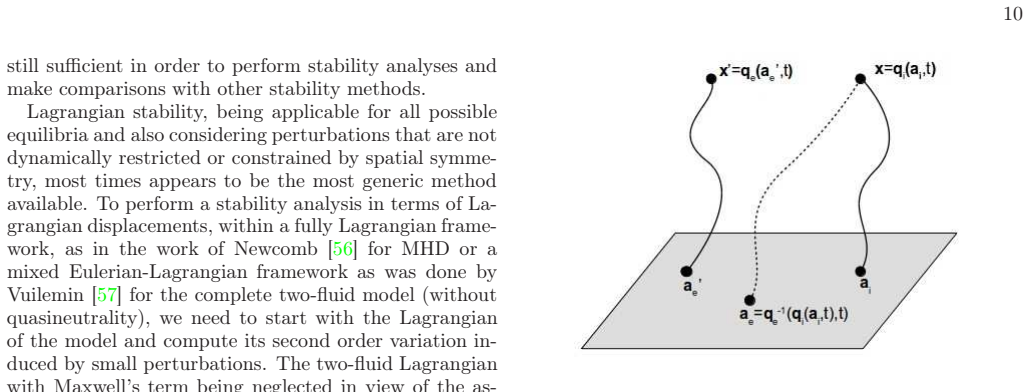
by means of the equilibrium trajectories, i.e., δ(ae − q−1 e0 (qi0(ai,t ),t )). This is equivalent to imposing x′ = x, after performing a single fluid Lagrange-Euler map (which involves the unperturbed trajectories, e.g. [ 20]) for each constituent fluid. The Lagrangian ( 81) is...
-
[82]
and ( 83) suggest that an appropriate normalization is ¯ζ = ζ/ℓ, ¯η = η / √ mi/µ0n0e2 = η/λi, (95) whereλi is the ion skin depth (λi =diℓ). In view of ( 94) and (95) and setting me = 0, the Lagrangian ( 84) can be brought into the following dimensionless form, L2 = ∫ d3x { ρ 2...
-
[83]
Lagrangian Formalism for a System Composed of Sev- eral Fluids Interacting through Electromagnetic Forces
“Lagrangian Formalism for a System Composed of Sev- eral Fluids Interacting through Electromagnetic Forces”, by M. Vuillemin, Association EURATOM-C.E.A. (1964)
1964
-
[84]
can be applied. The departing point for performing this transformation is to define the generalized momenta πζ and πη as follows: πζ := δL2 δ ˙ζ =mn ( ∂tζ + v · ∇ζ + mime m2 w · ∇η ) +enη · ∇A, (90) πη := δL2 δ ˙η = mime m n ( ∂tη + v · ∇η + w · ∇ζ + m2 e −m2 i m2 w · ∇η ) +en ...
-
[85]
G. N. Throumoulopoulos and H. Tasso, Phys. Plasmas 14, 122104 (2007)
2007
-
[87]
In view of this condition, the term that contains Φ 1 in W can be eliminated upon 13 integrating by parts
expresses charge neu- trality for the perturbed state. In view of this condition, the term that contains Φ 1 in W can be eliminated upon 13 integrating by parts. Also, in principle ( 88) can be used to express A1 in terms of ζ and η . Combining Eq. ( 88) with ( 83), we find the...
-
[104]
Note that the term containing ∇Φ 1 can be neglected in view of ∇ · (ρη ) = 0 and η · ˆ n ⏐ ⏐ ∂D = 0
describes correctly the dynam- ics, we conclude that − ∫ d3x Whmhd(ζ, η ) ≥ 0, (114) where Whmhd(ζ, η ) is given by ( 97) with A1 = ( ζ − diη ) × B0, is sufficient for stability. Note that the term containing ∇Φ 1 can be neglected in view of ∇ · (ρη ) = 0 and η · ˆ n ⏐ ⏐ ∂D = 0....
2014
-
[105]
with the Hamiltonian equations ( 106) and ( 108) to find ∂tA1 =∂t(ζ −diη ) × B0. (113) Integrating in time would in general introduce a station- ary vector, however this should vanish because otherwise time independent terms would appear in the linearized dynamical equations. T...
-
[115]
can be brought in the following form: δ2Hda = ∫ V d3x { ρ ⏐ ⏐− ∇g0 + ζ × ω + η × B∗ + ζ · ∇v − v · ∇ζ ⏐ ⏐2 + ⏐ ⏐δBda ⏐ ⏐2 −ρζ · ∇[h′(ρ)∇ · (ρζ)] −(ζ · ∇h)∇ · (ρζ) − ζ · (v · ∇v)∇ · (ρζ) − (ζ × J) · ∇ × (ζ × B∗) −ρζ · [(ζ · ∇v − v · ∇ζ) · ∇v] −ρζ · (v · ∇)(ζ · ∇v − v · ∇ζ) + 2d...
-
[116]
( 117) along ∇φ we find ∇(rBφ) · (∇ψ∗ × ∇φ) = 0 , ⇔rBφ =F (ψ∗)
and Eq. ( 117) along ∇φ we find ∇(rBφ) · (∇ψ∗ × ∇φ) = 0 , ⇔rBφ =F (ψ∗). (118) Similarly projecting Eq. ( 117) and using result ( 118) we find ∇(rvφ) · (∇ψ∗ × ∇φ) = 0 , ⇔rvφ =G(ψ∗). (119) Equations ( 118) and ( 119) imply J = −∆ ∗ψ∇φ + F ′(ψ∗)∇ψ∗ × ∇φ and ω = G′(ψ∗)∇ψ∗ × ∇φ, resp...
-
[118]
and projecting ( 116) along B∗ we find ∇˜h · (∇ψ∗ × ∇φ) = 0 , ⇔ ˜h = ˜h(ψ∗). (120) For equilibria with purely toroidal flows, subject to per- turbations with displacement vectors tangent to the com- mon surfaces, it easy to understand that every product of the form bi × cj where...
Reviewed August 14, 2026 · model on record in the stance chip above.
Discussion (0). Continue with ORCID to comment.