Visualizing Lagrangian Heat Transport Paths and Density Structures in Unsteady Heat Transfer
Pith reviewed 2026-07-02 05:38 UTC · model grok-4.3
The pith
Massless particles advected along a time-reparameterized spacetime formulation of thermal transport reveal coherent heat routes and finite-time attracting and repelling structures.
A machine-rendered reading of the paper's core claim, the machinery that carries it, and where it could break.
Core claim
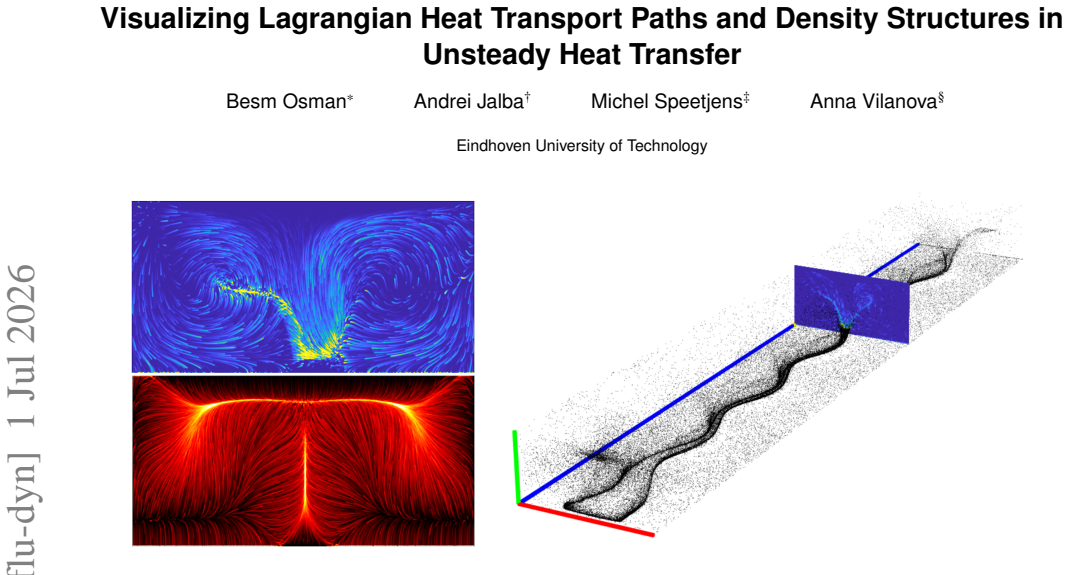
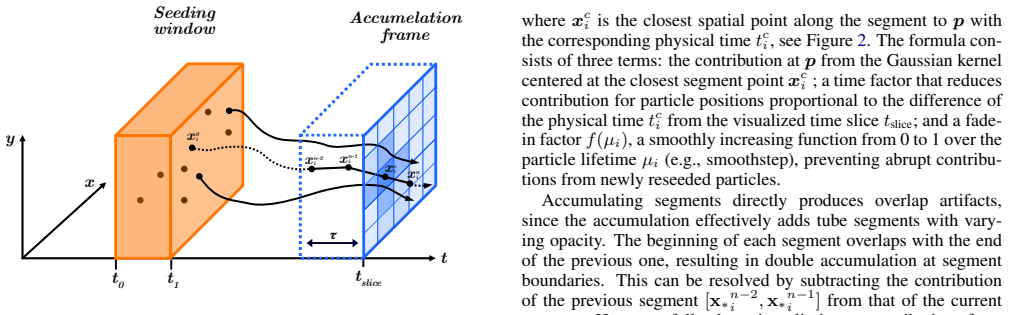
We present a particle-based visualization technique that addresses these challenges by advecting massless particles along a time-reparameterized spacetime formulation of thermal transport, accumulating path contributions to reveal coherent transport routes and finite-time attracting and repelling structures that conventional methods cannot show.
What carries the argument
Time-reparameterized spacetime formulation of thermal transport, which enables particle advection and path-contribution accumulation to expose coherent routes and structures.
If this is right
- Reveals coherent transport routes invisible from Eulerian temperature fields.
- Identifies finite-time attracting and repelling structures specific to heat transport.
- Handles aperiodic and non-conservative transport where traditional fluid-mixing techniques fail.
- Accumulates path contributions to display density structures along transport routes.
Where Pith is reading between the lines
- The same particle-advection approach could be tested on scalar transport problems such as species mixing or pollutant dispersion.
- Designers of heat-exchange equipment might use the extracted structures to locate and reinforce preferred heat pathways.
- Coupling the method to existing Lagrangian fluid tools could enable joint analysis of momentum and thermal coherent structures in a single framework.
Load-bearing premise
A time-reparameterized spacetime formulation of thermal transport can be used to advect massless particles in a manner that faithfully reveals physically meaningful coherent structures without introducing artifacts from the reparameterization or from the non-conservative nature of heat.
What would settle it
In a controlled unsteady convection benchmark, the accumulated particle paths and extracted structures do not match the actual heat-flux trajectories obtained by direct integration of the energy equation.
Figures
read the original abstract
Convective heat transfer is traditionally visualized from a Eulerian perspective using scalar temperature fields, offering limited insight into the underlying transport mechanisms. A Lagrangian view, analogous to mass transport along fluid paths, can reveal coherent structures and transport routes invisible from a Eulerian view of temperature. However, heat transport is aperiodic and non-conservative, hampering the application of fluid mixing and transport visualization techniques, developed primarily for time-periodic, conservative transport. We present a particle-based visualization technique that addresses these challenges by advecting massless particles along a time-reparameterized spacetime formulation of thermal transport, accumulating path contributions to reveal coherent transport routes and finite-time attracting and repelling structures that conventional methods cannot show.
Editorial analysis
A structured set of objections, weighed in public.
Referee Report
Summary. The manuscript presents a particle-based Lagrangian visualization method for convective heat transfer. Massless particles are advected in a time-reparameterized spacetime formulation of thermal transport; path contributions are accumulated to identify coherent transport routes and finite-time attracting/repelling structures in aperiodic, non-conservative heat flows that are invisible in conventional Eulerian temperature fields.
Significance. If the reparameterization and accumulation steps are shown to preserve the physics of the advection-diffusion equation without introducing artifacts, the technique would extend Lagrangian coherent structure analysis to thermal transport and supply a practical tool for inspecting unsteady heat paths in engineering and geophysical flows.
major comments (2)
- [§3.2, Eq. (7)] §3.2, Eq. (7): the time-reparameterization that converts the aperiodic heat equation into an autonomous spacetime flow is defined, but the manuscript does not derive or demonstrate that the resulting velocity field remains consistent with the original non-conservative advection-diffusion operator; without this step the claimed structures could be reparameterization artifacts.
- [§4.3 and §5.1] §4.3 and §5.1: validation consists of visual comparisons on two periodic test cases and one aperiodic DNS snapshot; no quantitative error norms against the heat equation, no sensitivity study on the reparameterization parameter, and no comparison with established Eulerian heat-flux diagnostics are reported, leaving the central claim that the structures are physically faithful untested.
minor comments (2)
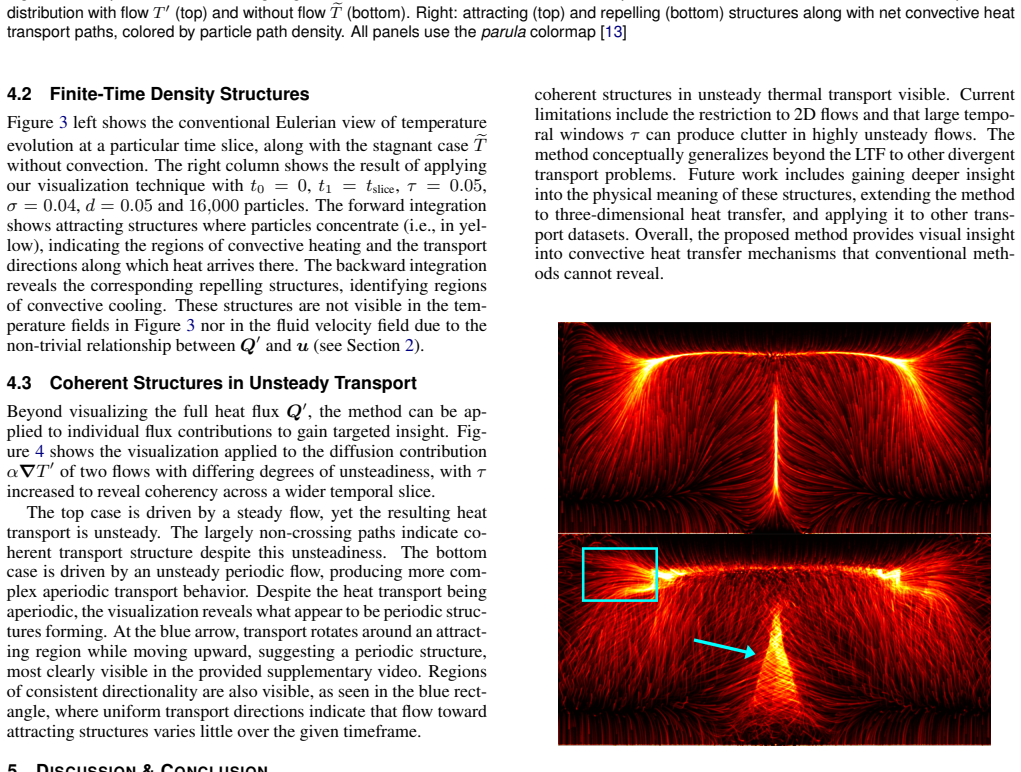
- [§3.4] Notation for the accumulated path density is introduced in §3.4 but never given an explicit integral definition or normalization; readers cannot reproduce the color maps in Figs. 4–6.
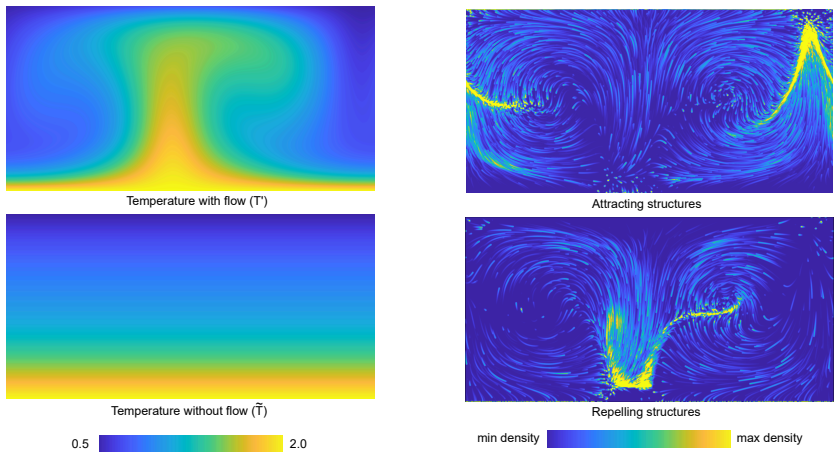
- [Figure 3] Figure 3 caption does not state the integration time or the value of the reparameterization constant used; this information is only recoverable from the supplementary movie.
Simulated Author's Rebuttal
We thank the referee for the constructive feedback on our manuscript. We address the two major comments below, clarifying the theoretical basis and outlining planned revisions to strengthen the validation.
read point-by-point responses
-
Referee: [§3.2, Eq. (7)] §3.2, Eq. (7): the time-reparameterization that converts the aperiodic heat equation into an autonomous spacetime flow is defined, but the manuscript does not derive or demonstrate that the resulting velocity field remains consistent with the original non-conservative advection-diffusion operator; without this step the claimed structures could be reparameterization artifacts.
Authors: The time-reparameterization is constructed so that the spacetime velocity field incorporates the advection-diffusion operator while converting the non-autonomous problem into an autonomous flow in the extended (space-time) domain; path accumulation then recovers integrated heat transport. We agree that an explicit derivation of consistency with the original operator would eliminate any ambiguity regarding artifacts. In the revised manuscript we will insert a short appendix deriving that the reparameterized trajectories satisfy the weak form of the heat equation and that the accumulated density fields converge to the Eulerian solution in the appropriate limit. revision: yes
-
Referee: [§4.3 and §5.1] §4.3 and §5.1: validation consists of visual comparisons on two periodic test cases and one aperiodic DNS snapshot; no quantitative error norms against the heat equation, no sensitivity study on the reparameterization parameter, and no comparison with established Eulerian heat-flux diagnostics are reported, leaving the central claim that the structures are physically faithful untested.
Authors: Visual identification of coherent structures is the established standard in the Lagrangian coherent structures literature precisely because pointwise error norms do not capture the topological fidelity of transport barriers. Nevertheless, we acknowledge that additional quantitative checks would increase confidence. In the revision we will add (i) a sensitivity analysis of the reparameterization parameter on one periodic case, (ii) an L2 comparison of the accumulated heat density against the Eulerian solution at selected times, and (iii) a side-by-side comparison of the identified attracting structures with the divergence of the Eulerian heat flux vector for the aperiodic DNS example. revision: partial
Circularity Check
No circularity: technique presented as independent construction
full rationale
The abstract and available text introduce a particle advection method on a time-reparameterized spacetime formulation of thermal transport without any equations, fitted parameters, or self-citations that reduce the claimed coherent structures or finite-time attracting/repelling features to definitions or prior fits. No load-bearing steps equate outputs to inputs by construction; the formulation is offered as a new construction to address aperiodicity and non-conservativeness in heat transport. This is the most common honest finding for a methods paper whose central claim rests on the independent validity of the reparameterized advection rather than on any internal reduction.
Axiom & Free-Parameter Ledger
axioms (1)
- standard math Fluid velocity fields and heat advection can be integrated numerically along particle trajectories.
Reference graph
Works this paper leans on
-
[1]
Bejan.Convection Heat Transfer
A. Bejan.Convection Heat Transfer. New York Academy of Sciences Series. John Wiley & Sons, Incorporated, Newark, 4th ed., 2013. 1
2013
-
[2]
Y .-C. Chen. A tutorial on kernel density estimation and recent ad- vances.Biostatistics & Epidemiology, 1(1):161–187, Jan. 2017. doi: 10.1080/24709360.2017.1396742 3
-
[3]
G. Haller. Lagrangian Coherent Structures.Annual Review of Fluid Mechanics, 47(V olume 47, 2015):137–162, Jan. 2015. doi: 10.1146/ annurev-fluid-010313-141322 1
2015
- [4]
-
[5]
F. P. Incropera, D. P. DeWitt, T. L. Bergman, and A. S. Lavine.Fun- damentals of Heat and Mass Transfer. Wiley, Hoboken, NJ, 6th ed.,
-
[6]
J. J. Monaghan. Smoothed particle hydrodynamics.Reports on Progress in Physics, 68(8):1703–1759, Aug. 2005. doi: 10.1088/0034 -4885/68/8/R01 3
-
[7]
B. Osman. FlowExplainer. https://github.com/besmosman/FlowExplainer,
-
[8]
S. W. Park, H. Yu, I. Hotz, O. Kreylos, L. Linsen, and B. Hamann. Structure-accentuating dense flow visualization. InProceedings of the Eighth Joint Eurographics / IEEE VGTC Conference on Visualization, EUROVIS’06, pp. 163–170. Eurographics Association, Goslar, DEU, May 2006. 1, 3
2006
-
[9]
M. Speetjens, G. Metcalfe, and M. Rudman. Lagrangian Transport and Chaotic Advection in Three-Dimensional Laminar Flows.Ap- plied Mechanics Reviews, 73(3):030801, May 2021. doi: 10.1115/1. 4050701 1
work page doi:10.1115/1 2021
-
[10]
M. F. M. Speetjens. A generalised Lagrangian formalism for thermal analysis of laminar convective heat transfer.International Journal of Thermal Sciences, 61:79–93, Nov. 2012. doi: 10.1016/j.ijthermalsci. 2012.06.009 1, 2, 3
-
[11]
M. F. M. Speetjens and A. A. van Steenhoven. Visualization of heat transfer in unsteady laminar flows.Computational Thermal Sci- ences: An International Journal, 3(1):31–47, 2011. doi: 10.1615/ ComputThermalScien.v3.i1.30 3
2011
-
[12]
Hot colormap array
The MathWorks Inc. Hot colormap array. https://www.mathworks.com/help/matlab/ref/hot.html, 2026. 4
2026
-
[13]
Parula colormap array
The MathWorks Inc. Parula colormap array. https://www.mathworks.com/help/matlab/ref/parula.html, 2026. 4
2026
-
[14]
J. J. van Wijk. Image based flow visualization.ACM Transactions on Graphics, 21(3):745–754, July 2002. doi: 10.1145/566654.566646 3
discussion (0)
Sign in with ORCID, Apple, or X to comment. Anyone can read and Pith papers without signing in.