REVIEW 4 major objections 6 minor 81 references
Magnetic Tunnel Junctions for Timekeeping in Intermittent Computing Systems
T0 review · 4 major / 6 minor · reviewed 2026-08-03 · deepseek-v4-flash
Pith's one-line read FLINT shows that batteryless devices can keep time during power failures by reading the predictable decay of deliberately unstable magnetic memory arrays, with an energy cost that does not grow with the interval measured.
desk verdict A genuinely new MTJ-based timekeeping idea with real device grounding, but the 12-hour/7-day and 'no added cost' claims are projections that outrun the evidence; worth refereeing, not accepting as-is. read the letter →
The pith
A machine-rendered reading of the paper's core claim, the machinery that carries it, and where it could break.
The reading
What carries the argument
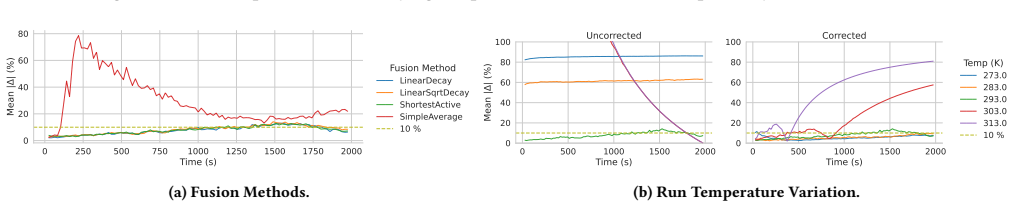
The central mechanism is the Néel-Arrhenius switching law for magnetic tunnel junctions: the mean dwell time τ in a magnetic state is τ = τ0 exp(Eb/kBT), where Eb is the energy barrier fixed by device geometry. An array of MTJs with near-normally distributed Eb, reset to one state, loses state exponentially over time, so the array's aggregate resistance changes smoothly. A single resistance measurement, inverted through a lookup table built by monotone interpolation of calibration data, gives the elapsed time. Multiple arrays with different Eb are fused by a weighted average that trusts each array only within its sensitive range, and temperature variation is corrected by scaling the estimate
What would settle it
Fabricate an MTJ array with a mean energy barrier around 30 kT, reset it to a known state, and measure the aggregate resistance after 12 hours and after 7 days; if the measured decay deviates from the simulation's prediction by more than 10%, the long-range extrapolation is refuted.
Extended reading notes
Core claim
We show that elapsed time during power outages can be recovered from the aggregate statistical decay of an array of MTJs engineered to have low thermal stability. The array is reset to a known state before shutdown; during the off-time each device stochastically flips between high- and low-resistance states according to its energy barrier, so the array's net resistance changes monotonically and reproducibly. On wake-up, one ADC resistance measurement is inverted through a precomputed monotone lookup table to yield the elapsed time. Because the dwell time is set by device geometry, not stored charge, the energy per measurement is independent of the interval and the behavior is unaffected by c
Load-bearing premise
The paper's long-range claims depend on the assumption that thermal switching measured on 21 devices at 10-second and 25-millisecond dwell times accurately predicts the aggregate decay of 16,384-junction arrays over 938 seconds, and that the same physics continues to hold at 28–34 kT energy barriers that were never fabricated or measured.
Editorial extensions
If this is right
- Timekeeping energy cost is decoupled from the measured interval: the same hardware serves seconds-to-days ranges without resizing or reconfiguring.
- Accuracy does not degrade over a multi-year deployment because there is no charge cycling, eliminating the dominant aging failure of capacitor clocks.
- Hour-to-day timekeeping becomes possible for battery-free sensors, a regime capacitor clocks cannot cover without prohibitive energy and area.
- Scheduling mistakes from timing bias drop by 16-52x over a one-year deployment compared to an aging capacitor clock.
- Because idle arrays draw no power and a single chip can host many arrays, applications can select their desired range at runtime from a 'one-size-fits-all' timekeeper.
Reading between the lines
- Editorial inference: A similar readout could be built from any bistable physical system with Poisson-distributed state transitions and tunable mean dwell time; MTJs are not the only possible implementation, but they benefit from existing fabrication infrastructure.
- Editorial inference: The approach effectively turns a random process into a deterministic clock, which may prove useful in other contexts where crystal oscillators cannot operate—such as extreme temperatures or high radiation.
- Editorial inference: The 12-hour and 7-day claims depend on Arrhenius scaling at energy barriers (28–34 kT) that were never fabricated; a direct test at those barriers would be the quickest way to confirm or refute the extrapolation.
- Editorial inference: One-time calibration requires sampling the full decay interval (up to ~1500 s), which may be costly in some deployments; a model-based calibration using measured Eb and TMR distributions could reduce this overhead.
Editorial analysis
A structured set of objections, weighed in public.
Referee Report
Summary. FLINT proposes a timekeeper for batteryless intermittent systems that measures power-off intervals from the stochastic retention loss of arrays of low-stability magnetic tunnel junctions (MTJs). The paper claims that, unlike capacitor-discharge clocks, the energy cost is independent of the measured interval, the accuracy is immune to charge-cycle aging, and the approach reaches 938 s of off-time within 10% geomean error at 1.03 µJ total energy, with extrapolation to 12 h and 7 d at about 2% error. Validation consists of 21 fabricated voltage-controlled MTJs, Monte Carlo array simulation anchored to those devices, Cadence/SPECTRE-based reset and measurement energy estimates, and a system-level comparison against capacitor-based timekeepers and four real energy-harvesting traces.
Significance. If the claims hold, FLINT would be a genuine contribution to intermittent-computing timekeeping: a physics-based primitive whose timescale is set by device geometry rather than stored charge, with an aging-immune, range-flexible architecture. The paper deserves credit for anchoring the device model in fabricated MTJ measurements (App. A), for providing a clear simulation methodology with explicit sensitivity analyses, and for quantifying capacitor aging as a failure mode (Sec. 5.4, Sec. 6.6). The core idea is novel and plausible. However, the central 'energy independent of range' claim is currently supported only for a single default Eb and is not validated for the higher-Eb arrays used in the long-duration case studies; the long-duration accuracy numbers are pure extrapolation. These gaps are load-bearing rather than cosmetic.
major comments (4)
- [§3.3, §6.4, Table 4] The 'no added cost for longer intervals' claim is not supported by the reported reset energy. Sec. 6.4 budgets reset at a single recipe (35 µA, 50 ns) for the default Eb≈23 kT device. Table 4 overrides Eb to 28–34 kT for D4/D5. For STT switching, critical current grows roughly linearly with Δ=Eb/kT, so the same 50 ns reset requires Ic scaling ~1.5× at 34 kT; E_reset=I²Rt then grows ~2.2×, making the four-array reset alone ≈1.03 µJ before the 560 nJ measurement/ADC/software cost. No reset characterization is reported for these Eb values, so 'extends to longer intervals at no added cost' (abstract, §3.3) is currently an extrapolation, not a result. Please either measure/derive Ic(Δ) and include the resulting energies in Table 6, or restate the cost-independence claim as fixed-array, fixed-range.
- [§6.4, §6.8] The energy budget omits high-voltage generation. With 64 series MTJs and R_AP=118.26 kΩ, forcing 35 µA through a row requires ≈265 V; even the P-state row is ≈118 V. The 1.03 µJ total uses only resistive dissipation in the MTJs (I²Rt). A practical on-chip boost converter from ~3.3 V to 265 V adds losses and area, and standard low-voltage NMOS reset transistors are not rated for this VDS. The paper's own limitation (§6.8) mentions high reset voltage, but Fig. 8 and the headline 1.03 µJ do not include this cost. Please quantify the converter/transistor overhead or explain the circuit that supplies 265 V within the claimed budget.
- [§5.2, §6.7, App. A] The array model is validated against 21 fabricated V-MTJs only at τ=10 s and τ=25 ms, over about 100 s of aggregate decay (Fig. 10). The headline 938 s/10% range and the 12 h/7 d results (Table 6) come from Monte Carlo simulations with Eb=28–34 kT, a regime not exercised by measurement. At 16,384 devices per array the iid Gaussian-Eb assumption could break via spatial correlations or tail behavior; the finite-sample floor in Fig. 10 already shows N-dependence. The long-duration accuracy figures should be labeled as extrapolations, and ideally supported by measurements at the actual Eb targets or by a sensitivity analysis to correlated variability.
- [§3.3 vs §6.4] There is a factor-of-9 inconsistency in the central energy number. §3.3 and Fig. 8 state FLINT pays 0.119 µJ 'at any range,' citing Sec. 6.4, but Sec. 6.4 computes 1.03 µJ for the four-array configuration. The 0.119 µJ equals the reset energy of a single array only. The 850× comparison to capacitor clocks should use the full 1.03 µJ system energy, or the per-array number should be explicitly qualified. Please reconcile the figures and text.
minor comments (6)
- [§6.4, §4.1, Conclusion] The reset pulse length is given as 50 ns in §4.1 and §6.4, but the shutdown time overhead and Conclusion state '50 µs'. Please correct the inconsistent factor of 1000.
- [Table 2, §5.3] Table 2 reports FLINT range as 273.6 s, while the default four-array configuration in Sec. 5.2/6.3 reaches 938 s. Add a footnote clarifying that Table 2 uses a different configuration (1024-entry LUT, three arrays) than the default.
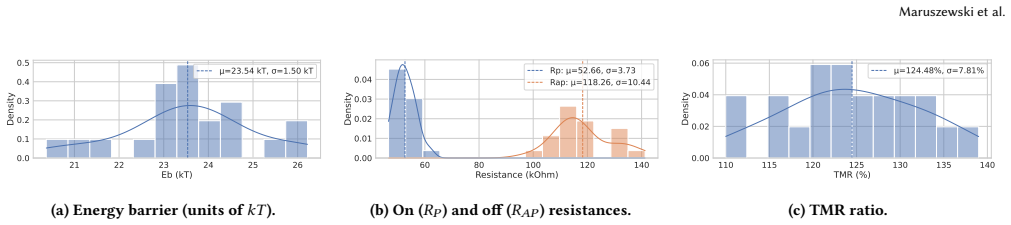
- [App. A, Fig. A1] Fig. A1 reports a mean dwell time of 44.0 s with std 71.4 s for a target of 10 s, while Fig. 11a reports mean Eb=23.5 kT. The relation between these summary statistics is not explained; please clarify the attempt frequency τ0 and why the mean dwell time differs from the target by 4.4×.
- [Eq. (3)] The notation bE_b is not defined. State that it is the dimensionless energy barrier in units of kT and clarify that it is the design value, not the measured per-device value.
- [Fig. 8] Caption says 'FLINT (flat, 0.119 J)' — likely a missing micro sign (µJ); also unify with the 1.03 µJ system total.
- [§6.7] Typo: 'respecitvely' in the paragraph after Table 6.
Circularity Check
No significant circularity: the central derivation is anchored to fabricated MTJ measurements and external physics; the 12h/7d extrapolations raise validity concerns, not circularity.
full rationale
The derivation chain is self-contained. The array model is anchored to 21 fabricated MTJs (Sec. 5.1, App. A, Fig. 10), which is an external benchmark: those measured devices supply the Eb, RP, and TMR distributions used in the Monte Carlo simulation. The calibration LUT is built from time-labeled decay samples (Alg. 1), and the headline 938 s / 10% error is a stochastic simulation result against that calibration, not a quantity encoded in the fit. Fusion constants G=1.25 and C=2 are heuristics with physical rationale (validity up to ~2× dwell time), not parameters fit to the error/range target. Aging immunity rests on external endurance literature [5,19] plus the geometric definition of Eb; the one self-citation [8] supplies measured device data, which is real, externally falsifiable evidence rather than an unverified premise. The 12 h and 7 d results are extrapolations of the validated Néel-Arrhenius model via Eb overrides; whether reset energy actually stays flat as Eb increases is a physical correctness/validity concern, not a circularity, because the paper never defines the energy-independence claim in terms of the simulated error result.
Assumptions & free parameters
free parameters (4)
- Energy barriers Eb of default multi-array configuration =
23/24/25/26 kT (τ = 9.74/26.5/72.0/196 s); D4: 28–31 kT; D5: 31–34 kT
- Fusion hyperparameters G and C =
G = 1.25, C = 2
- Reset pulse parameters =
50 ns, 35 µA
- Capacitor aging rate α =
0.20/yr and 0.50/yr
assumptions (7)
- standard math Néel-Arrhenius switching τ = τ0 exp(Eb/kT) governs each MTJ with a constant attempt frequency τ0
- domain assumption Devices within an array switch independently and have normally distributed Eb (σ = 6.3%)
- domain assumption Thermal fluctuation is the only state-change mechanism during off-time; no applied current, voltage, or magnetic field perturbs the array
- domain assumption MTJ energy barrier does not drift over a one-year deployment despite reset/measure cycling
- domain assumption V-MTJ characterization with voltage-tuned Eb faithfully represents the STT-MTJ devices used in the FLINT system
- ad hoc to paper The 21-device measured parameter distributions extrapolate to 16,384-device arrays and to Eb = 28–34 kT
- domain assumption Capacitor degradation is linear: C(d) = C0(1 − αd/365)
Cite this review
Pith. "Pith review of Magnetic Tunnel Junctions for Timekeeping in Intermittent Computing Systems." pith.science (2026). https://pith.science/paper/UCCXETYE
@misc{pith2026260723000,
  author       = {Pith},
  title        = {Pith review of: Magnetic Tunnel Junctions for Timekeeping in Intermittent Computing Systems},
  year         = {2026},
  howpublished = {\url{https://pith.science/paper/UCCXETYE}},
  note         = {Machine review of arXiv:2607.23000}
}
abstract
Batteryless intermittent systems run unattended for years, but power failures erase timekeeping state, corrupting sensing, scheduling, and coordination. State-of-the-art timekeepers infer elapsed time from capacitor discharge; however, the capacitor must be sized for the longest interval measured (so range, energy, and area grow together), and repeated charge-discharge cycling lowers capacitance over time, biasing every estimate further as the deployment ages. We present FLINT, a timekeeper that reads elapsed time from the stochastic retention loss of an array of "broken" Magnetic Tunnel Junctions (MTJs)---spintronic memory cells engineered to lose state predictably. Because the decay timescale is fixed by device geometry, the energy to read it is independent of the interval measured and does not drift with device age. We validate FLINT's array model against 21 fabricated MTJs, then evaluate the full timekeeper in real-device-trace-driven simulation, showing that it tracks over 15 minutes of off-time within 10% error while consuming only 1.03 $\mu J$ and occupying under 0.1 $mm^2$---$9.2\times$ the range at $11\times$ lower energy than prior work. It extends to longer intervals at no added cost, and makes $16-52\times$ fewer scheduling errors than an aging capacitor clock over a one-year deployment.
Figures


Figures from the paper (17 more)






Reference graph
Works this paper leans on
-
[1]
Mikhail Afanasov et al. 2020. Battery-less zero-maintenance embedded sensing at the mithræum of circus maximus. InProceedings of the 18th Conference on Embedded Networked Sensor Systems, 368–381
2020
-
[2]
Saad Ahmed, Naveed Anwar Bhatti, Muhammad Hamad Alizai, Junaid Ha- roon Siddiqui, and Luca Mottola. 2019. Efficient intermittent computing with differential checkpointing. InProceedings of the 20th ACM SIGPLAN/SIGBED In- ternational Conference on Languages, Compilers, and Tools for Embedded Systems, 70–81
2019
-
[3]
Arwa Alsubhi, Nicole Tobias, Simeon Babatunde, and Jacob Sorber. 2020. Can crystal oscillators keep time without power? InProceedings of the 8th Inter- national Workshop on Energy Harvesting and Energy-Neutral Sensing Systems, 84–85. Maruszewski et al
2020
-
[4]
Ambiq Micro, Inc. 2022. Artasie am18x5 real-time clock datasheet. https://amb iq.com/wp-content/uploads/2020/10/Artasie-AM18X5-RTC-Datasheet.pdf. Accessed: 2026-04-01. (2022)
2022
-
[5]
Dmytro Apalkov, Bernard Dieny, and Jon M Slaughter. 2016. Magnetoresistive random access memory.Proceedings of the IEEE, 104, 10, 1796–1830
2016
-
[6]
ARM. 2013. Cortex-A15 MPCore Processor Technical Reference Manual r4p0. ARM Developer. (June 24, 2013). Retrieved Apr. 15, 2026 from https://develope r.arm.com/documentation/ddi0438/i/?lang=en
2013
-
[7]
Alberto Rodriguez Arreola, Theodoros D Verykios, Marco A Gurrola Navarro, and Carlos F Calvillo Cortes. 2022. Federated time persistency in intermittently powered iot systems.Journal of Systems Architecture, 130, 102667
2022
-
[8]
Jordan Athas, Christian Duffee, Thomas Neuner, Noraica Davila Melendez, Jordan A Katine, and Pedram Khalili Amiri. 2025. Statistical study of large voltage-controlled magnetic anisotropy in 3x-nm perpendicular magnetic tun- nel junctions.IEEE Electron Device Letters
2025
Show all 81 references
-
[9]
Abu Bakar, Rishabh Goel, Jasper de Winkel, Jason Huang, Saad Ahmed, Bashima Islam, Przemysław Pawełczak, Kasım Sinan Yıldırım, and Josiah Hester. 2022. Protean: an energy-efficient and heterogeneous platform for adaptive and hardware-accelerated battery-free computing. InProce...
2022
-
[10]
Domenico Balsamo, Alex S Weddell, Anup Das, Alberto Rodriguez Arreola, Davide Brunelli, Bashir M Al-Hashimi, Geoff V Merrett, and Luca Benini. 2016. Hibernus++: a self-calibrating and adaptive system for transiently-powered embedded devices.IEEE Transactions on Computer-Aided ...
2016
-
[11]
William A Borders, Ahmed Z Pervaiz, Shunsuke Fukami, Kerem Y Camsari, Hideo Ohno, and Supriyo Datta. 2019. Integer factorization using stochastic magnetic tunnel junctions.Nature, 573, 7774, 390–393
2019
-
[12]
Adriano Branco, Luca Mottola, Muhammad Hamad Alizai, and Junaid Haroon Siddiqui. 2019. Intermittent asynchronous peripheral operations. InProceedings of the 17th Conference on Embedded Networked Sensor Systems, 55–67
2019
-
[13]
Kerem Yunus Camsari, Rafatul Faria, Brian M Sutton, and Supriyo Datta. 2017. Stochastic p-bits for invertible logic.Physical Review X, 7, 3, 031014
2017
-
[14]
Nilotpal Chakravarti. 1989. Isotonic Median Regression: A Linear Programming Approach.Mathematics of Operations Research, 14, 2, (May 1989), 303–308. doi:1 0.1287/moor.14.2.303
1989
-
[15]
Zhuo Cheng, Bradley Denby, Kyle McCleary, and Brandon Lucia. 2024. Ea- gleeye: nanosatellite constellation design for high-coverage, high-resolution sensing. InProceedings of the 29th ACM International Conference on Architec- tural Support for Programming Languages and Operati...
2024
-
[16]
Jongouk Choi, Hyunwoo Joe, and Changhee Jung. 2022. Capos: capacitor error resilience for energy harvesting systems.IEEE Transactions on Computer-Aided Design of Integrated Circuits and Systems, 41, 11, 4539–4550
2022
-
[17]
Alexander Curtiss et al. 2021. Facebit: smart face masks platform.Proceedings of the ACM on Interactive, Mobile, Wearable and Ubiquitous Technologies, 5, 4, 1–44
2021
-
[18]
Jasper De Winkel, Vito Kortbeek, Josiah Hester, and Przemysław Pawełczak
-
[19]
Alina M Deac et al. 2008. Bias-driven high-power microwave emission from mgo-based tunnel magnetoresistance devices.Nature Physics, 4, 10, 803–809
2008
-
[20]
Vishal Deep, Vishak Narayanan, Mathew Wymore, Daji Qiao, and Henry Duwe
-
[21]
Jan de Leeuw. 1977. Correctness of Kruskal’s algorithms for monotone regres- sion with ties.Psychometrika, 42, 1, (Mar. 1, 1977), 141–144. doi:10.1007/BF0229 3750
1977 doi
-
[22]
In2020 IEEE Real-Time Systems Symposium (RTSS)
HARC: A Heterogeneous Array of Redundant Persistent Clocks for Batteryless, Intermittently-Powered Systems. In2020 IEEE Real-Time Systems Symposium (RTSS). 2020 IEEE Real-Time Systems Symposium (RTSS). (Dec. 2020), 270–282. doi:10.1109/RTSS49844.2020.00033
2020
-
[23]
Jasper de Winkel, Carlo Delle Donne, Kasim Sinan Yildirim, Przemysław Pawełczak, and Josiah Hester. 2020. Reliable Timekeeping for Intermittent Computing. InProceedings of the Twenty-Fifth International Conference on Ar- chitectural Support for Programming Languages and Operat...
2020
-
[24]
Harsh Desai, Matteo Nardello, Davide Brunelli, and Brandon Lucia. 2022. Ca- maroptera: a long-range image sensor with local inference for remote sensing applications.ACM Transactions on Embedded Computing Systems (TECS)
2022
-
[25]
Christian Duffee, Jordan Athas, Andrea Grimaldi, Deborah Volpe, Giovanni Finocchio, Ermin Wei, and Pedram Khalili Amiri. 2025. P-dits: probabilistic d-dimensional bits for extended-variable probabilistic computing.Physical Review Applied, 24, 4, 044077
2025
-
[26]
Maria Doglioni, Eren Yildiz, Matteo Nardello, Khakim Akhunov, Kasim Sinan Yildirim, and Davide Brunelli. 2025. Capdyn: adaptive self-scaling energy stor- age for powering batteryless iot.ACM Transactions on Embedded Computing Systems, 24, 5, 1–32
2025
-
[27]
Christian Duffee, Jordan Athas, Yixin Shao, Noraica Davila Melendez, Eleonora Raimondo, Jordan A Katine, Kerem Y Camsari, Giovanni Finocchio, and Pedram Khalili Amiri. 2025. An integrated-circuit-based probabilistic computer that uses voltage-controlled magnetic tunnel junctio...
2025
-
[28]
Christian Duffee, Jordan Athas, Igor Kadota, Randall Berry, and Pedram Khalili Amiri. 2026. P-dits for the frequency assignment problem with transmitter deactivation in dense environments.IEEE Journal on Exploratory Solid-State Computational Devices and Circuits
2026
-
[29]
Ferhat Erata, Eren Yildiz, Arda Goknil, Kasim Sinan Yildirim, Jakub Szefer, Ruzica Piskac, and Gokcin Sezgin. 2023. Etap: energy-aware timing analysis of intermittent programs.ACM Transactions on Embedded Computing Systems, 22, 2, 1–31
2023
-
[30]
Christian Duffee, Chadbourne M Burling-Smith, Jordan Athas, Andrea Grimaldi, Giovanni Finocchio, Ermin Wei, and Pedram Khalili Amiri. 2026. P-dit prob- abilistic ising machine for solving the quadratic assignment problem.arXiv preprint arXiv:2605.24408
2026 arXiv
-
[31]
F. N. Fritsch and J. Butland. 1984. A Method for Constructing Local Mono- tone Piecewise Cubic Interpolants.SIAM Journal on Scientific and Statistical Computing, 5, 2, (June 1984), 300–304. doi:10.1137/0905021
1984 doi
-
[32]
Espressif Systems. 2025. ESP32-WROOM-32 Datasheet. Datasheet v3.6. Espres- sif Systems, (Aug. 8, 2025). https://documentation.espressif.com/esp32-wroom -32_datasheet_en.pdf
2025
-
[33]
Fernando García-Redondo, Pranay Prabhat, Mudit Bhargava, and Cyrille Dray
-
[34]
Fernando García-Redondo, Pranay Prabhat, and Mudit Bhargava. 2021. A Fokker-Planck Solver to Model MTJ Stochasticity. (June 23, 2021). arXiv: 2 106.12304 [cs]. Retrieved Oct. 2, 2025 from http://arxiv.org/abs/2106.12304. Pre-published
2021 arXiv
-
[35]
Kai Geissdoerfer and Marco Zimmerling. 2022. Learning to communicate effec- tively between battery-free devices. In19th USENIX Symposium on Networked Systems Design and Implementation (NSDI 22), 419–435
2022
-
[36]
Kai Geissdoerfer and Marco Zimmerling. 2024. Riotee: an open-source hardware and software platform for the battery-free internet of things. InProceedings of the 22nd ACM Conference on Embedded Networked Sensor Systems, 198–210
2024
-
[37]
Kai Geissdoerfer and Marco Zimmerling. 2021. Bootstrapping battery-free wireless networks: efficient neighbor discovery and synchronization in the face of intermittency. In18th USENIX Symposium on Networked Systems Design and Implementation (NSDI 21), 439–455
2021
-
[38]
Josiah Hester, Kevin Storer, and Jacob Sorber. 2017. Timely execution on inter- mittently powered batteryless sensors. InProceedings of the 15th ACM Confer- ence on Embedded Network Sensor Systems, 1–13
2017
-
[39]
Josiah Hester, Nicole Tobias, Amir Rahmati, Lanny Sitanayah, Daniel Holcomb, Kevin Fu, Wayne P Burleson, and Jacob Sorber. 2016. Persistent clocks for batteryless sensing devices.ACM Transactions on Embedded Computing Systems (TECS), 15, 4, 1–28
2016
-
[40]
Josiah Hester, Kevin Storer, and Jacob Sorber. 2017. Timely Execution on Intermittently Powered Batteryless Sensors. InProceedings of the 15th ACM Conference on Embedded Network Sensor Systems(SenSys ’17). Association for Computing Machinery, New York, NY, USA, (Nov. 6, 2017),...
2017
-
[41]
Sumio Ikegawa, Frederick B Mancoff, and Sanjeev Aggarwal. 2021. Commercial- ization of mram–historical and future perspective. In2021 IEEE International Interconnect Technology Conference (IITC). IEEE, 1–3
2021
-
[42]
Bashima Islam and Shahriar Nirjon. 2020. Scheduling computational and energy harvesting tasks in deadline-aware intermittent systems. In2020 IEEE Real-Time and Embedded Technology and Applications Symposium (RTAS). IEEE, 95–109
2020
-
[43]
Burleson, and Jacob Sorber
Josiah Hester, Nicole Tobias, Amir Rahmati, Lanny Sitanayah, Daniel Holcomb, Kevin Fu, Wayne P. Burleson, and Jacob Sorber. 2016. Persistent Clocks for Batteryless Sensing Devices.ACM Trans. Embed. Comput. Syst., 15, 4, (Aug. 2, 2016), 77:1–77:28. doi:10.1145/2903140
2016 doi
-
[44]
Philo Juang, Hidekazu Oki, Yong Wang, Margaret Martonosi, Li-Shiuan Peh, and Daniel Rubenstein. 2002. Energy-efficient computing for wildlife tracking: design tradeoffs and early experiences with ZebraNet. InProceedings of the 10th International Conference on Architectural Sup...
2002
-
[45]
Doo Hyung Kang and Mincheol Shin. 2021. Critical switching current density of magnetic tunnel junction with shape perpendicular magnetic anisotropy through the combination of spin-transfer and spin-orbit torques.Scientific Reports, 11, 1, (Nov. 24, 2021), 22842. doi:10.1038/s4...
2021 doi
-
[46]
Bashima Islam and Shahriar Nirjon. 2019. Zygarde: time-sensitive on-device deep inference and adaptation on intermittently-powered systems.arXiv preprint arXiv:1905.03854
2019 arXiv
-
[47]
Jan de Leeuw, Kurt Hornik, and Patrick Mair. 2010. Isotone Optimization in R: Pool-Adjacent-Violators Algorithm (PAVA) and Active Set Methods.Journal of Statistical Software, 32, 1–24. doi:10.18637/jss.v032.i05
2010 doi
-
[48]
Xiang Li et al. 2015. Thermally stable voltage-controlled perpendicular mag- netic anisotropy in mo| cofeb| mgo structures.Applied Physics Letters, 107, 14
2015
-
[49]
Vito Kortbeek, Kasim Sinan Yildirim, Abu Bakar, Jacob Sorber, Josiah Hester, and Przemysław Pawełczak. 2020. Time-sensitive intermittent computing meets legacy software. InProceedings of the Twenty-Fifth International Conference Magnetic Tunnel Junctions for Timekeeping in Int...
2020
-
[50]
Yunwen Liu and Jiang Xiao. 2025. Application of probabilistic bits in measure- ment and sensing.Applied Physics Letters, 126, 12
2025
-
[51]
LLVM Project. 2026. Llvm-mca - LLVM Machine Code Analyzer — LLVM 23.0.0git documentation. LLVM Compiler Infrastructure. (Apr. 14, 2026). Re- trieved Apr. 14, 2026 from https://llvm.org/docs/CommandGuide/llvm-mca.ht ml
2026
-
[52]
Yunwen Liu and Jiang Xiao. 2025. Application of probabilistic bits in mea- surement and sensing.Applied Physics Letters, 126, 12, (Mar. 25, 2025), 122403. doi:10.1063/5.0253449
2025 doi
-
[53]
Kiwan Maeng and Brandon Lucia. 2020. Adaptive low-overhead scheduling for periodic and reactive intermittent execution. InProceedings of the 41st ACM SIGPLAN Conference on Programming Language Design and Implementation, 1005–1021
2020
-
[54]
Matthew J Marinella. 2021. Radiation effects in advanced and emerging non- volatile memories.IEEE Transactions on Nuclear Science, 68, 5, 546–572
2021
-
[55]
Kiwan Maeng, Alexei Colin, and Brandon Lucia. 2017. Alpaca: intermittent exe- cution without checkpoints.Proceedings of the ACM on Programming Languages, 1, OOPSLA, 1–30
2017
-
[56]
Rohan Menon, Rohit Gujarathi, Ali Saffari, and Joshua R Smith. 2022. Wireless identification and sensing platform version 6.0. InProceedings of the 20th ACM Conference on Embedded Networked Sensor Systems, 899–905
2022
-
[57]
Sébastien Mercier, Stéphane Villeneuve, Martin Mondor, and Ismail Uysal
-
[58]
Ellwood, and David W
Andrew Markham, Niki Trigoni, Stephen A. Ellwood, and David W. Macdon- ald. 2010. Revealing the hidden lives of underground animals using magneto- inductive tracking. InProceedings of the 8th ACM Conference on Embedded Networked Sensor Systems(SenSys ’10). Association for Comp...
2010
-
[59]
Benjamin Ransford, Jacob Sorber, and Kevin Fu. 2011. Mementos: system sup- port for long-running computation on rfid-scale devices. InProceedings of the sixteenth international conference on Architectural support for programming languages and operating systems, 159–170
2011
-
[60]
Yixin Shao, Christian Duffee, Eleonora Raimondo, Noraica Davila, Victor Lopez- Dominguez, Jordan A Katine, Giovanni Finocchio, and Pedram Khalili Amiri
-
[61]
Nihal Sanjay Singh et al. 2024. Cmos plus stochastic nanomagnets enabling heterogeneous computers for probabilistic inference and learning.Nature Com- munications, 15, 1, 2685
2024
-
[62]
Cleve B. Moler. 2004. 3. Interpolation. InNumerical Computing with Matlab. Other Titles in Applied Mathematics. Society for Industrial and Applied Math- ematics, (Jan. 2004), 93–116.isbn: 978-0-89871-660-3. doi:10.1137/1.9780898717 952.ch3
2004 doi
-
[63]
Texas Instruments. 2018. MSP430FR596x, MSP430FR594x Mixed-Signal Micro- controllers. Datasheet SLAS704G. Texas Instruments, Dallas, Texas, U.S., (Aug. 2018). https://www.ti.com/lit/ds/symlink/msp430fr5969.pdf
2018
-
[64]
2015.An Instruction Level Energy Characterization of ARM Processors
Evangelos Vasilakis. 2015.An Instruction Level Energy Characterization of ARM Processors. Technical Report. University of Crete, Foundation of Research and Technology Hellas, (Mar. 2015). Retrieved Apr. 14, 2026 from https://projects.ic s.forth.gr/carv/greenvm/files/tr450.pdf
2015
-
[65]
KL Wang, JG Alzate, and P Khalili Amiri. 2013. Low-power non-volatile spin- tronic memory: stt-ram and beyond.Journal of Physics D: Applied Physics, 46, 7, 074003
2013
-
[66]
Harrison Williams and Matthew Hicks. 2024. Energy-adaptive buffering for efficient, responsive, and persistent batteryless systems. InProceedings of the 29th ACM International Conference on Architectural Support for Programming Languages and Operating Systems, Volume 3, 268–282
2024
-
[67]
Robert Szewczyk, Alan Mainwaring, Joseph Polastre, John Anderson, and David Culler. 2004. An analysis of a large scale habitat monitoring application. In Proceedings of the 2nd International Conference on Embedded Networked Sensor Systems (SenSys), 214–226
2004
-
[68]
Eren Yildiz, Khakim Akhunov, Lorenzo Antonio Riva, Arda Goknil, Ivan Kurtev, and Kasim Sinan Yildirim. 2024. Adaptable runtime monitoring for intermittent systems. InProceedings of the Nineteenth European Conference on Computer Systems, 1175–1191
2024
-
[69]
Eren Yildiz, Davide Cavedon, Stefano Antonio Putelli, Josiah Hester, and Kasim Sinan Yildirim. 2026. Bionic: a co-designed hardware and runtime for time- sensitive battery-free iot. InProceedings of the 24th Annual International Con- ference on Mobile Systems, Applications and...
2026
-
[70]
Eren Yildiz, Davide Cavedon, and Kasim Sinan Yildirim. 2024. On Tracking Time with Better Resolution and Range in Batteryless Systems. InProceedings of the 12th International Workshop on Energy Harvesting and Energy-Neutral Sensing Systems(ENSsys ’24). Association for Computin...
2024
-
[71]
Kasım Sinan Yıldırım, Amjad Yousef Majid, Dimitris Patoukas, Koen Schaper, Przemyslaw Pawelczak, and Josiah Hester. 2018. Ink: reactive kernel for tiny batteryless sensors. InProceedings of the 16th ACM Conference on Embedded Networked Sensor Systems, 41–53
2018
-
[72]
Eren Yildiz, Saad Ahmed, Bashima Islam, Josiah Hester, and Kasim Sinan Yildirim. 2023. Efficient and safe i/o operations for intermittent systems. In Proceedings of the Eighteenth European Conference on Computer Systems, 63–78
2023
-
[73]
Eren Yıldız and Kasım Sinan Yıldırım. 2021. Persistent timekeeping using harvested power measurements. InProceedings of the 19th ACM Conference on Embedded Networked Sensor Systems, 572–574
2021
-
[74]
Wenzhe Zhang, Qiang Hao, and Gang Xiao. 2011. Low-frequency noise in serial arrays of mgo-based magnetic tunnel junctions.Physical Review B—Condensed Matter and Materials Physics, 84, 9, 094446
2011
-
[75]
Chen Zhao, Yen-Ting Wang, David Genzer, Degang Chen, and Randall Geiger
-
[77]
Eren Yıldız, Lijun Chen, and Kasim Sinan Yıldırım. 2022. Immortal threads: multithreaded event-driven intermittent computing on {ultra-low-power} microcontrollers. In16th USENIX Symposium on Operating Systems Design and Implementation (OSDI 22), 339–355
2022
-
[2013]
In2013 IEEE International Symposium on Circuits and Systems (ISCAS)
A CMOS on-chip temperature sensor with -0.21°C 0.17°C inaccuracy from -20°C to 100°C. In2013 IEEE International Symposium on Circuits and Systems (ISCAS). 2013 IEEE International Symposium on Circuits and Systems (ISCAS). (May 2013), 2621–2625. doi:10.1109/ISCAS.2013.6572416. ...
2013
-
[2017]
Time–temperature management along the food cold chain: a review of recent developments.Comprehensive Reviews in Food Science and Food Safety, 16, 4, 647–667
-
[2020]
Battery-free game boy.Proceedings of the ACM on Interactive, Mobile, Wearable and Ubiquitous Technologies, 4, 3, 1–34
-
[2021]
(June 9, 2021)
A Compact Model for Scalable MTJ Simulation. (June 9, 2021). arXiv: 2106.04976 [cs]. Retrieved Oct. 2, 2025 from http://arxiv.org/abs/2106.04976. Pre-published
2021 arXiv
-
[2023]
Probabilistic computing with voltage-controlled dynamics in magnetic tunnel junctions.Nanotechnology, 34, 49, 495203
Reviewed August 3, 2026 · model on record in the stance chip above.
Discussion (0). Continue with ORCID to comment.