A Stateful Stochastic Allocation Mechanism with Fairness Guarantees for Networked Electricity Systems
Pith reviewed 2026-06-27 02:49 UTC · model grok-4.3
The pith
The FP-AMM ensures per-node delivery ratios converge almost surely to contracted fairness targets F^* with O(1/sqrt(T)) bounds.
A machine-rendered reading of the paper's core claim, the machinery that carries it, and where it could break.
Core claim
The Fair Play Automatic Market Maker employs a two-stage stochastic clearing rule with service-priority sampling and inverse-fairness weighting, coupled with a DC-OPF feasibility set and a saturated integrator for shortage memory. Under the Fair Play priority rule, the per-node delivery ratio converges almost surely to the contracted target F^*, with a finite-time O(1/sqrt(T)) bound obtained via Lyapunov analysis of the deficit recursion. The shortage-memory state is invariant in [0,1]^N with contraction rate 1-β, and the intra-interval clearing operator converges linearly to a unique fixed point.
What carries the argument
The deficit recursion updated by a saturated integrator under the Fair Play priority rule, analyzed via Lyapunov methods to establish almost-sure convergence.
If this is right
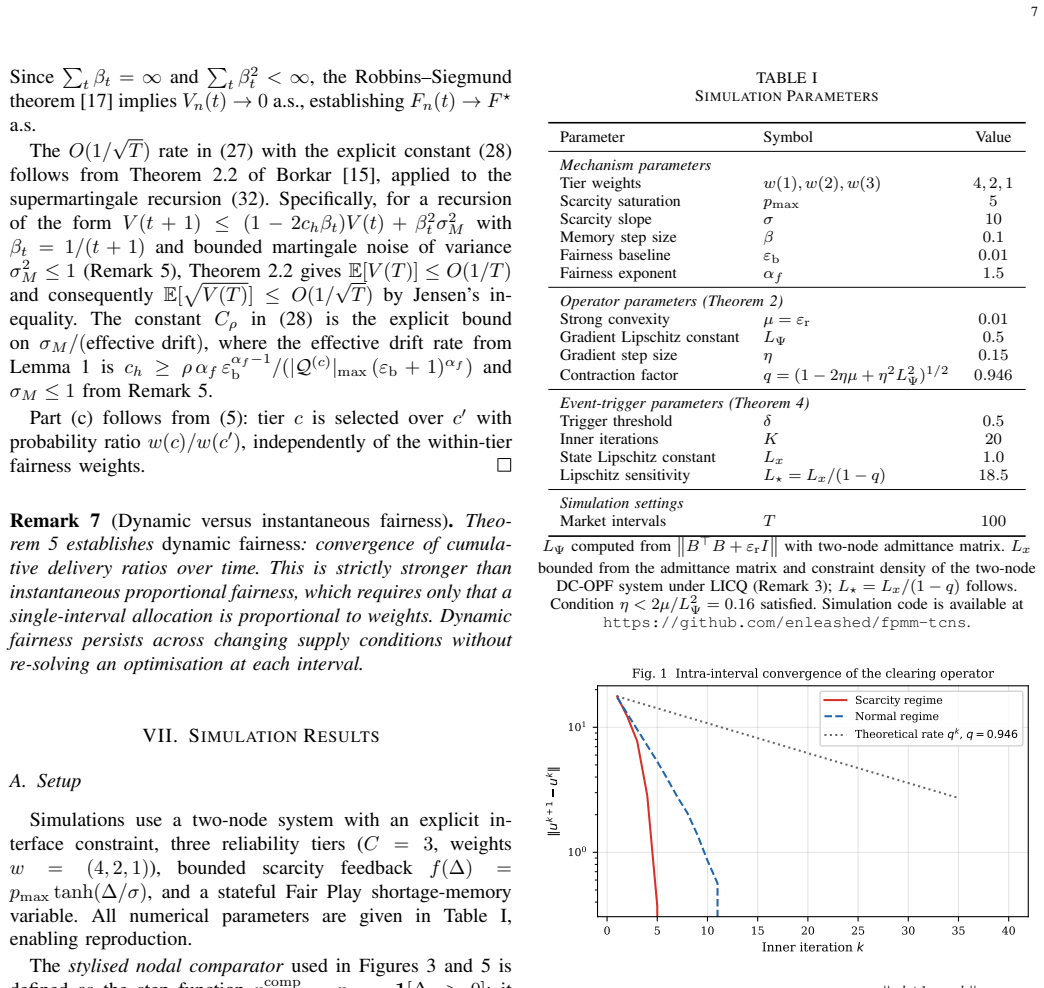
- The intra-interval clearing operator converges linearly to a unique fixed point with contraction factor q in (0,1).
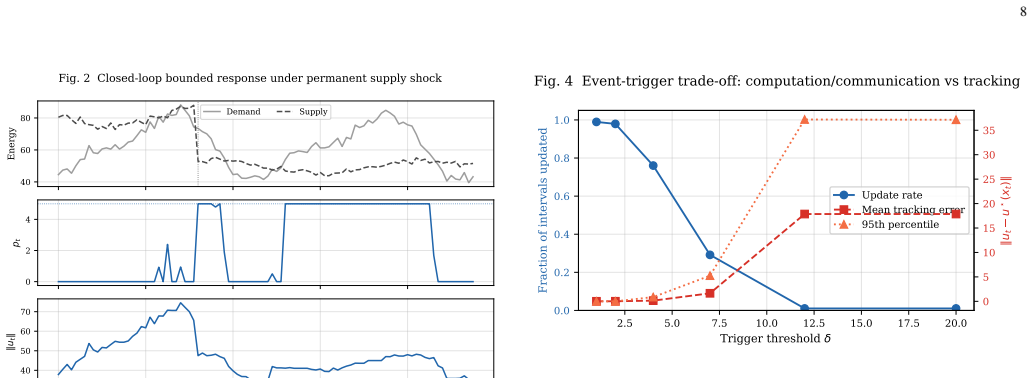
- The shortage-memory state is invariant in [0,1]^N and the update map is a contraction with rate 1-β.
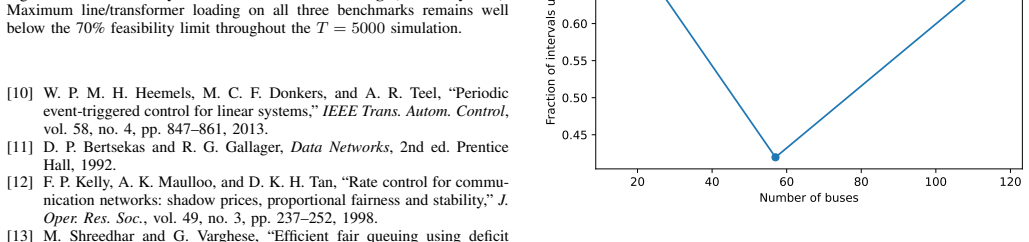
- Event-triggered execution guarantees practical ultimate boundedness of the allocation tracking error.
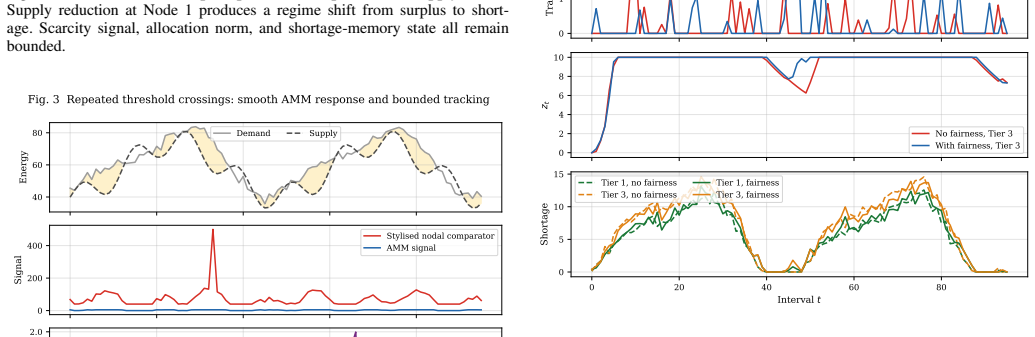
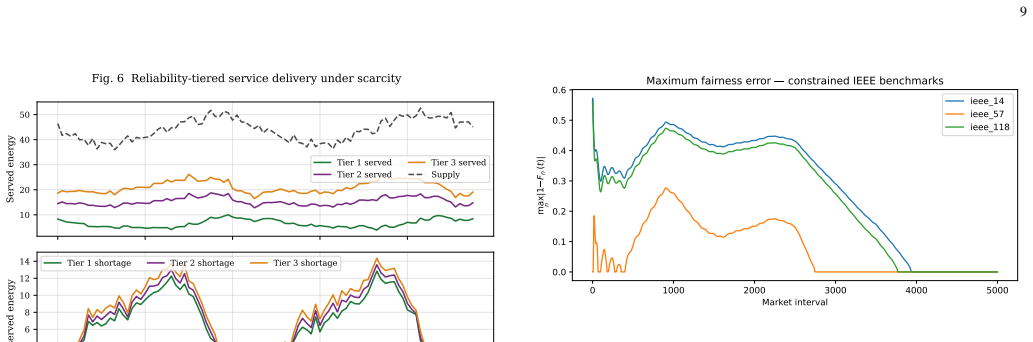
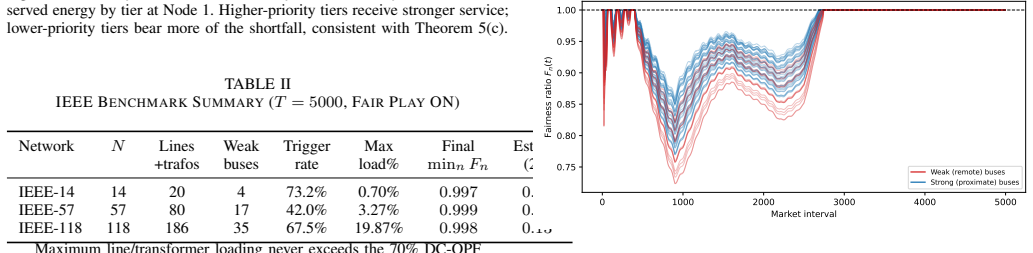
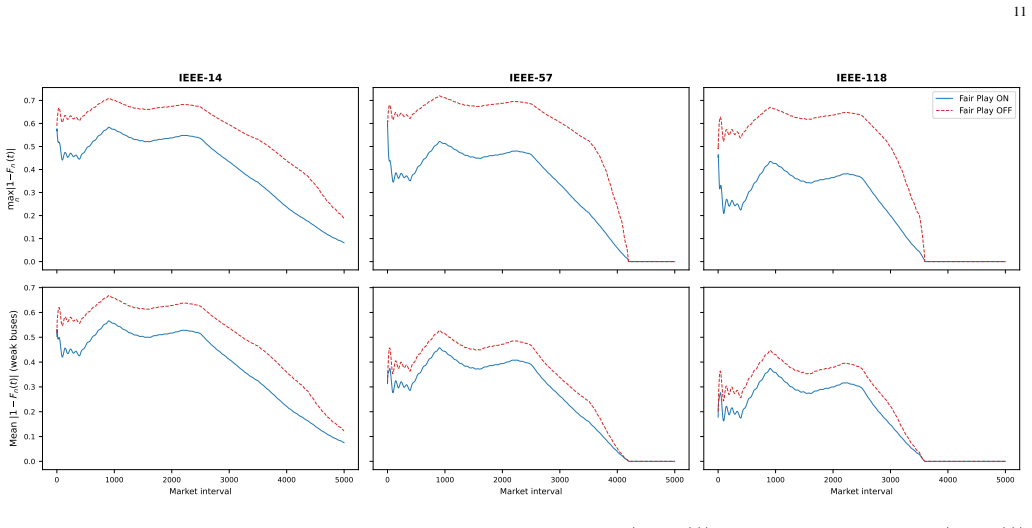
- Fairness convergence to F^* is achieved on all IEEE benchmark networks with peak weak-bus fairness error reduced by up to 55% during scarcity.
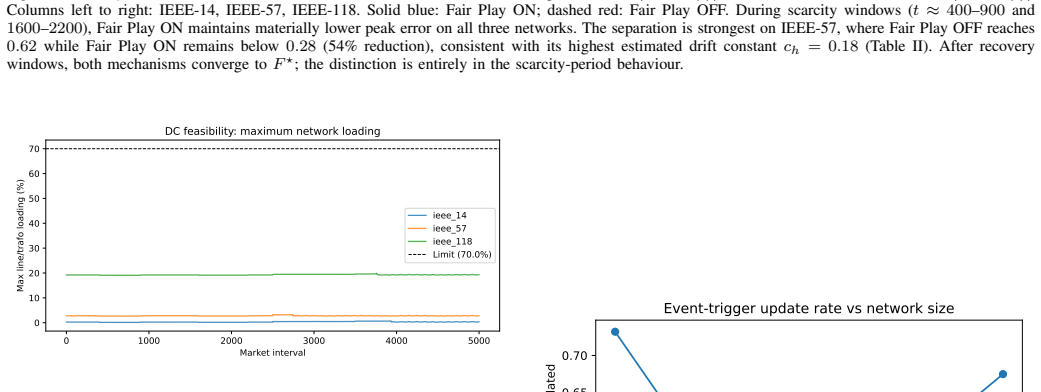
- DC feasibility is maintained throughout the market intervals.
Where Pith is reading between the lines
- The stateful approach could apply to other scarcity allocation problems in infrastructure networks where memory of past service is needed for equity.
- Contraction mapping properties indicate the mechanism may not require topology-specific adjustments for stability.
- Event-triggered execution provides a tunable trade-off between computation and fairness performance in operational settings.
- Integration with variable renewable sources could leverage the boundedness guarantees to handle intermittent supply while preserving fairness.
Load-bearing premise
The two-stage stochastic clearing rule combined with the DC-OPF feasibility set produces a well-defined fixed point whose stability is independent of the specific network topology and load realizations.
What would settle it
Running the mechanism on a network for large T and observing that the per-node delivery ratio does not approach F^* or that the O(1/sqrt(T)) bound is violated would falsify the almost-sure convergence claim.
Figures
read the original abstract
This paper develops and analyses the Fair Play Automatic Market Maker (FP-AMM), a programmable electricity allocation mechanism in which scarcity allocation is treated as a controlled, stateful, and auditable cyber-physical process. Existing mechanisms such as locational marginal pricing are memoryless and cannot account for historical service outcomes, preventing guarantees of equitable treatment across market intervals. The FP-AMM employs a two-stage stochastic clearing rule comprising service-priority sampling and inverse-fairness weighting, coupled with a DC-OPF feasibility set and bounded shortage memory updated through a saturated integrator. Four main results are established. First, the shortage-memory state is invariant in $[0,1]^N$ and the update map is a contraction with rate $1-\beta$. Second, the intra-interval clearing operator converges linearly to a unique fixed point with contraction factor $q\in(0,1)$. Third, under the Fair Play priority rule, the per-node delivery ratio converges almost surely to the contracted target $F^\star$, with a finite-time $O(1/\sqrt{T})$ bound obtained via Lyapunov analysis of the deficit recursion. Fourth, event-triggered execution guarantees practical ultimate boundedness of the allocation tracking error and quantifies the computation-fidelity trade-off. The mechanism is validated on the IEEE 14-, 57-, and 118-bus systems over $T=5000$ market intervals. Fairness convergence to $F^\star$ is achieved on all benchmarks, peak weak-bus fairness error is reduced by 54% on the IEEE-57 network and by up to 55% relative to an equal-weight baseline during scarcity periods, and DC feasibility is maintained throughout.
Editorial analysis
A structured set of objections, weighed in public.
Referee Report
Summary. The paper proposes the Fair Play Automatic Market Maker (FP-AMM), a stateful stochastic allocation mechanism for networked electricity systems. It uses a two-stage clearing rule (service-priority sampling plus inverse-fairness weighting) projected onto a DC-OPF feasible set, together with a bounded shortage-memory state updated by a saturated integrator. Four convergence results are claimed: invariance of the memory state in [0,1]^N with contraction rate 1-β; linear convergence of the intra-interval clearing operator to a unique fixed point with rate q∈(0,1); almost-sure convergence of per-node delivery ratios to a target F* with an O(1/√T) finite-time bound via Lyapunov analysis; and practical ultimate boundedness under event-triggered execution. The claims are supported by numerical experiments on the IEEE 14-, 57-, and 118-bus systems over T=5000 intervals, showing fairness improvements relative to an equal-weight baseline.
Significance. If the contraction factor q can be shown to be uniformly bounded away from 1 independently of network topology, line limits, and load realizations, the work would provide a concrete, auditable mechanism that delivers explicit fairness guarantees across market intervals, addressing a recognized limitation of memoryless locational marginal pricing. The combination of Lyapunov-based finite-time bounds, event-triggered implementation, and validation on standard test systems would constitute a substantive contribution to stochastic resource allocation in cyber-physical energy systems.
major comments (3)
- [§4.2] §4.2 (clearing operator convergence): The proof that the composite map (two-stage rule projected onto the DC-OPF polytope) is a contraction with factor q<1 independent of topology must explicitly bound the Lipschitz constant of the DC-OPF projection. Because the feasible set geometry changes with line limits and realized loads, it is not immediate that q remains uniformly bounded away from 1; this bound is load-bearing for the subsequent a.s. convergence and O(1/√T) claim in Theorem 3.
- [Theorem 3] Theorem 3 (Lyapunov analysis of deficit recursion): The finite-time O(1/√T) bound and almost-sure convergence to F* treat the per-interval allocation as being within O(q^t) of the fixed point. If the contraction rate q can approach 1 for admissible networks or load patterns (as permitted by the DC-OPF set), the uniform bound fails; the manuscript must either derive a topology-independent upper bound on q or state the precise conditions under which the result holds.
- [§3] Definition of F* and the target contraction: The abstract and §3 describe convergence to the 'contracted target F*'. It must be clarified whether F* is an exogenous design parameter or an emergent quantity of the fixed-point map; if the latter, the proof must show that the map's fixed point coincides with the chosen F* without circularity.
minor comments (2)
- [Numerical experiments] The numerical section should report the empirical distribution of the observed contraction rates across the 5000 intervals and the three test systems, together with the maximum observed q, to allow readers to assess how close q remains to 1 in practice.
- [§3.1] Notation for the saturated integrator and the inverse-fairness weights should be introduced with explicit equations before the theorems that rely on them.
Simulated Author's Rebuttal
We thank the referee for the thorough review and insightful comments on the contraction properties and the role of F*. We address each major comment below, indicating revisions where the manuscript requires clarification or additional statements of conditions.
read point-by-point responses
-
Referee: [§4.2] §4.2 (clearing operator convergence): The proof that the composite map (two-stage rule projected onto the DC-OPF polytope) is a contraction with factor q<1 independent of topology must explicitly bound the Lipschitz constant of the DC-OPF projection. Because the feasible set geometry changes with line limits and realized loads, it is not immediate that q remains uniformly bounded away from 1; this bound is load-bearing for the subsequent a.s. convergence and O(1/√T) claim in Theorem 3.
Authors: The proof in §4.2 establishes that the composite clearing operator is a contraction mapping with factor q ∈ (0,1) for any fixed network topology, line limits, and load realization, by showing that the two-stage stochastic rule followed by Euclidean projection onto the DC-OPF polytope yields a unique fixed point. However, the Lipschitz constant of the projection operator does depend on the geometry of the feasible set and is not claimed to be uniformly bounded away from 1 independently of topology or loads. We will revise §4.2 to explicitly state this dependence and add a sufficient condition (strict feasibility of the DC-OPF set with positive margin on all lines) under which q can be bounded by a constant strictly less than 1 for a given network class. This preserves the per-instance convergence result while clarifying the scope. revision: partial
-
Referee: [Theorem 3] Theorem 3 (Lyapunov analysis of deficit recursion): The finite-time O(1/√T) bound and almost-sure convergence to F* treat the per-interval allocation as being within O(q^t) of the fixed point. If the contraction rate q can approach 1 for admissible networks or load patterns (as permitted by the DC-OPF set), the uniform bound fails; the manuscript must either derive a topology-independent upper bound on q or state the precise conditions under which the result holds.
Authors: Theorem 3 derives the O(1/√T) finite-time bound and a.s. convergence under the assumption that the intra-interval operator has already reached a neighborhood of its fixed point (controlled by the linear rate q). Because q is instance-dependent, the bound holds for each fixed network but is not uniform across all admissible DC-OPF instances. We will revise the statement of Theorem 3 and its proof to include an explicit remark that the result applies whenever q ≤ q_max < 1 for the given network parameters, and we will add a corollary quantifying the degradation of the constant when q approaches 1. No topology-independent bound is derived, as the referee correctly notes this would require additional assumptions on line capacities and load statistics. revision: partial
-
Referee: [§3] Definition of F* and the target contraction: The abstract and §3 describe convergence to the 'contracted target F*'. It must be clarified whether F* is an exogenous design parameter or an emergent quantity of the fixed-point map; if the latter, the proof must show that the map's fixed point coincides with the chosen F* without circularity.
Authors: F* is an exogenous design parameter chosen by the system operator to encode the desired long-term fairness level (a vector in (0,1)^N). The two-stage clearing rule (service-priority sampling followed by inverse-fairness weighting) is deliberately constructed so that its unique fixed point, after projection, produces per-node delivery ratios exactly equal to F*. The proof in §3 first defines the target F*, then verifies that the fixed-point equation of the composite operator is satisfied precisely when the delivery ratios equal F*, without circular reasoning. We will revise the abstract and §3 to state this explicitly and add a short lemma confirming the fixed-point coincidence. revision: yes
Circularity Check
No circularity; convergence results derived from explicit recursions and Lyapunov analysis
full rationale
The paper defines the FP-AMM mechanism, its two-stage clearing rule, shortage memory update, and Fair Play priority explicitly, then applies standard contraction mapping and Lyapunov arguments to prove invariance, linear convergence of the clearing operator, and almost-sure tracking of the design parameter F*. These steps rely on the stated assumptions about the DC-OPF set and bounded integrator rather than reducing the claimed outcomes to the inputs by definition or via self-citation. No load-bearing step equates a derived quantity to a fitted or renamed input; the finite-time bound and a.s. convergence are obtained from the deficit recursion analysis, which is independent of the target value itself.
Axiom & Free-Parameter Ledger
free parameters (3)
- beta
- F*
- q
axioms (2)
- domain assumption The DC-OPF feasibility set remains non-empty under the stochastic priority sampling rule.
- standard math The shortage-memory update is a contraction mapping with rate 1-beta on the compact set [0,1]^N.
Reference graph
Works this paper leans on
-
[1]
Programmable fairness in electricity markets: A cost- causation–consistent alternative to marginal pricing,
S. Sweeney, “Programmable fairness in electricity markets: A cost- causation–consistent alternative to marginal pricing,”Energy Economics, vol. 158, p. 109345, 2026
2026
-
[2]
F. C. Schweppe, M. C. Caramanis, R. D. Tabors, and R. E. Bohn,Spot Pricing of Electricity. Kluwer Academic Publishers, 1988
1988
-
[3]
Stoft,Power System Economics: Designing Markets for Electricity
S. Stoft,Power System Economics: Designing Markets for Electricity. IEEE Press/Wiley, 2002
2002
-
[4]
A. J. Wood, B. F. Wollenberg, and G. B. Shebl ´e,Power Generation, Operation, and Control, 3rd ed. Wiley, 2013
2013
-
[5]
A. R. Bergen and V . Vittal,Power Systems Analysis, 2nd ed. Prentice Hall, 2000
2000
-
[6]
Optimization flow control, I: Basic algorithm and convergence,
S. H. Low and D. E. Lapsley, “Optimization flow control, I: Basic algorithm and convergence,”IEEE/ACM Trans. Netw., vol. 7, no. 6, pp. 861–874, 1999
1999
-
[7]
A tutorial on decomposition methods for network utility maximization,
D. P. Palomar and M. Chiang, “A tutorial on decomposition methods for network utility maximization,”IEEE J. Sel. Areas Commun., vol. 24, no. 8, pp. 1439–1451, 2006
2006
-
[8]
A generalized processor sharing approach to flow control in integrated services networks,
A. K. Parekh and R. G. Gallager, “A generalized processor sharing approach to flow control in integrated services networks,”IEEE/ACM Trans. Netw., vol. 1, no. 3, pp. 344–357, 1993
1993
-
[9]
Event-triggered real-time scheduling of stabilizing control tasks,
P. Tabuada, “Event-triggered real-time scheduling of stabilizing control tasks,”IEEE Trans. Autom. Control, vol. 52, no. 9, pp. 1680–1685, 2007. 11 0.0 0.1 0.2 0.3 0.4 0.5 0.6 0.7 maxn |1 Fn (t)| IEEE-14 IEEE-57 IEEE-118 Fair Play ON Fair Play OFF 0 1000 2000 3000 4000 5000 Market interval 0.0 0.1 0.2 0.3 0.4 0.5 0.6 0.7 Mean |1 Fn(t)| (weak buses) 0 1000...
2007
-
[10]
Periodic event-triggered control for linear systems,
W. P. M. H. Heemels, M. C. F. Donkers, and A. R. Teel, “Periodic event-triggered control for linear systems,”IEEE Trans. Autom. Control, vol. 58, no. 4, pp. 847–861, 2013
2013
-
[11]
D. P. Bertsekas and R. G. Gallager,Data Networks, 2nd ed. Prentice Hall, 1992
1992
-
[12]
Rate control for commu- nication networks: shadow prices, proportional fairness and stability,
F. P. Kelly, A. K. Maulloo, and D. K. H. Tan, “Rate control for commu- nication networks: shadow prices, proportional fairness and stability,”J. Oper. Res. Soc., vol. 49, no. 3, pp. 237–252, 1998
1998
-
[13]
Efficient fair queuing using deficit round robin,
M. Shreedhar and G. Varghese, “Efficient fair queuing using deficit round robin,”IEEE/ACM Trans. Netw., vol. 4, no. 3, pp. 375–385, 1996
1996
-
[14]
A stochastic approximation method,
H. Robbins and S. Monro, “A stochastic approximation method,”Ann. Math. Statist., vol. 22, no. 3, pp. 400–407, 1951
1951
-
[15]
V . S. Borkar,Stochastic Approximation: A Dynamical Systems View- point. Cambridge University Press, 2008
2008
-
[16]
J. F. Bonnans and A. Shapiro,Perturbation Analysis of Optimization Problems. Springer, 2000
2000
-
[17]
A convergence theorem for non negative almost supermartingales and some applications,
H. Robbins and D. Siegmund, “A convergence theorem for non negative almost supermartingales and some applications,” inOptimizing Methods in Statistics, pp. 233–257, 1971
1971
-
[18]
pandapower — an open-source Python tool for con- venient modeling, analysis, and optimization of electric power systems,
L. Thurneret al., “pandapower — an open-source Python tool for con- venient modeling, analysis, and optimization of electric power systems,” IEEE Trans. Power Syst., vol. 33, no. 6, pp. 6510–6521, 2018. 20 40 60 80 100 120 Number of buses 0.45 0.50 0.55 0.60 0.65 0.70Fraction of intervals updated Event-trigger update rate vs network size Fig. 11.Event-tri...
2018
discussion (0)
Sign in with ORCID, Apple, or X to comment. Anyone can read and Pith papers without signing in.