REVIEW 3 major objections 5 minor 1 cited by
A Gray Level Indicator-Based Regularized Telegraph Diffusion Equation Applied to Image Despeckling
T0 review · 3 major / 5 minor · reviewed 2026-08-14 · deepseek-v4-flash
Pith's one-line read This paper presents a gray level indicator based regularized telegraph diffusion equation for speckle removal, proves existence and uniqueness of its weak solution, and reports higher PSNR and SSIM values than the Shan et al.
desk verdict A plausible model combination with a real gap in the fixed-point proof and demonstrations too optimistic to support the superiority claim. read the letter →
The pith
A machine-rendered reading of the paper's core claim, the machinery that carries it, and where it could break.
The reading
What carries the argument
The object that carries the argument is the diffusion coefficient $g(I_\xi,|\nabla I_\xi|)$: the product of a gray level indicator $2s^\nu/(1+s^\nu)$ with $s=|I_\xi|/M^I_\xi$ and a regularized Perona-Malik edge detector $1/(1+(|\nabla I_\xi|/K)^2)$. The gray level factor makes the amount of smoothing depend on how bright or dark a region is, while the edge factor reduces diffusion where the smoothed gradient is large. The Gaussian convolution $I_\xi=G_\xi*I$ gives the coefficient a positive lower bound, which is what lets the Galerkin energy estimates run. The second-order time derivative $I_{tt}$ with damping $\gamma I_t$ is the hyperbolic part: it gives the process wave-like memory so high-frequency texture can survive smoothing. In the well-posedness proof, the set $W_0$, consisting of functions with bounded $L^\infty(0,T;H^1)$ and $L^\infty(0,T;L^2)$ norms and a positive lower bound $\alpha$, is the fixed-point domain that must be mapped into itself.
What would settle it
Solve the linearized problem (3.1) with any positive frozen coefficient built from $w\in W_0$ and an $H^2$ initial image with minimum exactly $\alpha$; if the solution falls below $\alpha$ at any time, the fixed-point map does not preserve its domain and the existence proof as written collapses. Alternatively, rerun the numerical section with a single fixed parameter set across all images and noise levels; if the proposed model's PSNR/SSIM advantage over [44] disappears, the reported superiority does not transfer outside the tuned settings.
Extended reading notes
Core claim
The paper's central claim is that the initial-boundary value problem $$ I_{tt}+\gamma I_t-\operatorname{div}\bigl(g(I_\xi,|\nabla I_\xi|)\nabla I\bigr)=0 $$ with Neumann boundary conditions, $I(x,0)=I_0(x)$, $I_t(x,0)=0$, and diffusion coefficient $$ g(I_\xi,|\nabla I_\xi|)=\frac{2|I_\xi|^\nu}{(M^I_\xi)^\nu+|I_\xi|^\nu}\cdot\frac{1}{1+(|\nabla I_\xi|/K)^2}, $$ where $I_\xi=G_\xi*I$ and $M^I_\xi=\max_{x\in\Omega}|I_\xi(x,t)|$, admits a unique weak solution whenever $I_0\in H^2(\Omega)$ and $\inf_\Omega I_0>0$. The proof passes through a linearized problem with a frozen diffusion coefficient, solves it by Galerkin's method, and applies Schauder's fixed point theorem to the solution map. The same model is then tested on gray images corrupted by multiplicative speckle noise, and the reported PSNR and SSIM values exceed those of the Shan et al. model at every noise level tested.
Load-bearing premise
The load-bearing premise is that when the diffusion coefficient is frozen using any positive function from the fixed-point set, the solution of the linearized equation stays above the same positive floor; this lower-bound propagation is asserted when the solution map is defined but never actually proved, and without it Schauder's theorem cannot be applied.
Editorial extensions
If this is right
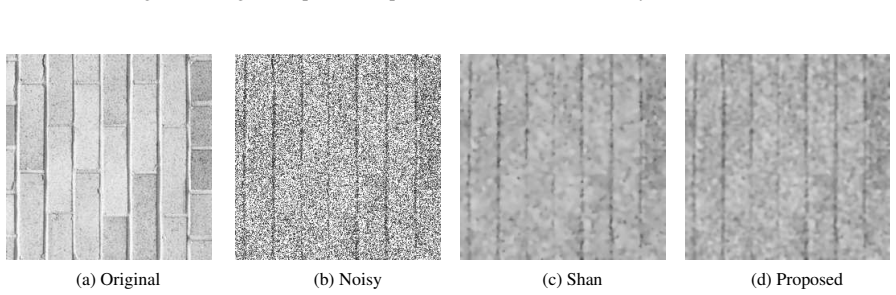
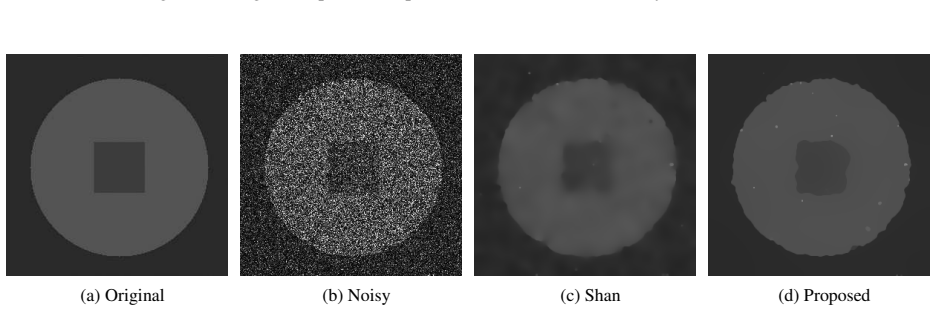
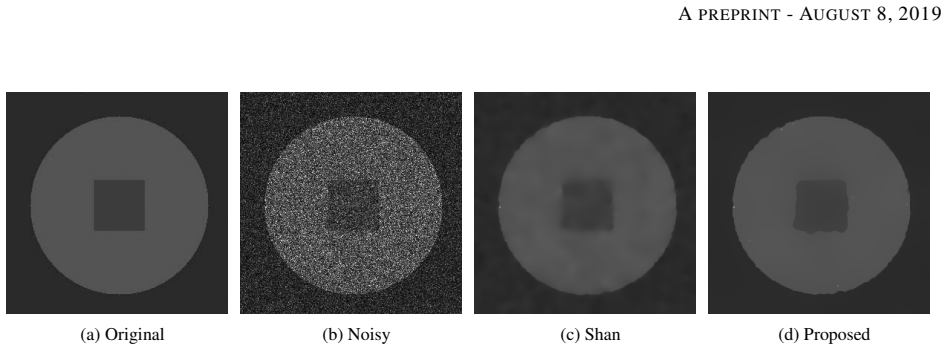
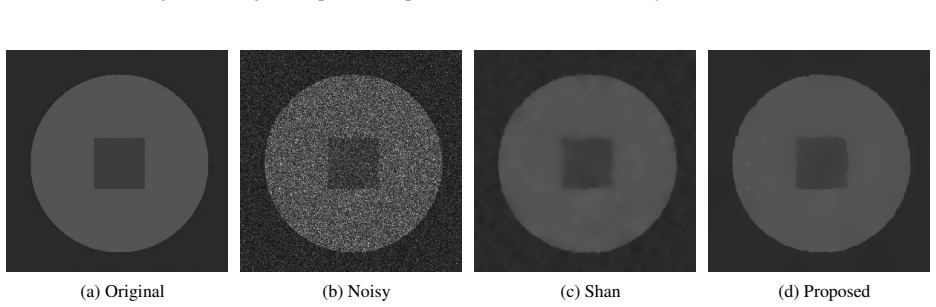
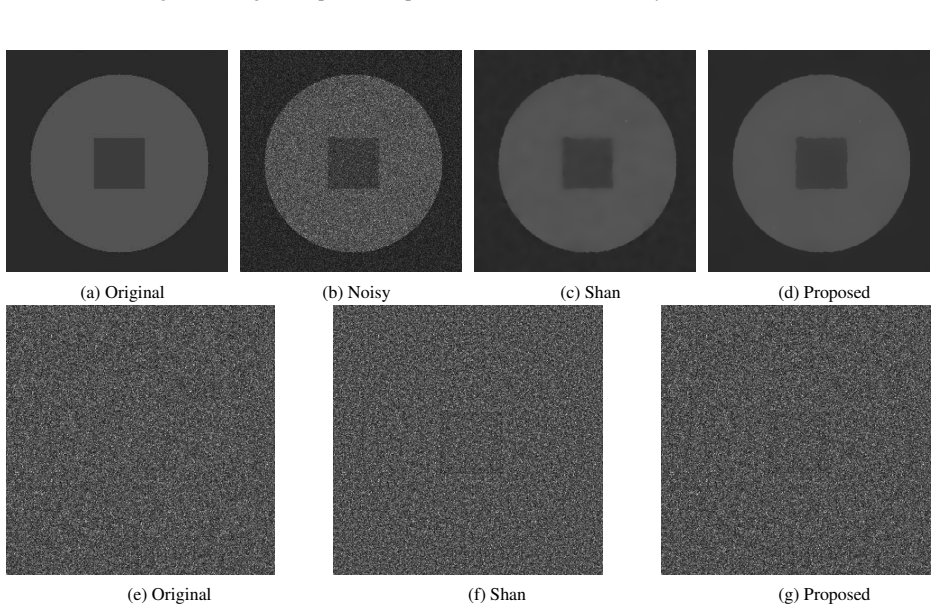
- At all tested speckle strengths (L=1,3,5,10,33), the proposed model reports higher PSNR and SSIM than the Shan et al. model on the Boat, Brick, and Circle images.
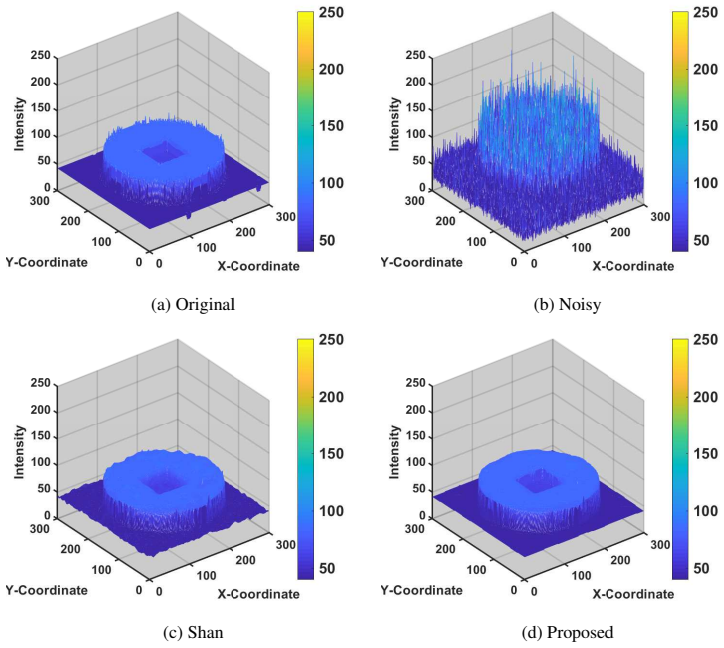
- Ratio images, contour maps, and 3D surface plots show fewer residual speckle patterns in flat regions and sharper edges in the restored images.
- The existence and uniqueness theorem means the same equation can be used with any H2 initial image with strictly positive minimum, without a separate derivation of well-posedness.
- The weak solution is bounded between the image minimum and maximum for almost every time, so intensities do not drift outside the original range during restoration.
Reading between the lines
- Inference: The missing lower-bound propagation could be supplied by a comparison principle for telegraph-diffusion equations; if one can prove that any solution of the linearized problem inherits the minimum of its initial data, the fixed-point theorem closes without further assumptions.
- Inference: Because the numerical test tunes parameters per image and per noise level, the real-world edge of this model is untested; a fair comparison would use fixed parameters or automatic selection on unseen SAR or ultrasound data.
- Inference: The diffusion coefficient depends on the global maximum M of the smoothed image; replacing it with a local estimate would change the gray-level indicator's behavior and could be tested for robustness.
- Inference: The paper compares only against the Shan model; the same explicit scheme could be run against other speckle filters to see where the hyperbolic term helps or hurts.
Signed reviews
Editorial analysis
A structured set of objections, weighed in public.
Referee Report
Summary. The paper proposes a gray-level-indicator-based regularized telegraph diffusion equation for multiplicative speckle noise removal, with diffusivity g(I_ξ, |∇I_ξ|) combining a gray-level factor and a gradient edge detector. The authors state an existence-and-uniqueness theorem for weak solutions, proved through a linearized problem and a Schauder fixed-point argument, together with a boundedness lemma. The numerical section presents an explicit finite-difference discretization and compares the proposed model with the Shan et al. model on three test images at several speckle levels, reporting PSNR and SSIM values in Table 1.
Significance. If the well-posedness result and the numerical comparison were fully supported, the paper would make a useful contribution: it extends hyperbolic telegraph-diffusion ideas to multiplicative noise while incorporating a gray-level indicator, a combination that is not standard in the despeckling literature. The theoretical framework is self-contained in its linearization and fixed-point setup, and the numerical experiments are clearly tabulated. However, both pillars of the paper currently have load-bearing gaps: the fixed-point argument does not establish the required lower bound on the linearized solution, and the numerical superiority claim rests on per-image parameter tuning with clean-image-based stopping. The significance is therefore conditional on substantial revision.
major comments (3)
- [Section 3.3, definition of W0 and the map P] The proof asserts P : W0 -> W0, but no argument shows that the solution I_w of the linearized problem (3.1) with frozen coefficient ḡ satisfies 0 < α ≤ I_w. Lemma 3.3 establishes the lower bound only for weak solutions of the nonlinear problem (2.5)-(2.7), and the linearized damped wave equation does not have a standard maximum principle that would propagate the lower bound from I0. Without a proof of I_w ≥ α, the map P is not shown to map W0 into itself, and the application of Schauder's fixed-point theorem is unsupported. The same missing lower bound affects the claim that the extracted limit I lies in W0 in the subsequence argument.
- [Section 5.2 and Table 1] The numerical superiority claim is not supported by the reported protocol. The parameter values in Table 1 are tuned separately for each image and each noise level, and Section 4 states that the process is stopped after obtaining the best PSNR value of the restored image, which requires access to the clean image. This is an oracle procedure: the reported PSNR/SSIM advantage is in part constructed by the evaluation protocol. A convincing comparison requires fixed or systematically chosen parameters for both models, a stopping rule that does not use the clean image, and results over multiple noise realizations with means and variances. Without these, the statement that the highest values 'clearly show' superiority is not justified.
- [Section 3.2, proof of Lemma 3.2] The proof of part (a) begins with 'Note that I_t ∈ L∞(0,T;H1)' and takes φ = I_t as a test function in (3.1). This regularity is not part of the space W(0,T), which only gives I_t ∈ L∞(0,T;L2), and it is not otherwise established. The energy estimate is standard for Galerkin approximations, but as written the argument is incomplete. In addition, part (b) cites 'Lemma 3.2' in the middle of the proof of Lemma 3.2, where Claim 3.1 is evidently meant.
minor comments (5)
- [Section 3.3, definition of W0] The bound in the definition of W0 is written as ||w||_{L∞(0,T;H1)} + ||w_t||_{L∞(0,T;L2)} ≤ C||I0||^2_{H1}, while Lemma 3.2 and Claim 3.1 give linear estimates with ||I0||_{H1}; this exponent appears to be a typo and creates an inconsistency between the fixed-point set and the a priori estimates.
- [Section 3.2, equation (3.1)] The frozen coefficient ḡ in the linearized problem is defined without the factor 2 that appears in the diffusivity in (2.4) and (2.5); the omitted factor changes the range stated in Claim 3.1 and should be reconciled.
- [Section 4, numerical implementation] The explicit finite-difference scheme is presented without a stability or CFL-type condition, even though the equation is hyperbolic; a brief discussion of stability in terms of τ, h, γ, and the diffusion coefficient would strengthen the numerical section.
- [Throughout] There are several typographical errors that should be corrected: 'telegr aph' in the abstract, 'imgaes' in the caption of Figure 8, 'sence' in the uniqueness proof, and 'M ATLAB' in Section 5.
- [Section 3, Theorem 3.1] The paper calls the result 'well-posedness' but proves existence, uniqueness, and boundedness; continuous dependence on the initial data is not established, so the term 'well-posedness' is used more broadly than in the standard Hadamard sense.
Circularity Check
The well-posedness proof is non-circular but has an unproved invariant-set step; the numerical superiority claim is partially circular because parameters are per-image tuned and stopping uses the clean-image-optimal PSNR.
-
fitted input called prediction
[Section 4 (Numerical Implementation), stopping criterion; Section 5.2 and Table 1 (parameter values); Section 5.1 (PSNR definition).]
"we stop the noise elimination process after getting the best PSNR value of the restored image. ... The highest values of PSNR and SSIM for each noise level clearly shows that the suggested model is better than the Shan model."
Section 5.1 defines PSNR against the clean image I. The protocol uses that clean image twice: the parameters (Table 1) are chosen per image/noise level, and the iteration is halted at the maximum PSNR. Hence the reported PSNR is, by construction, the largest value over the simulated time family, and the superiority verdict is an in-sample comparison between tuned optima rather than a parameter-free prediction of the model. The conclusion is thus not derived from the equations alone; it is co-produced by the tuning/stopping choices.
full rationale
The mathematical core — existence and uniqueness of a weak solution — is not circular. The proof linearizes (2.5)-(2.7) as (3.1), establishes coefficient bounds in Claim 3.1, proves a-priori estimates in Lemma 3.2, and attempts a Schauder fixed point on W0. None of these steps derives the theorem from the theorem; the load-bearing defect is the unproved inclusion P(W0)⊂W0, specifically the lower bound 0<α≤Iw for the linearized solution. That is a completeness/correctness gap, not a circular reduction, so it does not raise the circularity score on its own. The citation of the authors' own [38] is motivational (the fidelity term is discarded and the diffusivity is replaced), so it is not load-bearing. The circularity concern is confined to the numerical demonstration. Table 1 reports parameters tuned for each image and noise level, and Section 4 stops the iteration at the best PSNR against the clean image. Since PSNR is also the quantitative criterion for 'superiority,' the reported values are in-sample optima of the evaluation metric. The conclusion that the proposed model outperforms Shan is therefore partly built into the tuning/stopping protocol rather than being an independent out-of-sample prediction. This warrants a moderate, not extreme, score because the mathematical well-posedness claim remains independent and the numerical comparison still uses a real external baseline (Shan [44]).
Assumptions & free parameters
free parameters (5)
- γ (damping coefficient) =
varies per image and noise level; e.g., 5, 4, 2, 2, 2 for Boat across L=1,3,5,10,33
- ν (gray level indicator exponent) =
varies per image and noise level; e.g., 1, 1.5, 1.5, 2, 3 for Boat
- K (gradient threshold) =
varies per image and noise level; e.g., 2, 2, 1, 1, 1 for Boat
- Stopping time or iteration count =
not reported; best PSNR value against the clean image
- α and β (listed in parameter table) =
vary per image and noise level
assumptions (4)
- domain assumption Initial data I0 ∈ H2(Ω) with 0 < α ≤ I0(x)
- standard math Galerkin method and Schauder fixed point theorem are applicable
- ad hoc to paper Solutions of the linearized problem (3.1) remain bounded below by the same α
- domain assumption Gaussian convolution Gξ * I preserves the positivity lower bound and gives L∞ control in terms of H1 norm
Cite this review
Pith. "Pith review of A Gray Level Indicator-Based Regularized Telegraph Diffusion Equation Applied to Image Despeckling." pith.science (2026). https://pith.science/paper/UE2DRUPD
@misc{pith2026190801147,
  author       = {Pith},
  title        = {Pith review of: A Gray Level Indicator-Based Regularized Telegraph Diffusion Equation Applied to Image Despeckling},
  year         = {2026},
  howpublished = {\url{https://pith.science/paper/UE2DRUPD}},
  note         = {Machine review of arXiv:1908.01147}
}
read the original abstract
In this work, a gray level indicator based non-linear telegraph diffusion model is presented for multiplicative noise removal problem. Most of the researchers focus only on diffusion equation-based model for multiplicative noise removal problem. The suggested model uses the benefit of the combined effect of diffusion equation as well as the wave equation. Wave nature of the model preserves the high oscillatory and texture pattern in an image. In this model, the diffusion coefficient depends not only on the image gradient but also on the gray level of the image, which controls the diffusion process better than only gradient-based diffusion models. Moreover, we prove the well-posedness of the present model using Schauder fixed point theorem. Furthermore, we show the superiority of the proposed model over a recently developed method on a set of gray level test images which are corrupted by speckle noise.
Figures


Figures from the paper (6 more)

Forward citations
Cited by 1 Pith paper
-
Well-posedness study of a non-linear hyperbolic-parabolic coupled system applied to image speckle reduction
A telegraph-diffusion model coupled to an edge-variable reaction-diffusion equation is proven to have a unique weak solution, and it modestly improves despeckling metrics over two comparison models on three test images.
Reference graph
Works this paper leans on
-
[1]
IEEE transactions on medical imaging 20 (8), 772-783 (2001)
Achim, A., Bezerianos, A., Tsakalides, P .: Novel bayesi an multiscale method for speckle removal in medical ultrasound images. IEEE transactions on medical imaging 20 (8), 772-783 (2001)
work page 2001
-
[2]
A. Averbuch, B. Epstein, N. Rabin, E. Turkel, Edge-enhan cement postprocessing using artificial dissipation, IEEE transactions on image processing 15 (6) (2006) 1486-1498
work page 2006
-
[3]
Adam, Sobolev spaces, in: Pure and Applied Mathematic s Series of Monographs and Textbooks, V ol
R. Adam, Sobolev spaces, in: Pure and Applied Mathematic s Series of Monographs and Textbooks, V ol. 65, Academic Press, Inc., New Y ork, San Francisco, London„ 1975
1975
-
[4]
IEEE Transactions on Geoscience and Remote Sensin g 36(5), 1466-1476 (1998)
Aiazzi, B., Alparone, L., Baronti, S.: Multiresolution local-statistics speckle filtering based on a ratio laplaci an pyramid. IEEE Transactions on Geoscience and Remote Sensin g 36(5), 1466-1476 (1998)
work page 1998
-
[5]
Alparone, L., Baronti, S., Carla, R.: Two-dimensional r ank-conditioned median filter. IEEE Transactions on Cir- cuits and Systems II: Analog and Digital Signal Processing 4 2(2), 130-132 (1995)
work page 1995
-
[6]
Pattern recognition letters 19(1), 89-96 (1998) A PREPRINT - A UGUST 8, 2019
Alparone, L., Garzelli, A.: Decimated geometric filter f or edge-preserving smoothing of non-white image noise. Pattern recognition letters 19(1), 89-96 (1998) A PREPRINT - A UGUST 8, 2019
work page 1998
-
[7]
IEEE Geoscience and remote sensing magazine 1(3), 6 -35 (2013)
Argenti, F., Lapini, A., Bianchi, T., Alparone, L.: A tut orial on speckle reduction in synthetic aperture radar images. IEEE Geoscience and remote sensing magazine 1(3), 6 -35 (2013)
work page 2013
-
[8]
SIAM Journal on Applied Mathe- matics 68(4), 925-946 (2008)
Aubert, G., Aujol, J.F.: A variational approach to remov ing multiplicative noise. SIAM Journal on Applied Mathe- matics 68(4), 925-946 (2008)
2008
Show all 56 references
-
[9]
In: Computer Vision and Pattern Recognition, 2005
Buades, A., Coll, B., Morel, J.M.: A non-local algorithm for image denoising. In: Computer Vision and Pattern Recognition, 2005. CVPR 2005. IEEE Computer Society Confer ence on, vol. 2, pp. 60-65. IEEE (2005)
2005
-
[10]
IEEE Transactions on Sonics and ultrasonics 25(1), 1-6 (1978)
Burckhardt, C.B.: Speckle in ultrasound b-mode scans. IEEE Transactions on Sonics and ultrasonics 25(1), 1-6 (1978)
1978
-
[11]
Nonlinear Analysis: Real World Applications 11(1), 253-26 1 (2010)
Cao, Y ., Yin, J., Liu, Q., Li, M.: A class of nonlinear par abolic-hyperbolic equations applied to image restoration . Nonlinear Analysis: Real World Applications 11(1), 253-26 1 (2010)
2010
-
[12]
Applied soft computing 8(2), 919-927 (2008)
Chaira, T., Ray, A.: A new measure using intuitionistic fuzzy set theory and its application to edge detection. Applied soft computing 8(2), 919-927 (2008)
2008
-
[13]
In: Biomedi- cal Imaging: From Nano to Macro, 2008
Coupé, P ., Hellier, P ., Kervrann, C., Barillot, C.: Bay esian non local means-based speckle filtering. In: Biomedi- cal Imaging: From Nano to Macro, 2008. ISBI 2008. 5th IEEE Int ernational Symposium on, pp. 1291-1294. IEEE (2008)
2008
-
[14]
Applied optics 24(10), 1438-1443 (1985)
Crimmins, T.R.: Geometric filter for speckle reduction . Applied optics 24(10), 1438-1443 (1985)
1985
-
[15]
IEEE Transactions on Image Processing 18(12 ), 2661-2672 (2009)
Deledalle, C.A., Denis, L., Tupin, F.: Iterative weigh ted maximum likelihood denoising with probabilistic patch - based weights. IEEE Transactions on Image Processing 18(12 ), 2661-2672 (2009)
2009
-
[16]
In: Abstract and Applied Analysis , vol
Dong, G., Guo, Z., Wu, B.: A convex adaptive total variat ion model based on the gray level indicator for multi- plicative noise removal. In: Abstract and Applied Analysis , vol. 2013. Hindawi Publishing Corporation (2013)
2013
-
[17]
Ultrasound Research Laboratory p
Dutt, V .: Statistical analysis of ultrasound echo enve lope. Ultrasound Research Laboratory p. 181 (1995)
1995
-
[18]
Evans, L.: Partial Differential Equations, in: Gradua te Studies in Mathematics, vol. 19. American Mathematical Society, Providence, Rhode Island (1998)
1998
-
[19]
IEEE Tr ansactions on pattern analysis and machine intelligence (2), 157-166 (1982)
Frost, V .S., Stiles, J.A., Shanmugan, K.S., Holtzman, J.C.: A model for radar images and its application to adaptive digital filtering of multiplicative noise. IEEE Tr ansactions on pattern analysis and machine intelligence (2), 157-166 (1982)
1982
-
[20]
Gonzalez, R.C., Woods, R.E.: Digital image processing (2002)
2002
-
[21]
IEEE Transactions on Medical Imaging 18(9), 787-794 (1999)
Hao, X., Gao, S., Gao, X.: A novel multiscale nonlinear t hresholding method for ultrasonic speckle suppressing. IEEE Transactions on Medical Imaging 18(9), 787-794 (1999)
1999
-
[22]
AEU-International Journal of Electronics and Com munications 69(9), 1291-1296 (2015)
Hao, Y ., Xu, J., Li, S., Zhang, X.: A variational model ba sed on split bregman method for multiplicative noise removal. AEU-International Journal of Electronics and Com munications 69(9), 1291-1296 (2015)
2015
-
[23]
EURASIP Journal on image and video processing 2010(1), 1 (2010)
Huang, L.L., Xiao, L., Wei, Z.H.: Multiplicative noise removal via a novel variational model. EURASIP Journal on image and video processing 2010(1), 1 (2010)
2010
-
[24]
In: Information Systems Design and Intelligent Applications, pp
Jain, S.K., Ray, R.K.: Edge detectors based telegraph t otal variational model for image filtering. In: Information Systems Design and Intelligent Applications, pp. 119-126. Springer (2016)
2016
-
[25]
IETE Technical Review pp
Jain, S.K., Ray, R.K.: Non-linear diffusion models for despeckling of images: achievements and future chal- lenges. IETE Technical Review pp. 1-17 (2019)
2019
-
[26]
Computers & Mathematics with Applications 70(3), 191-211 (2015)
Jain, S.K., Ray, R.K., Bhavsar, A.: Iterative solvers f or image denoising with diffusion models: A comparative study. Computers & Mathematics with Applications 70(3), 191-211 (2015)
2015
-
[27]
Circuits, Systems, and Signal Proces sing pp
Jain, S.K., Ray, R.K., Bhavsar, A.: A nonlinear coupled diffusion system for image despeckling and application to ultrasound images. Circuits, Systems, and Signal Proces sing pp. 1-30 (2018)
2018
-
[28]
In: Inter- national Conference on Pattern Recognition and Mach ine Intelligence, pp
Jidesh, P ., Bini, A.: A complex diffusion driven approa ch for removing data-dependent multiplicative noise. In: Inter- national Conference on Pattern Recognition and Mach ine Intelligence, pp. 284-289. Springer (2013)
2013
-
[29]
IEEE Trans - actions on Information Technology in Biomedicine 4(4), 298 -305 (2000)
Jin, J.S.,Wang, Y ., Hiller, J.: An adaptive nonlinear d iffusion algorithm for filtering medical images. IEEE Trans - actions on Information Technology in Biomedicine 4(4), 298 -305 (2000)
2000
-
[30]
Journal of Mathematical Analysis and Applications 362(2), 415-426 (2010)
Jin, Z., Y ang, X.: Analysis of a new variational model fo r multiplicative noise removal. Journal of Mathematical Analysis and Applications 362(2), 415-426 (2010)
2010
-
[31]
Journal of Math- ematical Imaging and Vision 39(1), 62-74 (2011) 15 A PREPRINT - A UGUST 8, 2019
Jin, Z., Y ang, X.: A variational model to remove the mult iplicative noise in ultrasound images. Journal of Math- ematical Imaging and Vision 39(1), 62-74 (2011) 15 A PREPRINT - A UGUST 8, 2019
2011
-
[32]
IEEE Transact ions on Pattern Analysis and Machine Intelligence (2), 165-177 (1985)
Kuan, D.T., Sawchuk, A.A., Strand, T.C., Chavel, P .: Ad aptive noise smoothing lter for images with signal-dependent noise. IEEE Transact ions on Pattern Analysis and Machine Intelligence (2), 165-177 (1985)
1985
-
[33]
IEEE transactions on pattern analysis and machine intelligence (2), 165-168 (1980)
Lee, J.S.: Digital image enhancement and noise filterin g by use of local statistics. IEEE transactions on pattern analysis and machine intelligence (2), 165-168 (1980)
1980
-
[34]
J. L. Lions, Contrôle Optimal de Systèmes Gouvernés par des Équations aux Dérivées Partielles, Dunod, Paris, 1968
1968
-
[35]
Journal of Visual Communi- cation and Image Representation 36, 187-198 (2016 )
Liu, M., Fan, Q.: A modified convex variational model for multiplicative noise removal. Journal of Visual Communi- cation and Image Representation 36, 187-198 (2016 )
2016
-
[36]
Nonlinear Analysis: Real World Applications 14(5), 2046-2058 (2013)
Liu, Q., Li, X., Gao, T.: A nondivergence p-laplace equa tion in a removing multiplicative noise model. Nonlinear Analysis: Real World Applications 14(5), 2046-2058 (2013)
2013
-
[37]
IEEE transactions on ultrasonics, ferroelectrics, and frequency control 52(10), 1653-1669 ( 2005)
Loizou, C.P ., Pattichis, C.S., Christodoulou, C.I., I stepanian, R.S., Pantziaris, M., Nicolaides, A.: Comparat ive evalu- ation of despeckle filtering in ultrasound imaging of the carotid artery. IEEE transactions on ultrasonics, ferroelectrics, and frequency control 52(10), ...
2005
-
[38]
Majee, S., Jain, S.K., Ray, R.K., Majee, A.K.: A fuzzy ed ge detector driven telegraph total variation model for image despeckling, a preprint, arXiv https://128.84.21.199/abs/1908.01134 (2019)
2019 arXiv
-
[39]
CVGIP: Graphical Models and Image Processing 56(2), 140-148 (1994)
Meer, P ., Park, R.H., Cho, K.: Multiresolution adaptiv e image smoothing. CVGIP: Graphical Models and Image Processing 56(2), 140-148 (1994)
1994
-
[40]
Pattern Analysis and Machine Intel- ligence, IEEE Transactions on 12(7), 629-639 (1990)
Perona, P ., Malik, J.: Scale-space and edge detection u sing anisotropic diffusion. Pattern Analysis and Machine Intel- ligence, IEEE Transactions on 12(7), 629-639 (1990)
1990
-
[41]
University of Cambridge, Department of Engineering (2001)
Prager, R., Gee, A., Treece, G., Berman, L.: Speckle det ection in ultrasound images using first order statistics. University of Cambridge, Department of Engineering (2001)
2001
-
[42]
In: Image Analysis and Processing, 2007
Ratner, V ., Zeevi, Y .Y .: Image enhancement using elastic manifolds. In: Image Analysis and Processing, 2007. ICIAP 2007. 14th International Conference on, pp. 769-774. IEEE (2007)
2007
-
[43]
In: Geometric Level Set Methods in Imaging, Vision, and Graphics, pp
Rudin, L., Lions, P .L., Osher, S.: Multiplicative deno ising and deblurring: Theory and algorithms. In: Geometric Level Set Methods in Imaging, Vision, and Graphics, pp. 103- 119. Springer (2003)
2003
-
[44]
Journal of Mathe- matical Imaging and Vision pp
Shan, X., Sun, J., Guo, Z.: Multiplicative noise remova l based on the smooth diffusion equation. Journal of Mathe- matical Imaging and Vision pp. 1-17 (2019)
2019
-
[45]
SIAM Journal on Imaging Sciences 1(3), 294-321 (2008)
Shi, J., Osher, S.: A nonlinear inverse scale space meth od for a convex multiplicative noise model. SIAM Journal on Imaging Sciences 1(3), 294-321 (2008)
2008
-
[46]
International journal of computer th eory and engineering 1(1), 7 (2009)
Sudha, S., Suresh, G., Sukanesh, R.: Speckle noise redu ction in ultrasound images by wavelet thresholding based on weighted variance. International journal of computer th eory and engineering 1(1), 7 (2009)
2009
-
[47]
Boundary V alue Problems 2016(1), 187 (2016)
Sun, J., Y ang, J., Sun, L.: A class of hyperbolic-parabo lic coupled systems applied to image restoration. Boundary V alue Problems 2016(1), 187 (2016)
2016
-
[48]
Compu- tational Statistic s & Data Analysis 56(12), 3821-3842 (2012)
A new similarity measure for nonlocal filtering in the pr esence of multiplicative noise. Compu- tational Statistic s & Data Analysis 56(12), 3821-3842 (2012)
2012
-
[49]
Image Processing, IEEE Transactions on 1 3(4), 600-612 (2004)
Wang, Z., Bovik, A.C., Sheikh, H.R., Simoncelli, E.P .: Image quality assessment: from error visibility to struc- tural similarity. Image Processing, IEEE Transactions on 1 3(4), 600-612 (2004)
2004
-
[50]
In: Proc
White, R.G.: A simulated annealing algorithm for sar an d mti image cross-section estimation. In: Proc. SPIE, vol. 2316, pp. 137-145. vol (1994)
1994
-
[51]
Mathematical Problems in Engineering 2014 (2014)
Y ang, Y .Q., Zhang, C.Y .: Kernel based telegraph-diffu sion equation for image noise removal. Mathematical Problems in Engineering 2014 (2014)
2014
-
[52]
IEEE Transactions on image processing 11(11), 1260-1270 (2002)
Y u, Y ., Acton, S.T.: Speckle reducing anisotropic diff usion. IEEE Transactions on image processing 11(11), 1260-1270 (2002)
2002
-
[53]
IEEE Transactions on Medical Imaging 26 (2), 200-211 (2007)
Zhang, F., Y oo, Y .M., Koh, L.M., Kim, Y .: Nonlinear diff usion in laplacian pyramid domain for ultrasonic speckle reduction. IEEE Transactions on Medical Imaging 26 (2), 200-211 (2007)
2007
-
[54]
Sign al Processing 107, 368-377 (2015)
Zhang, W ., Li, J., Y ang, Y .: Spatial fractional telegraph equation for image structure preserving denoising. Sign al Processing 107, 368-377 (2015)
2015
-
[55]
IEEE Tra nsactions on Image Processing 24(1), 249-260 (2015)
Zhou, Z., Guo, Z., Dong, G., Sun, J., Zhang, D., Wu, B.: A d oubly degenerate diffusion model based on the gray level indicator for multiplicative noise removal. IEEE Tra nsactions on Image Processing 24(1), 249-260 (2015)
2015
-
[56]
Journal of Nonlinear Science 28(2), 443-470 (2018 ) 16
Zhou, Z., Guo, Z., Zhang, D., Wu, B.: A nonlinear diffusi on equation-based model for ultrasound speckle noise removal. Journal of Nonlinear Science 28(2), 443-470 (2018 ) 16
2018
Reviewed August 14, 2026 · model on record in the stance chip above.
Discussion (0). Continue with ORCID to comment.