REVIEW 4 major objections 5 minor 60 references
Non-spreading matter-wave packets in a ring
T0 review · 4 major / 5 minor · reviewed 2026-08-14 · deepseek-v4-flash
Pith's one-line read A free ring allows just one family of shape-preserving matter-wave packets, the paper argues.
desk verdict The central solution has a sign error and the uniqueness proof is false, but the numerical study is honest; the paper needs major revision. read the letter →
The pith
A machine-rendered reading of the paper's core claim, the machinery that carries it, and where it could break.
The reading
What carries the argument
The mechanism is the amplitude-phase (Madelung) decomposition $\psi=A e^{iS}$ together with the travelling-shape ansatz $A=A(\theta-f(t))$. Substituting these into the free Schrödinger equation produces a continuity equation that, evaluated at an angle where $A$ vanishes, forces the phase gradient to be a function of time only. That leaves a linear oscillator equation for $A$, whose periodic solutions are $\cos(m\varphi)$ with integer $m$, and fixes the packet speed as the ratio of two integers, $l/m$.
What would settle it
Take equation (11), substitute it directly into the free-ring Schrödinger equation (1) with periodic boundary conditions, and check whether the time-dependent phase is consistent for integer $m,l$. The calculation is short enough to be done by hand, and its outcome decides whether the displayed packet is a solution and therefore whether the uniqueness claim stands.
Extended reading notes
Core claim
The paper's central claim is a completeness statement: for a free ring, the only non-spreading wave packets are the cosine-modulated plane waves of equation (11). The proof separates $\psi$ into an amplitude $A(\varphi)$ moving with the packet and a phase $S(\theta,t)$, then shows that periodicity forces $A$ to be $C\cos(m\varphi)$ and the phase to have the special time dependence of the displayed formula. The constant-density plane wave of equation (9) is recovered as the $m=0$ member of the same set. The paper also shows that the linear-order time dependence would lead to an Airy function, which cannot satisfy periodic boundary conditions, and that higher-order time dependence is inconsistent, so no self-accelerating non-spreading packets exist in a ring.
Load-bearing premise
The derivation needs every non-uniform packet to have at least one point where its density is zero, so the integration constant in the amplitude-current relation is forced to vanish; if a shape-preserving packet keeps a positive density background, that step no longer applies and those packets are not covered by the proof.
Editorial extensions
If this is right
- Equation (11) gives the complete list: every shape-preserving packet in a free ring is one of these cosine-modulated plane waves.
- Packet speeds are locked to the fractional values $l/m$, so only quantized velocities occur, and $2m$ counts the nodes of the density profile.
- Airy-type accelerating non-spreading packets are impossible in a periodic ring, even though they exist on the infinite line.
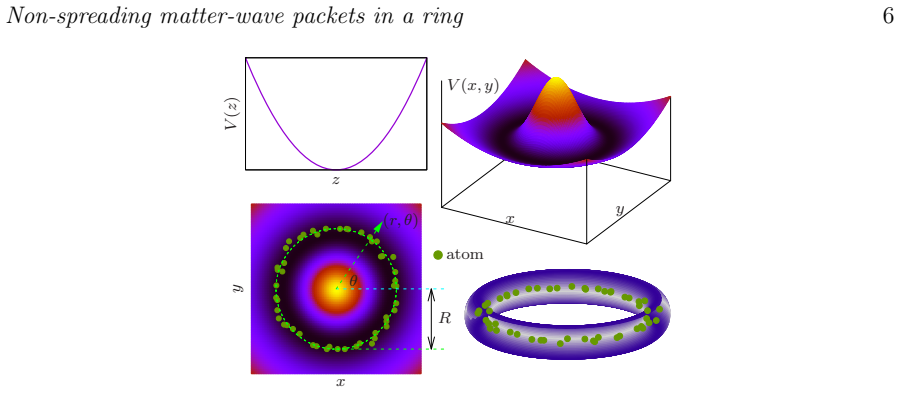
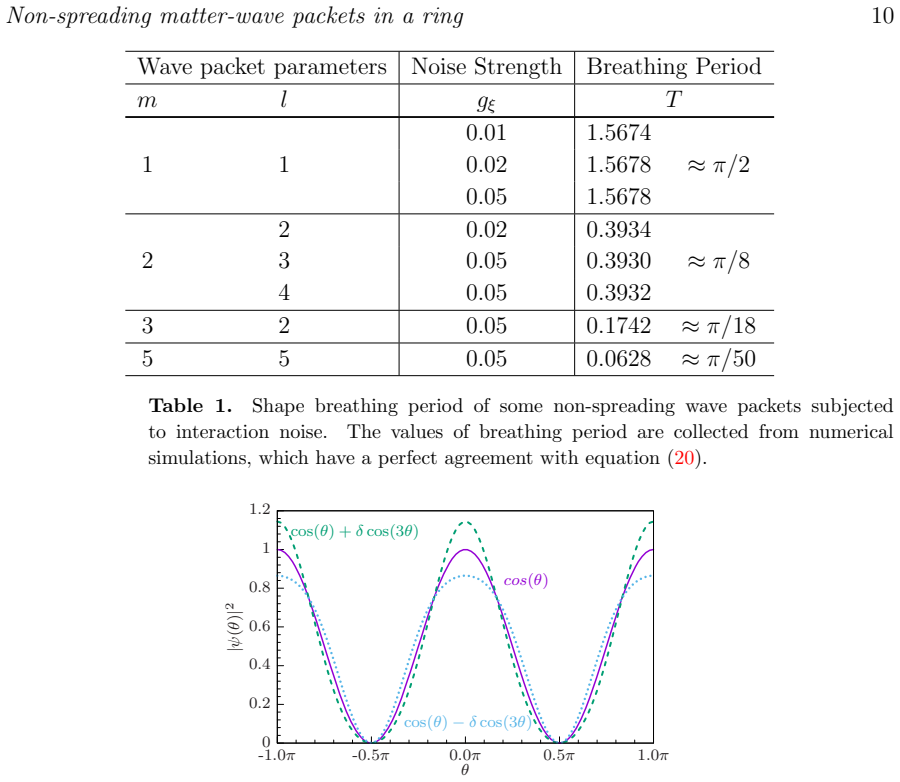
- In a toroidal BEC with interactions removed by a Feshbach resonance, these packets should persist without spreading; residual noise produces breathing with period $T=\pi/(2m^2)$.
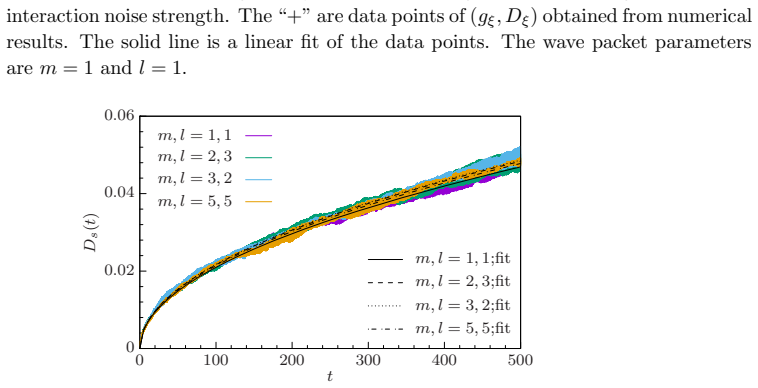
- All packets in the family resist interaction noise equally well, and the shape difference after time $t$ grows as $D_\xi\sqrt{t}$, with $D_\xi$ proportional to the noise strength.
Reading between the lines
- Because the uniqueness proof relies on finding a zero of the amplitude, packets with a permanently positive density background (for example, unequal mixtures of $\pm m$ modes) are not explicitly covered; evolving such a superposition in a ring simulation would test whether the list in equation (11) is truly exhaustive.
- The breathing formula $T=\pi/(2m^2)$ offers a diagnostic: the dominant shape-oscillation frequency of a noisy packet directly reveals its node quantum number $m$.
- If the family is indeed unique and linear, a ring-based matter-wave interferometer built from these packets could avoid the nonlinear phase diffusion that affects soliton interferometers, while keeping the packets from spreading during the sequence.
Signed reviews
Editorial analysis
A structured set of objections, weighed in public.
Referee Report
Summary. The manuscript considers the linear Schrödinger equation on a ring, Eq. (1), and claims to prove that the only non-spreading matter-wave packets are those of Eq. (11), with envelope cos(mθ−lt) and phase ilθ + i(m²+l²)t/2. It then proposes a toroidal BEC realization using Feshbach resonance to eliminate interactions, and reports numerical stability results: weak residual noise preserves shape, stronger noise induces breathing with period π/(2m²), and the shape difference grows as Dξ√t with Dξ linear in the noise strength.
Significance. The claimed uniqueness theorem would be a clean and useful result if true, and the numerical stability study addresses a relevant experimental question. However, the central analytical result fails direct substitution: Eq. (11) is not a solution of Eq. (1) for general m,l, and Eq. (9) has the same sign error. The uniqueness proof relies on a false assertion that nonconstant amplitudes must vanish somewhere, and explicit non-spreading superpositions of ±m modes provide counterexamples. The numerical section is carefully executed (500 realizations, operator splitting, a quantitative shape-difference metric) and the breathing-period relation is plausible, but it is built on the incorrect kinematics of Eq. (11) for m≠1. The paper's main claim is therefore unsupported and in fact false.
major comments (4)
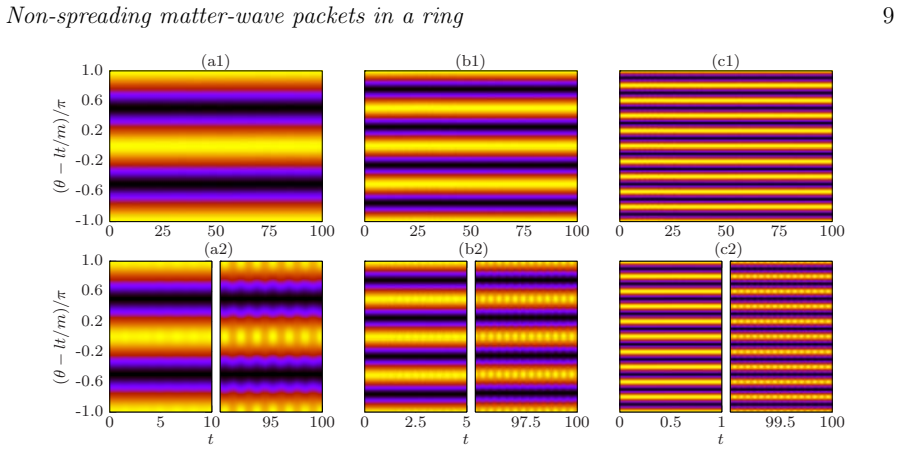
- [Sec. 2, Eq. (11)] Direct substitution of ψ=C cos(mθ−lt) exp[ilθ+i(m²+l²)t/2] into Eq. (1) gives i∂tψ = [−(m²+l²)/2 cos(mθ−lt) + i l sin(mθ−lt)]e^{iS}, while −1/2∂²ψ = [(m²+l²)/2 cos(mθ−lt) + i l m sin(mθ−lt)]e^{iS}. The real parts have opposite signs and the imaginary parts agree only for m=1; for m=1 the time phase would need the opposite sign. Moreover, the exact evolution of the initial state C cos(mθ)e^{ilθ} is C cos(m(θ−lt)) e^{ilθ} e^{−i(m²+l²)t/2}, so Eq. (11) has the wrong envelope time argument for m≠1. Thus Eq. (11) is not a solution of Eq. (1) for general m,l, and the paper's central formula is invalid.
- [Sec. 2, Eq. (9)] The trivial state has the same time-phase error: ψ=C e^{ilθ+il²t/2} gives i∂tψ=−l²/2 ψ but −1/2∂²ψ=+l²/2 ψ; the correct state is C e^{ilθ−il²t/2}. The error is systematic in the derivation: after Eq. (7), the paper obtains A_φφ+(c0²−2G1)A=0, whereas the correct reduction of Eq. (7) for A_φφ=−m²A, S_θ=c0, and S_t=G1 gives G1=−(c0²+m²)/2. These two forms conflict unless the sign in front of G1 is reversed.
- [Sec. 2, after Eq. (8)] The proof that c(t)=0 rests on the assertion that every nonconstant A(φ) has an angle φ0 with A(φ0)=0. This assertion is false: the density of |a e^{imθ}+b e^{-imθ}|² = a²+b²+2ab cos(2mθ) is positive and nonconstant for a≠b, and the corresponding wave function is time-independent up to a global phase, hence non-spreading. It is not of the form Eq. (11). The uniqueness conclusion is therefore unsupported, and the 'only set' claim is false.
- [Sec. 4, Figs. 2, 4 and Eq. (22)] The numerical stability analysis inherits the incorrect kinematics of Eq. (11). For the initial state C cos(mθ)e^{ilθ}, the exact free evolution has density C² cos²(m(θ−lt)), so the packet travels at speed l, whereas the paper shifts by φ=θ−lt/m throughout Figs. 2 and 4. For m≠1 the plotted co-moving frame does not track the packet, so the shape difference D_s(t) is not measured in the packet's rest frame. Furthermore, the quantitative laws D_s=D_ξ√t and D_ξ∝g_ξ (Figs. 5–7) are fits to the same numerical data from which they are extracted, presented without error bars, ensemble-size checks, or independent validation; they should be reframed as empirical fits and re-examined in the correct frame.
minor comments (5)
- [Fig. 7 caption] The fitted Dξ values are listed as 2.09, 2.16, 1.18, 2.14×10⁻³; the third value appears to be a typo for 2.18, since the text states 2.18 and the curves are said to nearly overlap.
- [Eq. (21)] The notation ψ(θ−θc,t,t) should be written more clearly, for example ψ(θ−θc(t),t), to indicate the shift by the packet's center at time t.
- [Throughout] There are typographical errors such as 'amizuthal' before Eq. (2) and 'svortices' in reference [47]; these should be corrected.
- [Table 1] For m=3, l=2 only one noise strength is shown; adding a second gξ value would strengthen the claim that the breathing period is independent of gξ.
- [Sec. 3] The estimate gξ≈0.022 from the experimental magnetic-field stability is stated without derivation; a brief calculation would improve reproducibility.
Circularity Check
No significant circularity: derivation is a direct solution of the Schrödinger equation; any defects are mathematical correctness issues, not input-output circularity.
full rationale
The paper's main analytic claim is obtained by inserting the standard Madelung ansatz ψ=A e^{iS} into Eq. (1), imposing periodicity, and solving the resulting ordinary differential equation for A. That ansatz is the usual definition of shape preservation (A depends on θ and t only through θ−f(t)), so using it is not a self-referential reduction of the conclusion to the premise. No parameter is fitted and then renamed as a prediction in the analytic part. The numerical stability section fits D_s(t)=D_ξ√t curves and then fits D_ξ versus g_ξ; these are explicitly labeled fits to simulation data, not statistically forced predictions of independent quantities. There are no self-citations or imported uniqueness theorems; references [54,55] merely justify the standard polar decomposition. The questionable step after Eq. (8) — asserting that every nonconstant A must vanish somewhere — is a mathematical falsehood and a gap in the uniqueness proof, but it is not circular: it does not assume the conclusion or fit a parameter to the result. Likewise, the apparent sign error in Eq. (11) relative to Eq. (1) is an algebraic correctness defect, not a circular reduction. Under the required criterion of exhibiting a specific reduction of a result to its own inputs by construction, no such reduction is present in this paper.
Assumptions & free parameters
free parameters (2)
- Dξ (shape-difference rate) =
4.23, 8.45, 13.4, 16.9, 21.2 ×10^-4 for gξ=0.01..0.05; 2.09, 2.16, 2.18, 2.14 ×10^-3 for m,l states at gξ=0.05
- Linear slope of Dξ vs gξ =
≈0.042 (from Fig. 6)
assumptions (7)
- standard math Periodic boundary conditions on the ring require ψ and ∂θψ to be 2π-periodic.
- standard math The wave function can be written in Madelung form ψ=A(θ,t)e^{iS(θ,t)} with real A and S.
- domain assumption Non-spreading means the density depends on θ through θ-f(t) for some real f(t).
- ad hoc to paper For any non-constant A, there exists an angle φ0 with A(φ0)=0, so c(t)=0 in Eq. (8).
- domain assumption df/dt can be expanded in a Taylor series in t.
- domain assumption In a toroidal BEC, strong transverse confinement reduces the system to a 1D ring and Feshbach resonance can set the interaction to zero.
- domain assumption Residual interaction noise is white and uniformly distributed in [-1,1].
Cite this review
Pith. "Pith review of Non-spreading matter-wave packets in a ring." pith.science (2026). https://pith.science/paper/UE2JQKAS
@misc{pith2026190806285,
  author       = {Pith},
  title        = {Pith review of: Non-spreading matter-wave packets in a ring},
  year         = {2026},
  howpublished = {\url{https://pith.science/paper/UE2JQKAS}},
  note         = {Machine review of arXiv:1908.06285}
}
read the original abstract
Non-spreading wave packets and matter-wave packets in ring traps both have attracted great research interests due to their miraculous physical properties and tempting applications for quite a long time. Here, we proved that there exists only one set of non-spreading matter-wave packets in a free ring, and this set of wave packets have been found analytically. These non-spreading matter-wave packets can be realized in a toroidal trapped Bose-Einstein condensate system with the help of Feshbach resonance to eliminate contact interaction between atoms. Since experimentally residual interaction noise will always exist, its effect on the stability of these non-spreading wave packets is also examined. Qualitatively, under weak residual interaction noise, these non-spreading wave packets can preserve their shape for quite a long time, while a stronger interaction noise will induce shape breathing of the wave packets. Shape-keeping abilities of these wave packets are further studied quantitatively. We found that this set of wave packets have the same shape-keeping ability against interaction noise. And, the shape-keeping ability is linearly related to the interaction noise strength.
Figures
Figures from the paper (5 more)



Reference graph
Works this paper leans on
-
[1]
Gangat A, Pradhan P, Pati G and Shahriar M S 2005 Two-dimensional nanolithography using atom interferometry Phys. Rev. A 71 043606
work page 2005
-
[2]
Fouda M F, Fang R, Ketterson J B and Shahriar M S 2016 Generation of arbitrary lithographic patterns using Bose-Einstein-condensate interferometry Phys. Rev. A 94 063644
work page 2016
-
[3]
O’Dwyer C, Gay G, de Lesegno B V, Weiner J, Camposeo A, Tantussi F, Fuso F, Allegrini M and Arimondo E 2005 Atomic nanolithography patterning of submicron features: writing an organic self-assembled monolayer with cold, bright Cs atom beams Nanotechnology 16 1536
work page 2005
-
[4]
Vengalattore M, Higbie J M, Leslie S R, Guzman J, Sadler L E and Stamper-Kurn D M 2007 High- resolution magnetometry with a spinor Bose-Einstein condensate Phys. Rev. Lett. 98 200801
work page 2007
-
[5]
Muessel W, Strobel H, Linnemann D, Hume D B and Oberthaler M K 2014 Scalable spin squeezing for quantum-enhanced magnetometry with Bose-Einstein condensates Phys. Rev. Lett. 113 103004
work page 2014
-
[6]
Cronin A D and Schmiedmayer J 2009 Optics and interferometry with atoms and molecules Rev. Mod. Phys. 81 1051
work page 2009
-
[7]
Lee C, Huang J, Deng H, Dai H and Xu J 2012 Nonlinear quantum interferometry with Bose condensed atoms Frontiers of Physics 7 109
work page 2012
-
[8]
M¨ untinga H, Ahlers H, Krutzik M, Wenzlawski A, Arnold S, Becker D, Bongs K, Dittus H, Duncker H, Gaaloul N, Gherasim C, Giese E, Grzeschik C, H¨ ansch T W, Hellmig O, Herr W, Herrmann S, Kajari E, Kleinert S, L¨ ammerzahl C, Lewoczko-Adamczyk W, Malcolm J, Meyer N, Nolte R, Peters A, Popp M, Reichel J, Roura A, Rudolph J, Schiemangk M, Schneider M, Seid...
work page 2013
Show all 60 references
-
[9]
Robins N P, Altin P A, Debs J E and Close J D 2013 Atom lasers: production, properties and prospects for precision inertial measurement Physics Reports 529 265
2013
-
[10]
Bolpasi V, Efremidis N K, Morrissey M J, Condylis P C, Sahagun D, Baker M and von Klitzing W 2014 An ultra-bright atom laser New Journal of Physics 16 033036
2014
-
[11]
Khaykovich L, Schreck F, Ferrari G, Bourdel T, Cubizolles J, Carr L D, Castin Y and Salomon C 2002 Formation of a matter-wave bright soliton Science 296 1290
2002
-
[12]
Strecker K E, Partridge G B, Truscott A G and Hulet R G 2002 Formation and propagation of matter-wave soliton trains Nature 417 150
2002
-
[13]
Strecker K E, Partridge G B, Truscott A G and Hulet R G 2003 Bright matter wave solitons in Bose-Einstein condensates New Journal of Physics 5 73
2003
-
[14]
Abdullaev F K and Garnier J 2008 Bright solitons in Bose-Einstein condensates: theory Emergent Nonlinear Phenomena in Bose-Einstein Condensates: Theory and Experiment ed P G Kevrekidis, D J Frantzeskakis and R Carretero-Gonzalez (Berlin, Heidelberg: Springer Berlin Heidelberg) p 25
2008
-
[15]
Martin A D and Ruostekoski J 2012 Quantum dynamics of atomic bright solitons under splitting and recollision, and implications for interferometry New Journal of Physics 14 043040
2012
-
[16]
Polo J and Ahufinger V 2013 Soliton-based matter-wave interferometer Phys. Rev. A 88 053628
2013
-
[17]
Gertjerenken B 2013 Bright-soliton quantum superpositions: Signatures of high- and low-fidelity states Phys. Rev. A 88 053623
2013
-
[18]
Helm J L, Rooney S J, Weiss C and Gardiner S A 2014 Splitting bright matter-wave solitons on narrow potential barriers: Quantum to classical transition and applications to interferometry Phys. Rev. A 89 033610
2014
-
[19]
Sakaguchi H and Malomed B A 2016 Matter-wave soliton interferometer based on a nonlinear splitter New Journal of Physics 18 025020
2016
-
[20]
McDonald G D, Kuhn C C N, Hardman K S, Bennetts S, Everitt P J, Altin P A, Debs J E, Close J D and Robins N P 2014 Bright Solitonic Matter-Wave Interferometer Phys. Rev. Lett. 113 Non-spreading matter-wave packets in a ring 15 013002
2014
-
[21]
McDonald G D, Kuhn C C N, Hardman K S, Bennetts S, Everitt P J, Altin P A, Debs J E, Close J D and Robins N P 2017 Erratum: Bright Solitonic Matter-Wave Interferometer [Phys. Rev. Lett. 113, 013002 (2014)] Phys. Rev. Lett. 118 219903
2014
-
[22]
Fattori M, D’Errico C, Roati G, Zaccanti M, Jona-Lasinio M, Modugno M, Inguscio M and Modugno G 2008 Atom interferometry with a weakly interacting Bose-Einstein condensatePhys. Rev. Lett. 100 080405
2008
-
[23]
Gustavsson M, Haller E, Mark M J, Danzl J G, Rojas-Kopeinig G and N¨ agerl H-C 2008 Control of interaction-induced dephasing of Bloch oscillations Phys. Rev. Lett. 100 080404
2008
-
[24]
Haine S A 2016 Mean-Field Dynamics and Fisher Information in Matter Wave Interferometry Phys. Rev. Lett. 116 230404
2016
-
[25]
Haine S A 2018 Quantum noise in bright soliton matterwave interferometryNew Journal of Physics 20 33009
2018
-
[26]
Jo G-B, Shin Y, Will S, Pasquini T A, Saba M, Ketterle W, Pritchard D E, Vengalattore M and Prentiss M 2007 Long Phase Coherence Time and Number Squeezing of Two Bose-Einstein Condensates on an Atom Chip Phys. Rev. Lett. 98 030407
2007
-
[27]
Berrada T, van Frank S, B¨ ucker R, Schumm T, Schaff J-F and Schmiedmayer J 2013 Integrated Mach-Zehnder interferometer for Bose-Einstein condensates Nature Communications 4 2077
2013
-
[28]
Gross C, Zibold T, Nicklas E, Est´ eve J and Oberthaler M K 2010 Nonlinear atom interferometer surpasses classical precision limit Nature 464 1165
2010
-
[29]
L¨ ucke B, Scherer M, Kruse J, Pezz´ e L, Deuretzbacher F, Hyllus P, Topic O, Peise J, Ertmer W, Arlt J, Santos L, Smerzi A and Klempt C 2011 Twin Matter Waves for Interferometry Beyond the Classical Limit Science 334 773
2011
-
[30]
Berry M V and Balazs N L 1979 Nonspreading wave packets American Journal of Physics 47 264
1979
-
[31]
Hu Y, Siviloglou G A, Zhang P, Efremidis N K, Christodoulides D N and Chen Z 2012 Self- accelerating Airy beams: generation, control, and applications Nonlinear Photonics and Novel Optical Phenomena (Springer Series in Optical Sciences vol 170) ed Z Chen and R Morandotti (New ...
2012
-
[32]
Siviloglou G A, Broky J, Dogariu A and Christodoulides D N 2007 Observation of accelerating Airy beams Phys. Rev. Lett. 99 213901
2007
-
[33]
Voloch-Bloch N, Lereah Y, Lilach Y, Gover A and Arie A 2013 Generation of electron Airy beams Nature 494 331
2013
-
[34]
Efremidis N K, Paltoglou V and von Klitzing W 2013 Accelerating and abruptly autofocusing matter waves Phys. Rev. A 87 043637
2013
-
[35]
Yuce C 2015 Self-accelerating matter waves Modern Physics Letters B 29 1550171
2015
-
[36]
Bouyer P 2014 The centenary of Sagnac effect and its applications: from electromagnetic to matter waves Gyroscopy and Navigation 5 20
2014
-
[37]
Barrett B, Geiger R, Dutta I, Meunier M, Canuel B, Gauguet A, Bouyer P and Landragin A 2014 The Sagnac effect: 20 years of development in matter-wave interferometry Comptes Rendus Physique 15 875
2014
-
[38]
Dayon D J, Toland J R E and Search C P 2010 Atom gyroscope with disordered arrays of quantum rings Journal of Physics B: Atomic, Molecular and Optical Physics 43 115302
2010
-
[39]
Helm J L, Cornish S L and Gardiner S A 2015 Sagnac interferometry using bright matter-wave solitons Phys. Rev. Lett. 114 134101
2015
-
[40]
Stevenson R, Hush M R, Bishop T, Lesanovsky I and Fernholz T 2015 Sagnac interferometry with a single atomic clock Phys. Rev. Lett. 115 163001
2015
-
[41]
Ryu C, Blackburn P W, Blinova A A and Boshier M G 2013 Experimental realization of Josephson junctions for an atom SQUID Phys. Rev. Lett. 111 205301
2013
-
[42]
Wang Y-H, Kumar A, Jendrzejewski F, Wilson R M, Edwards M, Eckel S, Campbell G K and Clark C W 2015 Resonant wavepackets and shock waves in an atomtronic SQUID New Journal of Physics 17 125012 Non-spreading matter-wave packets in a ring 16
2015
-
[43]
Mathey A C and Mathey L 2016 Realizing and optimizing an atomtronic SQUID New Journal of Physics 18 055016
2016
-
[44]
Kumar A, Anderson N, Phillips W D, Eckel S, Campbell G K and Stringari S 2016 Minimally destructive, Doppler measurement of a quantized flow in a ring-shaped Bose-Einstein condensate New Journal of Physics 18 025001
2016
-
[45]
Beattie S, Moulder S, Fletcher R J and Hadzibabic Z 2013 Persistent currents in spinor condensates Phys. Rev. Lett. 110 025301
2013
-
[46]
Ryu C, Andersen M F, Clad´ e P, Natarajan V, Helmerson K and Phillips W D 2007 Observation of persistent flow of a Bose-Einstein condensate in a toroidal trap Phys. Rev. Lett. 99 260401
2007
-
[47]
Brand J and Reinhardt W P 2001 Generating ring currents, solitons and svortices by stirring a Bose-Einstein condensate in a toroidal trap Journal of Physics B: Atomic, Molecular and Optical Physics 34 L113
2001
-
[48]
Li T, Gong Z-X, Yin Z-Q, Quan H T, Yin X, Zhang P, Duan L-M and Zhang X 2012 Space-time crystals of trapped ions Phys. Rev. Lett. 109 163001
2012
-
[49]
¨Ohberg P and Wright E M 2018 On quantum time crystals and interacting gauge theories in atomic Bose-Einstein condensates arXiv:1812.04672
2018 arXiv
-
[50]
Sacha K and Zakrzewski J 2018 Time crystals: a review Reports on Progress in Physics 81 16401
2018
-
[51]
Chin C, Grimm R, Julienne P and Tiesinga E 2010 Feshbach resonances in ultracold gases Rev. Mod. Phys. 82 1225
2010
-
[52]
Timmermans E, Tommasini P, Hussein M and Kerman A 1999 Feshbach resonances in atomic Bose-Einstein condensates Physics Reports 315 199
1999
-
[53]
Pollack S E, Dries D, Junker M, Chen Y P, Corcovilos T A and Hulet R G 2009 Extreme Tunability of Interactions in a 7Li Bose-Einstein Condensate Phys. Rev. Lett. 102 090402
2009
-
[54]
Madelung E 1927 Quantentheorie in hydrodynamischer Form Zeitschrift f¨ ur Physik40 322
1927
-
[55]
Lin C-L, Huang M-J and Hsiung T-C 2008 Nonspreading wave packets in a general potential V(x,t) in one dimension arXiv:0809.4105
2008 arXiv
-
[56]
Wright E M, Arlt J and Dholakia K 2000 Toroidal optical dipole traps for atomic Bose-Einstein condensates using Laguerre-Gaussian beams Phys. Rev. A 63 13608
2000
-
[57]
Arnold A S 2004 Adaptable-radius, time-orbiting magnetic ring trap for Bose-Einstein condensates Journal of Physics B: Atomic, Molecular and Optical Physics 37 L29
2004
-
[58]
Crookston M B, Baker P M and Robinson M P 2005 A microchip ring trap for cold atoms Journal of Physics B: Atomic, Molecular and Optical Physics 38 3289
2005
-
[59]
W H Heathcote W H, Nugent E,Sheard B T and Foot C J 2008 A ring trap for ultracold atoms in an RF-dressed state New Journal of Physics 10, 043012
2008
-
[60]
Gardiner C W 1985 Handbook of stochastic methods for physics, chemistry, and the natural sciences (Berlin, Heidelberg, New York: Springer-Verlag)
1985
Reviewed August 14, 2026 · model on record in the stance chip above.
Discussion (0). Continue with ORCID to comment.