REVIEW 3 major objections 3 minor 59 references
Minimum Monotone Spanning Trees
T0 review · 3 major / 3 minor · reviewed 2026-08-12 · deepseek-v4-flash
Pith's one-line read For any fixed set of directions, the shortest spanning tree whose every path is monotone can be computed in polynomial time; for two directions, in quadratic time.
desk verdict New problem, a real structural characterization, and XP algorithms with a fixable gap at k>=3; worth a serious referee. read the letter →
The pith
A machine-rendered reading of the paper's core claim, the machinery that carries it, and where it could break.
The reading
What carries the argument
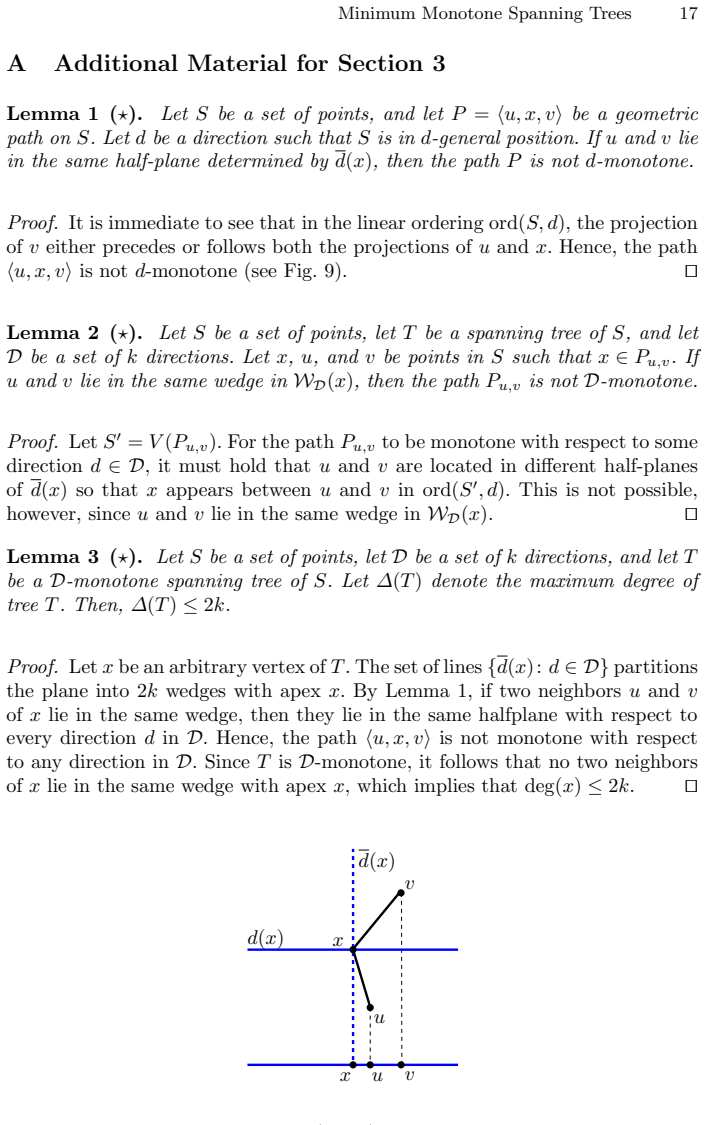
The machinery is the decomposition of a $D$-monotone spanning tree into leaf paths and branches, each carrying a wedge set. With $k$ directions, the lines through a point perpendicular to those directions cut the plane into $2k$ wedges; the wedge set of a directed path is the smallest consecutive block of wedges containing all directions that path travels in. Two derived objects do the work: $W_{u\setminus v}(u)$, the wedge region of the subtree at $u$ that avoids $v$, and $R_{u,v}$, the region of the branch or leaf path between $u$ and $v$. Theorem 1 makes monotonicity equivalent to three conditions on these objects, Lemma 11 shows that a fixed tree shape, vertex mapping, and wedge assignment determine a unique candidate tree in $O(n \log n + nk + k)$ time, and a counting lemma bounds the number of homeomorphically irreducible trees (embedded trees with no degree-2 vertices) with at most $\ell$ leaves by $O(7^\ell \ell!)$.
What would settle it
Run an exhaustive search over all small point sets in general position with, say, six points and $k=2$ or $k=3$: check whether the spanning trees satisfying conditions (a)–(c) of Theorem 1 are exactly the $D$-monotone spanning trees, and whether the best tree over all $k$-direction sets is matched by the best tree using only directions from slopes of point pairs. A single mismatch in either test would refute the characterization or the direction-restriction claim on which the XP algorithms rest.
Extended reading notes
Core claim
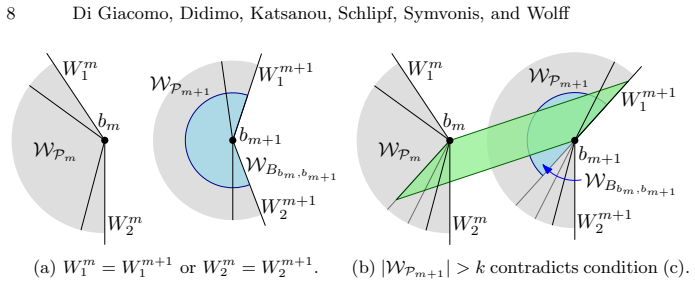
The central claim is a characterization (Theorem 1): a spanning tree $T$ of a point set $S$ is $D$-monotone if and only if (a) every leaf path and every branch of $T$ is $D$-monotone, (b) the wedge sets of any two leaf paths are disjoint, and (c) for every branch or leaf path $P_{u,v}$, the region $R_{u,v}$ of that path is disjoint from the wedge region $W_{u\setminus v}(u)$ of the subtree hanging from $u$ away from $v$. This turns a condition on every pair of vertices into local conditions on $O(k)$ paths, which is what makes enumeration feasible. The paper argues that once a tree shape, a mapping of branching vertices to points, and an assignment of the $2k$ wedges to leaves are fixed, the optimal tree is unique and can be built in near-linear time by sorting points along two boundary directions. Enumerating shapes, mappings, and wedge assignments yields the XP algorithm for a prescribed direction set, and applying that over direction sets drawn from the slopes of point pairs yields the XP algorithm for choosing $k$ directions.
Load-bearing premise
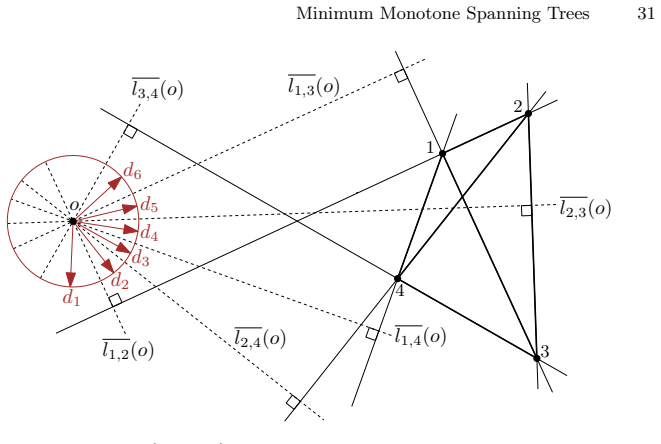
The load-bearing premise is that, for $k \ge 3$, no optimal direction set is lost by restricting to directions taken from the finite list of slopes of lines through pairs of input points and by perturbing the points into general position; the paper states that an exchange argument proves this, but does not supply the argument.
Editorial extensions
If this is right
- For every fixed $k$, both versions of the problem — directions prescribed or directions chosen — can be solved in polynomial time, with exponents linear in $k$ for the prescribed case and quadratic in $k$ for the chosen case.
- A $D$-monotone spanning tree has at most $2k$ leaves and maximum degree at most $2k$, so the enumeration over tree shapes is finite and the degree bound is tight in the worst case.
- For two prescribed directions, the minimum $D$-monotone spanning tree can be found in $O(n^2)$ time, improving the generic $O(n^3 \log n)$ bound for that case.
- For choosing one direction, the optimum is a monotone spanning path, computable in $O(n^2 \log n)$ time by sweeping the circular sequence of directions defined by slopes of point pairs.
- The shortest $k$-monotone spanning tree can be forced to have a vertex of degree $2k$, so monotonicity, unlike the Euclidean MST property, does not keep degrees small.
Reading between the lines
- The characterization suggests a recognition algorithm the paper does not spell out: a given geometric spanning tree can be checked for $D$-monotonicity by testing the $O(k)$ conditions (a)–(c) rather than all vertex pairs.
- The degree-$2k$ lower bound hints that monotone trees behave like hub-and-spoke structures under restricted direction sets, which could matter for routing or network design where paths must be non-backtracking; the paper does not explore applications.
- A natural stress test for the XP algorithm is to compare the length of the shortest $k$-monotone spanning tree with the ordinary Euclidean MST on random point sets; the paper gives no computational data, and the gap should grow with $k$ and with anisotropy of the point distribution.
- The XP results leave open whether the direction-choice problem stays polynomial when $k$ is part of the input; the next target is to prove NP-hardness for variable $k$ or to find a fixed-parameter-tractable algorithm.
Editorial analysis
A structured set of objections, weighed in public.
Referee Report
Summary. The paper introduces the minimum monotone spanning tree problem. For a point set S and a set D of directions, a spanning tree is D-monotone if the unique path between every pair of vertices is monotone with respect to some direction in D. The central contribution is a structural characterization (Theorem 1) of D-monotone spanning trees in terms of wedge sets of leaf paths, branches, and disjointness conditions. Using this characterization, the authors give an XP algorithm for MMST(S,D) parameterized by |D|, an O(n^2)-time algorithm for |D|=2, algorithms for MMST(S,k) for k=1 and k=2, an XP algorithm for general k, and a construction showing that minimum k-directional monotone spanning trees can have degree 2k, in contrast to the degree bound 6 for Euclidean MSTs. The proofs are largely self-contained, with several details deferred to appendices.
Significance. If the results are correct, the paper contributes a reusable structural characterization of D-monotone spanning trees and establishes exact complexity-theoretic upper bounds (XP) for natural parameterized geometric optimization problems. The algorithms are deterministic and are derived from the characterization rather than from heuristic fitting or numerical search, which is a strength. The degree-2k construction is a clean and explicit counterpoint to the bounded-degree property of classical Euclidean MSTs. The main caveat is that the XP claim for MMST(S,k) with k >= 3 depends on an unproven exchange argument in the proof of Theorem 7; this part of the paper needs to be completed or corrected before the advertised result can be considered established.
major comments (3)
- [Appendix C, proof of Theorem 7] The step limiting the search to k-tuples of directions from the Goodman-Pollack sequence sigma is not proved for k >= 3. The proof says only: "By using an exchange argument as in the proof of Theorem 6, it can be proven that it is sufficient to restrict ourselves to sets D of k directions for which S is in D-general position." Theorem 6 covers only k = 2 and perturbs one direction while keeping the other fixed. For k >= 3 one must show that an optimal D-monotone tree T remains D'-monotone under a simultaneous perturbation D' of all k directions, and that each perturbed direction can be replaced by a direction from sigma without increasing the optimum. This is load-bearing because the abstract claims that MMST(S,k) is in XP for every k. The gap appears repairable, e.g., by intersecting the open monotonicity intervals of all paths in T and selecting generic directions with representatives in sigma, but the argument must be supplied in full.
- [Appendix C, Theorem 7] The stated running time is arithmetically inconsistent with the proof. The proof applies Theorem 2, which has running time O(f(k) * n^{2k-1} log n), to each of the C(h,k) = O(n^{2k}) direction sets obtained from sigma, yielding O(f(k) * n^{4k-1} log n) after absorbing h = O(n^2). The paper instead claims O(f(k) * n^{2k(2k-1)} log n). The corrected bound is still in XP, but the stated complexity should be fixed.
- [Theorem 1, proof of converse direction] The induction step in the proof of the converse direction of Theorem 1 asserts that if both the leading and trailing wedges of W_{P_m} change when passing to W_{P_{m+1}}, then |W_{B_{b_{m+1},b_m}}| > k. This is plausible but is stated without a formal argument, and it is essential for the characterization on which all subsequent algorithms rest. Please expand this step so that the reader can verify the wedge counting in the case analysis, especially with respect to the orientation of the branch B_{b_m,b_{m+1}}.
minor comments (3)
- [Theorem 1, proof of converse direction] In the last paragraph of the proof, the expression "W_{P_m}(b_m) \subset W_{b_m,b_{m+1}}(b_m)" appears to contain a typographical error: W_{b_m,b_{m+1}} is not defined, and the intended set is presumably W_{b_m \setminus b_{m+1}}. Please correct the subscript.
- [Appendix C, Theorem 7] The final sentence of the proof says "it is sufficient to restrict ourselves to sets D of k directions for which S is D-monotone." This should read "S is in D-general position," since the former is a property of trees, not of point-direction pairs.
- [Appendix B, proof of Lemma 11] There is a typo in the sentence "The assignment A of the wedges of WD to the leaves of H defines, for each leaf path, a reagion that must contain it." Replace "reagion" with "region."
Circularity Check
No circularity: the new characterization drives the algorithms, and the only flagged issues are an unproven exchange argument and a runtime exponent slip, neither of which assumes the conclusion.
full rationale
The derivation chain is self-contained. Theorem 1 characterizes D-monotone spanning trees via conditions (a)-(c); its necessity direction uses Lemma 6(ii) and Lemma 9, and its sufficiency direction builds a leaf-to-leaf path from leaf paths and branches and uses Corollary 1 (from Lemma 5) together with an induction on the branch sequence, never assuming that the target path is D-monotone. Lemma 5 and Corollary 1 are proved directly from the projection definition of monotonicity. The algorithms of Lemma 11 and Theorem 2 are enumerations over HITs, point mappings, and wedge assignments; their correctness is reduced to Theorem 1, and Lemma 11's solution uniqueness follows from sorted unique monotone paths inside each region, not from a fitted parameter. For MMST(S,k), Theorem 5 enumerates the Goodman-Pollack direction sequence and proves every 1-directional monotone path is represented because its monotonicity interval is an open sector bounded by lines in L; Theorem 6 gives the rotation argument for two directions. The only flagged issues are in Appendix C (Theorem 7): the statement 'By using an exchange argument as in the proof of Theorem 6, it can be proven that it is sufficient to restrict ourselves to sets D of k directions for which S is in D-general position' is an omitted proof for k>=3, and the stated runtime O(f(k)n^{2k(2k-1)}log n) does not follow from C(h,k) in O(n^{2k}) applications of an O(f(k)n^{2k-1}log n) procedure, which gives O(f(k)n^{4k-1}log n). These are correctness risks, not circularity, because neither assumes the optimality of the enumerated set. Self-citations to Mastakas and Symvonis are related work; the load-bearing monotone-path lemma (Lemma 4) is external and standard, and no claim reduces to a self-citation. Hence no circular step occurs.
Assumptions & free parameters
assumptions (4)
- standard math A path is monotone iff its sector of directions has angle less than pi (Lemma 4 of Angelini et al.).
- domain assumption Real RAM model with exact real arithmetic.
- domain assumption Point set S is in d-general position for the directions used, or degeneracies are handled by perturbation.
- standard math The Goodman-Pollack circular sequence of O(n^2) slopes captures all relevant monotone spanning paths.
Cite this review
Pith. "Pith review of Minimum Monotone Spanning Trees." pith.science (2026). https://pith.science/paper/UF5ZPED3
@misc{pith2026241114038,
  author       = {Pith},
  title        = {Pith review of: Minimum Monotone Spanning Trees},
  year         = {2026},
  howpublished = {\url{https://pith.science/paper/UF5ZPED3}},
  note         = {Machine review of arXiv:2411.14038}
}
abstract
Given a finite set $S$ of points in the plane and a finite set $\mathcal{D}$ of directions, a geometric spanning tree~$T$ of~$S$ is $\mathcal{D}$-monotone if every path in $T$ is monotone with respect to some direction in $\mathcal{D}$. We study the problem of computing, for a given point set $S$ and a given set $\mathcal{D}$ of directions, a minimum-length $\mathcal{D}$-monotone spanning tree of~$S$. We present a quadratic-time algorithm for two directions. More generally, we show that the problem belongs to the complexity class XP when parameterized by the number of directions. We further study, for a given positive integer $k$ and point set~$S$, the problem of finding a minimum-length $\mathcal{D}$-monotone spanning tree of $S$ over all possible sets~$\mathcal{D}$ of $k$ directions. We prove that this problem, too, is in XP when parameterized by~$k$, and present two algorithms that run in $O(n^2 \log n)$ and $O(n^6)$ time for $k=1$ and $k=2$, respectively, where $n$ is the number of points in~$S$. Finally, in contrast to the classical Euclidean minimum spanning tree of a set of points, whose vertex degree is bounded by six, we show that for every even integer~$k$, there exists a point set~$S_k$ and a set $\mathcal{D}_k$ of $k$ directions such that any minimum-length $\mathcal{D}_k$-monotone spanning tree of $S_k$ has maximum vertex degree~$2k$.
Figures


Figures from the paper (17 more)







Reference graph
Works this paper leans on
-
[1]
Chan, Elyot Grant, Anna Lubiw, and Vinayak Pathak
Soroush Alamdari, Timothy M. Chan, Elyot Grant, Anna Lubiw, and Vinayak Pathak. Self-approaching graphs. In Walter Didimo and Maurizio Patrignani, editors, Proc. 20th Int. Symp. Graph Drawing (GD’12), volume 7704 of LNCS, pages 260–271. Springer, 2012. doi:10.1007/978-3-642-36763-2\_23
-
[2]
Monotone drawings of graphs with few directions
Patrizio Angelini. Monotone drawings of graphs with few directions. Inform. Process. Lett., 120:16–22, 2017. doi:10.1016/j.ipl.2016.12.004
-
[3]
Patrizio Angelini, Michael A. Bekos, Walter Didimo, Luca Grilli, Philipp Kinder- mann, Tamara Mchedlidze, Roman Prutkin, Antonios Symvonis, and Alessandra Tappini. Greedy rectilinear drawings. Theor. Comput. Sci., 795:375–397, 2019. doi:10.1016/J.TCS.2019.07.019
-
[4]
Patrizio Angelini, Enrico Colasante, Giuseppe Di Battista, Fabrizio Frati, and Maurizio Patrignani. Monotone drawings of graphs. J. Graph Algorithms Appl., 16(1):5–35, 2012. doi:10.7155/jgaa.00249
-
[5]
Monotone drawings of graphs with fixed embedding
Patrizio Angelini, Walter Didimo, Stephen Kobourov, Tamara Mchedlidze, Vin- cenzo Roselli, Antonios Symvonis, and Stephen Wismath. Monotone drawings of graphs with fixed embedding. Algorithmica, 71:233–257, 2015. doi:10.1007/ s00453-013-9790-3
work page 2015
-
[6]
An algorithm to construct greedy drawings of triangulations
Patrizio Angelini, Fabrizio Frati, and Luca Grilli. An algorithm to construct greedy drawings of triangulations. J. Graph Algorithms Appl., 14(1):19–51, 2010. doi: 10.7155/jgaa.00197
-
[7]
Arkin, Robert Connelly, and Joseph S
Esther M. Arkin, Robert Connelly, and Joseph S. B. Mitchell. On monotone paths among obstacles with applications to planning assemblies. In Proc. 5th Ann. ACM Symp. Comput. Geom. (SoCG), pages 334–343, 1989. doi:10.1145/73833.73870
-
[8]
Ex- ploring increasing-chord paths and trees
Yeganeh Bahoo, Stephane Durocher, Sahar Mehrpour, and Debajyoti Mondal. Ex- ploring increasing-chord paths and trees. In Joachim Gudmundsson and Michiel Smid, editors, Proc. 29th Canadian Conf. Comput. Geometry (CCCG), pages 19– 24, 2017
work page 2017
Show all 59 references
-
[9]
(Weakly) Self-approaching geometric graphs and spanners
Davood Bakhshesh and Mohammad Farshi. (Weakly) Self-approaching geometric graphs and spanners. Comput. Geom., 78:20–36, 2019. doi:10.1016/j.comgeo. 2018.10.002
2019 doi
-
[10]
Angle-monotonicity of Delaunay trian- gulation
Davood Bakhshesh and Mohammad Farshi. Angle-monotonicity of Delaunay trian- gulation. Comput. Geom., 94:101711, 2021. doi:10.1016/j.comgeo.2020.101711
2021
-
[11]
On the plane angle-monotone graphs
Davood Bakhshesh and Mohammad Farshi. On the plane angle-monotone graphs. Comput. Geom., 100:101818, 2022. doi:10.1016/j.comgeo.2021.101818
2022
-
[12]
Gabriel triangulations and angle-monotone graphs: Local routing and recognition
Nicolas Bonichon, Prosenjit Bose, Paz Carmi, Irina Kostitsyna, Anna Lubiw, and Sander Verdonschot. Gabriel triangulations and angle-monotone graphs: Local routing and recognition. In Yifan Hu and Martin N¨ ollenburg, editors, Proc. Int. Symp Graph Drawing & Network Vis. (GD), ...
2016 doi
-
[13]
Bernard Chazelle and David P. Dobkin. Intersection of convex objects in two and three dimensions. J. ACM, 34(1):1–27, 1987. doi:10.1145/7531.24036
1987
-
[14]
Algorithms for updating minimal spanning trees
Francis Chin and David Houck. Algorithms for updating minimal spanning trees. J. Comput. Syst. Sci., 16(3):333–344, 1978. doi:10.1016/0022-0000(78)90022-3
1978 doi
-
[15]
Increasing- chord graphs on point sets
Hooman Reisi Dehkordi, Fabrizio Frati, and Joachim Gudmundsson. Increasing- chord graphs on point sets. In Christian Duncan and Antonios Symvonis, editors, Proc. Int. Symp. Graph Drawing (GD), volume 8871 of LNCS, pages 464–475. Springer, 2014. doi:10.1007/978-3-662-45803-7_39...
2014 doi
-
[16]
Greedy drawings of triangulations
Raghavan Dhandapani. Greedy drawings of triangulations. Discrete. Comput. Geom., 43:375–392, 2010. doi:10.1007/s00454-009-9235-6
2010 doi
-
[17]
Upward graph drawing
Walter Didimo. Upward graph drawing. In Ming-Yang Kao, editor, Encyclopedia of Algorithms, pages 2308–2312. Springer, 2016. doi:10.1007/978-1-4939-2864-4\ _653
2016 doi
-
[18]
Finding the k smallest spanning trees
David Eppstein. Finding the k smallest spanning trees. BIT, 32:237–248, 1992. doi:10.1007/BF01994879
1992 doi
-
[19]
Spanning trees and spanners
David Eppstein. Spanning trees and spanners. In J.-R. Sack and J. Urrutia, editors, Handbook of Computational Geometry, pages 425–461. North-Holland, Amsterdam,
-
[20]
Strongly monotone drawings of planar graphs
Stefan Felsner, Alexander Igamberdiev, Philipp Kindermann, Boris Klemz, Tamara Mchedlidze, and Manfred Scheucher. Strongly monotone drawings of planar graphs. In S´ andor Fekete and Anna Lubiw, editors,Proc. 32nd Int. Symp. Comput. Geom. (SoCG), volume 51 of LIPIcs, pages 37:1...
2016 doi
-
[21]
The Euclidean degree-4 minimum span- ning tree problem is NP-hard
Andrea Francke and Michael Hoffmann. The Euclidean degree-4 minimum span- ning tree problem is NP-hard. In Proc. 25th Ann. ACM Symp. Comput. Geom. (SoCG), pages 179–188, 2009. doi:10.1145/1542362.1542399
2009
-
[22]
Frederickson
Greg N. Frederickson. Ambivalent data structures for dynamic 2-edge-connectivity and k smallest spanning trees. SIAM J. Comput., 26(2):484–538, 1997. doi: 10.1137/S0097539792226825
1997 doi
-
[23]
Harold N. Gabow. Two algorithms for generating weighted spanning trees in order. SIAM J. Comput., 6:139–150, 1977. doi:10.1137/0206011
1977 doi
-
[24]
Upward planarity testing
Ashim Garg and Roberto Tamassia. Upward planarity testing. Order, 12(2):109– 133, 1995. doi:10.1007/BF01108622
1995 doi
-
[25]
Papadimitriou
George Georgakopoulos and Christos H. Papadimitriou. The 1-Steiner tree prob- lem. J. Algorithms, 8(1):122–130, 1987. doi:10.1016/0196-6774(87)90032-0
1987 doi
-
[26]
Goodman and Richard Pollack
Jacob E. Goodman and Richard Pollack. On the combinatorial classification of nondegenerate configurations in the plane. J. Combin. Theory Ser. A, 29(2):220– 235, 1980. doi:10.1016/0097-3165(80)90011-4
1980 doi
-
[27]
Graham and Pavol Hell
Ronald L. Graham and Pavol Hell. On the history of the minimum spanning tree problem. Ann. Hist. Comput., 7(1):43–57, 1985. doi:10.1109/MAHC.1985.10011
1985
-
[28]
The number of homeomorphically irreducible trees, and other species
Frank Harary and Geert Prins. The number of homeomorphically irreducible trees, and other species. Acta Math., 101(1–2):141–162, 1959. doi:10.1007/BF02559543
1959 doi
-
[29]
Robinson, and Allen J
Frank Harary, Robert W. Robinson, and Allen J. Schwenk. Twenty-step algorithm for determining the asymptotic number of trees of various species. J. Austral. Math. Soc., 20(4):483–503, 1975. doi:10.1017/S1446788700016190
1975 doi
-
[30]
Optimal monotone drawings of trees
Dayu He and Xin He. Optimal monotone drawings of trees. SIAM J. Discrete Math., 31(3):1867–1877, 2017. doi:10.1137/16M1080045
2017 doi
-
[31]
Monotone drawings of 3-connected plane graphs
Xin He and Dayu He. Monotone drawings of 3-connected plane graphs. In Nikhil Bansal and Irene Finocchi, editors, Proc. Europ. Symp. Algorithms (ESA), volume 9294 of LNCS, pages 729–741. Springer, 2015. doi:10.1007/978-3-662-48350-3_ 61
2015 doi
-
[32]
Iqbal Hossain and Md
Md. Iqbal Hossain and Md. Saidur Rahman. Good spanning trees in graph drawing. Theoret. Comput. Sci., 607:149–165, 2015. doi:10.1016/j.tcs.2015.09.004
2015 doi
-
[33]
On monotone drawings of trees
Philipp Kindermann, Andr´ e Schulz, Joachim Spoerhase, and Alexander Wolff. On monotone drawings of trees. In Christian Duncan and Antonios Symvonis, editors, Proc. Int. Symp. Graph Drawing (GD), volume 8871 of LNCS, pages 488–500. Springer, 2014. doi:10.1007/978-3-662-45803-7_41
2014 doi
-
[34]
Michael P. Knapp. Sines and cosines of angles in arithmetic progression. Mathe- matics Magazine, 82(5):371–372, 2009. doi:10.4169/002557009X478436. Minimum Monotone Spanning Trees 15
2009 doi
-
[35]
Luccio, and Franco P
Hsiang-Tsung Kung, Fabrizio L. Luccio, and Franco P. Preparata. On finding the maxima of a set of vectors. J. ACM, 22(4):469–476, 1975. doi:10.1145/321906. 321910
1975 doi
-
[36]
Construction and local routing for angle- monotone graphs
Anna Lubiw and Debajyoti Mondal. Construction and local routing for angle- monotone graphs. J. Graph Algorithms Appl., 23(2):345–369, 2019. doi:10.7155/ jgaa.00494
2019
-
[37]
Uniform 2d-monotone minimum spanning graphs
Konstantinos Mastakas. Uniform 2d-monotone minimum spanning graphs. In Stephane Durocher and Shahin Kamali, editors, Proc 30th Canadian Conf. Com- put. Geom. (CCCG), pages 318–325, 2018. URL: https://arxiv.org/abs/1806. 08770
2018
-
[38]
Drawing a rooted tree as a rooted y-monotone minimum spanning tree
Konstantinos Mastakas. Drawing a rooted tree as a rooted y-monotone minimum spanning tree. Inform. Process. Lett., 166:106035, 2021. doi:10.1016/j.ipl. 2020.106035
2021
-
[39]
On the construction of increasing- chord graphs on convex point sets
Konstantinos Mastakas and Antonios Symvonis. On the construction of increasing- chord graphs on convex point sets. In Proc. 6th Int. Conf. Inform. Intell. Syst. Appl. (IISA), pages 1–6, 2015. doi:10.1109/IISA.2015.7388028
2015
-
[40]
Rooted uniform monotone min- imum spanning trees
Konstantinos Mastakas and Antonios Symvonis. Rooted uniform monotone min- imum spanning trees. In Dimitris Fotakis, Aris Pagourtzis, and Vangelis Th. Paschos, editors, Proc. Int. Conf. Algorithms & Complexity (CIAC), volume 10236 of LNCS, pages 405–417. Springer, 2017. doi:10....
2017 doi
-
[41]
Mitrinovi´ c
Dragoslav S. Mitrinovi´ c. Analytic Inequalities. Springer, 1970. doi:10.1007/ 978-3-642-99970-3
1970
-
[42]
On self-approaching and increasing-chord drawings of 3-connected planar graphs
Martin N¨ ollenburg, Roman Prutkin, and Ignaz Rutter. On self-approaching and increasing-chord drawings of 3-connected planar graphs. J. Comput. Geom., 7(1):47–69, 2016. doi:10.20382/jocg.v7i1a3
2016 doi
-
[43]
Simple compact monotone tree drawings
Anargyros Oikonomou and Antonios Symvonis. Simple compact monotone tree drawings. In Fabrizio Frati and Kwan-Liu Ma, editors,Proc. 25th Int. Symp. Graph Drawing & Netw. Vis. (GD), volume 10692 of LNCS, pages 326–333. Springer,
-
[44]
Monotone drawings of k-inner planar graphs
Anargyros Oikonomou and Antonios Symvonis. Monotone drawings of k-inner planar graphs. In Therese Biedl and Andreas Kerren, editors, Proc. 26th Int. Symp. Graph Drawing & Netw. Vis. (GD), volume 11282 of LNCS, pages 347–353. Springer, 2018. doi:10.1007/978-3-030-04414-5_24
2018 doi
-
[45]
Papadimitriou and David Ratajczak
Christos H. Papadimitriou and David Ratajczak. On a conjecture related to ge- ometric routing. Theor. Comput. Sci., 344(1):3–14, 2005. doi:10.1016/j.tcs. 2005.06.022
2005 doi
-
[46]
Papadimitriou and Umesh V
Christos H. Papadimitriou and Umesh V. Vazirani. On two geometric problems related to the travelling salesman problem. J. Algorithms, 5(2):231–246, 1984. doi:10.1016/0196-6774(84)90029-4
1984 doi
-
[47]
Geographic routing without location information
Ananth Rao, Sylvia Ratnasamy, Christos Papadimitriou, Scott Shenker, and Ion Stoica. Geographic routing without location information. In Proc. 9th Ann. ACM Conf. Mobile Comput. Network. (MobiCom), pages 96–108, 2003. doi:10.1145/ 938985.938996
2003
-
[48]
Geometric minimum diameter minimum cost spanning tree problem
Dae Young Seo, Der-Tsai Lee, and Tien-Ching Lin. Geometric minimum diameter minimum cost spanning tree problem. In Proc. 20th Int. Symp. Algorithms & Com- put. (ISAAC), page 283–292. Springer, 2009. doi:10.1007/978-3-642-10631-6\ _30
2009 doi
-
[49]
Closest-point problems
Michael Ian Shamos and Dan Hoey. Closest-point problems. In Proc. 16th Ann. IEEE Symp. Foundat. Comput. Sci. (FOCS), pages 151–162, 1975. doi:10.1109/ SFCS.1975.8. 16 Di Giacomo, Didimo, Katsanou, Schlipf, Symvonis, and Wolff
1975
-
[50]
P. M. Spira and A. Pan. On finding and updating spanning trees and shortest paths. SIAM J. Comput., 4(3):375–380, 1975. doi:10.1137/0204032. Minimum Monotone Spanning Trees 17 A Additional Material for Section 3 Lemma 1 (⋆). Let S be a set of points, and let P = ⟨u, x, v⟩ be a...
1975 doi
-
[53]
A D-path is simply a path; clearly it must be d1-monotone or d2-monotone
-
[54]
By Theorem 1(ii), each leaf path lies in a distinct wedge of WD(v)
A single-degree-4 D-tree consists of a degree-4 vertex v and four leaf paths emanating from v. By Theorem 1(ii), each leaf path lies in a distinct wedge of WD(v). Since every wedge is bounded by both d1 and d2, Corollary 1 ensures that each leaf path is both d1- and d2-monotone
-
[55]
A single-degree-3 D-tree consists of a degree-3 vertex v and three paths emanating from v such that, for some i ∈ {0, 1, 2, 3}, one path lies in the wedge Wi(v) and one in Wi+1(v), these two paths are both d1- and d2- monotone, and the third path connects all points in Wi+2(v)...
-
[56]
A double-degree-3 D-tree consists of two degree-3 vertices u and v and five paths such that, for somei ∈ {0, 1, 2, 3}, one path lies inWi(u), one in Wi+1(u), one in Wi+2(v), and one in Wi+3(v); these four paths are both d1- and d2-monotone, and the fifth path connects all poin...
-
[57]
If qy < m′ y, then q fails the test because the points m and m′ both dominate it directly; see Fig. 15a. Set the flag of q to false. Minimum Monotone Spanning Trees 27 m m′ q (a) qy < m′ y (< my) m m′ q (b) m′ y < qy < my p m r q (c) (m′ y <) my < qy Fig. 15:The three cases th...
-
[58]
If m′ y < qy < my, then set the flag of q to true, establish a pointer from q to m, and set m = q; see Fig. 15b
-
[59]
If my < qy, then we follow pointers from m to its successors as long as the current point is below q; see Fig. 15c. If the last such point p has a pointer to a point r in W1(q), establish a pointer from q to r. Independently of that, set the flag of q to true, set m = q, and s...
-
[2000]
doi:10.1016/B978-044482537-7/50010-3
-
[2017]
doi:10.1007/978-3-319-73915-1_26
Reviewed August 12, 2026 · model on record in the stance chip above.
Discussion (0). Continue with ORCID to comment.