REVIEW 1 major objections 2 cited by
Supermassive Black Hole Assembly from Heavy Seeds with Dynamical Friction in the BRAHMA Simulations: Implications for JWST, LISA, and the Local Universe
T0 review · 1 major / 0 minor · reviewed 2026-06-27 · grok-4.3
Pith's one-line read Lenient heavy black hole seed models in BRAHMA simulations produce merger rates above 100 per year and near-unity occupation fractions in galaxies down to 10 million solar masses, while strict models yield rates around 1 per year and fracti
desk verdict Lenient heavy-seed models in the new BRAHMA runs produce merger rates above 100 per year and near-unity occupation fractions, versus roughly 1 per year and low fractions for the strict model, but the subgrid dynamical friction implementation is the main uncertainty. read the letter →
The pith
A machine-rendered reading of the paper's core claim, the machinery that carries it, and where it could break.
The reading
What carries the argument
The subgrid dynamical friction model combined with lenient versus strict criteria for forming 10,000 and 100,000 solar-mass seeds inside halos that contain sufficient dense and metal-poor gas, run inside the BRAHMA cosmological simulations.
What would settle it
A measurement of the present-day black hole occupation fraction in galaxies with stellar mass near 10 million solar masses that is either near 100 percent or below 10 percent would distinguish the lenient from the strict seed models.
Extended reading notes
Core claim
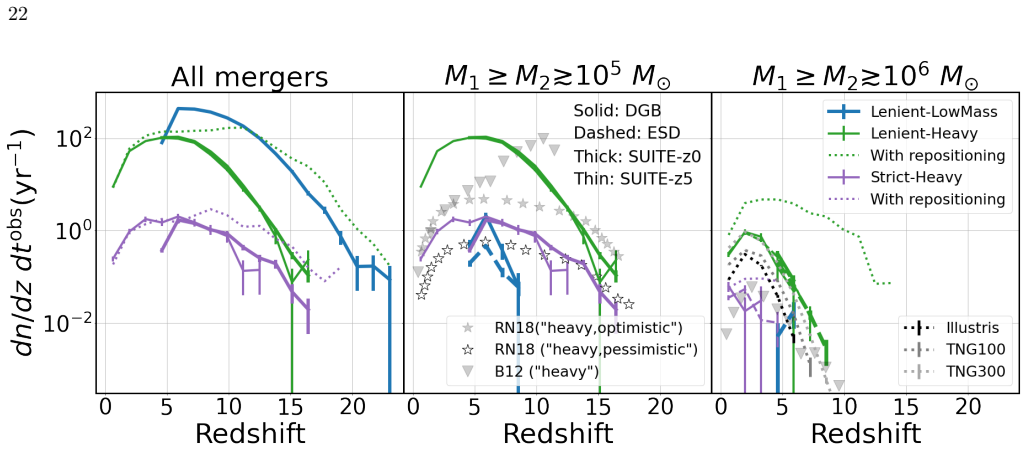
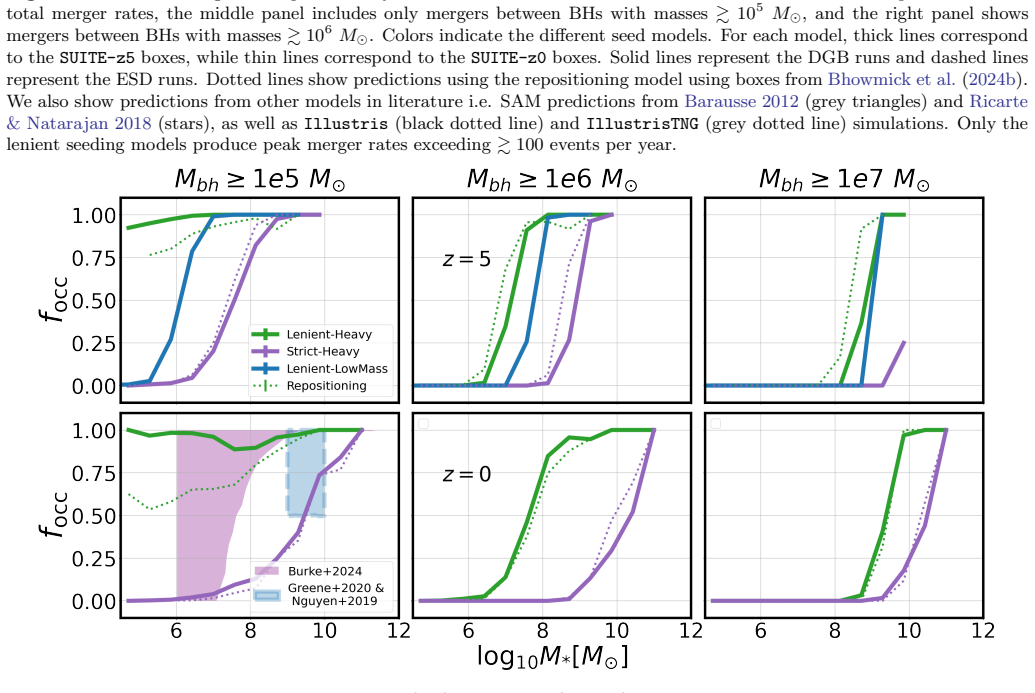
In the BRAHMA simulations, lenient seed models in which all halos with sufficient dense and metal-poor gas form 10,000 and 100,000 solar-mass seeds generate by z approximately 5 multiple systems with black-hole-to-stellar-mass ratios at or above 0.01 that reach luminosities of 10^43 to 10^45 erg per second, while at z equals 0 they produce merger rates of at least 100 per year and occupation fractions near unity even for galaxies with stellar masses below 10 million solar masses; the strict seed model, which forms 100,000 solar-mass seeds only under additional direct-collapse conditions, instead produces merger rates of only about 1 per year and occupation fractions below 10 percent for gala
Load-bearing premise
The subgrid dynamical friction model and the specific criteria defining sufficient dense and metal-poor gas for lenient seeding versus additional direct-collapse constraints for strict seeding accurately represent unresolved high-redshift astrophysical processes.
Editorial extensions
If this is right
- Lenient production of 100,000 solar-mass seeds produces multiple overmassive systems with black-hole-to-stellar-mass ratios at or above 0.01 inside galaxies that host 100 million to 1 billion solar-mass black holes.
- All three seed models produce black-hole-to-stellar-mass relations broadly consistent with the local universe for galaxies above 1 billion solar masses by redshift 5.
- The lenient scenarios also generate systems near the upper envelope of the observed local scatter in the black-hole-to-stellar-mass relation.
- Future gravitational-wave event rates and measurements of local black hole occupation fractions will constrain the dominant pathways for high-redshift black hole assembly.
Reading between the lines
- If observations favor the lenient models, then mergers contribute a larger fraction of black hole growth at high redshift than they do under strict seeding.
- The overmassive black holes produced at redshift 5 in lenient models suggest that seeding alone, without requiring sustained super-Eddington accretion, can account for some JWST detections.
- High occupation fractions in present-day dwarf galaxies would favor lenient seeding even if the strict model matches other observables.
- The efficiency of the dynamical friction model in driving seed mergers sets the scale of the predicted rate differences between the two classes of models.
Editorial analysis
A structured set of objections, weighed in public.
Referee Report
Summary. The manuscript presents results from the BRAHMA cosmological simulations investigating the assembly of supermassive black holes from heavy seeds under different seed formation prescriptions coupled with a subgrid dynamical friction model. It reports that lenient seed models, allowing seed formation in halos with sufficient dense and metal-poor gas for ~10^4 and ~10^5 M_sun seeds, lead to high BH merger rates of ≳100 yr^{-1} and near-unity local occupation fractions even in low-mass galaxies (M_* ≲ 10^7 M_⊙). In contrast, a strict seed model with additional direct-collapse constraints yields merger rates of ~1 yr^{-1} and occupation fractions ≲10% for M_* ≲ 10^8 M_⊙. The models produce M_*-M_BH relations consistent with local observations for massive galaxies, with lenient models also producing overmassive BHs.
Significance. If the results hold, they demonstrate that variations in seed prescriptions can lead to dramatically different predictions for observable quantities like merger rates and BH occupation fractions, providing potential constraints from JWST, LISA, and local universe observations. The work highlights the sensitivity of high-redshift BH assembly to seeding criteria.
major comments (1)
- [Abstract (subgrid dynamical friction model and seed criteria)] The central claims regarding the distinction in merger rates (≳100 vs ~1 yr^{-1}) and occupation fractions (near-unity vs ≲10%) between lenient and strict models rely on the subgrid dynamical friction implementation and the specific seed formation criteria. The provided text reports simulation outputs but provides no details on validation, convergence tests, or error quantification for the subgrid DF model or the 'dense & metal-poor gas' thresholds, making the quantitative predictions model-dependent without independent checks against resolved high-z calculations.
Simulated Author's Rebuttal
We thank the referee for their constructive comments on our manuscript. We address the major comment below.
read point-by-point responses
-
Referee: [Abstract (subgrid dynamical friction model and seed criteria)] The central claims regarding the distinction in merger rates (≳100 vs ~1 yr^{-1}) and occupation fractions (near-unity vs ≲10%) between lenient and strict models rely on the subgrid dynamical friction implementation and the specific seed formation criteria. The provided text reports simulation outputs but provides no details on validation, convergence tests, or error quantification for the subgrid DF model or the 'dense & metal-poor gas' thresholds, making the quantitative predictions model-dependent without independent checks against resolved high-z calculations.
Authors: We agree that the manuscript would benefit from expanded details on the subgrid DF model and seed criteria. Section 2 describes the DF implementation (following the formulation validated in our prior BRAHMA papers) and the seed thresholds (motivated by dense, metal-poor gas conditions for direct-collapse scenarios). In the revision we will add an explicit paragraph summarizing the referenced validation and convergence tests from those works, plus a short discussion of threshold sensitivity. We will also note the model dependence of the quantitative rates more prominently. Direct new comparisons to fully resolved high-z calculations remain outside the scope of this large-volume study. revision: partial
- Independent checks against resolved high-z calculations for the subgrid DF model and seed thresholds
Circularity Check
No significant circularity; simulation outputs are direct consequences of input prescriptions
full rationale
The paper reports merger rates and occupation fractions as direct outputs from BRAHMA cosmological simulations run with two classes of heavy-seed prescriptions (lenient vs strict) plus a subgrid dynamical friction model. These quantities are generated by evolving the specified initial conditions and subgrid rules; they do not reduce via the paper's equations to quantities fitted to JWST, LISA, or local-universe data, nor do they rely on self-definitional loops, load-bearing self-citations, or ansatzes smuggled from prior author work. The central claims remain independent simulation predictions under the stated model variations.
Assumptions & free parameters
free parameters (2)
- Seed mass
- Formation criteria thresholds
assumptions (2)
- standard math Standard Lambda-CDM cosmological framework
- domain assumption Subgrid models for unresolved gas physics, star formation, and black hole dynamics
Cite this review
Pith. "Pith review of Supermassive Black Hole Assembly from Heavy Seeds with Dynamical Friction in the BRAHMA Simulations: Implications for JWST, LISA, and the Local Universe." pith.science (2026). https://pith.science/paper/UFXSR75M
@misc{pith2026260612851,
  author       = {Pith},
  title        = {Pith review of: Supermassive Black Hole Assembly from Heavy Seeds with Dynamical Friction in the BRAHMA Simulations: Implications for JWST, LISA, and the Local Universe},
  year         = {2026},
  howpublished = {\url{https://pith.science/paper/UFXSR75M}},
  note         = {Machine review of arXiv:2606.12851}
}
abstract
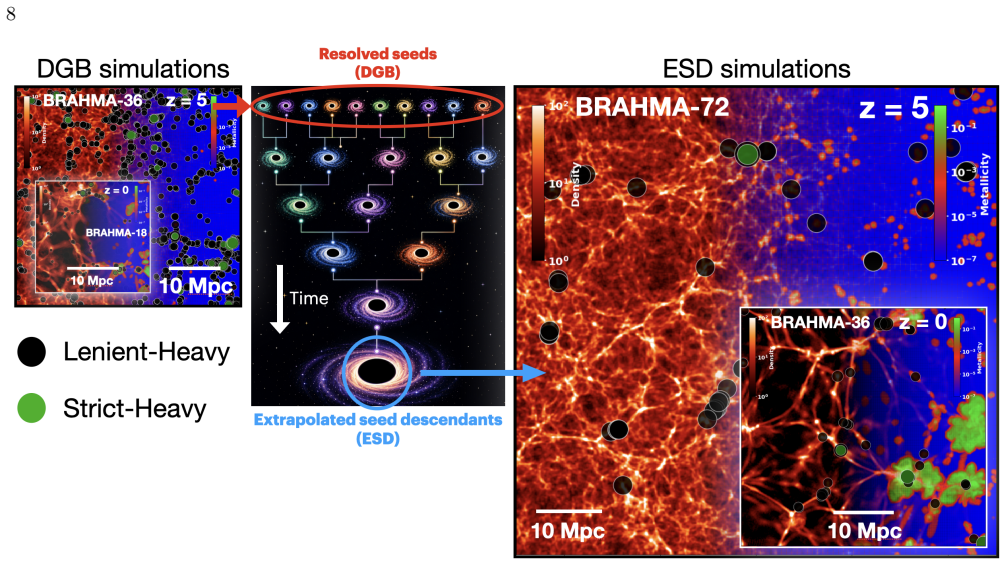
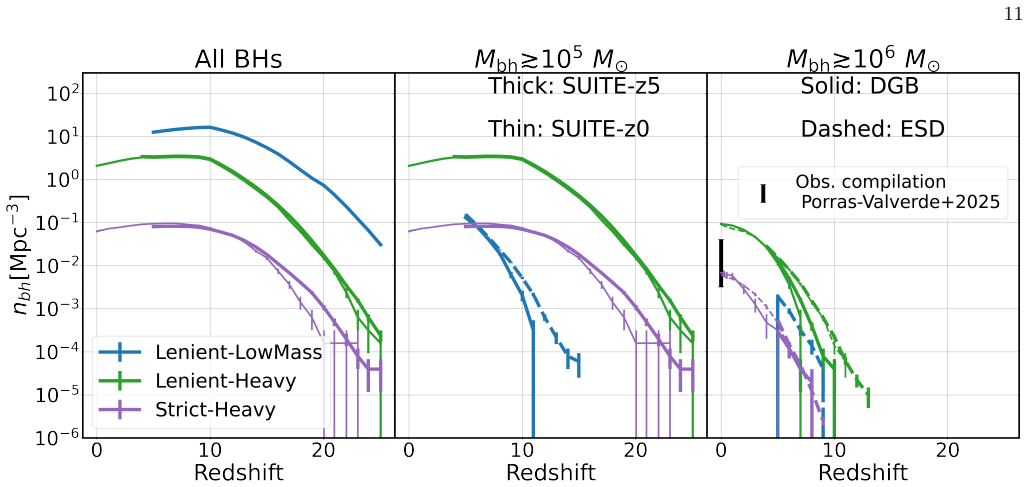
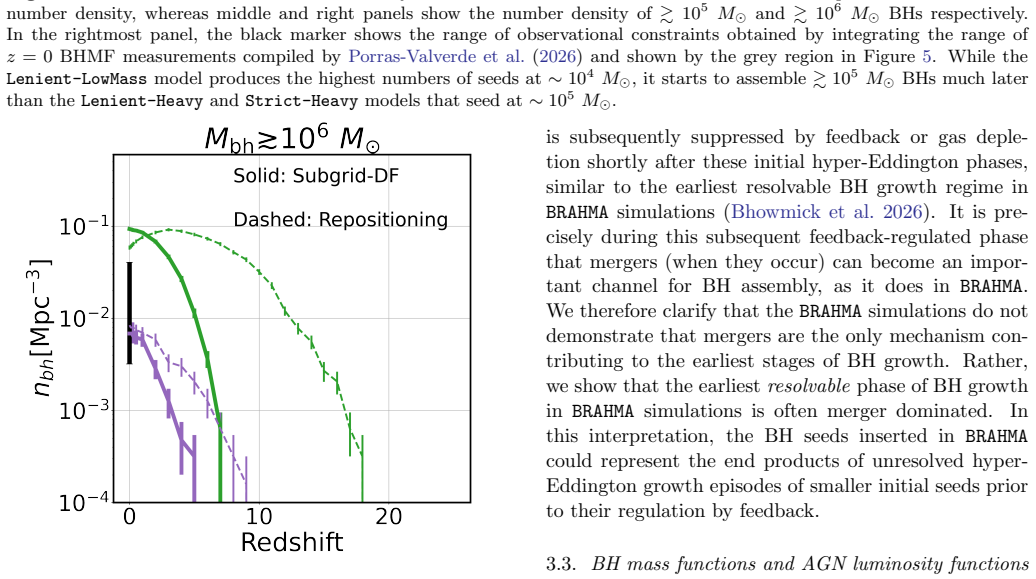
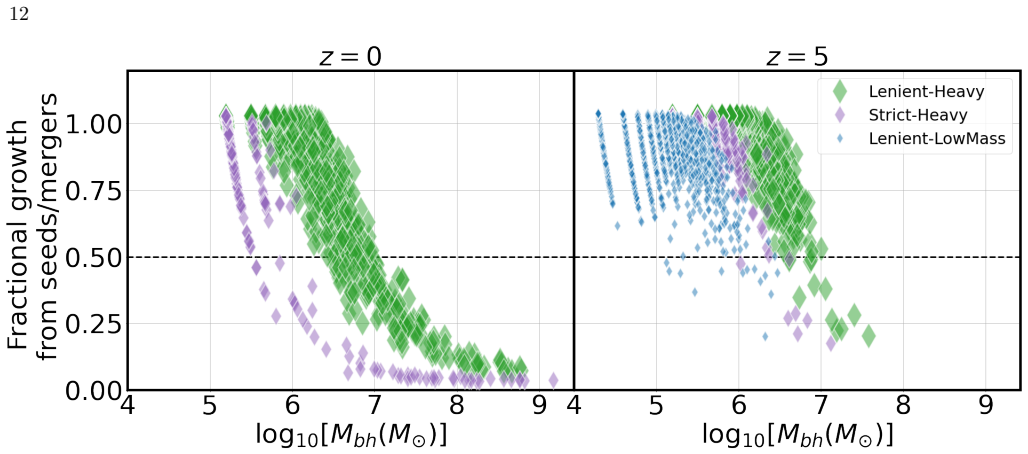
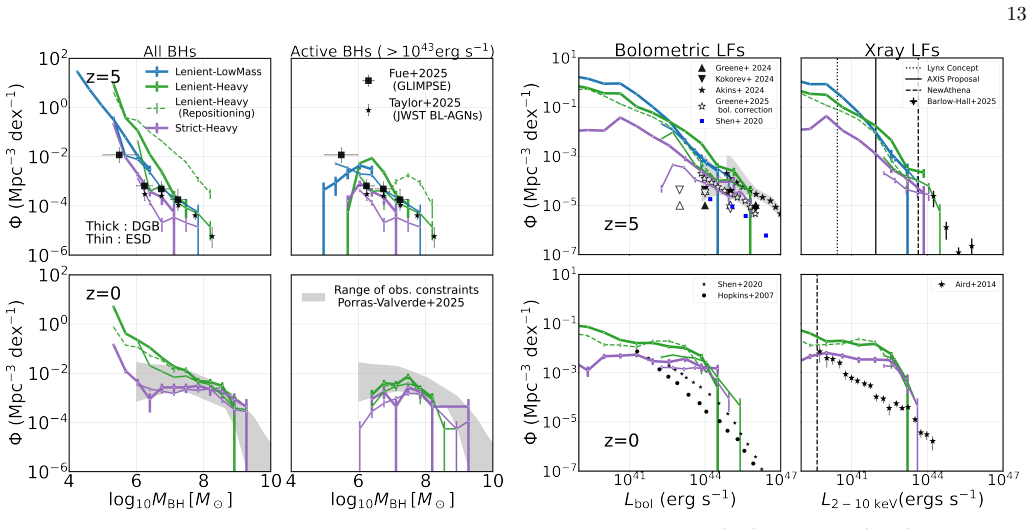
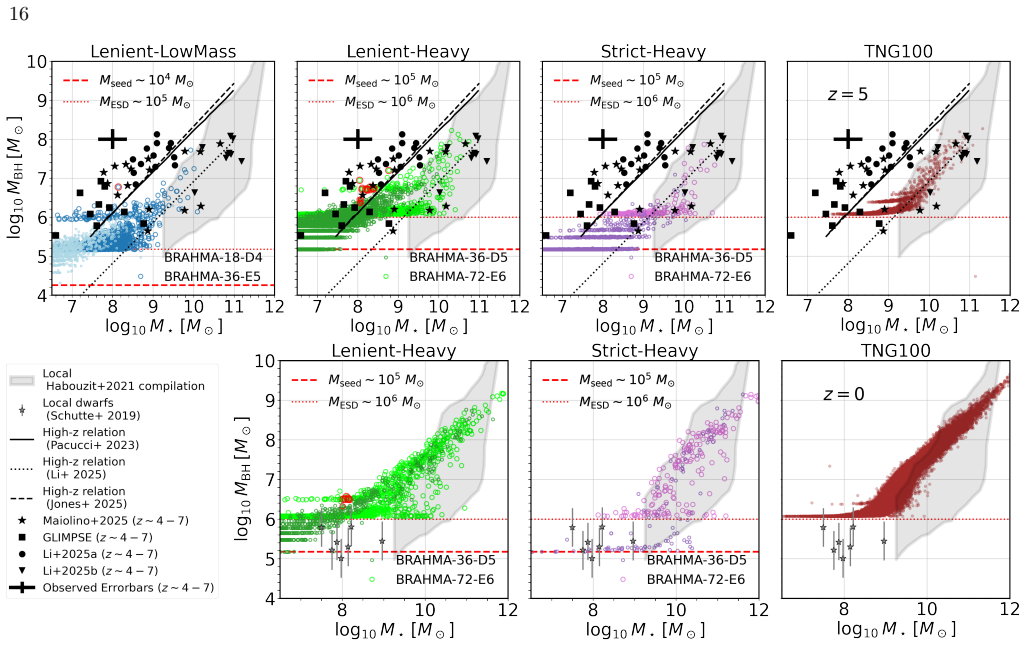
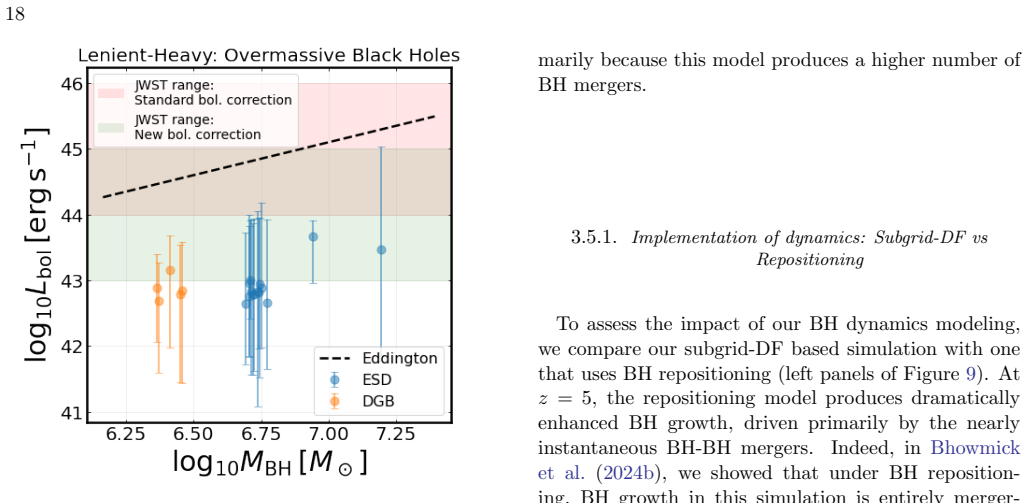
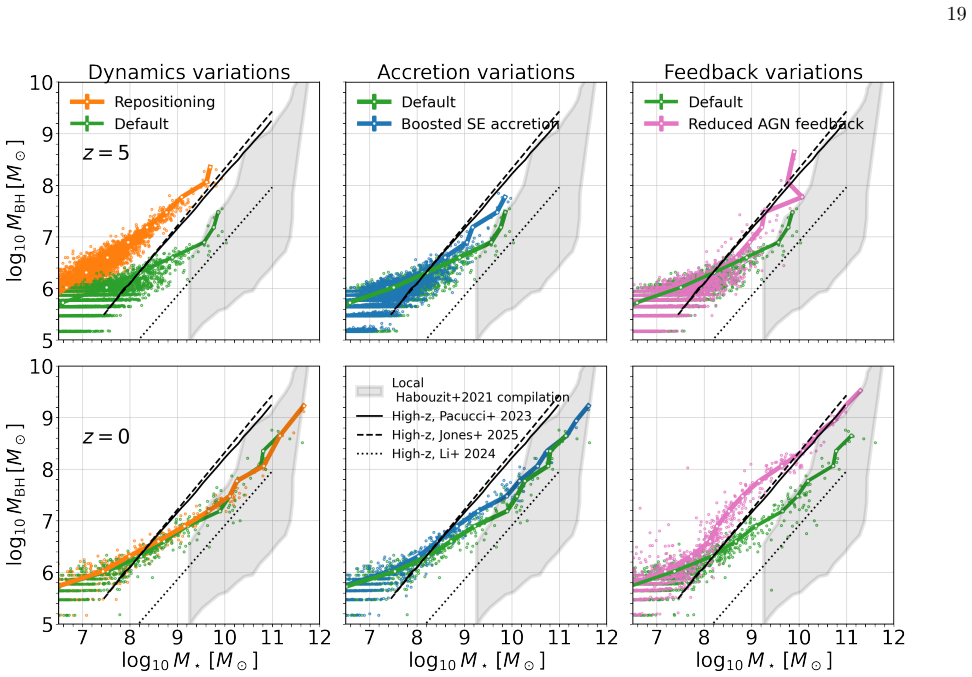
The JWST discoveries of supermassive black holes (BHs) at $z \gtrsim 5$ may provide key insights into their seeding origins. Using new $[18{-}72~\rm Mpc]^3$ BRAHMA cosmological simulations, we investigate how variations in heavy-seed prescriptions, coupled with a subgrid dynamical friction model, shape BH populations at $z \sim 5$ and $z \sim 0$. We consider two "lenient'' seed models, in which all halos containing sufficient dense & metal-poor gas form $\sim10^4$ and $\sim10^5~M_{\odot}$ seeds, and a "strict'' seed model, in which $\sim10^5 M_{\odot}$ seeds form only under additional constraints motivated by direct collapse black hole formation. By $z \sim 5$, all models produce $M_*-M_{\rm BH}$ relations broadly consistent with the observed local Universe for $M_*\gtrsim10^9~M_{\odot}$ galaxies, but only the lenient scenarios generate systems near the upper envelope of the observed local scatter. In galaxies hosting $M_{\rm BH} \sim 10^8$-$10^9~M_{\odot}$ BHs, lenient production of $\sim10^5~M_{\odot}$ seeds also produces multiple overmassive systems with $M_{\rm BH}/M_* \gtrsim 0.01$. Although their growth is dominated by seeding and mergers, these systems reach luminosities of $\sim10^{43}$-$10^{45}\mathrm{erg s^{-1}}$, comparable to those inferred for JWST-detected BHs. As a key observational signature, the lenient seed models yield merger rates of $\gtrsim100\mathrm{yr^{-1}}$ and near-unity local BH occupation fractions even in galaxies with $M_* \lesssim 10^7~M_{\odot}$. In contrast, the strict seed model produces merger rates of only $\sim1\mathrm{yr^{-1}}$ and local occupation fractions of $\lesssim10\%$ for galaxies with $M_* \lesssim 10^8~M_{\odot}$. Future gravitational-wave event rates and measurements of local BH occupation fractions will therefore provide strong constraints on the dominant pathways responsible for high-redshift BH assembly.
Figures
Figures from the paper (12 more)
Forward citations
Cited by 2 Pith papers
-
How to raise a supermassive black hole: interpreting early JWST AGN with the AESOPICA simulations
A systematic simulation suite with a mock JWST survey shows early overmassive black holes can arise from any seed mass under fast accretion, and broad-line selection explains much of the observed overmassiveness.
-
Black Hole Occupation Fraction: Dependence on Black Hole Mass Threshold, Environment, Resolution and Redshift
Black hole occupation fraction rises with stellar mass but its normalization, shape, and redshift trend depend strongly on BH mass threshold, central vs satellite galaxies, simulation box, resolution, and sampled popu...
Reference graph
Works this paper leans on
-
[1]
Dunlop, J. S. 2013, MNRAS, 432, 3438, doi: 10.1093/mnras/stt696
-
[2]
Agazie, G., Anumarlapudi, A., Archibald, A. M., et al. 2023, ApJL, 951, L8, doi: 10.3847/2041-8213/acdac6
-
[3]
Aird, J., Coil, A. L., Georgakakis, A., et al. 2015, MNRAS, 451, 1892, doi: 10.1093/mnras/stv1062
-
[4]
Akins, H. B., Casey, C. M., Lambrides, E., et al. 2025, ApJ, 991, 37, doi: 10.3847/1538-4357/ade984
-
[5]
Science , archivePrefix = "arXiv", eprint =
Alexander, T., & Natarajan, P. 2014, Science, 345, 1330, doi: 10.1126/science.1251053 Alonso-´Alvarez, G., Cline, J. M., & Dewar, C. 2024, PhRvL, 133, 021401, doi: 10.1103/PhysRevLett.133.021401
-
[6]
Laser Interferometer Space Antenna
Amaro-Seoane, P., Audley, H., Babak, S., et al. 2017, arXiv e-prints, arXiv:1702.00786, doi: 10.48550/arXiv.1702.00786
work page Pith review arXiv doi:10.48550/arxiv.1702.00786 2017
-
[7]
T., Jahnke, K., Onoue, M., et al
Andika, I. T., Jahnke, K., Onoue, M., et al. 2024, A&A, 685, A25, doi: 10.1051/0004-6361/202349025 Ba˜ nados, E., Venemans, B. P., Mazzucchelli, C., et al. 2018, Nature, 553, 473, doi: 10.1038/nature25180
-
[8]
Barausse, E. 2012, MNRAS, 423, 2533, doi: 10.1111/j.1365-2966.2012.21057.x
Show all 146 references
-
[9]
L., & Aird, J
Barlow-Hall, C. L., & Aird, J. 2025, arXiv e-prints, arXiv:2506.16145, doi: 10.48550/arXiv.2506.16145
2025 doi
-
[10]
1986, Nature, 324, 446, doi: 10.1038/324446a0 Ba˜ nados, E., Venemans, B
Barnes, J., & Hut, P. 1986, Nature, 324, 446, doi: 10.1038/324446a0 Ba˜ nados, E., Venemans, B. P., Decarli, R., et al. 2016, The Astrophysical Journal Supplement Series, 227, 11, doi: 10.3847/0067-0049/227/1/11
1986 doi
-
[11]
C., & Silk, J
Begelman, M. C., & Silk, J. 2023, MNRAS, 526, L94, doi: 10.1093/mnrasl/slad124
2023 doi
-
[12]
C., Volonteri, M., & Rees, M
Begelman, M. C., Volonteri, M., & Rees, M. J. 2006, MNRAS, 370, 289, doi: 10.1111/j.1365-2966.2006.10467.x
2006 doi
-
[13]
K., et al
Bernardi, M., Meert, A., Sheth, R. K., et al. 2013, MNRAS, 436, 697, doi: 10.1093/mnras/stt1607
2013 doi
-
[14]
K., Blecha, L., Torrey, P., et al
Bhowmick, A. K., Blecha, L., Torrey, P., et al. 2022, MNRAS, 510, 177, doi: 10.1093/mnras/stab3439 —. 2024a, MNRAS, 529, 3768, doi: 10.1093/mnras/stae780 —. 2021, MNRAS, 507, 2012, doi: 10.1093/mnras/stab2204 —. 2024b, MNRAS, 533, 1907, doi: 10.1093/mnras/stae1819 —. 2024c, MN...
2022 doi
-
[15]
K., Blecha, L., Kelley, L
Bhowmick, A. K., Blecha, L., Kelley, L. Z., et al. 2025b, ApJ, 991, 81, doi: 10.3847/1538-4357/adf96b
-
[16]
K., Blecha, L., Torrey, P., et al
Bhowmick, A. K., Blecha, L., Torrey, P., et al. 2026, ApJ, 997, 187, doi: 10.3847/1538-4357/ae2607 Bogd´ an,´A., Goulding, A. D., Natarajan, P., et al. 2024, Nature Astronomy, 8, 126, doi: 10.1038/s41550-023-02111-9
2026 doi
-
[17]
2003, ApJ, 596, 34, doi: 10.1086/377529
Bromm, V., & Loeb, A. 2003, ApJ, 596, 34, doi: 10.1086/377529
2003 doi
-
[18]
R., Simons, R
Brooks, M., Trump, J. R., Simons, R. C., et al. 2026, ApJ, 1002, 129, doi: 10.3847/1538-4357/ae5652
2026 doi
-
[19]
J., Natarajan, P., Baldassare, V
Burke, C. J., Natarajan, P., Baldassare, V. F., & Geha, M. 2024, Multi-wavelength constraints on the local black hole occupation fraction. https://arxiv.org/abs/2410.11177
2024
-
[20]
J., Natarajan, P., Baldassare, V
Burke, C. J., Natarajan, P., Baldassare, V. F., & Geha, M. 2025, ApJ, 978, 77, doi: 10.3847/1538-4357/ad94d9 31
2025 doi
-
[21]
2025, MNRAS, 542, 2597, doi: 10.1093/mnras/staf1362
Cenci, E., & Habouzit, M. 2025, MNRAS, 542, 2597, doi: 10.1093/mnras/staf1362
2025 doi
-
[22]
2003, PASP, 115, 763, doi: 10.1086/376392
Chabrier, G. 2003, PASP, 115, 763, doi: 10.1086/376392
2003 doi
-
[23]
2024, ApJ, 969, 93, doi: 10.3847/1538-4357/ad4966
Cho, H., & Woo, J.-H. 2024, ApJ, 969, 93, doi: 10.3847/1538-4357/ad4966
2024 doi
-
[24]
2026, arXiv e-prints, arXiv:2601.04955, doi: 10.48550/arXiv.2601.04955
Springel, V. 2026, arXiv e-prints, arXiv:2601.04955, doi: 10.48550/arXiv.2601.04955
2026 doi
-
[25]
Das, A., Schleicher, D. R. G., Basu, S., & Boekholt, T. C. N. 2021a, MNRAS, doi: 10.1093/mnras/stab1428
-
[26]
Das, A., Schleicher, D. R. G., Leigh, N. W. C., & Boekholt, T. C. N. 2021b, MNRAS, 503, 1051, doi: 10.1093/mnras/stab402
-
[27]
B., Miller, M
Davies, M. B., Miller, M. C., & Bellovary, J. M. 2011, ApJL, 740, L42, doi: 10.1088/2041-8205/740/2/L42
2011 doi
-
[28]
S., & White, S
Davis, M., Efstathiou, G., Frenk, C. S., & White, S. D. M. 1985, ApJ, 292, 371, doi: 10.1086/163168
1985 doi
-
[29]
2020, MNRAS, 491, 4973, doi: 10.1093/mnras/stz3309
DeGraf, C., & Sijacki, D. 2020, MNRAS, 491, 4973, doi: 10.1093/mnras/stz3309
2020 doi
-
[30]
C., Chowdhury, D
Dekel, A., Stone, N. C., Chowdhury, D. D., et al. 2025, A&A, 695, A97, doi: 10.1051/0004-6361/202452393
2025 doi
-
[31]
Durodola, E., Pacucci, F., & Hickox, R. C. 2024, arXiv e-prints, arXiv:2406.10329, doi: 10.48550/arXiv.2406.10329 —. 2025, ApJ, 985, 169, doi: 10.3847/1538-4357/adced2 EPTA Collaboration, InPTA Collaboration, Antoniadis, J., et al. 2024, A&A, 685, A94, doi: 10.1051/0004-6361/202347433
2024 doi
-
[32]
K., Lupton, R
Fan, X., Narayanan, V. K., Lupton, R. H., et al. 2001, AJ, 122, 2833, doi: 10.1086/324111
2001 doi
-
[33]
P., et al
Fei, Q., Fujimoto, S., Naidu, R. P., et al. 2025, arXiv e-prints, arXiv:2509.20452, doi: 10.48550/arXiv.2509.20452
2025 doi
-
[34]
S., & Sagunski, L
Fischer, M. S., & Sagunski, L. 2024, A&A, 690, A299, doi: 10.1051/0004-6361/202451304
2024 doi
-
[35]
L., Woosley, S
Fryer, C. L., Woosley, S. E., & Heger, A. 2001, ApJ, 550, 372, doi: 10.1086/319719
2001 doi
-
[36]
D., Greene, J
Goulding, A. D., Greene, J. E., Setton, D. J., et al. 2023, ApJL, 955, L24, doi: 10.3847/2041-8213/acf7c5
2023 doi
-
[37]
E., Strader, J., & Ho, L
Greene, J. E., Strader, J., & Ho, L. C. 2020, ARA&A, 58, 257, doi: 10.1146/annurev-astro-032620-021835
2020 doi
-
[38]
E., Labbe, I., Goulding, A
Greene, J. E., Labbe, I., Goulding, A. D., et al. 2023, arXiv e-prints, arXiv:2309.05714, doi: 10.48550/arXiv.2309.05714 —. 2024, ApJ, 964, 39, doi: 10.3847/1538-4357/ad1e5f
2023 doi
-
[39]
E., Setton, D
Greene, J. E., Setton, D. J., Furtak, L. J., et al. 2025, arXiv e-prints, arXiv:2509.05434, doi: 10.48550/arXiv.2509.05434
2025 doi
-
[40]
2016, MNRAS, 463, 529, doi: 10.1093/mnras/stw1924
Peirani, S. 2016, MNRAS, 463, 529, doi: 10.1093/mnras/stw1924
2016 doi
-
[41]
S., et al
Habouzit, M., Li, Y., Somerville, R. S., et al. 2021, MNRAS, 503, 1940, doi: 10.1093/mnras/stab496
2021 doi
-
[42]
2011, MNRAS, 415, 2101, doi: 10.1111/j.1365-2966.2011.18820.x
Hahn, O., & Abel, T. 2011, MNRAS, 415, 2101, doi: 10.1111/j.1365-2966.2011.18820.x
2011 doi
-
[43]
N., Maiolino, R., Juodˇ zbalis, I., et al
Hainline, K. N., Maiolino, R., Juodˇ zbalis, I., et al. 2025, ApJ, 979, 138, doi: 10.3847/1538-4357/ad9920
2025 doi
-
[44]
2023, ApJ, 959, 39, doi: 10.3847/1538-4357/ad029e Hern´ andez-Y´ evenes, J., Nagar, N., Arratia, V., & Jarrett, T
Harikane, Y., Zhang, Y., Nakajima, K., et al. 2023, ApJ, 959, 39, doi: 10.3847/1538-4357/ad029e Hern´ andez-Y´ evenes, J., Nagar, N., Arratia, V., & Jarrett, T. H. 2024, MNRAS, 531, 4503, doi: 10.1093/mnras/stae1372
2023 doi
-
[45]
F., Richards, G
Hopkins, P. F., Richards, G. T., & Hernquist, L. 2007, ApJ, 654, 731, doi: 10.1086/509629
2007 doi
-
[46]
2026, arXiv e-prints, arXiv:2603.17967
Iani, E., Rinaldi, P., Torralba, A., et al. 2026, arXiv e-prints, arXiv:2603.17967. https://arxiv.org/abs/2603.17967
2026
-
[47]
Jeon, J., Bromm, V., Liu, B., & Finkelstein, S. L. 2024, arXiv e-prints, arXiv:2402.18773, doi: 10.48550/arXiv.2402.18773 —. 2025, ApJ, 979, 127, doi: 10.3847/1538-4357/ad9f3a
2024 doi
-
[48]
D., Fan, X., et al
Jiang, L., McGreer, I. D., Fan, X., et al. 2016, ApJ, 833, 222, doi: 10.3847/1538-4357/833/2/222
2016 doi
-
[49]
L., Kocevski, D
Jones, B. L., Kocevski, D. D., Pacucci, F., et al. 2025, arXiv e-prints, arXiv:2510.07376, doi: 10.48550/arXiv.2510.07376 Juodˇ zbalis, I., Maiolino, R., Baker, W. M., et al. 2024, Nature, 636, 594, doi: 10.1038/s41586-024-08210-5
2025 doi
-
[50]
H., & Hernquist, L
Katz, N., Weinberg, D. H., & Hernquist, L. 1996, ApJS, 105, 19, doi: 10.1086/192305
1996 doi
-
[51]
2017, MNRAS, 467, 4739, doi: 10.1093/mnras/stx126
Kaviraj, S., Laigle, C., Kimm, T., et al. 2017, MNRAS, 467, 4739, doi: 10.1093/mnras/stx126
2017 doi
-
[52]
K., Weinberger, R., et al
Kho, J., Bhowmick, A. K., Weinberger, R., et al. 2026, Learning the Universe at High Redshifts: Impact of Accretion Modeling on Early Black Hole Growth. https://arxiv.org/abs/2606.10036
2026 arXiv
-
[53]
2024, A&A, 691, A52, doi: 10.1051/0004-6361/202348857
Killi, M., Watson, D., Brammer, G., et al. 2024, A&A, 691, A52, doi: 10.1051/0004-6361/202348857
2024 doi
-
[54]
D., Onoue, M., Inayoshi, K., et al
Kocevski, D. D., Onoue, M., Inayoshi, K., et al. 2023, ApJL, 954, L4, doi: 10.3847/2041-8213/ace5a0
2023 doi
-
[55]
D., Finkelstein, S
Kocevski, D. D., Finkelstein, S. L., Barro, G., et al. 2024, arXiv e-prints, arXiv:2404.03576, doi: 10.48550/arXiv.2404.03576
2024 doi
-
[56]
2023, ApJL, 957, L7, doi: 10.3847/2041-8213/ad037a
Kokorev, V., Fujimoto, S., Labbe, I., et al. 2023, ApJL, 957, L7, doi: 10.3847/2041-8213/ad037a
2023 doi
-
[57]
I., Greene, J
Kokorev, V., Caputi, K. I., Greene, J. E., et al. 2024a, ApJ, 968, 38, doi: 10.3847/1538-4357/ad4265 32
-
[58]
2024b, ApJ, 975, 178, doi: 10.3847/1538-4357/ad7d03
Kokorev, V., Chisholm, J., Endsley, R., et al. 2024b, ApJ, 975, 178, doi: 10.3847/1538-4357/ad7d03
-
[59]
Kormendy, J., & Ho, L. C. 2013, ARA&A, 51, 511, doi: 10.1146/annurev-astro-082708-101811 Kov´ acs, O. E., Bogd´ an,´A., Natarajan, P., et al. 2024, ApJL, 965, L21, doi: 10.3847/2041-8213/ad391f
2013 doi
-
[60]
2023, PhRvD, 108, 083012, doi: 10.1103/PhysRevD.108.083012
Kritos, K., Berti, E., & Silk, J. 2023, PhRvD, 108, 083012, doi: 10.1103/PhysRevD.108.083012
2023 doi
-
[61]
2020, MNRAS, 498, 5652, doi: 10.1093/mnras/staa2276
Kroupa, P., Subr, L., Jerabkova, T., & Wang, L. 2020, MNRAS, 498, 5652, doi: 10.1093/mnras/staa2276
2020 doi
-
[62]
E., Bezanson, R., et al
Labbe, I., Greene, J. E., Bezanson, R., et al. 2025, ApJ, 978, 92, doi: 10.3847/1538-4357/ad3551
2025 doi
-
[63]
L., Garofali, K., et al
Lambrides, E., Larson, R. L., Garofali, K., et al. 2026, Nature Astronomy, doi: 10.1038/s41550-026-02813-w
2026 doi
-
[64]
L., Finkelstein, S
Larson, R. L., Finkelstein, S. L., Kocevski, D. D., et al. 2023, ApJL, 953, L29, doi: 10.3847/2041-8213/ace619
2023 doi
-
[65]
R., Tremaine, S., Richstone, D., & Faber, S
Lauer, T. R., Tremaine, S., Richstone, D., & Faber, S. M. 2007, ApJ, 670, 249, doi: 10.1086/522083
2007 doi
-
[66]
2025a, arXiv e-prints, arXiv:2502.05048, doi: 10.48550/arXiv.2502.05048
Li, J., Shen, Y., & Zhuang, M.-Y. 2025a, arXiv e-prints, arXiv:2502.05048, doi: 10.48550/arXiv.2502.05048
-
[67]
D., Shen, Y., et al
Li, J., Silverman, J. D., Shen, Y., et al. 2025b, ApJ, 981, 19, doi: 10.3847/1538-4357/ada603
-
[68]
C., & Chen, C.-H
Li, R., Ho, L. C., & Chen, C.-H. 2025c, arXiv e-prints, arXiv:2505.12867, doi: 10.48550/arXiv.2505.12867
-
[69]
R., & Ma, C.-P
Liepold, E. R., & Ma, C.-P. 2024, ApJL, 971, L29, doi: 10.3847/2041-8213/ad66b8
2024 doi
-
[70]
2006, MNRAS, 371, 1813, doi: 10.1111/j.1365-2966.2006.10801.x —
Lodato, G., & Natarajan, P. 2006, MNRAS, 371, 1813, doi: 10.1111/j.1365-2966.2006.10801.x —. 2007, MNRAS, 377, L64, doi: 10.1111/j.1745-3933.2007.00304.x
2006 doi
-
[71]
2018, MNRAS, 476, 3523, doi: 10.1093/mnras/sty362
Luo, Y., Ardaneh, K., Shlosman, I., et al. 2018, MNRAS, 476, 3523, doi: 10.1093/mnras/sty362
2018 doi
-
[72]
2020, MNRAS, 492, 4917, doi: 10.1093/mnras/staa153
Luo, Y., Shlosman, I., Nagamine, K., & Fang, T. 2020, MNRAS, 492, 4917, doi: 10.1093/mnras/staa153
2020 doi
-
[73]
2014, MNRAS, 442, 3616, doi: 10.1093/mnras/stu1120
Lupi, A., Colpi, M., Devecchi, B., Galanti, G., & Volonteri, M. 2014, MNRAS, 442, 3616, doi: 10.1093/mnras/stu1120
2014 doi
-
[74]
2024, A&A, 689, A128, doi: 10.1051/0004-6361/202451249
Mazzucchelli, C. 2024, A&A, 689, A128, doi: 10.1051/0004-6361/202451249
2024 doi
-
[75]
F., Kelley, L
Ma, L., Hopkins, P. F., Kelley, L. Z., & Faucher-Gigu` ere, C.-A. 2023, MNRAS, 519, 5543, doi: 10.1093/mnras/stad036
2023 doi
-
[76]
Madau, P., & Rees, M. J. 2001, ApJL, 551, L27, doi: 10.1086/319848
2001 doi
-
[77]
2023, arXiv e-prints, arXiv:2308.01230, doi: 10.48550/arXiv.2308.01230
Maiolino, R., Scholtz, J., Curtis-Lake, E., et al. 2023, arXiv e-prints, arXiv:2308.01230, doi: 10.48550/arXiv.2308.01230
2023 doi
-
[78]
2024a, Nature, 627, 59, doi: 10.1038/s41586-024-07052-5
Maiolino, R., Scholtz, J., Witstok, J., et al. 2024a, Nature, 627, 59, doi: 10.1038/s41586-024-07052-5
-
[79]
2024b, A&A, 691, A145, doi: 10.1051/0004-6361/202347640
Maiolino, R., Scholtz, J., Curtis-Lake, E., et al. 2024b, A&A, 691, A145, doi: 10.1051/0004-6361/202347640
-
[80]
2018, ApJS, 237, 5, doi: 10.3847/1538-4365/aac724
Matsuoka, Y., Iwasawa, K., Onoue, M., et al. 2018, ApJS, 237, 5, doi: 10.3847/1538-4365/aac724
2018 doi
-
[81]
2019, ApJL, 872, L2, doi: 10.3847/2041-8213/ab0216
Matsuoka, Y., Onoue, M., Kashikawa, N., et al. 2019, ApJL, 872, L2, doi: 10.3847/2041-8213/ab0216
2019 doi
-
[82]
Z., et al
Matt, C., G¨ ultekin, K., Kelley, L. Z., et al. 2026, ApJ, 997, 188, doi: 10.3847/1538-4357/ae2480
2026 doi
-
[83]
P., Brammer, G., et al
Matthee, J., Naidu, R. P., Brammer, G., et al. 2024, ApJ, 963, 129, doi: 10.3847/1538-4357/ad2345
2024 doi
-
[84]
R., Zwick, L., & Di Matteo, T
Mayer, L., Capelo, P. R., Zwick, L., & Di Matteo, T. 2024, ApJ, 961, 76, doi: 10.3847/1538-4357/ad11cf
2024 doi
-
[85]
A., & Prole, L
Mehta, D., Regan, J. A., & Prole, L. 2024, The Open Journal of Astrophysics, 7, 107, doi: 10.33232/001c.126629
2024 doi
-
[86]
H., Regan, J
Mehta, D. H., Regan, J. A., & Prole, L. 2026, Nature Astronomy, doi: 10.1038/s41550-025-02767-5
2026 doi
-
[87]
2008, MNRAS, 388, 1011, doi: 10.1111/j.1365-2966.2008.13472.x
Merloni, A., & Heinz, S. 2008, MNRAS, 388, 1011, doi: 10.1111/j.1365-2966.2008.13472.x
2008 doi
-
[88]
2024, ApJL, 966, L30, doi: 10.3847/2041-8213/ad3c2a
Mezcua, M., Pacucci, F., Suh, H., Siudek, M., & Natarajan, P. 2024, ApJL, 966, L30, doi: 10.3847/2041-8213/ad3c2a
2024 doi
-
[89]
P., Gallo, E., Greene, J
Miller, B. P., Gallo, E., Greene, J. E., et al. 2015, ApJ, 799, 98, doi: 10.1088/0004-637X/799/1/98
2015 doi
-
[90]
J., Warren, S
Mortlock, D. J., Warren, S. J., Venemans, B. P., et al. 2011, Nature, 474, 616, doi: 10.1038/nature10159
2011 doi
- [91]
-
[92]
2021, MNRAS, 501, 1413, doi: 10.1093/mnras/staa3724
Natarajan, P. 2021, MNRAS, 501, 1413, doi: 10.1093/mnras/staa3724
2021 doi
-
[93]
2017, ApJ, 838, 117, doi: 10.3847/1538-4357/aa6330
Natarajan, P., Pacucci, F., Ferrara, A., et al. 2017, ApJ, 838, 117, doi: 10.3847/1538-4357/aa6330
2017 doi
-
[94]
2024, ApJL, 960, L1, doi: 10.3847/2041-8213/ad0e76
Natarajan, P., Pacucci, F., Ricarte, A., et al. 2024, ApJL, 960, L1, doi: 10.3847/2041-8213/ad0e76
2024 doi
-
[95]
2012, MNRAS, 422, 2051, doi: 10.1111/j.1365-2966.2012.20708.x
Natarajan, P., & Volonteri, M. 2012, MNRAS, 422, 2051, doi: 10.1111/j.1365-2966.2012.20708.x
2012 doi
-
[96]
D., Seth, A
Nguyen, D. D., Seth, A. C., Neumayer, N., et al. 2019, ApJ, 872, 104, doi: 10.3847/1538-4357/aafe7a
2019 doi
-
[97]
2023, ApJL, 942, L17, doi: 10.3847/2041-8213/aca9d3
Onoue, M., Inayoshi, K., Ding, X., et al. 2023, ApJL, 942, L17, doi: 10.3847/2041-8213/aca9d3
2023 doi
-
[98]
2025, ApJ, 994, 40, doi: 10.3847/1538-4357/ae1619
Pacucci, F., Hernquist, L., & Fujii, M. 2025, ApJ, 994, 40, doi: 10.3847/1538-4357/ae1619
2025 doi
-
[99]
2023, ApJL, 957, L3, doi: 10.3847/2041-8213/ad0158
Pacucci, F., Nguyen, B., Carniani, S., Maiolino, R., & Fan, X. 2023, ApJL, 957, L3, doi: 10.3847/2041-8213/ad0158
2023 doi
-
[100]
2011, MNRAS, 418, 1392, doi: 10.1111/j.1365-2966.2011.19591.x
Pakmor, R., Bauer, A., & Springel, V. 2011, MNRAS, 418, 1392, doi: 10.1111/j.1365-2966.2011.19591.x
2011 doi
-
[101]
2016, MNRAS, 462, 2603, doi: 10.1093/mnras/stw1761 33
Springel, V. 2016, MNRAS, 462, 2603, doi: 10.1093/mnras/stw1761 33
2016 doi
-
[102]
2018a, MNRAS, 473, 4077, doi: 10.1093/mnras/stx2656
Pillepich, A., Springel, V., Nelson, D., et al. 2018a, MNRAS, 473, 4077, doi: 10.1093/mnras/stx2656
-
[103]
2018b, MNRAS, 475, 648, doi: 10.1093/mnras/stx3112 Planck Collaboration, Ade, P
Pillepich, A., Nelson, D., Hernquist, L., et al. 2018b, MNRAS, 475, 648, doi: 10.1093/mnras/stx3112 Planck Collaboration, Ade, P. A. R., Aghanim, N., et al. 2016, A&A, 594, A13, doi: 10.1051/0004-6361/201525830
2016 doi
-
[104]
J., Ricarte, A., Natarajan, P., et al
Porras-Valverde, A. J., Ricarte, A., Natarajan, P., et al. 2026, ApJ, 998, 48, doi: 10.3847/1538-4357/ae2fb1
2026 doi
-
[105]
R., Regan, J
Prole, L. R., Regan, J. A., Mehta, D., et al. 2025, arXiv e-prints, arXiv:2511.09640, doi: 10.48550/arXiv.2511.09640 Ramos Padilla, A. F., Ashby, M. L. N., Smith, H. A., et al. 2020, MNRAS, 499, 4325, doi: 10.1093/mnras/staa2813
2025 doi
-
[106]
L., McMahon, R
Reed, S. L., McMahon, R. G., Martini, P., et al. 2017, MNRAS, 468, 4702, doi: 10.1093/mnras/stx728
2017 doi
-
[107]
A., Wise, J
Regan, J. A., Wise, J. H., Woods, T. E., et al. 2020, The Open Journal of Astrophysics, 3, 15, doi: 10.21105/astro.2008.08090
2020 doi
-
[108]
E., & Volonteri, M
Reines, A. E., & Volonteri, M. 2015, ApJ, 813, 82, doi: 10.1088/0004-637X/813/2/82
2015 doi
-
[109]
2018, MNRAS, 481, 3278, doi: 10.1093/mnras/sty2448
Ricarte, A., & Natarajan, P. 2018, MNRAS, 481, 3278, doi: 10.1093/mnras/sty2448
2018 doi
-
[110]
P., et al
Rusakov, V., Watson, D., Nikopoulos, G. P., et al. 2026, Nature, 649, 574, doi: 10.1038/s41586-025-09900-4
2026 doi
-
[111]
F., Davies, F
Schindler, J.-T., Hennawi, J. F., Davies, F. B., et al. 2025, Nature Astronomy, 9, 1732, doi: 10.1038/s41550-025-02660-1
2025 doi
-
[112]
2023, MNRAS, 526, 3250, doi: 10.1093/mnras/stad2503
Schneider, R., Valiante, R., Trinca, A., et al. 2023, MNRAS, 526, 3250, doi: 10.1093/mnras/stad2503
2023 doi
-
[113]
E., & Greene, J
Schutte, Z., Reines, A. E., & Greene, J. E. 2019, ApJ, 887, 245, doi: 10.3847/1538-4357/ab35dd
2019 doi
-
[114]
T., & Haiman, Z
Scoggins, M. T., & Haiman, Z. 2024, MNRAS, 531, 4584, doi: 10.1093/mnras/stae1449
2024 doi
-
[115]
T., Haiman, Z., & Wise, J
Scoggins, M. T., Haiman, Z., & Wise, J. H. 2023, MNRAS, 519, 2155, doi: 10.1093/mnras/stac3715
2023 doi
-
[116]
L., & Haiman, Z
Shang, C., Bryan, G. L., & Haiman, Z. 2010, MNRAS, 402, 1249, doi: 10.1111/j.1365-2966.2009.15960.x
2010 doi
-
[117]
F., Faucher-Gigu` ere, C.-A., et al
Shen, X., Hopkins, P. F., Faucher-Gigu` ere, C.-A., et al. 2020, MNRAS, 495, 3252, doi: 10.1093/mnras/staa1381
2020 doi
-
[118]
2008, MNRAS, 385, 1443, doi: 10.1111/j.1365-2966.2008.12922.x
Smith, B., Sigurdsson, S., & Abel, T. 2008, MNRAS, 385, 1443, doi: 10.1111/j.1365-2966.2008.12922.x
2008 doi
-
[119]
D., Regan, J
Smith, B. D., Regan, J. A., Downes, T. P., et al. 2018, MNRAS, 480, 3762, doi: 10.1093/mnras/sty2103
2018 doi
-
[120]
2010, MNRAS, 401, 791, doi: 10.1111/j.1365-2966.2009.15715.x
Springel, V. 2010, MNRAS, 401, 791, doi: 10.1111/j.1365-2966.2009.15715.x
2010 doi
-
[121]
2003, MNRAS, 339, 289, doi: 10.1046/j.1365-8711.2003.06206.x
Springel, V., & Hernquist, L. 2003, MNRAS, 339, 289, doi: 10.1046/j.1365-8711.2003.06206.x
2003 doi
-
[122]
Springel, V., White, S. D. M., Tormen, G., & Kauffmann, G. 2001, MNRAS, 328, 726, doi: 10.1046/j.1365-8711.2001.04912.x
2001 doi
-
[123]
Sugimura, K., Omukai, K., & Inoue, A. K. 2014, MNRAS, 445, 544, doi: 10.1093/mnras/stu1778
2014 doi
-
[124]
J., Finkelstein, S
Taylor, A. J., Finkelstein, S. L., Kocevski, D. D., et al. 2024, arXiv e-prints, arXiv:2409.06772, doi: 10.48550/arXiv.2409.06772
2024 doi
-
[125]
2014, MNRAS, 442, 2751, doi: 10.1093/mnras/stu983
Taylor, P., & Kobayashi, C. 2014, MNRAS, 442, 2751, doi: 10.1093/mnras/stu983
2014 doi
-
[126]
2014, MNRAS, 438, 1985, doi: 10.1093/mnras/stt2295
Torrey, P., Vogelsberger, M., Genel, S., et al. 2014, MNRAS, 438, 1985, doi: 10.1093/mnras/stt2295
2014 doi
-
[127]
2017, MNRAS, 470, 1121, doi: 10.1093/mnras/stx1160
Tremmel, M., Karcher, M., Governato, F., et al. 2017, MNRAS, 470, 1121, doi: 10.1093/mnras/stx1160
2017 doi
-
[128]
2024, arXiv e-prints, arXiv:2412.14248, doi: 10.48550/arXiv.2412.14248
Trinca, A., Valiante, R., Schneider, R., et al. 2024, arXiv e-prints, arXiv:2412.14248, doi: 10.48550/arXiv.2412.14248
2024 doi
-
[129]
P., Verdoes Kleijn, G
Venemans, B. P., Verdoes Kleijn, G. A., Mwebaze, J., et al. 2015, MNRAS, 453, 2259, doi: 10.1093/mnras/stv1774
2015 doi
-
[130]
2018, ApJL, 865, L9, doi: 10.3847/2041-8213/aadf3a
Visbal, E., & Haiman, Z. 2018, ApJL, 865, L9, doi: 10.3847/2041-8213/aadf3a
2018 doi
-
[131]
2013, MNRAS, 436, 3031, doi: 10.1093/mnras/stt1789
Vogelsberger, M., Genel, S., Sijacki, D., et al. 2013, MNRAS, 436, 3031, doi: 10.1093/mnras/stt1789
2013 doi
-
[132]
2014, MNRAS, 444, 1518, doi: 10.1093/mnras/stu1536
Vogelsberger, M., Genel, S., Springel, V., et al. 2014, MNRAS, 444, 1518, doi: 10.1093/mnras/stu1536
2014 doi
-
[133]
2018, ApJL, 869, L9, doi: 10.3847/2041-8213/aaf1d2 —
Wang, F., Yang, J., Fan, X., et al. 2018, ApJL, 869, L9, doi: 10.3847/2041-8213/aaf1d2 —. 2021, ApJL, 907, L1, doi: 10.3847/2041-8213/abd8c6
2018 doi
-
[134]
2020, ApJS, 248, 32, doi: 10.3847/1538-4365/ab908c
Weinberger, R., Springel, V., & Pakmor, R. 2020, ApJS, 248, 32, doi: 10.3847/1538-4365/ab908c
2020 doi
-
[135]
2017, MNRAS, 465, 3291, doi: 10.1093/mnras/stw2944
Weinberger, R., Springel, V., Hernquist, L., et al. 2017, MNRAS, 465, 3291, doi: 10.1093/mnras/stw2944
2017 doi
-
[136]
2018, MNRAS, 479, 4056, doi: 10.1093/mnras/sty1733
Weinberger, R., Springel, V., Pakmor, R., et al. 2018, MNRAS, 479, 4056, doi: 10.1093/mnras/sty1733
2018 doi
-
[137]
J., Delorme, P., Reyl´ e, C., et al
Willott, C. J., Delorme, P., Reyl´ e, C., et al. 2010, AJ, 139, 906, doi: 10.1088/0004-6256/139/3/906
2010 doi
-
[138]
H., Regan, J
Wise, J. H., Regan, J. A., O’Shea, B. W., et al. 2019, Nature, 566, 85, doi: 10.1038/s41586-019-0873-4
2019 doi
-
[139]
2025, ApJL, 993, L48, doi: 10.3847/2041-8213/ae14d4
Wu, Z., Cen, R., & Teyssier, R. 2025, ApJL, 993, L48, doi: 10.3847/2041-8213/ae14d4
2025 doi
-
[140]
H., & Norman, M
Xu, H., Wise, J. H., & Norman, M. L. 2013, ApJ, 773, 83, doi: 10.1088/0004-637X/773/2/83
2013 doi
-
[141]
2023, Research in Astronomy and Astrophysics, 23, 075024, doi: 10.1088/1674-4527/acdfa5
Xu, H., Chen, S., Guo, Y., et al. 2023, Research in Astronomy and Astrophysics, 23, 075024, doi: 10.1088/1674-4527/acdfa5
2023 doi
-
[142]
2019, AJ, 157, 236, doi: 10.3847/1538-3881/ab1be1
Yang, J., Wang, F., Fan, X., et al. 2019, AJ, 157, 236, doi: 10.3847/1538-3881/ab1be1
2019 doi
-
[143]
R., Boresta, M., et al
Zana, T., Capelo, P. R., Boresta, M., et al. 2026, A&A, 708, A7, doi: 10.1051/0004-6361/202557006
2026 doi
-
[144]
2023, MNRAS, 518, 2123, doi: 10.1093/mnras/stac2633
Zhang, H., Behroozi, P., Volonteri, M., et al. 2023, MNRAS, 518, 2123, doi: 10.1093/mnras/stac2633
2023 doi
-
[145]
2026, ApJL, 1000, L19, doi: 10.3847/2041-8213/ae4bd0 34
Zhang, S., Liu, B., Bromm, V., & K¨ uhnel, F. 2026, ApJL, 1000, L19, doi: 10.3847/2041-8213/ae4bd0 34
2026 doi
-
[146]
2025, JCAP, 2025, 040, doi: 10.1088/1475-7516/2025/04/040
Ziparo, F., Gallerani, S., & Ferrara, A. 2025, JCAP, 2025, 040, doi: 10.1088/1475-7516/2025/04/040
2025 doi
Reviewed June 27, 2026 · model on record in the stance chip above.
Discussion (0). Continue with ORCID to comment.