Oscillations of red giant stars with magnetic damping in the core. II. Mixed mode visibilities on the red-giant branch
Pith reviewed 2026-06-27 08:23 UTC · model grok-4.3
The pith
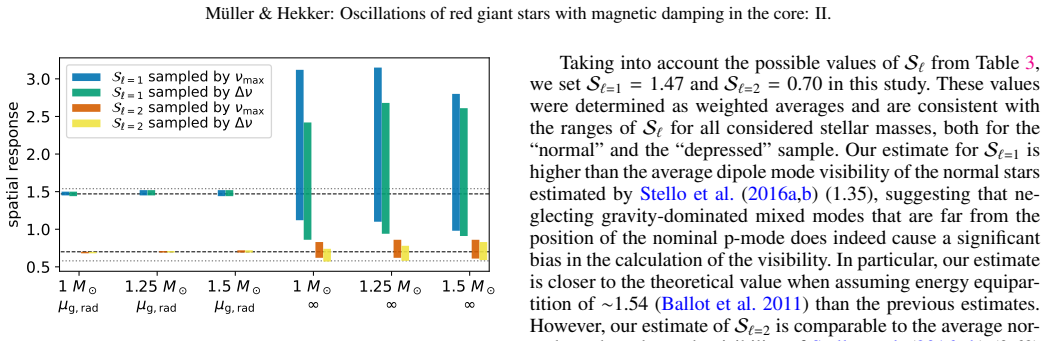
Accounting for how observers divide power spectra into frequency segments raises the inferred dipole-mode visibility in red giants to 1.47 and shows that partial magnetic damping in the core can make mixed-mode signatures appear or disappea
A machine-rendered reading of the paper's core claim, the machinery that carries it, and where it could break.
Core claim
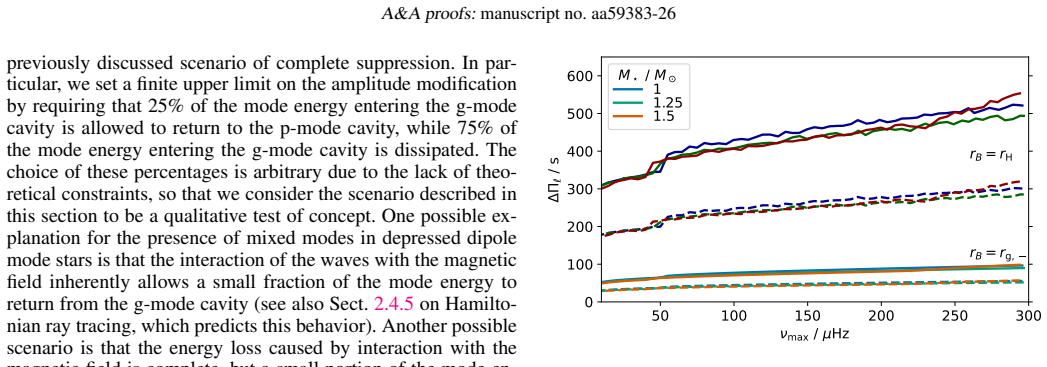
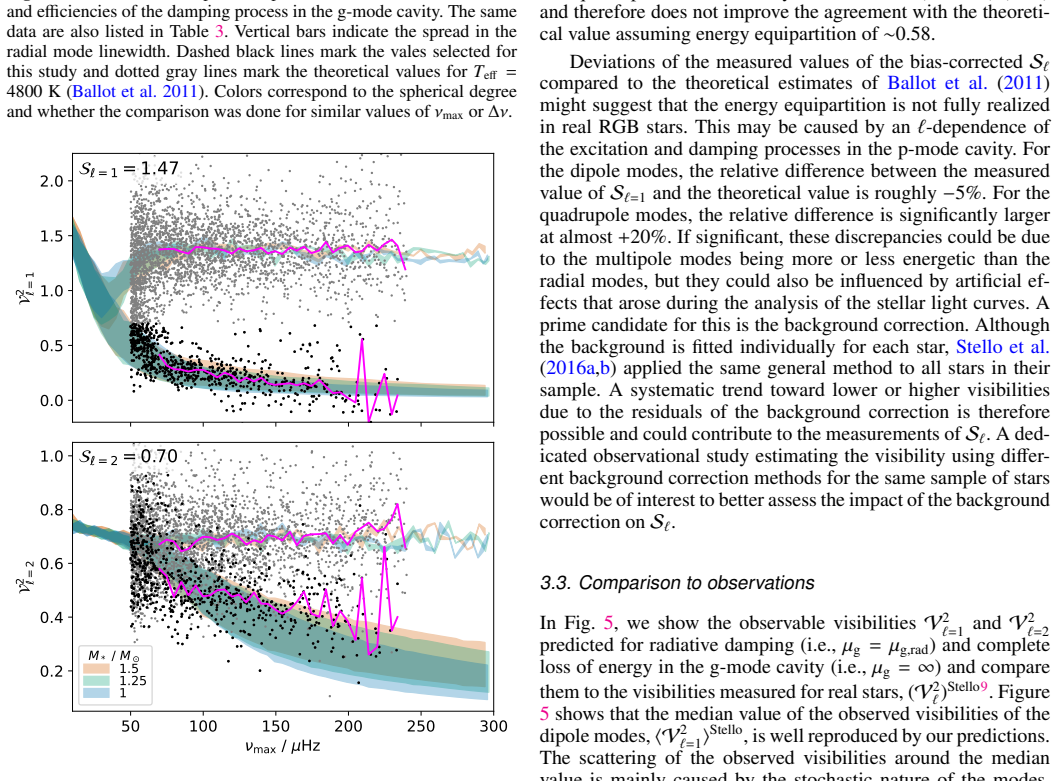
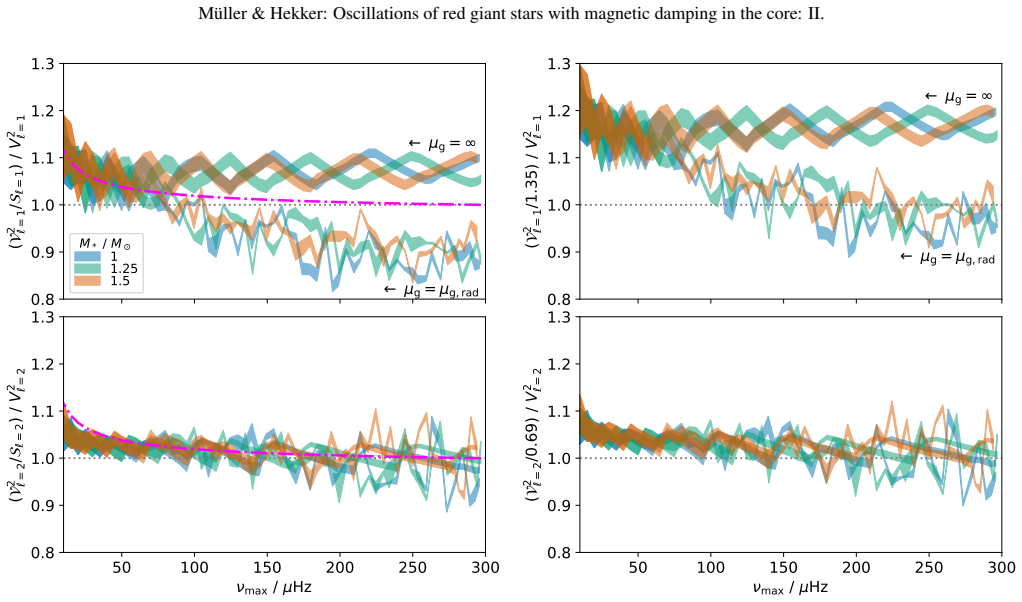
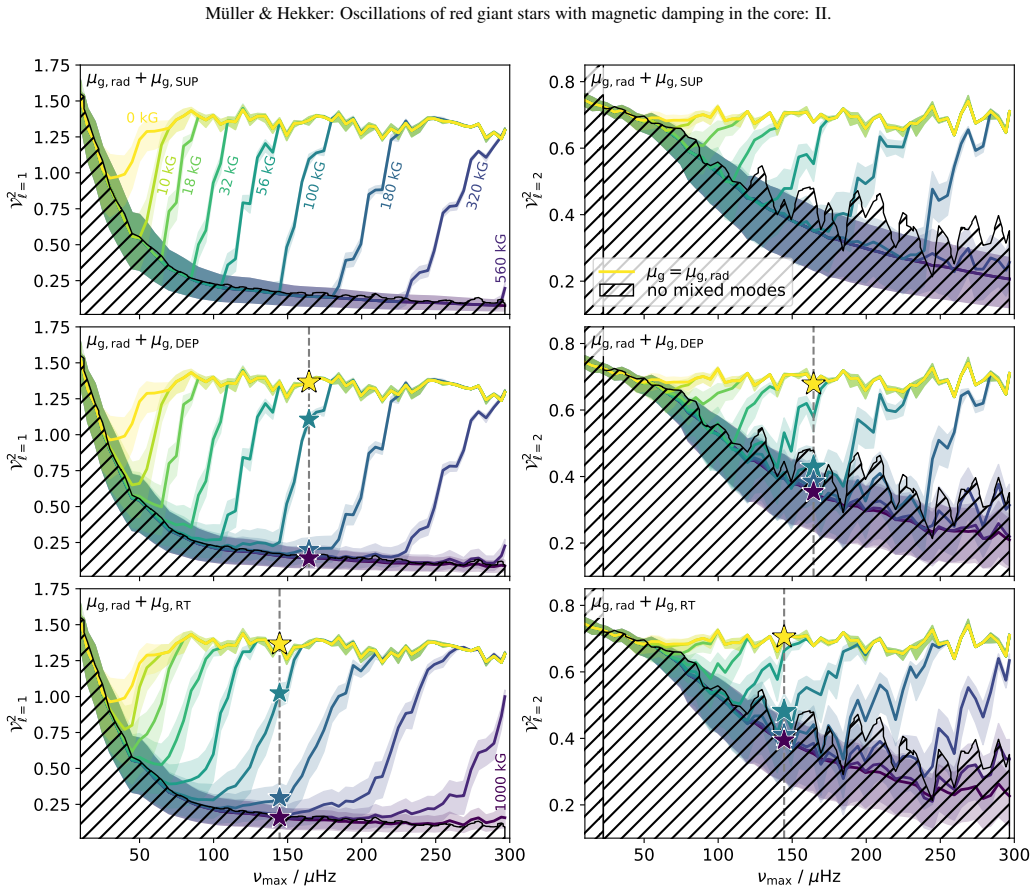
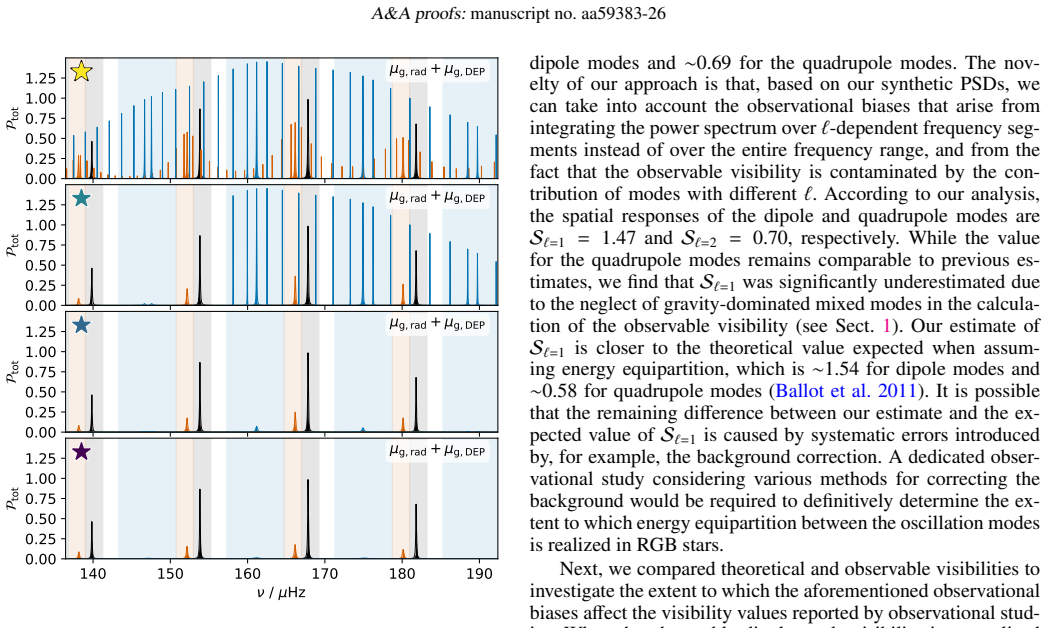
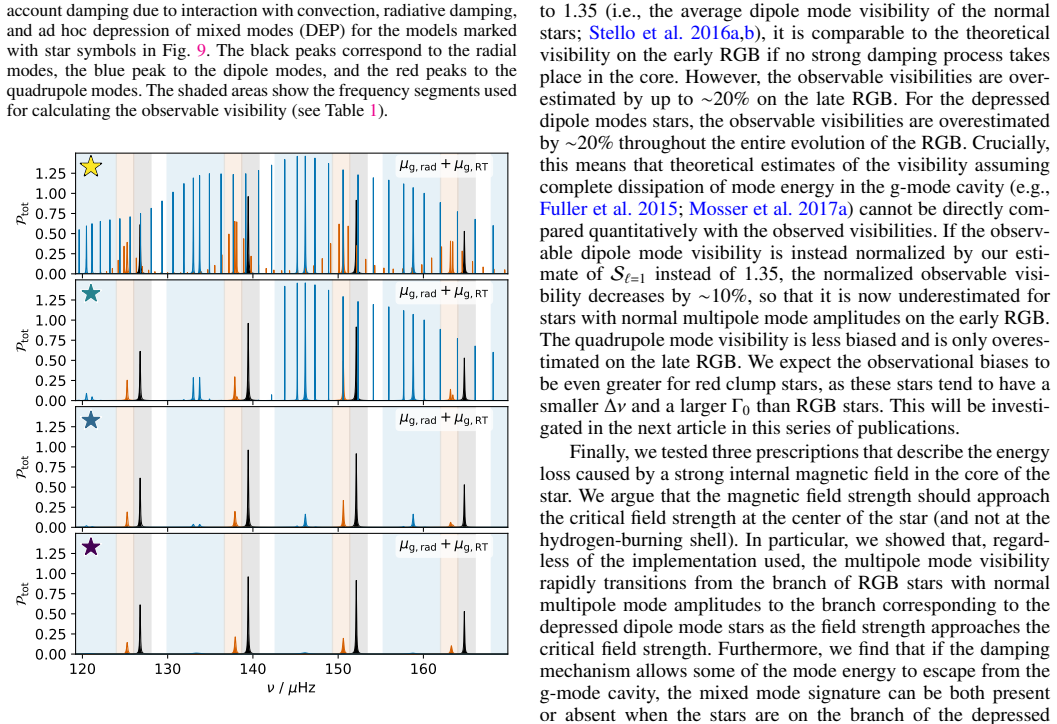
Using synthetic power spectra that replicate the observational frequency-segment division and noise properties, the measured spatial response of the dipole modes becomes 1.47 once biases are removed. This value is closer to theory than earlier estimates, and the normalized dipole visibility of late red-giant-branch stars is predicted to be overestimated by up to 20 percent in published data. When magnetic damping prescriptions incorporate the g-mode cavity turning point, partial energy loss allows the mixed-mode signature to be either present or absent in observable spectra, matching the range of detections seen in real stars.
What carries the argument
Synthetic power spectra that apply the same frequency-segment division and noise model used in observations, combined with magnetic energy-loss prescriptions that account for the inner turning point of the g-mode cavity.
If this is right
- Normalized dipole mode visibility of late RGB stars is overestimated by up to 20 percent in published observations.
- For stars with depressed dipole modes the overestimation reaches 20 percent across the entire RGB evolution.
- Quadrupole mode visibility remains largely unaffected by the segmentation bias except on the late RGB.
- Partial dissipation of mode energy by a strong internal magnetic field permits both detectable and undetectable mixed-mode signatures in the same evolutionary stage.
Where Pith is reading between the lines
- If the turning-point prescription is adopted more widely, mode-visibility corrections could be applied to existing catalogs of red-giant oscillations without new observations.
- The same bias correction may alter inferred core rotation rates or magnetic-field strengths derived from mixed-mode period spacings in large surveys.
- Testing the partial-dissipation model against stars that show intermittent mixed-mode detection across multiple observing campaigns would provide an independent check on the energy-loss rate.
Load-bearing premise
The synthetic spectra reproduce the exact frequency-segment division procedure and observational noise properties used in published visibility measurements, and the tested magnetic energy-loss prescriptions correctly capture the interaction at the g-mode turning point.
What would settle it
A set of new red-giant observations in which the power spectrum is analyzed without the conventional frequency-segment division, or with independent visibility measurements from space-based photometry that avoids the same segmentation, would show whether the corrected dipole visibility remains near 1.47.
Figures
read the original abstract
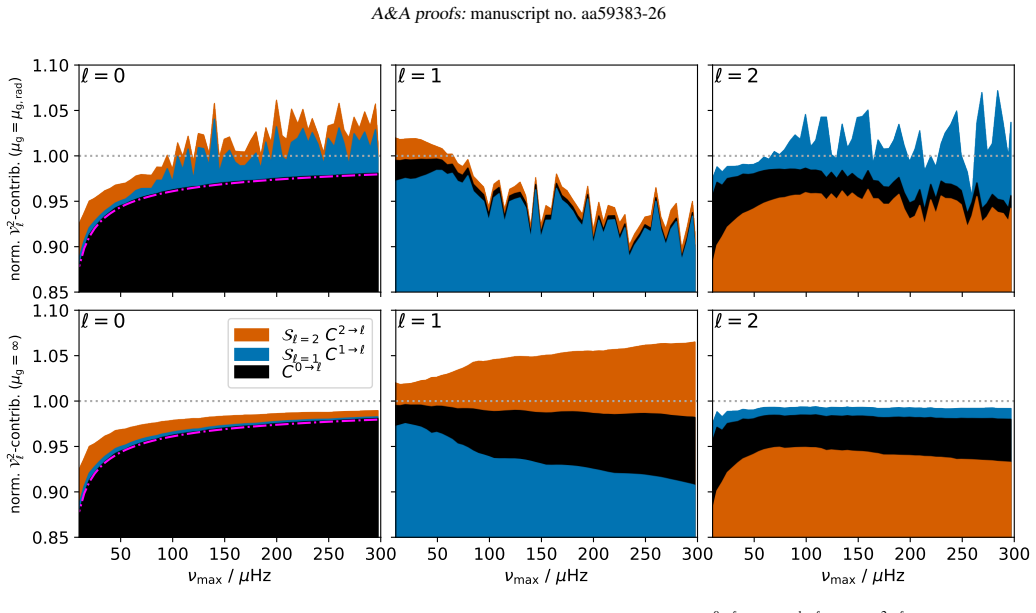
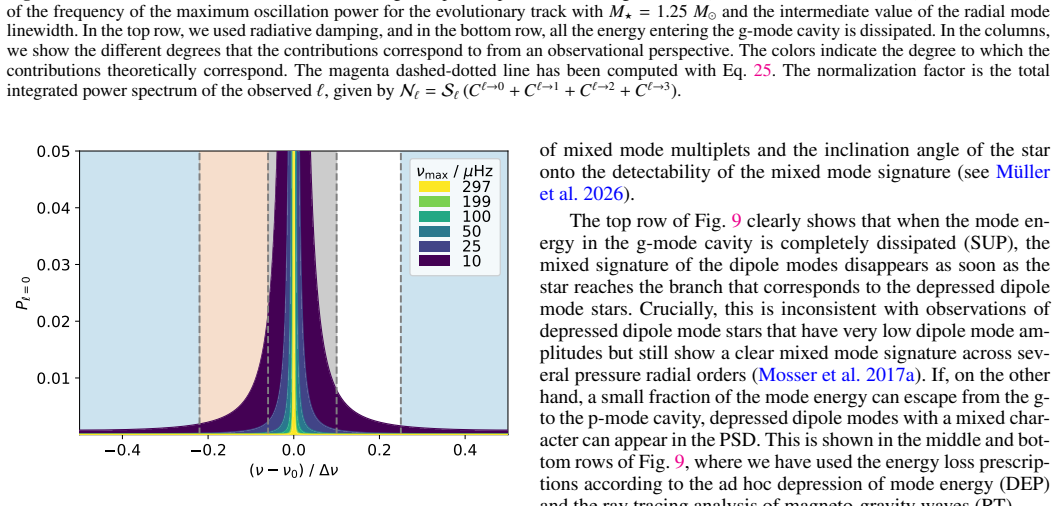
Mode visibilities can be estimated from observed power spectra or from theory by making assumptions about the damping processes occurring in the star. However, a quantitative comparison between the two approaches was so far not feasible due to observational biases. The biases arise from the fact that in observations, the power spectrum is divided into frequency segments in which modes of a certain spherical degree are expected to dominate. In this work, we used synthetic power spectra to calculate the visibility as it has been done in observations and compare it with published observed visibilities to quantify the influence of the biases. We find that, taking the biases into account, the observed spatial response of the dipole modes is 1.47, which is closer to the theoretical value than previous estimates. In particular, we predict that the normalized dipole mode visibility of late red-giant branch (RGB) stars might be overestimated by up to 20% in published observations. For stars with depressed dipole modes, we find that the normalized dipole mode visibilities estimated in observational studies might be overestimated by 20% throughout their entire evolution on the RGB. The quadrupole mode visibility, on the other hand, appears to be largely unaffected by the biases, expect on the late RGB. In addition, we investigated the evolution of the visibility and detectability of the mixed mode signature while testing different prescriptions for the energy loss caused by a strong internal magnetic field in the stellar core. We argue that taking into account the inner turning point of the g-mode cavity could allow a portion of the mode energy to be preserved when interacting with a strong magnetic field. We further show that such partial dissipation allows the mixed mode signature to be both present or absent in the observable power spectra, which is consistent with observations.
Editorial analysis
A structured set of objections, weighed in public.
Referee Report
Summary. The manuscript uses synthetic power spectra to quantify observational biases arising from frequency-segment division when estimating mode visibilities in red-giant stars. It reports a bias-corrected normalized dipole visibility of 1.47 (closer to theoretical expectations) and predicts up to 20% overestimation in published values for late RGB stars, with similar bias for stars showing depressed dipoles. It further tests several magnetic energy-loss prescriptions that incorporate the g-mode turning point and argues that partial dissipation can produce both detectable and undetectable mixed-mode signatures, consistent with observations.
Significance. If the synthetic spectra are shown to replicate the exact observational segment-division algorithm and noise statistics, the bias correction would be a useful calibration for asteroseismic visibility measurements on the RGB. The exploration of partial magnetic dissipation provides a physically motivated mechanism that can reconcile the intermittent presence of mixed modes without requiring complete suppression, building on prior work in a quantitative way.
major comments (3)
- [§3] §3 (synthetic spectra): the central claim that the observed dipole spatial response is 1.47 after bias correction requires explicit demonstration that the frequency-segment delimitation procedure and noise realization in the synthetics are identical to those used in the reference observational papers; without this match the derived correction factor does not transfer.
- [Abstract and §4] Abstract and §4 (visibility results): the quantitative prediction of up to 20% overestimation for late-RGB dipole visibilities (and 20% throughout evolution for depressed modes) is load-bearing for the main conclusion but is stated without reported uncertainties, sensitivity tests to noise properties, or comparison of the exact estimator implementation.
- [§5] §5 (magnetic damping): the argument that accounting for the inner turning point allows partial energy preservation (and thus both presence and absence of mixed-mode signatures) rests on the tested prescriptions; the manuscript must show quantitative detectability metrics rather than qualitative consistency to substantiate the claim against observations.
minor comments (2)
- The abstract would be strengthened by a one-sentence statement of the number of synthetic models and the range of stellar parameters explored.
- Notation for normalized visibility should be defined consistently between text and figures to avoid ambiguity in the 1.47 value.
Simulated Author's Rebuttal
We thank the referee for the constructive and detailed report. We address each major comment below and indicate the revisions planned to strengthen the manuscript.
read point-by-point responses
-
Referee: [§3] §3 (synthetic spectra): the central claim that the observed dipole spatial response is 1.47 after bias correction requires explicit demonstration that the frequency-segment delimitation procedure and noise realization in the synthetics are identical to those used in the reference observational papers; without this match the derived correction factor does not transfer.
Authors: We agree that explicit verification of the matching procedures is required for the correction factor to be transferable. In the revised manuscript we will add a dedicated methods subsection (or appendix) that documents the precise frequency-segment delimitation algorithm implemented in the synthetic spectra, provides a direct side-by-side comparison with the procedures described in the cited observational papers, and details how the noise realizations were generated to reproduce the reported observational noise statistics. revision: yes
-
Referee: [Abstract and §4] Abstract and §4 (visibility results): the quantitative prediction of up to 20% overestimation for late-RGB dipole visibilities (and 20% throughout evolution for depressed modes) is load-bearing for the main conclusion but is stated without reported uncertainties, sensitivity tests to noise properties, or comparison of the exact estimator implementation.
Authors: We acknowledge that the 20 % overestimation statement would be more robust with accompanying uncertainties and sensitivity information. In revision we will (i) derive and report uncertainties on the visibility bias from an ensemble of independent noise realizations, (ii) include sensitivity tests that vary the noise properties, and (iii) supply a concise description or pseudocode of the visibility estimator so that readers can confirm its equivalence to the observational implementation. revision: yes
-
Referee: [§5] §5 (magnetic damping): the argument that accounting for the inner turning point allows partial energy preservation (and thus both presence and absence of mixed-mode signatures) rests on the tested prescriptions; the manuscript must show quantitative detectability metrics rather than qualitative consistency to substantiate the claim against observations.
Authors: The present analysis demonstrates qualitative consistency between the partial-dissipation models and the observed intermittent appearance of mixed-mode signatures. To meet the request for quantitative support we will add, in the revised §5, explicit detectability metrics (e.g., synthetic signal-to-noise ratios for the mixed-mode peaks and a detection-probability threshold calibrated to the observational noise level) for each magnetic-damping prescription. revision: yes
Circularity Check
No circularity: bias correction anchored to external published observations
full rationale
The paper generates synthetic power spectra, applies the exact frequency-segment division and visibility estimator used in prior observational studies, then compares the resulting visibilities directly to independently published observed values (e.g., the adjusted dipole spatial response of 1.47). This comparison is external and falsifiable. Magnetic energy-loss prescriptions are tested for qualitative consistency with the presence/absence of mixed-mode signatures but are not fitted to the target visibility data in a way that renders the reported correction tautological. No self-definitional equations, fitted-input predictions, or load-bearing self-citations appear in the derivation chain.
Axiom & Free-Parameter Ledger
Reference graph
Works this paper leans on
-
[1]
Near-critical magnetic fields in Kepler red giants. , keywords =. doi:10.1051/0004-6361/202659344 , archivePrefix =. 2604.09901 , primaryClass =
-
[2]
Asteroseismic g-mode period spacings in strongly magnetic rotating stars. , keywords =. doi:10.1093/mnras/stad3461 , archivePrefix =. 2310.19873 , primaryClass =
-
[3]
Spectroscopic parameters, the amplitude─activity relation, and unexpected halo orbits
The highest mass Kepler red giants ─ II. Spectroscopic parameters, the amplitude─activity relation, and unexpected halo orbits. , keywords =. doi:10.1093/mnras/staf1421 , archivePrefix =. 2508.12585 , primaryClass =
-
[4]
Magnetic activity of red giants: Correlation between the amplitude of solar-like oscillations and chromospheric indicators. , keywords =. doi:10.1051/0004-6361/202349008 , archivePrefix =. 2401.13549 , primaryClass =
-
[5]
Surface magnetism of rapidly rotating red giants: Single versus close binary stars. , keywords =. doi:10.1051/0004-6361/202245083 , archivePrefix =. 2211.01026 , primaryClass =
-
[6]
Active red giants: Close binaries versus single rapid rotators. , keywords =. doi:10.1051/0004-6361/202037781 , archivePrefix =. 2004.13792 , primaryClass =
-
[7]
Communications in Asteroseismology , keywords =
Automated extraction of oscillation parameters for Kepler observations of solar-type stars. Communications in Asteroseismology , keywords =. doi:10.48550/arXiv.0910.2764 , archivePrefix =. 0910.2764 , primaryClass =
-
[8]
The Octave (Birmingham-Sheffield Hallam) automated pipeline for extracting oscillation parameters of solar-like main-sequence stars. , keywords =. doi:10.1111/j.1365-2966.2009.16030.x , archivePrefix =. 0911.2612 , primaryClass =
-
[9]
Asteroseismology of red giants from the first four months of Kepler data: Fundamental stellar parameters. , keywords =. doi:10.1051/0004-6361/201015263 , archivePrefix =. 1010.4589 , primaryClass =
-
[10]
Solar-like Oscillations in Low-luminosity Red Giants: First Results from Kepler. , keywords =. doi:10.1088/2041-8205/713/2/L176 , archivePrefix =. 1001.0229 , primaryClass =
-
[11]
Radius Determination of Solar-type Stars Using Asteroseismology: What to Expect from the Kepler Mission. , keywords =. doi:10.1088/0004-637X/700/2/1589 , archivePrefix =. 0906.0766 , primaryClass =
-
[12]
CoRoT sounds the stars: p-mode parameters of Sun-like oscillations on HD 49933. , keywords =. doi:10.1051/0004-6361:200810297 , adsurl =
-
[13]
The Red-giant Branch Bump Revisited: Constraints on Envelope Overshooting in a Wide Range of Masses and Metallicities. , keywords =. doi:10.3847/1538-4357/aabf90 , archivePrefix =. 1804.06669 , primaryClass =
-
[14]
Research Notes of the American Astronomical Society , keywords =
Exploring Mixing Thresholds in Asteroseismic Stellar Evolution Models. Research Notes of the American Astronomical Society , keywords =. doi:10.3847/2515-5172/adf06d , archivePrefix =. 2507.23275 , primaryClass =
-
[15]
Living Reviews in Solar Physics , keywords =
Asteroseismology of solar-type stars. Living Reviews in Solar Physics , keywords =. doi:10.1007/s41116-019-0020-1 , archivePrefix =. 1906.12262 , primaryClass =
-
[16]
Asteroseismology of Solar-Type and Red-Giant Stars. , keywords =. doi:10.1146/annurev-astro-082812-140938 , archivePrefix =. 1303.1957 , primaryClass =
Pith/arXiv arXiv doi:10.1146/annurev-astro-082812-140938 1957
-
[17]
, year = 2009, month = may, volume =
Non-radial oscillation modes with long lifetimes in giant stars. , year = 2009, month = may, volume =. doi:10.1038/nature08022 , adsurl =
-
[18]
Near-degeneracy effects on the frequencies of rotationally-split mixed modes in red giants. , keywords =. doi:10.1051/0004-6361/201730786 , archivePrefix =. 1705.10326 , primaryClass =
-
[19]
From an Asymptotic Description to Data Fitting
Near-degeneracy effects in Quadrupolar Mixed Modes. From an Asymptotic Description to Data Fitting. arXiv e-prints , keywords =
-
[20]
Weak or strong: Coupling of mixed oscillation modes on the red giant branch. , keywords =. doi:10.1051/0004-6361/202555255 , archivePrefix =. 2506.04829 , primaryClass =
-
[21]
Conversion and Damping of Nonaxisymmetric Internal Gravity Waves in Magnetized Stellar Cores. , keywords =. doi:10.3847/1538-4357/ae4d18 , archivePrefix =. 2510.14026 , primaryClass =
-
[22]
Unstable non-radial modes in radial pulsators: theory and an example. , keywords =. doi:10.1046/j.1365-8711.1998.01540.x , adsurl =
-
[23]
, keywords =
Oscillations of giants and supergiants. , keywords =
-
[24]
Bayesian peak bagging analysis of 19 low-mass low-luminosity red giants observed with Kepler. , keywords =. doi:10.1051/0004-6361/201525895 , archivePrefix =. 1503.08821 , primaryClass =
-
[25]
Red-giant versus main-sequence stars
Amplitudes and lifetimes of solar-like oscillations observed by CoRoT. Red-giant versus main-sequence stars. , keywords =. doi:10.1051/0004-6361/201014037 , archivePrefix =. 1102.1896 , primaryClass =
-
[26]
Amplitude and lifetime of radial modes in red giant star spectra observed by Kepler. , keywords =. doi:10.1051/0004-6361/201732477 , archivePrefix =. 1805.03690 , primaryClass =
-
[27]
EAS Publications Series , year = 2015, series =
Stellar oscillations - II - The non-adiabatic case. EAS Publications Series , year = 2015, series =. doi:10.1051/eas/1573003 , archivePrefix =. 1510.01151 , primaryClass =
-
[28]
Nonlocal Time-dependent Convection Theory. , keywords =. doi:10.1086/312959 , adsurl =
-
[29]
Mixing-length theory for pulsating stars. , keywords =. doi:10.1086/155244 , adsurl =
-
[30]
, year = 1967, month = jun, volume =
The Stellar Radial Pulsation Coupled with the Convection. , year = 1967, month = jun, volume =. doi:10.1093/pasj/19.2.140 , adsurl =
-
[31]
Convection-pulsation coupling. I. A mixing-length perturbative theory. , keywords =. doi:10.1051/0004-6361:20041816 , adsurl =
-
[32]
Bulletin of the Astronomical Society of India , year = 1996, month = jun, volume =
Solar oscillations : theory. Bulletin of the Astronomical Society of India , year = 1996, month = jun, volume =
1996
-
[33]
Nur Ismail and Cristine Calil Kores and Dimitri Geskus and Markus Pollnau , journal =. Fabry-P&\#x00E9;rot resonator: spectral line shapes, generic and related Airy distributions, linewidths, finesses, and performance at low or frequency-dependent reflectivity , volume =. 2016 , url =
2016
-
[34]
Oscillations of UMa and other red giants. , keywords =. doi:10.1046/j.1365-8711.2001.04894.x , archivePrefix =. astro-ph/0108337 , primaryClass =
-
[35]
Asymptotic power spectra and visibilities of damped mixed modes. , keywords =. doi:10.1051/0004-6361/202557877 , archivePrefix =. 2601.21745 , primaryClass =
-
[36]
Acoustical excitation by turbulent convection
Solar pulsational stability - III. Acoustical excitation by turbulent convection. , year = 1992, month = apr, volume =. doi:10.1093/mnras/255.4.639 , adsurl =
-
[37]
Structural Glitches near the Cores of Red Giants Revealed by Oscillations in g-mode Period Spacings from Stellar Models. , keywords =. doi:10.1088/0004-637X/805/2/127 , archivePrefix =. 1503.09085 , primaryClass =
-
[38]
Mixed-mode coupling in the red clump: I. Standard single star models. , keywords =. doi:10.1051/0004-6361/202451281 , archivePrefix =. 2410.02865 , primaryClass =
-
[39]
, year = 1941, month = jan, volume =
The non-radial oscillations of polytropic stars. , year = 1941, month = jan, volume =. doi:10.1093/mnras/101.8.367 , adsurl =
-
[40]
Seismic constraints on the internal structure of evolved stars: From high-luminosity RGB to AGB stars. , keywords =. doi:10.1051/0004-6361/202040240 , archivePrefix =. 2103.16718 , primaryClass =
-
[41]
Detectability of Axisymmetric Magnetic Fields from the Core to the Surface of Oscillating Post-main-sequence Stars. , keywords =. doi:10.3847/1538-4357/ad4708 , archivePrefix =. 2404.17167 , primaryClass =
-
[42]
Period spacings in red giants. III. Coupling factors of mixed modes. , keywords =. doi:10.1051/0004-6361/201630053 , archivePrefix =. 1612.08453 , primaryClass =
-
[43]
Evolution of dipolar mixed-mode coupling factor in red giant stars: impact of buoyancy spike. , keywords =. doi:10.1093/mnras/stac2065 , archivePrefix =. 2207.09878 , primaryClass =
-
[44]
Amplitudes of stochastically excited oscillations in main-sequence stars. , keywords =. doi:10.48550/arXiv.astro-ph/9909107 , archivePrefix =. astro-ph/9909107 , primaryClass =
-
[45]
A closure model with plumes. II. Application to the stochastic excitation of solar p modes. , keywords =. doi:10.1051/0004-6361:20065370 , archivePrefix =. astro-ph/0607570 , primaryClass =
-
[46]
Excitation of stellar p-modes by turbulent convection. I. Theoretical formulation. , keywords =. doi:10.1051/0004-6361:20010212 , archivePrefix =. astro-ph/0101109 , primaryClass =
-
[47]
Modules for Experiments in Stellar Astrophysics (MESA): Time-dependent Convection, Energy Conservation, Automatic Differentiation, and Infrastructure. , keywords =. doi:10.3847/1538-4365/acae8d , archivePrefix =. 2208.03651 , primaryClass =
-
[48]
Dissipation of mode energy in dipole-like magnetic fields
Oscillations of red giant stars with magnetic damping in the core: I. Dissipation of mode energy in dipole-like magnetic fields. , keywords =. doi:10.1051/0004-6361/202553888 , archivePrefix =. 2503.11451 , primaryClass =
-
[49]
The radial modes of stars with suppressed dipole modes. , keywords =. doi:10.1051/0004-6361/202450037 , archivePrefix =. 2409.12692 , primaryClass =
-
[50]
Study of KIC 8561221 observed by Kepler: an early red giant showing depressed dipolar modes. , keywords =. doi:10.1051/0004-6361/201322823 , archivePrefix =. 1311.6990 , primaryClass =
-
[51]
The impact of rotation on the stochastic excitation of stellar acoustic modes in solar-like pulsators. , keywords =. doi:10.1051/0004-6361/202452093 , archivePrefix =. 2412.14952 , primaryClass =
-
[52]
Asteroseismic Data Analysis: Foundations and Techniques
-
[53]
Momentum Conservation and Mode Classification of the Dipolar Oscillations of Stars. , keywords =. doi:10.1093/pasj/57.2.375 , adsurl =
-
[54]
Evolution of the gravity offset of mixed modes in RGB stars. , keywords =. doi:10.1051/0004-6361/201935327 , archivePrefix =. 1905.05691 , primaryClass =
-
[55]
A general analytical resonance condition
Multi-cavity gravito-acoustic oscillation modes in stars. A general analytical resonance condition. , keywords =. doi:10.1051/0004-6361/202243157 , archivePrefix =. 2203.03402 , primaryClass =
-
[56]
Period spacings in red giants. I. Disentangling rotation and revealing core structure discontinuities. , keywords =. doi:10.1051/0004-6361/201527075 , archivePrefix =. 1509.06193 , primaryClass =
-
[57]
The Contour Method: a New Approach to Finding Modes of Nonadiabatic Stellar Pulsations. , keywords =. doi:10.3847/1538-4357/aba748 , archivePrefix =. 2006.13223 , primaryClass =
-
[58]
Progress of Seismology of the Sun and Stars , year = 1990, editor =
Comments on Helioseismic Inference. Progress of Seismology of the Sun and Stars , year = 1990, editor =. doi:10.1007/3-540-53091-610.1007/3-540-53091-6_93 , adsurl =
-
[59]
Analysis of Adiabatic Dipolar Oscillations of Stars. , keywords =. doi:10.1093/pasj/58.5.893 , adsurl =
-
[60]
doi:10.1007/978-1-4020-5803-5 , adsurl =
Asteroseismology. doi:10.1007/978-1-4020-5803-5 , adsurl =
-
[61]
Probing the mid-layer structure of red giants. I. Mixed-mode coupling factor as a seismic diagnosis. , keywords =. doi:10.1051/0004-6361/201936864 , archivePrefix =. 1912.06008 , primaryClass =
-
[62]
Modeling of magneto-rotational stellar evolution. I. Method and first applications. , keywords =. doi:10.1051/0004-6361/202039253 , archivePrefix =. 2010.13909 , primaryClass =
-
[63]
Asteroseismic signatures of core magnetism and rotation in hundreds of low-luminosity red giants. , keywords =. doi:10.1093/mnras/stae2053 , archivePrefix =. 2409.01157 , primaryClass =
-
[64]
Asteroseismology of the young open cluster NGC 2516. I. Photometric and spectroscopic observations. , keywords =. doi:10.1051/0004-6361/202348901 , archivePrefix =. 2311.16991 , primaryClass =
-
[65]
Core rotation braking on the red giant branch for various mass ranges. , keywords =. doi:10.1051/0004-6361/201832822 , archivePrefix =. 1802.04558 , primaryClass =
-
[66]
The Rotational Shear Layer inside the Early Red-giant Star KIC 4448777. , keywords =. doi:10.3847/1538-4357/aac7c4 , archivePrefix =. 1805.09021 , primaryClass =
-
[67]
Internal rotation of 13 low-mass low-luminosity red giants in the Kepler field. , keywords =. doi:10.1051/0004-6361/201629186 , archivePrefix =. 1702.07910 , primaryClass =
-
[68]
How different are red-giant stars with a mass ratio of 1.015?
Seismic probing of the first dredge-up event through the eccentric red-giant and red-giant spectroscopic binary KIC 9163796. How different are red-giant stars with a mass ratio of 1.015?. , keywords =. doi:10.1051/0004-6361/201731269 , archivePrefix =. 1712.05208 , primaryClass =
-
[69]
A sample study and the analysis of KIC 5006817
Pulsating red giant stars in eccentric binary systems discovered from Kepler space-based photometry. A sample study and the analysis of KIC 5006817. , keywords =. doi:10.1051/0004-6361/201322477 , archivePrefix =. 1312.4500 , primaryClass =
-
[70]
Asteroseismology of the Open Clusters NGC 6791, NGC 6811, and NGC 6819 from 19 Months of Kepler Photometry. , keywords =. doi:10.1088/0004-637X/757/2/190 , archivePrefix =. 1205.4023 , primaryClass =
-
[71]
Frequency, splitting, linewidth and amplitude estimates of low- p modes of Cen A: analysis of Wide-Field Infrared Explorer photometry. , keywords =. doi:10.1111/j.1365-2966.2006.10727.x , archivePrefix =. astro-ph/0607172 , primaryClass =
-
[72]
, year = 1979, month = jan, volume =
Modal Analysis of Stellar Nonradial Oscillations by an Asymptotic Method. , year = 1979, month = jan, volume =
1979
-
[73]
Seismic evidence for a weak radial differential rotation in intermediate-mass core helium burning stars. , keywords =. doi:10.1051/0004-6361/201526449 , archivePrefix =. 1506.02704 , primaryClass =
-
[74]
Nonradial oscillations of stars
-
[75]
Can mass loss and overshooting prevent the excitation of g-modes in blue supergiants?. , keywords =. doi:10.1111/j.1365-2966.2009.14903.x , archivePrefix =. 0904.4641 , primaryClass =
-
[76]
The Equilibrium of a Self-Gravitating Incompressible Fluid Sphere with a Magnetic Field. I. , year = 1956, month = may, volume =. doi:10.1086/146186 , adsurl =
doi:10.1086/146186 1956
-
[77]
Tayler, R. J. , title = ". Monthly Notices of the Royal Astronomical Society , volume =. 1980 , month =. doi:10.1093/mnras/191.1.151 , url =
-
[78]
Stability of magnetic fields in non-barotropic stars: an analytic treatment. , keywords =. doi:10.1093/mnras/stt913 , archivePrefix =. 1302.0273 , primaryClass =
-
[79]
Royal Society Open Science , keywords =
Magnetic fields in non-convective regions of stars. Royal Society Open Science , keywords =. doi:10.1098/rsos.160271 , archivePrefix =. 1510.03198 , primaryClass =
-
[80]
Stable magnetic fields in stellar interiors. , keywords =. doi:10.1051/0004-6361:20041980 , archivePrefix =. astro-ph/0510316 , primaryClass =
discussion (0)
Sign in with ORCID, Apple, or X to comment. Anyone can read and Pith papers without signing in.