REVIEW 3 major objections 5 minor 53 references
Time-Continuous Frequency Allocation for Feeder Links of Mega Constellations with Multi-Antenna Gateway Stations
T0 review · 3 major / 5 minor · reviewed 2026-08-15 · deepseek-v4-flash
Pith's one-line read Graph-coloring frequency allocation can keep mega-LEO feeder links within the regulatory interference limit while switching frequencies only about 1.5 percent of the time.
desk verdict A real engineering problem and a plausible toolkit, but the P1-to-P2 graph transformation is circular as written and the sub-1% link-failure claims rest on an unverified equivalence. read the letter →
The pith
A machine-rendered reading of the paper's core claim, the machinery that carries it, and where it could break.
The reading
What carries the argument
The load-bearing object is the time-varying interference graph $G(t)$, whose vertices are the working satellites and whose edges are placed by an adaptive threshold: an interfering link becomes an edge when its single-link interference exceeds a per-satellite threshold chosen so that the aggregate interference of every link stays under the regulatory limit. This edge construction is what converts the original integer nonlinear link-failure minimization into a conflict-minimization coloring problem. The second mechanism is the clique partition of $G(t)$: satellites serving the same multi-antenna gateway form a clique or quasi-clique, and Lemma 1 guarantees that coloring each clique with all distinct colors removes every intra-gateway conflict. GG and CTS solve the coloring at scale, and the time-continuous variants freeze the colors of satellites that keep their gateway and switch a constrained satellite's color only with a probability proportional to the number of conflicts it would remove; this probabilistic switch is the mechanism that holds the frequency switching rate near 0.015.
What would settle it
Re-run the edge-construction rule on one time slot with two different allocations—CTS's output and a random assignment—and compare the resulting edge sets; if they differ materially, the graph is not a fixed interference topology and the reported link-failure rates cannot be attributed solely to the coloring solutions.
Extended reading notes
Core claim
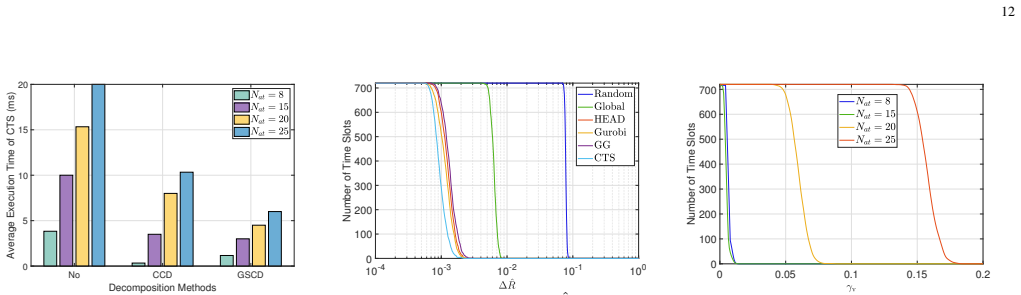
The central claim is that the aggregate-interference constraint on feeder links—the ITU requirement that each link's interference-to-noise ratio stay below -12.2 dB—can be converted into a graph-coloring problem with almost no loss, provided the graph edges are drawn with an adaptive per-satellite threshold rather than a fixed one. The paper identifies a structural fact that makes the coloring easy: all satellites selected by the same multi-antenna gateway point their antennas at the same location, so they form a clique or quasi-clique of size equal to the number of gateway antennas. Assigning distinct subchannels inside each clique eliminates all intra-gateway interference by Lemma 1, and a tabu search over these clique-structured initial colorings removes most inter-gateway interference as well. On a simulated Starlink constellation of 34,396 satellites, the paper reports that these methods keep average link failure below 1 percent, with the clique-based variant reaching 0.89 percent and outperforming a strong general-purpose graph-coloring algorithm at lower runtime; the time-continuous modification extends the same protection to a frequency switching rate as low as 0.015.
Load-bearing premise
The interference graph is defined using the very frequency assignment the coloring procedure is supposed to produce, so the reduction from link-failure minimization to graph coloring is only well-posed if the graph's edges are read as potential interference that does not depend on the current allocation.
Editorial extensions
If this is right
- If the paper's results are right, a mega-constellation operator can hold average feeder-link failure below about 1 percent using only as many subchannels as the gateway has antennas, with the clique-based CTS variant reaching 0.89 percent on the simulated 34,396-satellite Starlink system.
- The time-continuous variants preserve that protection at low switching cost: TCFA-CTS stays below 1.1 percent link failure at a frequency switching rate of 0.015, which the paper argues makes feeder-link stability practical without heavy signaling overhead.
- The two decomposition methods scale the approach to full mega constellations: connected-component decomposition saves about half the execution time, and gateway-station clustering saves about 70 percent, with CTS experiencing almost no interference-mitigation loss.
- Because the paper bounds capacity loss once the ITU interference constraint is met, graph-coloring IM nearly reaches the interference-free capacity ceiling; the paper reports system capacity degradation below 0.1 percent for CTS.
- List-coloring-based vacant subchannel reuse can then raise system capacity by about 6 percent at 20 antennas per gateway and 17 percent at 25 antennas, without adding conflicts.
Reading between the lines
- The paper leaves implicit that the clique partition is a geometric fact rather than a Starlink-specific one: any gateway with several antennas pointed at nearby satellites generates near-cliques, so CTS should transfer to other mega constellations and to multi-beam gateway architectures.
- A testable extension would replace the binary adaptive threshold with continuous edge weights and solve a weighted coloring problem; the small gap between CTS and the direct integer optimization suggests that weighted conflict minimization could close it while keeping the polynomial-time scaling.
- The switching probability is a tunable knob: an operator could adapt it online to honor a hard frequency-switching budget, which the paper does not explore.
- A stress test for coexistence would apply the method when two operators' satellites share the same gateway region, since then the clean per-gateway clique partition is broken and the method's performance is not covered by the paper's simulations.
Signed reviews
Editorial analysis
A structured set of objections, weighed in public.
Referee Report
Summary. The paper addresses interference mitigation for feeder links of mega LEO satellite constellations with multi-antenna gateway stations (MAGSs). It models the system, formulates an aggregate I/N link-failure minimization problem P1, and transforms it into a graph coloring problem P2 with an adaptive interference threshold. Two coloring algorithms are proposed: Generalized Global (GG) and Clique-Based Tabu Search (CTS), together with time-continuous variants (TCFA-GG, TCFA-CTS), two constellation decomposition methods, and a list-coloring-based vacant subchannel utilization scheme. Simulations on a Starlink Gen1/Gen2 constellation with 34,396 satellites report average link failure rates below 1% for GG, CTS, and HEAD, with TCFA-CTS below 1.1% at a frequency switching rate of 0.015.
Significance. If the core formulation is valid, the paper makes a significant engineering contribution: it proposes scalable, low-complexity frequency allocation for a pressing real-world problem, leverages the clique structure of MAGSs in a principled way, and addresses time continuity explicitly. The simulation scale is realistic, the comparison against Gurobi and HEAD is informative, and the reported performance figures are concrete and falsifiable. The main weakness is that the central problem transformation from P1 to P2 is not soundly established as written, and the reported sub-1% LF results depend on this transformation.
major comments (3)
- [Section III, Eq. (6)-(7)] The edge-construction rule in Eq. (6) uses S_I^s(c_s,t), the set of satellites already transmitting on subchannel c_s. This set is only defined after a subchannel assignment is chosen, so the edge set E(t) depends on the very coloring being optimized. Consequently f_con in Eq. (8) counts conflicts on a coloring-dependent graph, and P2 is not a standard K-coloring problem as stated. Please redefine the graph using potential co-channel interferers independent of the current assignment (e.g., all satellites above the horizon whose interference would exceed the threshold if co-channel), or provide a fixed-point/iterative formulation in which the graph and coloring are consistent. This is a load-bearing issue because all later algorithms operate on G(t).
- [Section III and Section VI-B] The claimed equivalence between P1 and P2 is not established. Fig. 9 is a threshold sweep of I_Gamma^th for CTS; it does not compare a P2-optimal coloring with a P1-optimal coloring on the same instances. No theorem bounds f_LF by f_con. Proposition 1 assumes the ITU constraint is met and concerns capacity degradation, not the P1-P2 gap. Please provide either a formal bound relating f_LF to f_con or a systematic numerical comparison (e.g., evaluating f_LF of colorings that minimize f_con on the same instances where Gurobi solves P1 directly).
- [Section III, Eq. (7)] Equation (7) is not well-posed as printed: the summation range and the role of I_s^th are ambiguous, and the expression appears to define a threshold from a sum over a subset of co-channel interferers that depends on the unknown coloring. Since I_s^th determines which edges are inserted into G(t), please rewrite this equation with explicit quantifiers and a clear definition of the set over which the sum is taken.
minor comments (5)
- [Section IV-B and Fig. 4] There are several typos: 'Freqency' in Section I-B, 'Adapitve' in Fig. 4, 'sturcture' in Section IV-B, and 'decompositon' in Section IV-D.
- [Algorithm 1] Algorithm 1 line 5 uses argmin over colors not used by neighbors; if all C colors are used by neighbors, the feasible set is empty, and the algorithm does not specify what color is assigned. The text in Section VI mentions a random color for conflicts, but the algorithm pseudocode should state this explicitly.
- [Section V-A, Eq. (26)] The notation log_{C/N}_s(1+I_R^th) is unusual; please write the base explicitly, e.g., log_{(C/N)_s}(1+I_R^th), to avoid confusion.
- [Section VI-A] The parameter p_s in Eq. (17) is used to control the long-term FSR but its value is not reported in Table I or the simulation setup. Please provide the value used in the simulations.
- [Eq. (32)] In the FSR formula, the outer sum is over all satellites S while m_c(s,t) is nonzero only for satellites selected in both t-1 and t; please clarify the index set.
Circularity Check
Eq. (6) defines the interference graph via S_I^s(c_s,t), the co-channel set of the very coloring P2 is optimizing, making the P1-to-P2 transformation self-referential.
-
self definitional
[Section III, Eqs. (6)-(9)]
"edges are constructed according to the following rule: e_{u,s}(t) = (1, ∀s∈W(t), ∀u∈S_I^s(c_s,t), I_{u,s,t}≥I_s^th, 0, otherwise), (6) where the adaptive interference threshold I_s^th for satellite s is determined as the maximum value satisfying ... (7). On this basis, the number of conflicting edges for subchannel assignment scheme (coloring scheme) c is calculated by fcon(c,t) = Σ_{s∈W(t)} Σ_{u∈W(t)} e_{u,s}(t) δ(c_s−c_u), (8) then P1 is transformed into P2: min_c fcon(c,t). (9)"
Earlier in Section II.A, S_I^u(c_u,t) is defined as the set of satellites 'simultaneously communicating on subchannel c_u', i.e., the set is determined by the current frequency allocation. Substituting that set into Eq. (6) makes the edge e_{u,s}(t) exist only when u is already assigned the same subchannel as s, and Eq. (7) makes the threshold I_s^th depend on the same assignment-dependent set. Therefore the graph G(t), the threshold, and the P2 objective fcon(c,t) are all functions of the candidate coloring c that P2 is supposed to determine. P2 is not a fixed-input K-coloring reformulation of P1; it is a self-referential count of strong co-channel pairs under c.
full rationale
The algorithmic contributions are otherwise self-contained: GG, CTS, TCFA-GG/CTS, and VSU are tested against external baselines (Global, HEAD, Gurobi) on a Starlink simulation, and no load-bearing self-citation or imported uniqueness theorem appears. The circularity is concentrated in the problem transformation. As written, Eq. (6) builds E(t) from S_I^s(c_s,t), the set of satellites already using subchannel c_s assigned to s; Eq. (7) tunes I_s^th from the same assignment-dependent set; and Eqs. (8)-(9) define P2 by minimizing conflicts on that self-referential graph. If the authors intended E(t) to represent potential co-channel interference independent of the current coloring, that would remove the circularity, but that is not what Eqs. (6)-(7) state. The later claim that 'the gap between P1 and P2 is trivial' (Section VI.B.1, Fig. 9) is an empirical threshold sweep for CTS and does not repair the definitional issue. Because the central derivation from P1 to P2 is self-referential by construction, the circularity score is 8.
Assumptions & free parameters
free parameters (6)
- I_Γ^th =
-13 dB
- N_GG =
100
- N_t_in, N_t_ca, Nit, Nn =
2000, 500, 250, 10
- σ (Gaussian noise std) =
not specified
- p_s (FSR proportionality constant) =
not specified
- C (number of subchannels) =
N_at
assumptions (4)
- ad hoc to paper The set S_I^s(c_s,t) of co-channel interferers can be used to build the graph before solving for c_s.
- domain assumption Each MAGS's selected satellites form a clique or quasi-clique of size N_at, and removing a few edges does not change the chromatic number.
- ad hoc to paper The gap between P1 (minimize link failures) and P2 (minimize conflicting edges) is trivial when I_Γ^th is tuned near -13 dB.
- domain assumption Satellite selection follows the maximum elevation angle principle and all satellites transmit at maximum power.
Cite this review
Pith. "Pith review of Time-Continuous Frequency Allocation for Feeder Links of Mega Constellations with Multi-Antenna Gateway Stations." pith.science (2026). https://pith.science/paper/UGEJI6YE
@misc{pith2026250512429,
  author       = {Pith},
  title        = {Pith review of: Time-Continuous Frequency Allocation for Feeder Links of Mega Constellations with Multi-Antenna Gateway Stations},
  year         = {2026},
  howpublished = {\url{https://pith.science/paper/UGEJI6YE}},
  note         = {Machine review of arXiv:2505.12429}
}
abstract
With the recent rapid advancement of mega low earth orbit (LEO) satellite constellations, multi-antenna gateway station (MAGS) has emerged as a key enabler to support extremely high system capacity via massive feeder links. However, the densification of both space and ground segment leads to reduced spatial separation between links, posing unprecedented challenges of interference exacerbation. This paper investigates graph coloring-based frequency allocation methods for interference mitigation (IM) of mega LEO systems. We first reveal the characteristics of MAGS interference pattern and formulate the IM problem into a $K$-coloring problem using an adaptive threshold method. Then we propose two tailored graph coloring algorithms, namely Generalized Global (GG) and Clique-Based Tabu Search (CTS), to solve this problem. GG employs a low-complexity greedy conflict avoidance strategy, while CTS leverages the unique clique structure brought by MAGSs to enhance IM performance. Subsequently, we innovatively modify them to achieve time-continuous frequency allocation, which is crucial to ensure the stability of feeder links. Moreover, we further devise two mega constellation decomposition methods to alleviate the complexity burden of satellite operators. Finally, we propose a list coloring-based vacant subchannel utilization method to further improve spectrum efficiency and system capacity. Simulation results on Starlink constellation of the first and second generations with 34396 satellites demonstrate the effectiveness and superiority of the proposed methodology.
Figures


Figures from the paper (7 more)


Reference graph
Works this paper leans on
-
[1]
On the road to 6G: Visions, requirements, key technologies, and testbeds,
C.-X. Wang et al. , “On the road to 6G: Visions, requirements, key technologies, and testbeds,” IEEE Commun. Surv. Tutor., vol. 25, no. 2, pp. 905–974, Feb. 2023
work page 2023
-
[2]
Integrated satellite-terrestrial networks toward 6G: Architectures, applications, and challenges,
X. Zhu and C. Jiang, “Integrated satellite-terrestrial networks toward 6G: Architectures, applications, and challenges,” IEEE Internet Things J., vol. 9, pp. 437–461, Nov. 2022
work page 2022
-
[3]
Satellite communications in the new space era: A survey and future challenges,
O. Kodheli et al. , “Satellite communications in the new space era: A survey and future challenges,”IEEE Commun. Surv. Tutor., vol. 23, no. 1, pp. 70–109, Sep. 2020
work page 2020
-
[4]
A survey on nongeostationary satellite systems: The communication perspective,
H. Al-Hraishawi et al., “A survey on nongeostationary satellite systems: The communication perspective,” IEEE Commun. Surv. Tutor., vol. 25, no. 1, pp. 101–132, Aug. 2023
work page 2023
-
[5]
I. Del Portillo, B. G. Cameron, and E. F. Crawley, “A technical comparison of three low earth orbit satellite constellation systems to provide global broadband,” Acta Astronautica , vol. 159, pp. 123–135, Jun. 2019
work page 2019
-
[6]
Ground segment architec- tures for large LEO constellations with feeder links in EHF-bands,
I. del Portillo, B. Cameron, and E. Crawley, “Ground segment architec- tures for large LEO constellations with feeder links in EHF-bands,” in Proc. IEEE Aerosp. Conf. , Mar. 2018, pp. 1–14
work page 2018
-
[7]
Gateway station geographical planning for emerging non-geostationary satellites constellations,
V . M. Baeza, F. Ortiz, E. Lagunas, T. S. Abdu, and S. Chatzinotas, “Gateway station geographical planning for emerging non-geostationary satellites constellations,” IEEE Network, Oct. 2023
work page 2023
-
[8]
Applications for Ka-band gateway earth station authorizations,
SpaceX Services, Inc., “Applications for Ka-band gateway earth station authorizations,” IBFS File Nos. SES-LIC-20190816-01062 and 01063; SES-LIC-20190827-01110; SES-LIC-20190906-01170 and 01171, Nov. 2019
work page 2019
Show all 53 references
-
[9]
Application for fixed satellite service by spacex services,
Federal Communications Commission (FCC), “Application for fixed satellite service by spacex services,” [Online]. Available: https://fcc. report/IBFS/Filing-List/SES-LIC, Jun. 2023. 13
2023
-
[10]
Should we worry about interference in emerging dense NGSO satellite constellations?
C. Braun, A. M. V oicu, L. Simi ´c, and P. M ¨ah¨onen, “Should we worry about interference in emerging dense NGSO satellite constellations?” in Proc. IEEE Int. Symp. Dynamic Spectr. Access Net. (DySPAN) , 2019, pp. 1–10
2019
-
[11]
The dense sky: Evaluating system coexistence of new NGSO satellite constellations in the Ka band,
J. Suilmann, A. M. V oicu, L. Simi ´c, and P. M ¨ah¨onen, “The dense sky: Evaluating system coexistence of new NGSO satellite constellations in the Ka band,” in Proc. IEEE Globecom Workshops (GC Wkshps) , 2021, pp. 1–6
2021
-
[12]
Dynamic cooperative spectrum sharing in a multi-beam LEO-GEO co-existing satellite system,
P. Gu, R. Li, C. Hua, and R. Tafazolli, “Dynamic cooperative spectrum sharing in a multi-beam LEO-GEO co-existing satellite system,” IEEE Trans. Wireless Commun., vol. 21, no. 2, pp. 1170–1182, Aug. 2021
2021
-
[13]
Multi-satellite beam hopping based on load balancing and interference avoidance for NGSO satellite communication systems,
Z. Lin, Z. Ni, L. Kuang, C. Jiang, and Z. Huang, “Multi-satellite beam hopping based on load balancing and interference avoidance for NGSO satellite communication systems,” IEEE Trans. Commun., vol. 71, no. 1, pp. 282–295, 2022
2022
-
[14]
The next generation of beam hopping satellite systems: Dynamic beam illumination with selective precoding,
L. Chen, V . N. Ha, E. Lagunas, L. Wu, S. Chatzinotas, and B. Ottersten, “The next generation of beam hopping satellite systems: Dynamic beam illumination with selective precoding,” IEEE Trans. Wireless Commun., vol. 22, no. 4, pp. 2666–2682, Oct. 2022
2022
-
[15]
Satellite-terrestrial coordinated multi-satellite beam hopping scheduling based on multi- agent deep reinforcement learning,
Z. Lin, Z. Ni, L. Kuang, C. Jiang, and Z. Huang, “Satellite-terrestrial coordinated multi-satellite beam hopping scheduling based on multi- agent deep reinforcement learning,” IEEE Trans. Wireless Commun. , vol. 23, no. 8, pp. 10 091–10 103, Feb. 2024
2024
-
[16]
Newspace spectrum sharing: Assessing interference risk and mitigations for new satellite constellations,
S. Tonkin and J. P. De Vries, “Newspace spectrum sharing: Assessing interference risk and mitigations for new satellite constellations,” in Proc. TPRC 46th Res. Conf. Commun. Inf. Internet Policy , Sep. 2018, pp. 1–102
2018
-
[17]
Beam pointing optimization based downlink interference mitigation technique between NGSO satellite systems,
L. Yin, R. Yang, Y . Yang, L. Deng, and S. Li, “Beam pointing optimization based downlink interference mitigation technique between NGSO satellite systems,” IEEE Wireless Commun. Lett., vol. 10, no. 11, pp. 2388–2392, Jul. 2021
2021
-
[18]
Radio resource allocation for multi- antenna gateway stations of diverse NGSO constellation networks,
Z. Ren, W. Li, J. Jin, and Y . Zhan, “Radio resource allocation for multi- antenna gateway stations of diverse NGSO constellation networks,” IET Commun., vol. 16, no. 7, pp. 734–744, Jan. 2022
2022
-
[19]
Joint power and tilt control in satellite constellation for NGSO-GSO interference mitigation,
M. Jalali, F. Ortiz, E. Lagunas, S. Kisseleff, L. Emiliani, and S. Chatzino- tas, “Joint power and tilt control in satellite constellation for NGSO-GSO interference mitigation,” IEEE Open J. Veh. Technol. , vol. 4, pp. 545– 557, Aug. 2023
2023
-
[20]
Statistical CSI-based distributed precoding design for OFDM-cooperative multi-satellite systems,
Y . Wang, V . N. Ha, K. Ntontin, H. Yan, W. Wang, S. Chatzinotas, and B. Ottersten, “Statistical CSI-based distributed precoding design for OFDM-cooperative multi-satellite systems,” 2025. [Online]. Available: https://arxiv.org/abs/2505.08038
2025
-
[21]
Distributed beamforming for multiple LEO satellites with imperfect delay and doppler compensations: Modeling and rate analysis,
S. Wu, Y . Wang, G. Sun, W. Wang, J. Wang, and B. Ottersten, “Distributed beamforming for multiple LEO satellites with imperfect delay and doppler compensations: Modeling and rate analysis,” IEEE Trans. Veh. Technol., May. 2025, Early Access
2025
-
[22]
A risk assessment framework for NGSO-NGSO interference,
F. T. A. Council, S. Group et al. , “A risk assessment framework for NGSO-NGSO interference,” Federal Communications Commision, Tech. Rep., Dec, 2017
2017
-
[23]
Frequency prediction and assignment among SatComs networks: A CNN-LSTM approach,
Z. Ren, J. Jin, W. Li, R. Wen, and Y . Zhan, “Frequency prediction and assignment among SatComs networks: A CNN-LSTM approach,” in Proc. 2022 IEEE/CIC Int. Conf. Commun. China , Aug. 2022, pp. 106–111
2022
-
[24]
Frequency plan design for multibeam satellite constellations using integer linear programming,
J. J. Garau-Luis, S. A. Torrens, G. C. Vila, N. Pachler, E. F. Crawley, and B. G. Cameron, “Frequency plan design for multibeam satellite constellations using integer linear programming,” IEEE Trans. Wireless Commun., vol. 23, no. 4, pp. 3312–3327, Aug. 2023
2023
-
[25]
Avoiding self- interference in megaconstellations through cooperative satellite routing and frequency assignment,
N. Pachler, E. F. Crawley, and B. G. Cameron, “Avoiding self- interference in megaconstellations through cooperative satellite routing and frequency assignment,” IEEE J. Sel. Areas Commun., vol. 42, no. 11, pp. 3188–3203, Jul. 2024
2024
-
[26]
Frequency assignment: Theory and applications,
W. Hale, “Frequency assignment: Theory and applications,” Proc. IEEE, vol. 68, no. 12, pp. 1497–1514, Dec. 1980
1980
-
[27]
Low-cost mmwave MIMO multi- streaming via bi-clustering, graph coloring, and hybrid beamforming,
A. Ghasemi and S. A. Zekavat, “Low-cost mmwave MIMO multi- streaming via bi-clustering, graph coloring, and hybrid beamforming,” IEEE Trans. Wireless Commun. , vol. 20, no. 7, pp. 4113–4127, Feb. 2021
2021
-
[28]
Topological interference manage- ment with adversarial topology perturbation: An algorithmic perspec- tive,
Y .-C. Liang, C.-S. Liao, and X. Yi, “Topological interference manage- ment with adversarial topology perturbation: An algorithmic perspec- tive,” IEEE Trans. Commun., vol. 70, no. 12, pp. 8153–8166, Oct. 2022
2022
-
[29]
2-layer interference coordination framework based on graph coloring algorithm for a cellular system with distributed MU-MIMO,
C. Ge, S. Xia, Q. Chen, and F. Adachi, “2-layer interference coordination framework based on graph coloring algorithm for a cellular system with distributed MU-MIMO,” IEEE Trans. Veh. Technol., vol. 72, no. 3, pp. 3557–3568, Nov. 2022
2022
-
[30]
UA V-assisted emergency communications in social IoT: A dynamic hypergraph col- oring approach,
B. Wang, Y . Sun, Z. Sun, L. D. Nguyen, and T. Q. Duong, “UA V-assisted emergency communications in social IoT: A dynamic hypergraph col- oring approach,” IEEE Internet Things J. , vol. 7, no. 8, pp. 7663–7677, Apr. 2020
2020
-
[31]
A greedy approach combined with graph coloring for non-uniform beam layouts under antenna constraints in multibeam satellite systems,
J.-T. Camino, S. Mourgues, C. Artigues, and L. Houssin, “A greedy approach combined with graph coloring for non-uniform beam layouts under antenna constraints in multibeam satellite systems,” in Proc. 2014 Adv. Satell. Multimed. Syst. Conf. Signal Process. Space , Sep. 2014, p...
2014
-
[32]
Quantum annealing for complex optimization in satellite communication systems,
T. Q. Dinh, S. H. Dau, E. Lagunas, S. Chatzinotas, D. N. Nguyen, and D. T. Hoang, “Quantum annealing for complex optimization in satellite communication systems,” IEEE Internet Things J. , vol. 12, no. 4, pp. 3771–3784, Oct. 2024
2024
-
[33]
Recommendation ITU-R S.1528: Satellite antenna radiation patterns for non-geostationary orbit satellite antennas operating in the fixed-satellite service below 30 GHz,
ITU-R, “Recommendation ITU-R S.1528: Satellite antenna radiation patterns for non-geostationary orbit satellite antennas operating in the fixed-satellite service below 30 GHz,” [Online]. Available: https://www. itu.int/rec/R-REC-S.1528, 2001
2001
-
[34]
Available: https://www.itu.int/dms pubrec/itu-r/rec/s/ R-REC-S.1428-1-200102-I!!PDF-E.pdf, 2001
ITU-R, “Recommendation ITU-R S.1428: Reference FSS earth-station radiation patterns for use in interference assessment involving non- GSO satellites in frequency bands between 10.7 GHz and 30 GHz,” [Online]. Available: https://www.itu.int/dms pubrec/itu-r/rec/s/ R-REC-S.1428-1...
-
[35]
ITU-R, “Recommendation ITU-R S.1325: Simulation methodologies for determining statistics of short-term interference between co-frequency, codirectional non-geostationary-satellite orbit fixed-satellite service sys- tems in circular orbits and other non-geostationary fixed-sate...
2003
-
[36]
Co-frequency interference analysis and avoidance between NGSO constellations: Challenges, techniques, and trends,
Y . He, Y . Li, and H. Yin, “Co-frequency interference analysis and avoidance between NGSO constellations: Challenges, techniques, and trends,” China Commun., vol. 20, no. 7, pp. 1–14, Jul. 2023
2023
-
[37]
ITU-R, “Recommendation ITU-R S.1432: Apportionment of the allow- able error performance degradations to fixed-satellite service (FSS) hy- pothetical reference digital paths arising from time invariant interference for systems operating below 30 GHz,” 2006
2006
-
[38]
Analysis of co-frequency interference avoidance effect of downlink between giant ngso constellations based on mesinr satellite selection,
Y . Li and Y . He, “Analysis of co-frequency interference avoidance effect of downlink between giant ngso constellations based on mesinr satellite selection,” in Proc. 2023 Int. Conf. Commun. Technol. (ICCT) , Oct. 2023, pp. 1214–1218
2023
-
[39]
Reducibility among combinatorial problems,
R. M. Karp, “Reducibility among combinatorial problems,” Complexity of Computer Computations , pp. 85–103, 1972
1972
-
[40]
Graph coloring based pilot assignment for cell-free massive MIMO systems,
H. Liu, J. Zhang, S. Jin, and B. Ai, “Graph coloring based pilot assignment for cell-free massive MIMO systems,” IEEE Trans. Veh. Technol., vol. 69, no. 8, pp. 9180–9184, Jun. 2020
2020
-
[41]
An upper bound for the chromatic number of a graph and its application to timetabling problems,
D. J. Welsh and M. B. Powell, “An upper bound for the chromatic number of a graph and its application to timetabling problems,” Comput. J., vol. 10, no. 1, pp. 85–86, Jan. 1967
1967
-
[42]
Effective and efficient dynamic graph coloring,
L. Yuan, L. Qin, X. Lin, L. Chang, and W. Zhang, “Effective and efficient dynamic graph coloring,” in Proc. VLDB Endow. , vol. 11, no. 3, Nov. 2017, pp. 338–351
2017
-
[43]
Complexity of clique coloring and related problems,
D. Marx, “Complexity of clique coloring and related problems,” Theo- retical Computer Science , vol. 412, no. 29, pp. 3487–3500, Jul. 2011
2011
-
[44]
Using tabu search techniques for graph coloring,
A. Hertz and D. d. Werra, “Using tabu search techniques for graph coloring,” Computing, vol. 39, no. 4, pp. 345–351, May. 1987
1987
-
[45]
The new memetic algorithm for graph coloring: An easy way for managing diversity,
L. Moalic and A. Gondran, “The new memetic algorithm for graph coloring: An easy way for managing diversity,” in Proc. Eur. Conf. Evol. Comput. Comb. Optim. , Jan. 2015, pp. 173–183
2015
-
[46]
Cluster analysis of multivariate data: efficiency versus interpretability of classifications,
E. W. Forgy, “Cluster analysis of multivariate data: efficiency versus interpretability of classifications,” Biometrics, vol. 21, no. 3, pp. 761– 777, Sep. 1965
1965
-
[47]
Graph colorings with local constraints-a survey,
Z. Tuza, “Graph colorings with local constraints-a survey,” Discuss. Math. Graph Theory , vol. 17, no. 2, pp. 161–228, Sep. 1997
1997
-
[48]
Amendment to pending applica- tion for the SpaceX Gen2 NGSO satellite system,
Space Exploration Holdings, LLC, “Amendment to pending applica- tion for the SpaceX Gen2 NGSO satellite system,” File No. SA- TAMD2021081800105, Aug. 2021
2021
-
[49]
Supplemental infor- mation regarding earth stations,
Space Exploration Technologies Corp. (SpaceX), “Supplemental infor- mation regarding earth stations,” 2021
2021
-
[50]
SpaceX non-geostationary satellite system,
FCC, “SpaceX non-geostationary satellite system,” [Online]. Available: https://fcc.report/IBFS/SAT-MOD-20181108-00083/1569860.pdf, 2018
2018
-
[51]
Gurobi Optimizer Reference Manual, Gurobi Optimization, LLC, Beaverton, OR, USA, 2022
2022
-
[52]
Spectrum graph coloring and applications to Wi-Fi channel assignment,
D. Orden, J. M. Gimenez-Guzman, I. Marsa-Maestre, and E. De la Hoz, “Spectrum graph coloring and applications to Wi-Fi channel assignment,” Symmetry, vol. 10, no. 3, p. 65, Mar. 2018
2018
-
[53]
Study on handover techniques for satellite-to-ground links in high and low interference regimes,
A. Bhattacharya and M. Petrova, “Study on handover techniques for satellite-to-ground links in high and low interference regimes,” in Proc. Jt. European Conf. Networks Commun. 6G Summit , Jun. 2023, pp. 359– 364
2023
Reviewed August 15, 2026 · model on record in the stance chip above.
Discussion (0). Continue with ORCID to comment.