REVIEW 2 minor 33 references
On near atomicity and a characterization of the FF property
T0 review · 0 major / 2 minor · reviewed 2026-06-25 · grok-4.3
Pith's one-line read An integral domain can be nearly atomic without being atomic, and finite factorization domains are exactly the nearly atomic IDF domains.
desk verdict Paper constructs a nearly atomic non-atomic integral domain and strengthens the FFD characterization to an iff with near atomicity plus IDF. read the letter →
The pith
A machine-rendered reading of the paper's core claim, the machinery that carries it, and where it could break.
The reading
What carries the argument
The explicit construction of a nearly atomic non-atomic integral domain together with the proof of the equivalence between FFD and (nearly atomic and IDF).
What would settle it
A check showing that the constructed domain does not meet the definition of near atomicity, or that there exists a nearly atomic IDF domain that is not an FFD.
Extended reading notes
Core claim
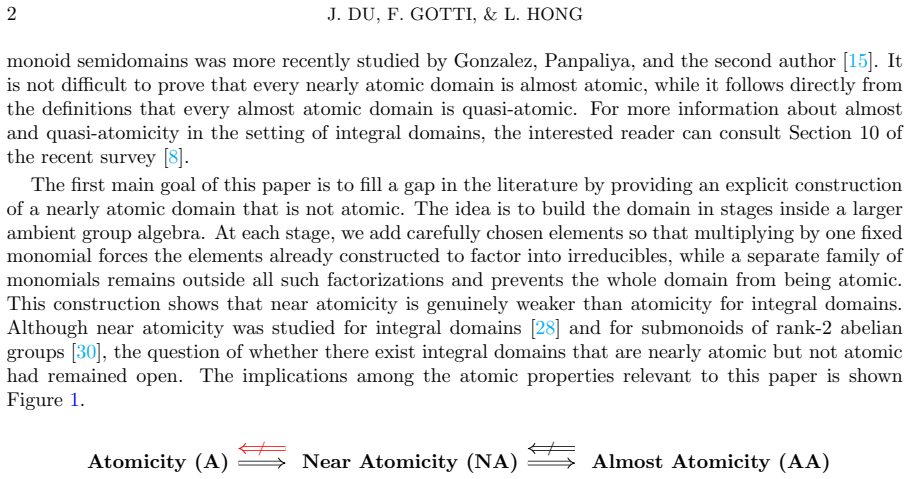
We construct an explicit nearly atomic integral domain that is not atomic. We prove that an integral domain is an FFD if and only if it is nearly atomic and IDF. Near atomicity cannot be weakened to almost atomicity in this characterization, even within the class of IDF domains.
Load-bearing premise
The constructed integral domain in the paper satisfies near atomicity but fails to be atomic.
Editorial extensions
If this is right
- An integral domain that is nearly atomic but not atomic exists.
- The finite factorization property is equivalent to being nearly atomic and IDF.
- The equivalence fails when near atomicity is replaced by almost atomicity for IDF domains.
Reading between the lines
- The construction provides a concrete test case for studying other properties related to factorization in domains.
- Similar examples might exist or be constructible in related monoid settings beyond integral domains.
Signed reviews
Editorial analysis
A structured set of objections, weighed in public.
Referee Report
Summary. The paper constructs an explicit nearly atomic integral domain that is not atomic, resolving an open question in the literature on weakenings of atomicity. It also proves that an integral domain is an FFD if and only if it is nearly atomic and an IDF, strengthening the Anderson--Anderson--Zafrullah characterization, and shows that almost atomicity cannot substitute for near atomicity in this equivalence even among IDF domains.
Significance. The explicit construction provides the first known example of a nearly atomic non-atomic integral domain, a concrete strength that allows direct verification of the properties. The strengthened iff characterization of FFDs is a clean and useful refinement of prior work. These results advance factorization theory by clarifying the relationships among near atomicity, IDF, and finite factorization properties.
minor comments (2)
- [§2] §2, Definition 2.3: the notation for near-atoms could be clarified by explicitly distinguishing the 'near' factorization length from standard atomic length to avoid reader confusion with almost atomicity introduced later.
- [Theorem 4.3] Theorem 4.3: the proof that almost atomicity fails to characterize FFDs among IDF domains would benefit from a brief remark on why the counterexample domain satisfies IDF but not the finite factorization property.
Simulated Author's Rebuttal
We thank the referee for the positive assessment of the manuscript, the accurate summary of its contributions, and the recommendation for minor revision. No specific major comments appear in the report.
Circularity Check
No circularity; explicit construction and proof are independent of inputs
full rationale
The paper constructs an explicit nearly atomic non-atomic integral domain and proves an iff characterization of FFDs as nearly atomic + IDF domains. These steps rest on external prior definitions of atomicity, near atomicity, IDF, and FFD (from Anderson--Anderson--Zafrullah and related literature) rather than self-definitions, fitted parameters renamed as predictions, or load-bearing self-citations. The existence claim is verified by direct construction satisfying the stated axioms, and the necessity direction follows from standard monoid/domain arguments without reducing to the paper's own inputs by construction. No enumerated circularity pattern applies.
Assumptions & free parameters
assumptions (1)
- standard math Standard axioms and definitions of commutative cancellative monoids and integral domains
Cite this review
Pith. "Pith review of On near atomicity and a characterization of the FF property." pith.science (2026). https://pith.science/paper/UH5CCF56
@misc{pith2026260625227,
  author       = {Pith},
  title        = {Pith review of: On near atomicity and a characterization of the FF property},
  year         = {2026},
  howpublished = {\url{https://pith.science/paper/UH5CCF56}},
  note         = {Machine review of arXiv:2606.25227}
}
read the original abstract
A commutative cancellative monoid is atomic if every nonunit factors into atoms, and an integral domain is atomic if its multiplicative monoid of nonzero elements is atomic. Several weakenings of atomicity have been introduced and studied during the past decade, including near atomicity, almost atomicity, and quasi-atomicity. Although nearly atomic monoids that are not atomic were already known, whether there exist nearly atomic integral domains that are not atomic had remained open. We answer this question affirmatively by constructing an explicit nearly atomic integral domain that is not atomic. We also strengthen the classical Anderson--Anderson--Zafrullah characterization of the finite factorization property by proving that an integral domain is an FFD if and only if it is both nearly atomic and IDF. We conclude by showing that near atomicity cannot be weakened to almost atomicity in this characterization, even within the class of IDF domains.
Figures

Reference graph
Works this paper leans on
-
[1]
D. D. Anderson, D. F. Anderson, and M. Zafrullah,Factorizations in integral domains, J. Pure Appl. Algebra69 (1990) 1–19
1990
-
[2]
D. F. Anderson and F. Gotti,Bounded and finite factorization domains. In: Rings, Monoids, and Module Theory (Eds. A. Badawi and J. Coykendall) pp. 7–57. Springer Proceedings in Mathematics & Statistics, Vol.382, Singapore, 2022
2022
-
[3]
J. P. Bell, A. Heinle, and V. Levandovskyy,On noncommutative finite factorization domains, Trans. Amer. Math. Soc.369(2017) 2675–2695
2017
-
[4]
Benelmekki and S
M. Benelmekki and S. El Baghdadi,Factorization of polynomials with rational exponents over a field, Comm. Algebra 50(2022) 4345–4355
2022
-
[5]
Boynton and J
J. Boynton and J. Coykendall,On the graph divisibility of an integral domain, Canad. Math. Bull.58(2015) 449–458
2015
- [6]
-
[7]
P. M. Cohn,Bezout rings and and their subrings, Proc. Cambridge Philos. Soc.64(1968) 251–264
1968
-
[8]
Coykendall and F
J. Coykendall and F. Gotti,Atomicity in integral domains. In: Recent Progress in Rings and Factorization Theory (Eds. M. Breˇ sar, A. Geroldinger, B. Olberding, and D. Smertnig) pp. 95–159. Springer Nature, Switzerland, 2025
2025
Show all 33 references
-
[9]
Coykendall and F
J. Coykendall and F. Gotti,On the atomicity of monoid algebras, J. Algebra539(2019) 138–151
2019
-
[10]
Du and F
J. Du and F. Gotti,An unrestricted notion of the finite factorization property. Preprint on arXiv: https://arxiv.org/pdf/2511.00691
-
[11]
Eftekhari and M
S. Eftekhari and M. R. Khorsandi,MCD-finite domains and ascent of IDF-property in polynomial extensions, Comm. Algebra46(2018) 3865–3872
2018
-
[12]
Geroldinger and F
A. Geroldinger and F. Gotti,On monoid algebras having every nonempty subset ofN ≥2 as a length set, Mediterr. J. Math.22(2025) 69
2025
-
[13]
Geroldinger and F
A. Geroldinger and F. Halter-Koch,Non-unique Factorizations: Algebraic, Combinatorial and Analytic Theory, Pure and Applied Mathematics Vol. 278, Chapman & Hall/CRC, Boca Raton, 2006
2006
-
[14]
Gilmer,Commutative Semigroup Rings, The University of Chicago Press, 1984
R. Gilmer,Commutative Semigroup Rings, The University of Chicago Press, 1984
1984
-
[15]
Gonzalez, F
V. Gonzalez, F. Gotti, and I. Panpaliya,On the ascent of almost and quasi-atomicity to monoid semidomains. Journal of Commutative Algebra (to appear). Preprint on arXiv: https://arxiv.org/abs/2501.04990
-
[16]
Gonzalez and I
V. Gonzalez and I. Panpaliya,On GL-domains and the ascent of the IDF property. Preprint on arXiv: https://arxiv.org/abs/2504.10722
-
[17]
Gotti,Increasing positive monoids of ordered fields are FF-monoids, J
F. Gotti,Increasing positive monoids of ordered fields are FF-monoids, J. Algebra518(2019) 40–56
2019
-
[18]
Gotti and B
F. Gotti and B. Li,Atomic semigroup rings and the ascending chain condition on principal ideals, Proc. Amer. Math. Soc.151(2023) 2291–2302
2023
-
[19]
Gotti and B
F. Gotti and B. Li,Divisibility and a weak ascending chain condition on principal ideals. Preprint available on arXiv: https://arxiv.org/abs/2212.06213
-
[20]
Gotti and H
F. Gotti and H. Polo,On the subatomicity of polynomial semidomains. In: Algebra and Polynomials: Algebraic, Number Theoretic, and Topological Aspects of Ring Theory (Eds. J. L. Chabert, M. Fontana, S. Frisch, S. Glaz, and K. Johnson) pp. 197–212. Springer Nature, Switzerland, 2023
2023
-
[21]
Gotti and H
F. Gotti and H. Rabinovitz,On the ascent of atomicity to monoid algebras, J. Algebra663(2025) 857–881
2025
-
[22]
Gotti and J
F. Gotti and J. Vulakh,On the atomic structure of torsion-free monoids, Semigroup Forum107(2023) 402–423
2023
-
[23]
Gotti and M
F. Gotti and M. Zafrullah,Integral domains and the IDF property, J. Algebra614(2023) 564–591
2023
-
[24]
Grams,Atomic rings and the ascending chain condition for principal ideals, Math
A. Grams,Atomic rings and the ascending chain condition for principal ideals, Math. Proc. Cambridge Philos. Soc. 75(1974) 321–329
1974
-
[25]
Grams and H
A. Grams and H. Warner,Irreducible divisors in domains of finite character, Duke Math. J.42(1975) 271–284
1975
-
[26]
Halter-Koch,Finiteness theorems for factorizations, Semigroup Forum44(1992) 112–117
F. Halter-Koch,Finiteness theorems for factorizations, Semigroup Forum44(1992) 112–117
1992
-
[27]
Jiang, S
H. Jiang, S. Kanungo, and H. Kim,A weaker notion of the finite factorization property, Commun. Korean Math. Soc.39(2024) 313–329
2024
-
[28]
Lebowitz-Lockard,On domains with properties weaker than atomicity, Comm
N. Lebowitz-Lockard,On domains with properties weaker than atomicity, Comm. Algebra47(2019) 1862–1868
2019
-
[29]
F. W. Levi,Arithmetische Gesetze im Gebiete diskreter Gruppen, Rend. Circ. Mat. Palermo35(1913) 225–236
1913
-
[30]
C. Liu, P. Rodriguez, and M. Tirador,Subatomicity in rank-2lattice monoids, J. Commut. Algebra16(2024) 337–352. ON NEAR ATOMICITY AND THE FF PROPERTY15
2024
-
[31]
Malcolmson and F
P. Malcolmson and F. Okoh,Polynomial extensions of IDF-domains and of IDPF-domains, Proc. Amer. Math. Soc. 137(2009) 431–437
2009
-
[32]
Roitman,Polynomial extensions of atomic domains, J
M. Roitman,Polynomial extensions of atomic domains, J. Pure Appl. Algebra87(1993) 187–199
1993
-
[33]
Zaks,Atomic rings without a.c.c
A. Zaks,Atomic rings without a.c.c. on principal ideals, J. Algebra74(1982) 223–231. Department of Mathematics, MIT, Cambridge, MA 02139 Email address:jndu@mit.edu Department of Mathematics, MIT, Cambridge, MA 02139 Email address:fgotti@mit.edu MIT PRIMES, MIT, Cambridge, MA 0...
1982
Reviewed June 25, 2026 · model on record in the stance chip above.
Discussion (0). Continue with ORCID to comment.