REVIEW 4 major objections 7 minor 33 references
Infrared properties of Planetary Nebulae with PG1159 central stars
T0 review · 4 major / 7 minor · reviewed 2026-08-11 · deepseek-v4-flash
Pith's one-line read Infrared ages of planetary nebulae link PG1159 stars to Wolf-Rayet nuclei, not to wels stars.
desk verdict First systematic IR study of the 26 known PG1159 PNe; the descriptive results are solid, but the evolutionary split between [WRE] and wels rests on a small-sample gap the authors themselves concede could be selection. read the letter →
The pith
A machine-rendered reading of the paper's core claim, the machinery that carries it, and where it could break.
The reading
What carries the argument
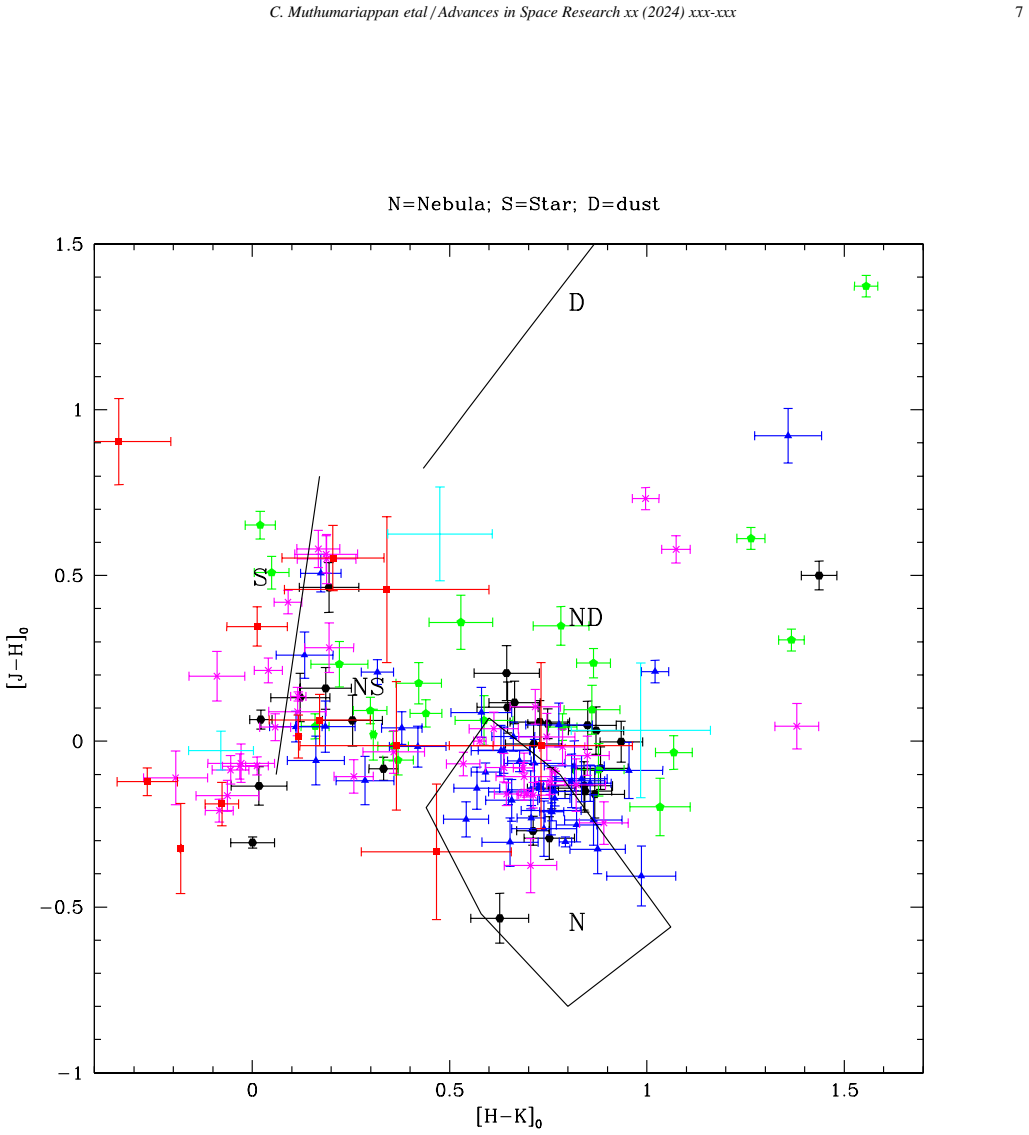
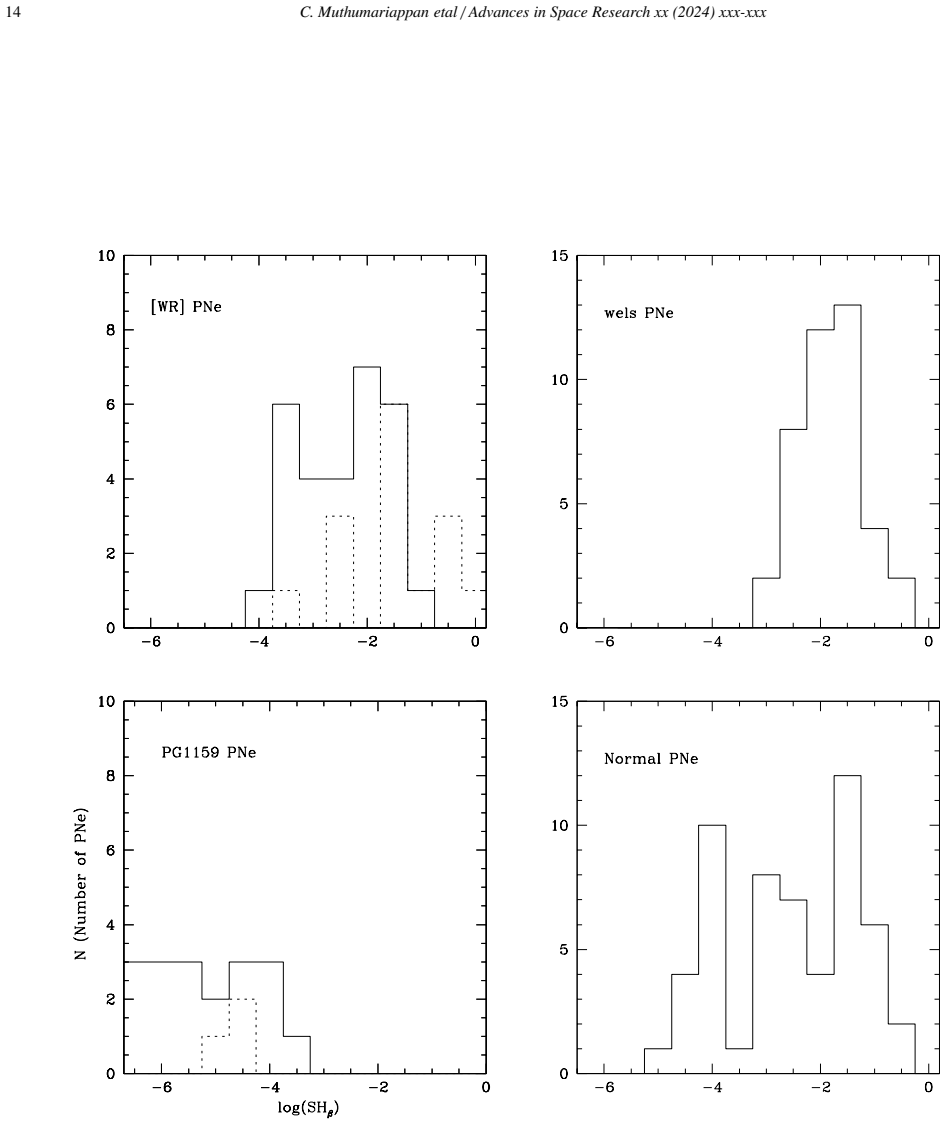
The central object is the nebular H-beta surface brightness S_H-beta, a distance-independent age indicator: younger, denser nebulae shine brighter, while older, expanded nebulae are fainter. The paper pairs this with infrared color-color diagrams and dust properties derived from IRAS 25 and 60 micron fluxes fitted with a modified blackbody, yielding dust color temperature, dust mass, dust-to-gas mass ratio, infrared luminosity, and infrared excess. A Kolmogorov-Smirnov test on the S_H-beta distributions decides whether young [WR]-, wels-, and normal-PNe come from similar parent samples, supporting the claim that these groups all evolved directly from the AGB.
What would settle it
A targeted deep survey for faint planetary nebulae around known PG1159 stars, or a systematic search for wels-PNe with log(S_H-beta) between roughly -4.5 and -5.5, would settle whether the gap is real; finding even a few objects in that range would weaken the claimed evolutionary discontinuity.
Extended reading notes
Core claim
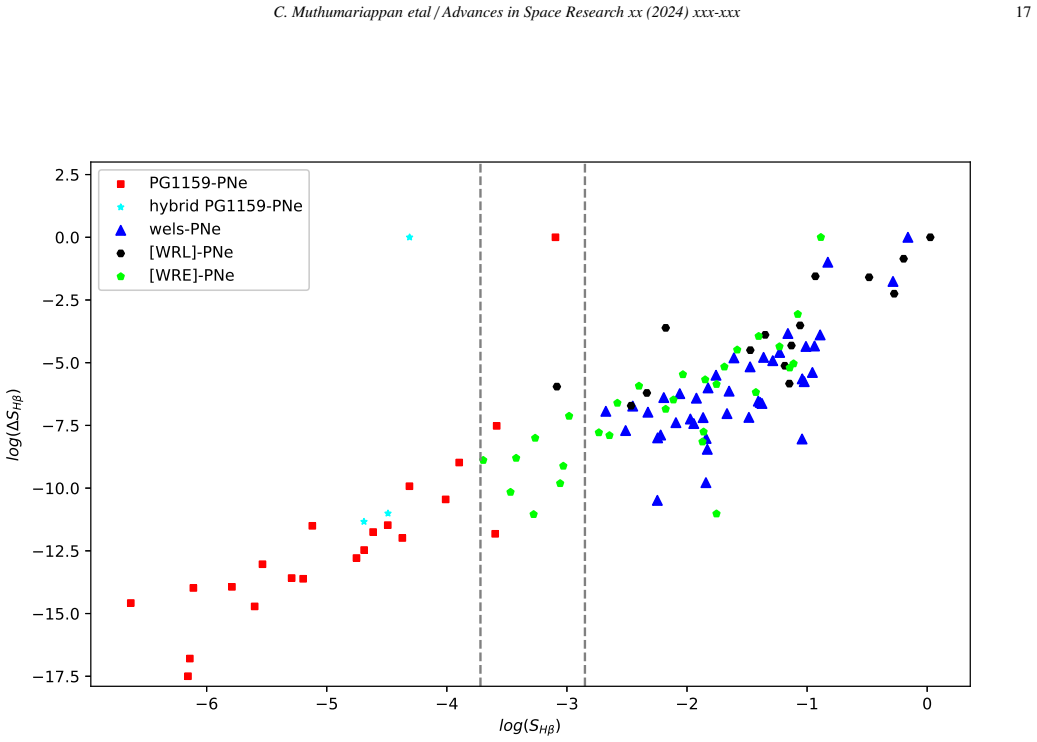
The central claim is that the distribution of H-beta surface brightness places PG1159-PNe in an evolutionary sequence with Wolf-Rayet nuclei but separates them from wels-PNe. The authors compile all known PNe with PG1159-type central stars, measure their infrared colors, dust temperatures, dust masses, infrared luminosities, and infrared excesses, and plot these against surface brightness. They find that PG1159-PNe sit at the low-surface-brightness end, where [WR]-PNe are absent, yet their values overlap with [WRE]-PNe. In contrast, wels-PNe and PG1159-PNe are separated by a gap of 0.42 in log(S_H-beta), which is three times the mean spacing for wels-PNe and 2.5 times that for PG1159-PNe. This leads them to propose an evolutionary sequence [WRL] to [WRE] to PG1159, and to conclude that wels stars are not the direct progenitors of PG1159 stars.
Load-bearing premise
The conclusion that wels stars are not progenitors of PG1159 stars assumes that the observed gap in H-beta surface brightness is real and not an artifact of the small, faint, incompletely surveyed sample of known PG1159-PNe.
Editorial extensions
If this is right
- If the sequence [WRL] to [WRE] to PG1159 is correct, late-type Wolf-Rayet nuclei are the youngest and PG1159 nuclei the oldest members of the same hydrogen-poor family.
- The wels gap implies that weak-emission-line nuclei are not the immediate predecessors of PG1159 stars; their nebulae evolve separately, possibly fading without leaving a detectable PG1159-type remnant.
- The similarity of young [WR]-, wels-, and normal-PNe age distributions indicates these three groups all form directly from AGB evolution, without requiring late or very late thermal pulses for the bulk of the population.
- The infrared data show that PG1159-PNe retain a significant hot-dust component similar to [WR]-PNe despite being old, while their AGB dust is cooler, suggesting a distinct dust-processing history.
- The lack of a trend in dust-to-gas mass ratio with S_H-beta supports the view that grain destruction timescales are longer than the lifetimes of planetary nebulae.
Reading between the lines
- If the wels gap is real, wels central stars should end their lives differently, perhaps as hydrogen-poor white dwarfs without luminous PNe; a deep search for faint, old nebulae around known wels nuclei would test this directly.
- The same S_H-beta overlap method could be applied to other hydrogen-poor classes, such as born-again PNe, to see whether all hydrogen-poor channels converge on PG1159 or whether multiple distinct paths exist.
- The hot-dust similarity between PG1159- and [WR]-PNe predicts that sensitive mid-infrared observations of the faintest known PG1159-PNe should detect statistically heated small grains; this is a testable extension of the paper's claim.
- The evolutionary conclusion rests on only 26 known PG1159-PNe, most discovered through targeted surveys; future all-sky surveys are likely to fill the apparent surface-brightness gap and may overturn the proposed sequence.
Editorial analysis
A structured set of objections, weighed in public.
Referee Report
Summary. This paper presents a uniform infrared analysis of 26 planetary nebulae with PG1159-type central stars (including four hybrids) using archival 2MASS, WISE, and IRAS photometry together with nebular H-beta fluxes, angular sizes, E(B-V) and distances from the literature. Following the MP20 methodology, the authors construct near-, mid- and far-IR colour-colour diagrams and derive dust colour temperatures, dust masses, dust-to-gas mass ratios, IR luminosities and IR excesses for the subsample with available IRAS 25/60 micron data (11 objects). The PG1159-PNe are found to have cooler AGB dust, lower IR luminosity, lower mean dust mass, marginally higher mean dust-to-gas ratio and similar IR excess compared with [WR]-, wels- and normal-PNe. The number distributions of log(S_H-beta) are interpreted as showing that [WR]-, wels- and normal-PNe have similar young populations, that [WRL]-, [WRE]- and PG1159-PNe form an age sequence, and that a significant gap between wels- and PG1159-PNe indicates that wels stars are not evolutionary progenitors of PG1159 stars.
Significance. If the evolutionary interpretation is accepted, the paper offers one of the few direct empirical links between [WR] and PG1159 central stars and separates the wels channel, which would be a useful step for post-AGB evolution. The descriptive IR dataset for the rare PG1159-PNe is a valuable compilation, and the parameter estimation follows a standard, published method with propagated errors. The paper is honest about its caveats (small sample, possible lack of observational points), and the plots comparing four groups on a common system make the comparisons transparent. However, the central evolutionary conclusions rest on a small number of S_H-beta values and on a visually assessed gap and overlap, so the significance depends on whether those statistics can be made robust.
major comments (4)
- [§3.3, Fig. 6] The claim of a good overlap between [WRE]- and PG1159-PNe is not supported by a statistical test; the KS test is applied only to [WR]-, wels- and normal-PNe pairs, not to the crucial [WRE]-PG1159 pair. Since overlap in S_H-beta underlies the proposed [WRL]-to-[WRE]-to-PG1159 sequence, a two-sample KS test (or an equivalent small-sample test) on those two groups should be added, and the result should be reported regardless of outcome.
- [§3.3 and Table 1] The significant gap between wels- and PG1159-PNe is load-bearing for the conclusion that wels stars do not evolve into PG1159 stars, but the paper itself concedes that the gap could be due to the lack of observational points in that range. Because the 26 PG1159-PNe were largely found through targeted surveys of hot central stars while wels-PNe are typically found in broader PN surveys, the apparent deficit at intermediate S_H-beta could be a selection artifact rather than an evolutionary discontinuity. The authors should quantify this possibility, for example by simulating the expected gap under random sparse sampling from the combined S_H-beta distribution, by comparing the discovery channels of the two samples, or by explicitly downgrading the evolutionary conclusion to a conjecture; without such a test the conclusion is not yet established.
- [§3.3] The significance of the wels-PG1159 gap is established by a post-hoc criterion (three times the mean of successive differences) that is not derived from any distributional model or pre-registered rule. The choice of criterion strongly controls whether the gap is called significant, so the authors should report the actual successive-difference values and demonstrate robustness of the gap, for example by bootstrap or by comparing the largest observed successive difference in the combined sample.
- [§3.2 and Table 4] The adopted electron density of 500 cm^-3 for sources with no measured n_e and the fixed emissivity exponent alpha=1.0 enter directly into the dust-to-gas mass ratios, and the mean md/mg comparison in Table 4 is based on only 11 PG1159-PNe. A sensitivity analysis varying n_e over a plausible range (and, if possible, alpha for carbonaceous versus silicate grains) should be reported before the claim that PG1159-PNe have a marginally larger dust-to-gas ratio is used as a physical result; at present that particular comparison is not demonstrated to be robust.
minor comments (7)
- [§3.1.1] The text introduces 'A70 and A30' but then gives coordinates for 'A78 and A30'; the first occurrence appears to be a typo for A78 and should be corrected.
- [Fig. 6] The label 'wel -PNe' in the figure should read 'wels-PNe' for consistency with the text.
- [References] The reference list contains a duplicated entry for Löbling et al. (2019); one of the two entries should be removed.
- [Table 1] The final row 'V * LWLib' has only dashes and no PNG identifier or other data; either complete the row or remove it from the table.
- [§2 and §4.1] The emissivity exponent is described as 1.0 in Section 2 but as 'alpha = -1' in Section 4.1; the sign convention should be stated once and used consistently.
- [§1] 'Palmoar survey' is a typo for 'Palomar survey'.
- [Table 4] The column header 'log[md-sun]' should be written as log(md/M_sun) or similar for clarity.
Circularity Check
No circularity: the PG1159 parameters and S_Hβ comparisons are independent empirical derivations; the acknowledged wels-gap selection caveat is a data limitation, not a definitional or fitting circularity.
full rationale
The claimed analysis is an empirical comparison, not a derivation of a predicted quantity from fitted parameters. PG1159-PNe's IR colours, Td, Md, LIR, IRE and S_Hβ are computed from archival 2MASS/WISE/IRAS photometry, Hβ fluxes, sizes, and distances with stated assumptions (e.g., modified blackbody with emissivity exponent 1.0, mean electron density 500 cm^-3 where missing). No parameter is fitted to the comparison groups and then read back as a prediction; the evolutionary overlap/gap is read directly from the resulting distributions. The only author-overlap input is MP20, which supplies the methodology and the [WR]-, wels-, normal-PNe comparison values; those are published measurements from an external catalog, not hypotheses constructed to force the present result, and the PG1159 data are new and independent. Section 3.3 explicitly concedes that the wels-PG1159 gap could be due to sparse sampling: 'there is also a possibility that this gap in log(S_Hβ) could be due to the lack of observational points in this range.' This is a selection-effect limitation on the evolutionary conclusion, not a circular step, because the gap is not imposed by the definitions or the analysis procedure. Similarly, Section 4.2 hedges that wels-PNe 'may not form an evolutionary sequence' pending more observations. No equation is defined in terms of the conclusion, and no fitted value is renamed as a prediction. Hence no significant circularity is present.
Assumptions & free parameters
free parameters (2)
- Adopted electron density n_e =
500 cm^-3
- Dust emissivity exponent alpha =
1.0
assumptions (7)
- domain assumption PNe are optically thin at far-infrared wavelengths.
- domain assumption SHβ is a reliable monotonic indicator of nebular age across different groups.
- domain assumption IRAS 25 and 60 micron fluxes are dominated by thermal equilibrium dust continuum.
- ad hoc to paper The known sample of 26 PG1159-PNe is representative of the population.
- ad hoc to paper The chosen threshold of 3 times the mean successive difference defines a significant gap.
- domain assumption Distances from Frew et al. (2016) are accurate.
- domain assumption Grain properties (opacity) are as assumed in MP20.
Cite this review
Pith. "Pith review of Infrared properties of Planetary Nebulae with PG1159 central stars." pith.science (2026). https://pith.science/paper/UHFGCJWK
@misc{pith2026241211721,
  author       = {Pith},
  title        = {Pith review of: Infrared properties of Planetary Nebulae with PG1159 central stars},
  year         = {2026},
  howpublished = {\url{https://pith.science/paper/UHFGCJWK}},
  note         = {Machine review of arXiv:2412.11721}
}
abstract
We study the properties of 26 PNe with PG1159-type central stars known till date and compare them with the properties of PNe having [WR], $wels$ and hydrogen-rich central stars published earlier. We use archival photometric measurements of $2MASS$ for near-IR analysis and $WISE$ and $IRAS$ data for mid- and far-IR analysis and derive the IR properties of PG1159-PNe. We analyze the IR colour-colour diagrams of PG1159-PNe and compare them with the other three groups of PNe. Similar to the [WR]-PNe, many PG1159-PNe also show large amount of near-IR emission from the hot-dust component but their AGB dust is relatively cooler. We also report here the dust colour temperatures, dust masses, dust-to-gas mass ratios, IR luminosities and IR excess of PG1159-PNe and plot them against their surface H$\beta$ brightness (age) and compare them with the distribution of other groups of PNe. The IR luminosity and dust temperature show strong correlation with surface H$\beta$ brightness, however, the dust-to-gas mass ratio and IR excess do not show any trend. While the mean dust mass has a lower value for PG1159-PNe, in compared to other groups, the average dust-to-gas mass ratio is found to be marginally larger for PG1159-PNe. An analysis of the number distribution of different groups of PNe against surface H$\beta$ brightness shows that a) younger [WR]-, $wels$- and normal-PNe have a similar distribution indicating that they all have evolved from the AGB in a similar way, b) while there is an overlap of surface H$\beta$ brightness between [WR]- and PG1159-PNe, showing an evolutionary connection between them, there exists a significant gap between the values derived for $wels$- and PG1159-PNe.
Figures


Figures from the paper (3 more)

Reference graph
Works this paper leans on
-
[3]
10.1093/mnras/stad524. 20 C. Muthumariappan etal / Advances in Space Research xx (2024) xxx-xxx Kazimierz J. Borkowski, J. Patrick Harrington, William P . B lair, and Jesse D. Bregman. The Dust in the Hydrogen-poor Eje cta of Abell
-
[7]
10.48550/arXiv.0711.2461. David J. Frew, Q. A. Parker, and I. S. Bojiˇ ci´ c. The H αsurface brightness-radius relation: a robust statistical distance indicator for planetary nebulae. Monthly Notices of the Royal Astronomical Society , 455(2):1459–1488, January
-
[14]
ISSN 0035-8711. 10.1093/mnras/stz1994. URL https://doi.org/10.1093/mnras/stz1994. R. H. Mendez. Photospheric Abundances in Central Stars of Pl anetary Nebulae, and Evolutionary Implications. In George s Michaud and A. V . Tutukov, editors, Evolution of Stars: the Photospheric Abundance Connection , volume 145, page 375, January
-
[22]
10.1086/498708. G. Stasi´ nska and R. Szczerba. VizieR Online Data Catalog: T he dust content of planetary nebulae (Stasi´ nska +, 1999). VizieR Online Data Catalog , art. J/A+A/352/297, November 1999a. Gra˙ zyna Stasi´ nska and Ryszard Szczerba. The dust content of planetary nebulae: a reappraisal. Astronomy & Astrophysics, 352:297–307, December 1999b. 1...
work page Pith review arXiv doi:10.48550/arxiv.astro-ph/9911006 1999
-
[23]
https://doi.org/10.1016/B978-0-12-810985-4.00001-3
ISBN 978-0-12-810985-4. https://doi.org/10.1016/B978-0-12-810985-4.00001-3 . URL https://www.sciencedirect.com/science/article/pii/B9780128109854000013. H. Todt, M. A. Guerrero, X. Fang, J. A. Toala, J. S. Arthur, W. P . Blair, Y . H. Chu, R. A. Gruendl, W. R. Hamann, R. A. Marquez-L ugo, L. Oskinova, N. Ruiz, M. Steffen, and D. Schoenberner. The Born-agai...
-
[24]
10.1017/S1743921306002869. W. A. Weidmann and R. Gamen. Central stars of planetary nebul ae: New spectral classifications and catalogue. aap, 526:A6, February
-
[26]
10.1051/0004-6361/202346401. Walter Alfredo Weidmann, MB Mari, Eduardo Osvaldo Schmidt, Gaia Gaspar, MM Miller Bertolami, Gabriel Andr´ es Oio, LA Gu ti´ errez-Soto, Maria Gabriela C. Muthumariappan etal / Advances in Space Research xx (2024) xxx-xxx 21 V olpe, R Gamen, and Damian Mast. Catalogue of the central sta rs of planetary nebulae-expanded edition...
-
[27]
ISBN 978-94-011-2020-3. 10.1007/978-94-011-2020-3_10 . URL https://doi.org/10.1007/978-94-011-2020-3_10 . K. Werner, T. Rauch, R. Napiwotzki, N. Christlieb, D. Reimer s, and C. A. Karl. Identification of a DO white dwarf and a PG 115 9 star in the ESO SN Ia progenitor survey (SPY). aap, 424:657–663, September
Show all 33 references
-
[29]
URL https://dx.doi.org/10.1086/500443
10.1086/500443. URL https://dx.doi.org/10.1086/500443. P . A. Whitelock. JHK photometry of planetary nebulae. Monthly Notices of the Royal Astronomical Society, 213:59–69, March
-
[31]
Patrick A
10.1086/163193. Patrick A. Woudt, Brian Warner, and Ewald Zietsman. SDSS J03 49-0059 is a GW Virginis star. Monthly Notices of the Royal Astronomical Society , 426(3): 2137–2141, November
-
[1981]
10.1086/159142. G. Neugebauer, H. J. Habing, R. van Duinen, H. H. Aumann, B. Ba ud, C. A. Beichman, D. A. Beintema, N. Boggess, P . E. Clegg, T. de Jong, J. P . Emerson, T. N. Gautier, F. C. Gillett, S. Harris, M. G. Hauser, J. R. Hou ck, R. E. Jennings, F. J. Low, P . L. Mars...
-
[1983]
10.1093/mnras/202.3.615
ISSN 0035-8711. 10.1093/mnras/202.3.615. S. R. Pottasch, C. Bignell, R. Olling, and A. A. Zijlstra. Pla netary nebulae near the galactic center. I. Method of discov ery and preliminary results. Astronomy & Astrophysics, 205:248–256, October
-
[1984]
10.1086/184209. J. A. Peacock. Two-dimensional goodness-of-fit testing in a stronomy. Monthly Notices of the Royal Astronomical Society , 202(3):615–627, 03
-
[1985]
10.1093/mnras/213.1.59. D. E. Winget, S. O. Kepler, E. L. Robinson, R. E. Nather, and D. Odonoghue. A measurement of secular evolution in the pre-wh ite dwarf star PG 1159-035. The Astrophysical Journal, 292:606–613, May
-
[1986]
Icko Iben
10.1086/191115. Icko Iben. The evolution of planetary nebulae, their precur sors and their progeny — a commentary. In Ronald Weinberger a nd Agnes Acker, editors, Planetary Nebulae, pages 587–596, Dordrecht,
-
[1989]
L L ¨ obling, T Rauch, M M Miller Bertolami, H Todt, F Friederich, M Ziegler, K Werner, and J W Kruk
10.1086/167906. L L ¨ obling, T Rauch, M M Miller Bertolami, H Todt, F Friederich, M Ziegler, K Werner, and J W Kruk. Spectral analysis of the h ybrid PG 1159-type central stars of the planetary nebulae abell 43 and NGC
-
[1993]
IS BN 978-94-011-2088-3
Springer Netherlands. IS BN 978-94-011-2088-3. A. Leene and S. R. Pottasch. IRAS pointed observations of pla netary nebulae. aap, 202:203–214, August
-
[1994]
10.1086/174849. M. Catelan, J. A. de Freitas Pacheco, and J. E. Horvath. The He lium-Core Mass at the Helium Flash in Low-Mass Red Giant Star s: Observations and Theory. The Astrophysical Journal, 461:231, April
-
[1996]
10.1086/177051. P . A. Crowther. Physical and Wind Properties of [WC] Stars. I n A. Werner and T. Rauch, editors, Hydrogen-Deficient Stars , volume 391 of Astronomical Society of the Pacific Conference Series , page 83, July
-
[2001]
10.1051/0004-6361:20011050. R. F. Green, M. Schmidt, and J. Liebert. The Palomar-Green Ca talog of Ultraviolet-Excess Stellar Objects. ApJS, 61:305, June
- [2002]
-
[2003]
10.1051/0004-6361:20030391. Z. Awad and A. Ali. Physical and Kinematical Characteristic s of Wolf-Rayet Central Stars and their Host Planetary Nebul ae. Research in Astronomy and Astro- physics, 23(9):095021, September
-
[2004]
Klaus Werner and Falk Herwig
10.1051/0004-6361:20041157. Klaus Werner and Falk Herwig. The elemental abundances in ba re planetary nebula central stars and the shell burning in ag b stars. Publications of the Astronomical Society of the Pacific , 118(840):183, feb
-
[2006]
URL https://dx.doi.org/10.1086/500041
10.1086/500041. URL https://dx.doi.org/10.1086/500041. C. Muthumariappan, M. Parthasarathy, and Y . Ita. Radiative transfer modelling of dust in IRAS 18333 −2357: the only planetary nebula in the metal-poor globular cluster M22. Monthly Notices of the Royal Astronomical Societ...
- [2008]
-
[2010]
Albert A
10.1088/0004-6256/140/6/1868. Albert A. Zijlstra. Hydrogen-poor planetary nebulae. Astrophysics and Space Science, 279:171–182, January
-
[2011]
10.1051/0004-6361/200913984. W. A. Weidmann, K. Werner, J. A. Ahumada, R. A. Pignata, and V . Firpo. Revealing the ionising star of evolved planetary neb ulae. aap, 676:A1, August
-
[2012]
Edward L
10.1111/j.1365-2966.2012.21899.x. Edward L. Wright, Peter R. M. Eisenhardt, Amy K. Mainzer, Mic hael E. Ressler, Roc M. Cutri, Thomas Jarrett, J. Davy Kirkpa trick, Deborah Padgett, Robert S. McMillan, Michael Skrutskie, S. A. Stanford, Martin Cohen, Russell G. Walker, John C....
2012
-
[2013]
10.1093/mnras/stt1319
ISSN 0035-8711. 10.1093/mnras/stt1319. A. Natta and N. Panagia. Dust in planetary nebulae. The Astrophysical Journal, 248:189–194, August
-
[2016]
Pascal Girard, J
10.1093/mnras/stv1516. Pascal Girard, J. Koppen, and A. Acker. Chemical compositions and plasma parameters of planetary nebulae with Wolf-Rayet and wels type central stars. Astronomy & Astrophysics, 463:265–274,
-
[2017]
10.1093/mnras/stx1071
ISSN 0035-8711. 10.1093/mnras/stx1071. C. Muthumariappan and M. Parthasarathy. Infrared properti es of planetary nebulae with [WR] and wels central stars. Monthly Notices of the Royal Astronomical Society, 493(1):730–746, March
-
[2020]
10.1093/mnras/staa217. C. Muthumariappan, Sun Kwok, and Kevin V olk. Subarcsecond mid-infrared imaging of dust in the bipolar nebula hen 3-401* . The Astrophysical Journal, 640(1): 353, mar
-
[2023]
Howard E
10.1088/1674-4527/acd993. Howard E. Bond, Klaus Werner, George H. Jacoby, and Gregory R . Zeimann. Spectroscopic survey of faint planetary-nebula nuclei - I. Six new ’O VI’ central stars. mnras, 521(1):668–676, May
Reviewed August 11, 2026 · model on record in the stance chip above.
Discussion (0). Continue with ORCID to comment.