REVIEW 1 major objections 1 minor 2 references
Creation of knowledge through exchanges of knowledge: Evidence from Japanese patent data
T0 review · 1 major / 1 minor · reviewed 2026-08-14 · deepseek-v4-flash
Pith's one-line read Collaborators' non-overlapping knowledge raises patent quality 3-4% and novelty 5%, Japanese data show.
desk verdict First inventor-level evidence for the Berliant–Fujita knowledge-exchange mechanism, with a real but contained identification concern: the exclusion restriction rests on no time-varying firm shocks, and the same-firm share in the instruments makes that assumption worth testing. read the letter →
The pith
A machine-rendered reading of the paper's core claim, the machinery that carries it, and where it could break.
The reading
What carries the argument
The theoretical machinery is the collaboration technology $y_{ij} = \delta_{ij} b (k^C_{ij})^\theta (k^D_{ij})^{(1-\theta)/2}(k^D_{ji})^{(1-\theta)/2}$, where $k^C_{ij}$ is the common knowledge shared by the two collaborators and $k^D_{ij}$ is the knowledge of one inventor that the other does not possess; output rises with both, but with decreasing returns. The empirical machinery is the inventor-level regression $\ln y_{it} = \alpha + \beta \ln k^D_{it} + \gamma_1 \ln k_{it} + \gamma_2(\ln k_{it})^2 + \ln A_{it} + \lambda_i + \tau_t + \varepsilon_{it}$, with the average differentiated knowledge of collaborators, $\ln k^D_{it}$, as the regressor of interest. The instrument $k^{D,IV\ell}_{it}$ is constructed as the average differentiated knowledge of the $\ell$-th indirect collaborators ($\ell=3,4,5$); the strategy works because technological specialization overlaps, measured by Jaccard indices, decay to near zero by the third degree of separation, while relevance is retained because many indirect collaborators share firm affiliations.
What would settle it
Re-estimate the baseline IV specification using sixth- to eighth-degree indirect collaborators as instruments instead of third- to fifth-degree ones; if the coefficient on $\ln k^D_{it}$ remains close to 0.33-0.51, the exclusion restriction is supported, whereas if it collapses toward zero, the original instruments likely captured decaying common shocks rather than knowledge exchange alone.
Extended reading notes
Core claim
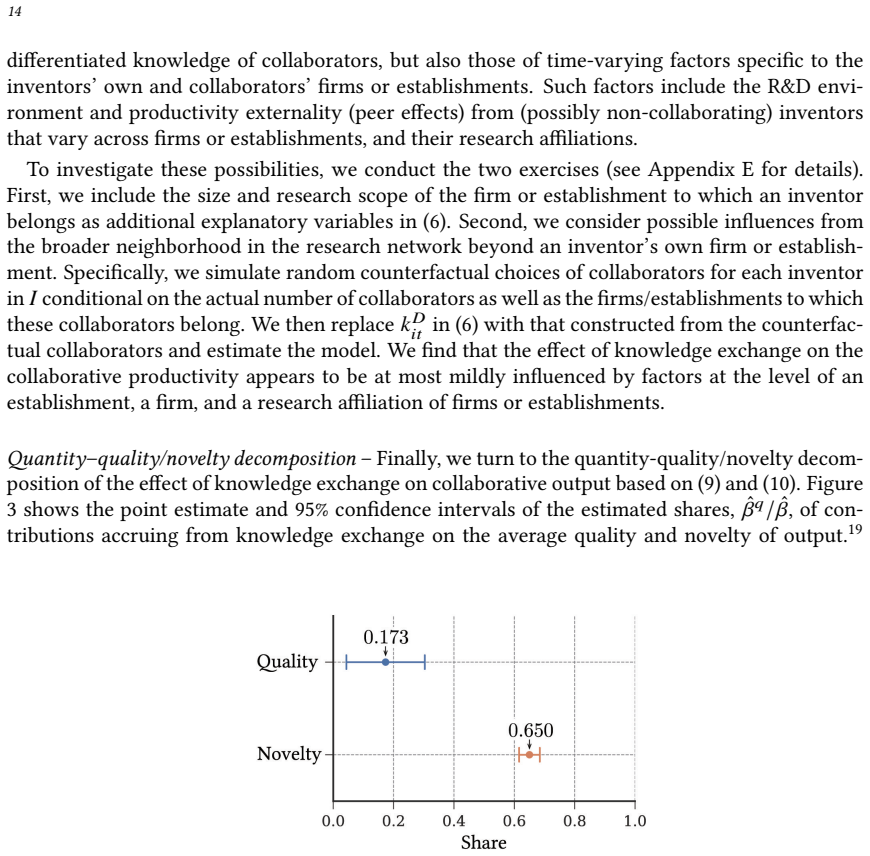
The paper claims that the theoretical mechanism of collaborative knowledge creation through direct knowledge exchange is empirically identifiable at the individual inventor level. In a two-period balanced panel of 29,287 Japanese inventors with up to fifth-degree indirect collaborators, the baseline 2SLS coefficient on $\ln k^D_{it}$ is 0.334-0.392 for citation-based quality and 0.478-0.511 for novelty-based productivity; a 10% rise in the average differentiated knowledge of collaborators therefore raises average pairwise output quality by roughly 3%-4% and novelty by roughly 5%. The elasticities below one indicate decreasing returns, consistent with the theory's prediction that common knowledge eventually dominates the gains from differentiated knowledge. Decomposing output into quantity and average quality or novelty, the paper finds that 83% of the quality effect runs through the number of patents while 65% of the novelty effect runs through the average novelty per patent, implying that collaboration is comparatively more effective for seeking novelty than for raising average quality.
Load-bearing premise
The distant collaborators used as instruments must affect an inventor's output only through the knowledge they bring, sharing no hidden firm, network, or technology-field shocks with the inventor.
Editorial extensions
If this is right
- If the estimates are causal, policies that encourage encounters and collaboration across organizations and institutions can be expected to raise innovation, especially its novelty.
- The extensive-margin dominance for quality implies that knowledge exchange is a way to increase the volume of inventive output, not just average quality.
- The intensive-margin dominance for novelty implies that the marginal effect of differentiated knowledge is concentrated in making each patent more novel.
- OLS underestimates the effect of collaborators' knowledge, so naive correlations between collaboration and productivity would understate the value of knowledge exchange.
- The overidentification tests do not reject instrument exogeneity, supporting the causal interpretation of the IV estimates.
Reading between the lines
- A natural out-of-sample test would apply the same instrumental-variable design to U.S. or European patent data, or to co-authored scientific publications, to see whether the 3%-4% quality and 5% novelty elasticities replicate outside Japan.
- The paper's decomposition implies that citation-based evaluations of collaboration policy will miss most of the novelty benefit; evaluators should also track first-mover status in technology categories.
- The theory predicts that inventors rotate collaborators to balance common and differentiated knowledge, so the same panel could be used to test whether inventors who change collaborators more often show faster novelty growth.
Signed reviews
Editorial analysis
A structured set of objections, weighed in public.
Referee Report
Summary. The paper tests the Berliant-Fujita (2008) mechanism of collaborative knowledge creation through the exchange of differentiated knowledge across individual inventors. Using Japanese patent application data on a balanced panel of 29,287 inventors over two five-year periods, it regresses the log of average pairwise collaborative output on the log of collaborators' average differentiated knowledge, measured by the value of collaborators' patents produced outside the joint projects with the focal inventor. Collaborative output is measured in two dimensions: quality, proxied by forward citations excluding citations from patents of any firm employing the inventors, and novelty, proxied by the inverse application order 1/r_j within the primary IPC subgroup. To address endogeneity, the regressor is instrumented by the average differentiated knowledge of 3rd-, 4th-, and 5th-indirect collaborators. The baseline IV results in Table 1 give coefficients of 0.334 for quality and 0.480 for novelty, which the authors interpret as a 10% increase in collaborators' differentiated knowledge raising quality and novelty by about 3%-4% and 5%, respectively. The paper further decomposes the effect into extensive and intensive margins, reporting that the quality effect operates mainly through patent counts while the novelty effect operates mainly through average novelty per patent.
Significance. If the identification is valid, this is the first micro-econometric evidence for active knowledge exchange as the mechanism of collaborative knowledge creation, as opposed to passive knowledge spillovers, and the quality-versus-novelty decomposition is a useful new fact. The paper has genuine strengths: a large and carefully constructed Japanese patent panel, a quality measure that excludes same-firm citations, first-stage effective F-statistics that are strong in most specifications, and a transparent set of robustness checks including a counterfactual-collaborator exercise. The main causal claim, however, rests on the exclusion restriction for the indirect-collaborator instruments, which is plausible but ultimately untestable with the current design. The paper itself acknowledges in footnote 17 that the Hansen J test cannot establish exogeneity when all instruments share the same bias. The novelty measure also deserves closer scrutiny because the same scarcity metric enters both the dependent variable and the regressor.
major comments (1)
- [Section VI and Appendix E, Table E2] The robustness regressions in Table E2 drop the sample from 58,574 to 56,744 observations because not all inventors have establishment/firm information, but the paper does not discuss how this sample restriction might affect the comparison with the baseline. If the missing inventors are systematically different in collaboration or output, the claim that the firm-control results move the estimate by less than 10% is less convincing. Please report the baseline IV3-5 estimate on the same 56,744-observation sample, or provide a short discussion of the characteristics of the dropped observations.
minor comments (1)
- [References] The reference to Zacchia (2020) lists the author as 'Paaolo Zacchia'; the correct spelling is 'Paolo Zacchia'.
Circularity Check
No significant circularity: the paper's regressions estimate a data relationship; the key regressor, outcomes, and instruments are separately constructed and no prediction is forced by definition or by self-citation.
full rationale
The paper's central claim is an empirical IV estimate (Table 1, Eq. 6) rather than a derivation from an input. The regressor k_D_it in Eq. (5) is defined as collaborators' output outside joint projects with i, while the outcome y_it in Eqs. (2)-(4) is inventor i's average pairwise output; the paper explicitly removes the joint-project patents from k_D_it (G_jt \ G_it) and, for citations, excludes citations from the relevant firms, so the positive association is not an identity. The instruments in Eq. (13) are averages of the same variable over 3rd-5th indirect collaborators; their relevance is an empirical first-stage property and their exogeneity is an identifying assumption, not a construction. The paper's own footnote 17 concedes that Hansen's J test cannot establish exogeneity when all instruments share a common bias; this is a limitation of the identification strategy, not circularity. No load-bearing result is justified by a self-citation: the theoretical framework is attributed to Berliant and Fujita (2008), which is not authored by Mori and Sakaguchi, and no 'uniqueness theorem' or prior result by the same authors is invoked to make the choice forced. The quantity-quality decomposition in Eqs. (9)-(10) is an accounting identity, but the estimated shares are data outcomes rather than inputs. Therefore no circular step can be exhibited.
Assumptions & free parameters
free parameters (4)
- Neighborhood radius (inventors, R&D, manufacturing) =
1 km (20 km for population)
- Forward citation window =
5 years
- Period aggregation =
Two 5-year periods (2000-2004, 2005-2009)
- IV indirectness levels =
3rd to 5th
assumptions (5)
- domain assumption Berliant-Fujita production function (equation 1): y_ij = δ_ij b (k^C)^θ (k^D_ij)^((1-θ)/2) (k^D_ji)^((1-θ)/2)
- ad hoc to paper Differentiated knowledge of collaborators is measured by their output outside joint projects (equation 5)
- domain assumption Instrument exogeneity: 3rd-5th indirect collaborators' average differentiated knowledge is uncorrelated with ε_it
- ad hoc to paper Novelty measured by inverse application order 1/r_j within primary IPC subgroup
- domain assumption Patent primary IPC subgroup represents the patent's technological category
Cite this review
Pith. "Pith review of Creation of knowledge through exchanges of knowledge: Evidence from Japanese patent data." pith.science (2026). https://pith.science/paper/UHQ2NKKB
@misc{pith2026190801256,
  author       = {Pith},
  title        = {Pith review of: Creation of knowledge through exchanges of knowledge: Evidence from Japanese patent data},
  year         = {2026},
  howpublished = {\url{https://pith.science/paper/UHQ2NKKB}},
  note         = {Machine review of arXiv:1908.01256}
}
read the original abstract
This study shows evidence for collaborative knowledge creation among individual researchers through direct exchanges of their mutual differentiated knowledge. Using patent application data from Japan, the collaborative output is evaluated according to the quality and novelty of the developed patents, which are measured in terms of forward citations and the order of application within their primary technological category, respectively. Knowledge exchange is shown to raise collaborative productivity more through the extensive margin (i.e., the number of patents developed) in the quality dimension, whereas it does so more through the intensive margin in the novelty dimension (i.e., novelty of each patent).
Figures


Reference graph
Works this paper leans on
-
[2005]
Large sample properties of generalized method of moments estima- tors
by MIAC. location of inventor i is de/f_ined as (C1) aINV it = { j∈ It\Nit : d(i, j)< ¯d } , where d(i, j) represents the great-circle distance between inventors i and j (rows 1–3, Table C1). To evaluate the pure spillover effects, this population excludes the collaborators, Nit , of i.21 R&D expenditure – Focusing on manufacturing, we /f_irst aggregate /f...
work page 2009
-
[2018]
Dancing with the stars: Innovation through interactions
“Dancing with the stars: Innovation through interactions”. Discussion paper No. 24466, National Bureau of Economic Research. Akcigit, Ufuk, and William R. Kerr. 2018. “Growth through heterogeneous innovations”.Jour- nal of Political Economy 126 (4): 1374–1443. Arti/f_icial Life Laboratory, Inc.2018. Patent database for research . Azoulay, Pierre, Joshua S...
work page 2018
Reviewed August 14, 2026 · model on record in the stance chip above.
Discussion (0). Continue with ORCID to comment.