REVIEW 2 major objections 4 minor 52 references
Inequivalent complexity criteria for free boundary minimal surfaces
T0 review · 2 major / 4 minor · reviewed 2026-08-14 · deepseek-v4-flash
Pith's one-line read In compact 3-manifolds with positive scalar curvature and mean-convex boundary, a Morse index bound alone bounds area, topology, and total curvature of free boundary minimal surfaces.
desk verdict A substantial, carefully built pair of results — index-to-area/topology compactness under positive scalar curvature and fixed-topology counterexamples — with one load-bearing imported estimate that deserves referee scrutiny. read the letter →
The pith
A machine-rendered reading of the paper's core claim, the machinery that carries it, and where it could break.
The reading
What carries the argument
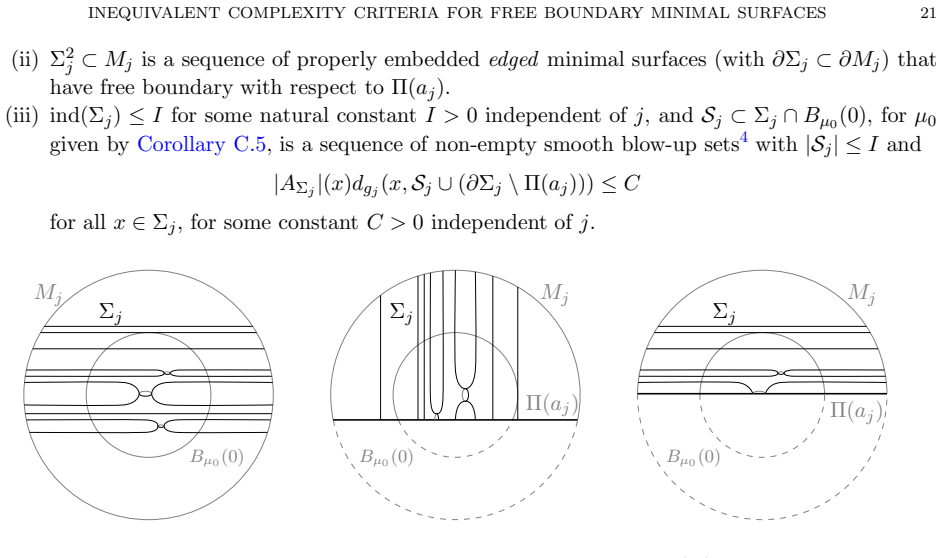
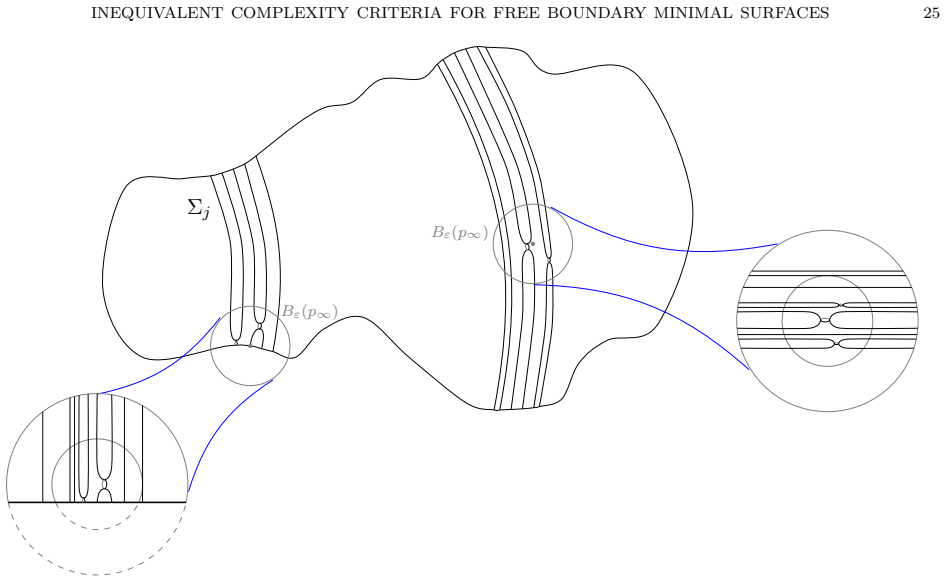
The engine is a two-scale degeneration analysis of bounded-index free boundary minimal surfaces. Smooth blow-up sets are finite subsets of the surfaces where curvature concentrates; bounded index forces at most $I$ such points, by induction using a curvature estimate for stable edged free boundary minimal surfaces, namely $\sup_\Sigma |A|\cdot d(\cdot,\partial\Sigma\setminus\partial M)\leq C$. Around each blow-up point, rescaling at the curvature scale produces a complete non-flat free boundary minimal surface in a Euclidean half-space, with index at most $I$, and a known index-topology estimate bounds its genus, ends, and boundary components in terms of $I$. A Morse-theoretic lemma counting intersection curves with both parts of geodesic-ball boundaries near $\partial M$ transfers these topological bounds down to fixed scale, and a 'simplification surgery' replaces the necks by flat discs to get a bounded-curvature surface. The area bound then comes from a new diameter estimate for stable free boundary minimal surfaces: under the positive-curvature hypotheses, a stable surface is a disc whose intrinsic diameter is controlled by $1/\sqrt{\rho_0}$ and $1/\sigma_0$, proved by conformally changing the metric so that the surface has nonnegative curvature and convex boundary.
What would settle it
A concrete way to test the theorem is to construct, in a compact 3-manifold satisfying the curvature hypotheses, a sequence of connected embedded free boundary minimal surfaces with index at most a fixed $I$ and area tending to infinity - Theorem 1.4 says this is impossible. The most targeted place to look is the edged stability estimate: finding a compact ambient manifold with positive scalar curvature and mean-convex boundary containing stable edged free boundary minimal surfaces whose curvature blows up away from the true boundary would invalidate the blow-up set construction and the proof.
Extended reading notes
Core claim
The central claim is Theorem 1.4: if $(M^3,g)$ is compact with boundary and has either positive scalar curvature with mean-convex boundary and no minimal boundary components, or nonnegative scalar curvature with strictly mean-convex boundary, then for each integer $I$ there exist constants $\Lambda_0$, $\tau_0$, $a_0$, $b_0$ such that every compact, connected, embedded free boundary minimal surface with nonempty boundary and Morse index at most $I$ has area at most $\Lambda_0$, total curvature at most $\tau_0$, genus at most $a_0$, and at most $b_0$ boundary components. In other words, no area bound is needed: the analytic invariant 'Morse index' is a complete finiteness parameter. The proof proceeds by contradiction: a sequence with bounded index and unbounded area would concentrate at finitely many points; away from those points it converges to a free boundary minimal lamination, and at the points a blow-up produces complete bounded-index free boundary minimal surfaces in Euclidean half-spaces, whose topology is controlled by index. A surgery step replaces the high-curvature necks by discs, yielding a bounded-curvature sequence that still has unbounded area, contradicting the compactness and diameter control for stable surfaces. The paper further shows the implication diagram is complete: fixed topology does not bound area or index, and bounded area does not bound topology or index.
Load-bearing premise
Everything depends on a curvature bound for stable surfaces that have been cut open: the paper assumes that stable free boundary minimal surfaces whose boundary includes artificial cuts (not part of the ambient boundary) still obey the same curvature estimate, citing a theorem that states this only for surfaces without such cuts and merely remarks the general version.
Editorial extensions
If this is right
- A bound on the Morse index alone implies uniform bounds on area, total curvature, genus, and number of boundary components for free boundary minimal surfaces in the relevant curvature regimes.
- Under the stronger hypotheses of nonnegative Ricci curvature and strictly convex boundary, fixed index gives subsequential $C^k$ compactness of the space of such surfaces.
- For generic metrics in the positive-scalar-curvature and mean-convex class, the space of free boundary minimal surfaces of index at most $I$ is finite, and the union over all $I$ is countable.
- Topological complexity is not a finiteness parameter: metrics of positive scalar curvature with mean-convex boundary can contain fixed-topology free boundary minimal surfaces whose areas and indices are arbitrarily large.
- Area boundedness is also insufficient alone; together with a complementary bound in the literature, the theorem makes the index equivalent, in this curvature regime, to simultaneous area and topology bounds.
Reading between the lines
- The proof's count of at most $I$ blow-up points suggests a bubble-tree picture for free boundary minimal surfaces with bounded index, where each curvature-concentration point consumes at least one negative eigen-direction; a natural extension is to make this recursive decomposition quantitative and derive explicit dependence of the constants on $I$ and the ambient geometry.
- The hierarchy established here implies that any compactness statement for free boundary minimal surfaces in this curvature regime must take the Morse index as an input, so topological data alone cannot parameterize moduli spaces; one testable extension is whether the generic finiteness conclusion survives under weaker topologies on the space of metrics.
- The diameter bound for stable free boundary surfaces is stated for two-sided surfaces; an open extension is to check whether one-sided stable free boundary minimal surfaces obey an analogous compactness statement, for instance via their two-sided double covers.
Signed reviews
Editorial analysis
A structured set of objections, weighed in public.
Referee Report
Summary. The paper studies the comparison of complexity criteria—area, topology, and Morse index—for free boundary minimal surfaces in compact three-dimensional manifolds with boundary. The main theorem (Theorem 1.4) states that, under either positive scalar curvature with mean-convex boundary having no minimal components, or nonnegative scalar curvature with strictly mean-convex boundary, a bound on the Morse index of compact connected embedded free boundary minimal surfaces with nonempty boundary implies uniform bounds on area, total curvature, genus, and number of boundary components. The paper also constructs, for any such manifold and any integers a≥0 and b>0, a metric of positive scalar curvature with a sequence of connected embedded free boundary minimal surfaces of genus a and b boundary components whose area and Morse index diverge (Theorem 1.12). The proof combines macroscopic convergence to free boundary minimal laminations, microscopic blow-up analysis, a surgery procedure, and a new diameter bound for stable free boundary minimal surfaces, supported by appendices on properness, reflection, Morse-theoretic arguments, and multiplicity-one convergence.
Significance. If correct, Theorem 1.4 is a substantial advance: it provides the first result showing that, in the positive-scalar-curvature/mean-convex-boundary regime, a Morse index bound alone controls the full geometric complexity of free boundary minimal surfaces, without any area assumption. This yields unconditional compactness and generic finiteness corollaries. The counterexample construction in Theorem 1.12 is also significant, as it shows that the same curvature hypotheses cannot imply compactness without an index bound, and it introduces explicit new building blocks for gluing free boundary surfaces with prescribed topology. The paper is careful with technical pitfalls, explicitly addressing properness issues, reflection arguments, and Morse-theoretic counting, and it includes a self-contained multiplicity-one convergence lemma. The main caveat is the reliance on an imported curved estimate for stable edged free boundary minimal surfaces; if that estimate is not fully justified, the degeneration analysis collapses.
major comments (2)
- [§4.2, Theorem 4.2 and Remark 4.3] Theorem 4.2 is stated as a theorem from [26], but Remark 4.3 in this paper acknowledges that [26, Theorem 1.2] is proved only for non-edged free boundary minimal surfaces and that the edged version is only observed in a remark there. This distinction is load-bearing: the proof of Lemma 4.4 removes geodesic balls around curvature concentration points, creating boundary components that lie in the sphere of the ball rather than in the ambient boundary, and the inductive hypothesis must apply to the resulting edged surfaces with arbitrary artificial boundary. If the edged estimate in [26, Remark 1.3] is not backed by a complete proof, then Lemma 4.4 has no base case, so Corollary 4.6, Theorem 5.7, Corollary 6.1, and the surgery step in the proof of Theorem 1.4 all lack foundation. Please either include a self-contained proof of the edged curvature estimate (an appendix would suffice) or provide a precise quotation of a complete proof in [26].
- [§8, proof of Theorem 1.4] After the surgery step, the proof states that 'a standard monodromy argument allows to conclude that, a posteriori, the whole component Σ̃_j converges to L smoothly with multiplicity one' and derives the desired uniform area bound from this. This is the final step that converts local multiplicity-one convergence into global control of area, but the monodromy argument is not given and no reference is supplied. The leaf L is known to be a disc at that point, but the details of how the covering component is controlled and why the convergence extends should be written out, since the contradiction depends on this step.
minor comments (4)
- [§9.5, proof of Theorem 1.12] For a=0 the construction of M' in Step 1 is not defined, because M' is introduced after gluing the tori blocks; please state explicitly how the a=0 case is handled, for example by omitting the tori blocks and setting M' to be the empty manifold or by skipping directly to the gluing with M0.
- [§4.2, Remark 4.3] The citation in Theorem 4.2 should be reconciled with the caveat in Remark 4.3; as written, the theorem is attributed to [26, Theorem 1.2] although the edged version is only a remark there.
- [Figure 1] The diagram in Figure 1 would benefit from a caption sentence explaining the convention for the arrows, in particular what the '×' labels mean for non-implications.
- [§5.2, Lemma 5.5] In the proof of Lemma 5.5, the constant κ(I) is used both for the topology bound of the blow-up limit and for the number of boundary intersections; the sentence 'possibly renaming κ(I) as the double of the constant introduced above' is informal but the intended meaning is clear.
Circularity Check
No circularity found: the paper's main theorem is a conditional geometric compactness proof; self-citations are to independent prior theorems and the admitted external reliance on [26] is a correctness risk, not a circular reduction.
full rationale
The derivation of Theorem 1.4 does not define any object in terms of the conclusion, fit a parameter to the target quantity, or import a uniqueness/choice theorem from the same authors to force the result. The area bound is proved by contradiction: bounded index gives a limit lamination, the stable leaf is shown to be a disc via Proposition 1.8 (proved from stability and Jacobi-field considerations), and surgery then gives uniformly bounded curvature with divergent area, contradicting convergence to the disc. Each external input is quoted with independent provenance: [26, Theorem 1.2] for the stable edged curvature estimate, [3, Corollary 4] for topology and curvature bounds once area and index are bounded, and [7, Proposition 2.12] for the closed-case diameter bound. These are parameter-free published theorems whose assumptions do not include Theorem 1.4; citing them is normal evidence, not circularity. The most delicate step is Theorem 4.2, which the paper flags in Remark 4.3: 'Actually, in [26] the theorem is stated only for non-edged free boundary minimal surfaces, but it is observed in Remark 1.3 therein that the conclusions still holds in such more general setting.' Lemma 4.4 has base case I = 0 exactly this estimate, and all subsequent blow-up and surgery conclusions inherit it. This is a genuine external-support risk: if the edged extension in [26, Remark 1.3] does not carry a proof, the paper's argument lacks a base case. However, that is a correctness or verification concern, not a circularity, because the paper does not assume the theorem it is proving and does not rename a fit as a prediction. Self-citation density is high, but no load-bearing argument reduces to a claim whose only justification is the same paper. Therefore the circularity score is 0.
Assumptions & free parameters
assumptions (6)
- standard math Local lamination compactness for free boundary minimal surfaces in complete 3-manifolds with boundary, cited as Colding-Minicozzi and Guang-Li-Zhou Theorem 3.5.
- standard math Curvature estimate for stable, edged free boundary minimal surfaces, cited as [26, Theorem 1.2] and extended to edged surfaces by Remark 4.3.
- standard math Index-topology bound for complete minimal surfaces in R^3 or half-spaces: index at most I bounds genus, ends, and boundary components, cited from Chodosh-Maximo and Proposition B.4.
- standard math Colding-De Lellis building blocks: spiraling minimal spheres in S^3 with positive scalar curvature and local foliations by great spheres, cited as Lemma 9.1 in this paper.
- standard math Gromov-Lawson connected sum and desingularization results for positive scalar curvature metrics, cited as [24, Theorem 5.7], and the constrained deformation lemma from [9, Lemma C.1].
- domain assumption Property (P): a smooth minimal surface meeting the ambient boundary orthogonally has its own boundary equal to its intersection with the ambient boundary.
Cite this review
Pith. "Pith review of Inequivalent complexity criteria for free boundary minimal surfaces." pith.science (2026). https://pith.science/paper/UI3DIUJ7
@misc{pith2026190804709,
  author       = {Pith},
  title        = {Pith review of: Inequivalent complexity criteria for free boundary minimal surfaces},
  year         = {2026},
  howpublished = {\url{https://pith.science/paper/UI3DIUJ7}},
  note         = {Machine review of arXiv:1908.04709}
}
read the original abstract
We obtain a series of results in the global theory of free boundary minimal surfaces, which in particular provide a rather complete picture for the way different complexity criteria, such as area, topology and Morse index compare, beyond the regime where effective estimates are at disposal.
Figures


Figures from the paper (9 more)




Reference graph
Works this paper leans on
- [26]
-
[1]
W. K. Allard, On the first variation of a varifold , Ann. of Math. (2) 95 (1972), 417–491
1972
-
[2]
Ambrosio, A
L. Ambrosio, A. Carlotto, and A. Massaccesi, Lectures on elliptic partial differential equations , Appunti. Scuola Normale Superiore di Pisa (Nuova Serie) [Lecture Notes. Scu ola Normale Superiore di Pisa (New Series)], vol. 18, Edizioni della Normale, Pisa, 2018
2018
-
[3]
L. Ambrozio, R. Buzano, A. Carlotto, and B. Sharp, Bubbling analysis and geometric convergence results for fr ee boundary minimal surfaces , Journal de l’ ´Ecole Polytechnique - Math´ ematiques6 (2019), 621–664
work page 2019
-
[4]
L. Ambrozio, A. Carlotto, and B. Sharp, Compactness analysis for free boundary minimal hypersurfa ces, Calc. Var. Partial Differential Equations 57 (2018), no. 1, 1–39
work page 2018
-
[5]
J. E. Brothers, Some open problems in geometric measure theory and its appli cations suggested by participants of the 1984 AMS summer institute , Proc. Sympos. Pure Math., 1986, pp. 441–464
work page 1984
-
[6]
Calabi, Minimal immersions of surfaces in Euclidean spheres , J
E. Calabi, Minimal immersions of surfaces in Euclidean spheres , J. Differential Geom. 1 (1967), 111–125
work page 1967
-
[7]
Carlotto, Generic finiteness of minimal surfaces with bounded Morse in dex, Ann
A. Carlotto, Generic finiteness of minimal surfaces with bounded Morse in dex, Ann. Sc. Norm. Super. Pisa Cl. Sci. (5) 17 (2017), no. 3, 1153–1171
work page 2017
Show all 52 references
-
[8]
Carlotto, O
A. Carlotto, O. Chodosh, and M. Eichmair, Effective versions of the positive mass theorem , Invent. Math. 206 (2016), no. 3, 975–1016
2016
-
[9]
Carlotto and C
A. Carlotto and C. Li, Constrained deformations of positive scalar curvature met rics, preprint (arXiv:1903.11772)
1903 arXiv
-
[10]
Chodosh, D
O. Chodosh, D. Ketover, and D. Maximo, Minimal hypersurfaces with bounded index , Invent. Math. 209 (2017), no. 3, 617–664
2017
-
[11]
Chodosh and D
O. Chodosh and D. Maximo, On the topology and index of minimal surfaces , J. Differential Geom. 104 (2016), no. 3, 399–418
2016
-
[12]
, On the topology and index of minimal surfaces II , preprint (arXiv:1808.06572)
-
[13]
H. I. Choi and R. Schoen, The space of minimal embeddings of a surface into a three-dim ensional manifold of positive Ricci curvature , Invent. Math. 81 (1985), no. 3, 387–394
1985
-
[14]
Colding and C
T. Colding and C. De Lellis, Singular limit laminations, Morse index, and positive scal ar curvature , Topology 44 (2005), no. 1, 25–45
2005
-
[15]
T. H. Colding and W. P. Minicozzi II, The space of embedded minimal surfaces of fixed genus in a 3-ma nifold. IV. Locally simply connected , Ann. of Math. (2) 160 (2004), no. 2, 573–615
2004
-
[16]
121, Amer
, A course in minimal surfaces , Graduate Studies in Mathematics, vol. 121, Amer. Math. Soc ., Providence, RI, 2011
2011
-
[17]
Ejiri and M
N. Ejiri and M. Micallef, Comparison between second variation of area and second vari ation of energy of a minimal surface, Adv. Calc. Var. 1 (2008), no. 3, 223–239
2008
-
[18]
Fischer-Colbrie, On complete minimal surfaces with finite Morse index in three -manifolds, Invent
D. Fischer-Colbrie, On complete minimal surfaces with finite Morse index in three -manifolds, Invent. Math. 82 (1985), no. 1, 121–132
1985
-
[19]
Fischer-Colbrie and R
D. Fischer-Colbrie and R. Schoen, The structure of complete stable minimal surfaces in 3-mani folds of nonnegative scalar curvature, Comm. Pure Appl. Math. 33 (1980), no. 2, 199–211
1980
-
[20]
Fraser and M
A. Fraser and M. Li, Compactness of the space of embedded minimal surfaces with f ree boundary in three-manifolds with nonnegative Ricci curvature and convex boundary , J. Differential Geom. 96 (2014), no. 2, 183–200
2014
-
[21]
Fraser and R
A. Fraser and R. Schoen, The first Steklov eigenvalue, conformal geometry, and minim al surfaces, Adv. Math. 226 (2011), no. 5, 4011–4030
2011
-
[22]
Math., 5 99, Amer
, Minimal surfaces and eigenvalue problems , Geometric analysis, mathematical relativity, and nonlin ear partial differential equations, 105–121, Contemp. Math., 5 99, Amer. Math. Soc., Providence, RI, 2013
2013
-
[23]
, Sharp eigenvalue bounds and minimal surfaces in the ball , Invent. Math. 203 (2016), no. 3, 823–890
2016
-
[24]
Gromov and H
M. Gromov and H. B. Lawson, Spin and scalar curvature in the presence of a fundamental gr oup. I , Ann. of Math. (2) 111 (1980), no. 2, 209–230
1980
-
[25]
Guang, M
Q. Guang, M. Li, Z. Wang, and X. Zhou, Min-max theory for free boundary minimal hypersurfaces II - General Morse index bounds and applications , preprint (arXiv:1907.12064)
1907 arXiv
-
[27]
Guang, Z
Q. Guang, Z. Wang, and X. Zhou, Compactness and generic finiteness for free boundary minima l hypersurfaces (I) , preprint (arXiv:1803.01509)
-
[28]
Gulliver and H
R. Gulliver and H. B. Lawson, The structure of stable minimal hypersurfaces near a singul arity, Geometric measure theory and the calculus of variations (Arcata, Calif., 1984 ), 213–237, Proc. Sympos. Pure Math., 44, Amer. Math. Soc., Providence, RI, 1986
1984
-
[29]
Hartman, Geodesic parallel coordinates in the large , Amer
P. Hartman, Geodesic parallel coordinates in the large , Amer. J. Math. 86 (1964), 705–727. INEQUIV ALENT COMPLEXITY CRITERIA FOR FREE BOUNDARY MINIMA L SURF ACES 49
1964
-
[30]
J. Hass, P. Norbury, and J. H. Rubinstein, Minimal spheres of arbitrarily high Morse index , Comm. Anal. Geom. 11 (2003), no. 3, 425–439
2003
-
[31]
Hsiang, Minimal cones and the spherical Bernstein problem
W.-Y. Hsiang, Minimal cones and the spherical Bernstein problem. I , Ann. of Math. (2) 118 (1983), no. 1, 61–73
1983
-
[32]
K. Irie, F. Marques, and A. Neves, Density of minimal hypersurfaces for generic metrics , Ann. of Math. (2) 187 (2018), no. 3, 963–972
2018
-
[33]
Kapouleas and M
N. Kapouleas and M. Li, Free boundary minimal surfaces in the unit three-ball via de singularization of the critical catenoid and the equatorial disk , preprint (arXiv:1709.08556)
-
[34]
Kapouleas and D
N. Kapouleas and D. Wiygul, Free-boundary minimal surfaces with connected boundary in the 3-ball by tripling the equatorial disc , preprint (arXiv:1711.00818)
-
[35]
Ketover, Equivariant min-max theory , preprint (arXiv:1612.08692)
D. Ketover, Equivariant min-max theory , preprint (arXiv:1612.08692)
-
[36]
, Free boundary minimal surfaces of unbounded genus , preprint (arXiv:arXiv:1612.08691)
-
[37]
Li, Free boundary minimal surfaces in the unit ball: recent adva nces and open questions , preprint (arXiv:1907.05053)
M. Li, Free boundary minimal surfaces in the unit ball: recent adva nces and open questions , preprint (arXiv:1907.05053)
1907 arXiv
-
[38]
Li and X
M. Li and X. Zhou, Min-max theory for free boundary minimal hypersurfaces I - r egularity theory, J. Differential Geom. ( to appear )
-
[39]
Lima, Bounds for the Morse index of free boundary minimal surfaces , preprint (arXiv:1710.10971)
V. Lima, Bounds for the Morse index of free boundary minimal surfaces , preprint (arXiv:1710.10971)
-
[40]
W. H. Meeks, J. P´ erez, and A. Ros, Local removable singularity theorems for minimal laminati ons, J. Differential Geom. 103 (2016), no. 2, 319–362
2016
-
[41]
Miao, Positive mass theorem on manifolds admitting corners along a hypersurface, Adv
P. Miao, Positive mass theorem on manifolds admitting corners along a hypersurface, Adv. Theor. Math. Phys. 6 (2002), no. 6, 1163–1182
2002
-
[42]
Schoen, Estimates for stable minimal surfaces in three dimensional manifolds, Seminar on minimal submanifolds, 111–126, Ann
R. Schoen, Estimates for stable minimal surfaces in three dimensional manifolds, Seminar on minimal submanifolds, 111–126, Ann. of Math. Stud., 103, Princeton Univ. Press, Pr inceton, NJ, 1983
1983
-
[43]
Differential Geom
, Uniqueness, symmetry, and embeddedness of minimal surface s, J. Differential Geom. 18 (1983), no. 4, 791–809
1983
-
[44]
Schoen and L
R. Schoen and L. Simon, Regularity of stable minimal hypersurfaces , Comm. Pure Appl. Math. 34 (1981), no. 6, 741–797
1981
-
[45]
Schoen and S.-T
R. Schoen and S.-T. Yau, The existence of a black hole due to condensation of matter , Comm. Math. Phys. 90 (1983), no. 4, 575–579
1983
-
[46]
, Positive Scalar Curvature and Minimal Hypersurface Singul arities, preprint (arXiv:1704.05490)
-
[47]
Shiohama, T
K. Shiohama, T. Shioya, and M. Tanaka, The geometry of total curvature on complete open surfaces , Cambridge Tracts in Mathematics, vol. 159, Cambridge University Pres s, Cambridge, 2003
2003
-
[48]
Volkmann, Free boundary problems governed by mean curvature , Ph.D
A. Volkmann, Free boundary problems governed by mean curvature , Ph.D. Thesis, 2015
2015
-
[49]
White, Complete surfaces of finite total curvature , J
B. White, Complete surfaces of finite total curvature , J. Differential Geom. 26 (1987), no. 2, 315–326
1987
-
[50]
, Curvature estimates and compactness theorems in 3-manifol ds for surfaces that are stationary for parametric elliptic functionals , Invent. Math. 88 (1987), no. 2, 243–256
1987
-
[51]
Differential Geom
, Which ambient spaces admit isoperimetric inequalities for submanifolds?, J. Differential Geom. 83 (2009), no. 1, 213–228
2009
-
[52]
Ser., 22 , Amer
, Introduction to minimal surface theory , Geometric analysis, 387–438, IAS/Park City Math. Ser., 22 , Amer. Math. Soc., Providence, RI, 2016. Alessandro Carlotto: ETH D-Math, R ¨amistrasse 101, 8092 Z ¨urich, Switzerland IAS, 1 Einstein drive, 08540 Princeton, United States o...
2016
Reviewed August 14, 2026 · model on record in the stance chip above.
Discussion (0). Continue with ORCID to comment.