REVIEW 3 major objections 5 minor 104 references
Probing $P,T$-Symmetry Violation with Optically Trapped Asymmetric Top Molecules
T0 review · 3 major / 5 minor · reviewed 2026-08-11 · deepseek-v4-flash
Pith's one-line read Alkaline-earth monoamides, as asymmetric tops, offer long-lived parity doublets and engineered clock transitions that project an electron-EDM sensitivity of about 1e-31 e·cm, more than an order of magnitude beyond today's best.
desk verdict Solid port of clock-transition and magic-angle methods to asymmetric tops, but the RaNH2 sensitivity projection leans on an unvalidated spin-rotation tensor. read the letter →
The pith
A machine-rendered reading of the paper's core claim, the machinery that carries it, and where it could break.
The reading
What carries the argument
The central object is the rotational K-doublet: the near-degenerate opposite-parity pair formed from symmetric-top states $|N,\pm K,M\rangle$ when the rotational asymmetry term $\frac{B-C}{4}$ mixes $\Delta K=\pm2$. In these near-prolate molecules the splitting is about 100 MHz for $N=1$, $K_a=1$, small enough to polarize at fields of order $10^2$ V/cm. The $K=1$ doublet is metastable because decay to $K=0$ requires the two hydrogen spins to flip from triplet to singlet, a process mediated only by the tiny off-diagonal hyperfine tensor $T_{ab}$ ($\sim1$ MHz); the resulting radiative lifetime is estimated at about a million years, leaving blackbody radiation as the dominant loss at room temperature. On top of this long-lived manifold the paper builds engineered clock transitions: operating points $(E,B)$ at which $f_E=\partial f/\partial E$ and $f_B=\partial f/\partial B$ vanish while $|\Delta\Sigma|$ remains large, with the residual second-order curvature and transverse couplings setting the coherence time. Finally, quasi-static trap shifts are handled by the magic angle $\theta_0=\arccos(1/\sqrt{3})\approx54.7^\circ$, where the rank-2 polarization tensor component $T^2_0$ vanishes, with an angle-tuned optimum $\theta^*$ that cancels residual second-order shifts.
What would settle it
Measure the spin-rotation constants (notably $\epsilon_{aa}$) of RaNH2 by high-resolution rotational or microwave-optical double-resonance spectroscopy and compare with the FS-CCSD value of 496 MHz; a deviation similar to the known factor-of-two discrepancies in CaNH2 and SrNH2 would invalidate the specific RaNH2 operating points and the $1\times10^{-31}$ e·cm projection, while agreement would support them. A cheaper near-term check is to verify the predicted Sr$^{14}$NH2 clock transition at $E=145.35$ V/cm, $B=28.26$ G and its roughly 65 s coherence time under the stated field-noise budget.
Extended reading notes
Core claim
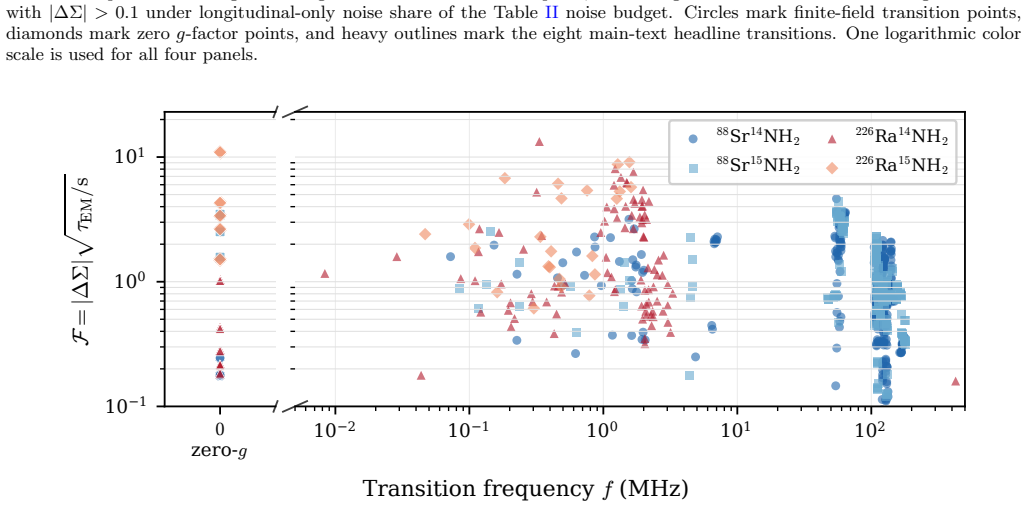
On the paper's own terms, the central discovery is that the intrinsic rotational asymmetry of $C_{2v}$ molecules—specifically the $\frac{B-C}{4}$ coupling that splits the $\pm K$ degeneracy into opposite-parity K-doublets—supplies long-lived parity doublets in the electronic and vibrational ground state, and that the dense hyperfine structure of these doublets contains many operating points at which the first-order sensitivity to electric- and magnetic-field noise vanishes while the differential sensitivity to the eEDM interaction, $\Delta\Sigma$, stays high. The authors demonstrate this by diagonalizing an effective Hamiltonian for Sr$^{14,15}$NH2 and Ra$^{14,15}$NH2, cataloguing hundreds of field-insensitive transitions with figure of merit $F=|\Delta\Sigma|\sqrt{\tau_{\rm EM}/1\,\text{s}}\ge0.25$, and by showing that the residual tensor ac-Stark shift from a 1064-nm optical trap can be cancelled by tilting the trap polarization to a magic angle. Together with a radiative lifetime far exceeding all experimental timescales and a blackbody-limited coherence that reaches $\sim10^3$ s at cryogenic temperatures, they project a statistical eEDM sensitivity of about $1\times10^{-31}$ e·cm for RaNH2.
Load-bearing premise
The load-bearing premise is that the calculated spin-rotation tensor for RaNH2—especially the $\epsilon_{aa}$ component, which FS-CCSD underestimates by about a factor of two for CaNH2 and SrNH2 relative to experiment—is accurate enough to place the radium clock transitions and the projected sensitivity; if it is off by a similar factor, the operating points and the headline $\delta d_e$ shift, though the availability of useful parity doublets would likely survive.
Editorial extensions
If this is right
- Ground-state parity doublets in asymmetric top molecules remove the vibrational-lifetime ceiling that limits $\ell$-doublet science states, so EDM measurements become coherence-limited, with $\tau\gtrsim10$ s in cryogenic traps.
- The $N=1$, $K_a=1$ manifolds of Sr$^{14,15}$NH2 and Ra$^{14,15}$NH2 contain order-100 field-insensitive transitions with $F\ge0.25$; one Ra$^{14}$NH2 transition reaches $\tau_{\rm EM}\approx262$ s and $F=13.3$ under 10 mV/cm, 100 $\mu$G field noise.
- Magic-angle trap polarization recovers at least a tenth of the trap-free figure of merit for most candidates, and roughly 80% of high-quality transitions survive in a 1-MHz-deep 1064-nm trap with 1% intensity noise.
- Using $W_d=110$ GV/cm for RaNH2, the shot-noise formula gives $\delta d_e\approx1\times10^{-31}$ e·cm for $10^3$ molecules, 10 s coherence, and one week of integration, an order of magnitude below the current best statistical sensitivity.
- The same engineered-transition framework extends to nuclear magnetic quadrupole and Schiff-moment searches in isotopologues with heavy, spinful nuclei such as $^{173}$Yb or $^{225}$Ra.
Reading between the lines
- The abundance of clock transitions among the four isotopologues suggests the qualitative result—field-insensitive, EDM-sensitive pairs in K-doublets—is robust; the quantitative RaNH2 projection, however, rests on the FS-CCSD spin-rotation tensor, so a measured $\epsilon_{aa}$ for RaNH2 would either confirm or shift the headline number.
- The static-field dressing described here could plausibly be combined with dynamical decoupling pulses; because the two approaches address different noise axes, their joint use might extend effective coherence times beyond the quasi-static field-noise limit estimated in the paper.
- The tunable K-doublet gap (smaller for larger $K$, larger for larger $N$) suggests the same molecule family could be adapted to other metrology settings, such as trapped-ion symmetry-violation searches or nuclear-spin-dependent parity-violation experiments, by choosing a manifold that matches an accessible drive frequency.
- A direct near-term experimental test would be to measure the Sr$^{14}$NH2 $M(+1/2\to+3/2)$ clock at $E=145.35$ V/cm, $B=28.26$ G: if the coherence time under the stated field-noise budget does not approach about 65 s, the underlying Hamiltonian parameters would need revision before radium is available.
Editorial analysis
A structured set of objections, weighed in public.
Referee Report
Summary. The paper proposes asymmetric top molecules of the M–NH2 family (M = Ca, Sr, Ba, Ra) as a platform for electron-EDM searches. It combines relativistic FS-CCSD calculations of molecular constants with an effective-Hamiltonian diagonalization of the N=1, K_a=1 manifolds of SrNH2 and RaNH2, and it identifies many field-insensitive clock transitions with large differential EDM sensitivity. It also analyzes optical-trap light shifts and proposes magic-angle polarization tuning to suppress differential ac Stark shifts. The central projection, in Section V, is that RaNH2 with Wd = 110 GV/cm, |ΔΣ| = 0.8, Np = 10^3, τ = 10 s, and T = 1 week gives δde ≈ 1×10^-31 e·cm, more than an order of magnitude beyond the current best statistical sensitivity of 2×10^-30 e·cm.
Significance. If the quantitative RaNH2 predictions were reliable, the paper would establish C2v asymmetric tops as a practical route to very long coherence times in EDM searches, complementing recent laser-cooling demonstrations in CaNH2. The paper's strengths are its systematic effective-Hamiltonian machinery, the transparent catalog of transition statistics in Appendices B and C, and the honest reporting of discrepancies between FS-CCSD and experimental spin-rotation constants in Table I. The qualitative message — that ATMs generically host many engineered field-insensitive transitions with strong EDM sensitivity — is well supported. The headline quantitative claim, however, is not yet robust because it rests on an unvalidated RaNH2 spin-rotation tensor and on a crude polarizability estimate. The 'circularity' concern raised in the stress-test does not land: the sensitivity formula is a stated conditional projection with assumed apparatus parameters, not a fitted target; the problem is uncertainty in the molecular inputs, not circular reasoning.
major comments (3)
- [Section IV C, Appendix C 1] The headline projection δde ≈ 1×10^-31 e·cm uses ⟨ΔΣ⟩ = 0.8 and τ = 10 s from the RaNH2 transitions in Table II, which are computed with the FS-CCSD spin-rotation tensor. Table I shows that FS-CCSD underestimates ε_aa by a factor of roughly 1.8 for CaNH2 (25.2 vs 45.7 MHz) and 2.0 for SrNH2 (80.4 vs 160.1 MHz); CCSD(T) improves the agreement but remains low, and Section III states that CCSD(T) is intractable for BaNH2 and RaNH2. Since ε_aa = 496 MHz drives the avoided crossings that produce the f_E = f_B = 0 operating points, a factor-of-two error can shift these points and change the wavefunction composition, thereby changing both |ΔΣ| and τ_EM. The statement in Section IV B that such transitions occur 'generally even when effective Hamiltonian parameters are varied' is not quantified anywhere in the manuscript. I request a parameter-sensitivity study over ε_aa (and ideally the full set of Hamiltonian parameters) spanning at least the observed FS-CCSD error ranges, with the resulting changes in F = |ΔΣ|√τ_EM and in δde reported. Without such a study, the claimed order-of-magnitude margin over the current 2×10^-30 e·cm sensitivity is not established.
- [Section IV B, Appendix B] The trap analysis uses dynamic polarizabilities estimated from a pure-precession model with atomic D-line strengths, with the text itself noting up to 50% uncertainty in the anisotropies. The magic-angle cancellation and figure-of-merit recovery in Figure 5 and Appendix C 2 are tested on a grid with the scalar polarizability fixed and with T2_0 varied by ±20% and T2_±2 scaled from -1 to 3 times the estimated value, but this grid does not map the full estimated uncertainty of the individual α_aa, α_bb, α_cc components. Because the τ = 10 s coherence assumed in Section V requires the optical trap to be magic, the projection should be tested under a more systematic polarizability-uncertainty model, or the projection should be explicitly conditioned on a future full dynamical-polarizability calculation.
- [Section II B] The catalog in Table III shows that field-insensitive transitions are abundant, so the qualitative existence claim is robust. However, the specific headline transition for Ra14NH2, M(-3/2 → +1/2) in Table II, is selected as the maximum-F candidate from a Hamiltonian built on calculated rather than measured hyperfine and spin-rotation constants. The manuscript does not report any uncertainty or range for the F value of this transition, nor for the values of |ΔΣ| and τ_EM that enter the Section V projection. I recommend adding a sensitivity table for the eight listed transitions, showing how (E*, B*), |ΔΣ|, τ_EM, and F change when the input constants are perturbed within the errors suggested by Table I and by the FS-CCSD/CCSD(T) comparison.
minor comments (5)
- [Table IV] Eq. (13) defines D ≡ Rτ, but the Section V formula δde = ℏ/(Wd |ΔΣ| √(τ Np T)) assumes R = 1/τ. Please state explicitly that the projection uses a coherence-time-limited repetition rate with no multiplexing.
- [Introduction] The table caption says entries below 0.1% are shown as upper bounds, but the upper-bound value is not defined. Please specify the actual threshold and whether the displayed value is 0.1% or a smaller bound.
- [Appendix C 1] The abstract and introduction state that ATMs 'combine large electric polarizability with long coherence times,' but the large polarizability is a model estimate rather than a measured quantity. Suggest softening this wording until measurements exist.
- [Section IV B] The spherical-tensor components T2_0 and T2_±2 of the polarizability are used in the stability grid but are not defined explicitly in terms of α_aa, α_bb, α_cc. A one-line definition would make the grid description self-contained.
- [Appendix D] The sentence 'The term f_EB is particularly of importance as it scales any non-reversing correlated noise, which could provide a false EDM' appears to refer to a systematic error rather than incoherent noise. Please clarify the distinction between correlated noise and a false EDM signal.
Circularity Check
No circularity found: the derivation is self-contained, and the headline sensitivity is a conditional projection using independently benchmarked ab initio constants and assumed experimental parameters.
full rationale
The paper's central derivation chain is self-contained and does not reduce to its own inputs. The molecular constants in Table I are obtained from independent relativistic ab initio calculations (FS-CCSD and CCSD(T) where tractable) and are benchmarked against experimental values for CaNH2 and SrNH2; the paper explicitly states that 'Experimental rotation and spin-rotation parameters of CaNH2 and SrNH2 are given for comparison and supersede calculated parameters in further modeling.' The clock transitions are found by numerical diagonalization of an effective Hamiltonian with fixed constants, searching for operating points with f_E = f_B = 0, rather than by fitting to any target sensitivity. The headline projection, 'Using Wd = 110 GV/cm for RaNH2, along with ⟨ΔΣ⟩ = 0.8, Np = 10^3, τ = 10 s, and T = 1 week, we obtain a projected sensitivity of δde ≈ 1×10^-31 ecm', is an explicit evaluation of the stated shot-noise formula δde = ℏ/(Wd |ΔΣ| √(τ Np T)); Np, τ, and T are assumed experimental parameters, and Wd is taken from an external calculation (Ref. [30]) rather than fitted here. The statement that field-insensitive transitions 'occur generally, even when effective Hamiltonian parameters are varied' addresses robustness rather than circularity. Self-citations to earlier clock-transition engineering work [23, 24, 39] provide methodological background and are not the sole justification for any result derived in this paper. The acknowledged limitations—FS-CCSD underestimates ϵ_aa by roughly a factor of two for CaNH2 and SrNH2, CCSD(T) was intractable for BaNH2 and RaNH2 (Section III), and the polarizability tensor is only estimated (Appendix C1)—are correctness and parameter-sensitivity risks for the quantitative RaNH2 projections, not circular steps, because the projected sensitivity is never used to define, fit, or justify any input parameter.
Assumptions & free parameters
free parameters (6)
- Field noise budget δE, δB =
δE = 10 mV/cm, δB = 100 μG
- Projected apparatus parameters N_p, τ, T =
N_p = 1000, τ = 10 s, T = 1 week
- Effective spin-orbit parameter ζ_eff for RaNH2 =
1540 cm^-1
- Trap depth and intensity noise =
1 MHz depth, 1% intensity noise
- Molecular transition dipole estimates =
Atomic M+ ns-np D-line strengths
- Representative rotational constants for lifetime estimate =
A=390 GHz, (B+C)/2=6 GHz, B-C=0.1 GHz, D_a=2 D
assumptions (7)
- domain assumption The ground vibronic state is X˜ 2A1 and only this state needs to be modeled; other vibrational states are well separated.
- domain assumption C2v symmetry and fermionic exchange of the two H nuclei enforce ortho-para state pairing, making K_a=1 states metastable.
- domain assumption The Curl relation g_aniso ≈ -ϵ/(2B) approximates the anisotropic g-factor.
- ad hoc to paper Pure-precession model with atomic D-line strengths estimates electronic transition dipoles for polarizability.
- domain assumption Quasi-static Gaussian field noise and second-order perturbation theory characterize dephasing.
- domain assumption W_d enhancement factors from Ref. [30] are correct.
- domain assumption FS-CCSD spin-rotation tensor for RaNH2 is accurate enough for quantitative clock-transition predictions.
Cite this review
Pith. "Pith review of Probing $P,T$-Symmetry Violation with Optically Trapped Asymmetric Top Molecules." pith.science (2026). https://pith.science/paper/UI3YP47W
@misc{pith2026260807811,
  author       = {Pith},
  title        = {Pith review of: Probing $P,T$-Symmetry Violation with Optically Trapped Asymmetric Top Molecules},
  year         = {2026},
  howpublished = {\url{https://pith.science/paper/UI3YP47W}},
  note         = {Machine review of arXiv:2608.07811}
}
abstract
Searches for $P,T$-violating electromagnetic moments are among the most sensitive probes of physics beyond the Standard Model. Extending beyond current limits will benefit from molecules with fully controllable orientation at low electric fields, long coherence times, and laser coolability---all offered by asymmetric top molecules (ATMs). Exploiting the intrinsic rotational $K$-doubling in ATMs and the associated long-lived ($T_1 \gtrsim 10$ s) parity doublets afforded by $C_{2v}$ symmetry and nuclear-spin statistics, these species combine large electric polarizability with long coherence times in modest laboratory fields. We study alkaline-earth(-like) monoamides, $\mathcal{M}$--NH$_2$ ($\mathcal{M}$ = Ca, Sr, Ba, Yb, Ra), which possess favorable electronic structure for laser cooling. We perform \textit{ab initio} calculations of fine and hyperfine constants, identifying the importance of relativistic effects in the spin-rotation tensor. An effective Hamiltonian then models the rotational and hyperfine structure of the vibronic ground state, quantifying electron electric dipole moment (EDM) sensitivities and identifying feasible measurement schemes. We compute the effect of external fields and identify engineered clock transitions that suppress sensitivity to external perturbations while retaining strong EDM sensitivity, and characterize the magic trapping conditions that null differential light shifts in an optical trap. Under these conditions we project a statistical electron-EDM sensitivity over an order of magnitude beyond current best experimental limits, with further gains available from increased molecule number and coherence time. Our results establish asymmetric top molecules as a tunable platform for sensitive symmetry-violation measurements with long coherence times.
Figures


Figures from the paper (8 more)




Reference graph
Works this paper leans on
-
[1]
Within the ground vibronic state, anti-symmetry under exchange of the two protons correlates the ortho man- ifold (I H = 1) with oddK a and the para manifold (IH = 0) with evenK a
Radiative Lifetime a.K a = 1States TheK a = 1 science manifold is protected against spontaneous rotational decay by nuclear-spin statistics. Within the ground vibronic state, anti-symmetry under exchange of the two protons correlates the ortho man- ifold (I H = 1) with oddK a and the para manifold (IH = 0) with evenK a. Further symmetry classifica- tion d...
-
[2]
Direct BBR- driven transitions within theK-doublet are also negligi- ble because the transition-rate factorω 3 ¯n(ω, T) strongly suppresses transitions at kHz–MHz frequencies
Blackbody Lifetime Blackbody radiation (BBR) in the electric-dipole ap- proximation preserves nuclear-spin symmetry and keeps the ortho and para stacks separate. Direct BBR- driven transitions within theK-doublet are also negligi- ble because the transition-rate factorω 3 ¯n(ω, T) strongly suppresses transitions at kHz–MHz frequencies. For the molecules c...
-
[3]
F requency Broadening We model the longitudinal electric and magnetic field noise as independent, quasistatic (i.e., slower than inter- nal molecular interactions) Gaussian random variables, δE ∼ N(0, σ2 E ) andδB ∼ N(0, σ2 B). Expanding the tran- sition frequency to second order gives δf=f E δE+f BδB +fEB δEδB+ 1 2 fEE δE 2 + 1 2 fBBδB2, (B1) where all d...
-
[4]
The primary catalog is restricted to |∆M| ≤2, corresponding to one- or two-photon address- ing
T ransition Statistics and Noise Budgets We search theN= 1,K a = 1 ortho manifold in fi- nite steps over 0≤ E ≤1000 V/cm for Sr 14,15NH2 and 0≤ E ≤500 V/cm for Ra14,15NH2, and 0≤ B ≤100 G for all isotopologues. The primary catalog is restricted to |∆M| ≤2, corresponding to one- or two-photon address- ing. Candidate clock transitions occur wheref E andf B ...
-
[5]
In Table VI, we show additional time-reverse state pairs through ∆M= 5 using the same longitudinal and transverse noise model optimization as Table II
Extension beyond|∆M| ≤2 If the|∆M| ≤2 restriction is lifted, more zerog-factor transitions are available with improved|∆Σ|and further reduced transverse coupling sensitivity. In Table VI, we show additional time-reverse state pairs through ∆M= 5 using the same longitudinal and transverse noise model optimization as Table II. A transverse magnetic interac-...
-
[6]
Dynamic Polarizability Estimate Evaluating trap-induced (AC-Stark) shifts of the magic transitions requires the molecule-frame dynamic polar- 17 0 40 80 120 (a) 88Sr14NH2 N = 485 N ¸ 1; 2; 5 = (179; 60; 0) 0 25 50 75 (b) 88Sr15NH2 N = 242 N ¸ 1; 2; 5 = (82; 32; 0) 10−1 100 101 0 5 10 15 (c) 226Ra14NH2 N = 100 N ¸ 1; 2; 5 = (51; 34; 9) 10−1 100 101 0 2 4 6...
-
[7]
For each finite-field transition candidate, we optimize withH ac over the operating parameters (E,B, θ)
Mitigating T rap Noise We consider a linearly polarized 1064-nm optical dipole trap (ODT) with a 1 MHz depth and 1% intensity noise resulting from finite molecule temperature in the trap. For each finite-field transition candidate, we optimize withH ac over the operating parameters (E,B, θ). To characterize angular tolerance, we then hold (E,B) fixed and ...
-
[8]
, and ignore higher-order centrifugal corrections
Rotational Structure For the rotational states, we focus on the lowest ro- tational quantum numbers,N= 0,1,2, . . ., and ignore higher-order centrifugal corrections. The moment of in- 22 −750 −500 −250 0 250 500 Energy (MHz) H ® 88Sr14NH2 H ® 88Sr15NH2 H ® 226Ra14NH2 H ® 226Ra15NH2 −1000 −500 0 500 1000 E (V/cm) −0.4 −0.2 0.0 0.2 0.4 ^a¢ ^Z ® ...
Show all 104 references
-
[9]
Because we are in the prolate limit,K a is well defined, and the sumK a +K c is eitherNorN+ 1, depending on theK c value, which is given by the parity of the wavefunction in Eq
Parity States Due to rotational parity doubling and±Kmixing, ATM eigenstates forK̸= 0 are given by symmetrized su- perpositions of|N,±K, M⟩states, known as Wang func- tions [95]: |NKa,Kc , M⟩:= 1√ 2 |N, Ka, M⟩+ (−1)Kc |N,−K a, M⟩ (E7) = 1√ 2 |N, Ka, M⟩ ±(−1)N−K a |N,−K a, M⟩ (...
-
[10]
A. D. Sakharov, Violation of CP Invariance, C Asym- metry, and Baryon Asymmetry of the Universe, Journal of Experimental and Theoretical Physics Letters5, 24 (1967)
1967
-
[11]
Pospelov and A
M. Pospelov and A. Ritz, Electric dipole moments as probes of new physics, Ann. Phys.318, 119 (2005)
2005
-
[12]
J. S. M. Ginges and V. V. Flambaum, Violations of fun- damental symmetries in atoms and tests of unification theories of elementary particles, Physics Reports397, 63 (2004)
2004
-
[13]
Engel, M
J. Engel, M. J. Ramsey-Musolf, and U. Van Kolck, Elec- tric dipole moments of nucleons, nuclei, and atoms: The Standard Model and beyond, Progress in Particle and Nuclear Physics71, 21 (2013)
2013
-
[14]
M. S. Safronova, D. Budker, D. DeMille, D. F. J. Kimball, A. Derevianko, and C. W. Clark, Search for new physics with atoms and molecules, Rev. Mod. Phys.90, 025008 (2018)
2018
-
[15]
T. E. Chupp, P. Fierlinger, M. J. Ramsey-Musolf, and J. T. Singh, Electric dipole moments of atoms, molecules, nuclei, and particles, Rev. Mod. Phys.91, 015001 (2019)
2019
-
[16]
Alarcon, J
R. Alarcon, J. Alexander, V. Anastassopoulos, T. Aoki, R. Baartman, S. Baeßler, L. Bartoszek, D. H. Beck, F. Bedeschi, R. Berger, M. Berz, H. L. Bethlem, T. Bhattacharya, M. Blaskiewicz, T. Blum, T. Bow- cock, A. Borschevsky, K. Brown, D. Budker, S. Bur- din, B. C. Casey, G. C...
2022 arXiv
-
[17]
T. S. Roussy, L. Caldwell, T. Wright, W. B. Cairncross, Y. Shagam, K. B. Ng, N. Schlossberger, S. Y. Park, A. Wang, J. Ye, and E. A. Cornell, An improved bound on the electron’s electric dipole moment, Science381, 46 (2023)
2023
-
[18]
ACME Collaboration, Improved limit on the electric dipole moment of the electron, Nature562, 355 (2018)
2018
-
[19]
E. S. Shuman, J. F. Barry, and D. DeMille, Laser cool- ing of a diatomic molecule., Nature467, 820 (2010), arXiv:1103.6004
2010 arXiv
-
[20]
Truppe, H
S. Truppe, H. J. Williams, M. Hambach, L. Caldwell, N. J. Fitch, E. A. Hinds, B. E. Sauer, and M. R. Tarbutt, Molecules cooled below the Doppler limit, Nature Phys 13, 1173 (2017)
2017
-
[21]
Anderegg, L
L. Anderegg, L. W. Cheuk, Y. Bao, S. Burchesky, W. Ketterle, K.-K. Ni, and J. M. Doyle, An Optical Tweezer Array of Ultracold Molecules, Science365, 1156 (2019), arXiv:1902.00497
2019 arXiv
-
[22]
L. D. Carr, D. DeMille, R. V. Krems, and J. Ye, Cold and ultracold molecules: Science, technology and appli- cations, New Journal of Physics11, 055049 (2009)
2009
-
[23]
M. A. Baranov, M. Dalmonte, G. Pupillo, and P. Zoller, Condensed matter theory of dipolar quantum gases., Chemical reviews112, 5012 (2012)
2012
-
[24]
Kozyryev and N
I. Kozyryev and N. R. Hutzler, Precision Measurement of Time-Reversal Symmetry Violation with Laser-Cooled Polyatomic Molecules, Physical Review Letters119, 133002 (2017)
2017
-
[25]
T. A. Isaev and R. Berger, Polyatomic candidates for cooling of molecules with lasers from simple theoretical concepts, Phys. Rev. Lett.116, 063006 (2016)
2016
-
[26]
Kozyryev, L
I. Kozyryev, L. Baum, K. Matsuda, and J. M. Doyle, Pro- posal for laser cooling of complex polyatomic molecules, ChemPhysChem17, 3641 (2016)
2016
-
[27]
M. Li, J. K los, A. Petrov, and S. Kotochigova, Emulating optical cycling centers in polyatomic molecules, Commu- nications Physics2, 148 (2019)
2019
-
[28]
M. V. Ivanov, F. H. Bangerter, and A. I. Krylov, To- wards a rational design of laser-coolable molecules: In- sights from equation-of-motion coupled-cluster calcula- tions, Physical Chemistry Chemical Physics21, 19447 (2019)
2019
-
[29]
T. A. Isaev, A. V. Zaitsevskii, and E. Eliav, Laser- coolable polyatomic molecules with heavy nuclei, Journal of Physics B: Atomic, Molecular and Optical Physics50, 225101 (2017)
2017
-
[30]
N. R. Hutzler, Polyatomic molecules as quantum sen- sors for fundamental physics, Quantum Sci. Technol.5, 044011 (2020)
2020
-
[31]
N. B. Vilas, C. Hallas, L. Anderegg, P. Robichaud, A. Winnicki, D. Mitra, and J. M. Doyle, Magneto- optical trapping and sub-Doppler cooling of a polyatomic molecule, Nature606, 70 (2022)
2022
-
[32]
Anderegg, N
L. Anderegg, N. B. Vilas, C. Hallas, P. Robichaud, A. Jadbabaie, J. M. Doyle, and N. R. Hutzler, Quan- tum control of trapped polyatomic molecules for eEDM searches, Science382, 665 (2023)
2023
-
[33]
Takahashi, C
Y. Takahashi, C. Zhang, A. Jadbabaie, and N. R. Hut- zler, Engineering Field-Insensitive Molecular Clock Tran- sitions for Symmetry Violation Searches, Phys. Rev. Lett. 131, 183003 (2023)
2023
-
[34]
Bause, N
R. Bause, N. Balasubramanian, T. Fikkers, E. H. Prin- sen, K. Steinebach, A. Jadbabaie, N. R. Hutzler, I. A. Au- car, L. c. v. F. Paˇ steka, A. Borschevsky, and S. Hoekstra, Prospects for measuring the electron’s electric dipole mo- ment with polyatomic molecules in an optical...
2025
-
[35]
Hallas, N
C. Hallas, N. B. Vilas, L. Anderegg, P. Robichaud, A. Winnicki, C. Zhang, L. Cheng, and J. M. Doyle, Opti- cal Trapping of a Polyatomic Molecule in anℓ-Type Par- ity Doublet State, Phys. Rev. Lett.130, 153202 (2023)
2023
-
[36]
Zhang, P
C. Zhang, P. Yu, A. Jadbabaie, and N. R. Hutzler, Quantum-Enhanced Metrology for Molecular Symmetry Violation Using Decoherence-Free Subspaces, Phys. Rev. Lett.131, 193602 (2023)
2023
-
[37]
Yu and N
P. Yu and N. R. Hutzler, Probing Fundamental Symme- tries of Deformed Nuclei in Symmetric Top Molecules, Phys. Rev. Lett.126, 023003 (2021)
2021
-
[38]
B. L. Augenbraun, J. M. Doyle, T. Zelevinsky, and I. Kozyryev, Molecular Asymmetry and Optical Cycling: Laser Cooling Asymmetric Top Molecules, Phys. Rev. X 10, 031022 (2020)
2020
-
[39]
Frenett, Z
A. Frenett, Z. Lasner, L. Cheng, and J. M. Doyle, Vibra- tional branching fractions for laser cooling of nonlinear strontium-containing molecules, Physical Review A110, 022811 (2024)
2024
-
[40]
J. M. Thompsen, P. M. Sheridan, and L. M. Ziurys, Ro- tational spectroscopy of the SrNH 2 and SrND 2 radicals ( ˜X2A1), Chemical Physics Letters330, 373 (2000)
2000
-
[41]
G. K. Li, G. Lee, J. Mango, H. Lampson, Y. Lee, W. Wang, A. Periwal, N. B. Vilas, A. Frenett, L. An- deregg, and J. M. Doyle, Photon cycling and laser cooling of an asymmetric top molecule (2026), arXiv:2606.12323 [physics.atom-ph]
2026 arXiv
-
[42]
Kozyryev, T
I. Kozyryev, T. C. Steimle, P. Yu, D.-T. Nguyen, and J. M. Doyle, Determination of CaOH and CaOCH 3 vi- brational branching ratios for direct laser cooling and trapping, New Journal of Physics21, 052002 (2019), arXiv:1812.05636
2019 arXiv
-
[43]
B. L. Augenbraun, L. Anderegg, C. Hallas, Z. D. Lasner, N. B. Vilas, and J. M. Doyle, Direct Laser Cooling of Polyatomic Molecules (2023), arXiv:2302.10161
2023 arXiv
-
[44]
T. A. Barckholtz and T. A. Miller, Quantitative insights about molecules exhibiting jahn-teller and related ef- fects, International Reviews in Physical Chemistry17, 435 (1998)
1998
-
[45]
Anderegg, B
L. Anderegg, B. L. Augenbraun, Y. Bao, S. Burchesky, L. W. Cheuk, W. Ketterle, and J. M. Doyle, Laser cooling of optically trapped molecules, Nature Physics14, 890 (2018)
2018
-
[46]
L. Baum, N. B. Vilas, C. Hallas, B. L. Augenbraun, S. Raval, D. Mitra, and J. M. Doyle, 1D Magneto-Optical Trap of Polyatomic Molecules, Physical Review Letters 124, 133201 (2020)
2020
-
[47]
Robichaud, C
P. Robichaud, C. Hallas, J. Tao, G. Lee, N. B. Vilas, and J. M. Doyle, Parity-doublet coherence times in optically trapped polyatomic molecules, Nature651, 43 (2026)
2026
-
[48]
Takahashi, H
Y. Takahashi, H. D. Ramachandran, A. Jadbabaie, Y. Zeng, C. Zhang, and N. R. Hutzler, Engineered molec- ular clock transitions for precision measurements, Phys. 31 Rev. X16, 031011 (2026)
2026
-
[49]
Derevianko and H
A. Derevianko and H. Katori,Colloquium: Physics of optical lattice clocks, Reviews of Modern Physics83, 331 (2011)
2011
-
[50]
K. Gaul, N. R. Hutzler, P. Yu, A. M. Jayich, M. Iliaˇ s, and A. Borschevsky,CP-violation sensitivity of closed-shell radium-containing polyatomic molecular ions, Physical Review A109, 042819 (2024)
2024
-
[51]
A. D. Kudashov, A. N. Petrov, L. V. Skripnikov, N. S. Mosyagin, T. A. Isaev, R. Berger, and A. V. Titov, Ab initio study of radium monofluoride (RaF) as a candi- date to search for parity- and time-and-parity–violation effects, Phys. Rev. A90, 052513 (2014)
2014
-
[52]
P. R. Bunker and P. Jensen,Molecular Symmetry and Spectroscopy, 2nd ed. (NRC Research Press, Ottawa, 1998)
1998
-
[53]
T. J. Sears, The calculation of the energy levels of an asymmetric top free radical in a magnetic field, Computer Physics Reports2, 1 (1984)
1984
-
[54]
H. S. M¨ uller, K. L¨ oblein, H. H¨ ubner, W. H¨ uttner, and J. M. Brown, The rotational spectrum of the NF 2 free radical: Determination of molecular structure, Journal of Molecular Spectroscopy251, 185 (2008), special issue dedicated to the pioneering work of Drs. Edward A. ...
2008
-
[55]
T. C. Steimle, J. M. Brown, and R. F. Curl, Jr., Mi- crowave optical double resonance of NH2. VI. ground state of NHD, The Journal of Chemical Physics73, 2552 (1980)
1980
-
[56]
Curl, The relationship between electron spin rotation coupling constants and g-tensor components, Molecular Physics9, 585 (1965)
R. Curl, The relationship between electron spin rotation coupling constants and g-tensor components, Molecular Physics9, 585 (1965)
1965
-
[57]
J. M. Brown and A. Carrington,Rotational Spectroscopy of Diatomic Molecules(Cambridge University Press, Cambridge, 2003)
2003
-
[58]
J. I. Melo, M. C. Ruiz de Az´ ua, C. G. Giribet, G. A. Aucar, and R. H. Romero, Relativistic effects on the nu- clear magnetic shielding tensor, J. Chem. Phys.118, 471 (2003)
2003
-
[59]
M. A. Brewster and L. M. Ziurys, The pure rotational spectrum of CaNH 2 and CaND 2 ( ˜X 2A1): Additional proof of planarity, The Journal of Chemical Physics113, 3141 (2000)
2000
-
[60]
Sheridan, M
P. Sheridan, M. Dick, J.-G. Wang, and P. Bernath, Rota- tional analysis of the ˜C 2A1– ˜X 2A1 transition of SrNH2, Journal of Molecular Spectroscopy233, 269 (2005)
2005
-
[61]
Visscher, E
L. Visscher, E. Eliav, and U. Kaldor, Formulation and implementation of the relativistic Fock-space coupled cluster method for molecules, The Journal of Chemical Physics115, 9720 (2001)
2001
-
[62]
K. G. Dyall, Relativistic double-zeta, triple-zeta, and quadruple-zeta basis sets for the light elements H–Ar, Theoretical Chemistry Accounts135, 128 (2016)
2016
-
[63]
K. G. Dyall, Relativistic Double-Zeta, Triple-Zeta, and Quadruple-Zeta Basis Sets for the 4s, 5s, 6s, and 7s Ele- ments, The Journal of Physical Chemistry A113, 12638 (2009)
2009
-
[64]
Thierfelder, P
C. Thierfelder, P. Schwerdtfeger, and T. Saue, 63Cu and 197Au nuclear quadrupole moments from four-component relativistic density-functional calculations using correct long-range exchange, Physical Review A76, 034502 (2007)
2007
-
[65]
T. Saue, L. Visscher, H. J. A. Jensen, R. Bast, and A. S. P. Gomes, DIRAC25: DIRAC, a relativistic ab ini- tio electronic structure program (2025)
2025
-
[66]
Zhang, X
C. Zhang, X. Zheng, J. Liu, A. Asthana, and L. Cheng, Analytic gradients for relativistic exact-two-component equation-of-motion coupled-cluster singles and doubles method, The Journal of Chemical Physics159, 244113 (2023)
2023
-
[67]
P. J. Stephens, F. J. Devlin, C. F. Chabalowski, and M. J. Frisch, Ab Initio Calculation of Vibrational Ab- sorption and Circular Dichroism Spectra Using Density Functional Force Fields, The Journal of Physical Chem- istry98, 11623 (1994)
1994
-
[68]
Kaupp, P
M. Kaupp, P. v. R. Schleyer, H. Stoll, and H. Preuss, Pseudopotential approaches to Ca, Sr, and Ba hydrides. Why are some alkaline earth MX2 compounds bent?, The Journal of Chemical Physics94, 1360 (1991)
1991
-
[69]
Weigend and R
F. Weigend and R. Ahlrichs, Balanced basis sets of split valence, triple zeta valence and quadruple zeta valence quality for H to Rn: Design and assessment of accuracy, Physical Chemistry Chemical Physics7, 3297 (2005)
2005
-
[70]
I. A. Aucar, S. S. G´ omez, M. C. R. de Az´ ua, and C. G. Giribet, Theoretical study of the nuclear spin- molecular rotation coupling for relativistic electrons and non-relativistic nuclei, The Journal of Chemical Physics 136, 204119 (2012)
2012
-
[71]
Petrov and A
A. Petrov and A. Zakharova, Sensitivity of the YbOH molecule to PT-odd effects in an external electric field, Phys. Rev. A105, L050801 (2022)
2022
-
[72]
B. L. Augenbraun,Methods for Direct Laser Cooling of Polyatomic Molecules, Ph.D. thesis, Harvard (2021)
2021
-
[73]
N. R. Hutzler, A. Borschevsky, D. Budker, D. DeMille, V. V. Flambaum, G. Gabrielse, R. F. G. Ruiz, A. M. Jayich, L. A. Orozco, M. Ramsey-Musolf, M. Reece, M. S. Safronova, J. T. Singh, M. R. Tarbutt, and T. Zelevinsky, Searches for new sources of CP violation using molecules a...
2020 arXiv
-
[74]
Burchesky, L
S. Burchesky, L. Anderegg, Y. Bao, S. S. Yu, E. Chae, W. Ketterle, K.-K. Ni, and J. M. Doyle, Rotational coher- ence times of polar molecules in optical tweezers, Phys. Rev. Lett.127, 123202 (2021)
2021
-
[75]
Caldwell and M
L. Caldwell and M. R. Tarbutt, Sideband cooling of molecules in optical traps, Phys. Rev. Res.2, 013251 (2020)
2020
-
[76]
D. K. Ruttley, T. R. Hepworth, A. Guttridge, and S. L. Cornish, Long-lived entanglement of molecules in magic- wavelength optical tweezers, Nature637, 827 (2025)
2025
-
[77]
Salas-Estrada, S.-M
A. Salas-Estrada, S.-M. Udrescu, G. Zheng, Q. Wang, A. Jadbabaie, V. Vuleti´ c, D. DeMille, R. F. G. Ruiz, and E. Pedrozo-Pe˜ nafiel, Non-destructive cavity read- out of molecules for precision measurements (2026), arXiv:2606.01743 [physics.atom-ph]
2026 arXiv
-
[78]
Timoney, I
N. Timoney, I. Baumgart, M. Johanning, A. F. Var´ on, M. B. Plenio, A. Retzker, and C. Wunderlich, Quantum gates and memory using microwave-dressed states, Na- ture476, 185 (2011)
2011
-
[79]
Youssef, K
E. Youssef, K. Wilson, J. Cao, R. Brislawn, A. Lakkireddy, K. Liu, A. Teo, P. Turner, and L. An- deregg, Enhanced Loading of a Molecular Magneto- Optical Trap (2026), arXiv:2605.30296 [physics.atom- ph]
2026 arXiv
-
[80]
Nasir, A
A. Nasir, A. Lunstad, M. Li, S. Salim, S. Liu, C. Hal- las, Z. Lasner, and J. M. Doyle, Order of Magnitude Im- proved Optical Trapping of Molecules Through Trans- 32 verse Cooling (2026), arXiv:2607.16913 [physics.atom- ph]
2026 arXiv
-
[81]
Altunta¸ s, J
E. Altunta¸ s, J. Ammon, S. B. Cahn, and D. DeMille, Measuring nuclear-spin-dependent parity violation with molecules: Experimental methods and analysis of sys- tematic errors, Phys. Rev. A97, 042101 (2018)
2018
-
[82]
E. B. Norrgard, D. S. Barker, S. Eckel, J. A. Fedchak, N. N. Klimov, and J. Scherschligt, Nuclear-spin depen- dent parity violation in optically trapped polyatomic molecules, Communications Physics2, 77 (2019)
2019
-
[83]
D. E. Maison, L. V. Skripnikov, and V. V. Flambaum, Theoretical study of 173YbOH to search for the nuclear magnetic quadrupole moment, Phys. Rev. A100, 032514 (2019)
2019
-
[84]
Auerbach, V
N. Auerbach, V. V. Flambaum, and V. Spevak, Collec- tive t- and p-odd electromagnetic moments in nuclei with octupole deformations, Phys. Rev. Lett.76, 4316 (1996)
1996
-
[85]
Engels, M
B. Engels, M. Peri´ c, W. Reuter, S. D. Peyerimhoff, and F. Grein, Study of the hyperfine coupling constants ( 14N and 1H) of the NH2 molecules in the ˜X 2B1 ground state and the ˜A 2A1 excited state, The Journal of Chemical Physics96, 4526 (1992)
1992
-
[86]
Kanamori, Z
H. Kanamori, Z. T. Dehghani, A. Mizoguchi, and Y. Endo, Detection of microwave transitions between or- tho and para states in a free isolated molecule, Phys. Rev. Lett.119, 173401 (2017)
2017
-
[87]
N. B. Vilas, C. Hallas, L. Anderegg, P. Robichaud, C. Zhang, S. Dawley, L. Cheng, and J. M. Doyle, Black- body thermalization and vibrational lifetimes of trapped polyatomic molecules, Phys. Rev. A107, 062802 (2023)
2023
-
[88]
Hoekstra, J
S. Hoekstra, J. J. Gilijamse, B. Sartakov, N. Vanhaecke, L. Scharfenberg, S. Y. T. van de Meerakker, and G. Mei- jer, Optical pumping of trapped neutral molecules by blackbody radiation, Phys. Rev. Lett.98, 133001 (2007)
2007
-
[89]
D. Haas, C. von Planta, T. Kierspel, D. Zhang, and S. Willitsch, Long-term trapping of Stark-decelerated molecules, Communications Physics2, 101 (2019)
2019
-
[90]
Chaffee, B
D. Chaffee, B. Margulis, A. Sheffield, J. Schmidt, A. Reisenfeld, D. R. Leibrandt, D. Leibfried, and C.- W. Chou, High-fidelity quantum state control of a po- lar molecular ion in a cryogenic environment, Phys. Rev. Lett.135, 240801 (2025)
2025
-
[91]
Zhang, T.-W
Z. Zhang, T.-W. Hsu, T. Y. Tan, D. H. Slichter, A. M. Kaufman, M. Marinelli, and C. A. Regal, High optical access cryogenic system for rydberg atom arrays with a 3000-second trap lifetime, PRX Quantum6, 020337 (2025)
2025
-
[92]
Chattopadhyay, B
S. Chattopadhyay, B. K. Mani, and D. Angom, Electric dipole polarizability of alkaline-earth-metal atoms from perturbed relativistic coupled-cluster theory with triples, Phys. Rev. A89, 022506 (2014)
2014
-
[93]
A. M. R. P. Bopegedera, C. R. Brazier, and P. F. Bernath, Laser spectroscopy of strontium and calcium monoalkylamides, The Journal of Physical Chemistry91, 2779 (1987)
1987
-
[94]
Morbi, C
Z. Morbi, C. Zhao, J. W. Hepburn, and P. F. Bernath, High-resolution visible laser spectroscopy of the ˜B 2B1– ˜X 2A1 transition of CaNH 2, The Journal of Chemical Physics108, 8891 (1998)
1998
-
[95]
and Ralchenko, Yu
Kramida, A. and Ralchenko, Yu. and Reader, J. and NIST ASD Team, NIST Atomic Spectra Database (ver- sion 5.12) (2024)
2024
-
[96]
Liu, Rotational and fine structure of open-shell molecules in nearly degenerate electronic states, The Journal of Chemical Physics148, 124112 (2018)
J. Liu, Rotational and fine structure of open-shell molecules in nearly degenerate electronic states, The Journal of Chemical Physics148, 124112 (2018)
2018
-
[97]
P. I. Presunka and J. A. Coxon, Laser spectroscopy of the ˜A 2Π– ˜X 2Σ+ transition of SrOH: Deperturbation analysis ofK-resonance in thev 2 = 1 level of the ˜A 2Π state, The Journal of Chemical Physics101, 201 (1994)
1994
-
[98]
J. D. Tandy, J.-G. Wang, and P. F. Bernath, High- resolution laser spectroscopy of BaOH and BaOD: Anomalous spin-orbit coupling in the ˜A 2Π state, Journal of Molecular Spectroscopy255, 63 (2009)
2009
-
[99]
Saberi, T
H. Saberi, T. Opatrn´ y, K. Mølmer, and A. del Campo, Adiabatic tracking of quantum many-body dynamics, Physical Review A90, 060301 (2014)
2014
-
[100]
Frame, R
D. Frame, R. He, I. Ipsen, D. Lee, D. Lee, and E. Rra- paj, Eigenvector Continuation with Subspace Learning, Physical Review Letters121, 032501 (2018)
2018
-
[101]
C. P. Koch, M. Lemeshko, and D. Sugny, Quantum con- trol of molecular rotation, Rev. Mod. Phys.91, 035005 (2019)
2019
-
[102]
R. N. Zare,Angular Momentum: Understanding Spa- tial Aspects in Chemistry and Physics(Wiley, New York, 1988)
1988
-
[103]
R. G. Littlejohn and M. Reinsch, Gauge fields in the sep- aration of rotations andinternal motions in the n-body problem, Reviews of Modern Physics69, 213 (1997)
1997
-
[104]
S. C. Wang, On the Asymmetrical Top in Quantum Me- chanics, Physical Review34, 243 (1929)
1929
Reviewed August 11, 2026 · model on record in the stance chip above.
Discussion (0). Continue with ORCID to comment.