REVIEW 3 major objections 4 minor 32 references
Coherent Control of Domain-Wall Transport in an Ultracold Bose Gas
T0 review · 3 major / 4 minor · reviewed 2026-08-12 · deepseek-v4-flash
Pith's one-line read By rotating the central spin domain, the authors show that domain-wall trajectories in a nondegenerate ultracold Bose gas can be accelerated, reversed, or suppressed, with quantum Boltzmann simulations attributing the control to…
desk verdict The experiment is solid; the phase-gradient control claim is a simulation with an unmeasured initial condition, so keep them separate. read the letter →
The pith
A machine-rendered reading of the paper's core claim, the machinery that carries it, and where it could break.
The reading
What carries the argument
The machinery that carries the argument is the magnetization vector field of the pseudo-spin-1/2 gas, decomposed into a longitudinal part $M_\parallel(z,t)$ and a transverse part $M_\perp(z)e^{i\phi(z)}$, together with the one-dimensional quantum Boltzmann equation $\partial_t \vec{m} + \partial_0 \vec{m} - (1/\hbar) g \vec{M}\times \vec{m} = \partial_t \vec{m}|_{\mathrm{coll}}$. The term $g \vec{M}\times \vec{m}$ encodes coherent spin-exchange collisions, which rotate the magnetization and generate the spin currents that move the walls; the collision term supplies diffusion. The experiments prepare the three-domain texture with a spatially patterned AC Stark shift, and the simulations use the phenomenological longitudinal profile plus a transverse profile whose domain orientations and phase gradients are the control knobs. In the simulations, larger phase gradients impede the adiabatic rotation of spin as atoms cross a wall, enhancing dephasing and speeding wall motion, and a mismatch between the two walls' phase textures makes the wall with the larger gradient dominate the ensemble dynamics.
What would settle it
Measure the transverse phase gradient $\partial_z\phi$ across each domain wall directly after preparation and compare it with the wall's initial acceleration; if walls with larger measured gradients do not move faster, the claim fails. As a companion calculation, set $\partial_z\phi=0$ everywhere in the quantum Boltzmann simulation while holding all other inputs fixed; if the simulated wall trajectories are unchanged, the phase-gradient control mechanism is falsified.
Extended reading notes
Core claim
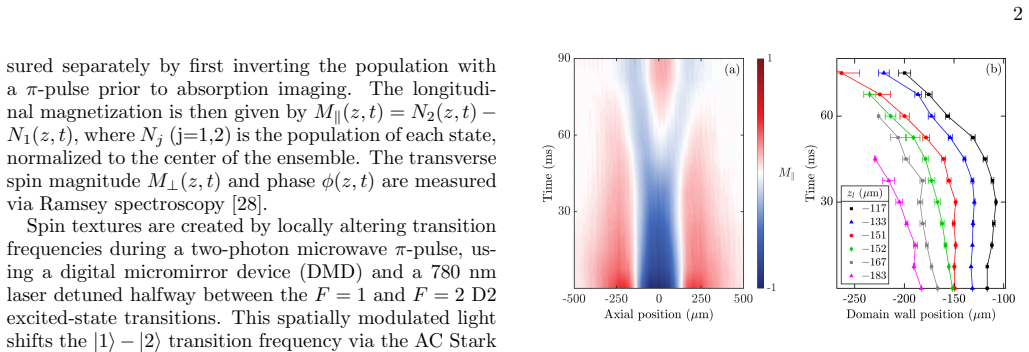
The paper's central discovery is that domain-wall transport in a weakly interacting nondegenerate Bose gas can be controlled through the coherence and phase geometry of the spin texture. In the experiment, 87Rb atoms in two hyperfine states form a pseudo-spin-1/2 sample with a three-domain longitudinal texture whose initial profile is modeled by a phenomenological tanh form. When the central domain is rotated away from fully longitudinal polarization ($P<1$), the transverse magnetization in the wall grows, exchange collisions are enhanced, and spin currents across the wall become imbalanced; the resulting trajectories show inward motion, faster outward motion, and, in some cases, spontaneous reversal. The paper reports a two-stage dynamics: an early exchange-stabilized stage in which coherent collisions suppress wall motion, ending at a coherence collapse around 40 ms, followed by a diffusion-dominated stage in which the wall accelerates toward the thermal velocity. Numerical integration of a one-dimensional quantum Boltzmann equation reproduces the measured trajectories when initialized with experimentally fitted longitudinal parameters and a Ramsey-guided transverse profile; simulations then show that the magnitude of the transverse phase gradient $\partial_z\phi$ across a wall sets its spin-transport rate, so that changing the phase texture of the right wall alters the trajectory of the left wall. This nonlocal, phase-gradient-mediated control is the paper's principal new mechanism, though it is established by simulation rather than by direct measurement.
Load-bearing premise
The argument depends on the assumed starting pattern of the sideways-pointing part of the spin (the transverse magnetization and its phase) at the walls, a quantity the authors did not measure directly at the walls and which is sensitive to the preparation light; if that assumed pattern is wrong, the simulated phase-gradient control may not be real.
Editorial extensions
If this is right
- Domain-wall motion in a thermal ultracold gas can be programmed by preparing the polarization and phase of spin domains, without applying external forces to the wall.
- The duration of the exchange-stabilized regime, and thus the delay before rapid transport, can be tuned by the initial coherence prepared in the wall.
- Phase gradients act nonlocally: changing the transverse phase texture of one wall alters the trajectory of another wall, providing a route to steer spin currents in atomtronic circuits.
- The quantum Boltzmann equation, initialized from measured longitudinal parameters and a Ramsey-guided transverse profile, can serve as a predictive tool for designing spin textures with desired wall trajectories.
Reading between the lines
- Beyond the paper, the phase-gradient mechanism suggests a design rule for atomtronic routing: a wall moving toward a junction could be steered by preparing a larger phase gradient on one side of the incoming texture; the paper does not demonstrate this, but its simulated nonlocal control implies it.
- A direct, fast spatially resolved measurement of the transverse phase in the first milliseconds of motion, rather than a Ramsey-guided initial condition, would turn the paper's numerical identification of phase-gradient control into an experimentally tested claim, since the authors identify this profile as their dominant uncertainty.
- If the two-regime picture is generic, the same exchange-stabilized-then-diffusive crossover should appear in other observables, such as the decay of transverse spin coherence or the entropy carried by the moving wall; the paper does not compute those, so this is an extension.
- Because the quantum Boltzmann equation is mean-field and the paper notes it breaks down below the mean collision time, single-shot spin-sensitive imaging at early times would show whether the reversal events seen near 40 ms are genuine exchange effects or beyond-mean-field physics.
Editorial analysis
A structured set of objections, weighed in public.
Referee Report
Summary. The paper reports experiments on domain-wall transport in a weakly interacting, nondegenerate ultracold Bose gas of 87Rb, initialized in a three-domain pseudo-spin-1/2 texture. The central experimental claim is that the trajectories of domain walls can be tuned by varying the polarization P of the central domain, with smaller P (more transverse spin) enhancing exchange-driven spin currents and changing wall motion, including reversals and suppression. A second, more speculative claim is that transverse phase gradients across domain walls act as a control parameter, including a nonlocal effect where the right wall's phase texture influences the left wall's dynamics; this claim rests on numerical solutions of a 1D quantum Boltzmann equation rather than direct experimental measurement. The paper also identifies a crossover between an exchange-stabilized regime and a diffusion-dominated regime. Simulation and experiment are compared in Fig. 4, with Monte Carlo uncertainty bands reflecting phase-gradient, temperature, and density uncertainties.
Significance. If the experimental results hold, the polarization-controlled domain-wall motion is a valuable demonstration of programmable spin transport in a nondegenerate atomic gas, extending prior work on exchange-mediated spin currents and coherence-stabilized spin textures. The paper is careful to show the P-dependence directly and to discuss systematic uncertainties. The phase-gradient mechanism, however, is currently a simulation-based prediction and is not independently verified; the paper itself identifies the initial transverse magnetization as a dominant uncertainty. Because the broader 'phase engineering' claim rests on this unmeasured input, the work would be significantly strengthened by either a direct measurement of the transverse phase profile or a clear reframing that separates the experimentally established polarization control from the numerically suggested phase-gradient control. The crossover observation and the use of Monte Carlo uncertainty propagation are strengths.
major comments (3)
- [§4, Fig. 4(c)] The nonlocal phase-gradient control claim (one wall's transverse phase texture tuning the other wall's dynamics) is not experimentally established: the initial transverse magnetization M⊥(z)e^{iθ(z)} is stated to be 'guided by Ramsey spectroscopy' but is also described as 'one of the dominant sources of uncertainty' due to sensitivity to preparation light and measurement challenges where M⊥ is small. If the phase profile is not independently fixed, agreement between simulated and measured trajectories in Fig. 4 does not by itself validate the mechanism, because the simulation inputs could be adjusted to match the data even if the physical cause is different. Please either provide an independent measurement of the transverse phase gradient profile, or perform and report a sensitivity analysis showing that no other phase profile consistent with the stated uncertainties can reproduce the observed left-wall trajectories, or clearly label the phase-gradient result as a numerical prediction rather than a conclusion supported by the experimental data.
- [§2, trajectory extraction] The domain-wall positions are extracted using a threshold algorithm with an unstated threshold value M_thr∥, and the extracted trajectories are central to Figs. 2(c), 3, and 4. Since the threshold choice can affect wall velocities and the apparent acceleration crossover, the paper should specify the threshold value and demonstrate that the reported conclusions (P-dependent reversal/suppression and the exchange-to-diffusion crossover) are robust over a reasonable range of thresholds. In addition, analysis is limited to left walls; please state explicitly whether the right-wall asymmetries could affect the comparison with simulations, which are initialized symmetrically except for the phase texture in Fig. 4(c).
- [§4, Eq. (2)] The quantum Boltzmann simulation is presented as reproducing the observed dynamics, but the list of initial conditions includes several quantities that are fitted or only indirectly constrained: the initial wall centers and widths, P, the transverse profile M⊥(z), the phase orientations φ_l/r, and the phase gradients ∂zφ_l/r. The text does not specify which of these are varied in the Monte Carlo uncertainty analysis or how the central ('best-fit') values are chosen. Please provide a table or explicit list of the initial-condition values and their uncertainties, and clarify whether the agreement in Fig. 4(a,b) is obtained with a single fixed set of phase-gradient parameters or with parameters adjusted per experimental realization. Without this information, the reader cannot assess how much of the agreement is guaranteed by construction.
minor comments (4)
- [§1, references] Reference [27] contains a formatting error ('A VS Quantum Science3' should likely be 'AVS Quantum Sci. 3, 039201 (2021)'); please correct it.
- [Fig. 1] Fig. 1(a) states that data are averaged over 3 measurements at each time, but no error bars or per-time fluctuations are shown; please add error bars or state that the line is an average without uncertainty.
- [§2, Eq. (1)] The phenomenological initial profile in Eq. (1) is said to be characterized by a fit, but no fit parameters or goodness-of-fit are reported for the examples shown; a brief statement of typical values and uncertainties would help.
- [§3] The discussion of the coherence collapse at ~40 ms refers to reference [31] for complementary measurements, but the present paper does not show the transverse magnetization data; adding a panel or a short description of those measurements would make the crossover claim more transparent.
Circularity Check
No circularity found: the central polarization-control result is a direct measurement, and the phase-gradient simulations are parameter studies with acknowledged uncertainty, not fitted outputs disguised as predictions.
full rationale
The paper's central experimental claim—that rotating the central domain polarization changes domain-wall trajectories—rests on directly measured quantities: the longitudinal magnetization M∥(z,t) is obtained from state-selective absorption imaging, the normalized projection P is extracted from measured populations in the center domain, and wall positions are extracted from M∥ with a threshold algorithm. No equation defining P or the wall positions is constructed from the trajectories themselves, so there is no self-definitional or fitted-input-called-prediction step in the main result. The quantum Boltzmann simulations use initial longitudinal parameters obtained from fits to the measured initial M∥, and the transverse magnetization profile is explicitly stated to be 'guided by Ramsey spectroscopy' and flagged as 'one of the dominant sources of uncertainty.' This is an honest limitation, not a hidden fit to the trajectory data: the paper does not claim that the phase-gradient parameters were adjusted to reproduce the measured wall motion, and the role of ∂zφ is explored by varying it in simulations to test sensitivity. Therefore the phase-gradient and nonlocal-control statements are simulation predictions, clearly presented as such, rather than circular re-derivations. The self-citations to prior McGuirk-group work (refs. [23], [24], [28], [29], [31]) are used for context, for the ISRE mechanism, and for interpreting coherence lifetimes; they are not invoked as load-bearing uniqueness theorems and they are independently published results. The acknowledged uncertainties in transverse phase gradients, coherence, and neglected loss processes are correctness or underdetermination concerns, not circularity. The derivation chain is therefore self-contained with respect to its major claims.
Assumptions & free parameters
free parameters (6)
- Initial wall centers z_l, z_r and widths λ_l, λ_r =
λ_l ≈ λ_r ≈ 70 µm; z_l, z_r varied, with |z_i| ≈ 135 µm for balanced populations
- Central-domain polarization P =
Varied by changing the AC Stark shift; exact values inferred from fits to M∥ profiles
- Initial transverse magnetization profile M⊥(z) and phase orientation θ(z) =
Not specified quantitatively; 'guided by Ramsey spectroscopy'
- Transverse phase gradients ∂zϕ_l, ∂zϕ_r and side-domain orientations =
Not specified; varied in simulations
- Domain-wall threshold M_thr for position extraction =
Not stated
- Quantum Boltzmann collisional relaxation rates =
Referenced, not specified in text
assumptions (5)
- domain assumption Pseudo-spin-1/2 two-level description with exchange-mediated spin currents via the identical spin rotation effect (ISRE)
- standard math The 1D quantum Boltzmann equation Eq. (2) describes magnetization evolution in the nondegenerate gas
- domain assumption Spin-independent potential from the mutual compensation scheme balancing differential mean-field and Zeeman shifts
- domain assumption Longitudinal magnetization is reconstructed from destructive absorption imaging with a π-pulse population inversion
- domain assumption Initial texture is described by Eq. (1), and the threshold algorithm yields physical wall positions
Cite this review
Pith. "Pith review of Coherent Control of Domain-Wall Transport in an Ultracold Bose Gas." pith.science (2026). https://pith.science/paper/UIHJBSTR
@misc{pith2026260807840,
  author       = {Pith},
  title        = {Pith review of: Coherent Control of Domain-Wall Transport in an Ultracold Bose Gas},
  year         = {2026},
  howpublished = {\url{https://pith.science/paper/UIHJBSTR}},
  note         = {Machine review of arXiv:2608.07840}
}
read the original abstract
Domain walls are carriers of spin transport whose controlled manipulation underlies a wide range of spintronic and information-processing technologies. Here we demonstrate tunable domain-wall transport in a weakly interacting nondegenerate ultracold Bose gas. We initialize a three-domain pseudo-spin-1/2 texture and observe spontaneous propagation of long-lived domain walls driven by exchange-mediated spin currents. By varying the orientation of the spin domains, we control the balance of spin currents across the walls and thereby tune their trajectories, including reversals of the initial direction of motion. Measurements reveal a crossover from an exchange-stabilized regime, in which coherent spin-exchange collisions suppress wall motion, to a diffusion-dominated regime characterized by rapid transport at thermal velocities. Numerical solutions of a quantum Boltzmann equation reproduce the observed dynamics and identify transverse phase gradients as an important control parameter governing domain-wall propagation. These results establish coherence and phase engineering as tools for programming spin transport in ultracold gases and provide a route toward controllable domain-wall dynamics in atomtronic systems.
Figures


Figures from the paper (1 more)

Reference graph
Works this paper leans on
-
[1]
T. Ono, H. Miyajima, K. S. nd K. Mibu, N. Hosoito, and T. Shinjo, Science284, 468 (1999)
work page 1999
-
[2]
D. Atkinson, D. A. Allwood, G. Xiong, M. D. Cooke, C. C. Faulkner, and R. P. Cowburn, Nat. Materials2, 85 (2003)
work page 2003
- [3]
-
[4]
A. Yamaguchi, T. Ono, S. Nasu, K. Miyake, K. Mibu, and T. Shinjo, Phys. Rev. Lett.92, 077205 (2004)
work page 2004
-
[5]
M. Hayashi, L. Thomas, R. Moriya, C. Rettner, and S. S. P. Parkin, Science320, 209 (2008)
work page 2008
-
[6]
A. Fert, N. Reyren, and V. Cros, Nat Rev Mater2, 17031 (2017)
work page 2017
-
[7]
S. S. P. Parkin, M. Hayashi, and L. Thomas, Science320, 190 (2008)
work page 2008
- [8]
Show all 32 references
-
[9]
D. A. Allwood, G. Xiong, C. C. Faulkner, D. Atkinson, D. Petit, and R. P. Cowburn, Science309, 1688 (2005)
2005
-
[10]
Beach, M
G. Beach, M. Tsoi, and J. Erskine, Journal of Magnetism and Magnetic Materials320, 1272 (2008)
2008
-
[11]
J. M. McGuirk, H. J. Lewandowski, D. M. Harber, T. Nikuni, J. E. Williams, and E. A. Cornell, Phys. Rev. Lett.89, 090402 (2002)
2002
-
[12]
M. O. Oktel and L. S. Levitov, Phys. Rev. Lett.88, 230403 (2002)
2002
-
[13]
J. N. Fuchs, D. M. Gangardt, and F. Lalo¨ e, Phys. Rev. Lett.88, 230404 (2002)
2002
-
[14]
X. Du, L. Luo, B. Clancy, and J. E. Thomas, Phys. Rev. Lett.101, 150401 (2008)
2008
-
[15]
Koschorreck, D
M. Koschorreck, D. Pertot, E. Vogt, and M. K¨ ohl, Nat. Phys.9, 405 (2013)
2013
-
[16]
Heinze, J
J. Heinze, J. S. Krauser, M. Fl¨ aschner, K. Sengstock, C. Becker, U. Ebling, A. Eckardt, and M. Lewenstein, Phys. Rev. Lett.110, 250402 (2013)
2013
-
[17]
Trotzky, S
S. Trotzky, S. Beattie, C. Luciuk, S. Smale, A. B. Bardon, T. Enss, E. Taylor, S. Zhang, and J. H. Thywissen, Phys. Rev. Lett.114, 015301 (2015)
2015
-
[18]
Chien, S
C. Chien, S. Peotta, and M. D. Ventra, Nat Phys11, 998–1004 (2015)
2015
-
[19]
E. P. Bashkin, JETP Lett.33, 8 (1981)
1981
-
[20]
Lhuillier and F
C. Lhuillier and F. Lalo¨ e, J. Phys.43, 197 (1982)
1982
-
[21]
H. J. Lewandowski, D. M. Harber, D. L. Whitaker, and E. A. Cornell, Phys. Rev. Lett.88, 070403 (2002)
2002
-
[22]
Sommer, M
A. Sommer, M. Ku, G. Roati, and M. W. Zwierlein, Na- ture472, 201 (2011)
2011
-
[23]
Niroomand, S
D. Niroomand, S. D. Graham, and J. M. McGuirk, Phys. Rev. Lett.115, 075302 (2015)
2015
-
[24]
S. D. Graham, D. Niroomand, R. J. Ragan, and J. M. McGuirk, Phys. Rev. A97, 051603 (2018)
2018
-
[25]
K. X. Yao, Z. Zhang, and C. Chin, Nature602, 68 (2022)
2022
-
[26]
Cominotti, A
R. Cominotti, A. Berti, C. Dulin, C. Rogora, G. Lam- poresi, I. Carusotto, A. Recati, A. Zenesini, and G. Fer- rari, Phys. Rev. X13, 021037 (2023)
2023
-
[27]
Amico, M
L. Amico, M. Boshier, G. Birkl, A. Minguzzi, C. Miniatura, L.-C. Kwek, D. Aghamalyan, V. Ahufinger, D. Anderson, N. Andrei,et al., A VS Quantum Science3 (2021)
2021
-
[28]
S. D. Graham, Ph.D. thesis, Simon Fraser University (2019)
2019
-
[29]
Pourzand, Master’s thesis, Simon Fraser University (2022)
M. Pourzand, Master’s thesis, Simon Fraser University (2022)
2022
-
[30]
Castaing, Physica B126, 212 (1984)
B. Castaing, Physica B126, 212 (1984)
1984
-
[31]
J. M. McGuirk and L. F. Zajiczek, Phys. Rev. A83, 013625 (2010)
2010
-
[32]
J. E. Williams, T. Nikuni, and C. W. Clark, Phys. Rev. Lett.88, 230405 (2002)
2002
Reviewed August 12, 2026 · model on record in the stance chip above.
Discussion (0). Continue with ORCID to comment.