REVIEW 2 major objections 2 minor 3 cited by
Two-beam Multiparticle Many-body simulations of Inhomogeneous FFI
T0 review · 2 major / 2 minor · reviewed 2026-05-22 · grok-4.3
Pith's one-line read Many-body neutrino flavor simulations equilibrate earlier than mean-field models but reach similar final states.
desk verdict Tensor-network framework lets them compare inhomogeneous many-body neutrino flavor runs against mean-field under open and closed boundaries, with MB cases equilibrating earlier but separated beams giving different final states. read the letter →
The pith
A machine-rendered reading of the paper's core claim, the machinery that carries it, and where it could break.
The reading
What carries the argument
Unified tensor-network framework enabling simulations of inhomogeneous neutrino flavor evolution.
What would settle it
A comparison run with substantially larger system sizes or smaller truncation error that yields markedly different equilibration times or final flavor states would falsify the central claim.
Extended reading notes
Core claim
Within a unified tensor-network framework for inhomogeneous and anisotropic flavor evolution, many-body systems equilibrate earlier than their mean-field counterparts while approaching similar final flavor states. Enlarging the interaction region allows open boundaries to reproduce closed-system behavior when beams begin superimposed and interact continuously, but initially separated configurations develop entanglement more slowly and equilibrate to different flavor content.
Load-bearing premise
The tensor-network truncation and chosen system sizes sufficiently capture the full many-body entanglement dynamics without introducing artifacts that alter the reported equilibration times or final states.
Editorial extensions
If this is right
- Many-body systems reach equilibrium on shorter timescales than mean-field approximations.
- Open boundary conditions reproduce closed-system results when the interaction region is enlarged and beams start superimposed.
- Initially separated beam configurations interact over longer times and end at different flavor states.
- Resolution convergence can be directly compared across multiple neutrino distributions in one consistent setup.
Reading between the lines
- Extending the framework to three spatial dimensions could expose additional effects from realistic supernova inhomogeneities.
- Faster many-body equilibration might shift the predicted timing of flavor conversion in observable neutrino signals from mergers.
- Applying similar tensor-network methods to other dense quantum systems could test whether the equilibration speedup is general.
Signed reviews
Editorial analysis
A structured set of objections, weighed in public.
Referee Report
Summary. The manuscript introduces a unified tensor-network framework for many-body simulations of inhomogeneous and anisotropic neutrino flavor evolution in two-beam setups relevant to core-collapse supernovae and neutron-star mergers. It enables larger systems with open boundaries and direct comparisons to mean-field results, reporting that many-body systems equilibrate earlier than mean-field counterparts while approaching similar final flavor states. The work also examines effects of initial beam configurations (superimposed vs. separated), boundary conditions, and resolution convergence on entanglement growth and equilibration.
Significance. If converged, the framework represents a technical advance over prior many-body studies limited to small closed systems or high symmetry, allowing more astrophysically relevant inhomogeneous configurations. The direct MB-MF comparison under consistent numerics and the reported earlier MB equilibration could inform neutrino transport modeling if the tensor-network results prove robust to truncation.
major comments (2)
- [Convergence and Methods] The convergence section reports tests with spatial resolution but does not include explicit bond-dimension scaling studies for the equilibration time and final flavor content metrics, especially in initially-separated beam configurations where the abstract notes slower entanglement development. This is load-bearing for the central claim, as insufficient bond dimension can suppress long-range correlations and artificially accelerate relaxation toward mean-field-like states.
- [Results on Equilibration] The headline result that many-body systems equilibrate earlier than mean-field while reaching similar final states (abstract and results section) assumes the tensor-network ansatz faithfully captures the full entanglement dynamics under inhomogeneity and open boundaries. Without bond-dimension convergence data tied to these observables, it remains unclear whether the reported time difference is physical or truncation-induced.
minor comments (2)
- [Abstract] Clarify in the abstract and methods whether 'convergence with resolution' encompasses tensor bond dimension or refers only to spatial discretization.
- [Figures] Ensure figure captions explicitly label MB versus MF curves, initial beam separations, and boundary conditions for all panels.
Simulated Author's Rebuttal
We thank the referee for their thorough and constructive review of our manuscript. The comments on convergence are well taken and highlight an important aspect for validating the tensor-network results. We address each major comment below and have prepared revisions to strengthen the presentation.
read point-by-point responses
-
Referee: [Convergence and Methods] The convergence section reports tests with spatial resolution but does not include explicit bond-dimension scaling studies for the equilibration time and final flavor content metrics, especially in initially-separated beam configurations where the abstract notes slower entanglement development. This is load-bearing for the central claim, as insufficient bond dimension can suppress long-range correlations and artificially accelerate relaxation toward mean-field-like states.
Authors: We agree that explicit bond-dimension scaling studies are necessary to confirm robustness, particularly for the separated-beam case with slower entanglement growth. In the revised manuscript we will add a dedicated convergence subsection (or appendix) that presents bond-dimension scaling for both equilibration timescales and final flavor content. These studies will be performed for the bond dimensions employed in the main results and will demonstrate that the reported differences remain stable under increased bond dimension. revision: yes
-
Referee: [Results on Equilibration] The headline result that many-body systems equilibrate earlier than mean-field while reaching similar final states (abstract and results section) assumes the tensor-network ansatz faithfully captures the full entanglement dynamics under inhomogeneity and open boundaries. Without bond-dimension convergence data tied to these observables, it remains unclear whether the reported time difference is physical or truncation-induced.
Authors: We acknowledge that directly linking bond-dimension convergence to the key observables strengthens the central claim. The revised manuscript will include bond-dimension scaling plots specifically for the many-body versus mean-field equilibration time difference and final states. These additional data will show that the earlier equilibration observed in the many-body simulations persists across a range of bond dimensions, indicating that the effect is not an artifact of truncation. revision: yes
Circularity Check
No circularity: results from direct numerical evolution
full rationale
The paper reports outcomes of tensor-network simulations comparing many-body and mean-field neutrino flavor evolution under inhomogeneous conditions. The central claims (earlier MB equilibration, similar final states) are direct numerical results from evolving the system under the stated ansatz, initial conditions, and boundaries. No step fits parameters to a data subset then renames the output as a prediction, defines quantities in terms of each other, or relies on a self-citation chain for the load-bearing result. The derivation chain is the simulation procedure itself, which is independent of the reported observables.
Assumptions & free parameters
assumptions (1)
- domain assumption Tensor-network ansatz captures essential entanglement structure of the inhomogeneous neutrino system.
Cite this review
Pith. "Pith review of Two-beam Multiparticle Many-body simulations of Inhomogeneous FFI." pith.science (2026). https://pith.science/paper/UJO2TGHV
@misc{pith2026251116506,
  author       = {Pith},
  title        = {Pith review of: Two-beam Multiparticle Many-body simulations of Inhomogeneous FFI},
  year         = {2026},
  howpublished = {\url{https://pith.science/paper/UJO2TGHV}},
  note         = {Machine review of arXiv:2511.16506}
}
read the original abstract
Neutrino flavor evolution in dense astrophysical environments is inherently nonlinear and sensitive to many-body (MB) quantum effects beyond the mean-field (MF) approximation. Existing MB studies are constrained by small system sizes, closed boundaries, and highly idealized symmetry assumptions. We present a unified tensor-network framework that enables simulations of inhomogeneous and anisotropic flavor evolution under conditions relevant to core-collapse supernovae and neutron-star mergers. Within this framework, we examine the effects of inhomogeneity, boundary conditions, and convergence with resolution for multiple neutrino distributions, allowing direct comparison of these setups under one consistent formulation. In our simulations, many-body systems equilibrate earlier than their mean-field counterparts while approaching similar final flavor states. Enlarging the interaction region allows open boundaries to reproduce closed-system behavior, but only when the beams begin superimposed and interact continuously. By contrast, initially separated configurations develop entanglement more slowly, interact over longer times, and equilibrate to a flavor content that differs from that obtained from initially superimposed calculations.
Figures


Figures from the paper (8 more)






Forward citations
Cited by 3 Pith papers
-
Improved Approximations for Collective Neutrino Oscillations
Second-order BBGKY truncation of an su(n) one-plus-two-body Hamiltonian approximates collective neutrino dynamics beyond mean field at polynomial classical cost and reveals large-N phase and entanglement structure.
-
Collective neutrino oscillations: Many-body non-forward effects and non-classicality
In a neutrino-gas model, the many-body Hamiltonian yields different evolution timescales and asymptotics than the quantum kinetic approach with collisions, while quantum resources for the full case sit at the low end ...
-
Neutrino helicity oscillations in astrophysical environments: a many-body approach
Many-body neutrino calculations in simple momentum-state configurations yield helicity conversion probabilities orders of magnitude above mean-field results due to momentum exchange.
Reference graph
Works this paper leans on
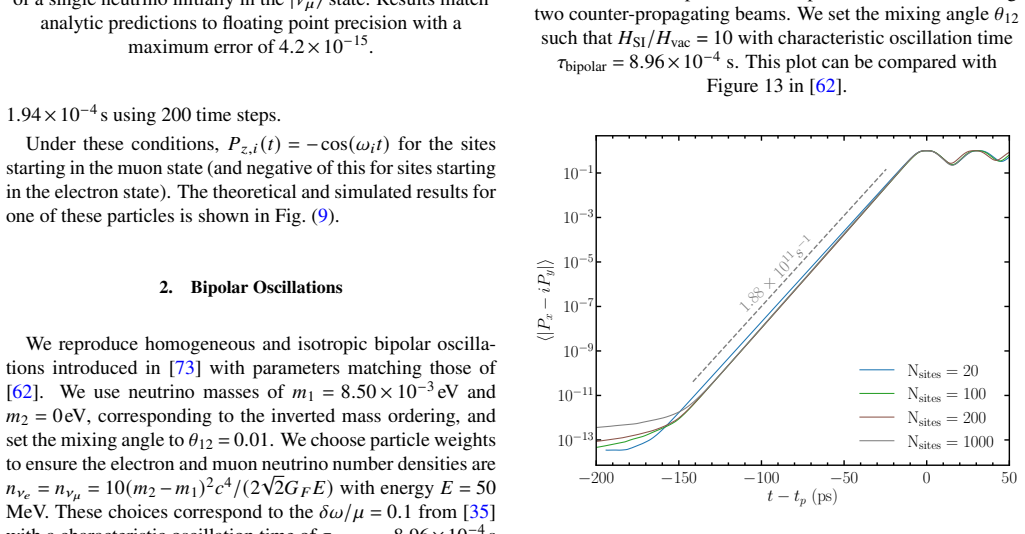
-
[1]
The Role of Inhomogeneity It is well understood that inhomogeneity allows modes of nonzero wavenumber to grow in the mean-field limit, but since the many-body depolarization is not a fast flavor insta- bility, it is natural to wonder what role inhomogeneity has in many-body depolarization. We ran a modified version of the inhomogeneous Symmetric simulatio...
-
[2]
We further explore the effect of flavor asymmetry in a two-beam model (Fig
Flavor Asymmetry So far, all of our simulations have explored the special case of a Symmetric FFI when there are equal initial numbers of electron and muon neutrinos. We further explore the effect of flavor asymmetry in a two-beam model (Fig. 4), where the number of electron neutrinos and similarly the number of electron neutrino sites is twice that of mu...
-
[3]
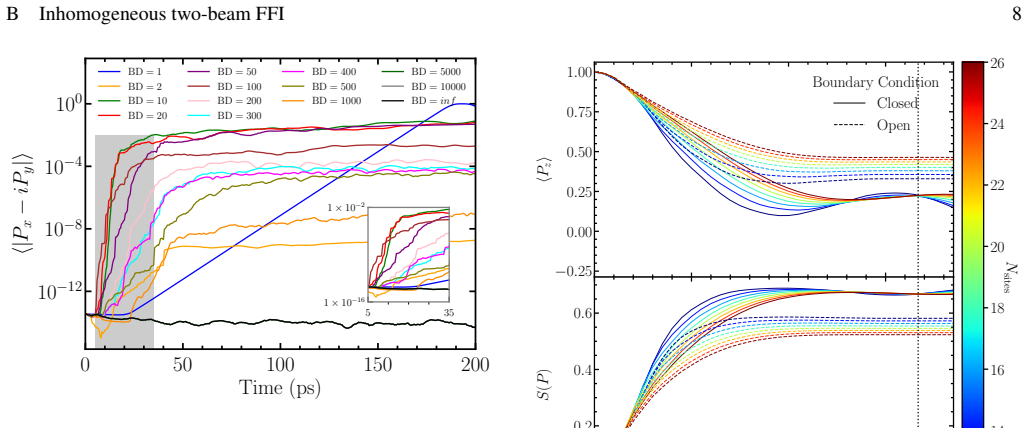
Finite Bond Dimension The infinite bond dimension calculations contain numerical errors associated with the spatial discretization and the size of the timestep, but retained all entanglement information in the quantum state. We investigate the convergence of many-body neutrino evolution simulations with respect tobond dimension (BD) in a 20-particle syste...
-
[4]
Open vs Closed systems Existing many-body (MB) studies of collective neutrino oscillations are typically constrained by closed (periodic) boundaries and idealized symmetry assumptions. To probe how these simplifications influence the dynamics, we system- atically relax each of these assumptions, beginning with the role of boundary conditions. Our first qu...
-
[5]
Superimposed vs. Separated Initial Conditions The above simulations of the MB system with open bound- ary conditions assumed that neutrinos begin superimposed with no flavor coherence or many-body entanglement. How- ever, it is not clear that this assumption is a good represen- tation of the behavior of neutrinos in astrophysical environ- ments, since neu...
-
[6]
H.-T. Janka, Explosion Mechanisms of Core-Collapse Super- novae, Annual Review of Nuclear and Particle Science62, 407 (2012)
work page 2012
-
[7]
A. Mezzacappa, P. Marronetti, R. E. Landfield, E. J. Lentz, R. D. Murphy, W. Raphael Hix, J. A. Harris, S. W. Bruenn, J. M. Blondin, O. Bronson Messer, J. Casanova, and L. L. Kro- nzer, Core collapse supernova gravitational wave emission for progenitors of 9.6, 15, and 25 Solar Masses, Physical Review D 107, 043008 (2023), publisher: American Physical Society
work page 2023
-
[8]
F. Foucart, Neutrino transport in general relativistic neutron star merger simulations, Living Reviews in Computational Astro- physics9, 1 (2023)
work page 2023
Show all 82 references
-
[9]
Burrows and D
A. Burrows and D. Vartanyan, Core-collapse supernova explo- sion theory, Nature589, 29 (2021)
2021
-
[10]
Qian and S
Y .-Z. Qian and S. E. Woosley, Nucleosynthesis in neutrino- driven winds. i. the physical conditions, Astrophys. J.471, 331 (1996)
1996
-
[11]
Wang and R
X. Wang and R. Surman, Neutrinos and heavy element nucle- osynthesis, inHandbook of Nuclear Physics(Springer, 2022) pp. 1–19
2022
-
[12]
Fischer, G
T. Fischer, G. Guo, K. Langanke, G. Martínez-Pinedo, Y .- Z. Qian, and M.-R. Wu, Neutrinos and nucleosynthesis of el- ements, Progress in Particle and Nuclear Physics , 104107 (2024)
2024
-
[13]
Wolfenstein, Neutrino oscillations in matter, inSolar neutri- nos(CRC Press, 2018) pp
L. Wolfenstein, Neutrino oscillations in matter, inSolar neutri- nos(CRC Press, 2018) pp. 294–299
2018
-
[14]
Mikheyev and A
S. Mikheyev and A. Y . Smirnov, Resonant neutrino oscilla- tions in matter, Progress in Particle and Nuclear Physics23, 41 (1989)
1989
-
[15]
Pantaleone, Neutrino oscillations at high densities, Physics Letters B287, 128 (1992)
J. Pantaleone, Neutrino oscillations at high densities, Physics Letters B287, 128 (1992)
1992
-
[16]
H. Duan, G. M. Fuller, and Y .-Z. Qian, Collective neutrino os- cillations, Annual Review of Nuclear and Particle Science60, 569 (2010)
2010
-
[17]
Tamborra and S
I. Tamborra and S. Shalgar, New developments in flavor evo- lution of a dense neutrino gas, Annual Review of Nuclear and Particle Science71, 165 (2021)
2021
-
[18]
Capozzi and N
F. Capozzi and N. Saviano, Neutrino flavor conversions in high- density astrophysical and cosmological environments, Universe 8, 94 (2022)
2022
-
[19]
Richers and M
S. Richers and M. Sen, Fast Flavor Transformations, inHand- book of Nuclear Physics(Springer, Singapore, 2022)
2022
-
[20]
Johns, S
L. Johns, S. Richers, and M.-R. Wu, Neutrino oscillations in core-collapse supernovae and neutron star mergers, Annual Re- view of Nuclear and Particle Science75(2025)
2025
-
[21]
M. C. V olpe, Neutrinos from dense environments: Flavor mech- anisms, theoretical approaches, observations, and new direc- tions, Reviews of Modern Physics96, 025004 (2024)
2024
-
[22]
R. F. Sawyer, Speed-up of neutrino transformations in a super- nova environment, Physical Review D72, 045003 (2005)
2005
-
[23]
Banerjee, A
A. Banerjee, A. Dighe, and G. Raffelt, Linearized flavor- stability analysis of dense neutrino streams, Physical Review D—Particles, Fields, Gravitation, and Cosmology84, 053013 (2011)
2011
-
[24]
Dasgupta, A
B. Dasgupta, A. Mirizzi, and M. Sen, Fast neutrino flavor con- versions near the supernova core with realistic flavor-dependent angular distributions, Journal of Cosmology and Astroparticle Physics2017(02), 019
-
[25]
D. F. Fiorillo, G. G. Raffelt, and G. Sigl, Inhomogeneous ki- netic equation for mixed neutrinos: tracing the missing energy, Physical Review Letters133, 021002 (2024)
2024
-
[26]
Shalgar and I
S. Shalgar and I. Tamborra, Breaking the symmetries in self- interacting neutrino systems: Fast conversions and directional crossings, Phys. Rev. D103, 063002 (2021)
2021
-
[27]
A. V . Patwardhan, M. J. Cervia, E. Rrapaj, P. Siwach, and A. B. Balantekin, Many-body collective neutrino oscillations: Recent developments, Handbook of nuclear physics , 1 (2022)
2022
-
[28]
Balantekin, M
A. Balantekin, M. J. Cervia, A. V . Patwardhan, E. Rrapaj, and P. Siwach, Quantum information and quantum simulation of neutrino physics, The European Physical Journal A59, 186 (2023)
2023
-
[29]
Raffelt and D
G. Raffelt and D. d. S. Seixas, Neutrino flavor pendulum in both mass hierarchies, Physical Review D—Particles, Fields, Gravi- tation, and Cosmology88, 045031 (2013)
2013
-
[30]
R. S. Hansen and S. Hannestad, Chaotic flavor evolution in an interacting neutrino gas, Physical Review D90, 025009 (2014)
2014
-
[31]
Chakraborty, R
S. Chakraborty, R. S. Hansen, I. Izaguirre, and G. Raffelt, Self-induced flavor conversion of supernova neutrinos on small scales, Journal of Cosmology and Astroparticle Physics2016 (01), 028
-
[32]
Duan and S
H. Duan and S. Shalgar, Flavor instabilities in the neutrino line model, Physics Letters B747, 139 (2015)
2015
-
[33]
Abbar, H
S. Abbar, H. Duan, S. Shalgar,et al., Flavor instabilities in the multiangle neutrino line model, Physical Review D92, 065019 (2015)
2015
-
[34]
Mangano, A
G. Mangano, A. Mirizzi, and N. Saviano, Damping the neutrino flavor pendulum by breaking homogeneity, Physical Review D 89, 073017 (2014)
2014
-
[35]
Mirizzi, G
A. Mirizzi, G. Mangano, and N. Saviano, Self-induced flavor instabilities of a dense neutrino stream in a two-dimensional model, Physical Review D92, 021702 (2015)
2015
-
[36]
N. F. Bell, A. A. Rawlinson, and R. Sawyer, Speed-up through entanglement—many-body effects in neutrino pro- cesses, Physics Letters B573, 86 (2003)
2003
-
[37]
Friedland and C
A. Friedland and C. Lunardini, Do many-particle neutrino inter- actions cause a novel coherent effect?, Journal of High Energy Physics2003, 043 (2003)
2003
-
[38]
Balantekin and Y
A. Balantekin and Y . Pehlivan, Neutrino–neutrino interactions and flavour mixing in dense matter, Journal of Physics G: Nu- clear and Particle Physics34, 47 (2006)
2006
-
[39]
A. V . Patwardhan, M. J. Cervia, E. Rrapaj, P. Siwach, and A. B. Balantekin, Many-body collective neutrino oscillations: recent developments, inHandbook of Nuclear Physics(Springer, Sin- gapore, 2023) pp. 1–16, 10.1007/978-981-15-8818-1_126-1
2023 doi
-
[40]
Roggero, Entanglement and many-body effects in collective neutrino oscillations, Physical Review D104, 103016 (2021)
A. Roggero, Entanglement and many-body effects in collective neutrino oscillations, Physical Review D104, 103016 (2021)
2021
-
[41]
Roggero, Dynamical phase transitions in models of col- lective neutrino oscillations, Physical Review D104, 123023 (2021)
A. Roggero, Dynamical phase transitions in models of col- lective neutrino oscillations, Physical Review D104, 123023 (2021)
2021
-
[42]
Roggero, E
A. Roggero, E. Rrapaj, and Z. Xiong, Entanglement and cor- relations in fast collective neutrino flavor oscillations, Physical Review D106, 043022 (2022)
2022
-
[43]
J. D. Martin, D. Neill, A. Roggero, H. Duan, and J. Carlson, Equilibration of quantum many-body fast neutrino flavor oscil- 12 lations, Physical Review D108, 123010 (2023)
2023
-
[44]
Illa and M
M. Illa and M. J. Savage, Multi-neutrino entanglement and cor- relations in dense neutrino systems, Physical Review Letters 130, 221003 (2023)
2023
-
[45]
Bhaskar, A
R. Bhaskar, A. Roggero, and M. J. Savage, Timescales in many- body fast-neutrino-flavor conversion, Physical Review C110, 045801 (2024)
2024
-
[46]
M. J. Cervia, P. Siwach, A. V . Patwardhan, A. Balantekin, S. Coppersmith, and C. W. Johnson, Collective neutrino oscil- lations with tensor networks using a time-dependent variational principle, Physical Review D105, 123025 (2022)
2022
-
[47]
Shalgar and I
S. Shalgar and I. Tamborra, Do we have enough evidence to invalidate the mean-field approximation adopted to model col- lective neutrino oscillations?, Physical Review D107, 123004 (2023)
2023
-
[48]
A. Kost, L. Johns, and H. Duan, Once-in-a-lifetime encounter models for neutrino media: From coherent oscillations to flavor equilibration, Physical Review D109, 103037 (2024)
2024
-
[49]
Johns, Neutrino many-body correlations, arXiv preprint arXiv:2305.04916 (2023)
L. Johns, Neutrino many-body correlations, arXiv preprint arXiv:2305.04916 (2023)
2023
-
[50]
Cirigliano, S
V . Cirigliano, S. Sen, and Y . Yamauchi, Neutrino many-body flavor evolution: The full hamiltonian, Physical Review D110, 123028 (2024)
2024
-
[51]
Goimil-García, S
M. Goimil-García, S. Shalgar, and I. Tamborra, Pauli blocking: Probing beyond-mean-field effects in neutrino flavor evolution, Physical Review D111, 083054 (2025)
2025
-
[52]
V olpe, D
C. V olpe, D. Väänänen, and C. Espinoza, Extended evolution equations for neutrino propagation<? format?> in astrophysical and cosmological environments, Physical Review D—Particles, Fields, Gravitation, and Cosmology87, 113010 (2013)
2013
-
[53]
M. J. Cervia, P. Siwach, A. V . Patwardhan, A. Balantekin, S. Coppersmith, and C. W. Johnson, Collective neutrino os- cillations with tensor networks using a time-dependent vari- ational principle, Physical Review D105, 10.1103/phys- revd.105.123025 (2022)
2022 doi
-
[54]
Siwach, A
P. Siwach, A. M. Suliga, and A. B. Balantekin, Entanglement in three-flavor collective neutrino oscillations, Physical Review D107, 10.1103/physrevd.107.023019 (2023)
2023 doi
-
[55]
Laraib and S
Z. Laraib and S. Richers, Many-body simulations of the fast flavor instability, arXiv preprint arXiv:2507.02040 (2025)
2025 arXiv
-
[56]
Fishman, S
M. Fishman, S. White, and E. M. Stoudenmire, The itensor soft- ware library for tensor network calculations, SciPost Physics Codebases , 004 (2022)
2022
-
[57]
Fishman, S
M. Fishman, S. White, and E. M. Stoudenmire, Codebase re- lease 0.3 for itensor, SciPost Physics Codebases , 004 (2022)
2022
-
[58]
Vidal, Efficient classical simulation of slightly entangled quantum computations, Physical review letters91, 147902 (2003)
G. Vidal, Efficient classical simulation of slightly entangled quantum computations, Physical review letters91, 147902 (2003)
2003
-
[59]
Vidal, Efficient simulation of one-dimensional quantum many-body systems, Physical review letters93, 040502 (2004)
G. Vidal, Efficient simulation of one-dimensional quantum many-body systems, Physical review letters93, 040502 (2004)
2004
-
[60]
Vidal, Classical simulation of infinite-size quantum lattice systems in one spatial dimension, Physical review letters98, 070201 (2007)
G. Vidal, Classical simulation of infinite-size quantum lattice systems in one spatial dimension, Physical review letters98, 070201 (2007)
2007
-
[61]
Verstraete, V
F. Verstraete, V . Murg, and J. I. Cirac, Matrix product states, projected entangled pair states, and variational renormalization group methods for quantum spin systems, Advances in physics 57, 143 (2008)
2008
-
[62]
Paeckel, T
S. Paeckel, T. Köhler, A. Swoboda, S. R. Manmana, U. Scholl- wöck, and C. Hubig, Time-evolution methods for matrix- product states, Annals of Physics411, 167998 (2019)
2019
-
[63]
Schollwöck, The density-matrix renormalization group in the age of matrix product states, Annals of physics326, 96 (2011)
U. Schollwöck, The density-matrix renormalization group in the age of matrix product states, Annals of physics326, 96 (2011)
2011
-
[64]
M. J. Cervia, A. V . Patwardhan, A. B. Balantekin, S. N. Cop- persmith, and C. W. Johnson, Entanglement and collective fla- vor oscillations in a dense neutrino gas, Physical Review D100, 083001 (2019)
2019
-
[65]
A. V . Patwardhan, M. J. Cervia, and A. B. Balantekin, Spectral splits and entanglement entropy in collective neutrino oscilla- tions, Physical Review D104, 123035 (2021)
2021
-
[66]
Chakraborty, R
S. Chakraborty, R. S. Hansen, I. Izaguirre, and G. G. Raffelt, Self-induced neutrino flavor conversion without flavor mixing, Journal of Cosmology and Astroparticle Physics2016(03), 042
-
[67]
Richers, D
S. Richers, D. E. Willcox, N. M. Ford, and A. Myers, Particle- in-cell simulation of the neutrino fast flavor instability, Physical Review D103, 083013 (2021)
2021
-
[68]
J. D. Martin, A. Roggero, H. Duan, J. Carlson, and V . Cirigliano, Classical and quantum evolution in a simple coherent neutrino problem, Physical Review D105, 083020 (2022)
2022
-
[69]
J. D. Martin, A. Roggero, H. Duan, and J. Carlson, Many-body neutrino flavor entanglement in a simple dynamic model, arXiv preprint arXiv:2301.07049 (2023)
2023
-
[70]
Balantekin, Quantum entanglement and neutrino many-body systems, inJournal of Physics: Conference Series, V ol
A. Balantekin, Quantum entanglement and neutrino many-body systems, inJournal of Physics: Conference Series, V ol. 2191 (IOP Publishing, 2022) p. 012004
2022
-
[71]
Rrapaj, Exact solution of multiangle quantum many-body collective neutrino-flavor oscillations, Physical Review C101, 065805 (2020)
E. Rrapaj, Exact solution of multiangle quantum many-body collective neutrino-flavor oscillations, Physical Review C101, 065805 (2020)
2020
-
[72]
Xiong, Many-body effects of collective neutrino oscillations, Physical Review D105, 103002 (2022)
Z. Xiong, Many-body effects of collective neutrino oscillations, Physical Review D105, 103002 (2022)
2022
-
[73]
Bhattacharyya and B
S. Bhattacharyya and B. Dasgupta, Fast flavor depolarization of supernova neutrinos, Physical Review Letters126, 061302 (2021)
2021
-
[74]
Izaguirre, G
I. Izaguirre, G. Raffelt, and I. Tamborra, Fast pairwise conver- sion of supernova neutrinos: A dispersion relation approach, Physical review letters118, 021101 (2017)
2017
-
[75]
R. F. Sawyer, Neutrino cloud instabilities just above the neu- trino sphere of a supernova, Physical Review Letters116, 081101 (2016)
2016
-
[76]
Padilla-Gay, H.-H
I. Padilla-Gay, H.-H. Chen, S. Abbar, M.-R. Wu, and Z. Xiong, Flavor equilibration of supernova neutrinos: Exploring the dy- namics of slow modes, Physical Review D112, 043039 (2025)
2025
-
[77]
M. J. Cervia, Interactions of neutrino wave packets, arXiv preprint arXiv:2510.22005 (2025)
2025
-
[78]
Hannestad, G
S. Hannestad, G. G. Raffelt, G. Sigl, and Y . Y . Wong, Self- induced conversion in dense neutrino gases: Pendulum in flavor space, Physical Review D74, 105010 (2006). Appendix A: Mean field tests
2006
-
[79]
We set 𝑁𝑖 =0for each site𝑖such that the self-interaction Hamiltonian is zero
Vacuum Oscillations We evolve a collection of six neutrinos, half of which start in the|𝜈 𝜇⟩state and the other half of which start in the|𝜈 𝑒⟩ state, i.e.,|Ψ 0⟩= Ë(𝑁 sites/2) 𝑛=1 | ↓⟩ ⊗ Ë(𝑁 sites/2) 𝑚=1 | ↑⟩ . We set 𝑁𝑖 =0for each site𝑖such that the self-interaction Hamiltoni...
-
[80]
We use neutrino masses of𝑚 1 =8.50×10 −3 eVand 𝑚2 =0 eV, corresponding to the inverted mass ordering, and set the mixing angle to𝜃 12 =0.01
Bipolar Oscillations We reproduce homogeneous and isotropic bipolar oscilla- tions introduced in [73] with parameters matching those of [62]. We use neutrino masses of𝑚 1 =8.50×10 −3 eVand 𝑚2 =0 eV, corresponding to the inverted mass ordering, and set the mixing angle to𝜃 12 =...
-
[81]
10: An isotropic one-zone bipolar oscillation test using two counter-propagating beams
Symmetric Fast Flavor Instability Convergence We check resolution requirements for resolving the lin- ear growth phase of the fast flavor instability and display 0 1 2 3 4 5 t/τbipolar □1.0 □0.5 0.0 0.5 1.0 Pz,i i = 1 i = 2 FIG. 10: An isotropic one-zone bipolar oscillation te...
-
[82]
In particular, we investigate whether the solver maintains the expected scaling with𝑁 sites when applied to flavor-asymmetric initial conditions in a closed, superim- posed setup
Asymmetric MF evolution and convergence behavior Building on the observed convergence of open-boundary systems toward closed-system MB behavior for superimposed configurations, we next re-assess the numerical consistency of our MF framework. In particular, we investigate wheth...
2021
Reviewed May 22, 2026 · model on record in the stance chip above.
Discussion (0). Continue with ORCID to comment.