REVIEW 4 major objections 4 minor 1 cited by
Discrete $\mu$-dichotomy spectrum: beyond uniformity and new insights
T0 review · 4 major / 4 minor · reviewed 2026-08-10 · deepseek-v4-flash
Pith's one-line read The paper proves that weak kinematic similarity does not preserve the nonuniform exponential dichotomy spectrum, refuting a recent invariance claim, and proposes new dichotomy properties and an intermediate spectrum.
desk verdict The UPP/USP material and the intermediate spectrum are genuinely new and worth reading, but the central counterexample to [12]'s spectral invariance is computed under a weaker dichotomy definition and does not refute the cited result as written. read the letter →
The pith
A machine-rendered reading of the paper's core claim, the machinery that carries it, and where it could break.
The reading
What carries the argument
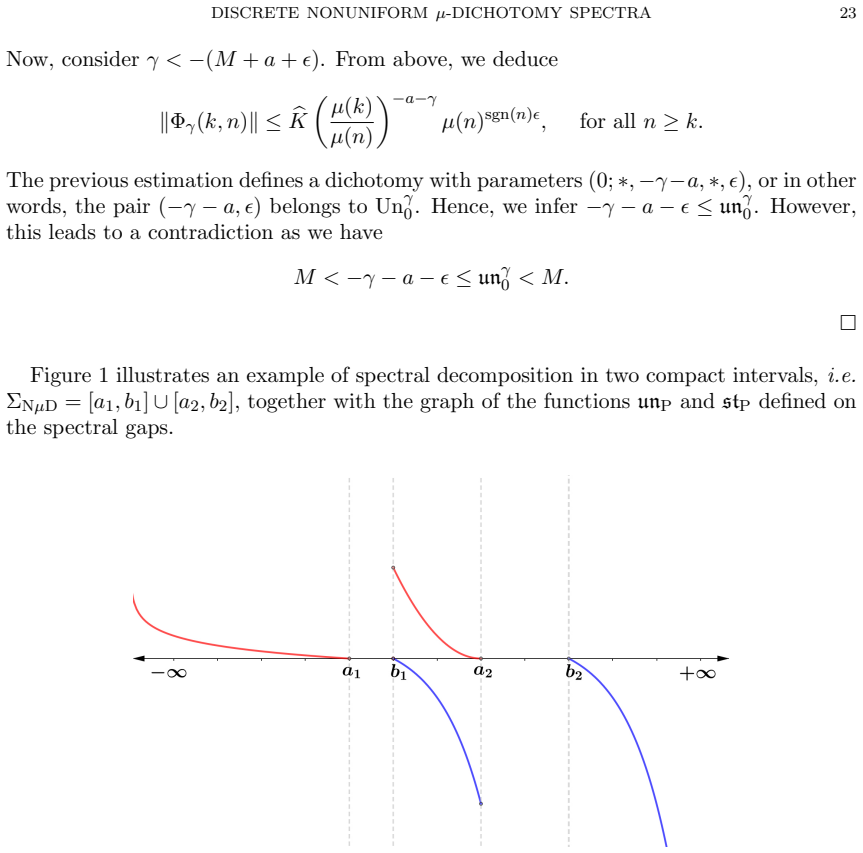
The central tools are the optimal ratio maps $\mathrm{st}_P$ and $\mathrm{un}_P$, defined on spectral gaps as the infimum of $\alpha+\theta$ and the supremum of $\beta-\nu$ over admissible dichotomy constants. These maps are decreasing and continuous and encode when nonuniformity parameters can be rebalanced across the weighted system. The counterexample uses the scalar family $x(n+1)=\exp(-\omega+a(n+1)\cos(n+1)-an\cos(n)-a\sin(n+1)+a\sin(n))\,x(n)$, with $S(n)=e^{-an}$ providing the weak kinematic equivalence. The spectral theorem for $\mathrm{N}\mu\mathrm{D}$ (Theorem 3.11) and the boundary identification given in Remark 4.11 are the load-bearing results used to read the spectrum off the optimal-ratio limits.
What would settle it
Recompute the two spectra in Example 5.8 directly from the definition of nonuniform exponential dichotomy, or verify whether the similarity $S(n)=e^{-an}$ meets the same-$\varepsilon$ condition required by the weak kinematic similarity definition: if the spectra coincide under that verification, the non-invariance claim is refuted.
Extended reading notes
Core claim
On its own terms, the paper establishes that two systems related by a weakly nondegenerate change of coordinates, the discrete analogue of nonuniform kinematic similarity, need not share the nonuniform $\mu$-dichotomy spectrum. Example 5.8 compares scalar systems whose spectra are $[-\omega-3a,\;-\omega+3a]$ and $[-\omega-2a,\;-\omega+4a]$, refuting Corollary 5.7 of [12] and its use in [31]. The mechanism is traced to optimal ratio maps: near the spectrum, the transferred dichotomy constants violate the conditions needed for the resolvent inclusion, so the error parameter of the similarity cannot be absorbed. The paper additionally argues that a spectrum defined by requiring the unique projector property, $\Sigma^{\mathrm{UPP}}_{sN\mu D}(A)$, sits strictly between the slow nonuniform and nonuniform spectra and may be the invariant object.
Load-bearing premise
The counterexample's spectra are read off using a spectral theorem and a boundary remark whose proofs are omitted, so if the theorem fails under the paper's nonuniform definition, the claimed spectra are not established.
Editorial extensions
If this is right
- Reducibility theorems that assume spectral invariance under weak kinematic similarity, such as [12, Thm. 3.11] and the normal forms result [31], lose their justification for nonuniform spectra.
- The nonuniform dichotomy spectrum is not a reliable invariant for classifying nonuniformly hyperbolic discrete systems under weak coordinate changes.
- The new intermediate spectrum $\Sigma^{\mathrm{UPP}}_{sN\mu D}(A)$, built on the unique projector property, is proposed as a candidate invariant for block diagonalization and should be tested on the same examples.
- If the USPP conjecture holds, spectral theorems for the intermediate spectrum follow; if it fails, the resolvent set may have infinitely many gaps or an ill-defined dimension map.
Reading between the lines
- Inference: the same non-invariance likely occurs in continuous time for nonuniform $(\mu,\varepsilon)$-kinematic similarity, since the mechanism is parameter rebalancing rather than discreteness.
- Inference: computing $\Sigma^{\mathrm{UPP}}_{sN\mu D}$ for the two systems in Example 5.8 would test the paper's conjecture that this spectrum is the invariant object; equality there would give a practical invariant for block diagonalization.
- Inference: the optimal ratio maps give a numerical test: scanning $\gamma$ near a spectral boundary should reveal where the transferred parameters fail the dichotomy inequalities, delimiting where resolvent inclusion breaks.
Editorial analysis
A structured set of objections, weighed in public.
Referee Report
Summary. The paper develops a spectral theory for nonautonomous linear difference systems under uniform, nonuniform, and slow nonuniform µ-dichotomies. It introduces two new properties (UPP and USP), a new 'unique projector slow nonuniform µ-dichotomy spectrum', and a conjecture (USPP) under which a spectral theorem is derived. The final section claims to refute the invariance of the nonuniform exponential dichotomy spectrum under weak kinematic similarity, previously asserted in [12] and used in [31], via a one-dimensional counterexample (Example 5.8).
Significance. If the counterexample were valid, the paper would remove a load-bearing assumption from known reducibility and normal-form results, which is a substantial contribution. The UPP/USP distinction and the intermediate spectrum are also potentially useful conceptual tools, and the explicit estimates in Examples 2.14 and 5.8 are helpful. However, the central refutation is not currently established: the counterexample is computed under a weaker definition than the one used in [12], and the spectrum computation relies on unproved spectral and optimal-ratio results. The significance of the paper therefore depends on completing or correcting these points.
major comments (4)
- [§5.2, Example 5.8 and Remark 2.5] The counterexample is computed under Definition 2.2, whose nonuniformity condition is α+θ<0, whereas [12] imposes the stricter condition α+2θ<0, as acknowledged in Remark 2.5. For the stable estimate (5.6) of the γ-weighted system one has α=−ω−γ+a and θ=2a; over the claimed interval [−ω−3a, −ω+3a], this gives α+2θ = −ω−γ+5a ≥ 2a > 0. Hence none of the γ-weighted systems in the displayed interval satisfies [12]'s condition. The sentence in Example 5.8 asserting that 'even considering α+2θ<0 ... the result is the same' is incompatible with the stated parameter range and is not proved. As written, the example does not refute [12, Cor. 5.7].
- [§3, Theorem 3.11 and Remark 4.11] Theorem 3.11 is stated without proof ('we omit the proof it and leave it as an exercise for the reader'), and Lemma 3.9 is also left as an exercise. Remark 4.11, which identifies endpoints of Σ_NµD(A) through zero limits of the optimal ratio maps, is a consequence of this unproved theorem. Example 5.8 uses exactly this endpoint identification to assert Σ_NµD(A)=[−ω−3a, −ω+3a] and Σ_NµD(B)=[−ω−2a, −ω+4a]. The spectrum computation is therefore not established by the manuscript. This is not a merely expository omission: the nonuniform definition changes the standard spectral argument, and the validity of Lemma 3.9 in this setting is part of what must be shown.
- [§5.3, Lemma 5.9 and the concluding discussion] Lemma 5.9 provides a sufficient condition, (5.9), for a resolvent point of system (1.1) to be a resolvent point of a weakly kinematically similar system. The subsequent argument only shows that this sufficient condition can fail for γ close to the spectrum of (1.1); it does not prove that such a γ is outside the resolvent of the second system. Thus the negative conclusion in Remark 5.11 rests entirely on Example 5.8. Since that example is not computed under [12]'s stricter hypotheses, the stated refutation of [12, Theorem 3.11] and its use in [31] is not supported by the present manuscript.
- [§3.2, Theorem 3.21] Theorem 3.21 is explicitly conditional on Conjecture 2.15, which is not proved. The paper is transparent about this, but the abstract and introduction present a 'spectral theorem' for the new spectrum as one of the main results. The reader should be warned more prominently that this result has the status of a conditional theorem pending an open conjecture, especially because the conjecture is also used implicitly in the discussion of the new spectrum's properties.
minor comments (4)
- [Definition 3.2] In Definition 3.2(iv), the slow nonuniform µ-resolvent set is written as 'ΣsNµD(A) = R \ ΣsNµD(A)'; the left-hand side should be ρsNµD(A).
- [Section 3 and Lemma 2.6] There are several typographical errors, including 'we omit the proof it and leave it as an exercise' before Theorem 3.11 and 'The other contention' in Lemma 2.6, which should be 'containment'.
- [Example 3.14] Example 3.14 states that the spectra for Σ_sNED and Σ^UPP_sNED are computed in Example 5.8, but Example 5.8 computes only the nonuniform exponential dichotomy spectrum; the claimed slow and UPP slow spectra are not derived there. A direct derivation or a precise pointer is needed.
- [Section 4] The text refers to 'lemma 2.21' before Definition 4.8, but no Lemma 2.21 appears in the paper; the intended reference is presumably Lemma 4.6 or another numbered result.
Circularity Check
No significant circularity: the non-invariance counterexample is computed from explicit dichotomy estimates; self-citations to [18] are not load-bearing.
full rationale
The central claim is Example 5.8, which gives explicit transition matrices, derives the bounds (5.6)-(5.7), and obtains the two spectra [−ω−3a, −ω+3a] and [−ω−2a, −ω+4a] from those bounds via the stated spectral-form theorem and optimal-ratio boundary criterion (Rem 4.11). No parameter is fitted to the target intervals, and the target equality/inequality is not inserted as an assumption; the spectra are derived endpoints, so the derivation is not circular by construction. The paper's reliance on Theorem 3.11 and Remark 4.11, whose proofs are omitted ('we omit the proof it and leave it as an exercise for the reader'), is a completeness gap rather than a self-referential reduction. Self-citations to [18] supply terminology, the optimal-ratio framework, and an analogous lemma (Lem 5.9), but the computed counterexample does not reduce to those citations, so they are not load-bearing. For the same reason, the unsupported assertion that the same non-invariance holds under [12]'s stricter α+2θ<0 condition is a correctness risk, not circularity: no step defines a prediction in terms of the data it is supposed to predict.
Assumptions & free parameters
free parameters (1)
- ω, a (Example 5.8) =
3a > ω > a
assumptions (5)
- domain assumption Discrete growth rate axioms (Def 2.1)
- domain assumption Evolution operator extension for singular A via invariant projectors (Section 2)
- domain assumption Nonuniform bounded growth (Nμ,ε)-growth (Def 3.5, used in Lem 3.7 and Section 4)
- standard math Lemma 3.9 and Theorem 3.11 (standard spectral dichotomy results) are taken as true without proof
- ad hoc to paper USPP Conjecture (Conj 2.15) and Conj 2.16
invented entities (2)
-
Unique projector slow nonuniform μ-dichotomy spectrum Σ^UPP_sNµD(A)
-
UPP and USP properties
Cite this review
Pith. "Pith review of Discrete $\mu$-dichotomy spectrum: beyond uniformity and new insights." pith.science (2026). https://pith.science/paper/UJR3GZAO
@misc{pith2026250104676,
  author       = {Pith},
  title        = {Pith review of: Discrete $\mu$-dichotomy spectrum: beyond uniformity and new insights},
  year         = {2026},
  howpublished = {\url{https://pith.science/paper/UJR3GZAO}},
  note         = {Machine review of arXiv:2501.04676}
}
abstract
We develop spectral theorems for nonautonomous linear difference systems, considering different types of $\mu$-dichotomies, both uniform and nonuniform. In the nonuniform case, intriguing scenarios emerge -- that have been employed but whose consequences have not been thoroughly explored -- which surprisingly exhibit unconventional behavior. These particular cases motivate us to introduce two novel properties of nonautonomous systems (even in the continuous-time framework), which appear to have been overlooked in the existing literature. Additionally, we introduce a new conceptualization of a nonuniform $\mu$-dichotomy spectrum, which lies between the traditional nonuniform $\mu$-dichotomy spectrum and the slow nonuniform $\mu$-dichotomy spectrum. Moreover, and this is particularly noteworthy, we propose a conjecture that enables the derivation of spectral theorems in this new setting. Finally, contrary to what has been believed in recent years, through the lens of optimal ratio maps, we show that the nonuniform exponential dichotomy spectrum is not preserved between systems that are weakly kinematically similar.
Figures
Forward citations
Cited by 1 Pith paper
-
Pugh's global linearization for the nonautonomous unbounded system with $\mu$-dichotomy via Lyapunov theory
A global topological conjugacy is established between a nonlinearly perturbed nonautonomous system and its linear part, assuming a nonuniform μ-dichotomy and a small, time-decaying Lipschitz perturbation.
Reference graph
Works this paper leans on
-
[12]
Chu, J.; Liao, F-F.; Siegmund, S.; Xia, Y.; Zhu, H.: Nonuniform dichotomy spectrum and reducibility for nonautonomous difference equations. Adv. Nonlinear Anal. 11 (2022), 369—384
work page 2022
-
[18]
A.: Spectrum invariance dilemma for nonuniformly kinematically similar sys- tems
Jara, N.; Gallegos, C. A.: Spectrum invariance dilemma for nonuniformly kinematically similar sys- tems. Math. Ann. (2024). https://doi.org/10.1007/s00208-024-02969-8
-
[31]
Journal of Function Spaces (2024), 6656183, 13 p
Song, N.: Normal forms for nonautonomous nonlinear difference systems under nonuniform dichotomy spectrum. Journal of Function Spaces (2024), 6656183, 13 p
work page 2024
-
[1]
Anagnostopoulou, V.; P¨ otzsche, C.; Rasmussen, M.: Nonautonomous Bifurcation Theory: Concepts and Tools. Springer, Cham, 2023
work page 2023
-
[2]
Barreira, L.; Dragiˇ cevi´ c, D.; Valls, C.: Nonuniform spectrum on Banach spaces. Adv. Math. 321 (2017), 547–591
work page 2017
-
[3]
Barreira, L.; Dragiˇ cevi´ c, D.; Valls, C.:Nonuniform spectrum on the half line and perturbations. Result. Math. 72 (2017), no. 1-2, 125–143
work page 2017
- [4]
-
[5]
Barreira, L.; Valls, C.: Smoothness of invariant manifolds for nonautonomous equations. Commun. Math. Phys. 59 (2005), 639–677
work page 2005
Show all 33 references
-
[6]
Barreira, L.; Valls, C.: Nonuniform exponential dichotomies and Lyapunov regularity. J. Dynam. Differential Equations 19 (2007), 215–241
2007
-
[7]
Barreira, L.; Valls, C.: Stable manifolds for nonautonomous equations without exponential dichotomy. J. Differential Equations 221 (2006), 58—90
2006
-
[8]
Lecture Notes in Mathematics 1926, Springer, Berlin, 2008
Barreira L.; Valls, C.: Stability of Nonautomous Differential Equations. Lecture Notes in Mathematics 1926, Springer, Berlin, 2008
1926
-
[9]
Bento, A.; Silva, C.: Generalized Nonuniform dichotomies and local stable manifolds. J. Dynam. Differential Equations 25 (2013),1139–1158
2013
-
[10]
Casta˜ neda,´A.; Huerta, I.: Nonuniform almost reducibility of nonautonomous linear differential equa- tions. J. Math. Anal. Appl. 485 (2020), no. 2, 123822, 22 pp
2020
-
[11]
Casta˜ neda,´A.; Jara, N.: A generalization of Siegmund’s normal forms theorem to systems with µ- dichotomies. J. Differential Equations 410 (2024), 449–480
2024
-
[13]
Chu, J.; Liao, F-F.; Siegmund, S.; Xia, Y.; Zhang, W.: Nonuniform dichotomy spectrum and reducibil- ity for nonautonomous equations. Bull. Sci. Math. 139 (2015), 538—557
2015
-
[14]
L.; Sasu, B.:On polynomial dichotomies of discrete nonautonomous systems on the half-line
Dragiˇ cevi´ c, D.; Sasu, A. L.; Sasu, B.:On polynomial dichotomies of discrete nonautonomous systems on the half-line . Carpathian J. Math. 38 (2022), no. 3, 663-680
2022
-
[15]
Dragiˇ cevi´ c, D.; Zhang, W.; Zhang, W.:Smooth linearization of nonautonomous difference equations with a nonuniform dichotomy. Math. Z. 292 (2019), no. 3-4, 1175–1193
2019
-
[16]
Dragiˇ cevi´ c, D.; Zhang, W.; Zhang, W.:Smooth linearization of nonautonomous differential equations with a nonuniform dichotomy. Proc. Lond. Math. Soc. (3) 121 (2020), no. 1, 32-50
2020
-
[17]
Annales scientifiques de l’ ´Ecole Normale Sup´ erieure, Serie 2, Volume 12, 47–88 (1883)
Floquet, G.: Sur les ´ equations diff´ erentielles lin´ eaires ` a coefficients p´ eriodiques. Annales scientifiques de l’ ´Ecole Normale Sup´ erieure, Serie 2, Volume 12, 47–88 (1883)
-
[19]
Discrete Contin
Huerta, I.: Linearization of a nonautonomous unbounded system with nonuniform contraction: a spectral approach. Discrete Contin. Dyn. Syst. 40 (2020), no. 9, 5571–5590
2020
-
[20]
E.,; Rasmussen, M.: Nonautonomous Dynamical Systems
Kloeden, P. E.,; Rasmussen, M.: Nonautonomous Dynamical Systems. Mathematical Surveys and Monographs, 176, Amer. Math. Soc., Providence, RI, 2011
2011
-
[21]
A.; Obaya, R.; Oliveira-Sousa, Alexandre N.: New notion of nonuniform exponential di- chotomy with applications to the theory of pullback and forward attractors
Langa, J. A.; Obaya, R.; Oliveira-Sousa, Alexandre N.: New notion of nonuniform exponential di- chotomy with applications to the theory of pullback and forward attractors. Nonlinearity 37 (2024), no. 10, Paper No. 105009, 41 pp
2024
-
[22]
Non- linear Anal
Naulin, R.; Pinto, M.: Dichotomies and asymptotic solutions of nonlinear differential systems. Non- linear Anal. Theory Methods Appl. 23 (1994), No. 7, 871–882
1994
-
[23]
Naulin, R.; Pinto, M.: Roughness of (h, k)-dichotomies. J. Differ. Equations 118 (1995), no. 1, 20–35
1995
-
[24]
Differential Equations and Dynamical Systems
Perko, L. Differential Equations and Dynamical Systems. Springer–Verlag, New York, 2001
2001
-
[25]
Asymptotic behavior in delay differential systems with impulse effect
Pinto, M. Asymptotic behavior in delay differential systems with impulse effect. Nonlinear Times Dig. 1 (1994), no. 2, 169–177
1994
-
[26]
Geometric Theory of Discrete Nonautonomous Dynamical Systems
P¨ otzsche, C. Geometric Theory of Discrete Nonautonomous Dynamical Systems. Lecture Notes in Math., 2002 Springer-Verlag, Berlin, 2010
2002
-
[27]
Siegmund, S.: Dichotomy spectrum for nonautonomous differential equations. J. Dynam. Differential Equations 14 (2002), 243–258
2002
-
[28]
Siegmund, S.: Reducibility of nonautonomous linear differential equations. J. London Math. Soc. (2) 65 (2002), 397—410. 30 A. CASTA ˜NEDA, C. A. GALLEGOS, AND N. JARA
2002
-
[29]
M.: Admissibility and generalized nonuniform dichotomies for discrete dynamics
Silva, C. M.: Admissibility and generalized nonuniform dichotomies for discrete dynamics. Commun. Pure Appl. Anal. 20 (2021), 3419–3443
2021
-
[30]
M.: Nonuniform µ-dichotomy spectrum and kinematic similarity
Silva, C. M.: Nonuniform µ-dichotomy spectrum and kinematic similarity. J. Differential Equations 375 (2023), 618–652
2023
-
[32]
Zhang, X.: Nonuniform dichotomy spectrum and normal forms for nonautonomous differential sys- tems. J. Funct. Anal. 267 (2014), 1889—1916
2014
-
[33]
Zhang, J; Fan, M; Yang, L.: Nonuniform (h, k, µ, ν)-dichotomy with applications to nonautonomous dynamical systems. J. Math. Anal. Appl. 452 (2017), 505—551. Universidad de Chile, UCH, F acultad de Ciencias, Departamento de Matem´aticas, Casilla 653, Santiago, Chile. Email add...
2017
Reviewed August 10, 2026 · model on record in the stance chip above.
Discussion (0). Continue with ORCID to comment.