REVIEW 3 major objections 4 minor 291 references
Unveiling Metal Mixing in a Grand-Design Spiral: A UV-optical multiphase spatially resolved study of M83
T0 review · 3 major / 4 minor · reviewed 2026-08-12 · deepseek-v4-flash
Pith's one-line read In the spiral M83, nitrogen freshly released by massive stars stays locked in the ionized gas around young clusters, showing a persistent ~1.5 dex offset from the neutral phase that does not close within 6 Myr, unlike the dwarf NGC 5253.
desk verdict Persistent ~1.5 dex nitrogen phase offset in M83 is a genuinely new result, but it rests on a strong-line Te calibration partly trained on M83 itself; worth refereeing with a required hold-out or direct Te(NII) check. read the letter →
The pith
A machine-rendered reading of the paper's core claim, the machinery that carries it, and where it could break.
The reading
What carries the argument
The load-bearing comparison is the multiphase abundance offset $Δ$(X/H) = (X/H)$_{HII}$ − (X/H)$_{HI}$, computed element by element for cospatial ionized and neutral gas. Neutral abundances come from multi-component Voigt-profile fits to HST/COS ultraviolet absorption lines (N I, S II, O I via S II, Fe II) with CLOUDY-based ionization corrections; ionized abundances come from reddening-corrected optical emission lines reduced with pyneb. Because auroral lines are undetectable in most of M83's metal-rich H II regions, the paper builds an empirical multi-zone electron-temperature calibration: linear fits, restricted to the metal-rich regime (12+log(O/H) > 8.0) and anchored on literature direct-method H II regions, that predict T$_e$(O III) from the O3N2 diagnostic, T$_e$(S III) from S3O3, and T$_e$(O II) from a combined DESIRED metallicity estimator. These predicted temperatures are what convert raw line fluxes into the ionized-phase abundances whose offsets carry the central claim.
What would settle it
Take deep optical spectra of a handful of these 18 H II regions to detect the auroral lines directly, [O III] λ4363, [N II] λ5755, and [S III] λ6312, and recompute the ionized-phase abundances with measured rather than predicted temperatures. If the direct-method temperatures are systematically higher than the empirical calibration predicts, the ionized N/H values drop and the nitrogen phase offset would fall well below 1 dex; alternatively, if deeper UV spectra reveal that the N I absorption used for neutral nitrogen is partially saturated, the neutral nitrogen abundance would rise and close the offset.
Extended reading notes
Core claim
The paper claims that in M83, nitrogen released by the current generation of massive O and B stars remains trapped in the ionized gas surrounding young clusters and does not transfer into the cold neutral gas on timescales of at least 6 Myr. The evidence is a systematic offset between neutral-phase and ionized-phase abundances: ionized gas shows N/H about 1.3–1.6 dex higher and N/O more than 1.5 dex higher than cospatial neutral gas, across all 18 clusters with no sign of closing with cluster age. Oxygen and sulphur, by contrast, show smaller and age-dependent offsets consistent with prompt core-collapse supernova enrichment on ~3–5 Myr timescales, while the ~1 dex iron offset is attributed mainly to dust depletion rather than nucleosynthesis. The authors interpret the nitrogen behaviour as a signature of feedback-regulated enrichment in a deep gravitational potential: strong stellar winds efficiently enrich the local ionized medium, but the potential well and dense interstellar medium inhibit dispersal of the enriched material into the surrounding H I reservoir, unlike in the low-mass starburst NGC 5253 where such offsets vanish within about 8 Myr.
Load-bearing premise
The ionized-phase nitrogen abundances rest on electron temperatures that were not measured but predicted from strong-line ratios calibrated on other H II regions; if those temperature predictions run systematically hot or cold for M83's specific metal-rich, high-density conditions, every ionized abundance shifts and the claimed ~1.5 dex nitrogen offset could shrink or vanish.
Editorial extensions
If this is right
- In a massive, metal-rich spiral, freshly synthesised nitrogen from massive stars remains confined to H II regions for at least ~6 Myr, so neutral-gas abundances understate the recent enrichment of the interstellar medium.
- Phase offsets of the alpha elements oxygen and sulphur grow with cluster age, consistent with core-collapse supernova enrichment appearing in the ionized phase on ~3–5 Myr timescales.
- The roughly 1 dex iron excess in ionized gas relative to neutral gas is dominated by dust depletion of iron in the cold phase rather than by nucleosynthesis, so iron phase offsets should not be read as enrichment clocks.
- The persistence of the nitrogen offset is environment-dependent: the same enrichment channel closes within ~8 Myr in the low-mass galaxy NGC 5253 but not in M83, linking chemical mixing efficiency to the depth of the galactic potential well.
- Adopting spectroscopically derived rather than photometric cluster ages shortens the inferred mixing timescale in NGC 5253 to about 8 Myr, sharpening the contrast between the dwarf and the spiral.
Reading between the lines
- If the offset really persists beyond 6 Myr, clusters in M83 at ages of ~10–30 Myr should still show elevated N/O in their ionized surroundings; observing such older clusters would test whether the confinement timescale scales with potential-well depth.
- The nitrogen missing from the neutral reservoir may reside in warm molecular gas: following the paper's own finding that the center of M83 holds mostly warm H2, a testable extension is to search for the 'missing' nitrogen in CO-dark molecular gas using infrared H2 lines.
- A corollary the authors leave implicit is that outflows from M83 should be metal-poor relative to the star-formation rate compared with dwarfs like NGC 5253, since metals stay trapped in the disk; this is testable through circumgalactic absorption-line surveys.
- The empirical multi-zone temperature calibration is a portable tool: applied to other metal-rich spirals where auroral lines are undetectable, it would allow the same multiphase comparison without direct temperature measurements, with the caveat that its accuracy depends on how well the calibration sample matches the target's physical conditions.
Editorial analysis
A structured set of objections, weighed in public.
Referee Report
Summary. This paper combines HST/COS far-UV absorption spectroscopy with cospatial VLT/MUSE and LBT/MODS optical emission-line spectroscopy for 18 young star clusters in M83 (ages ~1–6 Myr) to derive multiphase (neutral H I and ionized H II) abundances of O, S, N, and Fe. Because auroral lines are mostly undetected, the authors build and apply an empirical strong-line electron-temperature calibration (Appendix G) to compute ionized-phase abundances with pyneb. The paper's central result is a large and persistent ionized-to-neutral nitrogen offset, typically ΔN/H ≈ 1.3–1.6 dex and ΔN/O > 1.5 dex, which is interpreted as evidence that freshly produced nitrogen from massive-star winds remains in the ionized gas and does not mix into the neutral reservoir on Myr timescales. This is contrasted with NGC 5253, where such offsets shrink within ~8 Myr. The paper also reports weaker phase offsets for α-elements, an iron excess attributed to dust depletion, and radial trends that differ between the phases.
Significance. If the central nitrogen-offset claim holds, the paper provides a rare, cluster-scale empirical constraint on multiphase metal mixing in a massive, metal-rich spiral, complementing the dwarf-galaxy picture from NGC 5253 and the CLASSY survey. The study is notable for its genuinely cospatial, multi-element (O, S, N, Fe) design, for deriving stellar ages/metallicities from UV spectral fitting, and for being transparent about key limitations: auroral non-detections, the absence of depletion corrections, the exclusion of the galactic center, and the use of ionization corrections calibrated on previous M83 work. The main claim is also falsifiable in a concrete way: direct auroral measurements in five regions and older clusters can test whether the offset is real and whether it persists. These strengths outweigh, for now, the validation gaps discussed below, but those gaps need to be closed before the quantitative claim can be considered secure.
major comments (3)
- [Appendix G, Eqs. (G3)–(G6); Fig. 28] The T_e calibration is fit on literature H II regions that include Bresolin et al. (2005) M83 regions, so the quoted WRMS of 0.018–0.026 dex is an in-sample scatter, not a predictive accuracy for the metal-rich, relatively high-density M83 sightlines studied here. Because every ionized-phase abundance in Table 6 is computed from these predicted temperatures, the central ΔN/H claim in Section 5.2.1 inherits this systematic uncertainty. Since the [NII] abundance scales roughly as T^{0.5} exp(25000/T), a 20% bias in T_e(NII) at ~7000 K shifts log(N/H) by about 0.25 dex; this would not erase a 1.5 dex offset but could reduce it to ~1.2 dex and weaken the quantitative contrast with NGC 5253. Please add a leave-one-out or hold-out validation (in particular excluding all M83 calibration points) and propagate the resulting T_e systematics into the reported N/H and N/O values.
- [Section 3.3.1, Tables 5 and 9] The paper states that [NII]λ5755 is detected in five regions (M83-3, R1, R2, R7, R12), but Table 9 lists upper limits for R1, R2, and R12 in that line, and Table 5 is captioned as derived entirely from the strong-line calibration. No direct T_e(NII) from the claimed detections is compared with the G6-based predicted T_e(NII). Please reconcile the detection list, mark direct versus predicted temperatures in Table 5, and present a direct-versus-predicted T_e(NII) comparison for every region with a meaningful auroral measurement.
- [Section 5.2.1, Fig. 18] The claim that the nitrogen offset 'does not diminish with cluster age' rests on a weak, non-significant correlation (r = 0.17, p = 0.65 for ΔN/H; the N/O trends in Fig. 18 are also non-significant). With only a 1–6 Myr age baseline, the data support 'no detected decline', not 'no decline'. Please state this as a non-detection with a bounded slope or credible interval, and adjust the abstract/summary wording from 'persistent' to 'no significant evolution over the sampled ages' where that is all the data can support.
minor comments (4)
- [Abstract and Section 5.2.1] The abstract quotes 'up to ΔN/H ~ 1.5 dex', but Tables 4 and 6 imply a maximum disk offset of about 2.0 dex for M83-7 (8.07 − 6.07); please reconcile the quoted range with the tabulated values.
- [Appendix G, Eqs. (G3)–(G6)] The printed equations contain malformed bracket/comma notation (e.g., '[Te(O,III) = (0.68±0.07),O3N2 + (9.73±0.62),]'); these should be written as proper equations, and the units and axes of Figure 27 should be clarified, since the caption appears to reverse the roles of the abundance and temperature axes.
- [Section F.2] The text refers to 'M83-POS-15', which is not a target in Table 2; this appears to be a typo for M83-15 or M83-POS-2.
- [Figure 18 caption] The caption reads 'follow the same format Figure. 7' and should read 'follow the same format as Figure 7'; similar minor grammatical issues appear in a few other captions.
Circularity Check
Ionized-phase Te 'predictions' are fits on a literature sample that includes M83, and the Appendix G 'validation' is in-sample; the nitrogen offset still has independent content.
-
fitted input called prediction
[Appendix G, Eqs. G3-G6 and Figure 28; applied via Section 3.3.1 and Table 5]
"These three relations are subsequently adopted to predict T_e(OII), T_e(OIII), and T_e(SIII) for the M83 HII regions. ... To assess the performance of the derived temperature relations, we applied the predicted values of T_e(OII), T_e(OIII), and T_e(SIII) to all literature HII regions and recalculated their elemental abundances using the direct method. These abundances were then compared to the corresponding direct-method abundances reported in the literature (See Figure. 28)."
The 'literature HII regions' used for the performance test are the same sample used to build the fits: Appendix G compiles 'F. Bresolin & R. C. Kennicutt 2002; F. Bresolin et al. 2005, 2009', and Section 5.1.4 identifies Bresolin et al. (2005) as HII regions in M83. Equations G3-G6 are linear fits of Te to strong-line diagnostics; calling their outputs 'predicted Te' and then validating them on the calibration sample (Figure 28, WRMS~0.02 dex) is an in-sample test, not out-of-sample prediction. The M83 YSC ionized abundances, including N/H and N/O, are then computed with Te values read off these same fitted relations for a galaxy that contributed to the fit, so part of the quoted abundance accuracy is imported from the fit rather than demonstrated independently.
full rationale
The central nitrogen-offset claim has two legs: neutral N/H from COS absorption (Table 4) and ionized N/H from [NII]+ICF+Te (Table 6). The latter leg depends on the Appendix G strong-line temperature calibration. The calibration is built from literature HII regions including Bresolin et al. (2005), which the paper itself elsewhere uses as 'direct oxygen abundance measurements of HII regions from the M83 literature' (Section 5.1.4); the fitted relations (Eqs. G3-G6) are then applied to the M83 YSC HII regions, and the reported WRMS validation (Fig. 28) is computed on the same literature sample used for the fit. That is an in-sample 'prediction,' so the small scatter does not establish out-of-sample accuracy for M83. This is partial circularity: a Te bias of ~20% shifts ionized N/H by only ~0.25 dex, so the 1.3-1.6 dex offset is not purely an artefact; neutral N/H is directly measured, and five regions have direct [NII]5755 temperatures, though no comparison of predicted vs direct Te is shown. The O-from-S substitution in the neutral phase is disclosed ('the oxygen column density is derived directly from sulphur'), so neutral oxygen trends are not independent but this does not affect the neutral nitrogen measurement. No uniqueness theorem or ansatz is smuggled via self-citation; overlapping-author citations (Hernandez et al. 2021 CLOUDY ICFs, Hernandez et al. 2019 stellar priors) are either small corrections or prior independent results. Overall, one central 'prediction' (ionized Te, and hence the ionized abundance scale) reduces to a fit on an M83-inclusive training set, but the headline nitrogen offset retains substantial independent content, giving a score of 6.
Assumptions & free parameters
free parameters (4)
- Te(OIII) calibration slope and intercept =
0.68 +/- 0.07, 9.73 +/- 0.62
- Te(SIII) calibration slope and intercept =
0.43 +/- 0.10, 7.73 +/- 0.86
- Te(OII) calibration slope and intercept =
0.60 +/- 0.06, 9.11 +/- 0.55
- Assumed n_e floor =
100 cm^-3
assumptions (6)
- domain assumption The strong-line Te relations (Eqs G3-G6) calibrated on literature H II regions transfer to M83 H II regions, including those in the calibration sample.
- domain assumption Neutral oxygen column density can be obtained from S II using the James and Aloisi (2018) O/S technique.
- domain assumption CLOUDY photoionization ICFs from James et al. (2014) and Hernandez et al. (2021) correctly correct neutral and ionized gas column densities.
- domain assumption The COS line of sight probes neutral gas associated with each YSC environment rather than unrelated disk gas.
- standard math Case B recombination Balmer decrement applies for reddening correction of H II region lines.
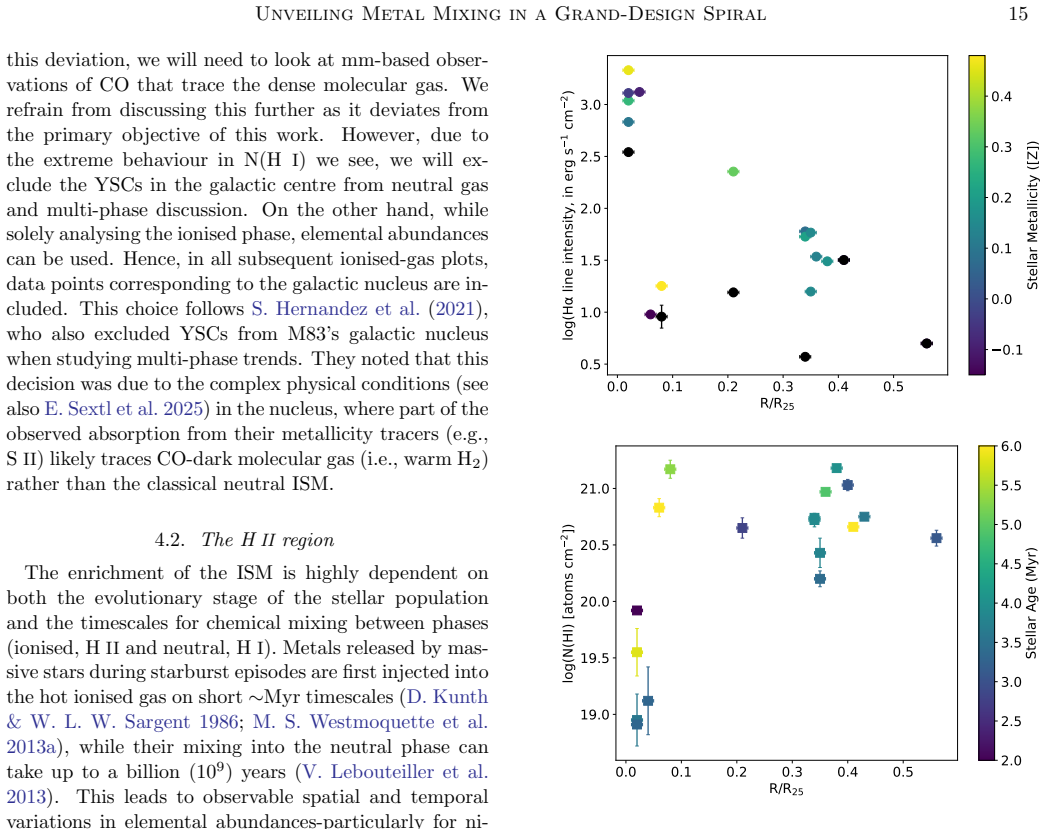
- ad hoc to paper Galactic center YSCs are excluded from neutral and multiphase analysis because H I is abnormally low.
Cite this review
Pith. "Pith review of Unveiling Metal Mixing in a Grand-Design Spiral: A UV-optical multiphase spatially resolved study of M83." pith.science (2026). https://pith.science/paper/UJRCTHMZ
@misc{pith2026260809064,
  author       = {Pith},
  title        = {Pith review of: Unveiling Metal Mixing in a Grand-Design Spiral: A UV-optical multiphase spatially resolved study of M83},
  year         = {2026},
  howpublished = {\url{https://pith.science/paper/UJRCTHMZ}},
  note         = {Machine review of arXiv:2608.09064}
}
abstract
We present a spatially resolved, multiphase study of chemical enrichment around young star clusters (YSCs) in the nearby grand-design spiral M83 by combining far-ultraviolet(UV) absorption-line spectroscopy from HST/COS with cospatial optical spectroscopy from VLT/MUSE and LBT/MODS. Our sample includes 18 YSCs spanning spectroscopic ages of ~1-6 Myr and galactocentric radii out to R/R_{25}=0.56. Neutral (H I) abundances were derived from UV absorption-line spectroscopy and compared with ionised (H II) abundances from reddening-corrected optical emission lines. Because auroral lines are not detected in all regions, we develop and apply an empirical multi-zone electron temperature (T_e) calibration based on strong-line diagnostics to estimate T_e and derive reliable nebular abundances. We measure oxygen(O), sulphur(S), nitrogen(N), and iron(Fe) abundance tracing enrichment from distinct nucleosynthetic channels. The alpha-elements (O and S) exhibit similar behaviour, consistent with enrichment by core-collapse supernovae, whereas Fe shows weaker variations, reflecting its delayed production by Type Ia supernovae. Nitrogen displays the largest phase offset (ionised-neutral), with enhancements of up to $Delta$N/H~1.5 dex and $Delta$N/O>1.5 dex in the ionised gas relative to the neutral phase, indicating localised enrichment by massive stars and inefficient mixing between gas phases on Myr timescales. While the ionised gas exhibits signatures of feedback-regulated chemical enrichment and large-scale abundance gradients, corresponding trends are weak or absent in the neutral gas, consistent with metals remaining largely confined to the immediate star-forming environment during the earliest stages of cluster evolution in a massive grand-design spiral.
Figures


Figures from the paper (21 more)




Reference graph
Works this paper leans on
-
[1]
METAL: The Metal Evolution, Transport, and Abundance in the Large Magellanic Cloud Hubble Program. III. Interstellar Depletions, Dust-to-Metal, and Dust-to-Gas Ratios versus Metallicity. , keywords =. doi:10.3847/1538-4357/ac5248 , archivePrefix =. 2202.04765 , primaryClass =
-
[2]
CHAOS. VIII. Far-ultraviolet Spectra of M101 and the Impact of Wolf─Rayet Stars. , keywords =. doi:10.3847/1538-4357/ad5292 , archivePrefix =. 2405.19477 , primaryClass =
-
[3]
The Chemical Composition of the Sun. , keywords =. doi:10.1146/annurev.astro.46.060407.145222 , archivePrefix =. 0909.0948 , primaryClass =
-
[4]
Ionization correction factors and dust depletion patterns in giant H II regions. , keywords =. doi:10.1093/mnras/stab1467 , archivePrefix =. 2105.08891 , primaryClass =
-
[5]
New empirical metallicity relations for the local and high-redshift universe
The DESIRED strong-line calibrations: I. New empirical metallicity relations for the local and high-redshift universe. arXiv e-prints , keywords =
-
[6]
The Open Journal of Astrophysics , keywords =
Sulphur abundances in star-forming regions from optical emission lines: A new approach based on photoionization models consistent with the direct method. The Open Journal of Astrophysics , keywords =. doi:10.33232/001c.151253 , archivePrefix =. 2506.14736 , primaryClass =
-
[7]
Electron temperature relations and the direct N, O, Ne, S and Ar abundances of 49959 star-forming galaxies in DESI Data Release 2. arXiv e-prints , keywords =. doi:10.48550/arXiv.2601.02463 , archivePrefix =. 2601.02463 , primaryClass =
-
[8]
Revista Mexicana de Astronomia y Astrofisica Conference Series , year = 2002, editor =
The Electron Temperature in Ionized Nebulae. Revista Mexicana de Astronomia y Astrofisica Conference Series , year = 2002, editor =. doi:10.48550/arXiv.astro-ph/0102403 , archivePrefix =. astro-ph/0102403 , primaryClass =
Show all 291 references
-
[9]
, keywords =
Comparison of two methods for determining the interstellar extinction of planetary nebulae. , keywords =
-
[10]
CLASSY. XIV. The Nitrogen Exception Multiphase Enrichment and Feedback in High-z Analogs. , keywords =. doi:10.3847/1538-4357/ae5056 , archivePrefix =. 2512.06271 , primaryClass =
-
[11]
Chemical Signatures of Metal Mixing or Enriched Gas Accretion?
Gas Metallicities in the Extended Disks of NGC 1512 and NGC 3621. Chemical Signatures of Metal Mixing or Enriched Gas Accretion?. , keywords =. doi:10.1088/0004-637X/750/2/122 , archivePrefix =. 1203.0956 , primaryClass =
-
[12]
CLusters in the UV as EngineS (CLUES). I. Survey Presentation and FUV Spectral Analysis of the Stellar Light. , keywords =. doi:10.3847/1538-3881/ac9311 , archivePrefix =. 2209.09914 , primaryClass =
-
[13]
, keywords =
Haro 11 - Untying the knots of the nuclear starburst. , keywords =. doi:10.1093/mnras/stab3774 , archivePrefix =. 2201.03585 , primaryClass =
-
[14]
, keywords =
The SAMI Galaxy Survey: Spatially resolved metallicity and ionization mapping. , keywords =. doi:10.1093/mnras/sty1782 , archivePrefix =. 1807.01522 , primaryClass =
-
[16]
, keywords =
Abundance gradients in a sample of barred spiral galaxies. , keywords =. doi:10.1051/0004-6361:20040219 , adsurl =
-
[17]
, keywords =
Interstellar Abundance Gradients in NGC 2403: Comparison to M33. , keywords =. doi:10.1086/304775 , adsurl =
-
[18]
, keywords =
Metallicities of 0.3<z<1.0 Galaxies in the GOODS-North Field. , keywords =. doi:10.1086/425299 , archivePrefix =. astro-ph/0408128 , primaryClass =
-
[19]
The TYPHOON Stellar Population Synthesis Survey. II. Pushing Full Spectral Fitting to the Limit in the Nearby Grand Design Barred Spiral M83. , keywords =. doi:10.3847/1538-4357/addec2 , archivePrefix =. 2505.21127 , primaryClass =
-
[20]
, keywords =
Characterizing Dust Attenuation in Local Star-forming Galaxies: Inclination Effects and the 2175 A Feature. , keywords =. doi:10.3847/1538-4357/aa9a43 , archivePrefix =. 1711.04814 , primaryClass =
-
[21]
, keywords =
The effects of dust on the spectral energy distribution of star-forming galaxies. , keywords =. doi:10.1016/S1387-6473(01)00144-0 , archivePrefix =. astro-ph/0008403 , primaryClass =
-
[22]
, keywords =
The Dust Attenuation Law in Galaxies. , keywords =. doi:10.1146/annurev-astro-032620-021933 , archivePrefix =. 2001.03181 , primaryClass =
2001 arXiv
-
[23]
, keywords =
Spectroscopic evolution of very massive stars at Z = 1/2.5 Z _ ☉. , keywords =. doi:10.1051/0004-6361/202243048 , archivePrefix =. 2202.13703 , primaryClass =
-
[24]
, keywords =
The Localized Chemical Pollution in NGC 5253 Revisited: Results from Deep Echelle Spectrophotometry. , keywords =. doi:10.1086/510112 , archivePrefix =. astro-ph/0609498 , primaryClass =
-
[25]
Galaxies , keywords =
Massive Star Formation in the Ultraviolet Observed with the Hubble Space Telescope. Galaxies , keywords =. doi:10.3390/galaxies8010013 , archivePrefix =. 2005.01761 , primaryClass =
2005 arXiv
-
[26]
, keywords =
Mass Loss: Its Effect on the Evolution and Fate of High-Mass Stars. , keywords =. doi:10.1146/annurev-astro-081913-040025 , archivePrefix =. 1402.1237 , primaryClass =
-
[27]
, keywords =
Optical Spectroscopy and Nebular Oxygen Abundances of the Spitzer/SINGS Galaxies. , keywords =. doi:10.1088/0067-0049/190/2/233 , archivePrefix =. 1007.4547 , primaryClass =
-
[28]
, keywords =
Integrated Nebular Abundances of Disk Galaxies. , keywords =. doi:10.1086/507570 , archivePrefix =. astro-ph/0511731 , primaryClass =
-
[29]
, keywords =
A Theoretical Recalibration of the Extragalactic H II Region Sequence. , keywords =. doi:10.1086/309538 , adsurl =
-
[30]
, keywords =
Maps of Dust Infrared Emission for Use in Estimation of Reddening and Cosmic Microwave Background Radiation Foregrounds. , keywords =. doi:10.1086/305772 , archivePrefix =. astro-ph/9710327 , primaryClass =
-
[31]
Stellar Populations - Planning for the Next Decade , year = 2010, editor =
MILES SSP Models. Stellar Populations - Planning for the Next Decade , year = 2010, editor =. doi:10.1017/S174392131000253X , adsurl =
2010 doi
-
[32]
doi:10.7910/DVN/EWCNL5 , adsurl =
SFD 1998 Map of Galactic Dust. doi:10.7910/DVN/EWCNL5 , adsurl =
1998 doi
- [33]
-
[34]
Effect of metallicity on surface abundances of O stars
X-Shooting ULLYSES: Massive stars at low metallicity: V. Effect of metallicity on surface abundances of O stars. , keywords =. doi:10.1051/0004-6361/202449457 , archivePrefix =. 2405.01267 , primaryClass =
-
[35]
, keywords =
Using H Morphology and Surface Brightness Fluctuations to Age-date Star Clusters in M83. , keywords =. doi:10.1088/0004-637X/729/2/78 , archivePrefix =. 1103.4026 , primaryClass =
-
[36]
, keywords =
The Luminosity, Mass, and Age Distributions of Compact Star Clusters in M83 Based on Hubble Space Telescope/Wide Field Camera 3 Observations. , keywords =. doi:10.1088/0004-637X/719/1/966 , archivePrefix =. 1007.5237 , primaryClass =
-
[37]
, keywords =
On the Cosmic Origins of Carbon and Nitrogen. , keywords =. doi:10.1086/309471 , archivePrefix =. astro-ph/0004299 , primaryClass =
-
[38]
Contributions of mid-infrared galaxies to the far-infrared background
The cosmic infrared background resolved by Spitzer. Contributions of mid-infrared galaxies to the far-infrared background. , keywords =. doi:10.1051/0004-6361:20054446 , archivePrefix =. astro-ph/0603208 , primaryClass =
-
[39]
, keywords =
Dust in Starburst Galaxies. , keywords =. doi:10.1086/304654 , archivePrefix =. astro-ph/9705043 , primaryClass =
-
[40]
, keywords =
The empirical metallicity dependence of the mass-loss rate of O- and early B-type stars. , keywords =. doi:10.1051/0004-6361:20077545 , archivePrefix =. 0708.2042 , primaryClass =
-
[41]
Exploring UV Diagnostics of the Interstellar Medium in Local High-z Analogs at the Dawn of the JWST Era
CLASSY IV. Exploring UV Diagnostics of the Interstellar Medium in Local High-z Analogs at the Dawn of the JWST Era. , keywords =. doi:10.3847/1538-4357/ac952c , archivePrefix =. 2209.09047 , primaryClass =
-
[42]
Payne, A. V. and others , title =. 2026 , organization =
2026
-
[43]
, keywords =
The formation of solar-neighbourhood stars in two generations separated by 5 billion years. , keywords =. doi:10.1038/s41586-018-0329-2 , archivePrefix =. 1809.02299 , primaryClass =
-
[44]
Simultaneous Estimates of Star-cluster Age, Metallicity, Mass, and Extinction (SESAMME). I. Presenting an MCMC Approach to Spectral Stellar Population Fitting. , keywords =. doi:10.3847/1538-4357/acfe0f , archivePrefix =. 2310.09365 , primaryClass =
-
[45]
10.1051/0004-6361/201322068
Astropy: A community Python package for astronomy , DOI= "10.1051/0004-6361/201322068", url= "https://doi.org/10.1051/0004-6361/201322068", journal =
-
[46]
Price-Whelan, A. M. and Sipőcz, B. M. and Günther, H. M. and Lim, P. L. and Crawford, S. M. and Conseil, S. and Shupe, D. L. and Craig, M. W. and Dencheva, N. and Ginsburg, A. and VanderPlas, J. T. and Bradley, L. D. and Pérez-Suárez, D. and de Val-Borro, M. and Aldcroft, T. L...
-
[47]
and Lim, Pey Lian and Earl, Nicholas and Starkman, Nathaniel and Bradley, Larry and Shupe, David L
The Astropy Collaboration and Price-Whelan, Adrian M. and Lim, Pey Lian and Earl, Nicholas and Starkman, Nathaniel and Bradley, Larry and Shupe, David L. and Patil, Aarya A. and Corrales, Lia and Brasseur, C. E. and Nöthe, Maximilian and Donath, Axel and Tollerud, Erik and Mor...
-
[48]
, keywords =
The Dust Content and Opacity of Actively Star-forming Galaxies. , keywords =. doi:10.1086/308692 , archivePrefix =. astro-ph/9911459 , primaryClass =
-
[49]
, keywords =
Dust depletion and abundance pattern in damped Lyalpha systems: A sample of Mn and Ti abundances at z < 2.2. , keywords =. doi:10.1051/0004-6361:20020198 , archivePrefix =. astro-ph/0202134 , primaryClass =
-
[50]
, keywords =
CLASSY XII: nitrogen enrichment shaped by gas density and feedback. , keywords =. doi:10.1093/mnras/staf1723 , archivePrefix =. 2507.11658 , primaryClass =
-
[51]
, keywords =
Core-collapse supernova subtypes in luminous infrared galaxies. , keywords =. doi:10.1051/0004-6361/202039240 , archivePrefix =. 2102.13512 , primaryClass =
-
[52]
, keywords =
Delay-time distribution of core-collapse supernovae with late events resulting from binary interaction. , keywords =. doi:10.1051/0004-6361/201629685 , archivePrefix =. 1701.07032 , primaryClass =
-
[53]
, keywords =
The Analysis of Apparent Optical Depth Profiles for Interstellar Absorption Lines. , keywords =. doi:10.1086/170498 , adsurl =
-
[54]
NGC 300 and 1365
On the composition of H II regions in southern galaxies - I. NGC 300 and 1365. , keywords =. doi:10.1093/mnras/189.1.95 , adsurl =
-
[56]
, keywords =
Multi-phase gas properties of extremely strong intervening DLAs towards quasars. , keywords =. doi:10.1051/0004-6361/202140604 , archivePrefix =. 2201.06413 , primaryClass =
-
[57]
, keywords =
Very massive stars and nitrogen-emitting galaxies. , keywords =. doi:10.1051/0004-6361/202347827 , archivePrefix =. 2310.10725 , primaryClass =
-
[58]
, keywords =
Abundances of Planetary Nebulae and Evolved Stars: Iron and Sulfur Depletion, and Carbon and Nitrogen Enrichment, in Low- and Intermediate-mass Stellar Populations in the Milky Way. , keywords =. doi:10.3847/1538-4357/ad5963 , archivePrefix =. 2407.05780 , primaryClass =
-
[59]
, keywords =
The Abundance of Interstellar Nitrogen. , keywords =. doi:10.1086/311023 , archivePrefix =. astro-ph/9710162 , primaryClass =
-
[60]
Stellar feedback in M83 as observed with MUSE. I. Overview, an unprecedented view of the stellar and gas kinematics and evidence of outflowing gas. , keywords =. doi:10.1051/0004-6361/202142315 , archivePrefix =. 2202.01738 , primaryClass =
-
[61]
Stellar feedback in M 83 as observed with MUSE. II. Analysis of the H II region population: Ionisation budget and pre-SN feedback. , keywords =. doi:10.1051/0004-6361/202243395 , archivePrefix =. 2206.09741 , primaryClass =
-
[62]
, keywords =
Better age estimation using ultraviolet-optical colours: breaking the age-metallicity degeneracy. , keywords =. doi:10.1111/j.1745-3933.2007.00370.x , archivePrefix =. astro-ph/0601050 , primaryClass =
2007
-
[63]
MNRAS , eprint =
Full spectrum fitting with photometry in PPXF: stellar population versus dynamical masses, non-parametric star formation history and metallicity for 3200 LEGA-C galaxies at redshift z 0.8. MNRAS , eprint =
-
[64]
, keywords =
Supernova Remnants in M83 as Observed with MUSE. , keywords =. doi:10.3847/1538-4357/ac5aa3 , archivePrefix =. 2202.09929 , primaryClass =
-
[65]
VizieR Online Data Catalog: SNR and HII regions in M83 observed with MUSE (Long+, 2022)
2022
-
[66]
, keywords =
An Ultraviolet Spectroscopic Atlas of Local Starbursts and Star-forming Galaxies: The Legacy of FOS and GHRS. , keywords =. doi:10.1088/0004-6256/141/2/37 , archivePrefix =. 1011.0385 , primaryClass =
-
[67]
, keywords =
Exploring chemical homogeneity in dwarf galaxies: a VLT-MUSE study of JKB 18. , keywords =. doi:10.1093/mnras/staa1280 , archivePrefix =. 2006.10768 , primaryClass =
2006 arXiv
-
[68]
I- Observations: the velocity field
Kinematics and dynamics of M 83 from H alpha interferometry. I- Observations: the velocity field. , year = 1981, month = jun, volume =
1981
-
[69]
Third Reference Catalogue of Bright Galaxies
-
[70]
, keywords =
The Extragalactic Distance Database: Color-Magnitude Diagrams. , keywords =. doi:10.1088/0004-6256/138/2/332 , archivePrefix =. 0902.3675 , primaryClass =
-
[71]
Galaxy Evolution: Emerging Insights and Future Challenges , year = 2009, editor =
The Impact of Feedback on Disk Galaxy Scaling Relations. Galaxy Evolution: Emerging Insights and Future Challenges , year = 2009, editor =. doi:10.48550/arXiv.1001.3406 , archivePrefix =. 1001.3406 , primaryClass =
-
[72]
, keywords =
Stellar Feedback in Molecular Clouds and its Influence on the Mass Function of Young Star Clusters. , keywords =. doi:10.1088/2041-8205/710/2/L142 , archivePrefix =. 0910.2238 , primaryClass =
-
[73]
, keywords =
Star Formation in Ultrafaint Dwarfs: Continuous or Single-Age Bursts?. , keywords =. doi:10.1088/2041-8205/799/2/L21 , archivePrefix =. 1501.02799 , primaryClass =
-
[74]
, year = 1998, month = jul, volume =
CLOUDY 90: Numerical Simulation of Plasmas and Their Spectra. , year = 1998, month = jul, volume =. doi:10.1086/316190 , adsurl =
1998 doi
-
[75]
, keywords =
De re metallica: the cosmic chemical evolution of galaxies. , keywords =. doi:10.1007/s00159-018-0112-2 , archivePrefix =. 1811.09642 , primaryClass =
-
[76]
, keywords =
Constraining the Metallicities, Ages, Star Formation Histories, and Ionizing Continua of Extragalactic Massive Star Populations. , keywords =. doi:10.3847/1538-4357/ab3104 , archivePrefix =. 1905.04314 , primaryClass =
1905 arXiv
-
[77]
, keywords =
LEGUS and H _ -LEGUS Observations of Star Clusters in NGC 4449: Improved Ages and the Fraction of Light in Clusters as a Function of Age. , keywords =. doi:10.3847/1538-4357/ab59e5 , archivePrefix =. 2005.02840 , primaryClass =
2005 arXiv
-
[78]
Ground-based and Airborne Instrumentation for Astronomy III , year = 2010, editor =
The multi-object double spectrographs for the Large Binocular Telescope. Ground-based and Airborne Instrumentation for Astronomy III , year = 2010, editor =. doi:10.1117/12.857215 , adsurl =
2010 doi
-
[79]
, keywords =
One Relation for All Wavelengths: The Far-ultraviolet to Mid-infrared Milky Way Spectroscopic R(V)-dependent Dust Extinction Relationship. , keywords =. doi:10.3847/1538-4357/accb59 , archivePrefix =. 2304.01991 , primaryClass =
-
[80]
, keywords =
Spectroscopic Characterization of Young Stellar Populations and Their Feedback in NGC 5253. , keywords =. doi:10.3847/1538-4357/ae75a8 , archivePrefix =. 2606.00332 , primaryClass =
-
[81]
arXiv e-prints , keywords =
CLASSY XIV: The Nitrogen Exception -- Multi-Phase Enrichment and Feedback in High- z Analogs. arXiv e-prints , keywords =
-
[82]
, keywords =
Metal enrichment of the neutral gas of blue compact dwarf galaxies: the compelling case of Pox 36. , keywords =. doi:10.1051/0004-6361:200811089 , archivePrefix =. 0812.2911 , primaryClass =
-
[83]
American Astronomical Society Meeting Abstracts \#202 , year = 2003, series =
FUSE Abundances in the Interstellar Medium of I Zw 18. American Astronomical Society Meeting Abstracts \#202 , year = 2003, series =
2003
-
[84]
, keywords =
The Cosmic Baryon and Metal Cycles. , keywords =. doi:10.1146/annurev-astro-021820-120014 , archivePrefix =. 2011.01935 , primaryClass =
2011 arXiv
-
[85]
Galaxies , keywords =
A Review of the Theory of Galactic Winds Driven by Stellar Feedback. Galaxies , keywords =. doi:10.3390/galaxies6040114 , archivePrefix =. 1811.00558 , primaryClass =
-
[86]
, keywords =
CHAOS III: Gas-phase Abundances in NGC 5457. , keywords =. doi:10.3847/0004-637X/830/1/4 , archivePrefix =. 1605.01612 , primaryClass =
-
[87]
, keywords =
The Chemical Evolution of Carbon, Nitrogen, and Oxygen in Metal-poor Dwarf Galaxies. , keywords =. doi:10.3847/1538-4357/ab020a , archivePrefix =. 1901.08160 , primaryClass =
1901 arXiv
-
[88]
, keywords =
A Window on the Earliest Star Formation: Extreme Photoionization Conditions of a High-ionization, Low-metallicity Lensed Galaxy at z 2*. , keywords =. doi:10.3847/1538-4357/aab7fa , archivePrefix =. 1803.02340 , primaryClass =
-
[89]
, keywords =
Empirical constraints on the nucleosynthesis of nitrogen. , keywords =. doi:10.1093/mnras/stad057 , archivePrefix =. 2202.04666 , primaryClass =
-
[90]
CLASSY. IX. The Chemical Evolution of the Ne, S, Cl, and Ar Elements. , keywords =. doi:10.3847/1538-4357/ad34cf , archivePrefix =. 2403.08401 , primaryClass =
-
[91]
, keywords =
Age distribution of LMC clusters from their integrated UBV colors: history of star formation. , keywords =
-
[92]
, keywords =
Detailed abundance analysis from integrated high-dispersion spectroscopy: globular clusters in the Fornax dwarf spheroidal. , keywords =. doi:10.1051/0004-6361/201219895 , archivePrefix =. 1209.1092 , primaryClass =
-
[93]
The Effects of Stellar Rotation. II. A Comprehensive Set of Starburst99 Models. , keywords =. doi:10.1088/0067-0049/212/1/14 , archivePrefix =. 1403.5444 , primaryClass =
-
[94]
, keywords =
pySTARBURST99: The Next Generation of STARBURST99. , keywords =. doi:10.3847/1538-4365/adddb6 , archivePrefix =. 2505.24841 , primaryClass =
-
[95]
, keywords =
Binary Population and Spectral Synthesis Version 2.1: Construction, Observational Verification, and New Results. , keywords =. doi:10.1017/pasa.2017.51 , archivePrefix =. 1710.02154 , primaryClass =
2017 arXiv
-
[96]
The Lives and Death-Throes of Massive Stars , year = 2017, editor =
Binary Population and Spectral Synthesis. The Lives and Death-Throes of Massive Stars , year = 2017, editor =. doi:10.1017/S1743921317003192 , adsurl =
2017 doi
-
[97]
, keywords =
PHANGS-ALMA: Arcsecond CO(2-1) Imaging of Nearby Star-forming Galaxies. , keywords =. doi:10.3847/1538-4365/ac17f3 , archivePrefix =. 2104.07739 , primaryClass =
-
[98]
, keywords =
Diverse Molecular Structures across the Whole Star-forming Disk of M83: High-fidelity Imaging at 40 pc Resolution. , keywords =. doi:10.3847/1538-4357/acc65e , archivePrefix =. 2303.12108 , primaryClass =
-
[99]
, keywords =
The Brightest Young Star Clusters in NGC 5253. , keywords =. doi:10.1088/0004-637X/811/2/75 , archivePrefix =. 1508.04476 , primaryClass =
-
[100]
, keywords =
Simulating Metal Mixing of Both Common and Rare Enrichment Sources in a Low-mass Dwarf Galaxy. , keywords =. doi:10.3847/1538-4357/ab6efc , archivePrefix =. 1909.04695 , primaryClass =
1909 arXiv
-
[101]
, keywords =
The COS Legacy Archive Spectroscopy Survey (CLASSY) Treasury Atlas. , keywords =. doi:10.3847/1538-4365/ac6c03 , archivePrefix =. 2203.07357 , primaryClass =
-
[102]
, keywords =
Stellar Populations and Star Formation History of the Metal-poor Dwarf Galaxy DDO 68. , keywords =. doi:10.3847/0004-637X/830/1/3 , archivePrefix =. 1604.06239 , primaryClass =
-
[103]
, keywords =
Metallicity gradients in small and nearby spiral galaxies. , keywords =. doi:10.1093/mnras/stz1947 , archivePrefix =. 1907.05071 , primaryClass =
1907 arXiv
-
[104]
, keywords =
O/H-N/O: the curious case of NGC 4670. , keywords =. doi:10.1093/mnras/sty402 , archivePrefix =. 1802.04797 , primaryClass =
-
[105]
, keywords =
A GMOS-N IFU study of the central H II region in the blue compact dwarf galaxy NGC 4449: kinematics, nebular metallicity and star formation. , keywords =. doi:10.1093/mnras/stx1414 , archivePrefix =. 1706.02310 , primaryClass =
-
[108]
, keywords =
Polycyclic aromatic hydrocarbon size tracers. , keywords =. doi:10.1093/mnras/stad2062 , archivePrefix =. 2307.03743 , primaryClass =
-
[109]
, keywords =
Linking Characteristics of the Polycyclic Aromatic Hydrocarbon Population with Galaxy Properties: A Quantitative Approach Using the NASA Ames PAH IR Spectroscopic Database. , keywords =. doi:10.3847/1538-4357/ac666f , archivePrefix =. 2204.05292 , primaryClass =
-
[110]
, keywords =
JWST/NIRCam Probes Young Star Clusters in the Reionization Era Sunrise Arc. , keywords =. doi:10.3847/1538-4357/acb59a , archivePrefix =. 2211.09839 , primaryClass =
-
[111]
, keywords =
Spatially Resolved Stellar Populations of 0.3 < z < 6.0 Galaxies in WHL 0137-08 and MACS 0647+70 Clusters as Revealed by JWST: How Do Galaxies Grow and Quench over Cosmic Time?. , keywords =. doi:10.3847/1538-4357/acba06 , archivePrefix =. 2301.02209 , primaryClass =
-
[112]
, keywords =
Resolved photometry of extragalactic young massive star clusters. , keywords =. doi:10.1051/0004-6361/201117185 , archivePrefix =. 1106.4560 , primaryClass =
-
[113]
, keywords =
Detecting PAHs in high-z galaxies in proxy: modelling physical conditions in an extremely strong damped Lyman absorber towards QSO SDSS J1143+1420 at z = 2.323. , keywords =. doi:10.1093/mnras/stac1290 , archivePrefix =. 2205.03088 , primaryClass =
-
[114]
Nature Astronomy , keywords =
Spitzer's perspective of polycyclic aromatic hydrocarbons in galaxies. Nature Astronomy , keywords =. doi:10.1038/s41550-020-1051-1 , archivePrefix =. 2003.10489 , primaryClass =
2003 arXiv
-
[115]
, year = 2008, month = sep, volume =
Interstellar polycyclic aromatic hydrocarbon molecules. , year = 2008, month = sep, volume =. doi:10.1146/annurev.astro.46.060407.145211 , adsurl =
2008
-
[116]
, keywords =
Exploring simulated early star formation in the context of the ultrafaint dwarf galaxies. , keywords =. doi:10.1093/mnras/sty064 , archivePrefix =. 1801.08569 , primaryClass =
-
[117]
, keywords =
Metal transport and chemical heterogeneity in early star forming systems. , keywords =. doi:10.1093/mnras/stv982 , archivePrefix =. 1408.0319 , primaryClass =
-
[118]
, keywords =
Star Clusters Across Cosmic Time. , keywords =. doi:10.1146/annurev-astro-091918-104430 , archivePrefix =. 1812.01615 , primaryClass =
-
[119]
, keywords =
The Circumgalactic Medium. , keywords =. doi:10.1146/annurev-astro-091916-055240 , archivePrefix =. 1709.09180 , primaryClass =
-
[120]
, keywords =
The fundamentally different dynamics of dust and gas in molecular clouds. , keywords =. doi:10.1093/mnras/stv2745 , archivePrefix =. 1510.02477 , primaryClass =
-
[121]
Chemical Reviews , year = 2013, month = dec, volume =
H2 Formation on Interstellar Grains. Chemical Reviews , year = 2013, month = dec, volume =. doi:10.1021/cr400156b , adsurl =
2013 doi
-
[122]
, keywords =
Dust dynamics in dense molecular cores. , keywords =. doi:10.1046/j.1365-8711.2002.05448.x , adsurl =
2002
-
[123]
, keywords =
Interpretation of Abundance Ratios. , keywords =. doi:10.1071/AS04042 , archivePrefix =. astro-ph/0409581 , primaryClass =
-
[124]
, keywords =
Forbidden Iron Lines and Dust Destruction in Supernova Remnant Shocks: The Case of N49 in the Large Magellanic Cloud. , keywords =. doi:10.3847/0004-637X/826/2/150 , archivePrefix =. 1605.02385 , primaryClass =
-
[125]
, keywords =
Metallicities of young massive clusters in NGC 5236 (M83). , keywords =. doi:10.1093/mnras/stx2397 , archivePrefix =. 1709.04466 , primaryClass =
-
[126]
, keywords =
Physical Properties of Wolf-Rayet Stars. , keywords =. doi:10.1146/annurev.astro.45.051806.110615 , archivePrefix =. astro-ph/0610356 , primaryClass =
-
[127]
, keywords =
A Comprehensive Study on the Relation between the Metal Enrichment of Ionized and Atomic Gas in Star-forming Galaxies. , keywords =. doi:10.3847/1538-4357/acd4b7 , archivePrefix =. 2301.07738 , primaryClass =
-
[128]
, keywords =
Simulating an isolated dwarf galaxy with multichannel feedback and chemical yields from individual stars. , keywords =. doi:10.1093/mnras/sty2689 , archivePrefix =. 1807.07182 , primaryClass =
-
[129]
Dust depletion of metals from local to distant galaxies. I. Peculiar nucleosynthesis effects and grain growth in the ISM. , keywords =. doi:10.1051/0004-6361/202243994 , archivePrefix =. 2207.08804 , primaryClass =
-
[131]
, keywords =
The Lyman break analogue Haro 11: spatially resolved chemodynamics with VLT FLAMES. , keywords =. doi:10.1093/mnras/stt034 , archivePrefix =. 1301.1288 , primaryClass =
-
[132]
, keywords =
The merging dwarf galaxy UM 448: chemodynamics of the ionized gas from VLT integral field spectroscopy. , keywords =. doi:10.1093/mnras/sts004 , archivePrefix =. 1209.3011 , primaryClass =
-
[133]
A JWST/MIRI View of the Interstellar Medium in M83. I. Resolved Molecular Hydrogen Properties, Star Formation, and Feedback. , keywords =. doi:10.3847/1538-4357/adce71 , archivePrefix =. 2410.09020 , primaryClass =
-
[134]
Memorie della Societa Astronomica Italiana Supplementi , keywords =
Chemical evolution of galaxies and GRB cosmic rate. Memorie della Societa Astronomica Italiana Supplementi , keywords =
-
[135]
, keywords =
Optical Spectroscopy of Metal-rich H II Regions and Circumnuclear Hot Spots in M83 and NGC 3351. , keywords =. doi:10.1086/340371 , archivePrefix =. astro-ph/0202383 , primaryClass =
-
[136]
, keywords =
Young Stars and Ionized Nebulae in M83: Comparing Chemical Abundances at High Metallicity. , keywords =. doi:10.3847/0004-637X/830/2/64 , archivePrefix =. 1607.06840 , primaryClass =
-
[137]
, keywords =
The Flat Oxygen Abundance Gradient in the Extended Disk of M83. , keywords =. doi:10.1088/0004-637X/695/1/580 , archivePrefix =. 0901.1127 , primaryClass =
-
[138]
, keywords =
Mapping Multiphase Metals in Star-forming Galaxies: A Spatially Resolved UV+Optical Study of NGC 5253. , keywords =. doi:10.3847/1538-4357/ad5e79 , archivePrefix =. 2406.16553 , primaryClass =
-
[139]
, keywords =
Newly Improved Ionization Corrections for the Neutral Interstellar Medium: Enabling Accurate Abundance Determinations in Star-forming Galaxies throughout the Universe. , keywords =. doi:10.3847/1538-4357/ab77c6 , archivePrefix =. 2002.07831 , primaryClass =
-
[140]
Characterizing Extreme Emission-line Galaxies. I. A Four-zone Ionization Model for Very High-ionization Emission. , keywords =. doi:10.3847/1538-4357/ac141b , archivePrefix =. 2105.12765 , primaryClass =
-
[141]
, keywords =
The Origin of Elements from Carbon to Uranium. , keywords =. doi:10.3847/1538-4357/abae65 , archivePrefix =. 2008.04660 , primaryClass =
2008 arXiv
-
[142]
, keywords =
Detection of Wolf-Rayet Stars of WN and WC Subtypes in Super--Star Clusters of NGC 5253. , keywords =. doi:10.1086/310659 , archivePrefix =. astro-ph/9703087 , primaryClass =
-
[143]
, keywords =
Chemical enrichment and physical conditions in I Zw 18. , keywords =. doi:10.1051/0004-6361/201220948 , archivePrefix =. 1302.4746 , primaryClass =
-
[144]
, year = 2013, month = jul, volume =
Astrophysics: How to catch a galactic wind. , year = 2013, month = jul, volume =. doi:10.1038/499416a , adsurl =
2013 doi
-
[145]
, keywords =
Piecing together the puzzle of NGC 5253: abundances, kinematics and WR stars. , keywords =. doi:10.1051/0004-6361/201220580 , archivePrefix =. 1212.2385 , primaryClass =
-
[146]
, keywords =
Spatially resolved kinematics of the multi-phase interstellar medium in the inner disc of M82. , keywords =. doi:10.1093/mnras/sts154 , adsurl =
-
[147]
, keywords =
I ZW 18 and the Existence of Very Metal Poor Blue Compact Dwarf Galaxies. , keywords =. doi:10.1086/163828 , adsurl =
-
[148]
, keywords =
JWST/NIRSpec insights into the circumnuclear region of Arp 220: A detailed kinematic study. , keywords =. doi:10.1051/0004-6361/202451442 , archivePrefix =. 2407.08505 , primaryClass =
-
[149]
, keywords =
Theory and Observation of Winds from Star-Forming Galaxies. , keywords =. doi:10.1146/annurev-astro-041224-011924 , archivePrefix =. 2406.08561 , primaryClass =
-
[150]
, keywords =
Physical properties and evolutionary state of the Lyman alpha emitting starburst galaxy IRAS 08339+6517. , keywords =. doi:10.1051/0004-6361/201323069 , archivePrefix =. 1403.7687 , primaryClass =
-
[151]
, keywords =
A ghostly damped Ly system revealed by metal absorption lines. , keywords =. doi:10.1093/mnrasl/slw233 , archivePrefix =. 1611.05421 , primaryClass =
-
[152]
, keywords =
M31* and its circumnuclear environment. , keywords =. doi:10.1111/j.1365-2966.2009.14918.x , archivePrefix =. 0902.3847 , primaryClass =
2009
-
[153]
, keywords =
JWST/MIRI Detection of [Ne v] and [Ne VI] in M83: Evidence for the Long Sought-after Active Galactic Nucleus?. , keywords =. doi:10.3847/1538-4357/adba5d , archivePrefix =. 2502.17621 , primaryClass =
-
[154]
, keywords =
Dissecting the Mid-infrared Heart of M83 with JWST. , keywords =. doi:10.3847/1538-4357/acc837 , archivePrefix =. 2301.09582 , primaryClass =
-
[155]
, keywords =
The First Metallicity Study of M83 Using the Integrated UV Light of Star Clusters. , keywords =. doi:10.3847/1538-4357/ab017a , archivePrefix =. 1901.08063 , primaryClass =
1901 arXiv
-
[156]
, keywords =
Electron Temperature Variations and the Measurement of Nebular Abundances. , keywords =. doi:10.1086/116146 , adsurl =
-
[157]
, keywords =
Investigating the Drivers of Electron Temperature Variations in H II Regions with Keck-KCWI and VLT-MUSE. , keywords =. doi:10.3847/1538-4357/ad303c , archivePrefix =. 2309.17440 , primaryClass =
-
[158]
A VLT study of metal-rich extragalactic H II regions. I. Observations and empirical abundances. , keywords =. doi:10.1051/0004-6361:20053369 , archivePrefix =. astro-ph/0506088 , primaryClass =
-
[159]
, keywords =
Understanding Galaxy Evolution Through Emission Lines. , keywords =. doi:10.1146/annurev-astro-081817-051832 , archivePrefix =. 1910.09730 , primaryClass =
1910 arXiv
-
[160]
PyNeb: Analysis of emission lines
-
[161]
, keywords =
Gas-phase Fe/O and Fe/N abundances in star-forming regions: Relations between nucleosynthesis, metallicity, and dust. , keywords =. doi:10.1051/0004-6361/202450928 , archivePrefix =. 2408.06215 , primaryClass =
-
[162]
, keywords =
Heavy Element Abundances in a New Sample of Low-Metallicity Blue Compact Galaxies. , keywords =. doi:10.1086/175676 , adsurl =
-
[163]
, keywords =
The [Fe IV] Discrepancy: Constraining the Iron Abundances in Nebulae. , keywords =. doi:10.1086/429958 , archivePrefix =. astro-ph/0504131 , primaryClass =
-
[164]
, keywords =
A grid of model HII regions for extragalactic studies. , keywords =
-
[165]
, keywords =
Iron abundance in H II regions. , keywords =. doi:10.1051/0004-6361:20011823 , archivePrefix =. astro-ph/0203394 , primaryClass =
-
[166]
, keywords =
The chemical composition of metal-poor emission-line galaxies in the Data Release 3 of the Sloan Digital Sky Survey. , keywords =. doi:10.1051/0004-6361:20053763 , archivePrefix =. astro-ph/0511644 , primaryClass =
-
[167]
, keywords =
DUNE: Dust depletion UNified method across cosmic time and Environments. , keywords =. doi:10.1051/0004-6361/202451488 , archivePrefix =. 2410.06155 , primaryClass =
-
[168]
Dust depletion of metals from local to distant galaxies. II. Cosmic dust-to-metal ratio and dust composition. , keywords =. doi:10.1051/0004-6361/202347171 , archivePrefix =. 2310.07709 , primaryClass =
- [169]
-
[170]
, keywords =
First Cospatial Comparison of Stellar, Neutral-gas, and Ionized-gas Metallicities in a Metal-rich Galaxy: M83. , keywords =. doi:10.3847/1538-4357/abd6c4 , archivePrefix =. 2012.12933 , primaryClass =
2012 arXiv
-
[171]
Investigating Nearby Star-forming Galaxies in the Ultraviolet with HST/COS Spectroscopy. I. Spectral Analysis and Interstellar Abundance Determinations. , keywords =. doi:10.1088/0004-637X/795/2/109 , archivePrefix =. 1408.4420 , primaryClass =
-
[172]
, keywords =
Tackling the Saturation of Oxygen: The Use of Phosphorus and Sulfur as Proxies within the Neutral Interstellar Medium of Star-forming Galaxies. , keywords =. doi:10.3847/1538-4357/aa9ffb , adsurl =
-
[173]
, keywords =
The Distribution of Thermal Pressures in the Interstellar Medium from a Survey of C I Fine-Structure Excitation. , keywords =. doi:10.1086/323326 , archivePrefix =. astro-ph/0107177 , primaryClass =
-
[174]
The Distribution of Thermal Pressures in the Diffuse, Cold Neutral Medium of Our Galaxy. II. An Expanded Survey of Interstellar C I Fine-structure Excitations. , keywords =. doi:10.1088/0004-637X/734/1/65 , archivePrefix =. 1104.2323 , primaryClass =
-
[175]
, keywords =
The Nature of Ionized Gas in the Milky Way Galactic Fountain. , keywords =. doi:10.3847/1538-4357/ab54cf , archivePrefix =. 1904.11014 , primaryClass =
1904 arXiv
-
[176]
, year = 2005, month = sep, volume =
The Three-Phase Interstellar Medium Revisited. , year = 2005, month = sep, volume =. doi:10.1146/annurev.astro.43.072103.150615 , adsurl =
2005 arXiv
-
[177]
Reviews of Modern Physics , keywords =
The interstellar environment of our galaxy. Reviews of Modern Physics , keywords =. doi:10.1103/RevModPhys.73.1031 , archivePrefix =. astro-ph/0106359 , primaryClass =
-
[178]
, keywords =
The Star Formation Rate Efficiency of Neutral Atomic-dominated Hydrogen Gas in the Outskirts of Star-forming Galaxies from z -0.5ex 1 to z -0.5ex 3. , keywords =. doi:10.3847/0004-637X/825/2/87 , archivePrefix =. 1604.08597 , primaryClass =
-
[179]
A new comprehensive set of elemental abundances in DLAs. III. Star formation histories. , keywords =. doi:10.1051/0004-6361:20077050 , archivePrefix =. 0705.1650 , primaryClass =
-
[180]
, keywords =
Spectroscopic Target Selection in the Sloan Digital Sky Survey: The Quasar Sample. , keywords =. doi:10.1086/340187 , archivePrefix =. astro-ph/0202251 , primaryClass =
-
[181]
, keywords =
HD 62542: Probing the Bare, Dense Core of a Translucent Interstellar Cloud. , keywords =. doi:10.3847/1538-4357/ab8f8e , archivePrefix =. 2005.10846 , primaryClass =
2005 arXiv
-
[182]
, keywords =
Accurate Oscillator Strengths for Interstellar Ultraviolet Lines of CL i. , keywords =. doi:10.1086/172484 , adsurl =
-
[183]
, keywords =
Estimating stellar birth radii and the time evolution of Milky Way's ISM metallicity gradient. , keywords =. doi:10.1093/mnras/sty2033 , archivePrefix =. 1804.06856 , primaryClass =
- [185]
-
[186]
, keywords =
On the dust properties of high-redshift molecular clouds and the connection to the 2175 A extinction bump. , keywords =. doi:10.1093/mnras/stz1012 , archivePrefix =. 1904.04301 , primaryClass =
1904 arXiv
-
[187]
SF2A-2016: Proceedings of the Annual meeting of the French Society of Astronomy and Astrophysics , year = 2016, editor =
WEAVE-QSO: A Massive Intergalactic Medium Survey for the William Herschel Telescope. SF2A-2016: Proceedings of the Annual meeting of the French Society of Astronomy and Astrophysics , year = 2016, editor =
2016
-
[188]
Research Notes of the American Astronomical Society , keywords =
Preliminary Target Selection for the DESI Quasar (QSO) Sample. Research Notes of the American Astronomical Society , keywords =. doi:10.3847/2515-5172/abc01a , archivePrefix =. 2010.11280 , primaryClass =
2010 arXiv
-
[189]
Astronomische Nachrichten , keywords =
Filling factors and scale heights of the diffuse ionized gas in the Milky Way. Astronomische Nachrichten , keywords =. doi:10.1002/asna.200510488 , archivePrefix =. astro-ph/0511172 , primaryClass =
-
[190]
, keywords =
Keck and VLT Observations of Super-Damped Lyman-Alpha Absorbers at z 2- 2.5: Constraints on Chemical Compositions and Physical Conditions. , keywords =. doi:10.1088/0004-637X/815/1/24 , archivePrefix =. 1510.05342 , primaryClass =
-
[191]
Term values and transition probabilities of VUV electronic bands
Theoretical calculations of excited rovibrational levels of HD. Term values and transition probabilities of VUV electronic bands. , keywords =. doi:10.1051/0004-6361:20053694 , adsurl =
-
[192]
, keywords =
Extreme-ultraviolet laser metrology of OI transitions. , keywords =. doi:10.1111/j.1745-3933.2008.00507.x , adsurl =
2008
-
[193]
Molecular Physics , volume=
Accurate level energies in the EF1'Y , author=. Molecular Physics , volume=. 2010 , publisher=
2010
-
[194]
Atomic Physics with the Goddard High-Resolution Spectrograph on the Hubble Space Telescope. II. Oscillator Strengths for Singly Ionized Iron. , keywords =. doi:10.1086/176299 , adsurl =
-
[195]
, keywords =
Isotopically resolved calibration of the 285-nm MgI resonance line for comparison with quasar absorptions. , keywords =. doi:10.1111/j.1745-3933.2006.00239.x , adsurl =
2006
-
[196]
, keywords =
The ratio of the C IV 1548,1550 rest-wavelengths from high-redshift QSO absorption lines. , keywords =. doi:10.1051/0004-6361:20041030 , adsurl =
-
[197]
Astrophysics and Space Science Proceedings , keywords =
Atomic Transition Frequencies, Isotope Shifts, and Sensitivity to Variation of the Fine Structure Constant for Studies of Quasar Absorption Spectra. Astrophysics and Space Science Proceedings , keywords =. doi:10.1007/978-3-642-19397-2\_2 , archivePrefix =. 1011.4136 , primaryClass =
-
[198]
, keywords =
Possible Signatures of a Cold-flow Disk from MUSE Using a z 1 Galaxy-Quasar Pair toward SDSS J1422-0001. , keywords =. doi:10.3847/0004-637X/820/2/121 , archivePrefix =. 1601.07567 , primaryClass =
-
[200]
, keywords =
The size distribution of interstellar grains. , keywords =. doi:10.1086/155591 , adsurl =
-
[201]
, keywords =
On the Incidence of Strong Mg II Absorbers along Gamma-Ray Burst Sight Lines. , keywords =. doi:10.1086/508061 , archivePrefix =. astro-ph/0605075 , primaryClass =
-
[202]
, keywords =
Velocity-metallicity correlation for high-z DLA galaxies: evidence of a mass-metallicity relation?. , keywords =. doi:10.1051/0004-6361:20054242 , archivePrefix =. astro-ph/0606185 , primaryClass =
-
[203]
, keywords =
A sample of galaxies giving rise to Mg II quasar absorption systems. , keywords =
-
[204]
, keywords =
MG II Absorption in the Spectra of 103 QSOs: Implications for the Evolution of Gas in High-Redshift Galaxies. , keywords =. doi:10.1086/191660 , adsurl =
-
[205]
, year = 2007, month = feb, volume =
Are strong Mg II absorbers the signature of outflows?. , year = 2007, month = feb, volume =. doi:10.1016/j.newar.2006.11.050 , adsurl =
2007 doi
-
[207]
, keywords =
A Far Ultraviolet Spectroscopic Explorer Survey of Interstellar Molecular Hydrogen in Translucent Clouds. , keywords =. doi:10.1086/342146 , archivePrefix =. astro-ph/0205415 , primaryClass =
-
[208]
, keywords =
Oxygen abundances in the Galactic bulge: evidence for fast chemical enrichment. , keywords =. doi:10.1051/0004-6361:20065659 , archivePrefix =. astro-ph/0609052 , primaryClass =
-
[209]
, keywords =
The metallicity distribution of bulge clump giants in Baade's window. , keywords =. doi:10.1051/0004-6361/200913757 , archivePrefix =. 1107.5199 , primaryClass =
-
[210]
Astrophysics and Space Science Supplement , keywords =
From Stellar Spectra to Abundances. Astrophysics and Space Science Supplement , keywords =. doi:10.1023/A:1012737307383 , adsurl =
-
[211]
Observations of O VI and N V absorption in damped Lyman- systems
Hot halos around high redshift protogalaxies. Observations of O VI and N V absorption in damped Lyman- systems. , keywords =. doi:10.1051/0004-6361:20066157 , archivePrefix =. astro-ph/0701392 , primaryClass =
-
[212]
, keywords =
The evolution of neutral gas in damped Lyman systems from the XQ-100 survey. , keywords =. doi:10.1093/mnras/stv2732 , archivePrefix =. 1511.05003 , primaryClass =
-
[213]
, keywords =
The neutral hydrogen cosmological mass density at z = 5. , keywords =. doi:10.1093/mnras/stv1182 , archivePrefix =. 1506.02037 , primaryClass =
-
[214]
, keywords =
A study of the circumgalactic medium at z 0.6 using damped Lyman galaxies. , keywords =. doi:10.1093/mnras/stw1965 , archivePrefix =. 1609.03843 , primaryClass =
-
[215]
Three additional detections
A SINFONI integral field spectroscopy survey for galaxy counterparts to damped Lyman systems - III. Three additional detections. , keywords =. doi:10.1111/j.1365-2966.2011.19947.x , archivePrefix =. 1110.0666 , primaryClass =
2011
-
[216]
, keywords =
Spatially resolved metal gas clouds. , keywords =. doi:10.1093/mnrasl/sly090 , archivePrefix =. 1805.07192 , primaryClass =
-
[217]
Damped Lyman-Alpha Absorption by Disk Galaxies with Large Redshifts. I. The Lick Survey. , keywords =. doi:10.1086/191114 , adsurl =
-
[218]
, keywords =
High-resolution observations of the interstellar lambda 3302 NA I doublet and a discussion of the resulting NaI/Ca II ratios. , keywords =. doi:10.1093/mnras/259.1.47 , adsurl =
-
[219]
, keywords =
The nitrogen and oxygen abundances in the neutral gas at high redshift. , keywords =. doi:10.1051/0004-6361:20078607 , archivePrefix =. 0712.2760 , primaryClass =
-
[220]
Stellar evolution with rotation. VIII. Models at Z = 10 ^ -5 and CNO yields for early galactic evolution. , keywords =. doi:10.1051/0004-6361:20020755 , archivePrefix =. astro-ph/0205370 , primaryClass =
-
[221]
, keywords =
New synthesis models of consistent extragalactic background light over cosmic time. , keywords =. doi:10.1093/mnras/stz174 , archivePrefix =. 1801.09693 , primaryClass =
-
[222]
Radiative Transfer in a Clumpy Universe. IV. New Synthesis Models of the Cosmic UV/X-Ray Background. , keywords =. doi:10.1088/0004-637X/746/2/125 , archivePrefix =. 1105.2039 , primaryClass =
-
[223]
Mg II Absorption at 2 < z < 6 with Magellan\/FIRE. II. A Longitudinal Study of H I, Metals, and Ionization in Galactic Halos. , keywords =. doi:10.1088/0004-637X/764/1/9 , archivePrefix =. 1207.2470 , primaryClass =
-
[224]
The MUSE Hubble Ultra Deep Field Survey. XII. Mg II emission and absorption in star-forming galaxies. , keywords =. doi:10.1051/0004-6361/201833281 , archivePrefix =. 1806.01864 , primaryClass =
-
[225]
, keywords =
Molecular Hydrogen in the Far Ultraviolet Spectroscopic Explorer Translucent Lines of Sight: The Full Sample. , keywords =. doi:10.1088/0067-0049/180/1/125 , adsurl =
-
[226]
, keywords =
Multicomponent H _ 2 in DLA at z _ abs = 2.05: physical conditions through observations and numerical models. , keywords =. doi:10.1093/mnras/sty2321 , archivePrefix =. 1808.07906 , primaryClass =
-
[227]
, keywords =
Physical conditions in two high-redshift H _ 2 -bearing GRB-DLAs, 120815A and 121024A. , keywords =. doi:10.1093/mnras/staa638 , archivePrefix =. 2003.00453 , primaryClass =
2003 arXiv
-
[228]
, keywords =
Physical conditions in three high-z H _ 2 -bearing DLAs: implications for grain size. , keywords =. doi:10.1093/mnras/stw788 , archivePrefix =. 1604.01523 , primaryClass =
-
[229]
, keywords =
Molecular Hydrogen in Star-forming Regions: Implementation of its Microphysics in CLOUDY. , keywords =. doi:10.1086/429215 , archivePrefix =. astro-ph/0501485 , primaryClass =
-
[230]
, keywords =
The 2017 Release Cloudy. , keywords =
2017
-
[231]
, keywords =
The 2013 Release of Cloudy. , keywords =
2013
-
[232]
, keywords =
Evidence for dust reddening in damped Ly absorbers identified through CaII (H&K) absorption. , keywords =. doi:10.1111/j.1745-3933.2005.00058.x , archivePrefix =. astro-ph/0505038 , primaryClass =
2005
-
[234]
, keywords =
Ca II absorbers in the Sloan Digital Sky Survey: element abundances and dust. , keywords =. doi:10.1093/mnras/stv1506 , archivePrefix =. 1504.02029 , primaryClass =
-
[235]
, keywords =
Ca II absorbers in the Sloan Digital Sky Survey: statistics. , keywords =. doi:10.1093/mnras/stu1554 , archivePrefix =. 1404.2649 , primaryClass =
-
[236]
, keywords =
Measurements of CaII absorption, metals and dust in a sample of z -0.5ex = 1 DLAs and subDLAs. , keywords =. doi:10.1111/j.1365-2966.2008.13857.x , archivePrefix =. 0808.2470 , primaryClass =
2008
-
[237]
, keywords =
Calcium H&K and sodium D absorption induced by the interstellar and circumgalactic media of the Milky Way. , keywords =. doi:10.1093/mnras/stv1277 , archivePrefix =. 1503.02697 , primaryClass =
-
[238]
Dust depletions and reddening at z -0.5ex 1
Selecting damped Lyman systems through CaII absorption - I. Dust depletions and reddening at z -0.5ex 1. , keywords =. doi:10.1111/j.1365-2966.2005.09935.x , archivePrefix =. astro-ph/0512042 , primaryClass =
2005
-
[239]
, keywords =
Metallicity Evolution of Damped Ly Galaxies. , keywords =. doi:10.1086/343855 , archivePrefix =. astro-ph/0207661 , primaryClass =
-
[240]
, keywords =
Damped Ly Absorber at High Redshift: Large Disks or Galactic Building Blocks?. , keywords =. doi:10.1086/305323 , archivePrefix =. astro-ph/9706201 , primaryClass =
-
[241]
Paucity of strong molecular hydrogen absorption
The Magellan uniform survey of damped Lyman systems - II. Paucity of strong molecular hydrogen absorption. , keywords =. doi:10.1093/mnras/stu1314 , archivePrefix =. 1407.1111 , primaryClass =
-
[242]
On the deficiency of argon in DLA systems
The ESO UVES Advanced Data Products Quasar Sample - IV. On the deficiency of argon in DLA systems. , keywords =. doi:10.1093/mnras/stu1904 , archivePrefix =. 1409.4577 , primaryClass =
-
[243]
, keywords =
The Fractional Ionization of the Warm Neutral Interstellar Medium. , keywords =. doi:10.1088/0004-637X/764/1/25 , archivePrefix =. 1301.3144 , primaryClass =
-
[244]
, keywords =
Interstellar Medium Absorption Profile Spectrograph Observations of Interstellar Neutral Argon and the Implications for Partially Ionized Gas. , keywords =. doi:10.1086/305684 , archivePrefix =. astro-ph/9712260 , primaryClass =
-
[245]
, keywords =
Extinction and metal column density of HI regions up to redshift z ≃ 2. , keywords =. doi:10.1051/0004-6361:20054742 , archivePrefix =. astro-ph/0604296 , primaryClass =
-
[246]
, keywords =
X-shooter observations of strong H _ 2 -bearing DLAs at high redshift. , keywords =. doi:10.1093/mnras/stz2707 , archivePrefix =. 1909.11064 , primaryClass =
1909 arXiv
-
[247]
, year = 1996, month = jan, volume =
Interstellar Abundances from Absorption-Line Observations with the Hubble Space Telescope. , year = 1996, month = jan, volume =. doi:10.1146/annurev.astro.34.1.279 , adsurl =
1996 doi
-
[248]
, keywords =
The Chemistry of Interstellar Molecules Containing the Halogen Elements. , keywords =. doi:10.1088/0004-637X/706/2/1594 , archivePrefix =. 0910.1927 , primaryClass =
1927 arXiv
-
[249]
, keywords =
A Unified Representation of Gas-Phase Element Depletions in the Interstellar Medium. , keywords =. doi:10.1088/0004-637X/700/2/1299 , archivePrefix =. 0905.3173 , primaryClass =
-
[250]
, keywords =
The abundance of interstellar chlorine in the galaxy. , keywords =. doi:10.1093/mnras/208.4.941 , adsurl =
-
[251]
, keywords =
Abundances of Interstellar Atoms from Ultraviolet Absorption Lines. , keywords =. doi:10.1086/163906 , adsurl =
-
[252]
, keywords =
Variations in the D/H Ratio of Extended Sight Lines from Far Ultraviolet Spectroscopic Explorer Observations. , keywords =. doi:10.1086/508611 , archivePrefix =. astro-ph/0609236 , primaryClass =
-
[253]
, keywords =
Chlorine-bearing molecules in molecular absorbers at intermediate redshifts. , keywords =. doi:10.1051/0004-6361/201935860 , archivePrefix =. 1908.04188 , primaryClass =
1908 arXiv
-
[254]
, keywords =
Thermal Pressure in Diffuse H2 Gas Measured by Herschel [C II] Emission and FUSE UV H2 Absorption. , keywords =. doi:10.3847/1538-4357/aa5eaf , archivePrefix =. 1702.02613 , primaryClass =
-
[255]
, keywords =
Neutral chlorine and molecular hydrogen at high redshift. , keywords =. doi:10.1051/0004-6361/201425553 , archivePrefix =. 1501.07165 , primaryClass =
-
[256]
, keywords =
Chlorine in the Galactic Interstellar Medium: Revised f-Values with the Far Ultraviolet Spectroscopic Explorer and the Space Telescope Imaging Spectrograph. , keywords =. doi:10.1086/508772 , archivePrefix =. astro-ph/0609132 , primaryClass =
-
[257]
, keywords =
Revisiting the Chlorine Abundance in Diffuse Interstellar Clouds from Measurements with the Copernicus Satellite. , keywords =. doi:10.1088/0004-637X/744/2/174 , archivePrefix =. 1110.0350 , primaryClass =
-
[258]
, keywords =
Elemental Abundances in Two High Column Density Damped Ly Systems at z < 1.5. , keywords =. doi:10.1086/426365 , archivePrefix =. astro-ph/0409695 , primaryClass =
-
[259]
, keywords =
Column density distribution and cosmological mass density of neutral gas: Sloan Digital Sky Survey-III Data Release 9. , keywords =. doi:10.1051/0004-6361/201220259 , archivePrefix =. 1210.1213 , primaryClass =
-
[260]
, keywords =
Lyman Limit Systems in Cosmological Simulations. , keywords =. doi:10.1086/510443 , archivePrefix =. astro-ph/0605032 , primaryClass =
-
[261]
, keywords =
Intrinsic Properties of the <z> = 2.7 Ly Forest from Keck Spectra of Quasar HS 1946+7658. , keywords =. doi:10.1086/304371 , archivePrefix =. astro-ph/9701209 , primaryClass =
1946 arXiv
-
[262]
Do they probe the same galactic environments as DLAs associated with -ray burst afterglows?
Chemical enrichment and host galaxies of extremely strong intervening DLAs towards quasars. Do they probe the same galactic environments as DLAs associated with -ray burst afterglows?. , keywords =. doi:10.1051/0004-6361/201936078 , adsurl =
-
[263]
, keywords =
Dust extinctions for an unbiased sample of gamma-ray burst afterglows. , keywords =. 2013. doi:10.1093/mnras/stt540 , archivePrefix =. 1303.4743 , primaryClass =
2013 arXiv
-
[264]
Astronomy & Astrophysics , volume=
The nature of “dark” gamma-ray bursts , author=. Astronomy & Astrophysics , volume=. 2011 , publisher=
2011
-
[265]
, archivePrefix = "arXiv", eprint =
Molecular hydrogen absorption systems in Sloan Digital Sky Survey. , archivePrefix = "arXiv", eprint =. doi:10.1093/mnras/stu275 , adsurl =
-
[266]
2000", month =
Spectral PSF subtraction I: the SPSF look-up-table method. The Messenger , year = "2000", month = "Mar", volume =
2000
-
[267]
, archivePrefix = "arXiv", eprint =
X-shooter, the new wide band intermediate resolution spectrograph at the ESO Very Large Telescope. , archivePrefix = "arXiv", eprint =. doi:10.1051/0004-6361/201117752 , adsurl =
-
[268]
I - Basic model
Photodissociation regions. I - Basic model. II - A model for the Orion photodissociation region. , keywords =. doi:10.1086/163111 , adsurl =
-
[269]
, keywords =
Fluorescent excitation of interstellar H2. , keywords =. doi:10.1086/165740 , adsurl =
-
[270]
, keywords =
Interstellar H2 - The population of excited rotational states and the infrared response to ultraviolet radiation. , keywords =. doi:10.1086/154055 , adsurl =
-
[271]
, archivePrefix = "arXiv", eprint =
Atomic and Molecular Carbon as a Tracer of Translucent Clouds. , archivePrefix = "arXiv", eprint =. doi:10.1088/0004-637X/708/1/334 , adsurl =
-
[272]
, eprint =
On the Kinematics of the Damped Lyman- Protogalaxies. , eprint =. doi:10.1086/304591 , adsurl =
-
[273]
, archivePrefix = "arXiv", eprint =
Mass and metallicity scaling relations of high-redshift star-forming galaxies selected by GRBs. , archivePrefix = "arXiv", eprint =. doi:10.1093/mnras/stx2451 , adsurl =
-
[274]
The remarkable host environment of GRB 080810 at z = 3.35
Gas inflow and outflow in an interacting high-redshift galaxy. The remarkable host environment of GRB 080810 at z = 3.35. , archivePrefix = "arXiv", eprint =. doi:10.1051/0004-6361/201731065 , adsurl =
-
[275]
Evidence for both circumburst plasma and outflowing interstellar gas
High-ion absorption in seven GRB host galaxies at z = 2-4. Evidence for both circumburst plasma and outflowing interstellar gas. , archivePrefix = "arXiv", eprint =. doi:10.1051/0004-6361:200810286 , adsurl =
-
[276]
Atomic Data for Resonance Absorption Lines. III. Wavelengths Longward of the Lyman Limit for the Elements Hydrogen to Gallium. , keywords =. doi:10.1086/377639 , adsurl =
-
[277]
, archivePrefix = "arXiv", eprint =
Metallicity Evolution of Damped Ly Systems Out to z \ 5. , archivePrefix = "arXiv", eprint =. doi:10.1088/0004-637X/755/2/89 , adsurl =
-
[278]
, eprint =
Abundance of damped Lyman absorbers in cosmological smoothed particle hydrodynamics simulations. , eprint =. doi:10.1111/j.1365-2966.2004.07393.x , adsurl =
2004
-
[279]
, eprint =
Surveys for z 3 Damped Ly Absorption Systems: The Evolution of Neutral Gas. , eprint =. doi:10.1086/317138 , adsurl =
-
[280]
, keywords =
Monster in the Dark: The Ultraluminous GRB 080607 and Its Dusty Environment. , keywords =. 2011. doi:10.1088/0004-6256/141/2/36 , archivePrefix =. 1009.0004 , primaryClass =
2011 arXiv
-
[281]
, archivePrefix = "arXiv", eprint =
A Population of Massive, Luminous Galaxies Hosting Heavily Dust-obscured Gamma-Ray Bursts: Implications for the Use of GRBs as Tracers of Cosmic Star Formation. , archivePrefix = "arXiv", eprint =. doi:10.1088/0004-637X/778/2/128 , adsurl =
-
[282]
, archivePrefix = "arXiv", eprint =
On the mass-metallicity relation, velocity dispersion, and gravitational well depth of GRB host galaxies. , archivePrefix = "arXiv", eprint =. doi:10.1093/mnras/stu2138 , adsurl =
-
[283]
, archivePrefix = "arXiv", eprint =
GRB 100219A with X-shooter - abundances in a galaxy at z =4.7. , archivePrefix = "arXiv", eprint =. doi:10.1093/mnras/sts303 , adsurl =
-
[284]
, eprint =
Keck Spectroscopy and Hubble Space Telescope Imaging of GRB 000926: Probing a Host Galaxy at z = 2.038. , eprint =. doi:10.1086/367603 , adsurl =
-
[285]
Unveiling the nature of high-redshift damped Lyman- systems
Evidence for diffuse molecular gas and dust in the hearts of gamma-ray burst host galaxies. Unveiling the nature of high-redshift damped Lyman- systems. , keywords =. 2019. doi:10.1051/0004-6361/201834422 , archivePrefix =. 1810.06403 , primaryClass =
2019 arXiv
-
[286]
, archivePrefix = "arXiv", eprint =
Dust reddening and extinction curves toward gamma-ray bursts at z 4. , archivePrefix = "arXiv", eprint =. doi:10.1051/0004-6361/201731255 , adsurl =
-
[287]
, archivePrefix = "arXiv", eprint =
Is atomic carbon a good tracer of molecular gas in metal-poor galaxies?. , archivePrefix = "arXiv", eprint =. doi:10.1093/mnras/stv2863 , adsurl =
-
[288]
, archivePrefix = "arXiv", eprint =
The CO-to-H _ 2 Conversion Factor. , archivePrefix = "arXiv", eprint =. doi:10.1146/annurev-astro-082812-140944 , adsurl =
-
[289]
, archivePrefix = "arXiv", eprint =
HD/H _ 2 as a Probe of the Roles of Gas, Dust, Light, Metallicity, and Cosmic Rays in Promoting the Growth of Molecular Hydrogen in the Diffuse Interstellar Medium. , archivePrefix = "arXiv", eprint =. doi:10.1088/0004-637X/799/1/66 , adsurl =
-
[290]
, archivePrefix = "arXiv", eprint =
Low-resolution Spectroscopy of Gamma-ray Burst Optical Afterglows: Biases in the Swift Sample and Characterization of the Absorbers. , archivePrefix = "arXiv", eprint =. doi:10.1088/0067-0049/185/2/526 , adsurl =
-
[291]
, keywords =
The X-shooter GRB afterglow legacy sample (XS-GRB). , keywords =. 2019. doi:10.1051/0004-6361/201832835 , archivePrefix =. 1802.07727 , primaryClass =
2019 arXiv
-
[292]
, eprint =
Long -ray bursts and core-collapse supernovae have different environments. , eprint =. doi:10.1038/nature04787 , adsurl =
-
[293]
, archivePrefix = "arXiv", eprint =
The host galaxies and explosion sites of long-duration gamma ray bursts: Hubble Space Telescope near-infrared imaging. , archivePrefix = "arXiv", eprint =. doi:10.1093/mnras/stx220 , adsurl =
-
[294]
, archivePrefix = "arXiv", eprint =
The Star Formation Law in Atomic and Molecular Gas. , archivePrefix = "arXiv", eprint =. doi:10.1088/0004-637X/699/1/850 , adsurl =
-
[295]
II: H I and H _ 2 Column Densities
The Atomic-to-Molecular Transition in Galaxies. II: H I and H _ 2 Column Densities. , archivePrefix = "arXiv", eprint =. doi:10.1088/0004-637X/693/1/216 , adsurl =
-
[296]
The Atomic-to-Molecular Transition in Galaxies. III. A New Method for Determining the Molecular Content of Primordial and Dusty Clouds. , archivePrefix = "arXiv", eprint =. doi:10.1088/0004-637X/709/1/308 , adsurl =
-
[297]
, archivePrefix = "arXiv", eprint =
The Fundamental Plane of Damped Ly Systems. , archivePrefix = "arXiv", eprint =. doi:10.1088/0004-637X/769/1/54 , adsurl =
-
[298]
, year = 1974, month = jul, volume = 191, pages =
Formation and destruction rates of interstellar H _ 2. , year = 1974, month = jul, volume = 191, pages =. doi:10.1086/152975 , adsurl =
1974 doi
-
[299]
, archivePrefix = "arXiv", eprint =
Probing the Physical Conditions of Atomic Gas at High Redshift. , archivePrefix = "arXiv", eprint =. doi:10.1088/0004-637X/800/1/7 , adsurl =
-
[300]
, eprint =
Structure of Stationary Photodissociation Fronts. , eprint =. doi:10.1086/177689 , adsurl =
Reviewed August 12, 2026 · model on record in the stance chip above.
Discussion (0). Continue with ORCID to comment.