REVIEW 5 major objections 5 minor 1 cited by
Stable and convective boundary-layer flows in an urban array
T0 review · 5 major / 5 minor · reviewed 2026-08-14 · deepseek-v4-flash
Pith's one-line read The paper claims that adding urban-scale roughness to a stratified boundary layer changes the surface stability itself: the Monin–Obukhov length grows up to 80% in stable conditions and doubles in convective conditions, with roughness…
desk verdict Useful stable-stratification dataset over a novel urban array, but the headline convective result is confounded by unheated building blocks. read the letter →
The pith
A machine-rendered reading of the paper's core claim, the machinery that carries it, and where it could break.
The reading
What carries the argument
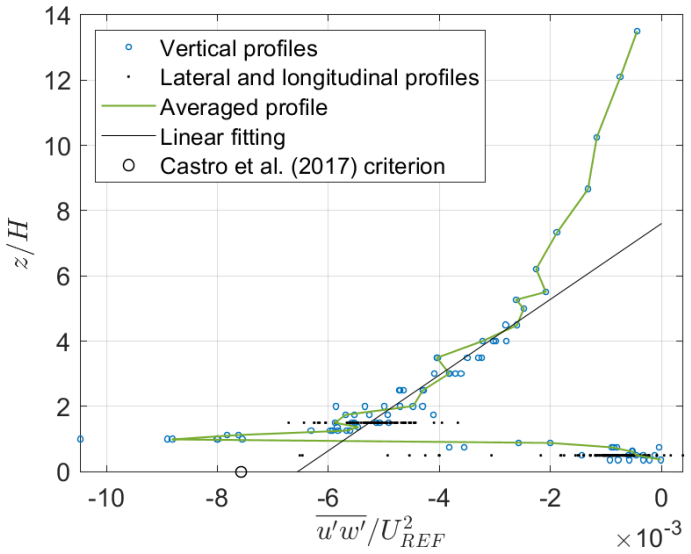
The Monin–Obukhov length $L$, the height at which mechanical and buoyant turbulence production become comparable, is the central diagnostic. The paper estimates $L$, friction velocity $u_*$, friction temperature $\theta_*$, roughness lengths $z_0$ and $z_{0h}$, and displacement heights $d$ and $d_h$ by fitting stability-corrected logarithmic profiles for wind and temperature to point measurements, and by linearly extrapolating measured Reynolds shear stress and vertical heat flux profiles to the surface. Comparisons between lower-roughness approaching flow and higher-roughness array flow isolate the effect of the urban geometry on these surface-layer parameters.
What would settle it
Measure the same array with dense three-dimensional sampling, or simulate it numerically with resolved surface heat flux, and compare the true area-averaged surface shear stress and heat flux with the linear extrapolation from $1.5H$ to $4H$; a systematic mismatch would mean the reported changes in $L$, $z_0$, and $d$ are artifacts of the extrapolation rather than real stratification-roughness interactions.
Extended reading notes
Core claim
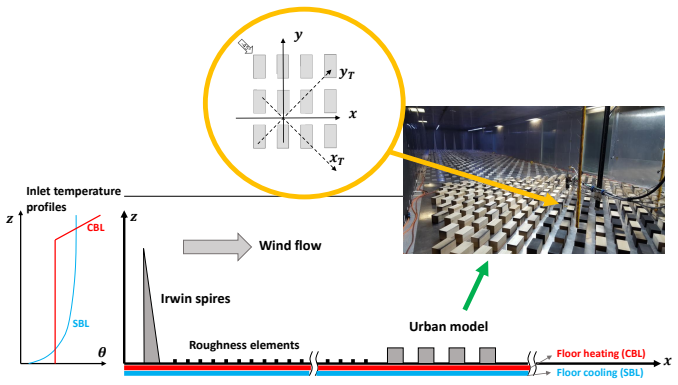
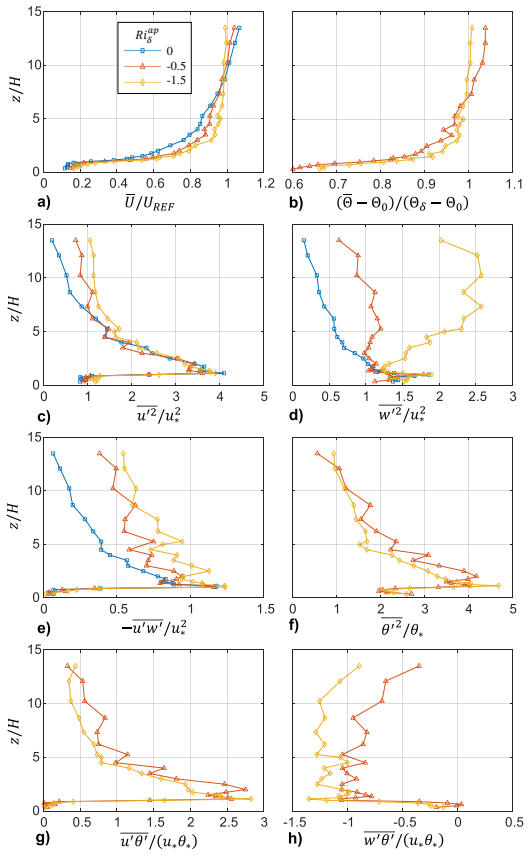
The paper shows experimentally that urban-like roughness modifies how Monin–Obukhov similarity applies to an already stratified flow. Over a regular array of $H \times 2H \times H$ blocks at 45° wind direction, stable stratification lowers the friction velocity $u_*$, cuts Reynolds stresses and in-canopy turbulence, reduces $z_0$ by 16–27%, raises $d$ by up to 5%, and increases the Monin–Obukhov length $L$ by up to 80% compared with the same flow without the array. Convective stratification raises $u_*$ through the combined action of roughness and instability, increases $z_0$ by up to 55%, reduces $d$ by about half, and doubles $L$. The authors conclude that urban surfaces reduce the effective stability felt by the flow, and that stability-dependent $z_0$ and $d$ are needed in urban parameterizations.
Load-bearing premise
The whole analysis rests on the assumption that, averaged across space, the downward momentum flux and upward heat flux decrease nearly linearly with height just above the building tops, so extending those measured trends to the surface gives the true surface fluxes; the paper itself notes the data were too coarse for a direct spatial average.
Editorial extensions
If this is right
- In stable conditions the urban array reduces the friction velocity and Reynolds stresses, cuts $z_0$ by up to 27%, raises $d$ by up to 5%, and increases $L$ by up to 80% compared with the approaching flow.
- In convective conditions the array increases $u_*$, raises $z_0$ by up to 55%, lowers $d$ by about half, and doubles $L$, meaning the surface feels weaker convection than the incoming flow does.
- Urban canopy parameterizations that keep $z_0$ and $d$ fixed at neutral values will misrepresent surface fluxes whenever the approaching boundary layer is stratified.
- The internal boundary layer developing over the array reaches about $2.5H$ in stable conditions and $3$\textendash $4H$ in convective conditions, setting a height limit for single-layer canopy models.
- Stable stratification suppresses in-canopy turbulence and slows canopy flow without changing its direction, while convective stratification increases in-canopy velocity variances.
Reading between the lines
- Implicit in the results, a single-layer urban scheme using neutral $z_0$ and $d$ would need stability-dependent corrections; the measured changes in $L$ give a direct target for such a parameterization.
- A testable extension is to repeat the experiment with heated building surfaces: the unheated wooden blocks reduced upward heat flux, so real cities with heated walls and roofs would likely show a smaller doubling of $L$.
- A further consequence is that dense roughness damps stratification in both directions, so urban arrays may act as a self-limiting buffer on extreme surface stability; varying building density and aspect ratio would test this.
Signed reviews
Editorial analysis
A structured set of objections, weighed in public.
Referee Report
Summary. The manuscript reports wind-tunnel measurements of stable and convective boundary layers over a regular array of rectangular building models, with approaching-flow comparisons intended to isolate roughness effects. Surface parameters (u*, z0, d, θ*, z0h, dh, L) are derived by fitting Monin-Obukhov similarity profiles to measured velocity and temperature profiles and by linearly extrapolating Reynolds shear stress and vertical heat flux profiles to the surface. The main findings are that in stable stratification the array increases the Monin-Obukhov length by up to 80%, reduces z0, increases d, and suppresses in-canopy turbulence; in convective stratification the array roughly doubles L, increases z0 by about 55%, reduces d, and increases u*. The paper also reports internal boundary-layer heights and velocity integral length scales, and makes the dataset openly available.
Significance. If the causal interpretation can be secured, the dataset is a valuable experimental resource for validating urban canopy models under non-neutral conditions, and the directional findings are broadly consistent with prior work. Strengths include the realistic building geometry, comparisons with field observations and earlier experiments, and open data availability. The main weakness is that the central claim that increased roughness reduces surface stratification is not cleanly identified, because the array configuration also changes the thermal boundary conditions (unheated buildings in the CBL cases and, most likely, uncooled buildings in the SBL cases). The quantitative percentages also lack uncertainty estimates and the abstract disagrees with the full text. These issues must be resolved before the quantitative conclusions can be accepted.
major comments (5)
- [Section 4.1, Table 2] The CBL claim that 'the increased roughness causes a reduction in the surface stratification' (L doubled over the array) is confounded by the thermal boundary condition. Section 4.1 states that 'the vertical heat flux over the array appears reduced, also as consequence of the wooden buildings not being heated.' In the approaching-flow reference the heated floor is uniform, while in the array case only the floor between the buildings is heated and the buildings themselves are unheated. The array therefore reduces the total upward heat flux simply by replacing part of the heated floor with unheated solid blocks; since |L| is proportional to u*^3/(w'θ')_0, both the increase in u* and the decrease in surface heat flux act to increase L, so the reported doubling can occur even if the roughness has no stability-modifying effect. The paper does not report building surface temperatures or a heat-budget estimate that would separate the roughness effect from the surface-temperature effect. Please quantify the building heat-flux contribution (or provide a bounding estimate) and revise the causal wording in the abstract and Section 5 accordingly.
- [Section 3.1, Table 1] The same identification problem applies to the stable cases. The lower-roughness reference is generated with uniformly cooled floor panels, while in the array case only the floor is cooled and the wooden building blocks are not described as actively cooled. If the blocks are warmer than the cooled floor, they will locally reduce the magnitude of the negative surface heat flux, which increases L and partially mimics a roughness-induced weakening of stability. The paper should state the thermal state of the building surfaces in the SBL runs and quantify its contribution to the reported L increase of up to 80%, or explicitly justify that the effect is negligible.
- [Abstract vs. full text and Conclusion] The abstract supplied with this version reports SBL z0 reduction up to 35% and d increase up to 12%, and CBL z0 increase up to 50%; the full-text abstract and Section 5 report 27%, 5%, and 55%, respectively. These are different quantitative claims for the same experiments. The authors must correct the inconsistency and ensure that the abstract, main text, tables, and conclusion report identical numbers.
- [Tables 1 and 2, Section 2.3] The headline ratios (L doubling, 80% increase, z0 and d changes) are reported as exact numbers without uncertainty estimates. Section 2.2 reports standard errors of 10-25% on the covariances that feed the flux extrapolation, so the propagated uncertainties in u*, θ*, and L are likely material to the claimed differences. Please propagate the measurement uncertainties into the derived surface parameters and report confidence intervals, or at least provide a sensitivity analysis of L to the chosen linear-extrapolation interval.
- [Equation (3)] Equation (3) as written has a sign error relative to standard Monin-Obukhov theory. With θ* = -(w'θ')_0/u*, the correct expression is ζ = (g/Θ0)θ*/(u*^2/kz), not the negative of that quantity. The tabulated δ/L values have the conventional signs, which suggests the computations used the standard form, but the printed equation must be corrected and its sign consistency with Eqs. (4)-(7) checked explicitly.
minor comments (5)
- [Section 2.2] Please state how the standard errors were computed (block averaging, bootstrap, or repeat runs) and how the resampling of the LDA and cold-wire signals affects the reported covariances.
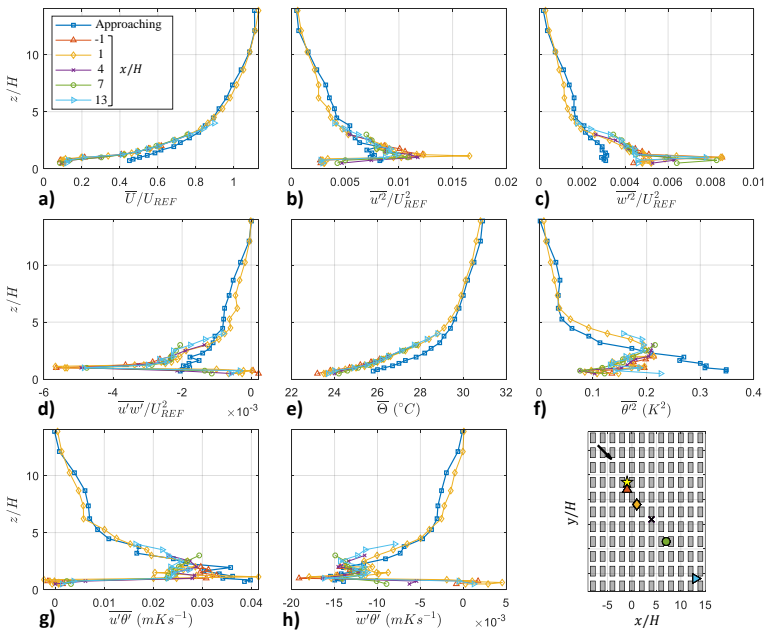
- [Figures 3 and 8] The SBL approaching-flow reference is a single profile at x_T/H = -35, while the CBL reference is the average of two profiles at x_T/H = 1.4 and 22.4. Since the two cases use different reference locations, please explain why this does not affect the comparability of the SBL and CBL results.
- [Section 2.1] Please clarify whether the neutral reference cases in Tables 1 and 2 were measured with the same spire sets as the stratified cases to which they are compared.
- [Section 5] The sentence 'the sum of the two contributions considered singularly is larger than the increment resulting by their combined effect' is unclear and should be rephrased for precision.
- [Acknowledgments] The data availability statement should be moved to a dedicated section and cite the figshare DOI in the standard format.
Circularity Check
No circularity: the reported Monin-Obukhov changes are measured differences, not predictions recovered from the same fitted law, and the self-cited method is externally validated.
full rationale
The paper reports wind-tunnel measurements and does not claim to derive a first-principles prediction from the same data it then confirms. Surface fluxes are obtained by linear extrapolation of measured Reynolds-stress and vertical-heat-flux profiles (Section 2.3), following Marucci et al. (2018), and the resulting friction velocity for the neutral urban-array case is checked against an independent estimate from Castro et al. (2017): the linear-fit value u*/UREF = 0.081 is compared with 0.087 from the 1.3-factor method and 0.089 from Castro et al. (2017). The Monin-Obukhov length is then computed from those extrapolated surface fluxes, while z0, d, and z0h are fitted using the standard diabatic log-law (Eqs. 4-7). Reporting how L changes between the lower- and higher-roughness configurations is an observed difference, not a fitted parameter renamed as a prediction. The stability functions are attributed to Högström (1988), not to the authors' own prior work. The self-citations (Marucci et al., 2018; Marucci and Carpentieri, 2019, 2020) supply the experimental technique and companion dispersion results; they do not contain the urban-array stability comparison claimed here. The unheated wooden buildings in the CBL runs (Section 4.1: 'The vertical heat flux over the array appears reduced, also as consequence of the wooden buildings not being heated') create a possible confound between roughness effects and imposed thermal-boundary-condition effects, but that is an experimental-design concern rather than a circular reduction of the conclusion to its inputs. No step in the derivation chain is equivalent by construction to its own inputs.
Assumptions & free parameters
free parameters (7)
- u* (friction velocity) =
0.047 to 0.118 of UREF across SBL and CBL cases
- z0 (aerodynamic roughness length) =
2.0 to 6.3 mm
- d (displacement height) =
0 to 55 mm
- theta* (friction temperature) =
0.221 to 0.355 C (SBL), -0.60 to -1.39 C (CBL)
- z0h (thermal roughness length) =
0.003 to 0.012 mm
- dh (thermal displacement height, fitted variant) =
21.5 to 52.3 mm
- Linear fitting interval for surface fluxes =
1.5H to 4H
assumptions (7)
- standard math Monin-Obukhov similarity theory
- standard math Högström (1988) stability correction functions
- domain assumption Linearity of stress and heat flux profiles above the roughness sublayer
- domain assumption Taylor's frozen turbulence hypothesis
- domain assumption Boundary layer depth over the array equals the approaching flow in CBL
- domain assumption Log-law fitting with fixed k yields valid d and z0
- domain assumption Reference temperature Theta0 at 10 mm above floor represents surface temperature
Cite this review
Pith. "Pith review of Stable and convective boundary-layer flows in an urban array." pith.science (2026). https://pith.science/paper/UKWEBXUR
@misc{pith2026190805463,
  author       = {Pith},
  title        = {Pith review of: Stable and convective boundary-layer flows in an urban array},
  year         = {2026},
  howpublished = {\url{https://pith.science/paper/UKWEBXUR}},
  note         = {Machine review of arXiv:1908.05463}
}
read the original abstract
In this paper non-neutral approaching flows were employed in a meteorological wind tunnel on a regular urban-like array of rectangular buildings. As far as stable stratification is concerned, results on the flow above and inside the canopy show a clear reduction of the Reynolds stresses and an increment of the Monin-Obukhov length up to 80%. The roughness length and displacement height were also affected, with a reduction up to 35% for the former and an increment up to 12% for the latter. A clear reduction of the turbulence within the canopy was observed. In the convective stratification cases, the friction velocity appears increased by both the effect of roughness and unstable stratification. The increased roughness causes a reduction in the surface stratification, reflected in an increase of the Monin-Obukhov length, which is double over the array compared to the approaching flow. The effect on the aerodynamic roughness length and displacement height are specular to the SBL case, an increase up to 50% of the former and a reduction of the same amount for the latter.
Figures
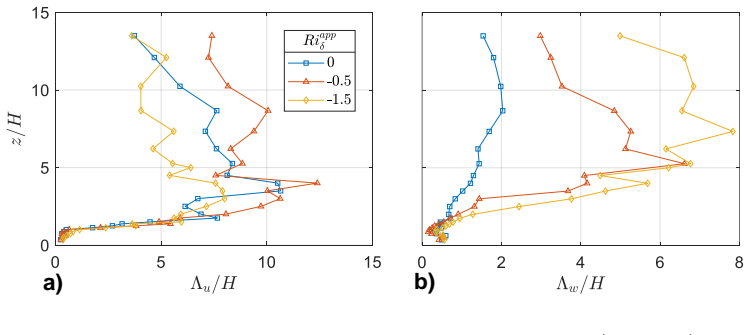
Figures from the paper (9 more)




Forward citations
Cited by 1 Pith paper
-
Dispersion in an array of buildings in stable and convective atmospheric conditions
Wind tunnel tracer tests over a regular building array show stable air roughly doubles in-street concentrations, convective air cuts them by up to three, and plume width changes little.
Reference graph
Works this paper leans on
-
[1]
write newline
" write newline "" before.all 'output.state := FUNCTION n.dashify 't := "" t empty not t #1 #1 substring "-" = t #1 #2 substring "--" = not "--" * t #2 global.max substring 't := t #1 #1 substring "-" = "-" * t #2 global.max substring 't := while if t #1 #1 substring * t #2 global.max substring 't := if while FUNCTION word.in bbl.in ":" * " " * FUNCTION f...
-
[2]
author Boppana, V.B.L. , author Xie, Z.T. , author Castro, I.P. , year 2014 . title Thermal Stratification Effects on Flow Over a Generic Urban Canopy . journal Boundary-Layer Meteorology volume 153 , pages 141--162 . :10.1007/s10546-014-9935-1
-
[3]
author Castro, I.P. , author Xie, Z.T. , author Fuka, V. , author Robins, A.G. , author Carpentieri, M. , author Hayden, P. , author Hertwig, D. , author Coceal, O. , year 2017 . title Measurements and Computations of Flow in an Urban Street System . journal Boundary-Layer Meteorology volume 162 , pages 207--230 . :10.1007/s10546-016-0200-7
-
[4]
author Caughey, S.J. , author Palmer, S.G. , year 1979 . title Some aspects of turbulence structure through the depth of the convective boundary layer . journal Quarterly Journal of the Royal Meteorological Society volume 105 , pages 811--827 . :10.1002/qj.49710544606
-
[5]
author Caughey, S.J. , author Wyngaard, J.C. , author Kaimal, J.C. , year 1979 . title Turbulence in the evolving stable boundary layer . journal J. Atmos. Sci. volume 36 , pages 1041--1052 . :10.1175/1520-0469(1979)036<1041:TITESB>2.0.CO;2
-
[6]
author Cheng, H. , author Castro, I. , year 2002 . title Near wall flow development after a step change in surface roughness . journal Boundary-layer Meteorology volume 105 , pages 411--432 . :10.1023/A:1020355306788
-
[7]
author Fuka, V. , author Xie, Z.T. , author Castro, I.P. , author Hayden, P. , author Carpentieri, M. , author Robins, A.G. , year 2018 . title Scalar fluxes near a tall building in an aligned array of rectangular buildings . journal Boundary-Layer Meteorology volume 167 , pages 53--76 . :10.1007/s10546-017-0308-4
-
[8]
author H \" o gstr \" o m, U. , year 1988 . title Non-Dimensional Wind and Temperature Profiles in the Atmospheric Surface Layer: A Re-Evaluation . journal Boundary-Layer Meteorology volume 42 , pages 55--78 . :10.1007/978-94-009-2935-7_6
Show all 31 references
-
[9]
, author Castillo, M.C.L
author Inagaki, A. , author Castillo, M.C.L. , author Yamashita, Y. , author Kanda, M. , author Takimoto, H. , year 2012 . title Large-Eddy Simulation of Coherent Flow Structures within a Cubical Canopy . journal Boundary-Layer Meteorology volume 142 , pages 207--222 . :10.100...
2012 doi
-
[10]
, year 1981
author Irwin, H.P.A.H. , year 1981 . title The design of spires for wind simulation . journal Journal of Wind Engineering and Industrial Aerodynamics volume 7 , pages 361--366 . :10.1016/0167-6105(81)90058-1
1981 doi
-
[11]
, year 1981
author Jackson, P. , year 1981 . title On the displacement height in the logarithmic velocity profile . journal J. Fluid Mech. volume 111 , pages 15--25
1981
-
[12]
, author Yoshie, R
author Jiang, G. , author Yoshie, R. , year 2018 . title Large-eddy simulation of flow and pollutant dispersion in a 3D urban street model located in an unstable boundary layer . journal Building and Environment volume 142 , pages 47--57 . https://doi.org/10.1016/j.buildenv.20...
2018 doi
-
[13]
, author Finnigan, J.J
author Kaimal, J.C. , author Finnigan, J.J. , year 1994 . title Atmospheric boundary layer flows: their structure and measurement . volume volume 72 . publisher Oxford University Press . :10.1016/0021-9169(95)90002-0
1994 doi
-
[14]
, author Yamao, Y
author Kanda, I. , author Yamao, Y. , year 2016 . title Passive scalar diffusion in and above urban-like roughness under weakly stable and unstable thermal stratification conditions . journal Journal of Wind Engineering and Industrial Aerodynamics volume 148 , pages 18--33 . h...
2016 doi
-
[15]
, author Britter, R
author Li, X.X. , author Britter, R. , author Norford, L.K. , year 2016 . title Effect of stable stratification on dispersion within urban street canyons: A large-eddy simulation . journal Atmospheric Environment volume 144 , pages 47--59 . :10.1016/j.atmosenv.2016.08.069
2016 doi
-
[16]
, author Carpentieri, M
author Marucci, D. , author Carpentieri, M. , year 2019 . title Effect of local and upwind stratification on flow and dispersion inside and above a bi-dimensional street canyon . journal Building and Environment volume 156 , pages 74--88 . http://arxiv.org/abs/1812.00512, :10....
2019 arXiv
-
[17]
, author Carpentieri, M
author Marucci, D. , author Carpentieri, M. , year 2020 . title Dispersion in an array of buildings in stable and convective atmospheric conditions . journal Atmospheric Environment volume 222 , pages 117100 . https://arxiv.org/abs/1908.06027, :10.1016/j.atmosenv.2019.117100, ...
2020 arXiv
-
[18]
, author Carpentieri, M
author Marucci, D. , author Carpentieri, M. , author Hayden, P. , year 2018 . title On the simulation of thick non-neutral boundary layers for urban studies in a wind tunnel . journal International Journal of Heat and Fluid Flow volume 72 , pages 37--51 . :10.1016/j.ijheatflui...
2018 doi
-
[19]
, author Obukhov, A.M
author Monin, A.S. , author Obukhov, A.M. , year 1954 . title Basic laws of turbulent mixing in the surface layer of the atmosphere . journal Contrib. Geophys. Inst. Acad. Sci. USSR volume 24 , pages 163--187
1954
-
[20]
, author Kleissl, J
author Nazarian, N. , author Kleissl, J. , year 2016 . title Realistic solar heating in urban areas : Air exchange and street-canyon ventilation . journal Building and Environment volume 95 , pages 75--93 . http://dx.doi.org/10.1016/j.buildenv.2015.08.021, :10.1016/j.buildenv....
2016 doi
-
[21]
, author Martilli, A
author Nazarian, N. , author Martilli, A. , author Kleissl, J. , year 2018 . title Impacts of Realistic Urban Heating , Part I : Spatial Variability of Mean Flow , Turbulent Exchange and Pollutant Dispersion . journal Boundary-Layer Meteorology volume 166 , pages 367--393 . :1...
2018 doi
-
[22]
, author Uchida, T
author Ohya, Y. , author Uchida, T. , year 2004 . title Laboratory and numerical studies of the convective boundary layer capped by a strong inversion . journal Boundary-Layer Meteorology volume 112 , pages 223--240 . :10.1023/B:BOUN.0000027913.22130.73
2004
-
[23]
, author Baik, J.J
author Park, S.B. , author Baik, J.J. , year 2013 . title A Large-Eddy Simulation Study of Thermal Effects on Turbulence Coherent Structures in and above a Building Array . journal Journal of applied meteorology and climatology volume 52 , pages 1348--1365 . :10.1175/JAMC-D-12-0162.1
2013 doi
-
[24]
, year 1979
author Robins, A.G. , year 1979 . title The Development and Structure of Simulated Neutrally Stable Atmospheric Boundary Layers . journal Journal of Industrial Aerodynamics volume 4 , pages 71--100
1979
-
[25]
, author Cui, G
author Shen, Z. , author Cui, G. , author Zhang, Z. , year 2017 . title Turbulent dispersion of pollutants in urban-type canopies under stable stratification conditions . journal Atmospheric Environment volume 156 , pages 1--14 . http://dx.doi.org/10.1016/j.atmosenv.2017.02.01...
2017 doi
-
[26]
, author Nagai, K
author Shirakata, S. , author Nagai, K. , author Mizumoto, N. , year 2002 . title Wind tunnel experiments for atmospheric diffusion under various stability conditions . journal J. Jpn. Soc. Atmos. Environ. (in Japanese) volume 37 , pages 141--154 . http://ir.obihiro.ac.jp/dspa...
2002
-
[27]
, author Pourquie, M.J.B.M
author Tomas, J.M. , author Pourquie, M.J.B.M. , author Jonker, H.J.J. , year 2016 . title Stable stratification effects on flow and pollutant dispersion in boundary layers entering a generic urban environement . journal Boundary-Layer Meteorology volume 159 , pages 221--239
2016
-
[28]
, author Murakami, S
author Uehara, K. , author Murakami, S. , author Oikawa, S. , author Wakamatsu, S. , year 2000 . title Wind tunnel experiments on how thermal stratification affects flow in and above urban street canyons . journal Atmospheric Environment volume 34 , pages 1553--1562 . :10.1016...
2000 doi
-
[29]
, author Phillips, M.S
author Wilczak, J.M. , author Phillips, M.S. , year 1986 . title An indirect Estimation of Convective Boundary Layer Structure for Use in Pollution Dispersion models . journal Journal of climate and applied meteorology volume 25 , pages 1609--1624 . :10.1175/1520-0450(1986)025...
1986 doi
-
[30]
, author Lacser, A
author Wood, C.R. , author Lacser, A. , author Barlow, J.F. , author Padhra, A. , author Belcher, S.E. , author Nemitz, E. , author Helfter, C. , author Famulari, D. , author Grimmond, C.S.B. , year 2010 . title Turbulent Flow at 190 m Height Above London During 2006-2008: A C...
2010 doi
-
[31]
, author Hayden, P
author Xie, Z.T. , author Hayden, P. , author Wood, C.R. , year 2013 . title Large-eddy simulation of approaching-flow stratification on dispersion over arrays of buildings . journal Atmospheric Environment volume 71 , pages 64--74 . http://dx.doi.org/10.1016/j.atmosenv.2013.0...
2013 doi
Reviewed August 14, 2026 · model on record in the stance chip above.
Discussion (0). Continue with ORCID to comment.