REVIEW 3 major objections 4 minor 30 references
Megapixels @ Megahertz -- The AGIPD High-Speed Cameras for the European XFEL
T0 review · 3 major / 4 minor · reviewed 2026-08-14 · deepseek-v4-flash
Pith's one-line read AGIPD, a hybrid pixel detector with per-pixel adaptive gain, claims to meet an X-ray free-electron laser's extreme requirements: single-photon sensitivity, a dynamic range of $10^4$ photons per pixel, and a 4.5 MHz frame rate.
desk verdict A candid, useful system status report: the installed AGIPD cameras work and the headline numbers hold up, but the dynamic-range claim rests on an indirect calibration with an unquantified systematic uncertainty. read the letter →
The pith
A machine-rendered reading of the paper's core claim, the machinery that carries it, and where it could break.
The reading
What carries the argument
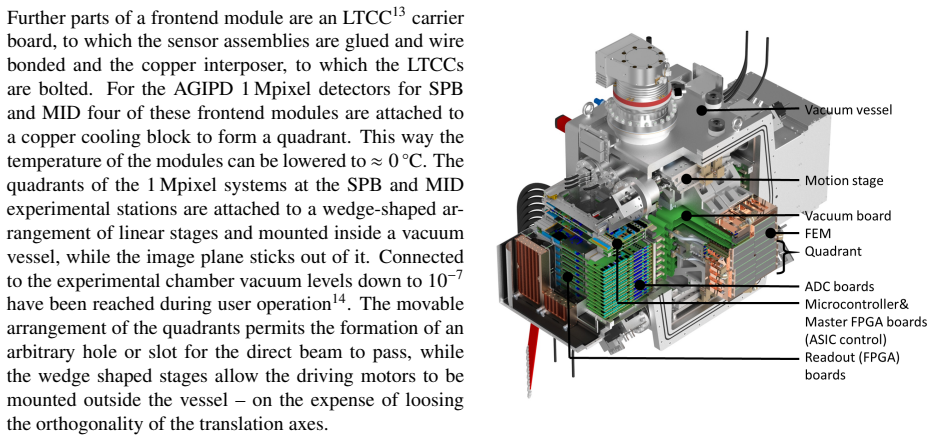
The load-bearing mechanism is the AGIPD readout ASIC: a 64x64 array of 200 µm pixels, each with a charge-sensitive preamplifier with three switchable gains, a discriminator that selects the gain when the preamplifier output crosses a threshold, a correlated double sampling stage, a 352-image analogue memory, and a second buffer for readout. An in-pixel constant current source and pulsed capacitor provide electrical calibration stimuli. This lets every pixel choose its own sensitivity for every pulse, so a single frame can contain both single photons and intense Bragg spots; the 99.4 ms gap between pulse trains is then used to digitise the stored frames.
What would settle it
Compare the detector's response to a directly calibrated X-ray beam at a synchrotron, using attenuators and Poisson statistics to cover the medium- and low-gain ranges; if the reconstructed photon counts disagree with the electrical-stimulus calibration by more than the stated 0.44% nonlinearity, the indirect calibration premise is wrong.
Extended reading notes
Core claim
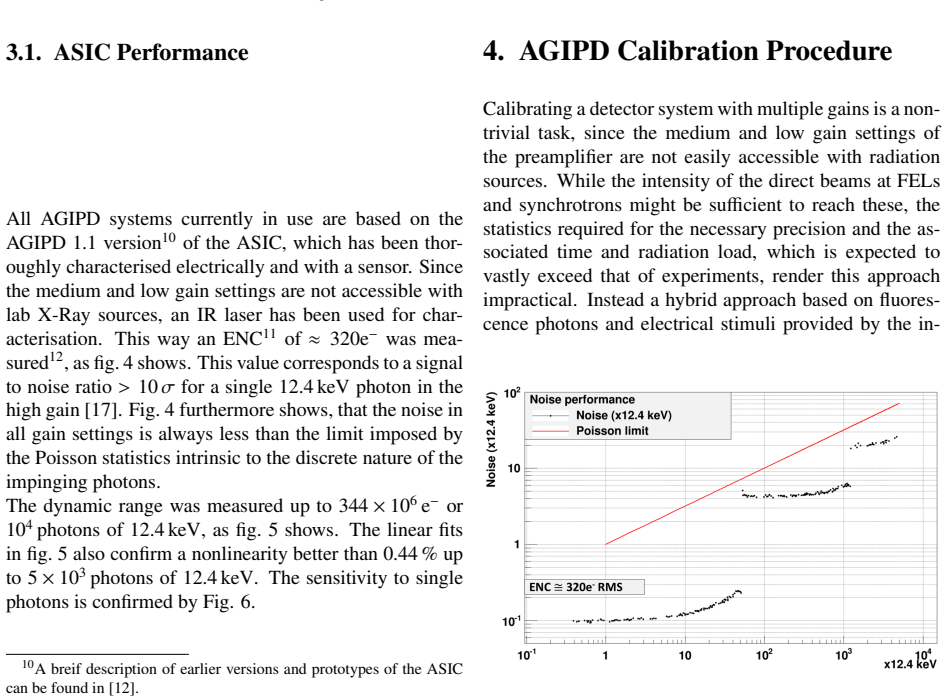
The central result is that a single pixel can be simultaneously sensitive to a single 6 keV photon and to a $10^4$-photon flash by switching its amplifier gain in three steps under discriminator control. Each 200 µm pixel contains a charge-sensitive preamplifier whose feedback capacitance is switched from 60 fF to 3 pF and 10 pF; a correlated double sampling stage removes reset noise, and the resulting amplitude plus gain bit is stored in a 352-frame analogue memory. A one-megapixel system built from these ASICs reaches a reported equivalent noise charge below 310 electrons, better than 0.44% nonlinearity up to $5\times10^3$ 12.4 keV photons, and has been used at 1.1 MHz to record diffraction patterns from protein microcrystals.
Load-bearing premise
The reported dynamic range and gain-switching accuracy depend on the stability of the in-pixel current source and on the preamplifier gain being independent of integration time, because the medium- and low-gain calibrations are derived from an electrical scan rather than direct photon exposure.
Editorial extensions
If this is right
- A 1-megapixel AGIPD camera can record a full diffraction pattern at the facility's burst rate, making megahertz serial femtosecond crystallography a practical experiment.
- At the installed system, users can collect up to 352 images per pulse train with per-pixel dynamic range spanning single photons to $10^4$ photons at 12.4 keV.
- The new readout board eliminates most connectors and power supply cabling, so future 4-megapixel systems can operate each module standalone with only an optical fibre and a single power supply.
- For the high-energy beamline, an electron-collecting ASIC with high-Z sensors is designed to detect photons up to about 25 keV, where silicon becomes transparent.
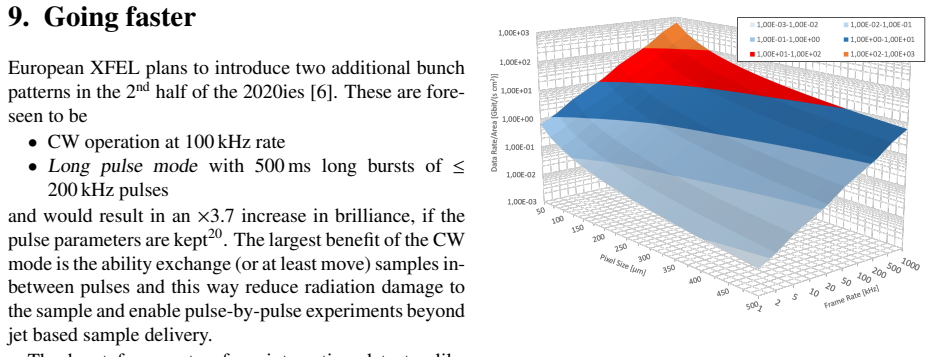
- At future continuous-wave operation around 100 kHz, the current detector's readout bandwidth and power dissipation would be limiting; the paper identifies in-pixel digitisation as the necessary next step.
Reading between the lines
- Because the medium- and low-gain calibration is indirect, the quoted dynamic-range accuracy likely carries a systematic uncertainty that is not reflected in the calibration constants; a direct X-ray cross-check at a synchrotron would settle this.
- The adaptive-gain on-pixel memory architecture is not tied to this laser's specific 220 ns spacing; it could be adapted to other high-repetition-rate sources, such as electron diffraction or plasma X-ray sources, whenever frames arrive in bursts.
- The power-scaling argument implies that below about 100 µm pixel pitch, continuous 100 kHz operation becomes thermally impractical before bandwidth does; future designs may need to trade pixel size for speed or use per-pixel digitisation to cut analog readout.
Signed reviews
Editorial analysis
A structured set of objections, weighed in public.
Referee Report
Summary. The paper describes the AGIPD hybrid pixel detector developed for the European XFEL, covering the source requirements, the pixel ASIC architecture, the installed 1 Mpixel cameras at SPB and MID, the calibration procedure, first user experiments, and plans for the 4 Mpixel SFX system, the HIBEF system with high-Z sensors, and future faster detectors. The central claim is stated in Section 10: the AGIPD 1 Mpixel system installed at SPB fulfills all requirements, specifically noise below 310 e- (≤1.2 keV), single-photon sensitivity, a dynamic range of at least 10^4 photons at 12 keV, and a 4.5 MHz frame rate. This claim is supported by ASIC-level characterization measurements (Figures 4-6), by a hybrid calibration procedure using fluorescence photons and electrical stimuli, and by citation of successful first user experiments including MHz serial crystallography.
Significance. If the stated performance is correct, AGIPD is a unique instrument: it provides single-photon sensitivity at 6-12 keV together with a dynamic range of 10^4 photons and an in-burst framing rate of 4.5 MHz, which enabled the first MHz serial crystallography experiments at the European XFEL. The paper gives a useful system-level overview of a complex detector and reports direct, external-stimulus measurements of noise, transfer characteristics, and single-photon spectra rather than relying on simulation. The practical calibration method and the openly described remaining shortcomings are also valuable. The main risk is that the headline performance claim is not accompanied by quantitative uncertainty estimates on the reported values, and the medium/low-gain calibration is indirect.
major comments (3)
- [Sections 3.1 and 10, Figures 4-6] The summary claim that the SPB system fulfills all requirements, in particular noise below 310 e- and dynamic range of 10^4 photons at 12 keV, is supported by measurements that appear to be performed on single ASICs or small systems rather than on the installed 1 Mpixel camera. Please state explicitly which measurements were made on the installed SPB system and which were made on ASIC-level test structures, and give uncertainties or at least confidence intervals for the headline values (for example, ENC ≈ 320 e- is reported without a statistical or systematic error). This distinction is load-bearing because the abstract and Section 10 attribute the performance to the installed system.
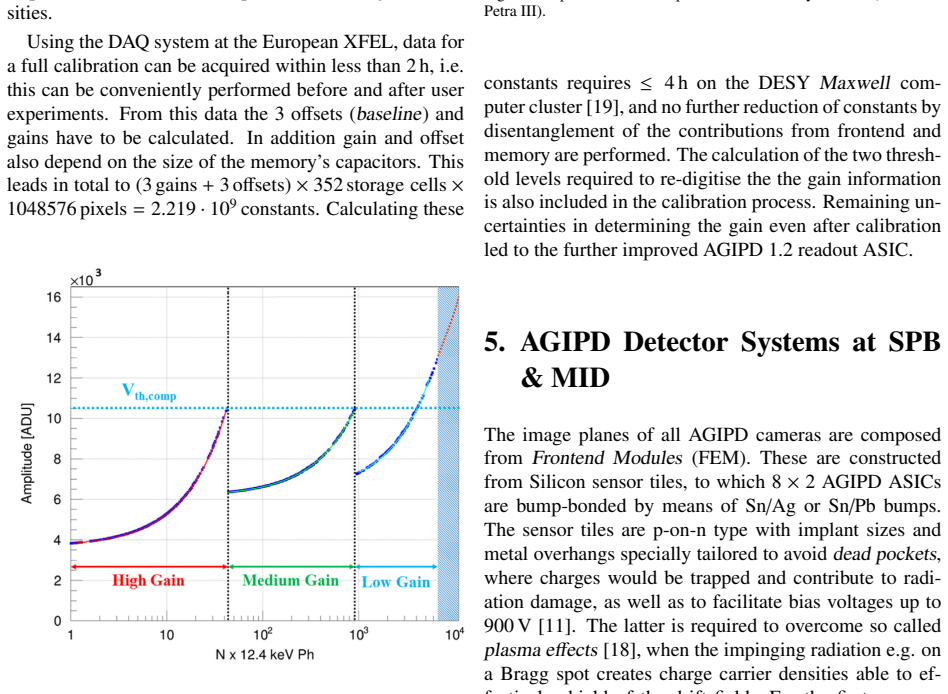
- [Section 4] The calibration of the medium and low gain settings is indirect: their sensitivities are determined relative to the high gain by scanning the preamplifier integration time with the in-pixel constant current source, while only the high gain is calibrated with fluorescence photons. This assumes that the current source is stable and that the preamplifier gain does not depend on integration time; neither assumption is quantified. Since the dynamic-range and gain-switching accuracy claims depend directly on these relative sensitivities, please provide an estimate of the resulting systematic uncertainty or explain quantitatively why the lever-arm procedure is insensitive to these effects.
- [Section 10] The paper admits an 'increasing uncertainty of the gain determination during readout' as a remaining shortcoming of the installed AGIPD 1.1 ASIC, but does not quantify how this affects the calibrated images or the stated dynamic-range and gain-accuracy figures. Without a bound on this effect, the claim that the system fulfills all requirements, especially the dynamic-range requirement, is not fully verifiable. Please either quantify the gain uncertainty versus memory-cell index or temper the summary claim to reflect the known limitation.
minor comments (4)
- [Section 5] There are several typographical errors, for example 'camara' should be 'camera' and 'loosing' should be 'losing'; please proofread the text.
- [Sections 7.1 and 8] The words 'comissioning' and 'decribed' should be 'commissioning' and 'described'; also 'sheild' in Section 2 should be 'shield'.
- [Section 3, footnote 9] The text says the memory stores 352 images, but the footnote states that the current firmware reads 300 separate amplitude and gain frames; please clarify whether the remaining 52 memory cells are unused or used for other purposes.
- [References] Several references contain formatting artifacts (for example, missing spaces or misplaced punctuation); please normalize the bibliography to the journal style.
Circularity Check
No circularity: performance claims are direct measurements against external stimuli; the indirect gain calibration is not a fitted quantity renamed as a prediction.
full rationale
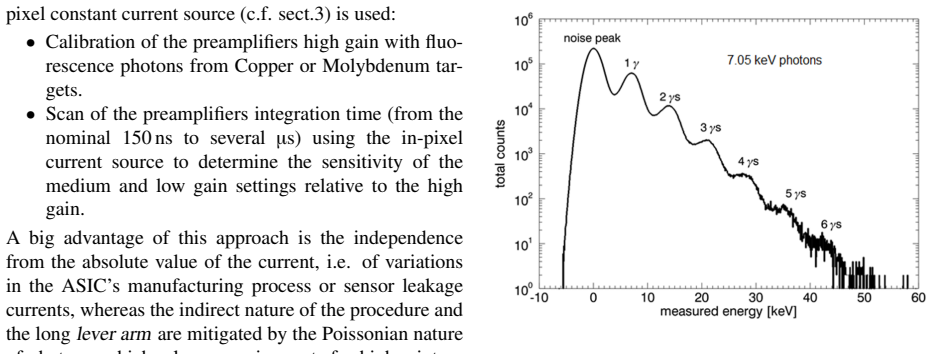
The paper is an instrument and performance report, not a theoretical derivation. The headline claims—noise below 310 e-, single-photon sensitivity, dynamic range >= 10^4 photons at 12 keV, and 4.5 MHz frame rate—are supported by direct characterization against external stimuli: ENC measured with an IR laser, transfer characteristics measured with laser injection and linear fits, a 7 keV photon spectrum from Petra III, and first-user MHz serial crystallography data. The medium- and low-gain calibration in Section 4 is indirect, using an integration-time scan with the in-pixel current source anchored to a fluorescence-photon high-gain calibration, but this is explicitly a calibration procedure; the resulting constants are corrections applied to raw data, not a parameter fitted to a subset and then renamed as a prediction of the same data. The paper also openly acknowledges the residual limitation: Section 10 states 'an increasing uncertainty of the gain determination during readout' as a remaining shortcoming, and Section 4 notes that 'remaining uncertainties in determining the gain even after calibration led to the further improved AGIPD 1.2 readout ASIC.' Self-citations to prior AGIPD characterization papers are normal for a multi-institute detector collaboration and do not carry a load-bearing theoretical premise; no uniqueness theorem or derivation is imported from those citations. No circularity pattern is instantiated, so the appropriate finding is no significant circularity.
Assumptions & free parameters
free parameters (2)
- Per-pixel gain and offset calibration constants =
2.219e9 values
- Gain threshold levels =
2 thresholds per pixel
assumptions (3)
- domain assumption Charge-sensitive amplifier with adaptive gain behaves linearly within each gain setting
- domain assumption The electrical calibration stimulus (constant current source) is stable and independent of absolute current value over the integration time scan
- domain assumption Standard semiconductor detector physics (charge collection, plasma effects) applies as modelled
Cite this review
Pith. "Pith review of Megapixels @ Megahertz -- The AGIPD High-Speed Cameras for the European XFEL." pith.science (2026). https://pith.science/paper/UL4F26S3
@misc{pith2026190802103,
  author       = {Pith},
  title        = {Pith review of: Megapixels @ Megahertz -- The AGIPD High-Speed Cameras for the European XFEL},
  year         = {2026},
  howpublished = {\url{https://pith.science/paper/UL4F26S3}},
  note         = {Machine review of arXiv:1908.02103}
}
abstract
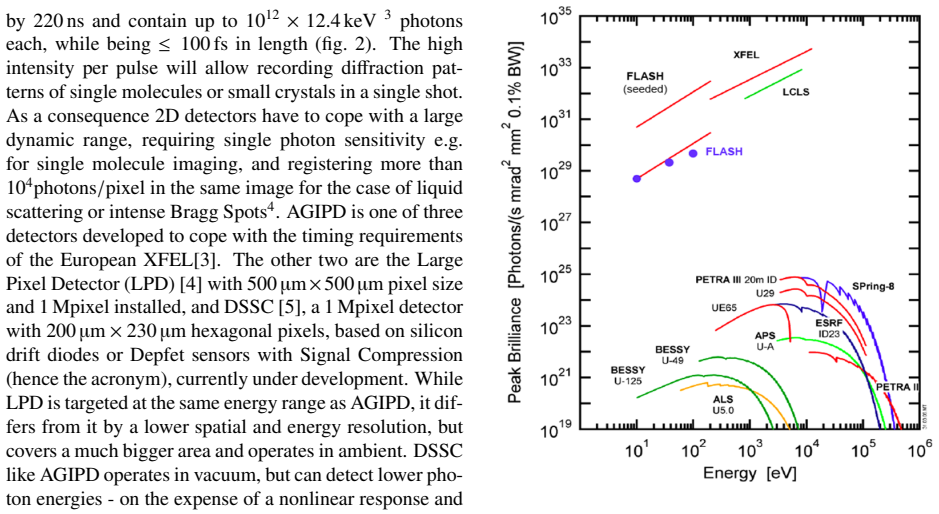
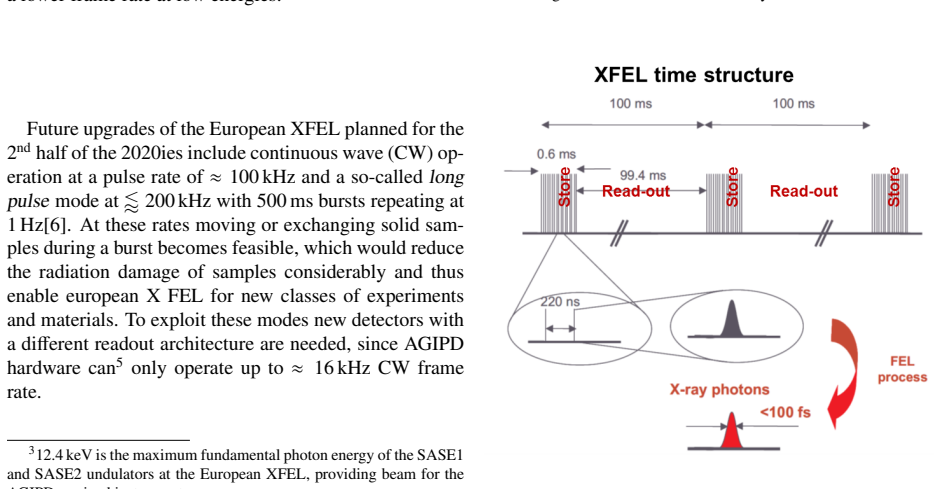
The European XFEL is an extremely brilliant Free Electron Laser Source with a very demanding pulse structure: trains of 2700 X-Ray pulses are repeated at 10 Hz. The pulses inside the train are spaced by 220 ns and each one contains up to $10^{12}$ photons of 12.4 keV, while being $\le 100$ fs in length. AGIPD, the Adaptive Gain Integrating Pixel Detector, is a hybrid pixel detector developed by DESY, PSI, and the Universities of Bonn and Hamburg to cope with these properties. It is a fast, low noise integrating detector, with single photon sensitivity (for $\text{E}_{\gamma} \ge 6$ keV) and a large dynamic range, up to $10^4$ photons at 12.4 keV. This is achieved with a charge sensitive amplifier with 3 adaptively selected gains per pixel. 352 images can be recorded at up to 6.5 MHz and stored in the in-pixel analogue memory and read out between pulse trains. The core component of this detector is the AGIPD ASIC, which consists of $64 \times 64$ pixels of $200 {\mu}\text{m} \times 200 {\mu}\text{m}$. Control of the ASIC's image acquisition and analogue readout is via a command based interface. FPGA based electronic boards, controlling ASIC operation, image digitisation and 10 GE data transmission interface AGIPD detectors to DAQ and control systems. An AGIPD 1 Mpixel detector has been installed at the SPB experimental station in August 2017, while a second one is currently commissioned for the MID endstation. A larger (4 Mpixel) AGIPD detector and one to employ Hi-Z sensor material to efficiently register photons up to $\text{E}_{\gamma} \approx 25$ keV are currently under construction.
Figures

Figures from the paper (11 more)


Reference graph
Works this paper leans on
-
[1]
Europran XFEL, http://www.xfel.eu/en/ index.php
-
[2]
Altarelli et al., [European X-ray Free Elec- tron Laser
M. Altarelli et al., [European X-ray Free Elec- tron Laser. Technical Design Report], ISBN 978-3- 935702-17-1 (2006), DOI:10.3204/DESY 06-097
doi:10.3204/desy 2006
-
[3]
H. Graafsma, ”Requirements for and development of 2 dimensional X-ray detectors for the Euro- pean X-ray Free Electron Laser in Hamburg”, JINST 4, P12011 (2009), DOI:10.1088 /1748- 0221/4/12/P12011
work page 2009
-
[4]
M.C. Veale et al., ”Characterisation of the high dynamic range Large Pixel Detector (LPD) and its use at X-ray free electron laser sources”, JINST 12, P12003 (2017), DOI:10.1088 /1748- 0221/12/12/P12003
work page 2017
-
[5]
M. Donato rt al., ”First functionality tests of a 64×64 pixel DSSC sensor module connected to the com- plete ladder readout”, JINST 12, C03025 (2017), DOI:10.1088/1748-0221/12/03/C03025
-
[6]
R.Brinkmann et al., ”Prospects for CW and LP operation of the European XFEL in hard X-ray regime”, Nucl. Instr. Meth. A 786, 20 (2014), DOI:10.1016/j.nima.2014.09.039
-
[7]
Becker et al., ”The Adaptive Gain In- tegrating Pixel Detector at the European XFEL”, J
J. Becker et al., ”The Adaptive Gain In- tegrating Pixel Detector at the European XFEL”, J. Synchrotron Rad. 26, 74-82 (2019), DOI:10.1107/S1600577518016077
-
[8]
D. Grei ffenberg et al.: ”The AGIPD detector for the European XFEL”, JINST 7, C01103 (2012), DOI:10.1088/1748 0221/7/01/C01103
doi:10.1088/1748 2012
Show all 30 references
-
[9]
Henrich et al.: ”The adaptive gain integrating pixel detector AGIPD: a detector for the European XFEL, Nucl
B. Henrich et al.: ”The adaptive gain integrating pixel detector AGIPD: a detector for the European XFEL, Nucl. Instr. Meth. A, 633, Supplement 1 (2010), s11-S14, DOI:10.1016/j.nima.2010.06.107
2010 doi
-
[10]
Allahgholi et al., ”The Adaptive Gain Integrating Pixel Detector AGIPD”, JINST 11, C02066 (2015), DOI:10.1088/1748-0221/11/02/C02066
A. Allahgholi et al., ”The Adaptive Gain Integrating Pixel Detector AGIPD”, JINST 11, C02066 (2015), DOI:10.1088/1748-0221/11/02/C02066
2015 doi
-
[11]
Schwandt et al, ”Design of the AGIPD sensor for the European XFEL”, Nucl
J. Schwandt et al, ”Design of the AGIPD sensor for the European XFEL”, Nucl. Instr. Meth. A 731, 252- 254 (2013), DOI:10.1016/j.nima.2013.04.031
2013 doi
-
[12]
U. Trunk et al., ”Architecture and design of the AGIPD detector for the European XFEL”, 2012 IEEE Nuclear Science Sympo- sium and Medical Imaging Conference Record (NSS/MIC), IEEE, ISBN: 978-1-4673-2028-3, DOI:10.1109/NSSMIC.2012.6551175
2012
-
[13]
Shi et al.: ”Challenges in chip design for the AGIPD detector”, Nucl
X. Shi et al.: ”Challenges in chip design for the AGIPD detector”, Nucl. Instr. Meth. A 624, 387-391 (2010), DOI:10.1016/j.nima.2010.05.038
2010 doi
-
[14]
Shi et al., ”A low noise high dynamic range analogue front-end ASIC for the AGIPD XFEL detector”, Proc
X. Shi et al., ”A low noise high dynamic range analogue front-end ASIC for the AGIPD XFEL detector”, Proc. 19th IEEE International Conference on Electronics, Circuits, and Sys- tems, ISBN 978-1-4673-1261-5, 933 (2012). DOI:10.1109/ICECS.2012.6463508
2012
-
[15]
Mezza et al., ”Characterization of AGIPD 1.0: the full scale chip”, Nucl
D. Mezza et al., ”Characterization of AGIPD 1.0: the full scale chip”, Nucl. Instr. Meth. A, 838, 39 (2016). DOI:10.1016/j.nima.2016.09.007 13
2016 doi
-
[16]
Buttler et al., ”Noise filtering for readout elec- tronics”, Nucl
W. Buttler et al., ”Noise filtering for readout elec- tronics”, Nucl. Instr. Meth. A 288, 187 (1990), DOI:10.1016/0168-9002(90)90484-N
1990 doi
-
[17]
Becker et al.: ”The single photon sensi- tivity of the Adaptive Gain Integrating Pixel Detector”, Nucl
J. Becker et al.: ”The single photon sensi- tivity of the Adaptive Gain Integrating Pixel Detector”, Nucl. Instr. Meth. A, 694, 8290, DOI:10.1016/j.nima.2012.08.008 (2012)
2012 doi
-
[18]
Becker et al.: ”Simulation and Experimen- tal Study of Plasma E ffects in Planar Silicon Sensors”, Nucl
J. Becker et al.: ”Simulation and Experimen- tal Study of Plasma E ffects in Planar Silicon Sensors”, Nucl. Instr. Meth. A, 624, 716-727, DOI:10.1016/j.nima.2010.10.010 (2010)
2010 doi
-
[19]
de/services/computing_infrastructure/ maxwell_hpc_cluster_including_gpu_ computing/index_eng.html
DESY Maxwell HPC Cluster, http://it.desy. de/services/computing_infrastructure/ maxwell_hpc_cluster_including_gpu_ computing/index_eng.html
-
[20]
I. A. Vartanyants et al.: ”Intensity interferometry of single x-ray pulses from a synchrotron storage ring”, Phys. Rev. Lett. 113, 064801, /1-4 (2014), DOI:/10.1103/PhysRevLett.113.064801
2014 doi
-
[21]
M. O. Wiedorn et al.: ”Megahertz serial crystal- lography” Nat Communications 9(1), 4025 (2018), DOI:10.1038/s41467-018-06156-7
2018 doi
-
[22]
Mezza et al., ”New calibration circuitry and concept for AGIPD,” JINST 11, C11019 (2016), DOI:10.1088/1748-0221/11/11/C11019
D. Mezza et al., ”New calibration circuitry and concept for AGIPD,” JINST 11, C11019 (2016), DOI:10.1088/1748-0221/11/11/C11019
2016 doi
-
[23]
Samtec FireFly, http://www.samtec.com/en/ optics/optical-cable/mid-board/firefly
-
[24]
Owens, A
A. Owens, A. Peacock: ”Compound semiconductor radiation detectors”, Nucl. Instr. Meth. A, 531, 18- 37 (2004), DOI: 10.1016/j.nima.2004.05.071
2004 doi
-
[25]
Veale et al.: ”Cadmium zinc telluride pixel detectors for high-intensity x-ray imaging at free electron lasers”, J
M.C. Veale et al.: ”Cadmium zinc telluride pixel detectors for high-intensity x-ray imaging at free electron lasers”, J. Physics D, 52 085106 (2019), DOI:/10.1088/1361-6463/aaf556
2019 doi
-
[26]
Strassburg, Ch
M. Strassburg, Ch. Schroeter and P. Hackenschmied: ”CdTe/CZT under high flux irradiation”, JINST 6, C01055 (2011), DOI:10.1088 /1748- 0221/6/01/C01055
2011
-
[27]
J. Becker et al.: ”Characterization of CdTe sen- sors with Schottky contacts coupled to charge- integrating pixel array detectors for X-ray science”, JINST 11, P12013 (2016), DOI:10.1088 /1748- 0221/11/12/P12013
2016
-
[28]
J. Becker et al.: ”Characterization of chromium compensated GaAs as an X-ray sensor mate- rial for charge-integrating pixel array detectors”, JINST 13, P01007 (2018), DOI: /10.1088/1748- 0221/13/01/P01007
2018 doi
-
[29]
Veale et al.: ”Investigating the suitability of GaAs:Cr material for high flux X-ray imag- ing”, JINST 9, C12047 (2014), DOI:10.1088 /1748- 0221/9/12/C12047
M.C. Veale et al.: ”Investigating the suitability of GaAs:Cr material for high flux X-ray imag- ing”, JINST 9, C12047 (2014), DOI:10.1088 /1748- 0221/9/12/C12047
2014
-
[30]
Zhang, R
J. Zhang, R. Klanner et al.: ”Study of X-ray ra- diation damage in the AGIPD sensor for the European XFEL”, JINST 9, C05022 (2014), DOI:10.1088/1748-0221/9/05/C05022 14
2014 doi
Reviewed August 14, 2026 · model on record in the stance chip above.
Discussion (0). Continue with ORCID to comment.