JWST resolves jet-driven H2 and ionized outflows in radio galaxy 3C305
Pith reviewed 2026-06-25 20:06 UTC · model grok-4.3
The pith
The jet in radio galaxy 3C305 drives massive kiloparsec-scale outflows in both molecular and ionized gas.
A machine-rendered reading of the paper's core claim, the machinery that carries it, and where it could break.
Core claim
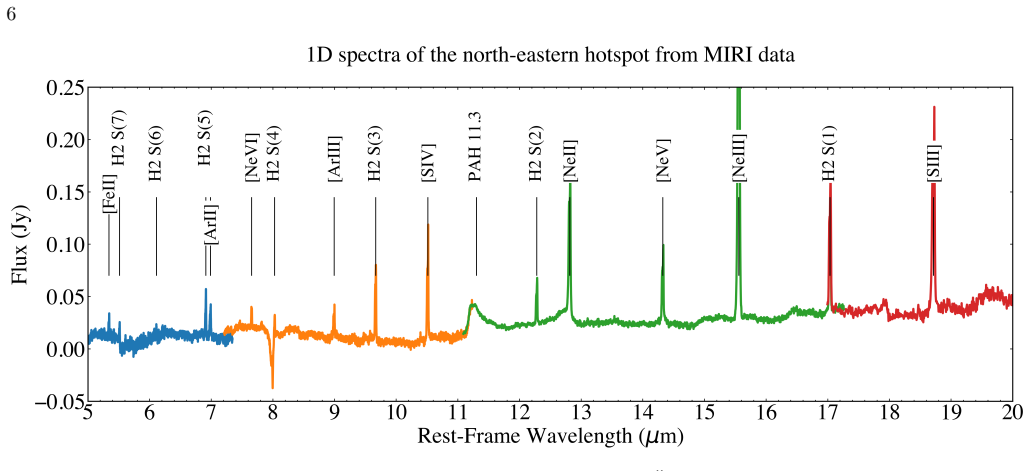
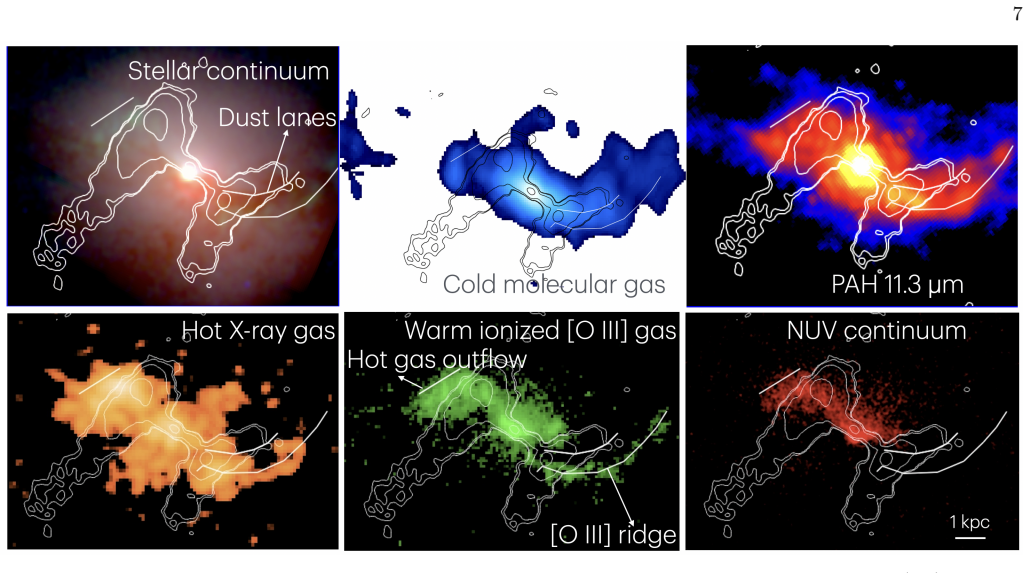
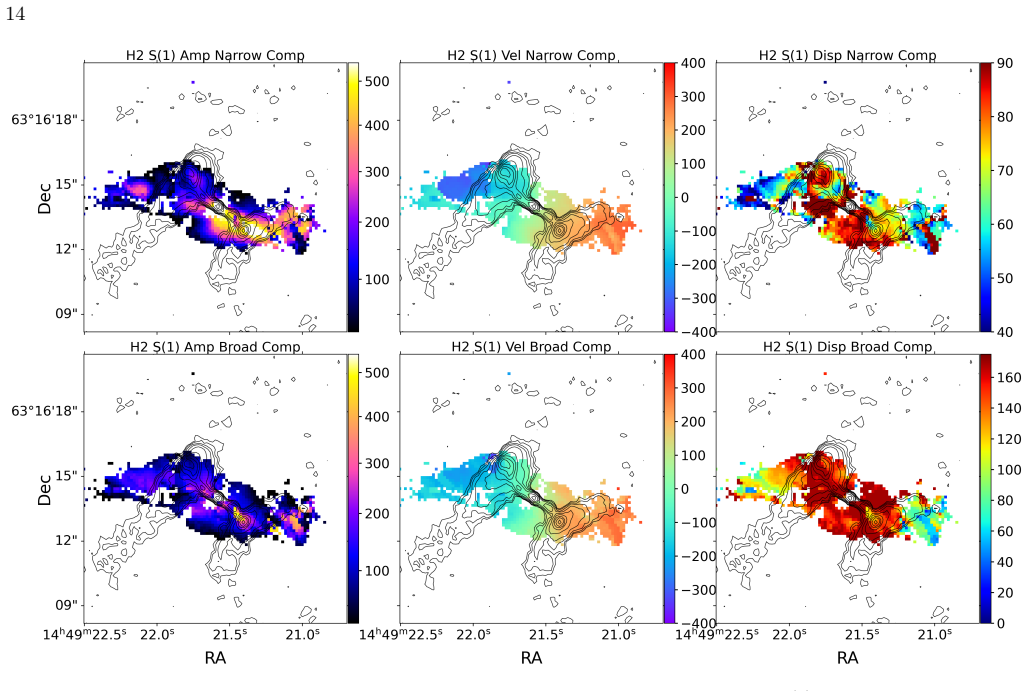
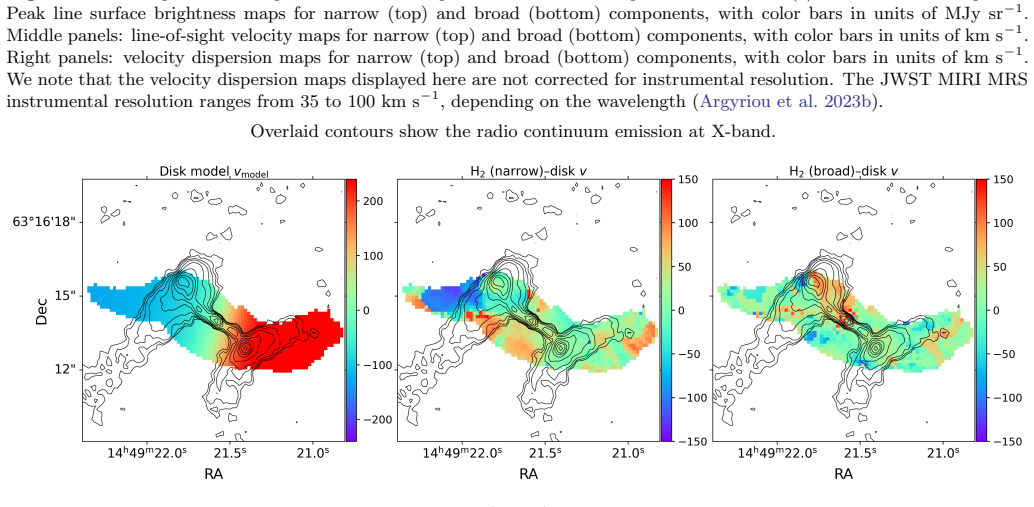
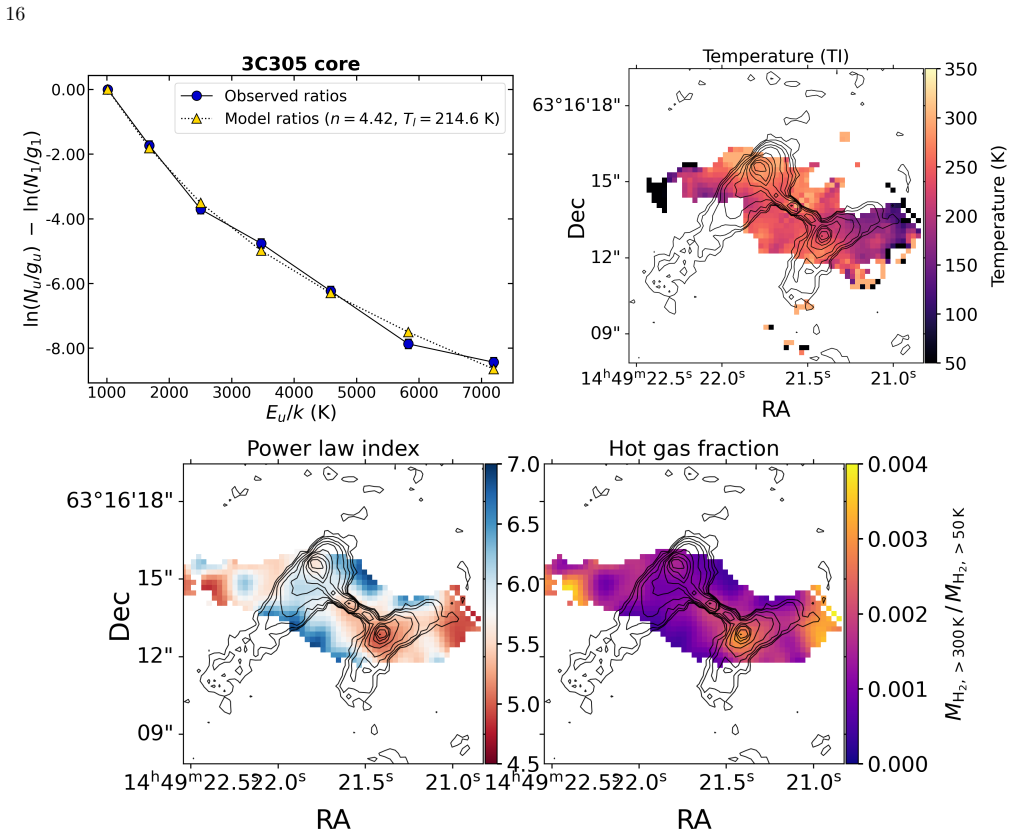
In 3C305 the radio jet shocks and accelerates multiphase gas, producing outflows whose total energy budget matches the jet power when line cooling is included. The MIRI MRS data require two Gaussian components for the H2 lines, with the high-velocity component aligned to the jet axis and reaching peak speeds at the hotspots; ionized fine-structure lines show even higher outflow speeds. MAPPINGS models fit most mid-IR ionized lines with shocks plus precursors, the H2 excitation diagram is flatter at the hotspots, and the combined molecular plus ionized outflow kinetic power plus radiative losses account for the jet power.
What carries the argument
Two-Gaussian kinematic decomposition of H2 lines combined with MAPPINGS shock-plus-precursor fitting to mid-IR fine-structure lines and H2 excitation diagrams.
If this is right
- Jets confined within the host galaxy can still drive kiloparsec-scale multiphase outflows.
- Ionized gas reaches higher outflow speeds than warm molecular gas at the same jet termination sites.
- Strong line cooling plus moderate kinetic power in outflows can fully account for observed jet power.
- Hotspots show a larger fraction of warm/hot H2 gas than the surrounding regions.
Where Pith is reading between the lines
- Similar confined jets in other radio galaxies may produce detectable multiphase outflows when observed at comparable resolution.
- The same jet-ISM coupling could remove enough gas to affect future star formation rates.
- Future observations of additional targets could test whether the two-component H2 kinematics and shock-model dominance are general.
Load-bearing premise
The observed line ratios and velocity fields are produced mainly by jet-driven shocks rather than star formation or AGN radiation.
What would settle it
Spatially resolved maps in which the highest outflow velocities or shock-like line ratios do not coincide with the radio jet hotspots.
Figures
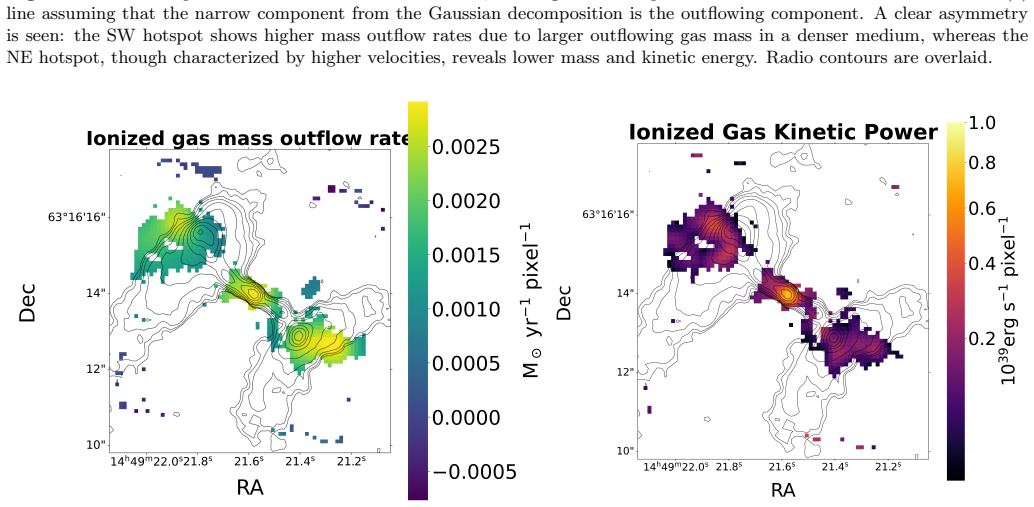
read the original abstract
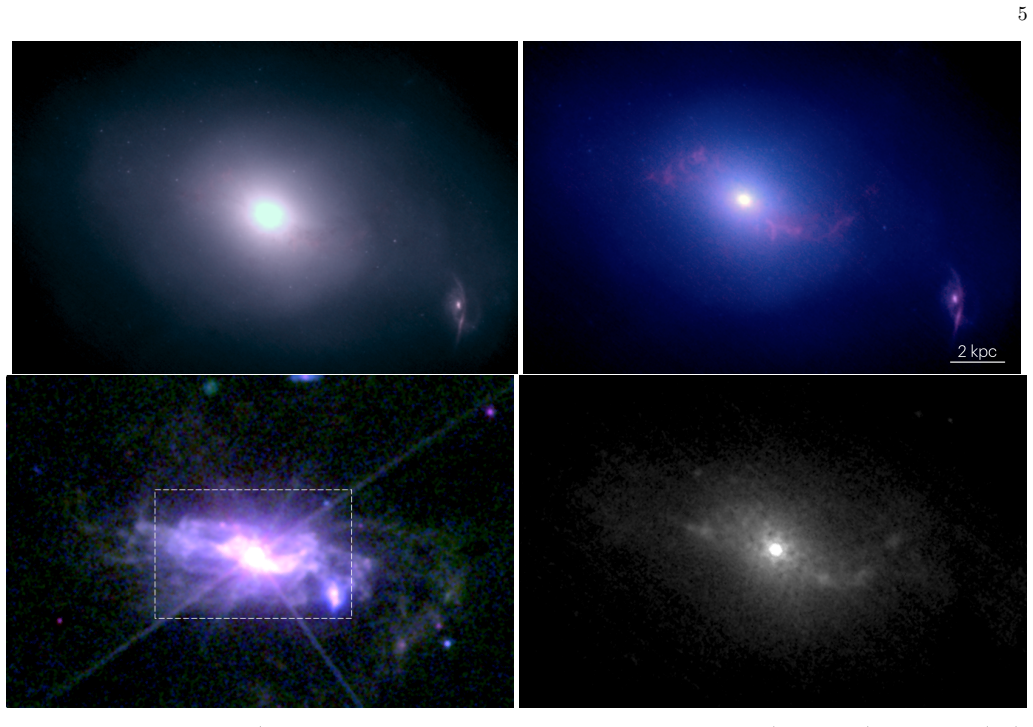
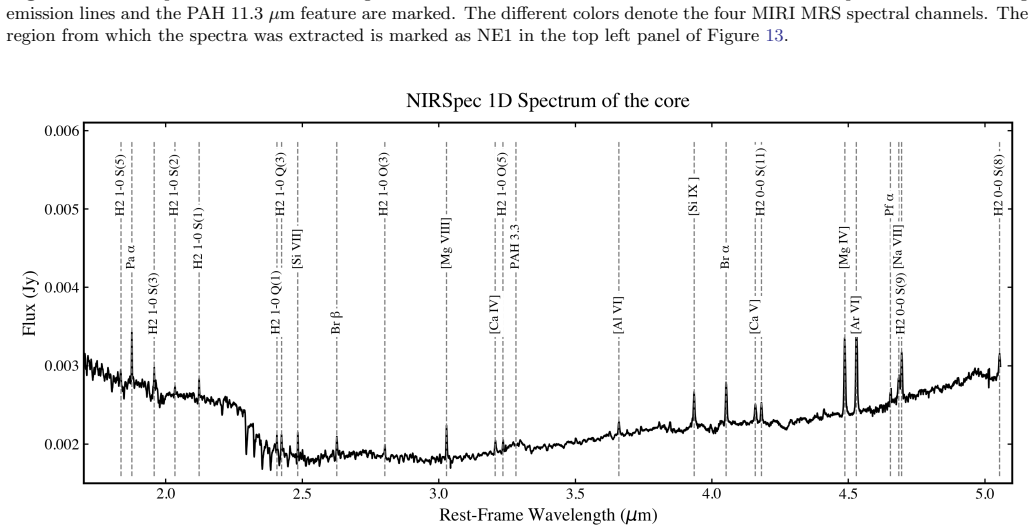
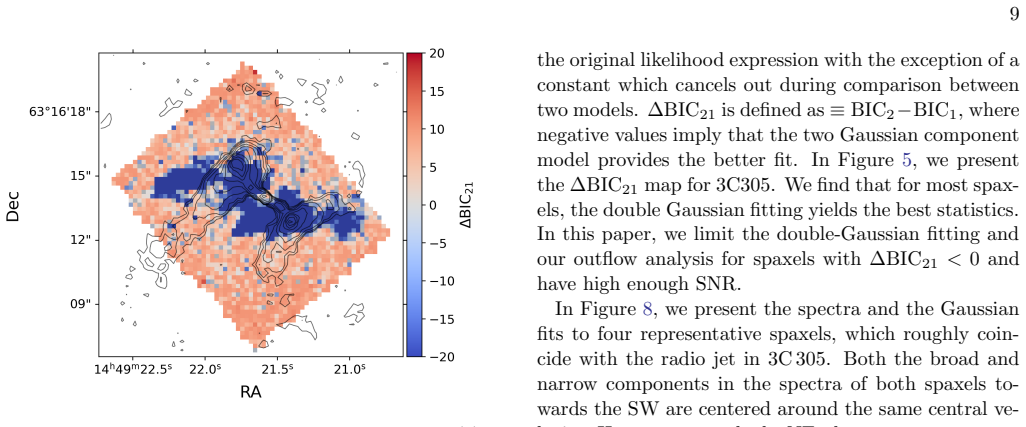
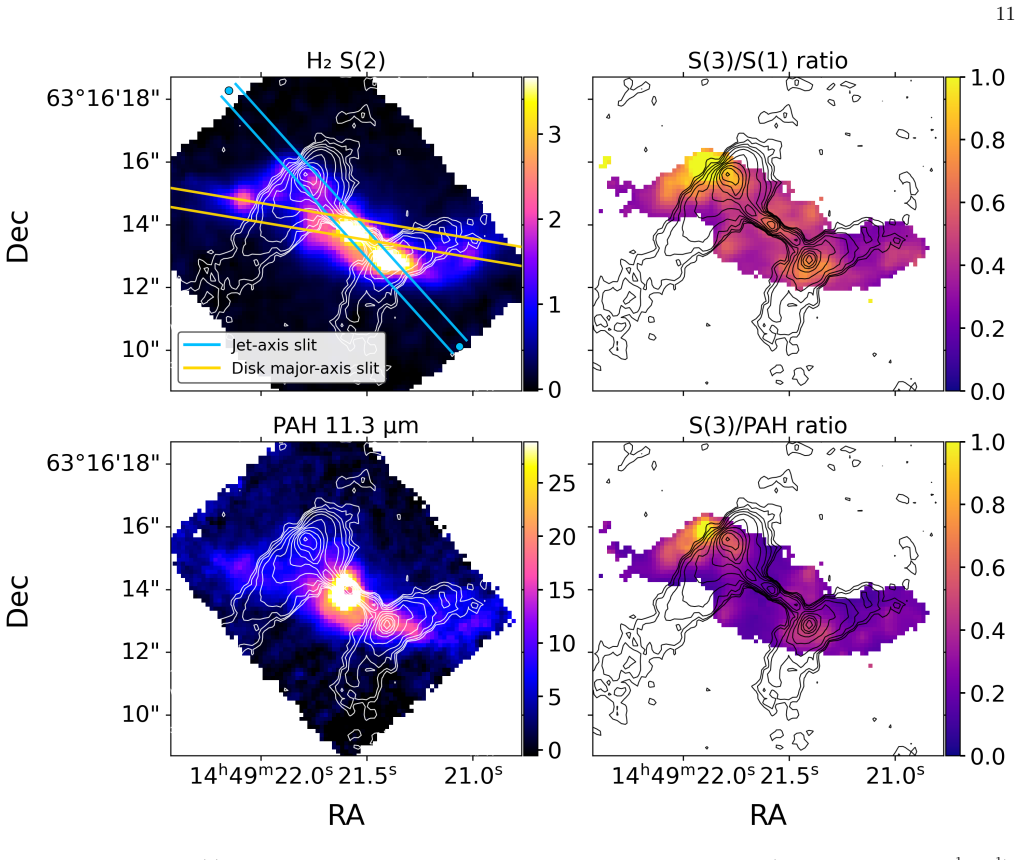
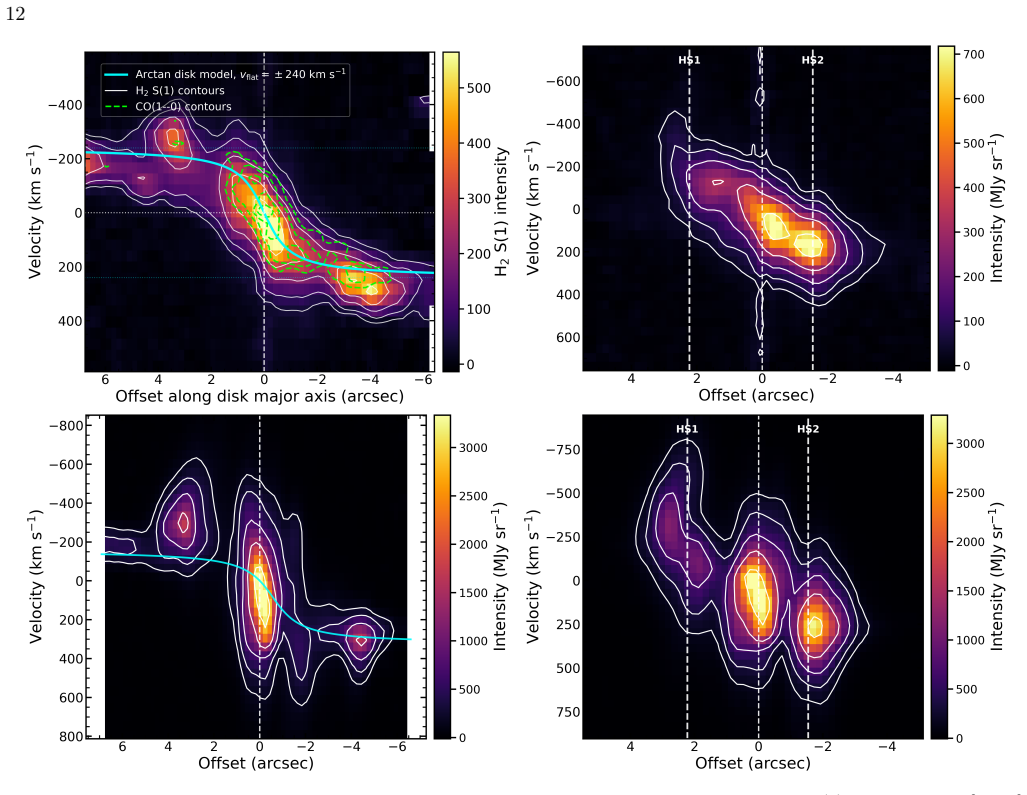
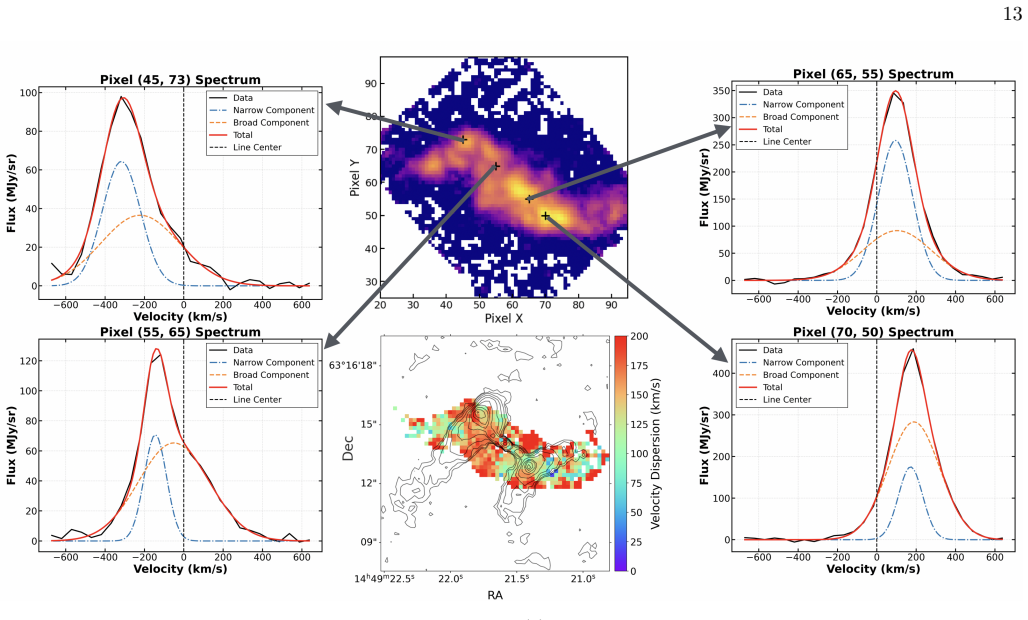
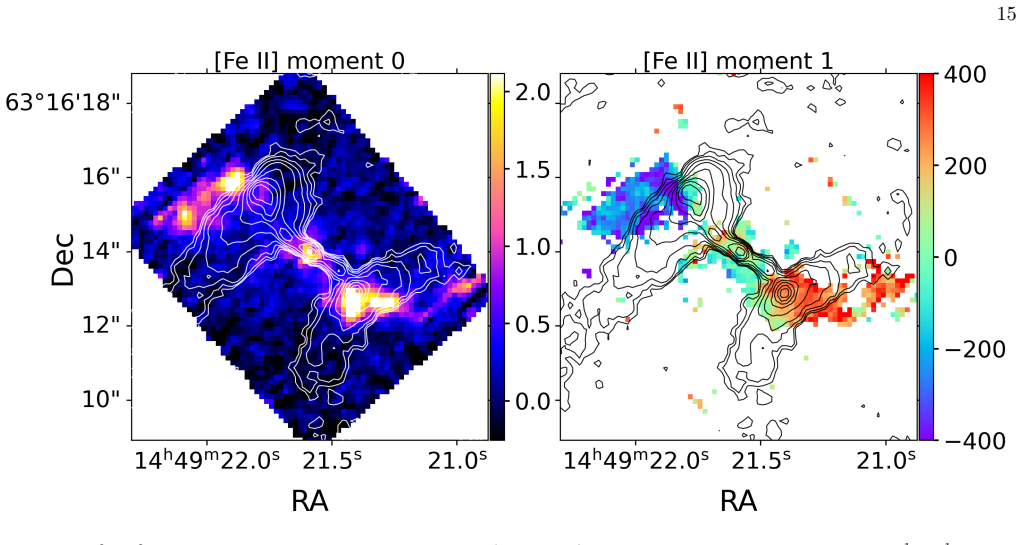
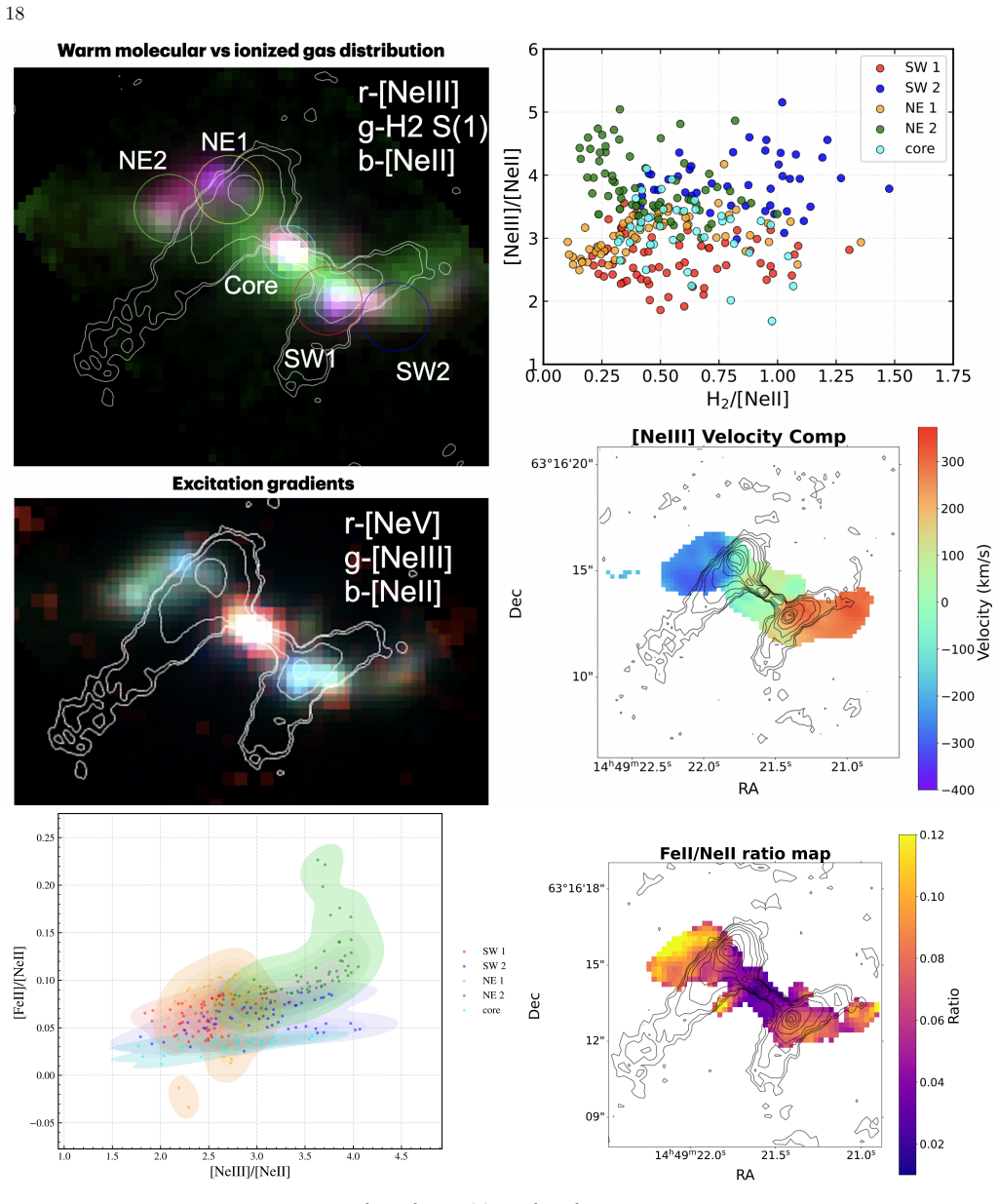
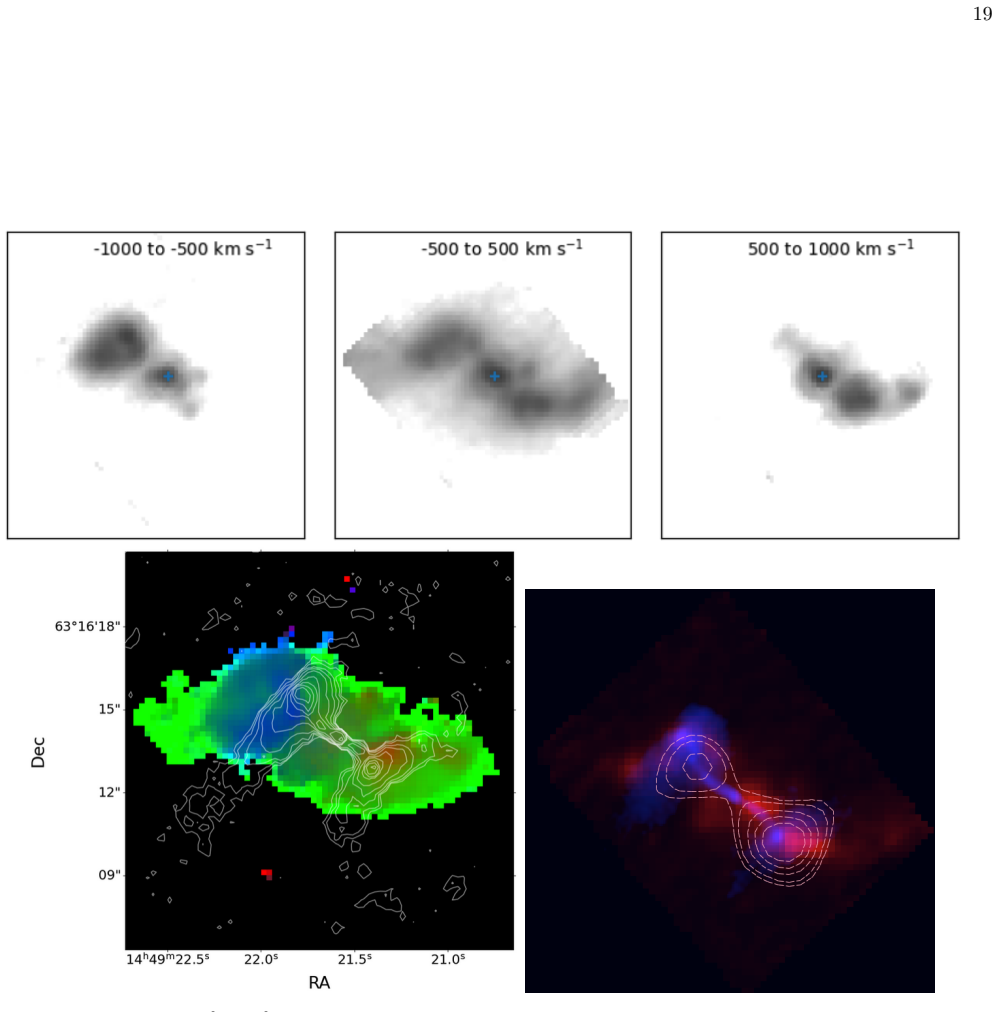
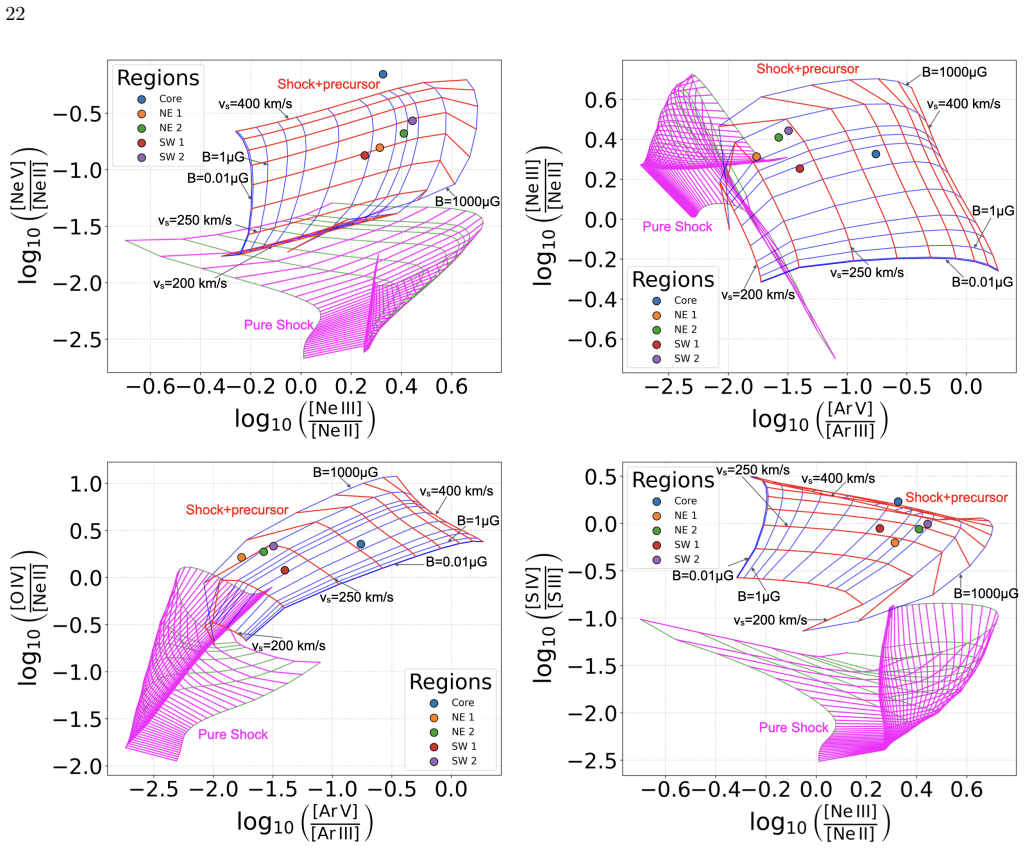
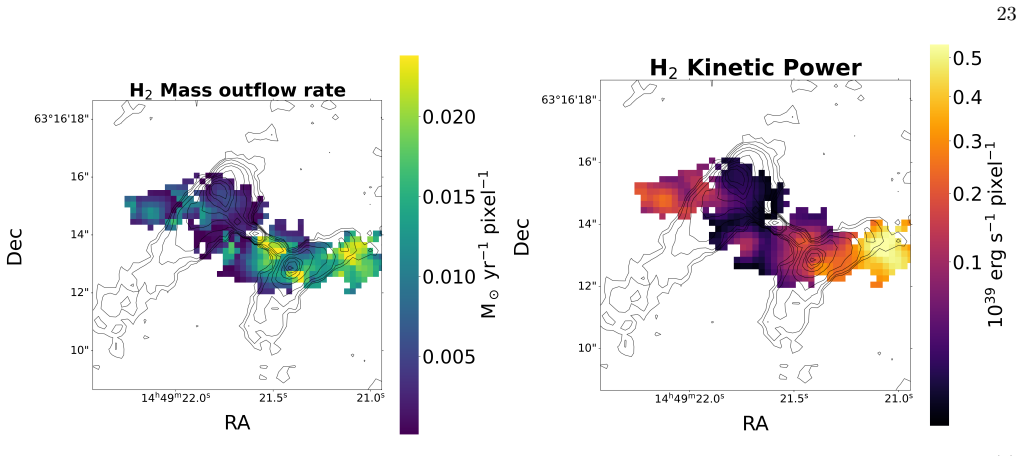
We present JWST MIRI MRS, NIRSpec, NIRCam, and MIRI imaging observations of 3C 305, a radio galaxy with a compact jet that is confined within the galaxy. We use the H2 0-0 S(1)-S(7) lines, several mid-IR fine-structure lines, and PAH emission in the MIRI MRS spectrum to conduct a multiphase study of the radio jet's impact on the interstellar medium. Multiple tracers, including H2/PAH 11.3 um and [Fe II] 5.34 um, provide evidence for shocks at the jet termination locations. Two Gaussian components are required to reproduce the warm H2 kinematics adequately, with one representing the bulk low-velocity component and the other corresponding to an outflow. The ionized gas reaches higher outflow velocities than the H2 gas, and the sharp increase in velocity at the jet hotspots points to jet-driven outflows. We fit the H2 excitation diagram with a power-law temperature distribution and find that the hotspots exhibit flatter slopes, indicating a larger warm/hot gas mass fraction at these locations. Our MAPPINGS line-ratio analysis indicates that most of the mid-IR ionized gas can be fit by a shock-plus-precursor model. We find that strong radiative losses dominated by line cooling, together with moderate kinetic power in the molecular and ionized gas outflows, can account for the estimated jet power, indicating high jet coupling efficiency in 3C 305. Together with other studies of multiphase gas, our results show that jets can efficiently shock-heat and accelerate the gas they encounter, driving massive, kiloparsec-scale, multiphase outflows.
Editorial analysis
A structured set of objections, weighed in public.
Referee Report
Summary. The manuscript presents JWST MIRI MRS, NIRSpec, NIRCam, and MIRI imaging of the radio galaxy 3C 305, whose compact jet is confined within the host. Using H2 0-0 S(1)–S(7) lines, mid-IR fine-structure lines, and PAH emission, the authors identify shock signatures at the jet termination points via H2/PAH and [Fe II] ratios, decompose the warm H2 kinematics into a low-velocity bulk component and a higher-velocity outflow component with two Gaussians, note higher outflow speeds in the ionized gas with sharp velocity jumps at the hotspots, fit the H2 excitation diagram to a power-law temperature distribution (finding flatter indices at the hotspots), and show that most ionized-gas line ratios are reproduced by MAPPINGS shock-plus-precursor models. An energy-budget comparison indicates that line cooling plus the kinetic power in the molecular and ionized outflows can account for the jet power, implying high coupling efficiency and supporting the conclusion that jets efficiently drive massive, kiloparsec-scale, multiphase outflows.
Significance. If the modeling and decomposition choices hold, the work supplies one of the most detailed multiphase (warm H2 + ionized) views of jet–ISM coupling at ~kpc scales with JWST resolution. The convergence of several independent tracers (line ratios, kinematics, excitation slopes, and energy balance) on a shock-driven picture is a clear strength, and the explicit energy accounting that closes the jet-power budget is directly useful for feedback prescriptions in galaxy-evolution models.
major comments (3)
- [§3.2] §3.2 (kinematic decomposition): the statement that “two Gaussian components are required” is load-bearing for the outflow identification, yet no quantitative justification (Δχ², F-test probability, or BIC/AIC comparison between one- and two-component fits) is provided; without it the decomposition could be sensitive to noise or continuum-subtraction choices.
- [§4.3] §4.3 (MAPPINGS line-ratio analysis): the claim that “most of the mid-IR ionized gas can be fit by a shock-plus-precursor model” rests on the specific grid of shock velocities, pre-shock densities, and magnetic parameters adopted; the manuscript must report the explored parameter ranges, the best-fit values with uncertainties, and the fraction of spaxels whose reduced χ² exceeds a stated threshold before the conclusion that shocks dominate over photoionization can be considered robust.
- [§5] §5 (energy balance): the assertion that radiative losses plus outflow kinetic power “can account for the estimated jet power” requires explicit propagation of uncertainties on both the jet power (derived from radio luminosity or lobe energetics) and the outflow kinetic luminosities; the current text does not show whether the budget closes within 1σ or only at the order-of-magnitude level.
minor comments (3)
- [Figure 4] Figure 4 (H2 excitation diagrams): the power-law slopes and their uncertainties should be tabulated for each spatial region so readers can judge the significance of the reported difference between hotspots and the rest of the galaxy.
- [Methods] The text refers to “the estimated jet power” without citing the exact radio-based formula or reference used; a short methods paragraph or table entry would remove ambiguity.
- [Figure 6] Several mid-IR line ratios are shown in figures but the corresponding MAPPINGS model curves are not over-plotted; adding the best-fit model loci would make the goodness-of-fit visually verifiable.
Simulated Author's Rebuttal
We thank the referee for their constructive and detailed report. We address each major comment below and will revise the manuscript accordingly to incorporate the requested quantitative details and uncertainty analyses.
read point-by-point responses
-
Referee: [§3.2] §3.2 (kinematic decomposition): the statement that “two Gaussian components are required” is load-bearing for the outflow identification, yet no quantitative justification (Δχ², F-test probability, or BIC/AIC comparison between one- and two-component fits) is provided; without it the decomposition could be sensitive to noise or continuum-subtraction choices.
Authors: We agree that a quantitative justification for adopting two Gaussian components is necessary to robustly support the outflow identification. In the revised manuscript we will add Δχ², F-test probabilities, and BIC comparisons between one- and two-component fits for representative spaxels across the field, demonstrating that the second component is statistically required rather than arising from noise or continuum choices. revision: yes
-
Referee: [§4.3] §4.3 (MAPPINGS line-ratio analysis): the claim that “most of the mid-IR ionized gas can be fit by a shock-plus-precursor model” rests on the specific grid of shock velocities, pre-shock densities, and magnetic parameters adopted; the manuscript must report the explored parameter ranges, the best-fit values with uncertainties, and the fraction of spaxels whose reduced χ² exceeds a stated threshold before the conclusion that shocks dominate over photoionization can be considered robust.
Authors: We will expand §4.3 to document the full MAPPINGS grid (shock velocities 100–1000 km s⁻¹, pre-shock densities 1–100 cm⁻³, magnetic parameters B/n^{1/2} = 0–10 μG cm^{3/2}), report best-fit values and uncertainties per spaxel, and state the fraction of spaxels whose reduced χ² exceeds a defined threshold (e.g., χ²_red > 3). This will allow readers to evaluate the robustness of the shock-dominated conclusion. revision: yes
-
Referee: [§5] §5 (energy balance): the assertion that radiative losses plus outflow kinetic power “can account for the estimated jet power” requires explicit propagation of uncertainties on both the jet power (derived from radio luminosity or lobe energetics) and the outflow kinetic luminosities; the current text does not show whether the budget closes within 1σ or only at the order-of-magnitude level.
Authors: We accept that explicit uncertainty propagation is required. In the revised §5 we will propagate uncertainties on the jet-power estimate (from radio luminosity and lobe energetics) and on the outflow kinetic luminosities (including distance, mass, and velocity uncertainties), presenting the energy-budget comparison with 1σ error bars to clarify whether the budget closes within uncertainties or only at the order-of-magnitude level. revision: yes
Circularity Check
No significant circularity; observational analysis with independent tracers
full rationale
The paper is an observational study presenting JWST data on 3C 305, using standard tools such as two-Gaussian kinematic decomposition, power-law fits to H2 excitation diagrams, and MAPPINGS shock-plus-precursor models for line ratios. These are applied to multiple independent tracers (H2/PAH, [Fe II], kinematics at hotspots, excitation slopes, energy balance) that converge on jet-driven shocks without any derivation reducing by construction to a fitted parameter renamed as a prediction. No self-definitional loops, load-bearing self-citations, uniqueness theorems from the authors, or ansatz smuggling are present in the described chain. The central claim rests on empirical convergence rather than internal redefinition.
Axiom & Free-Parameter Ledger
free parameters (1)
- power-law index for H2 temperature distribution
axioms (1)
- domain assumption MAPPINGS shock-plus-precursor models are the appropriate physical description for the observed mid-IR ionized gas line ratios
Reference graph
Works this paper leans on
-
[1]
Jet-driven shocks and turbulence in radio-loud Active Galactic Nuclei observed with JWST MIRI/MRS. arXiv e-prints , keywords =. doi:10.48550/arXiv.2605.02663 , archivePrefix =. 2605.02663 , primaryClass =
-
[2]
Trigonometric Parallaxes of High Mass Star Forming Regions: The Structure and Kinematics of the Milky Way. , keywords =. doi:10.1088/0004-637X/783/2/130 , archivePrefix =. 1401.5377 , primaryClass =
-
[3]
JWST MIRI flight performance: The Medium-Resolution Spectrometer. , keywords =. doi:10.1051/0004-6361/202346489 , archivePrefix =. 2303.13469 , primaryClass =
-
[4]
The DUVET Survey: Resolved maps of star formation-driven outflows in a compact, starbursting disc galaxy. , keywords =. doi:10.1093/mnras/stac420 , archivePrefix =. 2202.04672 , primaryClass =
-
[5]
reproject: Python-based astronomical image reprojection
-
[6]
American Astronomical Society Meeting Abstracts \#241 , year = 2023, series =
JWST/HST Alignment Tool (JHAT). American Astronomical Society Meeting Abstracts \#241 , year = 2023, series =
2023
-
[7]
Quasar feedback survey: multiphase outflows, turbulence, and evidence for feedback caused by low power radio jets inclined into the galaxy disc. , keywords =. doi:10.1093/mnras/stac073 , archivePrefix =. 2201.02208 , primaryClass =
-
[8]
Feedback from low-luminosity radio galaxies: B2 0258+35. , keywords =. doi:10.1051/0004-6361/201935931 , archivePrefix =. 1908.00374 , primaryClass =
-
[9]
Jet-mode Feedback in NGC 5972: Insights from Resolved MUSE, GMRT, and VLA Observations. , keywords =. doi:10.3847/1538-4357/adc38d , archivePrefix =. 2503.19031 , primaryClass =
-
[10]
Kinematics and excitation of the nuclear spiral in the active galaxy Arp 102B. , keywords =. doi:10.1093/mnras/stt1491 , archivePrefix =. 1308.1891 , primaryClass =
-
[11]
Gas inflows towards the nucleus of the active galaxy NGC 7213. , keywords =. doi:10.1093/mnras/stt2440 , archivePrefix =. 1401.5650 , primaryClass =
-
[12]
Feeding and feedback in NGC 3081. , keywords =. doi:10.1093/mnras/stw037 , archivePrefix =. 1601.05432 , primaryClass =
-
[13]
The Complex Gas Kinematics in the Nucleus of the Seyfert 2 Galaxy NGC 1386: Rotation, Outflows, and Inflows. , keywords =. doi:10.1088/0004-637X/806/1/84 , archivePrefix =. 1504.05089 , primaryClass =
-
[14]
The AGNIFS survey: spatially resolved observations of hot molecular and ionized outflows in nearby active galaxies. , keywords =. doi:10.1093/mnras/stad599 , archivePrefix =. 2302.11324 , primaryClass =
-
[15]
Multiphase Gas Flows in the Nearby Seyfert Galaxy ESO428-G014. Paper I. , keywords =. doi:10.3847/1538-4357/ab67bd , archivePrefix =. 1904.01483 , primaryClass =
-
[16]
Gas rotation, shocks and outflow within the inner 3 kpc of the radio galaxy 3C 33. , keywords =. doi:10.1093/mnras/stx962 , archivePrefix =. 1704.06343 , primaryClass =
-
[17]
Mixing between AGN winds and ISM clouds produces luminous X-ray emission. , keywords =. doi:10.1093/mnras/staf2065 , archivePrefix =. 2511.14834 , primaryClass =
-
[18]
On the origin of X-ray oxygen emission lines in obscured AGN. , keywords =. doi:10.1093/mnras/staa3169 , archivePrefix =. 2010.05412 , primaryClass =
-
[19]
Probing the Excitation of Extreme Starbursts: High-Resolution Mid-Infrared Spectroscopy of Blue Compact Dwarfs. , keywords =. doi:10.1088/0004-637X/704/2/1159 , archivePrefix =. 0908.4084 , primaryClass =
-
[20]
On the Hydrodynamic Interaction of Shock Waves with Interstellar Clouds. I. Nonradiative Shocks in Small Clouds. , keywords =. doi:10.1086/173554 , adsurl =
-
[21]
Spectral Signatures of Fast Shocks. I. Low-Density Model Grid. , keywords =. doi:10.1086/192255 , adsurl =
-
[22]
Outflow densities and ionization mechanisms in the NLRs of the prototypical Seyfert galaxies NGC 1068 and NGC 4151. , keywords =. doi:10.1093/mnras/stad1677 , archivePrefix =. 2306.03920 , primaryClass =
-
[23]
AGN-driven outflows and the AGN feedback efficiency in young radio galaxies. , keywords =. doi:10.1051/0004-6361/202039077 , archivePrefix =. 2009.11175 , primaryClass =
-
[24]
Shock excitation of H _ 2 in the James Webb Space Telescope era. , keywords =. doi:10.1051/0004-6361/202346254 , archivePrefix =. 2307.04178 , primaryClass =
-
[25]
JWST NIRCam Imaging of NGC 4258. I. Observation Overview. , keywords =. doi:10.3847/1538-4357/adfb62 , archivePrefix =. 2508.11044 , primaryClass =
-
[26]
JWST MIRI flight performance: Imaging. , keywords =. doi:10.1051/0004-6361/202449451 , archivePrefix =. 2403.16686 , primaryClass =
-
[27]
NSClean: An Algorithm for Removing Correlated Noise from JWST NIRSpec Images. , keywords =. doi:10.1088/1538-3873/ad1b36 , archivePrefix =. 2306.03250 , primaryClass =
-
[28]
The SINFONI survey of powerful radio galaxies at z 2: Jet-driven AGN feedback during the Quasar Era. , keywords =. doi:10.1051/0004-6361/201528040 , archivePrefix =. 1610.02057 , primaryClass =
-
[29]
AGN outflows and feedback twenty years on. Nature Astronomy , keywords =. doi:10.1038/s41550-018-0403-6 , archivePrefix =. 1802.10306 , primaryClass =
-
[30]
Blowing Star Formation Away in AGN Hosts (BAH). II. Investigating the Origin of the H _ 2 Emission Excess in Nearby Galaxies with JWST MIRI. , keywords =. doi:10.3847/1538-4357/adb8dd , archivePrefix =. 2410.06960 , primaryClass =
-
[31]
Low-power jet-interstellar medium interaction in NGC 7319 revealed by JWST/MIRI MRS. , keywords =. doi:10.1051/0004-6361/202244725 , archivePrefix =. 2208.04835 , primaryClass =
-
[32]
The JWST View of Cygnus A: Jet-driven Coronal Outflow with a Twist. , keywords =. doi:10.3847/1538-4357/adb71a , archivePrefix =. 2502.06603 , primaryClass =
-
[33]
JWST Reveals Powerful Feedback from Radio Jets in a Massive Galaxy at z = 4.1. , keywords =. doi:10.3847/1538-4357/ad4bda , archivePrefix =. 2401.11612 , primaryClass =
-
[34]
Blowin' in the Wind: Both ``Negative'' and ``Positive'' Feedback in an Obscured High-z Quasar. , keywords =. doi:10.1088/0004-637X/799/1/82 , archivePrefix =. 1411.4208 , primaryClass =
-
[35]
Unleashing Positive Feedback: Linking the Rates of Star Formation, Supermassive Black Hole Accretion, and Outflows in Distant Galaxies. , keywords =. doi:10.1088/0004-637X/772/2/112 , archivePrefix =. 1305.5840 , primaryClass =
-
[36]
Compact steep-spectrum and peaked-spectrum radio sources. , keywords =. doi:10.1007/s00159-021-00131-w , archivePrefix =. 2009.02750 , primaryClass =
-
[37]
Destruction and survival of polycyclic aromatic hydrocarbons in active galaxies. , keywords =. doi:10.1093/mnras/258.4.841 , adsurl =
-
[38]
Shocked, heated, and now resolved: H _ 2 excitation in the low-luminosity AGN at M58 core with JWST. , keywords =. doi:10.1051/0004-6361/202556565 , archivePrefix =. 2509.25483 , primaryClass =
-
[39]
Jet-shocked H _ 2 and CO in the Anomalous Arms of Molecular Hydrogen Emission Galaxy NGC 4258. , keywords =. doi:10.1088/2041-8205/788/2/L33 , archivePrefix =. 1405.2040 , primaryClass =
-
[40]
An Independent Derivation of the Oxford Jet Kinetic Luminosity Formula. , keywords =. doi:10.1086/430140 , archivePrefix =. astro-ph/0503267 , primaryClass =
-
[41]
Ionized outflows in local luminous AGN: what are the real densities and outflow rates?. , keywords =. doi:10.1093/mnras/staa2413 , archivePrefix =. 2003.06153 , primaryClass =
-
[42]
The Origin of the Infrared Emission in Radio Galaxies. III. Analysis of 3CRR Objects. , keywords =. doi:10.1088/0004-637X/722/2/1333 , archivePrefix =. 1008.2719 , primaryClass =
-
[43]
The impact of the warm outflow in the young (GPS) radio source and ULIRG PKS 1345+12 (4C 12.50). , keywords =. doi:10.1111/j.1365-2966.2010.17535.x , archivePrefix =. 1008.2846 , primaryClass =
-
[44]
Star Formation in 3CR Radio Galaxies and Quasars at z < 1. , keywords =. doi:10.3847/0004-6256/151/5/120 , archivePrefix =. 1602.07443 , primaryClass =
-
[45]
Quasar feedback revealed by giant molecular outflows. , keywords =. doi:10.1051/0004-6361/201015164 , archivePrefix =. 1006.1655 , primaryClass =
-
[46]
Massive molecular outflows and evidence for AGN feedback from CO observations. , keywords =. doi:10.1051/0004-6361/201322464 , archivePrefix =. 1311.2595 , primaryClass =
-
[47]
Suppression of Star Formation in NGC 1266. , keywords =. doi:10.1088/0004-637X/798/1/31 , archivePrefix =. 1410.4556 , primaryClass =
-
[48]
Young Radio Sources Expanding in Gas-Rich ISM: Using Cold Molecular Gas to Trace Their Impact. Galaxies , keywords =. doi:10.3390/galaxies11010024 , archivePrefix =. 2302.14095 , primaryClass =
-
[49]
Ionized outflows from active galactic nuclei as the essential elements of feedback. Nature Astronomy , keywords =. doi:10.1038/s41550-020-01255-2 , archivePrefix =. 2012.06945 , primaryClass =
-
[50]
Cool outflows in galaxies and their implications. , keywords =. doi:10.1007/s00159-019-0121-9 , archivePrefix =. 2002.07765 , primaryClass =
-
[51]
Extreme ionised outflows are more common when the radio emission is compact in AGN host galaxies. , keywords =. doi:10.1051/0004-6361/201936408 , archivePrefix =. 1909.05260 , primaryClass =
-
[52]
Prevalence of radio jets associated with galactic outflows and feedback from quasars. , keywords =. doi:10.1093/mnras/stz556 , archivePrefix =. 1902.07727 , primaryClass =
-
[53]
A Relationship Between AGN Jet Power and Radio Power. , keywords =. doi:10.1088/0004-637X/720/2/1066 , archivePrefix =. 1006.5699 , primaryClass =
-
[54]
Radiative Efficiency and Content of Extragalactic Radio Sources: Toward a Universal Scaling Relation between Jet Power and Radio Power. , keywords =. doi:10.1086/591416 , archivePrefix =. 0806.1929 , primaryClass =
-
[55]
MICONIC: JWST/MIRI MRS observations of the nuclear and circumnuclear regions of Mrk 231. , keywords =. doi:10.1051/0004-6361/202450071 , archivePrefix =. 2407.02180 , primaryClass =
-
[56]
A Spitzer High-resolution Mid-Infrared Spectral Atlas of Starburst Galaxies. , keywords =. doi:10.1088/0067-0049/184/2/230 , archivePrefix =. 0908.2812 , primaryClass =
-
[57]
The jet-ISM interactions in IC 5063. , keywords =. doi:10.1093/mnras/sty067 , archivePrefix =. 1801.06875 , primaryClass =
-
[58]
Blowing star formation away in AGN Hosts (BAH) -- III: Feeding and feedback in 3C 293 observed with JWST NIRSpec. arXiv e-prints , keywords =. doi:10.48550/arXiv.2506.20896 , archivePrefix =. 2506.20896 , primaryClass =
-
[59]
H _ 2 emission arises outside photodissociation regions in ultraluminous infrared galaxies. , keywords =. doi:10.1038/nature09037 , archivePrefix =. 1005.3832 , primaryClass =
-
[60]
Warm molecular gas temperature distribution in six local infrared bright Seyfert galaxies. , keywords =. doi:10.1051/0004-6361/201423430 , archivePrefix =. 1404.6470 , primaryClass =
-
[61]
Observational Evidence of Active Galactic Nuclei Feedback. , keywords =. doi:10.1146/annurev-astro-081811-125521 , archivePrefix =. 1204.4114 , primaryClass =
-
[62]
Supermassive black holes and their feedback effects in the IllustrisTNG simulation. , keywords =. doi:10.1093/mnras/sty1733 , archivePrefix =. 1710.04659 , primaryClass =
-
[63]
The EAGLE project: simulating the evolution and assembly of galaxies and their environments. , keywords =. doi:10.1093/mnras/stu2058 , archivePrefix =. 1407.7040 , primaryClass =
-
[64]
The many lives of active galactic nuclei: cooling flows, black holes and the luminosities and colours of galaxies. , keywords =. doi:10.1111/j.1365-2966.2005.09675.x , archivePrefix =. astro-ph/0508046 , primaryClass =
-
[65]
Simulations of the formation, evolution and clustering of galaxies and quasars. , keywords =. doi:10.1038/nature03597 , archivePrefix =. astro-ph/0504097 , primaryClass =
-
[66]
Energy input from quasars regulates the growth and activity of black holes and their host galaxies. , keywords =. doi:10.1038/nature03335 , archivePrefix =. astro-ph/0502199 , primaryClass =
-
[67]
Quasars and galaxy formation. , keywords =. doi:10.48550/arXiv.astro-ph/9801013 , archivePrefix =. astro-ph/9801013 , primaryClass =
-
[68]
A Relationship between Nuclear Black Hole Mass and Galaxy Velocity Dispersion. , keywords =. doi:10.1086/312840 , archivePrefix =. astro-ph/0006289 , primaryClass =
-
[69]
A Fundamental Relation between Supermassive Black Holes and Their Host Galaxies. , keywords =. doi:10.1086/312838 , archivePrefix =. astro-ph/0006053 , primaryClass =
-
[70]
Observational Tests of Active Galactic Nuclei Feedback: An Overview of Approaches and Interpretation. Galaxies , keywords =. doi:10.3390/galaxies12020017 , archivePrefix =. 2404.08050 , primaryClass =
-
[71]
Jet-driven AGN feedback on molecular gas and low star-formation efficiency in a massive local spiral galaxy with a bright X-ray halo. , keywords =. doi:10.1051/0004-6361/202140544 , archivePrefix =. 2103.12816 , primaryClass =
-
[72]
Blowing Star Formation Away in Active Galactic Nuclei Hosts. I. Observation of Warm Molecular Outflows with JWST MIRI. , keywords =. doi:10.3847/1538-4357/ad702a , archivePrefix =. 2408.06100 , primaryClass =
-
[73]
A Case Study of Gas Impacted by Black-hole Jets with the JWST: Outflows, Bow Shocks, and High Excitation of the Gas in the Galaxy IC 5063. , keywords =. doi:10.3847/1538-4357/ad89ba , archivePrefix =. 2406.03218 , primaryClass =
-
[74]
Jet acceleration of the fast molecular outflows in the Seyfert galaxy IC 5063. , keywords =. doi:10.1038/nature13520 , archivePrefix =. 1407.1332 , primaryClass =
-
[75]
Effects of Preionization in Radiative Shocks. I. Self-consistent Models. , keywords =. doi:10.3847/1538-4365/aa6541 , archivePrefix =. 1702.07453 , primaryClass =
-
[76]
The MAPPINGS III Library of Fast Radiative Shock Models. , keywords =. doi:10.1086/589652 , archivePrefix =. 0805.0204 , primaryClass =
-
[77]
A virtual observatory for photoionized nebulae: the Mexican Million Models database (3MdB). , keywords =. doi:10.48550/arXiv.1412.5349 , archivePrefix =. 1412.5349 , primaryClass =
-
[78]
Extensive Online Shock Model Database. , keywords =. doi:10.22201/ia.01851101p.2019.55.02.21 , archivePrefix =. 1908.08579 , primaryClass =
-
[79]
Warm Molecular Hydrogen in the Spitzer SINGS Galaxy Sample. , keywords =. doi:10.1086/521667 , archivePrefix =. 0707.0395 , primaryClass =
-
[80]
Resolved Molecular Hydrogen Properties, Star Formation, and Feedback
A JWST/MIRI View of the ISM in M83: I. Resolved Molecular Hydrogen Properties, Star Formation, and Feedback. arXiv e-prints , keywords =. doi:10.48550/arXiv.2410.09020 , archivePrefix =. 2410.09020 , primaryClass =
discussion (0)
Sign in with ORCID, Apple, or X to comment. Anyone can read and Pith papers without signing in.