The butterflies' effects
Pith reviewed 2026-06-29 14:13 UTC · model grok-4.3
The pith
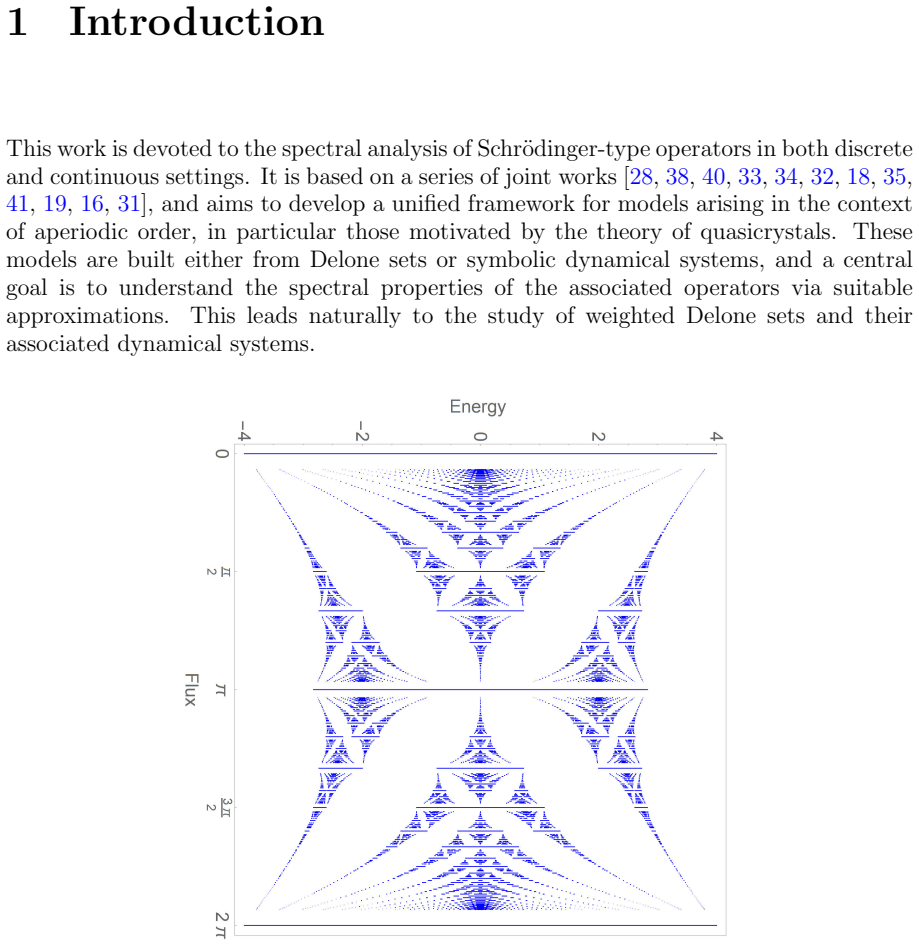
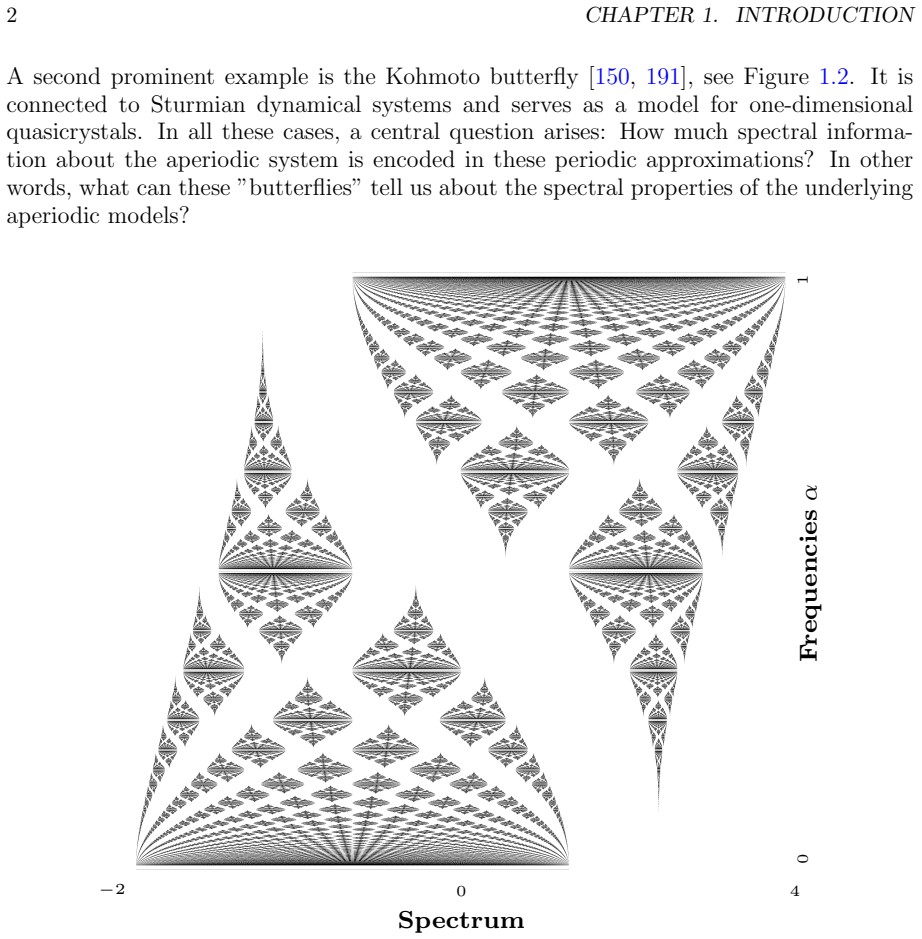
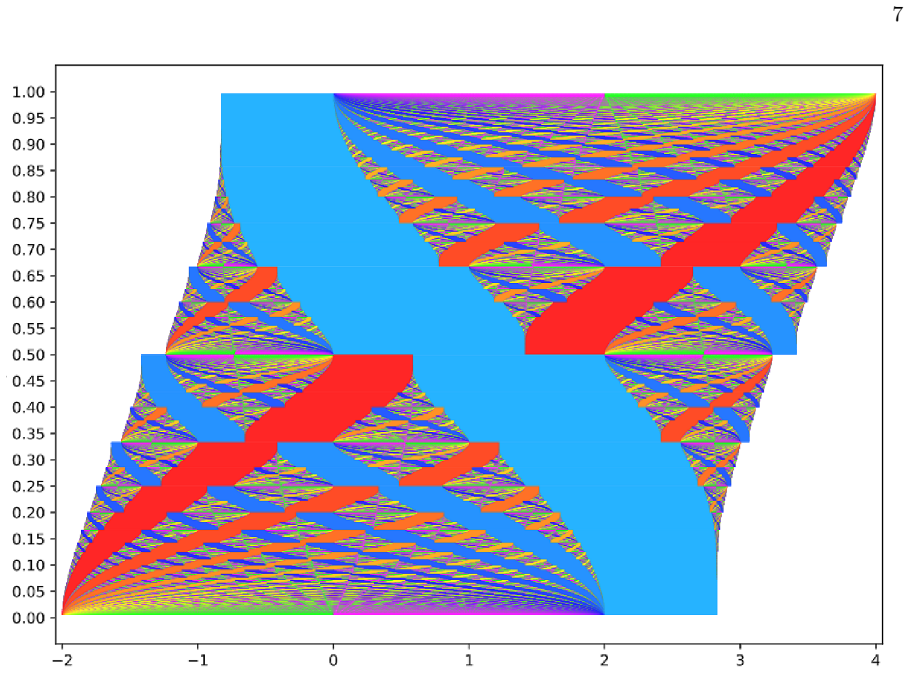
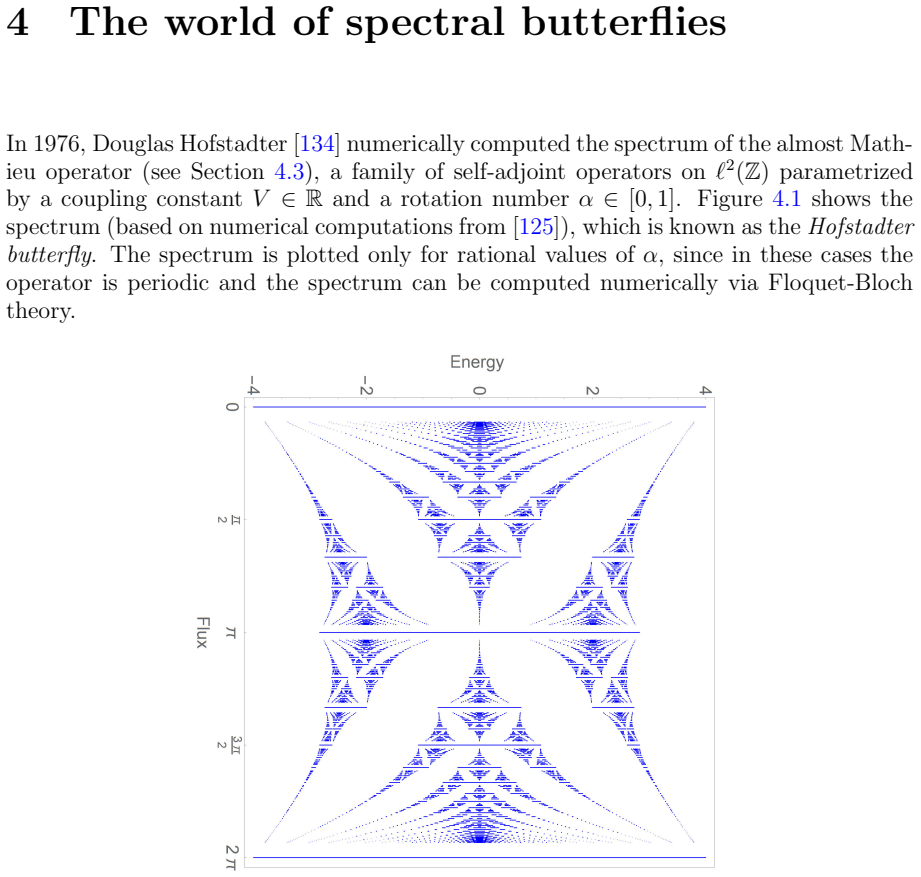
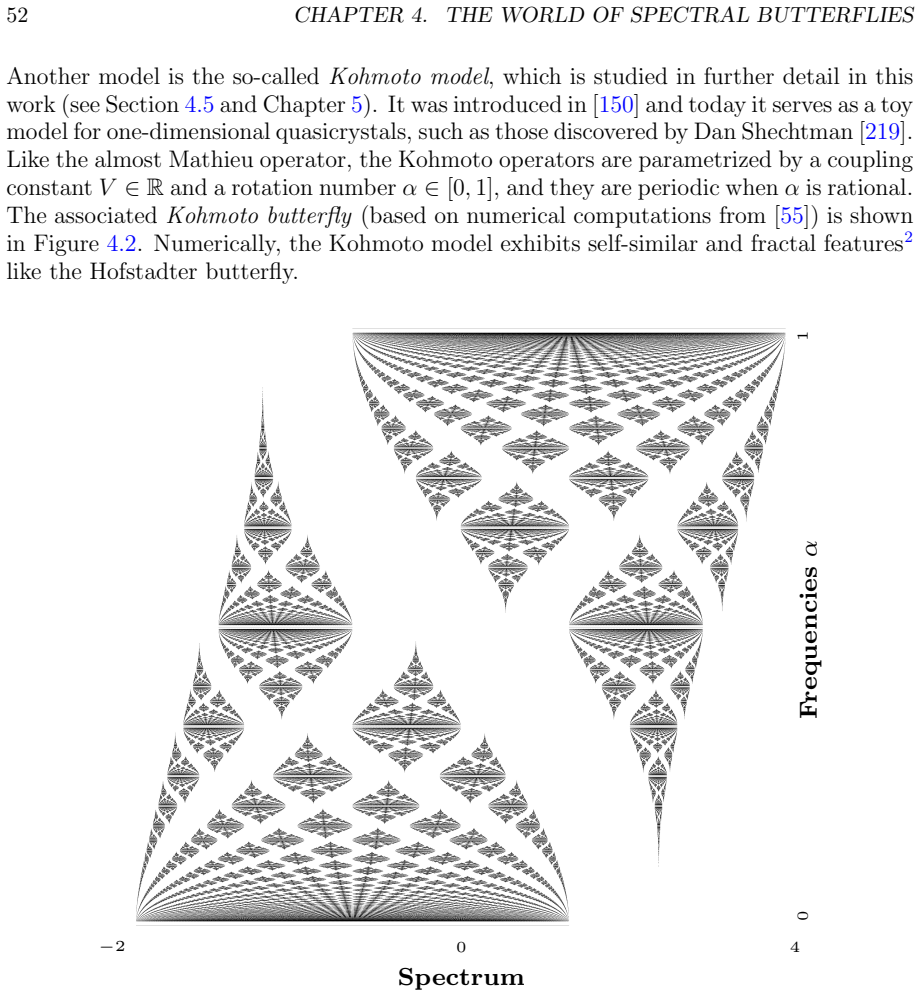
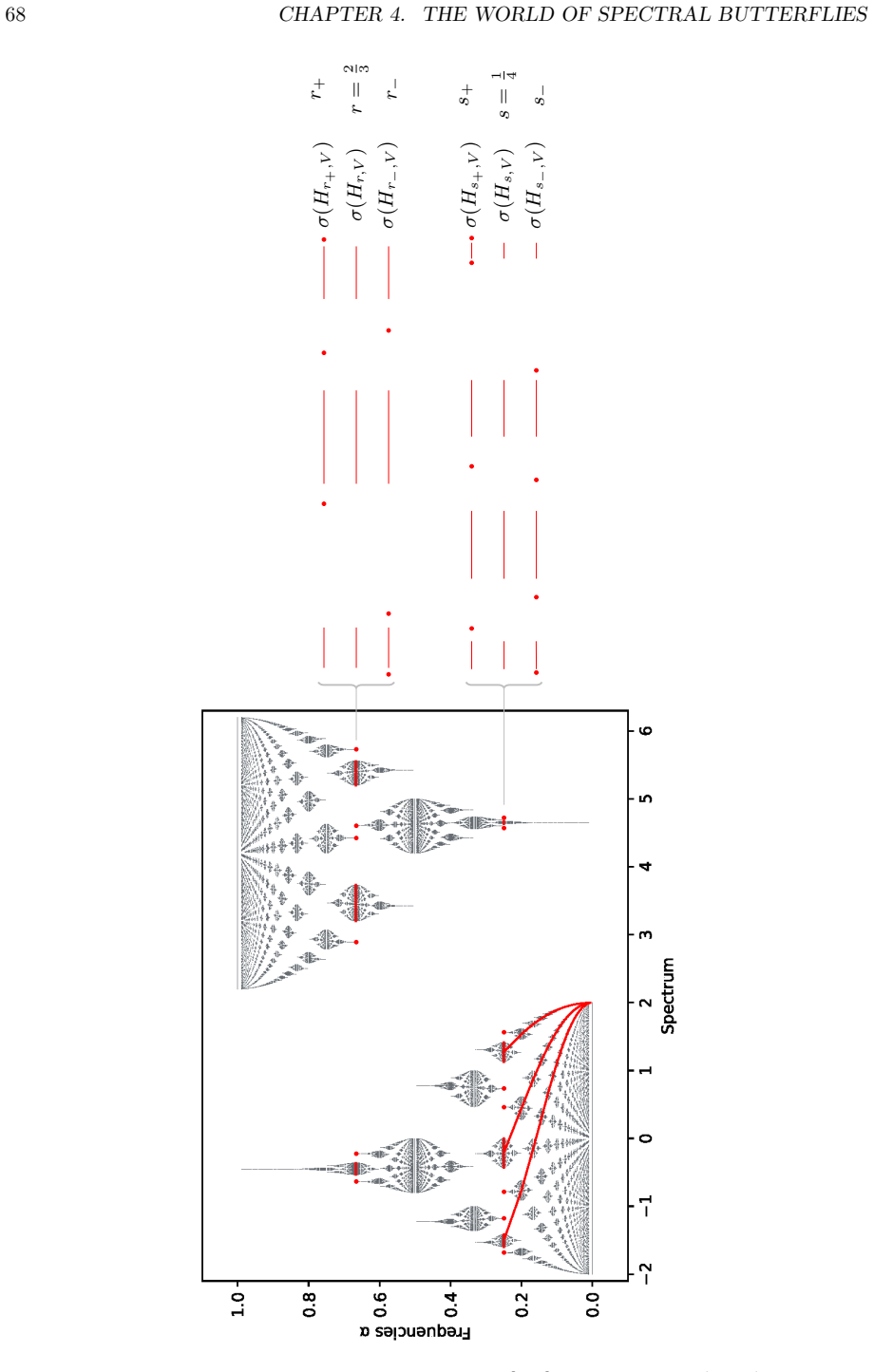
Spectra of Schrödinger operators on weighted Delone sets form spectral butterflies with fractal and self-similar structures.
A machine-rendered reading of the paper's core claim, the machinery that carries it, and where it could break.
Core claim
Using weighted Delone sets to model aperiodic order, parameter-dependent families of Schrödinger operators interpolate between periodic and aperiodic regimes. Their spectra form spectral butterflies that reflect fractal and self-similar structures. This approach is largely dimension-independent and extends to non-Abelian groups and more general settings, with new examples and connections established.
What carries the argument
Spectral butterflies arising from parameter-dependent families of Schrödinger operators on weighted Delone sets, which reveal the fractal nature of the spectra through the interplay of dynamics and spectral properties.
If this is right
- The spectra exhibit self-similarity and fractal structures in both periodic and aperiodic limits.
- New connections are made between existing works on aperiodic spectral theory.
- The results hold in higher dimensions and for non-Abelian groups.
- Additional examples can be constructed to illustrate the butterfly effect in spectra.
Where Pith is reading between the lines
- Such butterflies might appear in physical systems like quasicrystals, suggesting observable fractal energy bands.
- Computational models could use these families to simulate spectral transitions.
- Links to ergodic theory and dynamical systems could be strengthened through this spectral view.
Load-bearing premise
Weighted Delone sets are sufficient to capture the essential interplay between the underlying dynamics and the spectral properties of the associated Schrödinger operators.
What would settle it
A counterexample where a parameter-dependent family on a weighted Delone set produces a spectrum without fractal or self-similar butterfly structure would disprove the main claim.
Figures
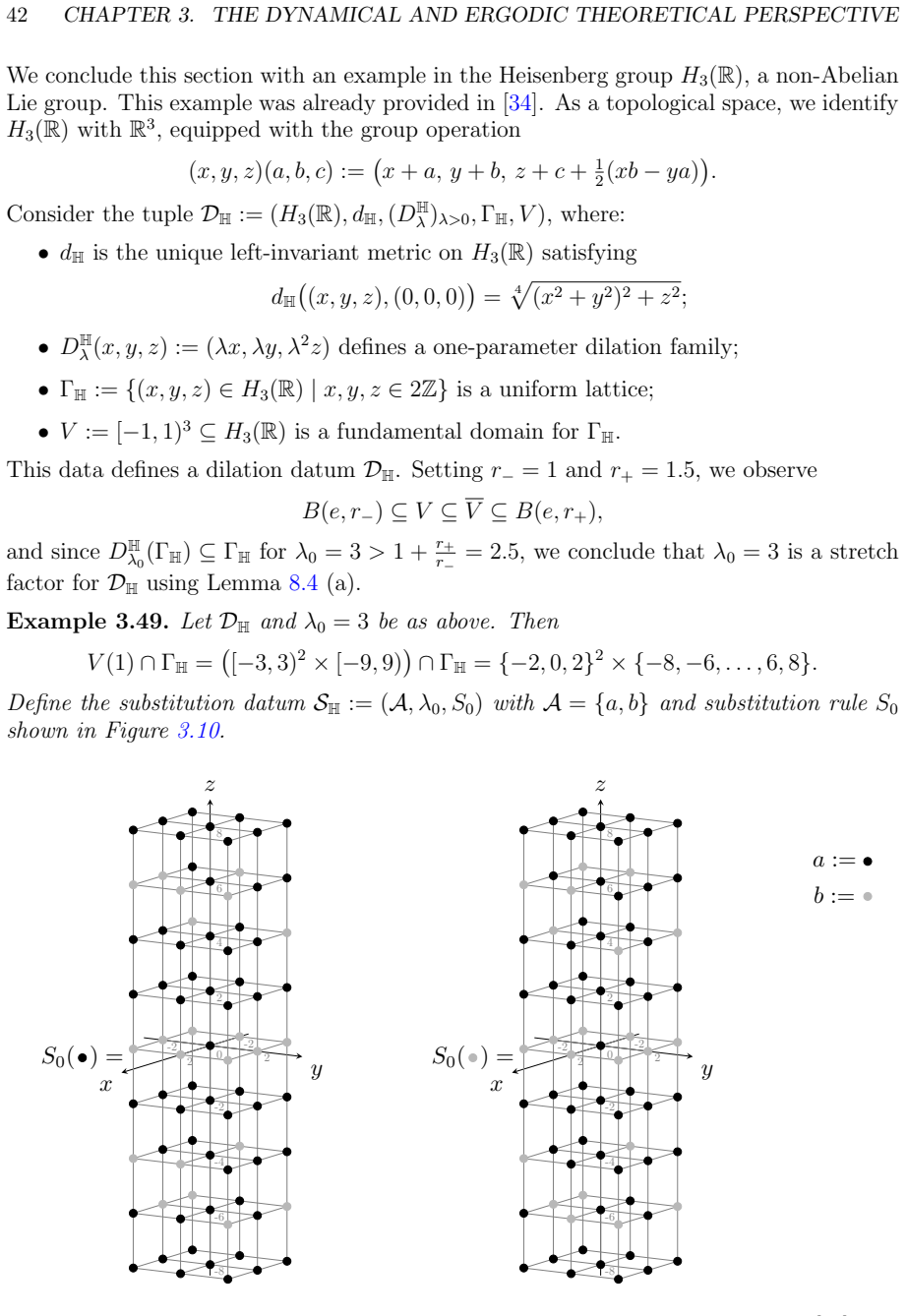
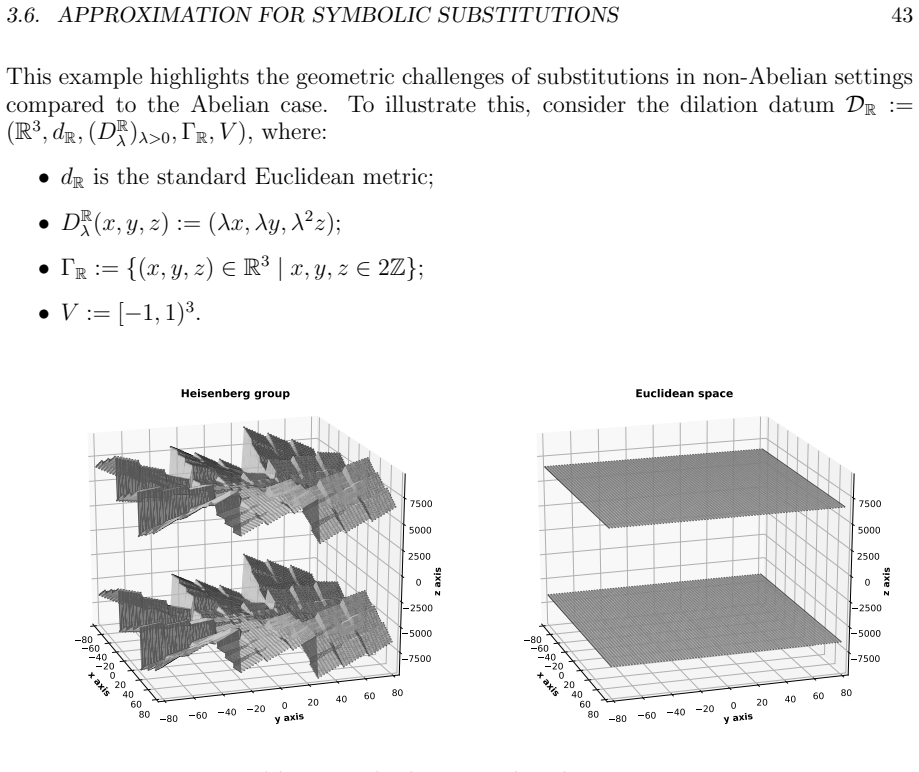
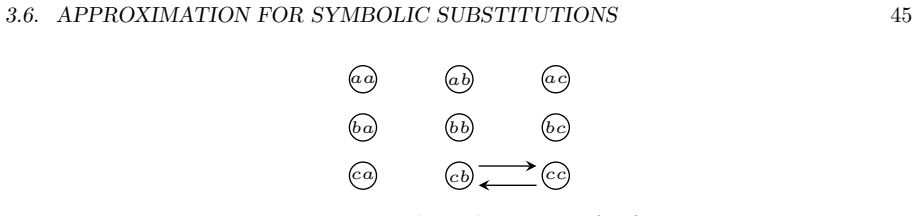
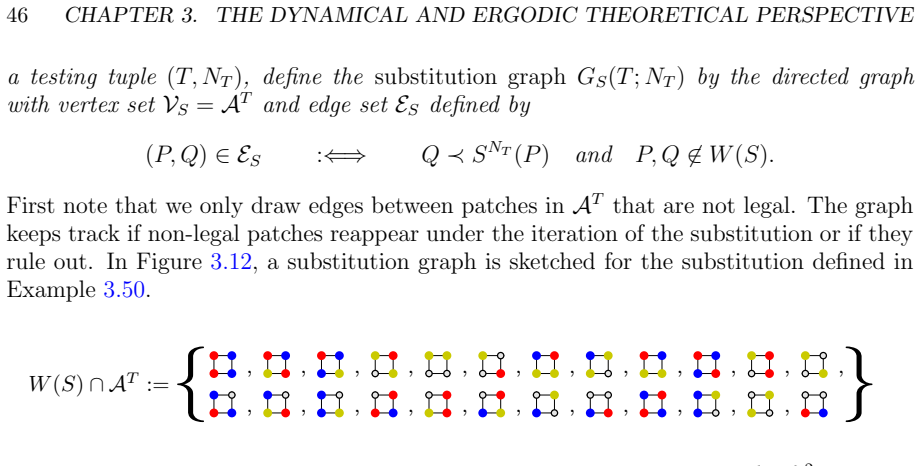
read the original abstract
This work studies spectral properties of Schr\"odinger operators in the context of aperiodic order, using weighted Delone sets to explore the interplay between the underlying dynamics and spectral properties. We study parameter-dependent families interpolating between periodic and aperiodic regimes, whose spectra form so-called spectral butterflies. These reflect fractal and self-similar structures of the spectra. We review existing results, introduce additional examples, and establish new connections between works in the literature. The framework is largely dimension-independent and extends to non-Abelian groups and more general settings.
Editorial analysis
A structured set of objections, weighed in public.
Referee Report
Summary. The manuscript studies spectral properties of Schrödinger operators in the context of aperiodic order, employing weighted Delone sets to examine the interplay between dynamics and spectra. It focuses on parameter-dependent families interpolating between periodic and aperiodic regimes, whose spectra form fractal and self-similar structures termed spectral butterflies. The work reviews existing results, introduces additional examples, and draws new connections across the literature. The framework is presented as largely dimension-independent and extendable to non-Abelian groups and more general settings.
Significance. If the claims hold, the paper offers a useful synthesis of results on spectral butterflies arising from parameter-dependent Schrödinger operators on aperiodic structures. By connecting disparate works and providing examples in a dimension-independent setting, it could serve as a reference point for researchers studying fractal spectra and the dynamics-spectra interplay. The standard use of weighted Delone sets to encode the relevant dynamics supports the review-plus-examples approach.
minor comments (2)
- [Abstract] Abstract: the term 'spectral butterflies' is introduced without a brief parenthetical definition or citation to the originating reference, which may hinder readers new to the subfield.
- [Introduction] The manuscript would benefit from an explicit statement in the introduction of which new connections between existing works are being established, to distinguish the review component from the novel contributions.
Simulated Author's Rebuttal
We thank the referee for the positive summary, significance assessment, and recommendation of minor revision. No specific major comments were provided in the report.
Circularity Check
No circularity; review paper with no load-bearing derivations or self-referential fits
full rationale
The provided text consists of an abstract and a high-level description of a review-plus-examples manuscript on spectral butterflies for Schrödinger operators on weighted Delone sets. No equations, parameter fits, uniqueness theorems, or derivation chains appear in the visible content. The central claims are framed as connections to existing literature rather than new derivations that could reduce to inputs by construction. As a dimension-independent review extending prior work without visible self-citation load-bearing steps or fitted predictions, the argument is self-contained against external benchmarks.
Axiom & Free-Parameter Ledger
axioms (1)
- domain assumption Weighted Delone sets capture the essential interplay between dynamics and spectral properties in aperiodic order.
Reference graph
Works this paper leans on
-
[1]
J. E. Anderson and I. F. Putnam. Topological invariants for substitution tilings and their associatedC ∗-algebras.Ergodic Theory Dynam. Systems, 18(3):509–537,
-
[2]
doi:10.1017/S0143385798100457
-
[3]
Argabright and J
L. Argabright and J. Gil de Lamadrid.Fourier analysis of unbounded measures on locally compact abelian groups, volume No. 145 ofMemoirs of the American Mathematical Society. American Mathematical Society, Providence, RI, 1974
1974
-
[4]
Avila and S
A. Avila and S. Jitomirskaya. The Ten Martini Problem.Ann. of Math. (2), 170(1):303–342, 2009
2009
-
[5]
A. Avila and S. Jitomirskaya. Almost localization and almost reducibility.J. Eur. Math. Soc. (JEMS), 12(1):93–131, 2010. doi:10.4171/JEMS/191
-
[6]
A. Avila and R. Krikorian. Reducibility or nonuniform hyperbolicity for quasiperiodic Schr¨ odinger cocycles.Ann. of Math. (2), 164(3):911–940, 2006. doi:10.4007/annals.2006.164.911
-
[7]
Avila, J
A. Avila, J. You, and Q. Zhou. Dry Ten Martini Problem in the non-critical case,
-
[8]
J. Avron and B. Simon. Almost periodic Schr¨ odinger operators. II. The integrated density of states.Duke Math. J., 50(1):369–391, 1983. doi:10.1215/S0012-7094-83- 05016-0
-
[9]
Avron, P
J. Avron, P. H. M. van Mouche, and B. Simon. On the measure of the spectrum for the almost Mathieu operator.Comm. Math. Phys., 132(1):103–118, 1990
1990
-
[10]
M. Ya. Azbel. Energy spectrum of a conduction electron in a magnetic field.Soviet Physics JETP, 19(3), 1964
1964
-
[11]
M. Baake. Diffraction of weighted lattice subsets.Canad. Math. Bull., 45(4):483– 498, 2002. Dedicated to Robert V. Moody
2002
-
[12]
Baake and U
M. Baake and U. Grimm.Aperiodic order. Vol. 1, volume 149 ofEncyclopedia of Mathematics and its Applications. Cambridge University Press, Cambridge, 2013. A mathematical invitation, With a foreword by Roger Penrose
2013
-
[13]
Indagationes Mathematicae , FJOURNAL =
M. Baake, C. Huck, and N. Strungaru. On weak model sets of extremal density. Indag. Math. (N.S.), 28(1):3–31, 2017. doi:10.1016/j.indag.2016.11.002
-
[14]
Ergodic Theory and Dynamical Systems , VOLUME =
M. Baake and D. Lenz. Dynamical systems on translation bounded measures: pure point dynamical and diffraction spectra.Ergodic Theory Dynam. Systems, 24(6):1867–1893, 2004. doi:10.1017/S0143385704000318. 107 108BIBLIOGRAPHY
-
[15]
M. Baake and R. V. Moody. Weighted Dirac combs with pure point diffraction.J. Reine Angew. Math., 573:61–94, 2004. doi:10.1515/crll.2004.064
-
[16]
Random Networks of Automata: A Simple Annealed Ap- proximation
R. Band and S. Beckus. From quasiperiodicity to a complete coloring of the Kohmoto butterfly.Europhysics Letters, 2026. in press, Doi: 10.1209/0295- 5075/ae59af
-
[17]
R. Band, S. Beckus, B. Biber, L. Raymond, and Y. Thomas. A review of a work by L. Raymond: Sturmian Hamiltonians with a large coupling constant—periodic approximations and gap labels. InMathematical models for interacting dynamics on networks, Trends Math., pages 1–83. Birkh¨ auser/Springer, Cham, [2026]©2026
2026
- [18]
- [19]
-
[20]
R. Band, S. Beckus, F. Pogorzelski, and L. Tenenbaum. Spectral approximation for substitution systems.Journal d’Analyse Math´ ematique, 2026. doi: 10.1007/s11854- 026-0445-0
-
[21]
R. Band, S. Beckus, F. Pogorzelski, and L. Tenenbaum. Spectral pollution in sub- stitution systems.ArXiv:2604.12637, 2026
work page internal anchor Pith review Pith/arXiv arXiv 2026
-
[22]
M. Baradaran, P. Exner, and J. Lipovsk´ y. Magnetic square lattice with vertex coupling of a preferred orientation.Ann. Physics, 454:Paper No. 169339, 12, 2023. doi:10.1016/j.aop.2023.169339
-
[23]
A. Baraviera and R. Leplaideur. Substreetutions and more on trees.Ergodic Theory Dynam. Systems, 44(9):2399–2453, 2024. doi:10.1017/etds.2023.108
-
[24]
M. Barge and C. Olimb. Asymptotic structure in substitution tiling spaces.Ergodic Theory Dynam. Systems, 34(1):55–94, 2014. doi:10.1017/etds.2012.118
-
[25]
S. Becker, R. Han, and S. Jitomirskaya. Cantor spectrum of graphene in magnetic fields.Invent. Math., 218(3):979–1041, 2019. doi:10.1007/s00222-019-00916-y
-
[27]
Beckus.Spectral approximation of aperiodic Schr¨ odinger operators
S. Beckus.Spectral approximation of aperiodic Schr¨ odinger operators. PhD thesis, Friedrich-Schiller-University Jena, Germany, 2016
2016
-
[28]
S. Beckus and J. Bellissard. Continuity of the spectrum of a field of self-adjoint operators.Ann. Henri Poincar´ e, 17(12):3425–3442, 2016. doi:10.1007/s00023-016- 0496-3
-
[29]
S. Beckus, J. Bellissard, and H. Cornean. H¨ older continuity of the spec- tra for aperiodic Hamiltonians.Ann. Henri Poincar´ e, 20(11):3603–3631, 2019. doi:10.1007/s00023-019-00848-6
-
[30]
Beckus, J
S. Beckus, J. Bellissard, and G. De Nittis. Spectral continuity for aperiodic quantum systems I. General theory.J. Funct. Anal., 275(11):2917–2977, 2018. BIBLIOGRAPHY109
2018
-
[31]
S. Beckus, J. Bellissard, and G. De Nittis. Spectral continuity for aperiodic quantum systems: applications of a folklore theorem.J. Math. Phys., 61(12):123505, 19, 2020. doi:10.1063/5.0011488
-
[32]
S. Beckus, J. Bellissard, and Y. Thomas. Spectral regularity and defects for the Kohmoto model.Ann. Henri Poincar´ e, 2025. doi:10.1007/s00023-025-01578-8
-
[33]
S. Beckus and B. Devyver. Generalized eigenfunctions and eigenvalues: a uni- fying framework for Shnol-type theorems.J. Anal. Math., 146(1):165–203, 2022. doi:10.1007/s11854-021-0191-2
-
[34]
S. Beckus and L. Eliaz. Eigenfunctions growth ofR-limits on graphs.J. Spectr. Theory, 11(4):1895–1933, 2021. doi:10.4171/jst/389
- [35]
-
[36]
S. Beckus, T. Hartnick, and F. Pogorzelski. Linear repetitivity beyond abelian groups.Ergodic Theory Dynam. Systems, 45(7):1947 – 1997, 2025. doi:10.1017/etds.2024.120
-
[37]
Beckus, D
S. Beckus, D. Lenz, M. Lindner, and C. Seifert. On the spectrum of operator families on discrete groups over minimal dynamical systems.Math. Z., 287(3-4):993–1007,
-
[38]
doi:10.1007/s00209-017-1856-5
-
[39]
Beckus, D
S. Beckus, D. Lenz, M. Lindner, and C. Seifert. Note on spectra of non-selfadjoint operators over dynamical systems.Proc. Edinb. Math. Soc. (2), 61(2):371–386, 2018
2018
-
[40]
S. Beckus and Y. Pinchover. Shnol-type theorem for the Agmon ground state.J. Spectr. Theory, 10(2):355–377, 2020. doi:10.4171/JST/296
-
[41]
S. Beckus and F. Pogorzelski. Spectrum of Lebesgue measure zero for Ja- cobi matrices of quasicrystals.Math. Phys. Anal. Geom., 16(3):289–308, 2013. doi:10.1007/s11040-013-9131-4
-
[42]
S. Beckus and F. Pogorzelski. Delone dynamical systems and spectral convergence. Ergodic Theory Dynam. Systems, 40(6):1510–1544, 2020. doi:10.1017/etds.2018.116
-
[43]
S. Beckus and A. Takase. Spectral estimates of dynamically-defined and amenable operator families.J. Spectr. Theory, 15(2):563–610, 2025. doi:10.4171/JST/554
-
[44]
Beckus, J
S. Beckus, J. van Velthoven, and U. Enstad. Deformations of frames and bases via continuous fields of groupoids. in preparation
-
[45]
N. B´ edaride and A. Hilion. Geometric realizations of two-dimensional substitutive tilings.Q. J. Math., 64(4):955–979, 2013. doi:10.1093/qmath/has025
-
[46]
Bellissard.Schr¨ odinger operators with almost periodic potential: An overview
J. Bellissard.Schr¨ odinger operators with almost periodic potential: An overview. Springer Berlin Heidelberg, Berlin, Heidelberg, 1982. Schrader, R. and Seiler, R. and Uhlenbrock, D. A
1982
-
[47]
Bellissard.K-theory ofC ∗-algebras in solid state physics
J. Bellissard.K-theory ofC ∗-algebras in solid state physics. InStatistical mechanics and field theory: mathematical aspects (Groningen, 1985), volume 257 ofLecture Notes in Phys., pages 99–156. Springer, Berlin, 1986. doi:10.1007/3-540-16777-3 74. 110BIBLIOGRAPHY
-
[48]
Bellissard
J. Bellissard. Gap Labelling Theorems for Schr¨ odinger operators. InFrom number theory to physics (Les Houches, 1989), pages 538–630. Springer, Berlin, 1992
1989
-
[49]
Bellissard
J. Bellissard. Lipshitz continuity of gap boundaries for Hofstadter-like spectra. Comm. Math. Phys., 160(3):599–613, 1994
1994
-
[50]
Bellissard
J. Bellissard. Delone sets and material science: a program. InMathematics of aperiodic order, volume 309 ofProgr. Math., pages 405–428. Birkh¨ auser/Springer, Basel, 2015
2015
-
[51]
Bellissard, A
J. Bellissard, A. Bovier, and J.-M. Ghez. Gap labelling theorems for one-dimensional discrete Schr¨ odinger operators.Rev. Math. Phys., 4(1):1–37, 1992
1992
-
[52]
Bellissard, B
J. Bellissard, B. Iochum, E. Scoppola, and D. Testard. Spectral properties of one- dimensional quasi-crystals.Comm. Math. Phys., 125(3):527–543, 1989
1989
-
[53]
Bellissard, B
J. Bellissard, B. Iochum, and D. Testard. Continuity properties of the electronic spectrum of 1d quasicrystals.Comm. Math. Phys., 141(2):353–380, 1991
1991
-
[54]
J. Bellissard and B. Simon. Cantor spectrum for the almost Mathieu equation.J. Functional Analysis, 48(3):408–419, 1982. doi:10.1016/0022-1236(82)90094-5
-
[55]
A. Besbes. Uniform ergodic theorems on aperiodic linearly repeti- tive tilings and applications.Rev. Math. Phys., 20(5):597–623, 2008. doi:10.1142/S0129055X0800333X
-
[56]
A. Besbes, M. Boshernitzan, and D. Lenz. Delone sets with finite local complexity: linear repetitivity versus positivity of weights.Discrete Comput. Geom., 49(2):335– 347, 2013. doi:10.1007/s00454-012-9455-z
-
[57]
B. Biber. Github, Kohmoto butterfly. https://github.com/DaAnIV/Quasiperiodic, 2022
2022
-
[58]
I. Biringer. Metrizing the Chabauty topology.Geom. Dedicata, 195:19–22, 2018. doi:10.1007/s10711-017-0274-5
-
[59]
M. Biroli and U. Mosco. A Saint-Venant type principle for Dirichlet forms on discontinuous media.Ann. Mat. Pura Appl. (4), 169:125–181, 1995. doi:10.1007/BF01759352
-
[60]
M. Bj¨ orklund and T. Hartnick. Approximate lattices.Duke Math. J., 167(15):2903– 2964, 2018. doi:10.1215/00127094-2018-0028
-
[61]
M. Bj¨ orklund, T. Hartnick, and F. Pogorzelski. Aperiodic order and spherical diffraction, I: auto-correlation of regular model sets.Proc. Lond. Math. Soc. (3), 116(4):957–996, 2018. doi:10.1112/plms.12091
-
[62]
M. Bj¨ orklund, T. Hartnick, and F. Pogorzelski. Aperiodic order and spherical diffraction, III: the shadow transform and the diffraction formula.J. Funct. Anal., 281(12):Paper No. 109265, 59, 2021. doi:10.1016/j.jfa.2021.109265
-
[64]
M. Bj¨ orklund, T. Hartnick, and F. Pogorzelski. Aperiodic order and spheri- cal diffraction, II: translation bounded measures on homogeneous spaces, 2022. doi:10.1007/s00209-021-02817-4
-
[65]
Boshernitzan
M. Boshernitzan. A unique ergodicity of minimal symbolic flows with linear block growth.J. Analyse Math., 44:77–96, 1984/85
1984
-
[66]
A. Boutet de Monvel, D. Lenz, and P. Stollmann. Sch’nol’s theorem for strongly local forms.Israel J. Math., 173:189–211, 2009. doi:10.1007/s11856-009-0088-8
-
[67]
A. Boutet de Monvel and P. Stollmann. Eigenfunction expansions for gen- erators of Dirichlet forms.J. Reine Angew. Math., 561:131–144, 2003. doi:10.1515/crll.2003.063
-
[68]
J. Breuer, S. Denisov, and L. Eliaz. On the essential spectrum of Schr¨ odinger operators on trees.Math. Phys. Anal. Geom., 21(4):Paper No. 33, 25, 2018. doi:10.1007/s11040-018-9290-4
-
[69]
R. Brooks. The spectral geometry ofk-regular graphs.J. Anal. Math., 57:120–151,
-
[70]
doi:10.1007/BF03041067
-
[71]
Butkevich.Convergence of averages in ergodic theory
S. Butkevich.Convergence of averages in ergodic theory. PhD thesis, Ohio State University, 2001
2001
-
[72]
Cao and Y
J. Cao and Y. Qu. Almost sure dimensional properties for the spectrum and the density of states of Sturmian Hamiltonians.Adv. Math., 478:Paper No. 110387, 74, 2025
2025
-
[73]
Casdagli
M. Casdagli. Symbolic dynamics for the renormalization map of a quasiperiodic Schr¨ odinger equation.Comm. Math. Phys., 107(2):295–318, 1986
1986
-
[74]
Castaing and M
C. Castaing and M. Valadier.Convex analysis and measurable multifunctions. Lec- ture Notes in Mathematics, Vol. 580. Springer-Verlag, Berlin-New York, 1977
1977
-
[75]
C. Cedzich and J. Fillman. Absence of bound states for quantum walks and CMV matrices via reflections.J. Spectr. Theory, 14(4):1513–1536, 2024. doi:10.4171/jst/533
-
[76]
C. Cedzich, J. Fillman, T. Geib, and A. H. Werner. Singular continuous Cantor spectrum for magnetic quantum walks.Lett. Math. Phys., 110(6):1141–1158, 2020. doi:10.1007/s11005-020-01257-1
-
[77]
C. Cedzich, J. Fillman, and D. C. Ong. Almost everything about the unitary almost Mathieu operator.Comm. Math. Phys., 403(2):745–794, 2023. doi:10.1007/s00220- 023-04808-4
-
[78]
Cedzich and L
C. Cedzich and L. Li. Twenty dry Martinis for the unitary almost-Mathieu operator. Ergodic Theory Dynam. Systems, 46(4):903–920, 2026
2026
-
[79]
Chabauty
C. Chabauty. Limite d’ensembles et g´ eom´ etrie des nombres.Bull. Soc. Math. France, 78:143–151, 1950
1950
-
[80]
S. N. Chandler-Wilde and M. Lindner. Limit operators, collective compactness, and the spectral theory of infinite matrices.Mem. Amer. Math. Soc., 210(989):viii+111,
-
[81]
doi:10.1090/S0065-9266-2010-00626-4. 112BIBLIOGRAPHY
-
[82]
M. D. Choi, G. A. Elliott, and N. Yui. Gauss polynomials and the rotation algebra. Invent. Math., 99(2):225–246, 1990. doi:10.1007/BF01234419
discussion (0)
Sign in with ORCID, Apple, or X to comment. Anyone can read and Pith papers without signing in.