REVIEW 4 major objections 5 minor 1 cited by
Revisiting the Intergalactic Medium Around GRB 130606A and Constraints on the Epoch of Reionization
T0 review · 4 major / 5 minor · reviewed 2026-08-11 · deepseek-v4-flash
Pith's one-line read The paper resolves the conflicting neutral-hydrogen measurements for GRB 130606A by showing they come from modeling assumptions, and its preferred fits put a 3-sigma upper limit of about 20 to 23 percent on the neutral fraction at z~5.9.
desk verdict A genuinely useful reproduction study that explains the GRB 130606A controversy, but the headline neutral-fraction limit is prior-dependent and the paper's own numbers don't agree. read the letter →
The pith
A machine-rendered reading of the paper's core claim, the machinery that carries it, and where it could break.
The reading
What carries the argument
The central object is the Lyman-$\alpha$ damping wing, the broad absorption trough produced when neutral hydrogen scatters Lyman-$\alpha$ photons; the trough extends redward of the line and reshapes the afterglow's otherwise smooth power-law continuum. The paper fits the spectrum with three model families: the original uniform-neutral-fraction model, a version that adds a free ionized-bubble radius around the host (the McQuinn model), and redshift-shell implementations in which the neutral fraction is either independent per shell or coupled through a linear slope. The mechanism that carries the argument is the degeneracy among the spectral index $\beta$, the host hydrogen column density, and $x_{\rm HI}$: when only the top of the damping wing is fitted, the neutral fraction drifts with the assumed $\beta$. The paper controls that degeneracy by extending the fit over a long wavelength lever arm and by applying a Gaussian prior on $\beta$ derived from the X-ray-to-optical continuum.
What would settle it
A concrete check would be to measure the ionized bubble radius around GRB 130606A directly, for example through deep Lyman-$\alpha$ imaging or integral-field spectroscopy of the host field, and to build an independent X-ray-to-near-infrared spectral energy distribution of the afterglow to test the single power-law prior; if the bubble exceeds roughly 90 Mpc or a spectral break appears between the X-ray and optical bands, the $x_{\rm HI}<0.20$ to $0.23$ limits would be invalidated.
Extended reading notes
Core claim
The paper's central claim is that the conflicting previous measurements for GRB 130606A were produced by the data-fitting assumptions, not by the data. Repeating each earlier analysis on the same X-shooter spectrum, with each paper's redshift boundary where the neutral IGM begins, spectral index, host column density treatment, and wavelength range, reproduces the published values from the low upper limit up to the high detection. The paper then argues that the statistically preferred choices, in particular starting the neutral IGM at $z\sim5.8$ rather than at the GRB redshift and using a Gaussian spectral-index prior tied to the X-ray-to-optical continuum, give consistent 3-$\sigma$ upper limits across the Miralda-Escude, McQuinn bubble, and shell models, in the range $x_{\rm HI}<0.20$ to $x_{\rm HI}<0.23$. The consequence, on the paper's own terms, is that the intergalactic medium along this line of sight at $z\sim5.9$ was at least about 77 percent ionized at 3-$\sigma$, in line with reionization ending near $z\sim5.5$ to $6$.
Load-bearing premise
The load-bearing assumption is that the neutral intergalactic medium along the line of sight begins only near $z\sim5.8$ (equivalently, that a large ionized bubble up to about 90 Mpc surrounds the GRB host) and that the X-ray-to-optical continuum is a single unbroken power law with the adopted spectral index; if the bubble is larger or a spectral break exists, the $x_{\rm HI}$ upper limits would need to be revised.
Editorial extensions
If this is right
- The IGM along the GRB 130606A sightline was at least about 77 percent ionized at z~5.9 at 3-sigma, consistent with reionization ending near z~5.5-6.
- Future damping-wing analyses should report or marginalize over the redshift where the neutral IGM begins (equivalently the ionized bubble radius) and the spectral index, since those choices, not the data, produced the earlier spread between an upper limit of 0.05 and a claimed 0.5 neutral fraction.
- The paper's statistically preferred neutral-IGM edge at z~5.8 matches independent hints of a neutral system or DLA near that redshift, though the damping wing alone cannot confirm its nature.
- Progress on Epoch-of-Reionization constraints from GRBs will require many more high-redshift bursts with high-quality optical-to-near-infrared spectra, so that no single sightline dominates the measurement.
Reading between the lines
- If the assumption-sensitivity found here generalizes, published GRB damping-wing neutral-fraction limits from other bursts may carry systematic uncertainties comparable to the original 0.05-to-0.5 spread, larger than their quoted statistical errors.
- A direct test would be to apply the same shell model, with common priors, to every existing high-redshift GRB afterglow spectrum; if inner shells consistently sit near zero while outer shells are unconstrained, GRB damping wings are mostly probing the ionized bubble boundary rather than the global neutral fraction.
- The Bayesian preference for a neutral edge at z~5.8 could be sharpened by a deeper search for metal-line absorption at that redshift; confirming a DLA would turn the xHI<0.2 limit into a statement about the IGM exterior to that system.
- The same control of the boundary and spectral-index degeneracies could be applied to quasar damping wings, where continuum uncertainties are larger, and might shrink the scatter in quasar-based neutral-fraction estimates.
Signed reviews
Editorial analysis
A structured set of objections, weighed in public.
Referee Report
Summary. The paper re-analyzes the VLT X-shooter spectrum of GRB 130606A to understand why previous damping-wing analyses of the same object yielded conflicting neutral-hydrogen fractions. Using the same spectrum but reproducing each earlier analysis's data ranges and assumptions, the authors argue that the discrepancies are driven by modeling assumptions and data selection rather than by the data themselves. They then present new fits with the Miralda-Escudé (1998), McQuinn et al. (2008), and shell-based damping-wing models, reporting 3-sigma upper limits on the IGM neutral fraction. The abstract quotes x_HI < 0.20–0.23, while the Conclusions quote x_HI < 0.28, < 0.24, and < 0.26 for the statistically preferred fits. The paper situates these results in the broader Epoch of Reionization context and compares with GRB 210905A.
Significance. If the claimed low neutral-fraction upper limits are robust, the paper would reconcile previously conflicting measurements of GRB 130606A and provide a meaningful constraint on the ionization state of the IGM at z ~ 5.9. The reconstruction exercise in Section 3 is a genuine strength: using a single high-resolution dataset to reproduce earlier results demonstrates convincingly that differing assumptions, rather than the data quality, are the main source of the earlier controversy. The use of multiple damping-wing models and explicit reporting of marginal likelihoods are also positive features. However, the headline numerical result is not currently presented in a self-consistent way, and the tightest upper limits depend on an external spectral-index prior and on assumed ionized-bubble geometry. These issues are fixable but are load-bearing for the paper's central claim.
major comments (4)
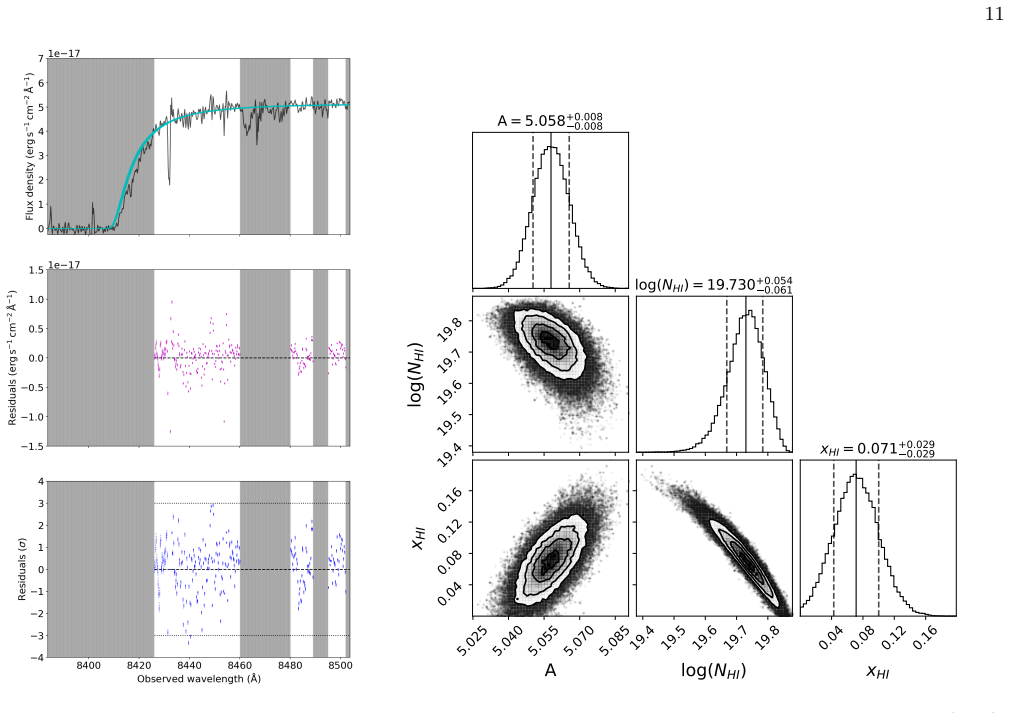
- [§4.1, §4.2, Tables 2–3] The headline 3-sigma upper limit is prior-dependent. With a uniform prior on the spectral index beta, the same X-shooter data give x_HI < 0.53 for the Miralda-Escudé model with z_IGM,u = 5.8 (Table 2) and x_HI < 0.76 for the McQuinn model (Table 3); the values x_HI < 0.20–0.23 quoted in the abstract appear only after imposing the Swift-XRT Gaussian prior beta = 0.71 ± 0.07. That prior is valid only if the optical-to-X-ray afterglow is a single unbroken power law; if host-galaxy extinction or a spectral break is present, the inferred neutral fraction could be biased. The Bayes factors quoted in §4.1 and §4.2 compare fits with different priors on beta rather than different physical models, so they do not by themselves demonstrate that the data require x_HI < 0.2. I recommend either reporting the uniform-prior limits as the conservative headline result or, at minimum, quantifying the sensitivity of the limit to the prior (e.g., by repeating the fits with broadened Gaussian priors and with a free spectral break).
- [Abstract and §6] The central number is not internally stable. The abstract states a 3-sigma upper limit ranging from x_HI < 0.20 to x_HI < 0.23, while the Conclusions report x_HI < 0.28, < 0.24, and < 0.26 for the statistically preferred Miralda-Escudé, McQuinn, and shell-model fits. Tables 2–4 list < 0.23, < 0.20, and < 0.22 for the Gaussian-prior fits. These three sets of numbers are mutually inconsistent, and the paper must reconcile them before publication; as written, the reader cannot determine which value is the claimed result.
- [§2.1, §4.1] The unexplained spectral feature between 8469 and 8480 Å is excluded from the analysis. This feature lies in the damping-wing region and is reported in multiple independent spectra (VLT, Gemini, Subaru, GTC). Removing it without modeling it or without a sensitivity test is an unquantified systematic. Please show that the neutral-fraction upper limit is insensitive to the treatment of this feature, for instance by including it with a broad-line model or by varying the mask boundaries by a few Å.
- [§4.2, §4.3, Fig. 8] The preferred low x_HI values are also conditional on the assumed ionized-bubble geometry. In the McQuinn model the bubble radius R_b is driven to the edge of its prior (60 Mpc h^-1), and in the dependent-shell model with free z_IGM,u the posterior is flat at z < 5.6, where the damping wing is insensitive. This means that the tight upper limits essentially assume that the IGM immediately outside the host is largely ionized (z_IGM,u ~ 5.8 or R_b <~ 60 Mpc/h). The paper should state this explicitly as a condition of the result and show how the x_HI upper limit changes as R_b or z_IGM,u is varied over a wider range.
minor comments (5)
- [§3.2.2] There is a typo in 'zhsost' that should read 'zhost'.
- [§4] The opening sentence of Section 4 mentions the 'Miralda-Escudé (1998) and Totani et al. (2006) models', but the section subsequently uses the Miralda-Escudé, McQuinn, and shell implementations; please clarify whether the Totani et al. (2006) model is used anywhere.
- [Table 1] The z_IGM,u row is visually confusing because several entries are placed under a single column; the table should be reformatted so that each analysis's z_IGM,u value is clearly aligned with its column.
- [§2.3] Please state explicitly how the reported 3-sigma upper limits are computed from the posterior distributions (e.g., as the 99.7th percentile) and apply this definition consistently to all tables.
- [Fig. 9] The y-axis label is partly described in the caption rather than appearing on the figure; ensure that the axis labels are readable and complete in the final version.
Circularity Check
No significant circularity: xHI constraints are observational spectral fits with transparent prior dependence, and the cited shell model is not load-bearing for the central result.
full rationale
The paper's derivation chain is an empirical spectral fit, not a derivation from the model output. The central quantity xHI is sampled by MCMC under three damping-wing models (Miralda-Escude 1998; McQuinn et al. 2008; and a shell implementation described in the paper and cited to Fausey et al. 2024). The tight headline values xHI<0.20-0.23 are obtained only when a Gaussian prior beta=0.71+/-0.07 from Swift-XRT is imposed (Tables 2-4), and the paper transparently reports the uniform-prior results (xHI<0.53, xHI<0.76, xHI<0.48) that are much weaker. This is prior sensitivity, not circularity: the prior comes from independent X-ray data, is not derived from the optical damping-wing spectrum, and does not by construction set the xHI posterior. The reported Bayes factors compare models on the same dataset, but that comparison is not a hidden fit of xHI to itself. The only self-citations (Fausey et al. 2024 for the shell implementation and marginal-likelihood usage) are methodological; the headline result is independently reproduced with the two externally established models, so the self-citation is not load-bearing. No parameter is fitted to a subset and then renamed a prediction, no uniqueness theorem is imported, and no known empirical pattern is relabeled as unification. The unexplained 8469-8480 A feature and the inconsistency between abstract upper limits (0.20-0.23) and conclusions (0.28, 0.24, 0.26) are robustness and reporting concerns, not circularity.
Assumptions & free parameters
free parameters (6)
- neutral fraction x_HI =
0 (3-sigma upper limit 0.20-0.23)
- spectral index beta =
0.69 +/- 0.03 (with Gaussian prior)
- host column density log(N_HI/cm^-2) =
~19.91
- ionized bubble radius R_b =
unconstrained, tends to 60 Mpc/h upper bound
- z_IGM,u (upper redshift of neutral IGM) =
5.8 (fixed) or free
- dx_HI/dz (slope) =
unconstrained
assumptions (6)
- domain assumption The Miralda-Escude (1998) damping wing model with uniform neutral fraction between z_IGM,u and z_IGM,l is a valid description of the IGM.
- domain assumption The GRB afterglow intrinsic spectrum is a single power law F_nu ∝ nu^-beta with no spectral break between X-ray and UV/optical.
- domain assumption The only absorption sources are the host HI column, the IGM damping wing, and identified metal/telluric lines; the 8469-8480 Å feature is not a real absorption system.
- domain assumption The McQuinn et al. (2008) model with an ionized bubble of radius R_b and fully ionized interior is a valid approximation.
- ad hoc to paper In the dependent shell model, the neutral fraction evolves linearly with redshift, with slope dx_HI/dz, within the fitted redshift range.
- domain assumption Planck 2020 cosmological parameters are correct.
Cite this review
Pith. "Pith review of Revisiting the Intergalactic Medium Around GRB 130606A and Constraints on the Epoch of Reionization." pith.science (2026). https://pith.science/paper/ULSSD2DW
@misc{pith2026241209732,
  author       = {Pith},
  title        = {Pith review of: Revisiting the Intergalactic Medium Around GRB 130606A and Constraints on the Epoch of Reionization},
  year         = {2026},
  howpublished = {\url{https://pith.science/paper/ULSSD2DW}},
  note         = {Machine review of arXiv:2412.09732}
}
read the original abstract
Gamma-ray bursts (GRBs) are excellent probes of the high-redshift Universe due to their high luminosities and the relatively simple intrinsic spectra of their afterglows. They can be used to estimate the fraction of neutral hydrogen (i.e., neutral fraction) in the intergalactic medium at different redshifts through the examination of their Lyman-alpha damping wing with high quality optical-to-near-infrared spectra. Neutral fraction estimates can help trace the evolution of the Epoch of Reionization, a key era of cosmological history in which the intergalactic medium underwent a phase change from neutral to ionized. We revisit GRB 130606A, a z ~ 5.9 GRB for which multiple analyses, using the same damping wing model and data from different telescopes, found conflicting neutral fraction results. We identify the source of the discrepant results to be differences in assumptions for key damping wing model parameters and data range selections. We perform a new analysis implementing multiple GRB damping wing models and find a 3-sigma neutral fraction upper limit ranging from xHI < 0.20 to xHI < 0.23. We present this result in the context of other neutral fraction estimates and Epoch of Reionization models, discuss the impact of relying on individual GRB lines of sight, and highlight the need for more high-redshift GRBs to effectively constrain the progression of the Epoch of Reionization.
Figures


Figures from the paper (9 more)




Forward citations
Cited by 1 Pith paper
-
Multi-fidelity emulator for large-scale 21 cm lightcone images: a few-shot transfer learning approach with generative adversarial network
Few-shot transfer learning lets a GAN trained on small 21 cm simulations emulate large-scale lightcone images with only 80 large-box simulations, at percent-level small-scale accuracy and tens-of-percent large-scale accuracy.
Reference graph
Works this paper leans on
-
[1]
, " * write output.state after.block = add.period write newline
ENTRY address archivePrefix author booktitle chapter doi edition editor eprint howpublished institution journal key month number organization pages publisher school series title misctitle type volume year version url label extra.label sort.label short.list INTEGERS output.state before.all mid.sentence after.sentence after.block FUNCTION init.state.consts ...
-
[2]
write newline
" write newline "" before.all 'output.state := FUNCTION format.url url empty "" new.block "" url * "" * if FUNCTION format.eprint eprint empty "" archivePrefix empty "" archivePrefix "arXiv" = new.block " " eprint * " " * new.block " " eprint * " " * if if if FUNCTION format.doi doi empty "" " " doi * " " * if FUNCTION format.pid doi empty eprint empty ur...
-
[3]
The Astropy Project: Building an Open-science Project and Status of the v2.0 Core Package
thebibliography [1] 20pt to REFERENCES 6pt =0pt -12pt 10pt plus 3pt =0pt =0pt =1pt plus 1pt =0pt =0pt -12pt =13pt plus 1pt =20pt =13pt plus 1pt \@M =10000 =-1.0em =0pt =0pt 0pt =0pt =1.0em @enumiv\@empty 10000 10000 `\.\@m \@noitemerr \@latex@warning Empty `thebibliography' environment \@ifnextchar \@reference \@latexerr Missing key on reference command E...
arXiv 2021
-
[4]
Abbott , B. P., Abbott , R., Abbott , T. D., et al. 2017, , 848, L13, 10.3847/2041-8213/aa920c
-
[5]
A., Nicuesa Guelbenzu , A., et al
Afonso , P., Kann , D. A., Nicuesa Guelbenzu , A., et al. 2013, GRB Coordinates Network, 14807, 1
2013
-
[6]
Amati , L., O'Brien , P. T., G \"o tz , D., et al. 2021, Experimental Astronomy, 52, 183, 10.1007/s10686-021-09807-8
-
[7]
Arons , J., & Wingert , D. W. 1972, , 177, 1, 10.1086/151682
-
[8]
Astropy Collaboration , Robitaille , T. P., Tollerud , E. J., et al. 2013, , 558, A33, 10.1051/0004-6361/201322068
Show all 140 references
-
[9]
M., Sip o cz , B
Astropy Collaboration , Price-Whelan , A. M., Sip o cz , B. M., et al. 2018, , 156, 123, 10.3847/1538-3881/aabc4f
2018 doi
-
[10]
M., Lim , P
Astropy Collaboration , Price-Whelan , A. M., Lim , P. L., et al. 2022, , 935, 167, 10.3847/1538-4357/ac7c74
2022 doi
-
[11]
L., Cordier , B., & Wei , J
Atteia , J. L., Cordier , B., & Wei , J. 2022, International Journal of Modern Physics D, 31, 2230008, 10.1142/S0218271822300087
2022 doi
-
[12]
P., Mazzucchelli , C., et al
Ba \ n ados , E., Venemans , B. P., Mazzucchelli , C., et al. 2018, , 553, 473, 10.1038/nature25180
2018 doi
- [13]
- [14]
-
[15]
2016, , 459, 3635, 10.1093/mnras/stw895
Beniamini , P., & Granot , J. 2016, , 459, 3635, 10.1093/mnras/stw895
2016 doi
-
[16]
C., Mason , C., et al
Bolan , P., Lemaux , B. C., Mason , C., et al. 2022, , 517, 3263, 10.1093/mnras/stac1963
2022 doi
-
[17]
J., Illingworth , G
Bouwens , R. J., Illingworth , G. D., Oesch , P. A., et al. 2012, , 752, L5, 10.1088/2041-8205/752/1/L5
2012 doi
-
[18]
Bruton , S., Lin , Y.-H., Scarlata , C., & Hayes , M. J. 2023, , 949, L40, 10.3847/2041-8213/acd5d0
2023 doi
-
[19]
2023, , 946, L31, 10.3847/2041-8213/acc39c
Burns , E., Svinkin , D., Fenimore , E., et al. 2023, , 946, L31, 10.3847/2041-8213/acc39c
2023 doi
-
[20]
A., Maio , U., Salvaterra , R., & Ciardi , B
Campisi , M. A., Maio , U., Salvaterra , R., & Ciardi , B. 2011, , 416, 2760, 10.1111/j.1365-2966.2011.19238.x
2011
- [21]
-
[22]
2024, , 528, L33, 10.1093/mnrasl/slad171
Chen , H. 2024, , 528, L33, 10.1093/mnrasl/slad171
2024 doi
- [23]
-
[24]
B., et al
Chornock , R., Berger , E., Fox , D. B., et al. 2013, , 774, 26, 10.1088/0004-637X/774/1/26
2013 doi
-
[25]
Christensen , L., Fynbo , J. P. U., Prochaska , J. X., et al. 2011, , 727, 73, 10.1088/0004-637X/727/2/73
2011 doi
- [26]
-
[27]
J., Fox , D
Cucchiara , A., Levan , A. J., Fox , D. B., et al. 2011, , 736, 7, 10.1088/0004-637X/736/1/7
2011 doi
-
[28]
B., Hennawi , J
Davies , F. B., Hennawi , J. F., Ba \ n ados , E., et al. 2018, , 864, 142, 10.3847/1538-4357/aad6dc
2018 doi
-
[29]
Eichler , D., Livio , M., Piran , T., & Schramm , D. N. 1989, , 340, 126, 10.1038/340126a0
1989 doi
-
[30]
A., Beardmore , A
Evans , P. A., Beardmore , A. P., Page , K. L., et al. 2007, , 469, 379, 10.1051/0004-6361:20077530
2007 doi
-
[31]
2009, , 397, 1177, 10.1111/j.1365-2966.2009.14913.x
---. 2009, , 397, 1177, 10.1111/j.1365-2966.2009.14913.x
2009
-
[32]
2008, , 688, 85, 10.1086/592289
Faucher-Gigu \`e re , C.-A., Lidz , A., Hernquist , L., & Zaldarriaga , M. 2008, , 688, 85, 10.1086/592289
2008 doi
- [33]
-
[34]
L., D'Aloisio , A., Paardekooper , J.-P., et al
Finkelstein , S. L., D'Aloisio , A., Paardekooper , J.-P., et al. 2019, , 879, 36, 10.3847/1538-4357/ab1ea8
2019 doi
-
[35]
L., Bagley , M
Finkelstein , S. L., Bagley , M. B., Ferguson , H. C., et al. 2023, , 946, L13, 10.3847/2041-8213/acade4
2023 doi
-
[36]
2016, The Journal of Open Source Software, 1, 24, 10.21105/joss.00024
Foreman-Mackey, D. 2016, The Journal of Open Source Software, 1, 24, 10.21105/joss.00024
2016 doi
-
[37]
W., Lang , D., & Goodman , J
Foreman-Mackey , D., Hogg , D. W., Lang , D., & Goodman , J. 2013, , 125, 306, 10.1086/670067
2013 doi
-
[38]
D., Hurley , K., Svinkin , D
Frederiks , D. D., Hurley , K., Svinkin , D. S., et al. 2013, , 779, 151, 10.1088/0004-637X/779/2/151
2013 doi
-
[39]
L., Lien , A
Fryer , C. L., Lien , A. Y., Fruchter , A., et al. 2022, , 929, 111, 10.3847/1538-4357/ac5d5c
2022 doi
-
[40]
J., Vreeswijk , P
Galama , T. J., Vreeswijk , P. M., van Paradijs , J., et al. 1998, , 395, 670, 10.1038/27150
1998 doi
-
[41]
2022, , 934, L12, 10.3847/2041-8213/ac80c7
Gao , H., Lei , W.-H., & Zhu , Z.-P. 2022, , 934, L12, 10.3847/2041-8213/ac80c7
2022 doi
-
[42]
Giannios , D., & Spruit , H. C. 2007, , 469, 1, 10.1051/0004-6361:20066739
2007 doi
-
[43]
2011, Astronomische Nachrichten, 332, 227, 10.1002/asna.201111523
Goldoni , P. 2011, Astronomische Nachrichten, 332, 227, 10.1002/asna.201111523
2011 doi
-
[44]
J., M \'e sz \'a ros , P., Abel , T., & Zhang , B
Gou , L. J., M \'e sz \'a ros , P., Abel , T., & Zhang , B. 2004, , 604, 508, 10.1086/382061
2004 doi
-
[45]
Greenhouse , M. A. 2016, in Society of Photo-Optical Instrumentation Engineers (SPIE) Conference Series, Vol. 9904, Space Telescopes and Instrumentation 2016: Optical, Infrared, and Millimeter Wave, ed. H. A. MacEwen , G. G. Fazio , M. Lystrup , N. Batalha , N. Siegler , & E. ...
2016 doi
-
[46]
2019, , 484, 5094, 10.1093/mnras/stz230
Greig , B., Mesinger , A., & Ba \ n ados , E. 2019, , 484, 5094, 10.1093/mnras/stz230
2019 doi
-
[47]
B., et al
Greig , B., Mesinger , A., Davies , F. B., et al. 2022, , 512, 5390, 10.1093/mnras/stac825
2022 doi
-
[48]
2023, , 265, 5, 10.3847/1538-4365/acaaa9
Harikane , Y., Ouchi , M., Oguri , M., et al. 2023, , 265, 5, 10.3847/1538-4365/acaaa9
2023 doi
-
[49]
E., Malesani , D., Fynbo , J
Hartoog , O. E., Malesani , D., Fynbo , J. P. U., et al. 2015, , 580, A139, 10.1051/0004-6361/201425001
2015 doi
-
[50]
2003, , 423, 847, 10.1038/nature01750
Hjorth , J., Sollerman , J., M ller , P., et al. 2003, , 423, 847, 10.1038/nature01750
2003 doi
-
[51]
2019, , 878, 12, 10.3847/1538-4357/ab1de7
Hoag , A., Brada c , M., Huang , K., et al. 2019, , 878, 12, 10.3847/1538-4357/ab1de7
2019 doi
-
[52]
M., J rgensen , I., Allington-Smith , J
Hook , I. M., J rgensen , I., Allington-Smith , J. R., et al. 2004, , 116, 425, 10.1086/383624
2004 doi
- [53]
-
[54]
K., Shimizu , I., Iwata , I., & Tanaka , M
Inoue , A. K., Shimizu , I., Iwata , I., & Tanaka , M. 2014, , 442, 1805, 10.1093/mnras/stu936
2014 doi
-
[55]
K., Hasegawa , K., Ishiyama , T., et al
Inoue , A. K., Hasegawa , K., Ishiyama , T., et al. 2018, , 70, 55, 10.1093/pasj/psy048
2018 doi
-
[56]
2018, , 854, 73, 10.3847/1538-4357/aaa544
Ishigaki , M., Kawamata , R., Ouchi , M., et al. 2018, , 854, 73, 10.3847/1538-4357/aaa544
2018 doi
-
[57]
I., Worseck , G., Schaerer , D., et al
Izotov , Y. I., Worseck , G., Schaerer , D., et al. 2021, , 503, 1734, 10.1093/mnras/stab612
2021 doi
-
[58]
2023, , 942, 59, 10.3847/1538-4357/aca678
Jin , X., Yang , J., Fan , X., et al. 2023, , 942, 59, 10.3847/1538-4357/aca678
2023 doi
-
[59]
2013, , 560, A91, 10.1051/0004-6361/201322433
Jones , A., Noll , S., Kausch , W., Szyszka , C., & Kimeswenger , S. 2013, , 560, A91, 10.1051/0004-6361/201322433
2013 doi
-
[60]
L., Dickinson , M., et al
Jung , I., Finkelstein , S. L., Dickinson , M., et al. 2020, , 904, 144, 10.3847/1538-4357/abbd44
2020 doi
-
[61]
S., Laporte , N., et al
Kakiichi , K., Ellis , R. S., Laporte , N., et al. 2018, , 479, 43, 10.1093/mnras/sty1318
2018 doi
-
[62]
2002, , 54, 819, 10.1093/pasj/54.6.819
Kashikawa , N., Aoki , K., Asai , R., et al. 2002, , 54, 819, 10.1093/pasj/54.6.819
2002 doi
-
[63]
E., & Raftery, A
Kass, R. E., & Raftery, A. E. 1995, Journal of the American Statistical Association, 90, 773, 10.1080/01621459.1995.10476572
1995
-
[64]
C., Puchwein , E., Bolton , J
Keating , L. C., Puchwein , E., Bolton , J. S., Haehnelt , M. G., & Kulkarni , G. 2024, , 531, L34, 10.1093/mnrasl/slae022
2024 doi
-
[65]
2018, , 70, S16, 10.1093/pasj/psx131
Konno , A., Ouchi , M., Shibuya , T., et al. 2018, , 70, S16, 10.1093/pasj/psx131
2018 doi
-
[66]
A., Fishman , G
Kouveliotou , C., Meegan , C. A., Fishman , G. J., et al. 1993, , 413, L101, 10.1086/186969
1993 doi
-
[67]
Q., & Reichart, D
Lamb, D. Q., & Reichart, D. E. 2000, The Astrophysical Journal, 536, 1, 10.1086/308918
2000 doi
-
[68]
J., Gompertz , B
Levan , A. J., Gompertz , B. P., Salafia , O. S., et al. 2024 a , , 626, 737, 10.1038/s41586-023-06759-1
2024 doi
- [69]
-
[70]
2015, , 805, 13, 10.1088/0004-637X/805/1/13
Li , L., Wu , X.-F., Huang , Y.-F., et al. 2015, , 805, 13, 10.1088/0004-637X/805/1/13
2015 doi
-
[71]
2021, , 917, 58, 10.3847/1538-4357/ac0af0
Lidz , A., Chang , T.-C., Mas-Ribas , L., & Sun , G. 2021, , 917, 58, 10.3847/1538-4357/ac0af0
2021 doi
-
[72]
M., Fryer , C
Lloyd-Ronning , N. M., Fryer , C. L., & Ramirez-Ruiz , E. 2002, , 574, 554, 10.1086/341059
2002 doi
-
[73]
2010, The Astrophysical Journal Letters, 725, L234, 10.1088/2041-8205/725/2/L234
Lyubarsky, Y. 2010, The Astrophysical Journal Letters, 725, L234, 10.1088/2041-8205/725/2/L234
2010 doi
- [74]
-
[75]
A., Treu , T., Dijkstra , M., et al
Mason , C. A., Treu , T., Dijkstra , M., et al. 2018, , 856, 2, 10.3847/1538-4357/aab0a7
2018 doi
-
[76]
A., Fontana , A., Treu , T., et al
Mason , C. A., Fontana , A., Treu , T., et al. 2019, , 485, 3947, 10.1093/mnras/stz632
2019 doi
- [77]
-
[78]
P., Golenetskii , S
Mazets , E. P., Golenetskii , S. V., Ilinskii , V. N., et al. 1981, , 80, 3, 10.1007/BF00649140
1981 doi
- [79]
-
[80]
2016, , 54, 313, 10.1146/annurev-astro-082214-122355
McQuinn , M. 2016, , 54, 313, 10.1146/annurev-astro-082214-122355
2016 doi
-
[81]
2008, , 388, 1101, 10.1111/j.1365-2966.2008.13271.x
McQuinn , M., Lidz , A., Zaldarriaga , M., Hernquist , L., & Dutta , S. 2008, , 388, 1101, 10.1111/j.1365-2966.2008.13271.x
2008
-
[82]
G., D'Avanzo , P., et al
Melandri , A., Bernardini , M. G., D'Avanzo , P., et al. 2015, , 581, A86, 10.1051/0004-6361/201526660
2015 doi
-
[83]
Mesinger , A., & Furlanetto , S. R. 2008, , 385, 1348, 10.1111/j.1365-2966.2007.12836.x
2008
-
[84]
A., Kakiichi , K., Bosman , S
Meyer , R. A., Kakiichi , K., Bosman , S. E. I., et al. 2020, , 494, 1560, 10.1093/mnras/staa746
2020 doi
-
[85]
1998, The Astrophysical Journal, 501, 15, 10.1086/305799
Miralda-Escude, J. 1998, The Astrophysical Journal, 501, 15, 10.1086/305799
1998 doi
-
[86]
M., Mason , C
Morales , A. M., Mason , C. A., Bruton , S., et al. 2021, , 919, 120, 10.3847/1538-4357/ac1104
2021 doi
-
[87]
2023, , 947, L24, 10.3847/2041-8213/acb99e
Morishita , T., Roberts-Borsani , G., Treu , T., et al. 2023, , 947, L24, 10.3847/2041-8213/acb99e
2023 doi
-
[88]
E., Shapley , A
Mostardi , R. E., Shapley , A. E., Steidel , C. C., et al. 2015, , 810, 107, 10.1088/0004-637X/810/2/107
2015 doi
-
[89]
B., Mirocha , J., Chisholm , J., Furlanetto , S
Mu \ n oz , J. B., Mirocha , J., Chisholm , J., Furlanetto , S. R., & Mason , C. 2024, , 535, L37, 10.1093/mnrasl/slae086
2024 doi
-
[90]
P., Tacchella , S., Mason , C
Naidu , R. P., Tacchella , S., Mason , C. A., et al. 2020, , 892, 109, 10.3847/1538-4357/ab7cc9
2020 doi
-
[91]
1992, , 395, L83, 10.1086/186493
Narayan , R., Paczynski , B., & Piran , T. 1992, , 395, L83, 10.1086/186493
1992 doi
-
[92]
2018, in SF2A-2018: Proceedings of the Annual meeting of the French Society of Astronomy and Astrophysics, ed
Neichel , B., Mouillet , D., Gendron , E., et al. 2018, in SF2A-2018: Proceedings of the Annual meeting of the French Society of Astronomy and Astrophysics, ed. P. Di Matteo , F. Billebaud , F. Herpin , N. Lagarde , J. B. Marquette , A. Robin , & O. Venot , Di, 10.48550/arXiv....
-
[93]
2012, , 543, A92, 10.1051/0004-6361/201219040
Noll , S., Kausch , W., Barden , M., et al. 2012, , 543, A92, 10.1051/0004-6361/201219040
2012 doi
-
[94]
2018, , 70, S13, 10.1093/pasj/psx074
Ouchi , M., Harikane , Y., Shibuya , T., et al. 2018, , 70, S13, 10.1093/pasj/psx074
2018 doi
-
[95]
J., Shapley , A., Steidel , C
Pahl , A. J., Shapley , A., Steidel , C. C., Chen , Y., & Reddy , N. A. 2021, , 505, 2447, 10.1093/mnras/stab1374
2021 doi
-
[96]
J., Mortlock , D
Patel , M., Warren , S. J., Mortlock , D. J., & Fynbo , J. P. U. 2010, , 512, L3, 10.1051/0004-6361/200913876
2010 doi
-
[97]
2020, , 641, A6, 10.1051/0004-6361/201833910
Planck Collaboration , Aghanim , N., Akrami , Y., et al. 2020, , 641, A6, 10.1051/0004-6361/201833910
2020 doi
-
[98]
Qin , Y., Mesinger , A., Bosman , S. E. I., & Viel , M. 2021, , 506, 2390, 10.1093/mnras/stab1833
2021 doi
-
[99]
C., Gompertz , B
Rastinejad , J. C., Gompertz , B. P., Levan , A. J., et al. 2022, , 612, 223, 10.1038/s41586-022-05390-w
2022 doi
- [100]
-
[101]
Robberto , M., Roming , P. W. A., van der Horst , A. J., et al. 2020, in Society of Photo-Optical Instrumentation Engineers (SPIE) Conference Series, Vol. 11447, Society of Photo-Optical Instrumentation Engineers (SPIE) Conference Series, 1144774, 10.1117/12.2568031
2020 doi
-
[102]
Robertson , B. E. 2022, , 60, 121, 10.1146/annurev-astro-120221-044656
2022 doi
-
[103]
E., Ellis , R
Robertson , B. E., Ellis , R. S., Furlanetto , S. R., & Dunlop , J. S. 2015, , 802, L19, 10.1088/2041-8205/802/2/L19
2015 doi
-
[104]
2022, , 932, 1, 10.3847/1538-4357/ac60a2
Rossi , A., Rothberg , B., Palazzi , E., et al. 2022, , 932, 1, 10.3847/1538-4357/ac60a2
2022 doi
-
[105]
J., Scarlata , C., Haardt , F., et al
Rutkowski , M. J., Scarlata , C., Haardt , F., et al. 2016, , 819, 81, 10.3847/0004-637X/819/1/81
2016 doi
-
[106]
D., De Cia , A., et al
Saccardi , A., Vergani , S. D., De Cia , A., et al. 2023, , 671, A84, 10.1051/0004-6361/202244205
2023 doi
-
[107]
2015, Journal of High Energy Astrophysics, 7, 35, 10.1016/j.jheap.2015.03.001
Salvaterra , R. 2015, Journal of High Energy Astrophysics, 7, 35, 10.1016/j.jheap.2015.03.001
2015 doi
-
[108]
2009, , 461, 1258, 10.1038/nature08445
Salvaterra , R., Della Valle , M., Campana , S., et al. 2009, , 461, 1258, 10.1038/nature08445
2009 doi
-
[109]
Sari , R., Piran , T., & Halpern , J. P. 1999, , 519, L17, 10.1086/312109
1999 doi
-
[110]
1998, The Astrophysical Journal, 497, L17, 10.1086/311269
Sari, R., Piran, T., & Narayan, R. 1998, The Astrophysical Journal, 497, L17, 10.1086/311269
1998 doi
-
[111]
2006, New Journal of Physics, 8, 195, 10.1088/1367-2630/8/9/195
Savaglio , S. 2006, New Journal of Physics, 8, 195, 10.1088/1367-2630/8/9/195
2006 doi
-
[112]
E., Kr \"u hler , T., et al
Sparre , M., Hartoog , O. E., Kr \"u hler , T., et al. 2014, , 785, 150, 10.1088/0004-637X/785/2/150
2014 doi
-
[113]
C., Daigne , F., & Drenkhahn , G
Spruit , H. C., Daigne , F., & Drenkhahn , G. 2001, , 369, 694, 10.1051/0004-6361:20010131
2001 doi
-
[114]
C., Bogosavljevi \'c , M., Shapley , A
Steidel , C. C., Bogosavljevi \'c , M., Shapley , A. E., et al. 2018, , 869, 123, 10.3847/1538-4357/aaed28
2018 doi
-
[115]
R., Fox , D
Tanvir , N. R., Fox , D. B., Levan , A. J., et al. 2009, , 461, 1254, 10.1038/nature08459
2009 doi
-
[116]
R., Levan , A
Tanvir , N. R., Levan , A. J., Fruchter , A. S., et al. 2012, , 754, 46, 10.1088/0004-637X/754/1/46
2012 doi
-
[117]
R., Laskar , T., Levan , A
Tanvir , N. R., Laskar , T., Levan , A. J., et al. 2018, , 865, 107, 10.3847/1538-4357/aadba9
2018 doi
-
[118]
R., Fynbo , J
Tanvir , N. R., Fynbo , J. P. U., de Ugarte Postigo , A., et al. 2019, , 483, 5380, 10.1093/mnras/sty3460
2019 doi
-
[119]
1994, , 270, 480, 10.1093/mnras/270.3.480
Thompson , C. 1994, , 270, 480, 10.1093/mnras/270.3.480
1994 doi
-
[120]
C., Fynbo , J
Th \"o ne , C. C., Fynbo , J. P. U., Goldoni , P., et al. 2013, , 428, 3590, 10.1093/mnras/sts303
2013 doi
-
[121]
2016, , 68, 15, 10.1093/pasj/psv123
Totani , T., Aoki , K., Hattori , T., & Kawai , N. 2016, , 68, 15, 10.1093/pasj/psv123
2016 doi
-
[122]
2006, , 58, 485, 10.1093/pasj/58.3.485
Totani , T., Kawai , N., Kosugi , G., et al. 2006, , 58, 485, 10.1093/pasj/58.3.485
2006 doi
-
[123]
2014, , 66, 63, 10.1093/pasj/psu032
Totani , T., Aoki , K., Hattori , T., et al. 2014, , 66, 63, 10.1093/pasj/psu032
2014 doi
-
[124]
N., Stamatikos , M., Maselli , A., et al
Ukwatta , T. N., Stamatikos , M., Maselli , A., et al. 2013, GCN Report, 444, 1
2013
-
[125]
2024, , 971, 124, 10.3847/1538-4357/ad554e
Umeda , H., Ouchi , M., Nakajima , K., et al. 2024, , 971, 124, 10.3847/1538-4357/ad554e
2024 doi
-
[126]
D., Cushing , M
Vacca , W. D., Cushing , M. C., & Rayner , J. T. 2003, , 115, 389, 10.1086/346193
2003 doi
-
[127]
2016, , 825, 41, 10.3847/0004-637X/825/1/41
Vanzella , E., de Barros , S., Vasei , K., et al. 2016, , 825, 41, 10.3847/0004-637X/825/1/41
2016 doi
-
[128]
Vergani , S. D. 2013, in SF2A-2013: Proceedings of the Annual meeting of the French Society of Astronomy and Astrophysics, ed. L. Cambresy , F. Martins , E. Nuss , & A. Palacios , 377--382
2013
-
[129]
2011, , 536, A105, 10.1051/0004-6361/201117752
Vernet , J., Dekker , H., D'Odorico , S., et al. 2011, , 536, A105, 10.1051/0004-6361/201117752
2011 doi
-
[130]
B., Vergani , S
Vielfaure , J. B., Vergani , S. D., Japelj , J., et al. 2020, , 641, A30, 10.1051/0004-6361/202038316
2020 doi
-
[131]
B., Yang , J., et al
Wang , F., Davies , F. B., Yang , J., et al. 2020, , 896, 23, 10.3847/1538-4357/ab8c45
2020 doi
-
[132]
E., Bauer , F
White , N. E., Bauer , F. E., Baumgartner , W., et al. 2021, in Society of Photo-Optical Instrumentation Engineers (SPIE) Conference Series, Vol. 11821, UV, X-Ray, and Gamma-Ray Space Instrumentation for Astronomy XXII, ed. O. H. Siegmund , 1182109, 10.1117/12.259929310.48550/...
2021
-
[133]
R., Mason , C
Whitler , L. R., Mason , C. A., Ren , K., et al. 2020, , 495, 3602, 10.1093/mnras/staa1178
2020 doi
- [134]
-
[135]
Woosley , S. E. 1993, , 405, 273, 10.1086/172359
1993 doi
-
[136]
2024, The Open Journal of Astrophysics, 7, 56, 10.33232/001c.121193
Wu , Z., & Kravtsov , A. 2024, The Open Journal of Astrophysics, 7, 56, 10.33232/001c.121193
2024 doi
-
[137]
2020, , 897, L14, 10.3847/2041-8213/ab9c26
Yang , J., Wang , F., Fan , X., et al. 2020, , 897, L14, 10.3847/2041-8213/ab9c26
2020 doi
-
[138]
2022, in Handbook of X-ray and Gamma-ray Astrophysics, ed
Yuan , W., Zhang , C., Chen , Y., & Ling , Z. 2022, in Handbook of X-ray and Gamma-ray Astrophysics, ed. C. Bambi & A. Sangangelo , 86, 10.1007/978-981-16-4544-0_151-1
2022 doi
-
[139]
D., Bosman , S
Zhu , Y., Becker , G. D., Bosman , S. E. I., et al. 2022, , 932, 76, 10.3847/1538-4357/ac6e60
2022 doi
- [140]
Reviewed August 11, 2026 · model on record in the stance chip above.
Discussion (0). Continue with ORCID to comment.