REVIEW 3 major objections 5 minor 2 cited by
Joint Transmit and Pinching Beamforming Optimization in Pinching Antenna-Assisted Symbiotic Radio Systems
T0 review · 3 major / 5 minor · reviewed 2026-08-05 · deepseek-v4-flash
Pith's one-line read Jointly optimizing transmit beamforming and pinching-antenna positions in a symbiotic radio downlink raises sum rate by up to 35.5% over fixed placement.
desk verdict The PASS–SR combination is new and the algorithms are sensible, but Eq. (10) reverses the direction of the KL bound, so the advertised detection guarantee and all constrained results rest on an invalid inequality. read the letter →
The pith
A machine-rendered reading of the paper's core claim, the machinery that carries it, and where it could break.
The reading
What carries the argument
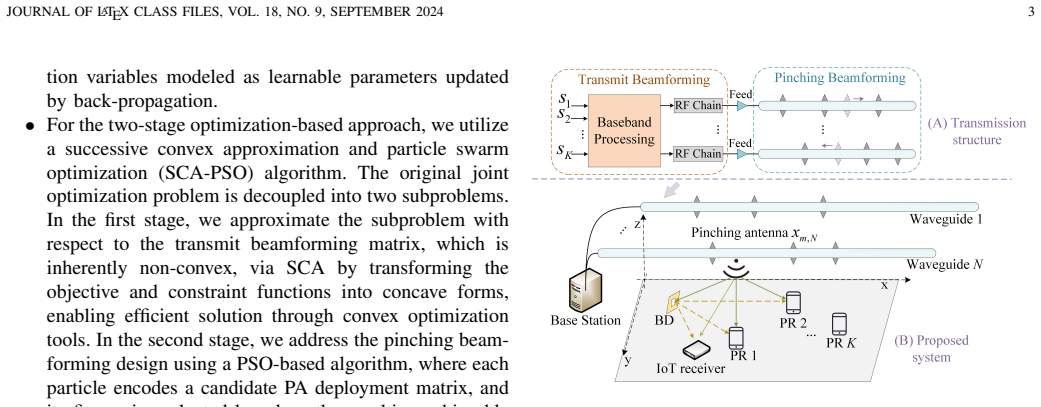
The pinching antenna system (PASS): dielectric waveguides populated by movable pinching antennas whose positions $x_{n,m}$ enter the channel as both phase shifts and distance-dependent path loss. The load-bearing mechanism is the joint optimization of the transmit beamforming matrix $\mathbf{W}$ and the position matrix $\mathbf{X}$, with positions reparameterized as non-negative offsets $\Delta x_{n,m}$ to enforce minimum-spacing constraints, and the detection requirement expressed through the KL divergence $D(P_0\|P_1)$.
What would settle it
Compute the exact minimum detection error probability $P_e$ for the OOK hypotheses in Eq. (7) by numerical integration over the likelihood ratio, and compare it with $1-\sqrt{D(P_0\|P_1)/2}$ across the system's operating SNRs. If the exact $P_e$ does not stay at or below that bound, or if the source cited for Eq. (10) gives the opposite inequality, then constraint (11c) does not guarantee the stated detection performance.
Extended reading notes
Core claim
The central claim is that reconfigurable pinching-antenna placement turns large-scale path loss and signal phase into controllable design variables, so a pinching-antenna base station can create strong line-of-sight links to primary receivers while managing the backscatter link for the IoT receiver. The paper formulates a sum-rate maximization over the transmit beamforming matrix W and the pinching position matrix X, constrained by transmit power, minimum antenna spacing, waveguide length, and a detection-error-probability requirement on the IoT receiver. It then solves this coupled nonconvex problem two ways—a differentiable reparameterization solved by gradient descent, and an alternating
Load-bearing premise
The load-bearing premise is that the inequality $P_e \le 1-\sqrt{D(P_0\|P_1)/2}$ in Eq. (10) has the correct direction, so requiring $D(P_0\|P_1)\ge 2\varepsilon^2$ truly enforces $P_e \le 1-\varepsilon$ on the IoT receiver's detection error.
Editorial extensions
If this is right
- If the central claim holds, pinching antennas give symbiotic radio a physical way to mitigate the weak double-fading backscatter link by moving radiators, not just by precoding.
- Joint position and beam optimization remains effective under a strict detection-error constraint on the IoT receiver, broadening where backscatter IoT services can be deployed.
- The two-stage SCA-PSO method achieves near-element-wise performance at much lower complexity, making it a practical candidate for implementation.
- The reported gains widen with higher transmit SNR and larger waveguide range, suggesting the advantage is tied to path-loss and phase control.
- The learning-aided gradient descent method offers a low-complexity plug-and-play alternative, though it is more prone to local optima.
Reading between the lines
- The offset reparameterization used here transfers directly to any movable-antenna problem with minimum-spacing constraints, so it could be reused beyond symbiotic radio.
- Because the simulations use a line-of-sight-only channel model, the reported gains likely represent the upper end of what pinching antennas can offer; a rich-scattering environment would be a direct stress test.
- The authors point to parasitic (same-symbol-duration) symbiotic radio as future work; extending the framework there would test whether the sum-rate gains survive under tighter timing constraints.
Editorial analysis
A structured set of objections, weighed in public.
Referee Report
Summary. This paper proposes a downlink symbiotic radio (SR) system in which a pinching-antenna system (PASS) base station serves multiple primary receivers and a backscatter-based IoT receiver. The authors formulate a joint transmit beamforming and pinching-antenna position optimization problem (P1) to maximize the primary sum rate subject to a detection error probability constraint at the IoT receiver, a minimum PA spacing constraint, and waveguide length limits. Two solution algorithms are proposed: a learning-aided gradient descent (LGD) method and a two-stage SCA-PSO method. Numerical results report substantial sum-rate gains of the PASS-SR design over fixed-antenna, conventional MIMO, and massive MIMO baselines.
Significance. If the central detection-constraint reformulation were valid, the paper would make a useful contribution by introducing PASS to symbiotic radio and by providing two practically oriented optimization algorithms. The simulations compare against external baselines, so the performance gains are not fitted to a target result. However, the main advertised guarantee—that the design satisfies the IoT receiver's detection error probability constraint—rests on an inequality whose direction is reversed. This affects every optimized solution and the interpretation of all numerical results. The core technical claim is therefore not established, and the significance of the paper is currently conditional on a repair of the constraint derivation.
major comments (3)
- [Section II-B, Eq. (10) and constraint (11c)] The inequality in Eq. (10) is used in the wrong direction. The cited result [37] (and the standard Pinsker-type bound for binary hypothesis testing) gives P_FA + P_MD >= 1 - sqrt(D(P0||P1)/2), i.e., Pe >= 1 - sqrt(D/2), not Pe <= 1 - sqrt(D/2). The manuscript explicitly calls Eq. (10) a 'lower bound' while writing it as an upper bound, which is internally inconsistent. Consequently, the reformulated constraint D(P0||P1) >= 2ε^2 does not imply Pe <= 1 - ε; at best it implies a lower bound that is trivially below the target for large D. Since constraint (11c) is the only mathematical encoding of the IoT receiver's detection requirement, both algorithms (LGD and SCA-PSO) solve a problem with an unverified constraint, and the abstract and conclusion's claim that the design satisfies the detection error probability constraint is unsupported. This is a load-bearing error: the detection probabi
- [Section IV-C, Eq. (33)] The monotonicity claim in Eq. (33), inequality (a), is not justified. Even if problem (P2.2) is solved optimally, it is a convex surrogate of (P2.1), not the original objective. A first-order Taylor lower bound is tight only at the expansion point under certain conditions; maximizing such a surrogate does not by itself guarantee that the original objective f(W,X) does not decrease, unless the surrogate is a global lower bound that equals the original objective at the current point and the solution is chosen to dominate the current point. The paper does not provide such an argument. The convergence analysis therefore overstates the monotonic improvement of the SCA stage. This does not affect the detection-constraint error above, but it is a second load-bearing gap in the claimed convergence behavior.
- [Section IV-A, Eq. (26)] The reformulated problem in Eq. (26) is written as 'max_X' but the optimization variable at this stage is the transmit beamforming matrix W, not X. This appears to be a typographical error, but it obscures the algorithm description. Additionally, equation numbers (26), (26b) are repeated with those in (26) and (26b) inside the same display, which complicates referencing. These are presentation issues, but the first one is in a central derivation and should be corrected.
minor comments (5)
- [Section IV-A, Eq. (24)] The definition of u2,k is misprinted: 'v1,k = |(heq_k + f_b,k)w_k|^2' should presumably be 'u2,k = ...'. The current text defines v1,k twice.
- [Section V] In the simulation setup, 'the ma transmit power' appears to be a truncated phrase; also, the text uses 'Pmax/δ_k^2' to define transmit SNR but the simulation varies Pmax in dBm. Clarify the SNR definition.
- [Section IV-B, Algorithm 2] The penalty factor μ is introduced as 'sufficiently large' and set to 10 in the simulations, but no sensitivity analysis or discussion of how μ interacts with the PSO fitness is provided. Since feasibility depends on this parameter, a brief discussion or ablation would be helpful.
- [References] Reference [44] is cited for PSO, but the listed citation (Das and Suganthan, 'Differential evolution: A survey...') is about differential evolution, not particle swarm optimization. The PSO description should cite a standard PSO reference.
- [Figures 8 and general reporting] Figure 8 reports bar values but no confidence intervals, despite the results being averages over 100 channel realizations. Given that the paper's performance claims are central, reporting confidence intervals or standard deviations would strengthen the numerical evidence.
Circularity Check
No significant circularity (2/10): rate gains are validated against external baselines and self-citations are non-load-bearing. Flagged but not scored as circular: Eq. (10) reverses the direction of the [37] bound, so constraint (11c) does not certify Pe ≤ 1 − ε.
-
self citation load bearing
[Section IV-C, Eq. (33) and Algorithm 2; Section III-A; Refs. [38], [21], [29], [30]]
"If the updated pinching-antenna position obtained from the PSO algorithm fails to yield an improvement in sum rate, the previous position is preserved [30]."
Self-citations by the present authors: [38] (Z. Wang, H. Xu) supports the projected gradient descent step; [30] (M. Zeng) supports preserving the previous PA position when PSO does not improve, underpinning inequality (b) in (33); [21] and [29] (M. Zeng, F. Fang) are survey/related-work cites. None is load-bearing: the projection operator (14) is standard, and the non-decreasing global-best property follows by construction from Algorithm 2's update rules (best positions are replaced only when strictly better). Deleting these citations would not alter any result; they do not establish the validity or optimality of the PASS-SR framework. They are therefore minor self-citations — reflected in the score of 2 — not circularity.
-
other
[Section II-B, Eq. (10) → constraint (11c); reused in (15), (25), (26)]
"a tractable lower bound on Pe is obtained according to [37], expressed as follows Pe ≤ 1 − sqrt(1/2 D(P0∥P1)) ... Hence, the detection constraint for the secondary transmission is derived as D(P0∥P1) ≥ 2ε², which is a more stringent constraint to guarantee Pe ≤ 1 − ε."
Not a circular step; flagged per the reviewing rule as a load-bearing unsupported premise. The passage labels (10) a 'lower bound' yet writes '≤', whereas the cited [37] (Bash et al., JSAC 2013) gives the converse for the error sum in (8): Pe ≥ 1 − sqrt(1/2 D(P0∥P1)). With the correct direction, D(P0∥P1) ≥ 2ε² yields only the weak statement Pe ≥ 1 − ε (vacuous for D > 2), not the advertised Pe ≤ 1 − ε; the as-written upper bound is negative for D > 2. Thus (11c) — also used in the penalty (15), the SCA form (25), and the power threshold (26) — does not certify the abstract's claim that the design 'satisfies the IoT receiver's detection error probability constraint.' This is a misquoted external theorem, not a self-referential derivation, so it is a correctness risk, not circularity.
full rationale
The paper's derivation chain is: LoS channel model (1)-(2) → average rate (5) → detection constraint via KL divergence (10)-(11c) → two solvers (LGD, Section III; SCA-PSO, Section IV) → simulation comparisons. The central rate-gain claims (17.1% over LGD, 35.5% over fixed-PA, up to 65.6% over massive MIMO) are obtained by solving (P1) and comparing against external baselines with parameters adopted from unrelated prior work ([25], [48]); no parameter is fitted to produce these percentages, and the solvers are not trained on data that encodes the target outcome, so no 'fitted input called prediction' pattern is present. The offset reparameterization (12) is derived in-paper from (11d); constraint (11c) is a function of signal power D(P0∥P1), not defined in terms of the sum-rate target; and no uniqueness theorem or ansatz is imported from the authors' prior work. The self-citations ([38], [21], [29], [30]) support only standard or self-evident steps — e.g., the non-decreasing global-best property used in (33)(b) follows directly from Algorithm 2's update rules — so they are minor and not load-bearing; the score therefore sits at 2. The one serious defect is Section II-B, Eq. (10): the text calls (10) a 'lower bound' yet writes Pe ≤ 1 − sqrt(D/2), and the cited [37] (Bash et al., JSAC 2013) gives the converse inequality Pe ≥ 1 − sqrt(D/2) for the error sum defined in (8). With the correct direction, (11c) does not guarantee Pe ≤ 1 − ε (and the as-written upper bound is negative for D > 2), so the abstract's claim that the design 'satisfies the IoT receiver's detection error probability constraint' is unsupported. This is a missing-support/correctness flaw, not a self-referential reduction, so it is weighed in the verdict but does not raise the circularity score.
Assumptions & free parameters
free parameters (3)
- LGD initial learning rate η =
10^-4 (used in Fig. 4a)
- Penalty coefficient for detection constraint (ξ in Eq. (15); μ in PSO) =
μ=10 mentioned in Section V; ξ not explicitly specified
- PSO hyperparameters (c1, c2, ωmax, ωmin, T, Q) =
Not fully specified in the paper
assumptions (5)
- domain assumption Only line-of-sight channel components are considered; NLoS is ignored.
- domain assumption Perfect channel state information, including the positions of PRs, IR, and BD, is available.
- domain assumption The IR can perfectly decode and cancel the direct-link signal via SIC.
- domain assumption The in-waveguide signal response has constant amplitude and linear phase with no attenuation along the waveguide.
- domain assumption The inequality Pe <= 1 - sqrt(D(P0||P1)/2) is a valid upper bound on the detection error probability.
Cite this review
Pith. "Pith review of Joint Transmit and Pinching Beamforming Optimization in Pinching Antenna-Assisted Symbiotic Radio Systems." pith.science (2026). https://pith.science/paper/UM6VBQB4
@misc{pith2026250807002,
  author       = {Pith},
  title        = {Pith review of: Joint Transmit and Pinching Beamforming Optimization in Pinching Antenna-Assisted Symbiotic Radio Systems},
  year         = {2026},
  howpublished = {\url{https://pith.science/paper/UM6VBQB4}},
  note         = {Machine review of arXiv:2508.07002}
}
read the original abstract
This paper investigates a novel downlink symbiotic radio framework enabled by the pinching antenna system (PASS), designed to enhance both primary and secondary transmissions through reconfigurable antenna positioning. This reconfigurability introduces additional degrees of freedom for adaptive pinching beamforming, thereby enabling constructive signal enhancement and interference suppression tailored to the locations of the backscatter device, the Internet of Things (IoT) receiver, and the primary receivers. To fully exploit these benefits, we formulate a joint transmit and pinching beamforming optimization problem that maximizes the achievable sum rate while satisfying the IoT receiver's detection error probability constraint and feasible deployment constraints for the pinching antennas. The resulting problem is inherently nonconvex and highly coupled. To address this challenge, we develop two complementary solution approaches. The first is a learning-aided gradient descent method, where the constrained optimization is reformulated into a differentiable form and solved through end-to-end learning. In this approach, the pinching antenna position matrix is reparameterized to automatically satisfy minimum spacing constraints, while transmit power and waveguide length limits are enforced via projection and normalization. The second approach is an optimization-based successive convex approximation-particle swarm optimization method, which first determines the transmit beamforming solution using successive convex approximation and subsequently optimizes pinching beamforming via a particle swarm optimization search over candidate pinching antenna placements.
Figures


Figures from the paper (4 more)


Forward citations
Cited by 2 Pith papers
-
Amplitude-Tunable Pinching Antenna Systems: Single-Mode Phase-Mismatch Radiation and Multiuser Beamforming
The paper proposes amplitude-tunable pinching antenna systems via single-mode phase-mismatch radiation and shows sum-rate gains in multiuser hybrid precoding.
-
Center-Fed Pinching Antenna System (C-PASS): Modeling, Analysis, and Beamforming Design
A single-waveguide pinching-antenna system with multiple center-fed input ports achieves degree-of-freedom min(M,K) and power gain O(P_T M), breaking the rank-one bottleneck of conventional end-fed designs.
Reference graph
Works this paper leans on
-
[37]
Limits of reliable communica- tion with low probability of detection on awgn channels,
B. A. Bash, D. Goeckel, and D. Towsley, “Limits of reliable communica- tion with low probability of detection on awgn channels,”IEEE Journal on Selected Areas in Communications, vol. 31, no. 9, pp. 1921–1930, 2013
1921
-
[1]
6g internet of things: A comprehensive survey,
D. C. Nguyen, M. Ding, P. N. Pathirana, A. Seneviratne, J. Li, D. Niyato, O. Dobre, and H. V . Poor, “6g internet of things: A comprehensive survey,”IEEE Internet of Things Journal, vol. 9, no. 1, pp. 359–383, 2022
2022
-
[2]
To- ward 6g networks: Use cases and technologies,
M. Giordani, M. Polese, M. Mezzavilla, S. Rangan, and M. Zorzi, “To- ward 6g networks: Use cases and technologies,”IEEE Communications Magazine, vol. 58, no. 3, pp. 55–61, 2020
2020
-
[3]
Hardware impaired ambient backscatter noma systems: Reli- ability and security,
X. Li, M. Zhao, M. Zeng, S. Mumtaz, V . G. Menon, Z. Ding, and O. A. Dobre, “Hardware impaired ambient backscatter noma systems: Reli- ability and security,”IEEE Transactions on Communications, vol. 69, no. 4, pp. 2723–2736, 2021
2021
-
[4]
Symbiotic radio: A new communication paradigm for passive internet of things,
R. Long, Y .-C. Liang, H. Guo, G. Yang, and R. Zhang, “Symbiotic radio: A new communication paradigm for passive internet of things,”IEEE Internet of Things Journal, vol. 7, no. 2, pp. 1350–1363, 2020
2020
-
[5]
Symbiotic radio: Cognitive backscattering communications for future wireless networks,
Y .-C. Liang, Q. Zhang, E. G. Larsson, and G. Y . Li, “Symbiotic radio: Cognitive backscattering communications for future wireless networks,” IEEE Transactions on Cognitive Communications and Networking, vol. 6, no. 4, pp. 1242–1255, 2020
2020
-
[6]
Physical-layer authentication for ambient backscatter- aided noma symbiotic systems,
X. Li, Q. Wang, M. Zeng, Y . Liu, S. Dang, T. A. Tsiftsis, and O. A. Dobre, “Physical-layer authentication for ambient backscatter- aided noma symbiotic systems,”IEEE Transactions on Communications, vol. 71, no. 4, pp. 2288–2303, 2023
2023
-
[7]
A novel wireless communication paradigm for intelligent reflecting surface based symbiotic radio systems,
M. Hua, Q. Wu, L. Yang, R. Schober, and H. V . Poor, “A novel wireless communication paradigm for intelligent reflecting surface based symbiotic radio systems,”IEEE Transactions on Signal Processing, vol. 70, pp. 550–565, 2022
2022
Show all 48 references
-
[8]
Full-duplex backscatter communications in symbiotic radio systems,
R. Long, H. Guo, L. Zhang, and Y .-C. Liang, “Full-duplex backscatter communications in symbiotic radio systems,”IEEE Access, vol. 7, pp. 21 597–21 608, 2019
2019
-
[9]
Covert communications with enhanced physical layer security in ris-assisted cooperative networks,
X. Li, M. Liu, S. Dang, N. C. Luong, C. Yuen, A. Nallanathan, and D. Niyato, “Covert communications with enhanced physical layer security in ris-assisted cooperative networks,”IEEE Transactions on Wireless Communications, vol. 24, no. 7, pp. 5605–5619, 2025
2025
-
[10]
Backscatter communication assisted by reconfigurable intelligent sur- faces,
Y .-C. Liang, Q. Zhang, J. Wang, R. Long, H. Zhou, and G. Yang, “Backscatter communication assisted by reconfigurable intelligent sur- faces,”Proceedings of the IEEE, vol. 110, no. 9, pp. 1339–1357, 2022
2022
-
[11]
Reconfigurable intelligent surface assisted mimo symbiotic radio networks,
Q. Zhang, Y .-C. Liang, and H. V . Poor, “Reconfigurable intelligent surface assisted mimo symbiotic radio networks,”IEEE Transactions on Communications, vol. 69, no. 7, pp. 4832–4846, 2021
2021
-
[12]
Realizing spectrum and power sharing with wi-fi: A ris-assisted symbiotic radio perspective,
H. Chen, R. Long, Y .-C. Liang, and G. Zhou, “Realizing spectrum and power sharing with wi-fi: A ris-assisted symbiotic radio perspective,” IEEE Journal on Selected Areas in Communications, pp. 1–1, 2025
2025
-
[13]
Movable antennas for wireless communi- cation: Opportunities and challenges,
L. Zhu, W. Ma, and R. Zhang, “Movable antennas for wireless communi- cation: Opportunities and challenges,”IEEE Communications Magazine, vol. 62, no. 6, pp. 114–120, 2024
2024
-
[14]
Fluid antenna systems,
K.-K. Wong, A. Shojaeifard, K.-F. Tong, and Y . Zhang, “Fluid antenna systems,”IEEE Transactions on Wireless Communications, vol. 20, no. 3, pp. 1950–1962, 2021
1950
-
[15]
Movable antenna enabled symbiotic radio systems: An opportunity for mutualism,
C. Zhou, B. Lyu, C. You, and Z. Liu, “Movable antenna enabled symbiotic radio systems: An opportunity for mutualism,”IEEE Wireless Communications Letters, vol. 13, no. 10, pp. 2752–2756, 2024
2024
-
[16]
Primary rate maximiza- tion in movable antennas empowered symbiotic radio communications,
B. Lyu, H. Liu, W. Hong, S. Gong, and F. Tian, “Primary rate maximiza- tion in movable antennas empowered symbiotic radio communications,” in2024 IEEE 99th Vehicular Technology Conference (VTC2024-Spring), 2024, pp. 1–6
2024
-
[17]
Channel modeling and characteristics for 6g wireless communications,
H. Jiang, M. Mukherjee, J. Zhou, and J. Lloret, “Channel modeling and characteristics for 6g wireless communications,”IEEE Network, vol. 35, no. 1, pp. 296–303, 2021
2021
-
[18]
Intelligent reflecting surfaces: Physics, propagation, and pathloss modeling,
O. ¨Ozdogan, E. Bj ¨ornson, and E. G. Larsson, “Intelligent reflecting surfaces: Physics, propagation, and pathloss modeling,”IEEE Wireless Communications Letters, vol. 9, no. 5, pp. 581–585, 2020
2020
-
[19]
Pinching antenna: Using a dielectric waveguide as an antenna,
H. O. Y . Suzuki and K. Kawai, “Pinching antenna: Using a dielectric waveguide as an antenna,”NTT DOCOMO Technical J, vol. 23, no. 3, pp. 5–12, 2022
2022
-
[20]
Flexible-antenna systems: A pinching-antenna perspective,
Z. Ding, R. Schober, and H. Vincent Poor, “Flexible-antenna systems: A pinching-antenna perspective,”IEEE Transactions on Communications, pp. 1–1, 2025
2025
-
[21]
Resource allocation for pinching-antenna systems: State-of-the-art, key techniques and open issues,
M. Zeng, J. Wang, O. A. Dobre, Z. Ding, G. K. Karagiannidis, R. Schober, and H. V . Poor, “Resource allocation for pinching-antenna systems: State-of-the-art, key techniques and open issues,” 2025. [Online]. Available: https://arxiv.org/abs/2506.06156
2025 arXiv
-
[22]
Modeling and beamforming optimization for pinching-antenna systems,
Z. Wang, C. Ouyang, X. Mu, Y . Liu, and Z. Ding, “Modeling and beamforming optimization for pinching-antenna systems,” 2025. [Online]. Available: https://arxiv.org/abs/2502.05917
2025 arXiv
-
[23]
Deep learning optimization of two- state pinching antennas systems,
O. G. Karagiannidis, V . E. Galanopoulou, P. D. Diamantoulakis, Z. Ding, and O. Dobre, “Deep learning optimization of two- state pinching antennas systems,” 2025. [Online]. Available: https: //arxiv.org/abs/2507.06222
2025 arXiv
-
[24]
Pinching- antenna systems (pass): Architecture designs, opportunities, and outlook,
Y . Liu, Z. Wang, X. Mu, C. Ouyang, X. Xu, and Z. Ding, “Pinching- antenna systems (pass): Architecture designs, opportunities, and outlook,” 2025. [Online]. Available: https://arxiv.org/abs/2501.18409
2025 arXiv
-
[25]
Joint transmit and pinching beamforming for pinching antenna systems (pass): Optimization-based or learning-based?
X. Xu, X. Mu, Y . Liu, and A. Nallanathan, “Joint transmit and pinching beamforming for pinching antenna systems (pass): Optimization-based or learning-based?” 2025. [Online]. Available: https://arxiv.org/abs/2502.08637
2025 arXiv
-
[26]
Channel estimation for pinching-antenna systems (pass),
J. Xiao, J. Wang, and Y . Liu, “Channel estimation for pinching-antenna systems (pass),”IEEE Communications Letters, pp. 1–1, 2025
2025
-
[27]
Array gain for pinching- antenna systems (pass),
C. Ouyang, Z. Wang, Y . Liu, and Z. Ding, “Array gain for pinching- antenna systems (pass),”IEEE Communications Letters, vol. 29, no. 6, pp. 1471–1475, 2025
2025
-
[28]
Los blockage in pinching-antenna systems: Curse or blessing?
Z. Ding and H. V . Poor, “Los blockage in pinching-antenna systems: Curse or blessing?”IEEE Wireless Communications Letters, pp. 1–1, 2025
2025
-
[29]
Energy-efficient design for downlink pinching-antenna systems with qos guarantee,
M. Zeng, J. Wang, G. Zhou, F. Fang, and X. Wang, “Energy-efficient design for downlink pinching-antenna systems with qos guarantee,” IEEE Transactions on Vehicular Technology, pp. 1–5, 2025
2025
-
[30]
Energy- efficient resource allocation for noma-assisted uplink pinching-antenna systems,
M. Zeng, X. Li, J. Wang, G. Huang, O. A. Dobre, and Z. Ding, “Energy- efficient resource allocation for noma-assisted uplink pinching-antenna systems,”IEEE Wireless Communications Letters, pp. 1–1, 2025
2025
-
[31]
Performance analysis of pinching- antenna systems,
D. Tyrovolas, S. A. Tegos, P. D. Diamantoulakis, S. Ioannidis, C. K. Liaskos, and G. K. Karagiannidis, “Performance analysis of pinching- antenna systems,”IEEE Transactions on Cognitive Communications and Networking, pp. 1–1, 2025
2025
-
[32]
Terahertz band: The last piece of rf spectrum puzzle for communication systems,
H. Elayan, O. Amin, B. Shihada, R. M. Shubair, and M.-S. Alouini, “Terahertz band: The last piece of rf spectrum puzzle for communication systems,”IEEE Open Journal of the Communications Society, vol. 1, pp. 1–32, 2020
2020
-
[33]
Deep learning based wavenumber domain channel estimation for holographic mimo communications,
J. Wang, X. Mei, J. Xiao, X. Li, P. Zhu, A. Nallanathan, and C. Yuen, “Deep learning based wavenumber domain channel estimation for holographic mimo communications,”IEEE Transactions on Vehicular Technology, pp. 1–6, 2025
2025
-
[34]
Capacity of noncoherent time-selective rayleigh-fading channels,
Y . Liang and V . Veeravalli, “Capacity of noncoherent time-selective rayleigh-fading channels,”IEEE Transactions on Information Theory, vol. 50, no. 12, pp. 3095–3110, 2004
2004
-
[35]
Reconfigurable intelligent surface empowered symbiotic radio over broadcasting signals,
X. Xu, Y .-C. Liang, G. Yang, and L. Zhao, “Reconfigurable intelligent surface empowered symbiotic radio over broadcasting signals,”IEEE Transactions on Communications, vol. 69, no. 10, pp. 7003–7016, 2021
2021
-
[36]
Intelligent reflecting surface (irs)-aided covert wireless communications with delay constraint,
X. Zhou, S. Yan, Q. Wu, F. Shu, and D. W. K. Ng, “Intelligent reflecting surface (irs)-aided covert wireless communications with delay constraint,”IEEE Transactions on Wireless Communications, vol. 21, no. 1, pp. 532–547, 2022
2022
-
[38]
Deep learning for joint pilot design and channel estimation in symbiotic radio communications,
Z. Wang, H. Xu, L. Zhao, X. Chen, and A. Zhou, “Deep learning for joint pilot design and channel estimation in symbiotic radio communications,” IEEE Wireless Communications Letters, vol. 11, no. 10, pp. 2056–2060, 2022
-
[39]
Multiuser commu- nications with movable-antenna base station: Joint antenna positioning, receive combining, and power control,
Z. Xiao, X. Pi, L. Zhu, X.-G. Xia, and R. Zhang, “Multiuser commu- nications with movable-antenna base station: Joint antenna positioning, receive combining, and power control,”IEEE Transactions on Wireless Communications, vol. 23, no. 12, pp. 19 744–19 759, 2024
2024
-
[40]
A learning-aided flexible gradient descent approach to miso beamforming,
Z. Yang, J.-Y . Xia, J. Luo, S. Zhang, and D. G ¨und¨uz, “A learning-aided flexible gradient descent approach to miso beamforming,”IEEE Wireless Communications Letters, vol. 11, no. 9, pp. 1895–1899, 2022
2022
-
[41]
Wideband beamform- ing for ris assisted near-field communications,
J. Wang, J. Xiao, Y . Zou, W. Xie, and Y . Liu, “Wideband beamform- ing for ris assisted near-field communications,”IEEE Transactions on Wireless Communications, vol. 23, no. 11, pp. 16 836–16 851, 2024
2024
-
[42]
Online deep neural network for optimization in wireless communications,
J. Gao, C. Zhong, G. Y . Li, and Z. Zhang, “Online deep neural network for optimization in wireless communications,”IEEE Wireless Communications Letters, vol. 11, no. 5, pp. 933–937, 2022. JOURNAL OF LATEX CLASS FILES, VOL. 18, NO. 9, SEPTEMBER 2024 13
2022
-
[43]
Multicast precoding for multigateway multibeam satellite systems with feeder link interfer- ence,
J. Wang, L. Zhou, K. Yang, X. Wang, and Y . Liu, “Multicast precoding for multigateway multibeam satellite systems with feeder link interfer- ence,”IEEE Transactions on Wireless Communications, vol. 18, no. 3, pp. 1637–1650, 2019
2019
-
[44]
Differential evolution: A survey of the state-of-the-art,
S. Das and P. N. Suganthan, “Differential evolution: A survey of the state-of-the-art,”IEEE Transactions on Evolutionary Computation, vol. 15, no. 1, pp. 4–31, 2011
2011
-
[45]
Movable antenna-aided secure full- duplex multi-user communications,
J. Ding, Z. Zhou, and B. Jiao, “Movable antenna-aided secure full- duplex multi-user communications,”IEEE Transactions on Wireless Communications, vol. 24, no. 3, pp. 2389–2403, 2025
2025
-
[46]
Joint active and passive beamforming opti- mization for intelligent reflecting surface assisted swipt under qos con- straints,
Q. Wu and R. Zhang, “Joint active and passive beamforming opti- mization for intelligent reflecting surface assisted swipt under qos con- straints,”IEEE Journal on Selected Areas in Communications, vol. 38, no. 8, pp. 1735–1748, 2020
2020
-
[47]
Joint beamforming design in multi-cluster miso noma reconfigurable intelligent surface-aided down- link communication networks,
Y . Li, M. Jiang, Q. Zhang, and J. Qin, “Joint beamforming design in multi-cluster miso noma reconfigurable intelligent surface-aided down- link communication networks,”IEEE Transactions on Communications, vol. 69, no. 1, pp. 664–674, 2021
2021
-
[48]
Rate maximization for downlink pinching-antenna systems,
Y . Xu, Z. Ding, and G. K. Karagiannidis, “Rate maximization for downlink pinching-antenna systems,”IEEE Wireless Communications Letters, vol. 14, no. 5, pp. 1431–1435, 2025
2025
Reviewed August 5, 2026 · model on record in the stance chip above.
Discussion (0). Continue with ORCID to comment.