REVIEW 3 major objections 5 minor 10 references
Runge-Kutta and Networks
T0 review · 3 major / 5 minor · reviewed 2026-08-14 · deepseek-v4-flash
Pith's one-line read If vector fields X and Y are related by an affine map, every explicit Runge-Kutta step and every iterated implicit RK step respects the same relation.
desk verdict The explicit-RK theorem is correct and useful, but the abstract overclaims the implicit case; the gap is fixable with a well-posedness condition. read the letter →
The pith
A machine-rendered reading of the paper's core claim, the machinery that carries it, and where it could break.
The reading
What carries the argument
The central object is the affine phase-space map $f(x)=Lx+p$ together with the stage-compatibility lemma (Lemma 3.5). A Runge-Kutta step is built from operations of the form: evaluate the vector field at a point produced by adding an $h$-scaled linear combination of earlier stage values to the current point, then combine the resulting values with weights $b_i$. The lemma shows that each such operation commutes with $f$ whenever the vector fields are $f$-related, and this is what transmits the relation through every stage of an explicit RK step and through every iteration of the implicit stage solve.
What would settle it
Take a pair of ODEs $X,Y$ with $Y(Lx+p)=L X(x)$ (for instance, the diagonal embedding of Example 5.1), run a fixed-step explicit Runge-Kutta method on both, and compute the residual vector $D_Y(Lx+p)-(L D_X(x)+p)$; its norm should be zero to round-off. Then repeat with an adaptive step-size controller or with an implicit method whose stage equations are solved exactly rather than by the paper's $q$-step iteration: a nonzero residual marks exactly where the theorem's hypotheses stop.
Extended reading notes
Core claim
The central claim is that the relation of being “$f$-related” by an affine map is preserved by every Runge-Kutta discretization with a fixed step size. If $X$ and $Y$ satisfy $Y(Lx+p)=L X(x)$, then the discrete maps satisfy $L D_X(x)+p = D_Y(Lx+p)$, for explicit methods and for implicit methods solved by the $q$-step fixed-point iteration defined in the paper. The proof is an induction over stages: the relation $k_{Y,1}(Lx+p)=L k_{X,1}(x)$ is the hypothesis itself, and each later stage value inherits it because the stage input is a linear combination of previous stage values evaluated through the affine map. The final update is a weighted sum of stage values, so the affine relation passes through unchanged. For implicit methods, the same induction runs over iterates of the stage fixed-point map, starting from the repeated vector of stage values $(X(x),\dots,X(x))$, so the $q$-step solver preserves the relation.
Load-bearing premise
The load-bearing premise is that each Runge-Kutta step uses one fixed step size $h$ and, for implicit methods, solves the stage equations by the paper's $q$-step fixed-point iteration; adaptive error-based step selection or exact implicit solves are not covered by the proof.
Editorial extensions
If this is right
- For any pair of $f$-related ODEs with affine $f$, explicit RK discretizations give $f$-related discrete systems, so trajectories initialized with $y_0=f(x_0)$ satisfy $y_n=f(x_n)$ for all $n$.
- Polydiagonals in coupled cell networks are invariant under every explicit Runge-Kutta method with fixed step size, independent of whether the polydiagonal is stable or unstable.
- The same invariance holds for implicit Runge-Kutta methods when the stage equations are solved by the paper's $q$-step fixed-point iteration, covering a practical class of implicit solvers rather than only exactly solved stage equations.
- Because the proof works for any choice of RK coefficients $A,b$ and any step size $h>0$, the result applies uniformly to all members of the Runge-Kutta family.
Reading between the lines
- The theorem fixes a single step size $h$; adaptive Runge-Kutta codes select $h$ from a local error estimator, and those estimators are generally not affine-equivariant. A testable extension is to identify which error estimators preserve affine relations or to build equivariant step-size controllers.
- For implicit Runge-Kutta, the proof relies on the particular fixed-point iteration of Definition 4.2. If the stage equations are solved exactly and have multiple fixed points, the equivariance of the chosen branch is not automatic; proving that the unique solution branch is equivariant would extend the result to exact implicit solves.
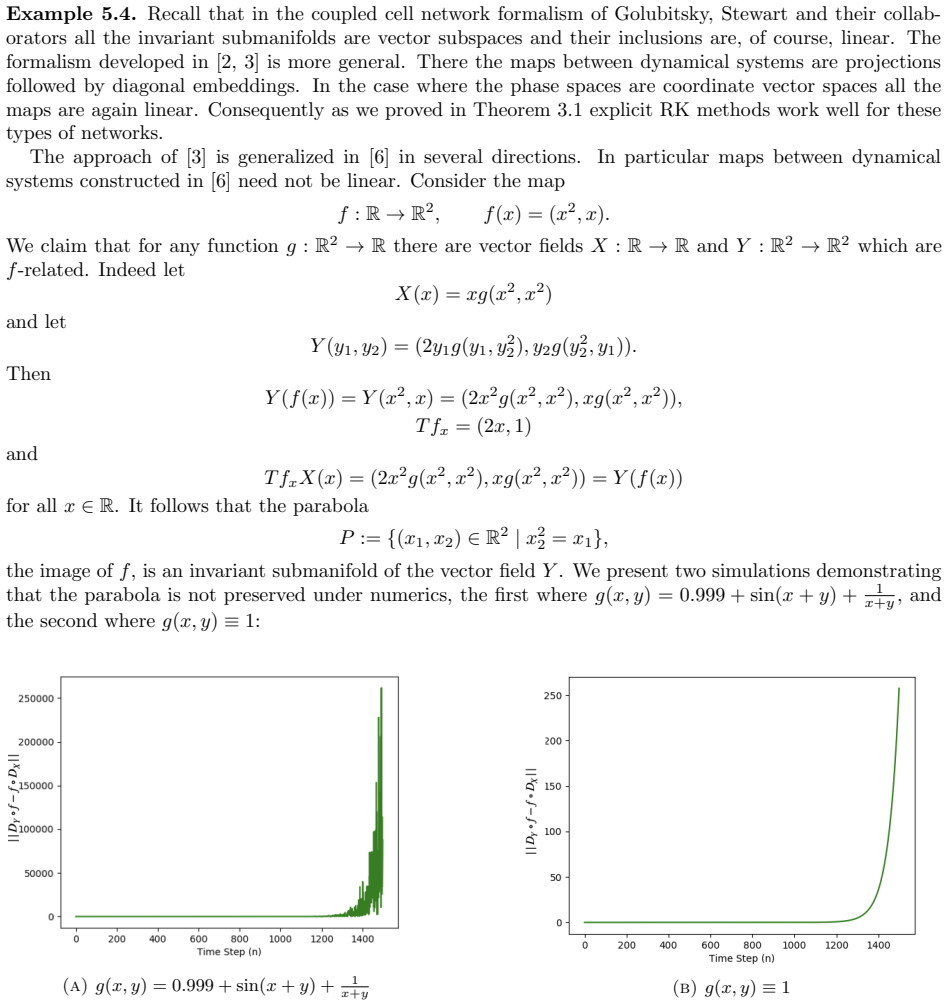
- The paper's example of a nonlinear invariant parabola that RK4 does not preserve suggests a general obstruction: the argument needs the map to be affine because only affine maps commute with the linear combinations and scaling that define the RK update. Nonlinear invariants would require methods specifically designed as geometric integrators.
Signed reviews
Editorial analysis
A structured set of objections, weighed in public.
Referee Report
Summary. The paper proves that Runge-Kutta discretizations preserve affine maps between vector fields. Specifically, if vector fields X on R^n and Y on R^m satisfy Y(Lx+p)=L X(x) for a linear map L and vector p, then the associated discrete-time maps commute with the affine map f(x)=Lx+p. The explicit case is proven by induction on the RK stages (Theorem 3.1). For implicit methods, the paper defines a q-step fixed-point iterative version of the RK map, D^{(A,b,h,q)}_X, and proves the analogous intertwining property for that map (Theorem 4.4). The paper then gives examples from coupled cell networks, invariant polydiagonals, affine invariant submanifolds, and a nonlinear invariant parabola that is not preserved. The declared goal is to explain why RK4 preserves invariant polydiagonals even when the latter are unstable.
Significance. If the result stood as stated for all implicit Runge-Kutta methods, it would be a clean structural theorem: any affine map of dynamical systems is also a map of the discretized systems for the entire RK family. The explicit proof is complete and elegant, and the examples support the claim for the implemented methods. The paper also connects the result to the coupled-cell-network formalism, providing a useful explanation for a numerical phenomenon observed in practice. The main limitation is that the implicit portion is proved only for a specific q-step fixed-point iteration, not for the exact solution of the implicit stage equations as defined in Definition 2.6.
major comments (3)
- [Section 4, Theorem 4.4] Theorem 4.4 does not prove the announced result for implicit Runge-Kutta methods as defined in Definition 2.6. The object D^{(A,b,h,q)}_X defined in Definition 4.2 is not the implicit method of Definition 2.6, whose stage equations (4.1) are to be solved exactly; it is the map obtained after exactly q applications of a fixed-point iteration started at (X(x),...,X(x)). The induction in the proof of Theorem 4.4 uses that every iterate satisfies eta^{(k)} = (L×...×L) xi^{(k)}, which holds for the fixed-point iteration but need not hold for an exact solution of the implicit equations when those equations have multiple roots. The statement should be restricted to the q-step iteration actually proved, or a well-posedness condition (e.g., a contraction hypothesis making the exact solve unique and equivariant) must be added and proved.
- [Abstract and Introduction, Theorem statement] The abstract and the introductory Theorem state that the result holds for 'a Runge-Kutta method (explicit or implicit)' with no qualification. This overstates what is proved. As written, the explicit case is fully proved, but the implicit case is proved only for the q-step fixed-point iteration. The central claim of the paper should be revised to match the proven theorem, either by defining implicit methods in the paper as the q-step iterative method or by proving the result for the exact implicit scheme under suitable hypotheses.
- [Section 4, Definition 4.2 and surrounding text] The paper's treatment of implicit methods does not address the possibility that the fixed-point iteration converges to different roots for the X-system and the Y-system. Because the proof only tracks the iteration from the prescribed starting point (X(x),...,X(x)), it does not cover the case where an implicit solver selects a root outside the image of the map (L×...×L). This is not a purely technical point: for implicit Euler, one can construct X, Y, L, and x such that the Y-stage equation has two roots and the solver picks different roots for the two components, breaking the intertwining identity. The manuscript needs either an explicit uniqueness assumption (with a proof that the root is equivariant) or a precise statement that only the q-step iteration is considered.
minor comments (5)
- [Throughout] There are numerous typographical errors, including 'explicity' in Sections 1 and 3, 'explicit' for 'explicit', 'networs' in Example 5.3, and 'machinary' in the same example. These should be corrected.
- [Introduction, Theorem statement] The notation 'DyY (Lx+p)' appears to be a typo for 'D_Y(Lx+p)'. The display should be corrected.
- [Example 5.3, equations (5.3) and (5.4)] The network diagrams displayed in (5.3) and (5.4) are rendered unclearly; the arrows and node labels should be redrawn so that the reader can see the network structure being described.
- [Section 5, Example 5.4] The statement 'P :={(x1,x2) in R^2 | x2^2 = x1}' refers to the image of f(x)=(x^2,x), but the notation x2^2 = x1 (with x1,x2 as coordinates) is ambiguous because x1 is also used as the first coordinate. This should be rewritten with clearer coordinate names.
- [Section 2, Definition 2.6] The definition of the RK map fixes the step size h, and the proof of Theorem 3.1 uses that same h for all stages. The paper should note explicitly that adaptive-stepsize implementations are outside the scope of the theorem, since the proof does not cover methods that choose h based on local error estimators.
Circularity Check
No significant circularity: the equivariance theorem for Runge-Kutta maps is proved directly from the defining RK equations and the affine-relation hypothesis, with no fitted inputs or self-citation chain carrying the argument.
full rationale
The paper's central claim is derived self-containedly. Theorem 3.1 proves that an explicit Runge-Kutta discretization intertwines affine-related vector fields by a straightforward induction on the stage equations, using only Definition 2.6, the relation LX(x)=Y(Lx+p), and linearity of L. Nothing is fitted, no quantity is renamed as a prediction, and no prior result by the authors is needed for the proof. Theorem 4.4 proves the analogous statement for the q-step fixed-point iteration explicitly defined in Definition 4.2; the proof again is an induction on the iterates and never imports the target conclusion. The authors' earlier network formalism [2,3] appears only as motivation and in examples, not as a load-bearing premise. The known scope limitation—that exact implicit stage solves are not treated, only the q-step iteration—is a correctness/scope observation and not a circularity. Hence the derivation chain is independent and the circularity score is 0.
Assumptions & free parameters
assumptions (3)
- domain assumption A Runge-Kutta step is defined by a fixed Butcher tableau (A,b) and a fixed step h for all points and all iterations.
- domain assumption For implicit methods, the stage values are obtained by the q-step fixed-point iteration defined in Definition 4.2 rather than by an exact solve of the implicit equations.
- standard math The standard fact that f-related vector fields map integral curves to integral curves, via uniqueness of ODE solutions and the chain rule.
Cite this review
Pith. "Pith review of Runge-Kutta and Networks." pith.science (2026). https://pith.science/paper/UMGVZHZL
@misc{pith2026190811453,
  author       = {Pith},
  title        = {Pith review of: Runge-Kutta and Networks},
  year         = {2026},
  howpublished = {\url{https://pith.science/paper/UMGVZHZL}},
  note         = {Machine review of arXiv:1908.11453}
}
read the original abstract
We categorify the RK family of numerical integration methods (explicit and implicit). Namely we prove that if a pair of ODEs are related by an affine map then the corresponding discrete time dynamical systems are also related by the map. We show that in practice this works well when the pairs of related ODEs come from the coupled cell networks formalism and, more generally, from fibrations of networks of manifolds.
Figures


Figures from the paper (2 more)

Reference graph
Works this paper leans on
-
[1]
Brown, Near Algebras, PhD thesis, Ohio State Univ., 1966
H.D. Brown, Near Algebras, PhD thesis, Ohio State Univ., 1966
work page 1966
-
[2]
Modular dynamical systems on networks
L. DeVille and E. Lerman, Modular dynamical systems on networks, J. Eur. Math. Soc. 17 (2015), no. 12, 2977–3013. arXiv:1303.3907 [math.DS]
work page Pith review arXiv 2015
-
[3]
Dynamics on Networks of Manifolds
L. DeVille and E. Lerman, Dynamics on networks of manifolds, SIGMA 11 (2015), Paper 022, 21 pp. arXiv:1208.1513 [math.DS]
work page Pith review arXiv 2015
-
[4]
M. Golubitsky, I. Stewart and A. T¨ or¨ ok, Patterns of synchrony in coupled cell networks with multiple arrows. SIAM J. Appl. Dyn. Syst. , 4(1):78–100 (electronic), 2005
work page 2005
-
[5]
A. Iserles, A first course in the numerical analysis of differential equations , Cambridge Texts in Applied Mathematics, Cambridge University Press, Cambridge, 1996. MR 1384977
work page 1996
-
[6]
E. Lerman, Networks of open systems, J. Geom. Phys. 130 (2018), 81–112; arXiv:1705.04814 [math.OC]
work page Pith review arXiv 2018
-
[7]
R.I. McLachlan, R.I. and G.R.W. Quispel, Geometric integrators for ODEs. Journal of Physics A: Mathematical and General ,39 (2006), p.5251-5285
work page 2006
-
[8]
I. Stewart, M. Golubitsky and M. Pivato, Symmetry groupoids and patterns of synchrony in coupled cell networks , SIAM Journal on Applied Dynamical Systems 2 (2003), no. 4, 609–646
work page 2003
Show all 10 references
-
[9]
Mayers, An introduction to numerical analysis , Cambridge University Press, Cambridge, 2003
Endre S¨ uli and David F. Mayers, An introduction to numerical analysis , Cambridge University Press, Cambridge, 2003. MR 2006500
2003
-
[10]
Warner, Foundations of differentiable manifolds and Lie groups, Springer-Verlag, New York Berlin Heidelberg Tokyo, 1983
F.W. Warner, Foundations of differentiable manifolds and Lie groups, Springer-Verlag, New York Berlin Heidelberg Tokyo, 1983. Department of Mathematics, University of Illinois, Urbana, IL 61801 11
1983
Reviewed August 14, 2026 · model on record in the stance chip above.
Discussion (0). Continue with ORCID to comment.